Portfolio Management for Everyone
January 21, 2015
Melissa Highley, PfMP, PMP
Agenda
• Project, Program and Portfolio Management Basics
• Portfolio Management Overview
• Practical Application
• Portfolio Management Professional (PfMP)
• Resources
2
Project, Program and Portfolio
Management Basics
3
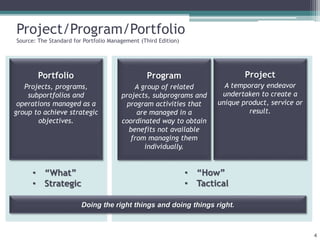
Project/Program/Portfolio
Source: The Standard for Portfolio Management (Third Edition)
Project
A temporary endeavor
undertaken to create a
unique product, service or
result.
Program
A group of related
projects, subprograms and
program activities that
are managed in a
coordinated way to obtain
benefits not available
from managing them
individually.
Portfolio
Projects, programs,
subportfolios and
operations managed as a
group to achieve strategic
objectives.
Doing the right things and doing things right.
• “How”
• Tactical
• “What”
• Strategic
4
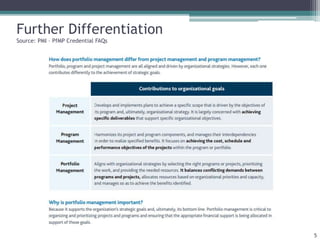
Further Differentiation
Source: PMI – PfMP Credential FAQs
5
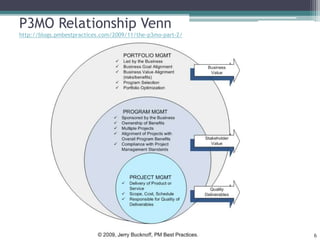
P3MO Relationship Venn
http://blogs.pmbestpractices.com/2009/11/the-p3mo-part-2/
6
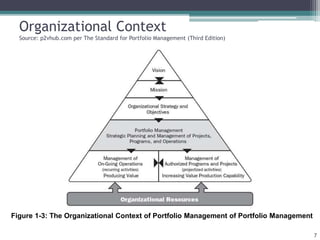
Organizational Context
Source: p2vhub.com per The Standard for Portfolio Management (Third Edition)
7
Figure 1-3: The Organizational Context of Portfolio Management of Portfolio Management
Portfolio Management Overview
8
Portfolio Management
Source: The Standard for Portfolio Management (Third Edition)
• A portfolio is a component collection of programs, projects, or
operations managed as a group to achieve strategic objectives.
The portfolio components may not necessarily be interdependent
or have related objectives. The portfolio components are
quantifiable, that is, they can be measured, ranked, and
prioritized.
• A portfolio exists to achieve one or more organizational strategies
and objectives and may consist of a set of past, current, and
planned or future portfolio components. Portfolios and programs
have the potential to be longer term with new projects rotating
into the portfolios or programs, unlike projects that have a
defined beginning and end.
• An organization may have more than one portfolio, each
addressing unique organizational strategies and objectives.
Proposed initiatives are structured as portfolios and components
are identified, evaluated, selected, and authorized. In addition,
portfolios may contain subportfolios.
9
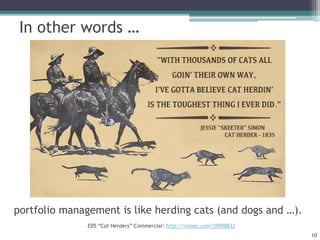
In other words …
portfolio management is like herding cats (and dogs and …).
EDS “Cat Herders” Commercial: http://vimeo.com/59098832
10
Domains
Source: The Standard for Portfolio Management (Third Edition)
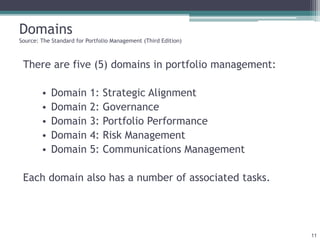
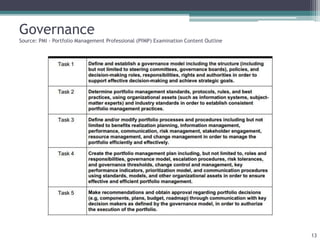
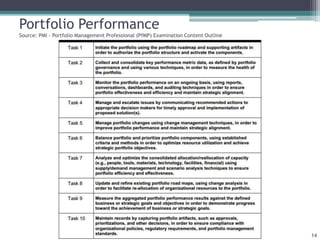
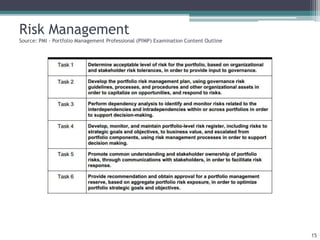
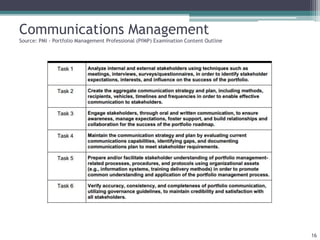
There are five (5) domains in portfolio management:
• Domain 1: Strategic Alignment
• Domain 2: Governance
• Domain 3: Portfolio Performance
• Domain 4: Risk Management
• Domain 5: Communications Management
Each domain also has a number of associated tasks.
11
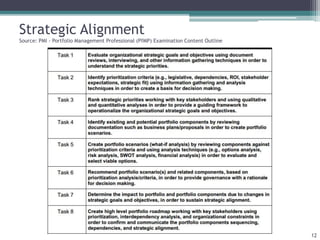
Strategic Alignment
Source: PMI - Portfolio Management Professional (PfMP) Examination Content Outline
12
Governance
Source: PMI - Portfolio Management Professional (PfMP) Examination Content Outline
13
Portfolio Performance
Source: PMI - Portfolio Management Professional (PfMP) Examination Content Outline
14
Risk Management
Source: PMI - Portfolio Management Professional (PfMP) Examination Content Outline
15
Communications Management
Source: PMI - Portfolio Management Professional (PfMP) Examination Content Outline
16
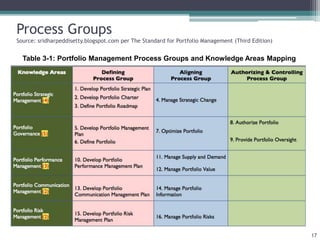
Process Groups
Source: sridharpeddisetty.blogspot.com per The Standard for Portfolio Management (Third Edition)
17
Table 3-1: Portfolio Management Process Groups and Knowledge Areas Mapping
Practical Application
18
Practical Application
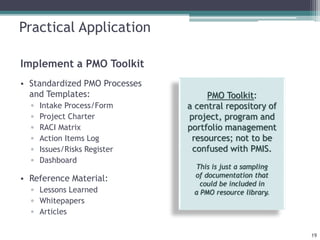
Implement a PMO Toolkit
• Standardized PMO Processes
and Templates:
▫ Intake Process/Form
▫ Project Charter
▫ RACI Matrix
▫ Action Items Log
▫ Issues/Risks Register
▫ Dashboard
• Reference Material:
▫ Lessons Learned
▫ Whitepapers
▫ Articles
19
PMO Toolkit:
a central repository of
project, program and
portfolio management
resources; not to be
confused with PMIS.
This is just a sampling
of documentation that
could be included in
a PMO resource library.
Practical Application
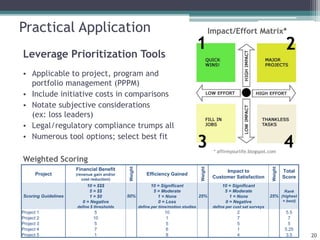
Leverage Prioritization Tools
20
Project
Financial Benefit
(revenue gain and/or
cost reduction)
Weight
Efficiency Gained
Weight
Impact to
Customer Satisfaction
Weight
Total
Score
Scoring Guidelines
10 = $$$
5 = $$
1 = $0
0 = Negative
define $ thresholds
50%
10 = Significant
5 = Moderate
1 = None
0 = Loss
define per time/motion studies
25%
10 = Significant
5 = Moderate
1 = None
0 = Negative
define per cust sat surveys
25%
Rank
(highest
= best)
Project 1 5 10 2 5.5
Project 2 10 1 7 7
Project 3 5 5 5 5
Project 4 7 6 1 5.25
Project 5 1 8 4 3.5
Impact/Effort Matrix*
Weighted Scoring
* affirmyourlife.blogspot.com
• Applicable to project, program and
portfolio management (PPPM)
• Include initiative costs in comparisons
• Notate subjective considerations
(ex: loss leaders)
• Legal/regulatory compliance trumps all
• Numerous tool options; select best fit
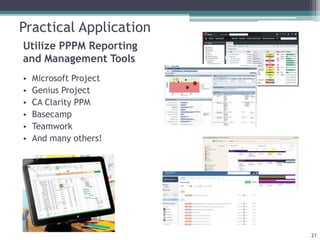
Utilize PPPM Reporting
and Management Tools
• Microsoft Project
• Genius Project
• CA Clarity PPM
• Basecamp
• Teamwork
• And many others!
21
Practical Application
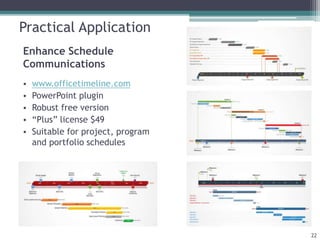
Enhance Schedule
Communications
• www.officetimeline.com
• PowerPoint plugin
• Robust free version
• “Plus” license $49
• Suitable for project, program
and portfolio schedules
22
Practical Application
Keys to Success
• Standardize tools, templates and processes
• One size does not fit all – select the best fit
• Ensure scalability and flexibility
• Leverage free resources
• Target easy adoption
• Consider the culture
• Solidify executive sponsorship
23
“Successful implementations are 80% people, process and
culture, and only 20% software, hardware and technology.”
Project and Program Management
Best Practices – Chartering the PMO
Niwot Ridge Consulting
Portfolio Management Professional
(PfMP)
24
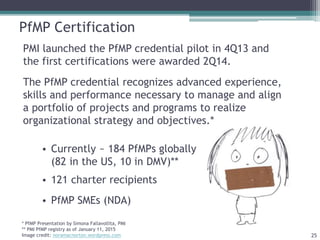
PfMP Certification
PMI launched the PfMP credential pilot in 4Q13 and
the first certifications were awarded 2Q14.
The PfMP credential recognizes advanced experience,
skills and performance necessary to manage and align
a portfolio of projects and programs to realize
organizational strategy and objectives.*
• Currently ~ 184 PfMPs globally
(82 in the US, 10 in DMV)**
• 121 charter recipients
• PfMP SMEs (NDA)
* PfMP Presentation by Simona Fallavollita, PMI
** PMI PfMP registry as of January 11, 2015
Image credit: noramacnorton.wordpress.com 25
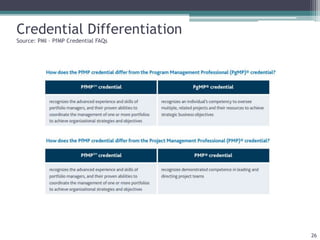
Credential Differentiation
Source: PMI – PfMP Credential FAQs
26
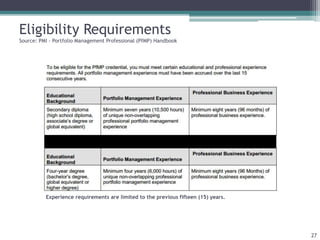
Eligibility Requirements
Source: PMI - Portfolio Management Professional (PfMP) Handbook
27
Experience requirements are limited to the previous fifteen (15) years.
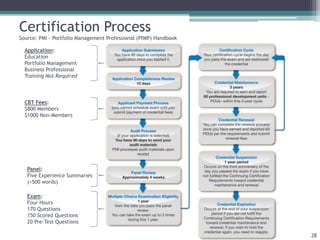
Certification Process
Source: PMI - Portfolio Management Professional (PfMP) Handbook
28
CBT Fees:
$800 Members
$1000 Non-Members
Application:
Education
Portfolio Management
Business Professional
Training Not Required
Panel:
Five Experience Summaries
(<500 words)
Exam:
Four Hours
170 Questions
150 Scored Questions
20 Pre-Test Questions
29
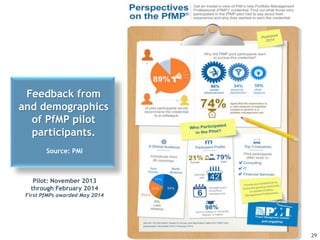
Feedback from
and demographics
of PfMP pilot
participants.
Source: PMI
Pilot: November 2013
through February 2014
First PfMPs awarded May 2014
Resources
30
PfMP Information
• The Portfolio Management Professional (PfMP) Handbook
http://www.pmi.org/Certification/~/media/PDF/Certifications/pfmphandbook.ashx
• PfMP Examination Content Outline
http://www.pmi.org/Certification/~/media/PDF/Certifications/PfPM_Examination%20Content%20
Outline.ashx
• PfMP Credential FAQs
http://www.pmi.org/Certification/~/media/PDF/Certifications/PfMP_FAQs_v3.ashx
• The Standard for Portfolio Management
http://marketplace.pmi.org/Pages/ProductDetail.aspx?GMProduct=00101388901
• Portfolio Management Publications
See reading list on following page
• LinkedIn Groups, Practice Tests, Study Guides, PMI.org (Books 24x7)
31
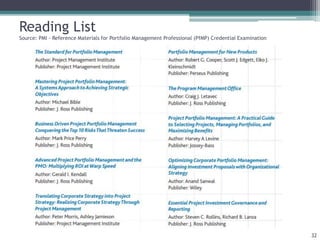
Reading List
Source: PMI - Reference Materials for Portfolio Management Professional (PfMP) Credential Examination
32

Melissa Highley presents: Portfolio Management for Everyone 21 Jan v15

  • 1.
    Portfolio Management forEveryone January 21, 2015 Melissa Highley, PfMP, PMP
  • 2.
    Agenda • Project, Programand Portfolio Management Basics • Portfolio Management Overview • Practical Application • Portfolio Management Professional (PfMP) • Resources 2
  • 3.
    Project, Program andPortfolio Management Basics 3
  • 4.
    Project/Program/Portfolio Source: The Standardfor Portfolio Management (Third Edition) Project A temporary endeavor undertaken to create a unique product, service or result. Program A group of related projects, subprograms and program activities that are managed in a coordinated way to obtain benefits not available from managing them individually. Portfolio Projects, programs, subportfolios and operations managed as a group to achieve strategic objectives. Doing the right things and doing things right. • “How” • Tactical • “What” • Strategic 4
  • 5.
    Further Differentiation Source: PMI– PfMP Credential FAQs 5
  • 6.
  • 7.
    Organizational Context Source: p2vhub.comper The Standard for Portfolio Management (Third Edition) 7 Figure 1-3: The Organizational Context of Portfolio Management of Portfolio Management
  • 8.
  • 9.
    Portfolio Management Source: TheStandard for Portfolio Management (Third Edition) • A portfolio is a component collection of programs, projects, or operations managed as a group to achieve strategic objectives. The portfolio components may not necessarily be interdependent or have related objectives. The portfolio components are quantifiable, that is, they can be measured, ranked, and prioritized. • A portfolio exists to achieve one or more organizational strategies and objectives and may consist of a set of past, current, and planned or future portfolio components. Portfolios and programs have the potential to be longer term with new projects rotating into the portfolios or programs, unlike projects that have a defined beginning and end. • An organization may have more than one portfolio, each addressing unique organizational strategies and objectives. Proposed initiatives are structured as portfolios and components are identified, evaluated, selected, and authorized. In addition, portfolios may contain subportfolios. 9
  • 10.
    In other words… portfolio management is like herding cats (and dogs and …). EDS “Cat Herders” Commercial: http://vimeo.com/59098832 10
  • 11.
    Domains Source: The Standardfor Portfolio Management (Third Edition) There are five (5) domains in portfolio management: • Domain 1: Strategic Alignment • Domain 2: Governance • Domain 3: Portfolio Performance • Domain 4: Risk Management • Domain 5: Communications Management Each domain also has a number of associated tasks. 11
  • 12.
    Strategic Alignment Source: PMI- Portfolio Management Professional (PfMP) Examination Content Outline 12
  • 13.
    Governance Source: PMI -Portfolio Management Professional (PfMP) Examination Content Outline 13
  • 14.
    Portfolio Performance Source: PMI- Portfolio Management Professional (PfMP) Examination Content Outline 14
  • 15.
    Risk Management Source: PMI- Portfolio Management Professional (PfMP) Examination Content Outline 15
  • 16.
    Communications Management Source: PMI- Portfolio Management Professional (PfMP) Examination Content Outline 16
  • 17.
    Process Groups Source: sridharpeddisetty.blogspot.comper The Standard for Portfolio Management (Third Edition) 17 Table 3-1: Portfolio Management Process Groups and Knowledge Areas Mapping
  • 18.
  • 19.
    Practical Application Implement aPMO Toolkit • Standardized PMO Processes and Templates: ▫ Intake Process/Form ▫ Project Charter ▫ RACI Matrix ▫ Action Items Log ▫ Issues/Risks Register ▫ Dashboard • Reference Material: ▫ Lessons Learned ▫ Whitepapers ▫ Articles 19 PMO Toolkit: a central repository of project, program and portfolio management resources; not to be confused with PMIS. This is just a sampling of documentation that could be included in a PMO resource library.
  • 20.
    Practical Application Leverage PrioritizationTools 20 Project Financial Benefit (revenue gain and/or cost reduction) Weight Efficiency Gained Weight Impact to Customer Satisfaction Weight Total Score Scoring Guidelines 10 = $$$ 5 = $$ 1 = $0 0 = Negative define $ thresholds 50% 10 = Significant 5 = Moderate 1 = None 0 = Loss define per time/motion studies 25% 10 = Significant 5 = Moderate 1 = None 0 = Negative define per cust sat surveys 25% Rank (highest = best) Project 1 5 10 2 5.5 Project 2 10 1 7 7 Project 3 5 5 5 5 Project 4 7 6 1 5.25 Project 5 1 8 4 3.5 Impact/Effort Matrix* Weighted Scoring * affirmyourlife.blogspot.com • Applicable to project, program and portfolio management (PPPM) • Include initiative costs in comparisons • Notate subjective considerations (ex: loss leaders) • Legal/regulatory compliance trumps all • Numerous tool options; select best fit
  • 21.
    Utilize PPPM Reporting andManagement Tools • Microsoft Project • Genius Project • CA Clarity PPM • Basecamp • Teamwork • And many others! 21 Practical Application
  • 22.
    Enhance Schedule Communications • www.officetimeline.com •PowerPoint plugin • Robust free version • “Plus” license $49 • Suitable for project, program and portfolio schedules 22 Practical Application
  • 23.
    Practical Application Keys toSuccess • Standardize tools, templates and processes • One size does not fit all – select the best fit • Ensure scalability and flexibility • Leverage free resources • Target easy adoption • Consider the culture • Solidify executive sponsorship 23 “Successful implementations are 80% people, process and culture, and only 20% software, hardware and technology.” Project and Program Management Best Practices – Chartering the PMO Niwot Ridge Consulting
  • 24.
  • 25.
    PfMP Certification PMI launchedthe PfMP credential pilot in 4Q13 and the first certifications were awarded 2Q14. The PfMP credential recognizes advanced experience, skills and performance necessary to manage and align a portfolio of projects and programs to realize organizational strategy and objectives.* • Currently ~ 184 PfMPs globally (82 in the US, 10 in DMV)** • 121 charter recipients • PfMP SMEs (NDA) * PfMP Presentation by Simona Fallavollita, PMI ** PMI PfMP registry as of January 11, 2015 Image credit: noramacnorton.wordpress.com 25
  • 26.
    Credential Differentiation Source: PMI– PfMP Credential FAQs 26
  • 27.
    Eligibility Requirements Source: PMI- Portfolio Management Professional (PfMP) Handbook 27 Experience requirements are limited to the previous fifteen (15) years.
  • 28.
    Certification Process Source: PMI- Portfolio Management Professional (PfMP) Handbook 28 CBT Fees: $800 Members $1000 Non-Members Application: Education Portfolio Management Business Professional Training Not Required Panel: Five Experience Summaries (<500 words) Exam: Four Hours 170 Questions 150 Scored Questions 20 Pre-Test Questions
  • 29.
    29 Feedback from and demographics ofPfMP pilot participants. Source: PMI Pilot: November 2013 through February 2014 First PfMPs awarded May 2014
  • 30.
  • 31.
    PfMP Information • ThePortfolio Management Professional (PfMP) Handbook http://www.pmi.org/Certification/~/media/PDF/Certifications/pfmphandbook.ashx • PfMP Examination Content Outline http://www.pmi.org/Certification/~/media/PDF/Certifications/PfPM_Examination%20Content%20 Outline.ashx • PfMP Credential FAQs http://www.pmi.org/Certification/~/media/PDF/Certifications/PfMP_FAQs_v3.ashx • The Standard for Portfolio Management http://marketplace.pmi.org/Pages/ProductDetail.aspx?GMProduct=00101388901 • Portfolio Management Publications See reading list on following page • LinkedIn Groups, Practice Tests, Study Guides, PMI.org (Books 24x7) 31
  • 32.
    Reading List Source: PMI- Reference Materials for Portfolio Management Professional (PfMP) Credential Examination 32