INTRODUCTION TO
PROJECT MANAGEMENT
Sonna Lynn Fernandez
Transportation Planning
Project Manager
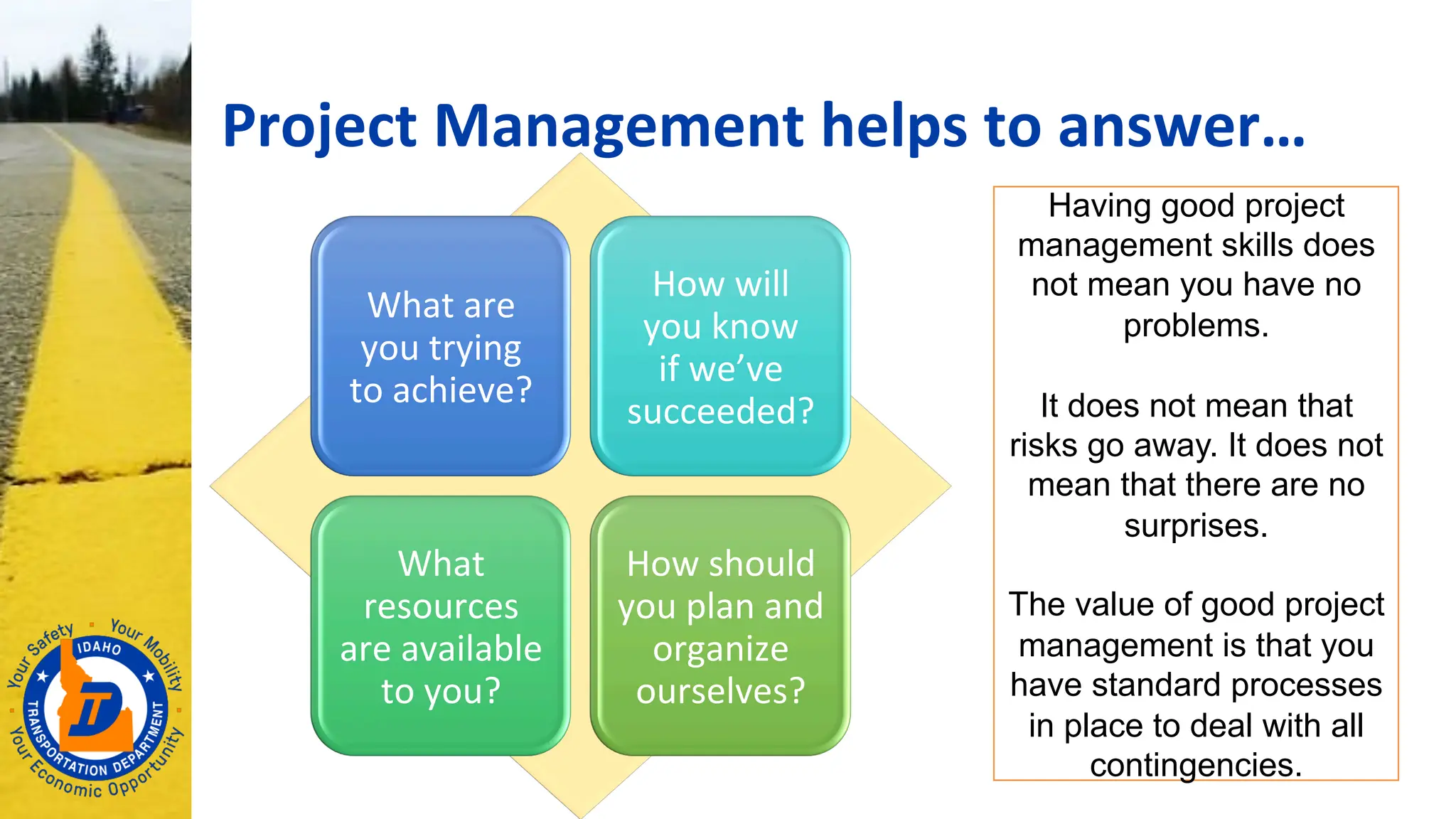
Project Management helps to answer…
What are
you trying
to achieve?
How will
you know
if we’ve
succeeded?
What
resources
are available
to you?
How should
you plan and
organize
ourselves?
Having good project
management skills does
not mean you have no
problems.
It does not mean that
risks go away. It does not
mean that there are no
surprises.
The value of good project
management is that you
have standard processes
in place to deal with all
contingencies.
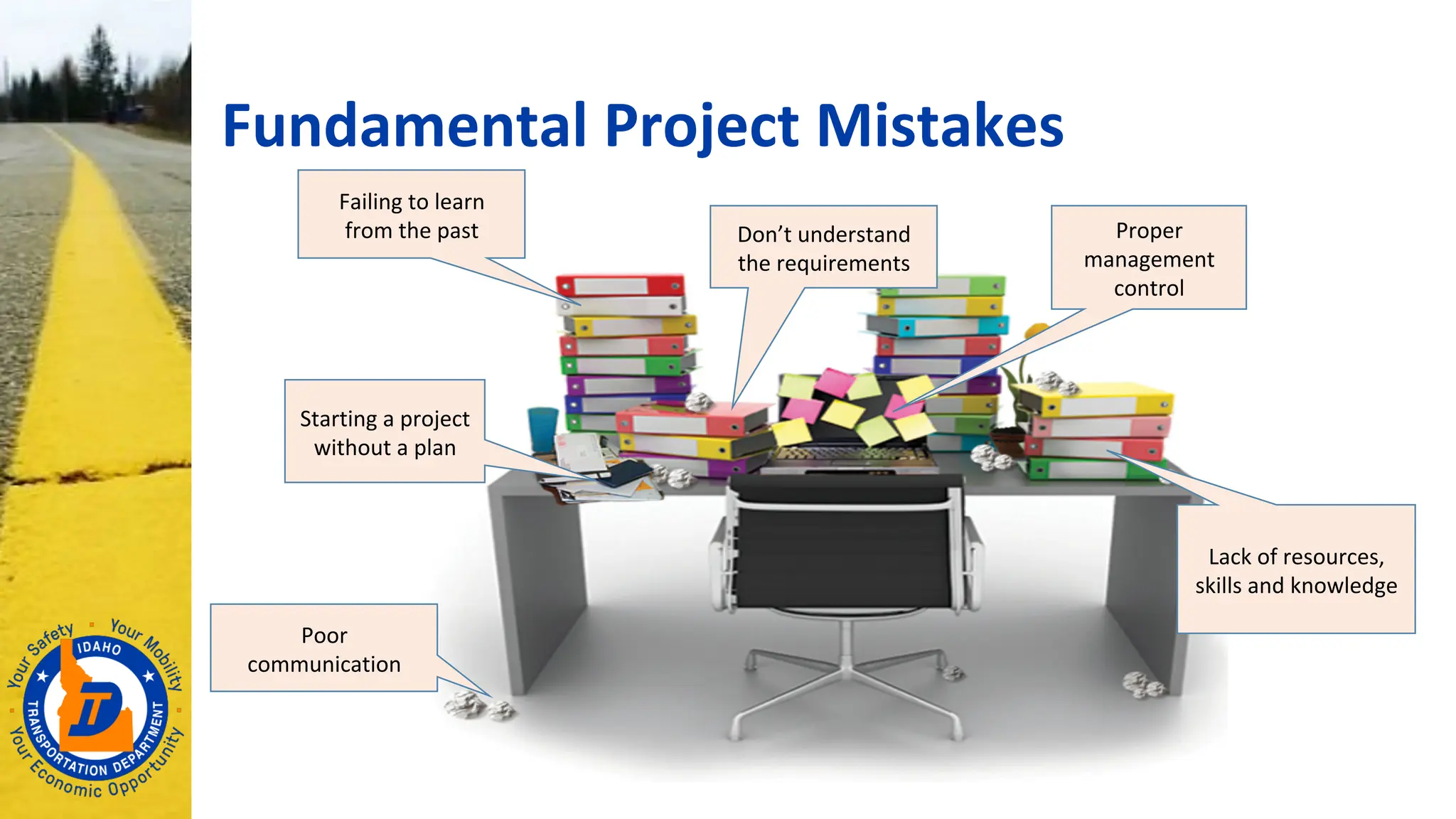
Fundamental Project Mistakes
Don’t understand
the requirements
Lack of resources,
skills and knowledge
Proper
management
control
Starting a project
without a plan
Poor
communication
Failing to learn
from the past
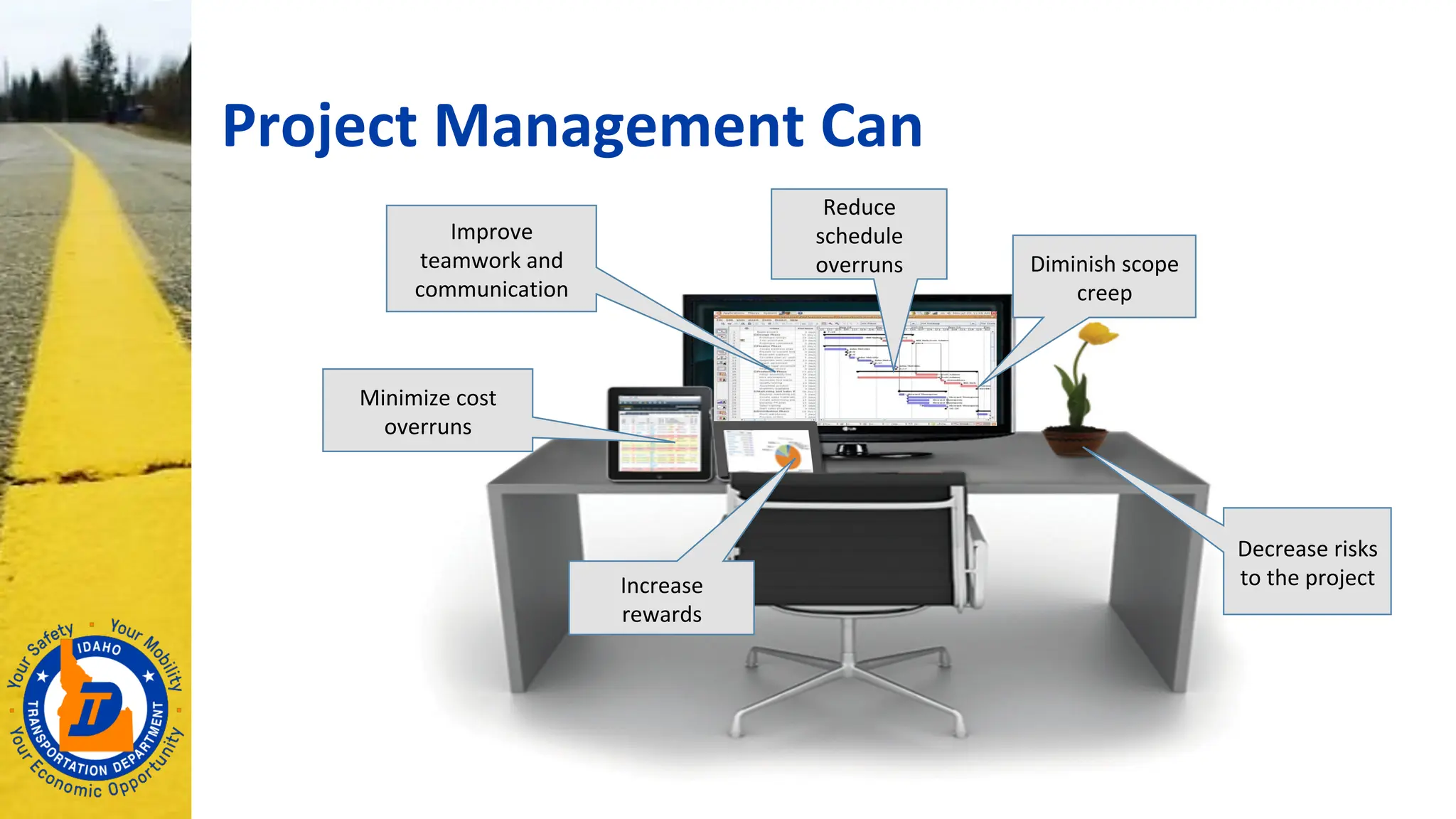
Project Management Can
Reduce
schedule
overruns
Decrease risks
to the project
Diminish scope
creep
Increase
rewards
Minimize cost
overruns
Improve
teamwork and
communication
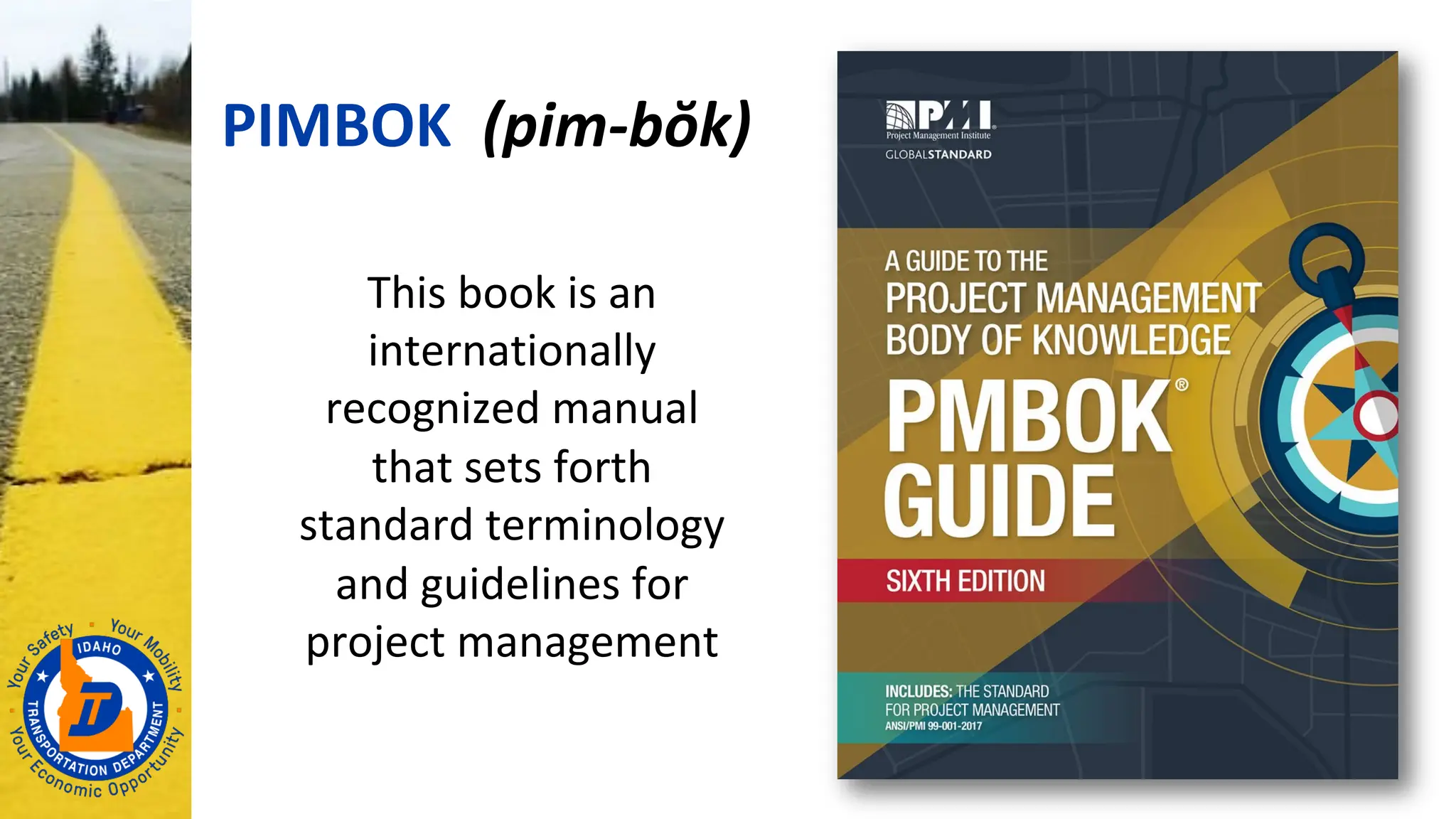
PIMBOK (pim-bŏk)
This book is an
internationally
recognized manual
that sets forth
standard terminology
and guidelines for
project management
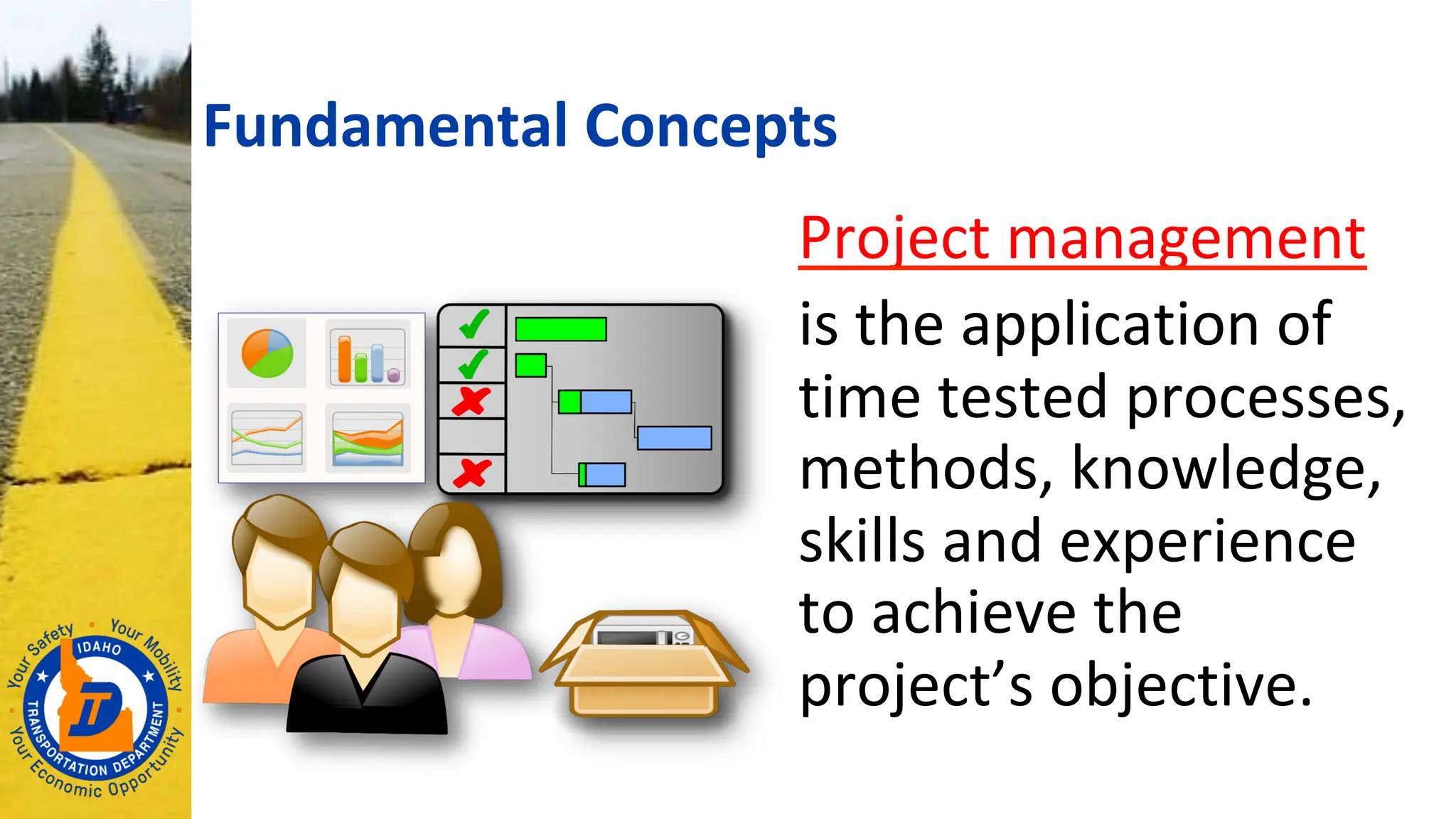
Project management
is the application of
time tested processes,
methods, knowledge,
skills and experience
to achieve the
project’s objective.
Fundamental Concepts
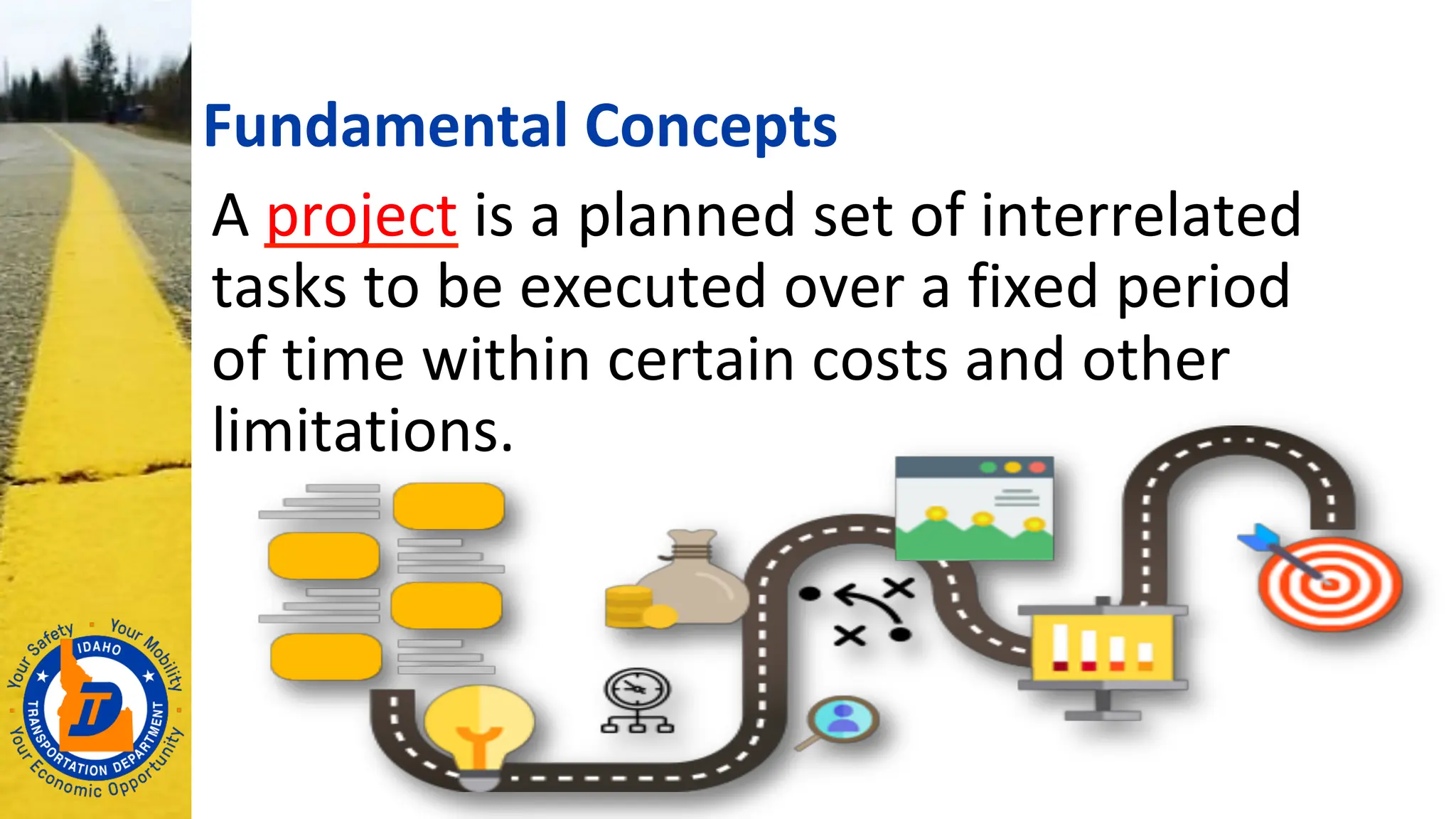
A project is a planned set of interrelated
tasks to be executed over a fixed period
of time within certain costs and other
limitations.
Fundamental Concepts
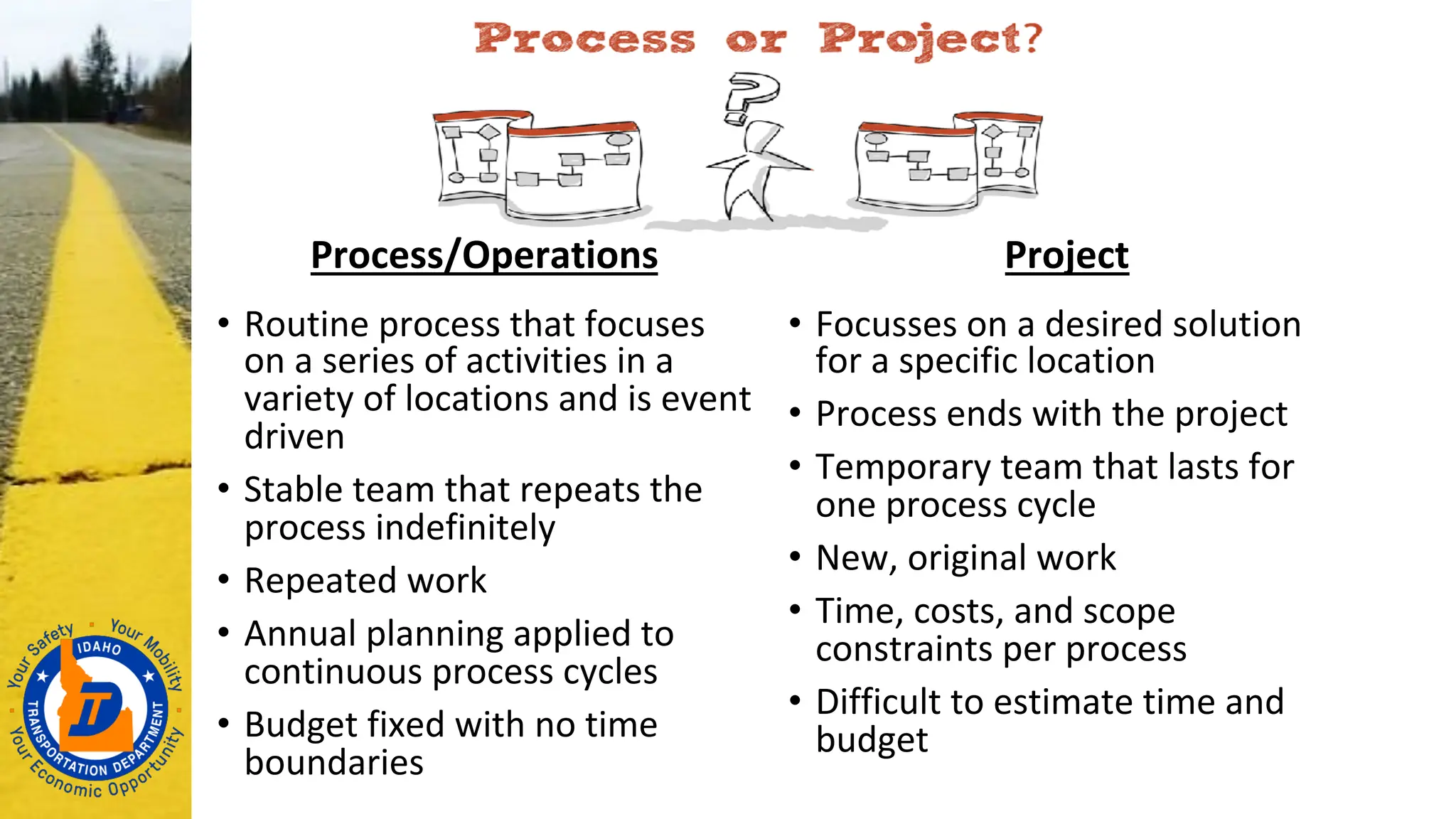
Process/Operations
• Routine process that focuses
on a series of activities in a
variety of locations and is event
driven
• Stable team that repeats the
process indefinitely
• Repeated work
• Annual planning applied to
continuous process cycles
• Budget fixed with no time
boundaries
Project
• Focusses on a desired solution
for a specific location
• Process ends with the project
• Temporary team that lasts for
one process cycle
• New, original work
• Time, costs, and scope
constraints per process
• Difficult to estimate time and
budget
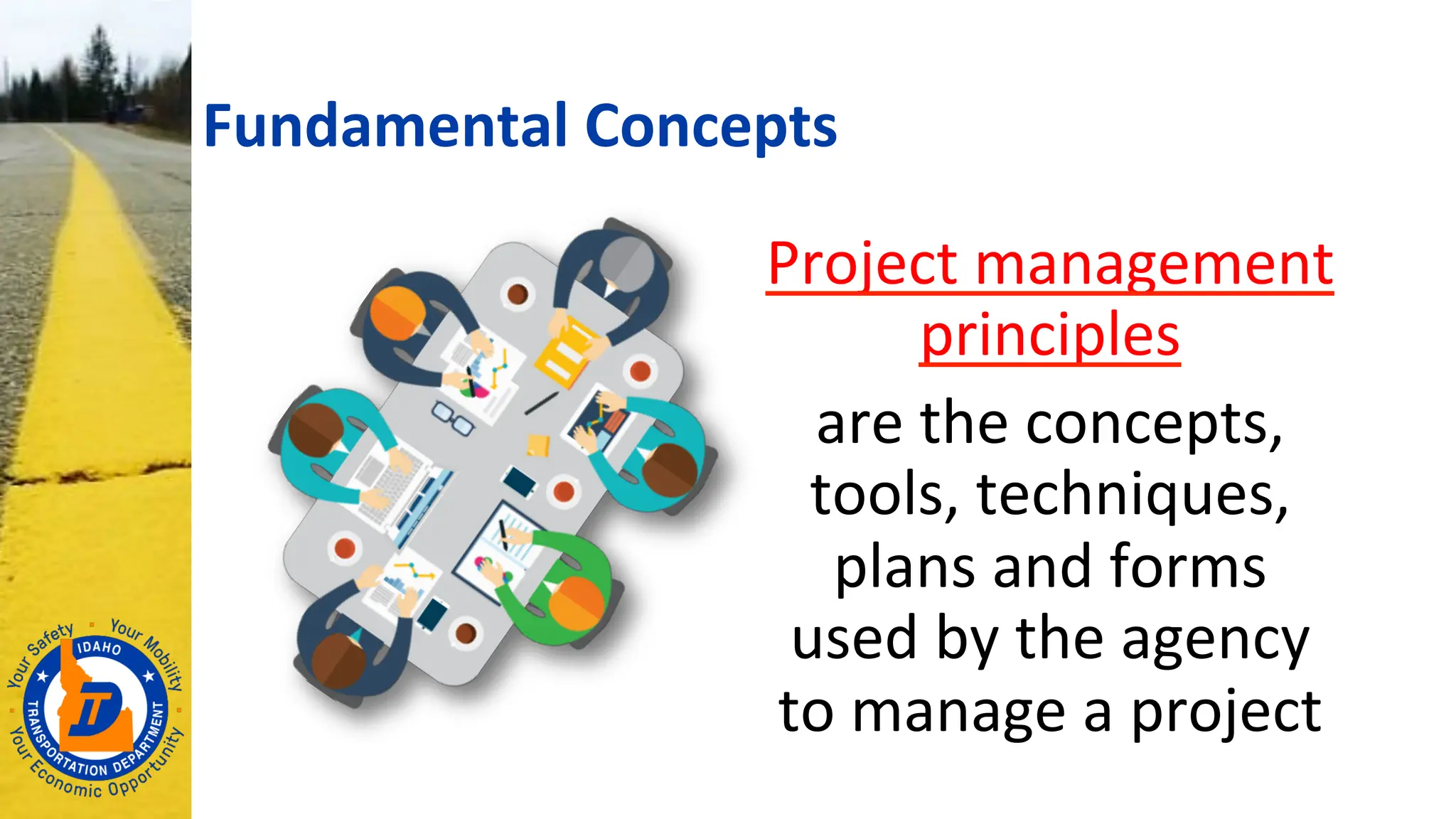
Project management
principles
are the concepts,
tools, techniques,
plans and forms
used by the agency
to manage a project
Fundamental Concepts
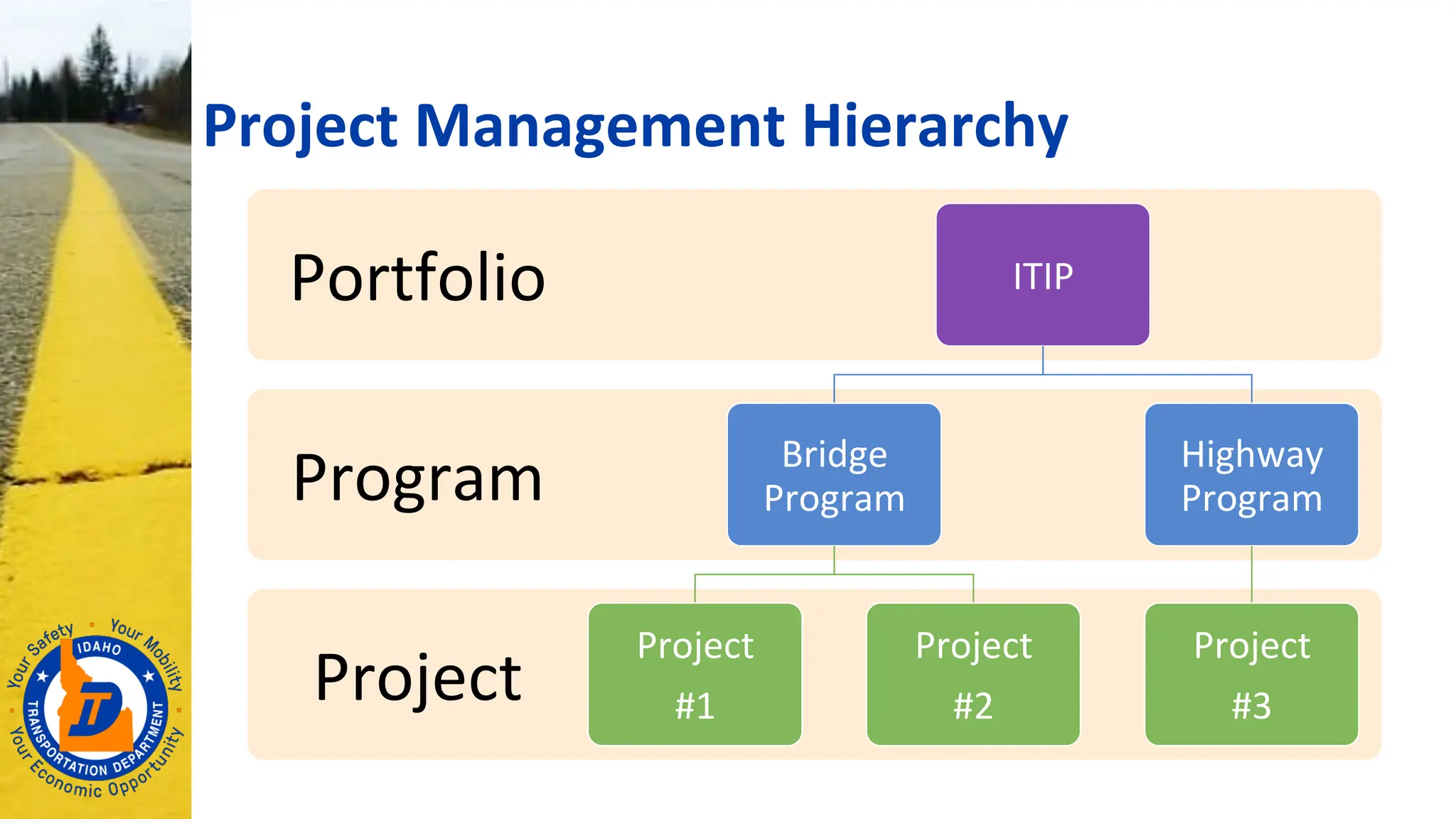
Project Management Hierarchy
Project
Program
Portfolio ITIP
Bridge
Program
Project
#1
Project
#2
Highway
Program
Project
#3
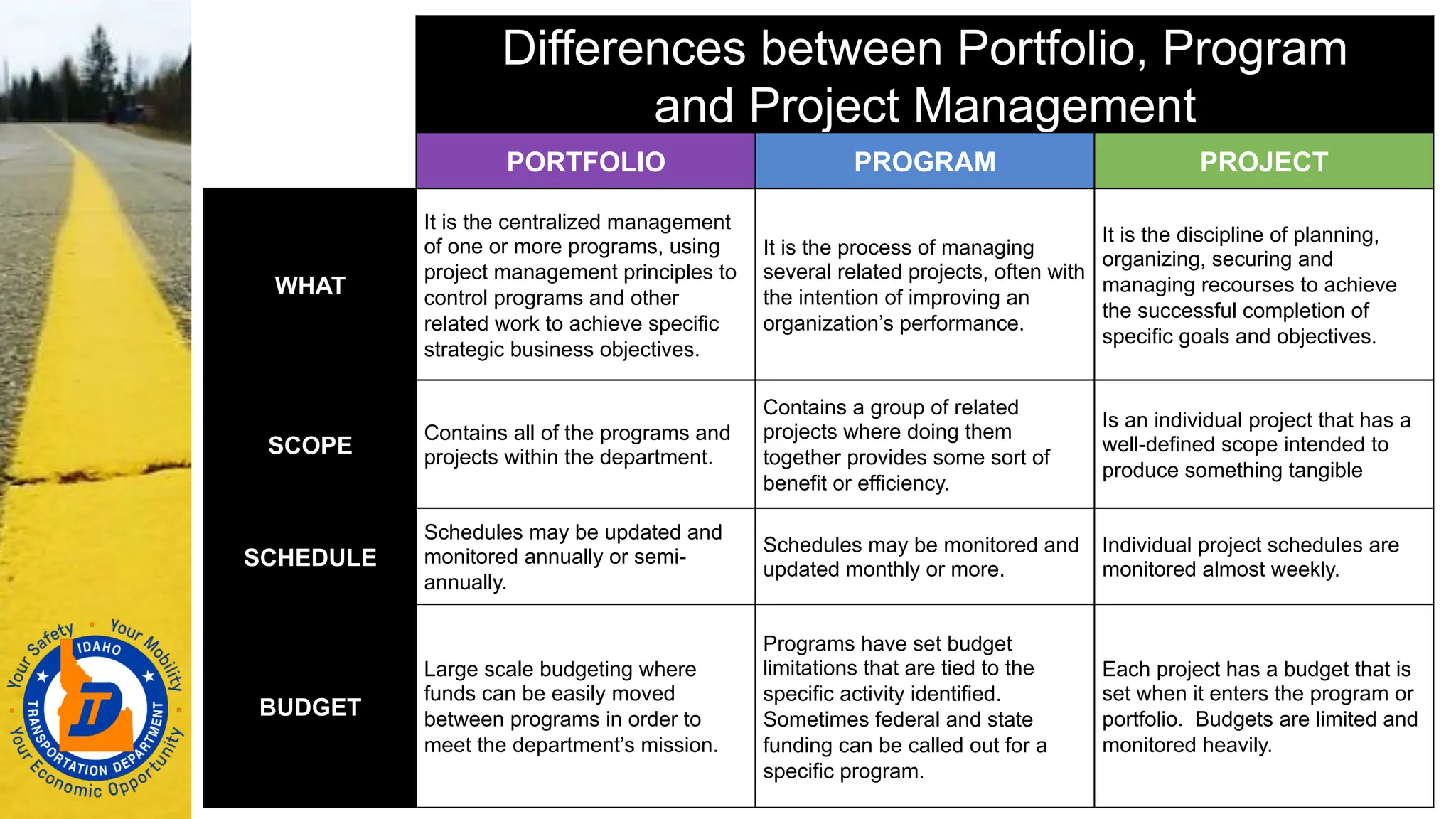
Differences between Portfolio, Program
and Project Management
PORTFOLIO PROGRAM PROJECT
WHAT
It is the centralized management
of one or more programs, using
project management principles to
control programs and other
related work to achieve specific
strategic business objectives.
It is the process of managing
several related projects, often with
the intention of improving an
organization’s performance.
It is the discipline of planning,
organizing, securing and
managing recourses to achieve
the successful completion of
specific goals and objectives.
SCOPE
Contains all of the programs and
projects within the department.
Contains a group of related
projects where doing them
together provides some sort of
benefit or efficiency.
Is an individual project that has a
well-defined scope intended to
produce something tangible
SCHEDULE
Schedules may be updated and
monitored annually or semi-
annually.
Schedules may be monitored and
updated monthly or more.
Individual project schedules are
monitored almost weekly.
BUDGET
Large scale budgeting where
funds can be easily moved
between programs in order to
meet the department’s mission.
Programs have set budget
limitations that are tied to the
specific activity identified.
Sometimes federal and state
funding can be called out for a
specific program.
Each project has a budget that is
set when it enters the program or
portfolio. Budgets are limited and
monitored heavily.
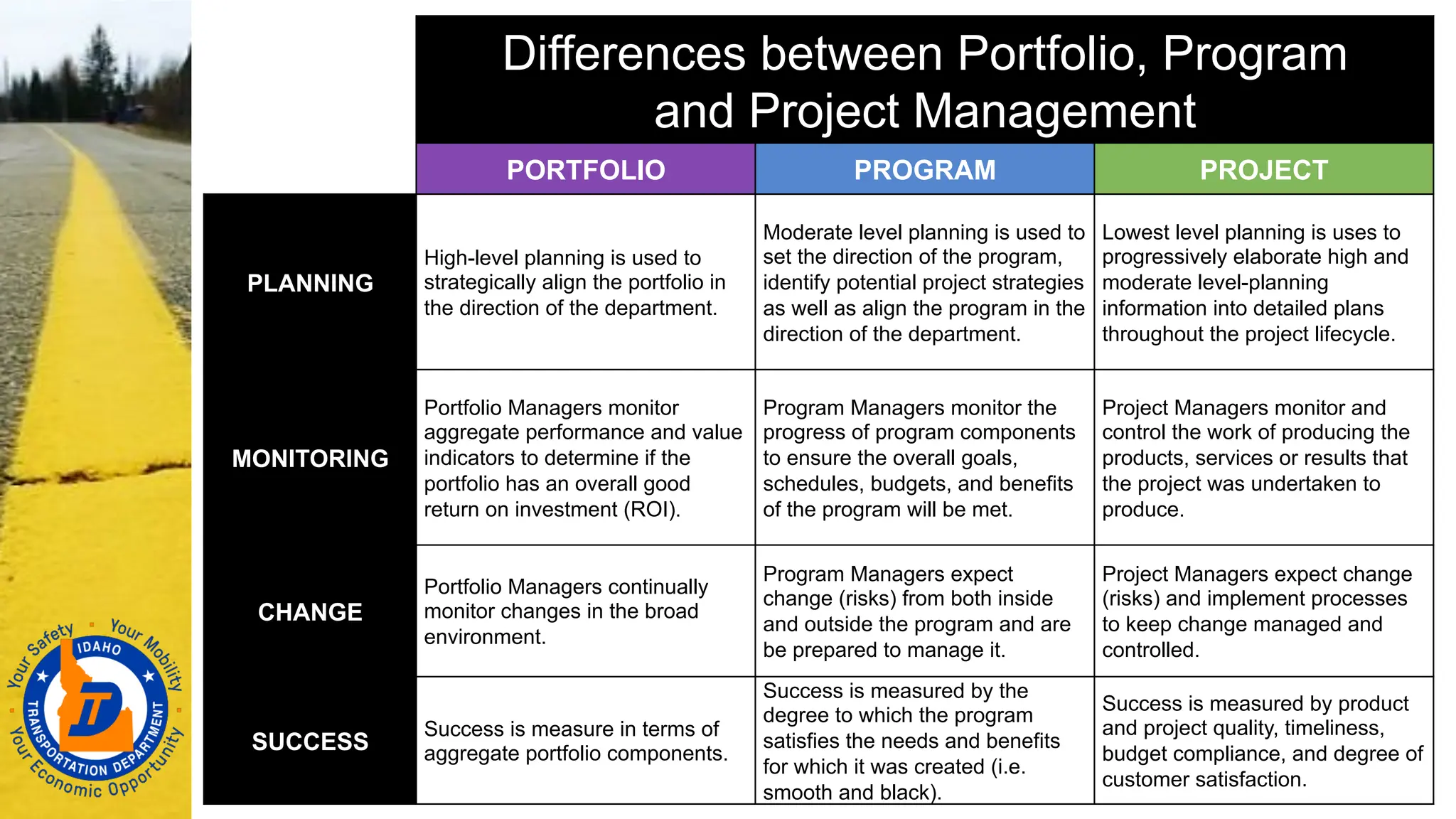
Differences between Portfolio, Program
and Project Management
PORTFOLIO PROGRAM PROJECT
PLANNING
High-level planning is used to
strategically align the portfolio in
the direction of the department.
Moderate level planning is used to
set the direction of the program,
identify potential project strategies
as well as align the program in the
direction of the department.
Lowest level planning is uses to
progressively elaborate high and
moderate level-planning
information into detailed plans
throughout the project lifecycle.
MONITORING
Portfolio Managers monitor
aggregate performance and value
indicators to determine if the
portfolio has an overall good
return on investment (ROI).
Program Managers monitor the
progress of program components
to ensure the overall goals,
schedules, budgets, and benefits
of the program will be met.
Project Managers monitor and
control the work of producing the
products, services or results that
the project was undertaken to
produce.
CHANGE
Portfolio Managers continually
monitor changes in the broad
environment.
Program Managers expect
change (risks) from both inside
and outside the program and are
be prepared to manage it.
Project Managers expect change
(risks) and implement processes
to keep change managed and
controlled.
SUCCESS
Success is measure in terms of
aggregate portfolio components.
Success is measured by the
degree to which the program
satisfies the needs and benefits
for which it was created (i.e.
smooth and black).
Success is measured by product
and project quality, timeliness,
budget compliance, and degree of
customer satisfaction.
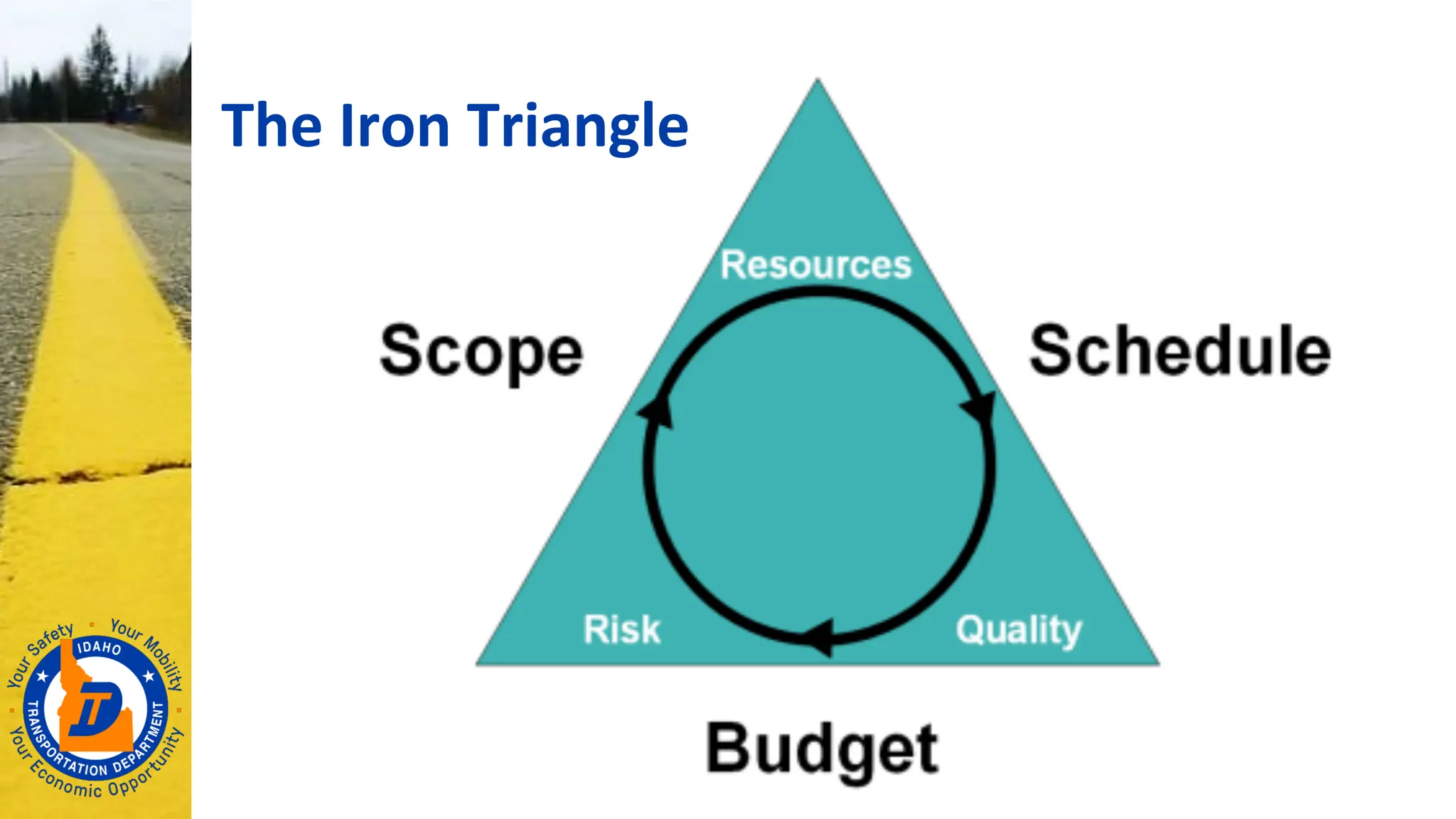
The Iron Triangle
Pre-Project Scope
• Project Goals
• Project justification
• Project description
• Deliverables
• Time
• Location
• Control
• Stakeholders (Internal/External)
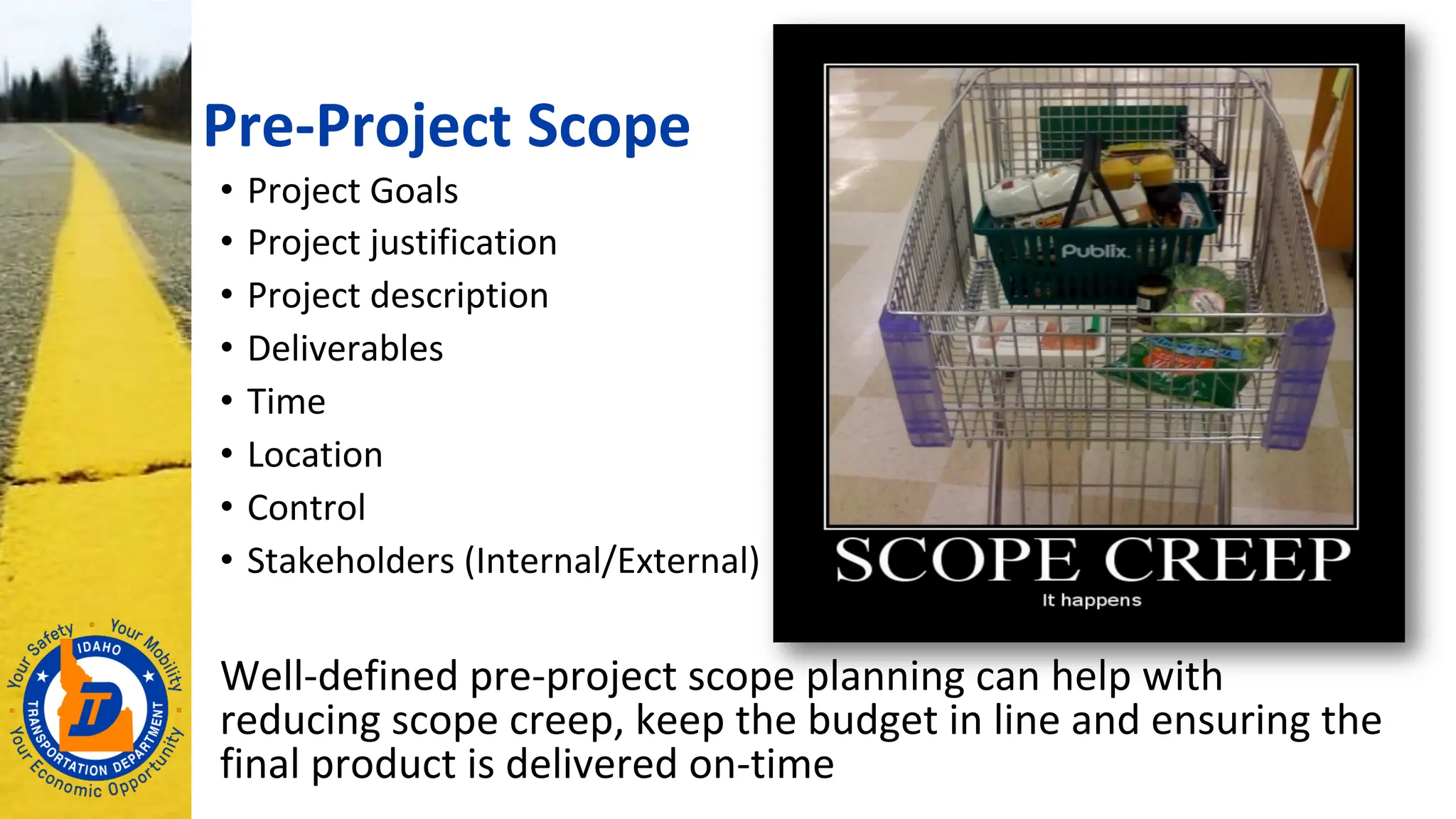
Well-defined pre-project scope planning can help with
reducing scope creep, keep the budget in line and ensuring the
final product is delivered on-time
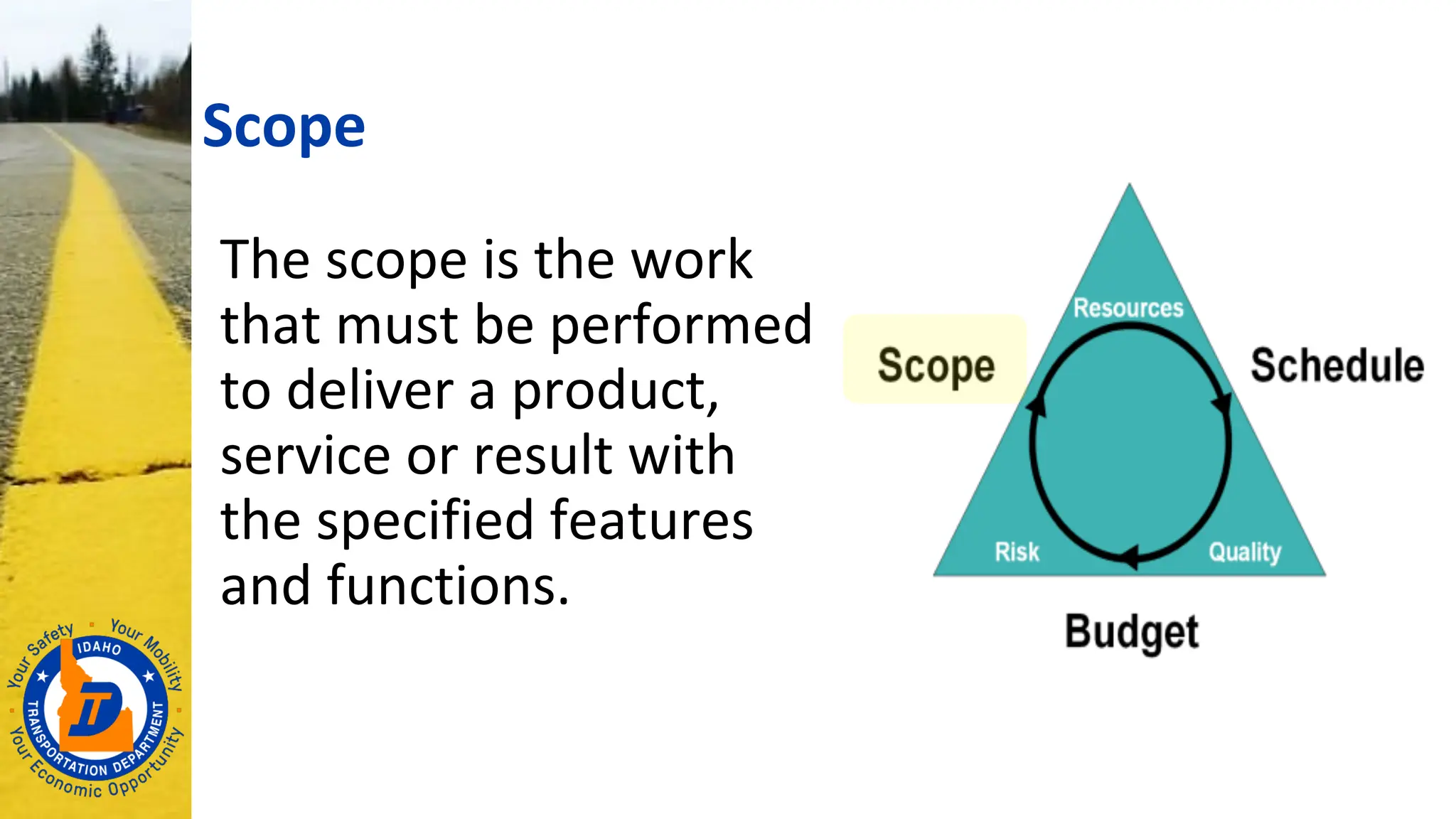
Scope
The scope is the work
that must be performed
to deliver a product,
service or result with
the specified features
and functions.
Project Charter
• Project goal
• Documents the reasons for
undertaking the project in clear,
concise language
• Project participants
• Identifies what people need to be
involved in the project and clearly
states their roles
• Stakeholders
• Identifies other people who will be
directly affected by the project and
need to know about the project's
progress
• Requirements
• Identifies what resources are required
for the project's objectives to be
achieved
• Constraints
• Documents potential roadblocks or
bottlenecks
• Milestones
• Identifies start date and completion
dates as well as dates for other
important checkpoints
• Communication
• Specifies how the project manager will
communicate with project owners,
participants and stakeholders through
the project
• Deliverables
• Documents what specific products,
processes or services the project will
provide upon completion.
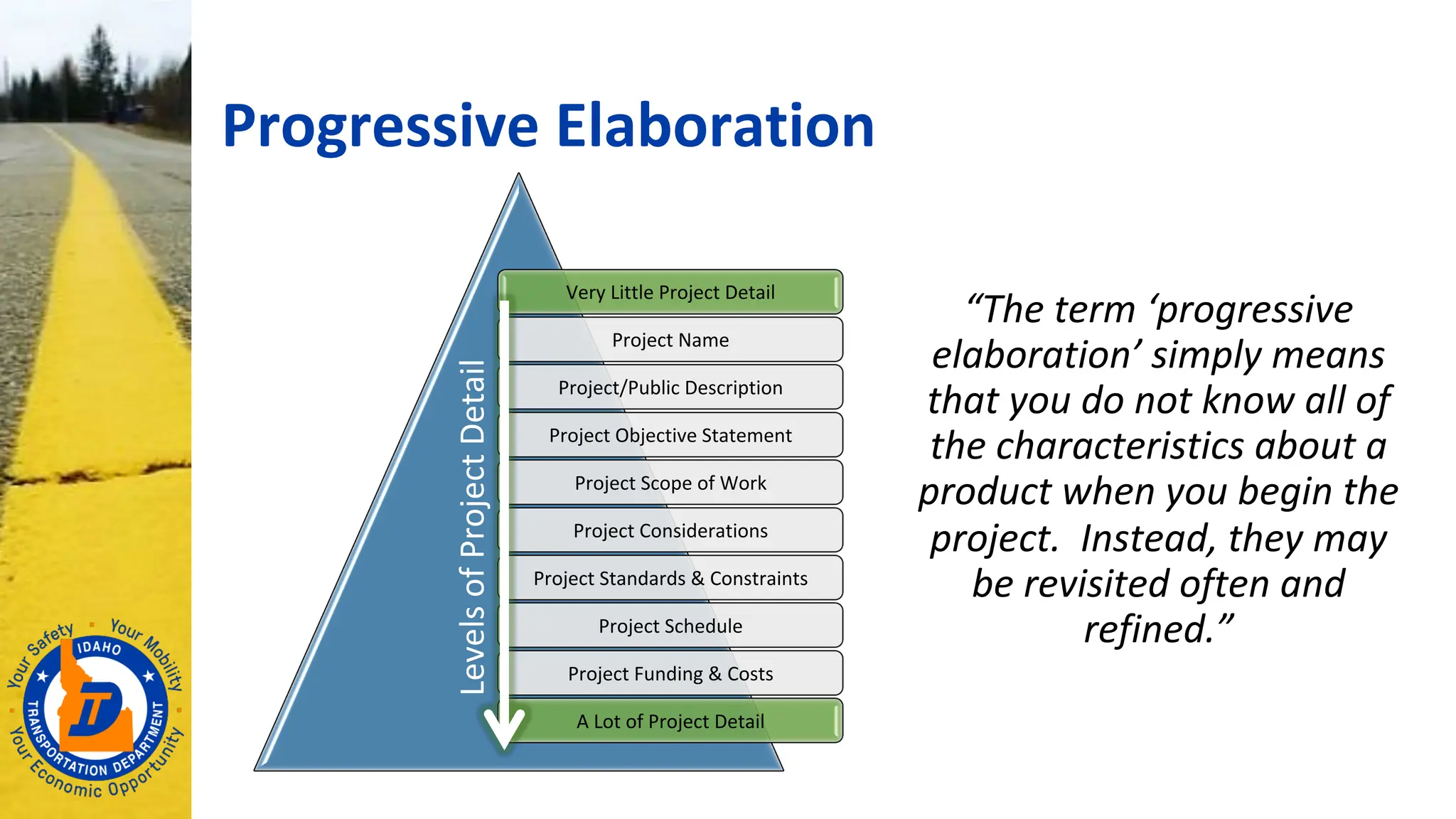
Progressive Elaboration
“The term ‘progressive
elaboration’ simply means
that you do not know all of
the characteristics about a
product when you begin the
project. Instead, they may
be revisited often and
refined.”
Very Little Project Detail
Project Name
Project/Public Description
Project Objective Statement
Project Scope of Work
Project Considerations
Project Standards & Constraints
Project Schedule
Project Funding & Costs
A Lot of Project Detail
Levels
of
Project
Detail
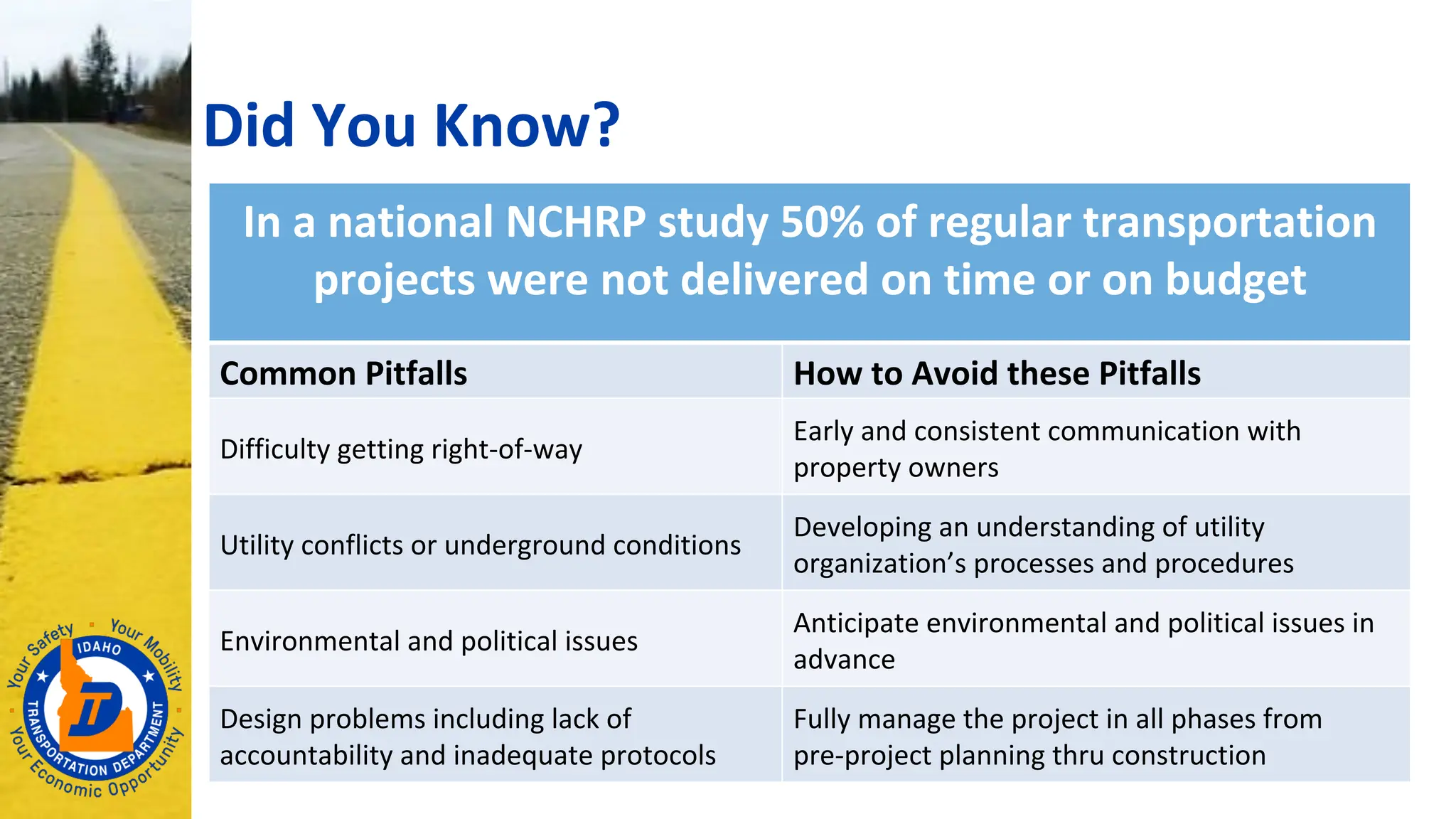
Did You Know?
In a national NCHRP study 50% of regular transportation
projects were not delivered on time or on budget
Common Pitfalls How to Avoid these Pitfalls
Difficulty getting right-of-way
Early and consistent communication with
property owners
Utility conflicts or underground conditions
Developing an understanding of utility
organization’s processes and procedures
Environmental and political issues
Anticipate environmental and political issues in
advance
Design problems including lack of
accountability and inadequate protocols
Fully manage the project in all phases from
pre-project planning thru construction
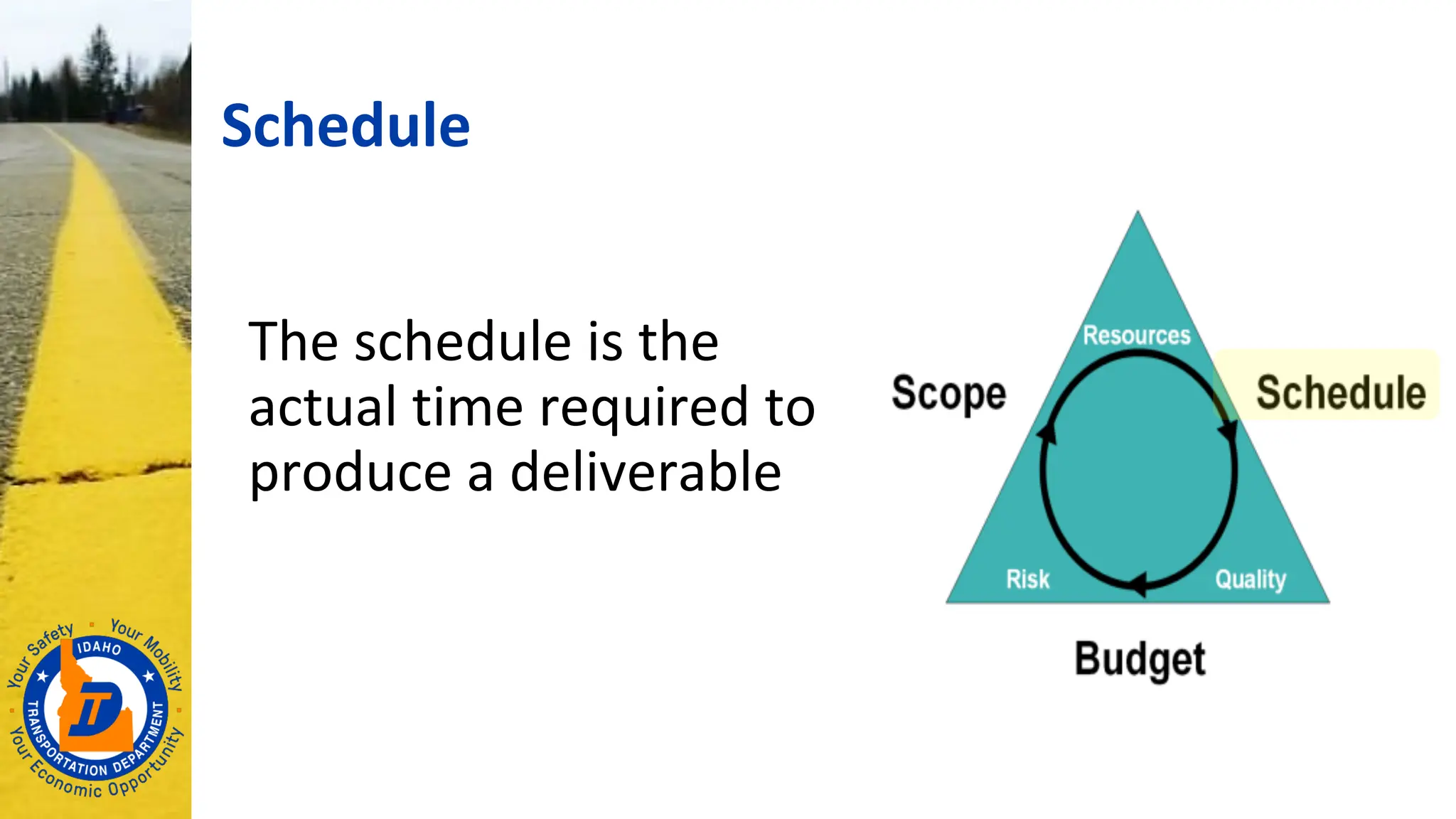
Schedule
The schedule is the
actual time required to
produce a deliverable
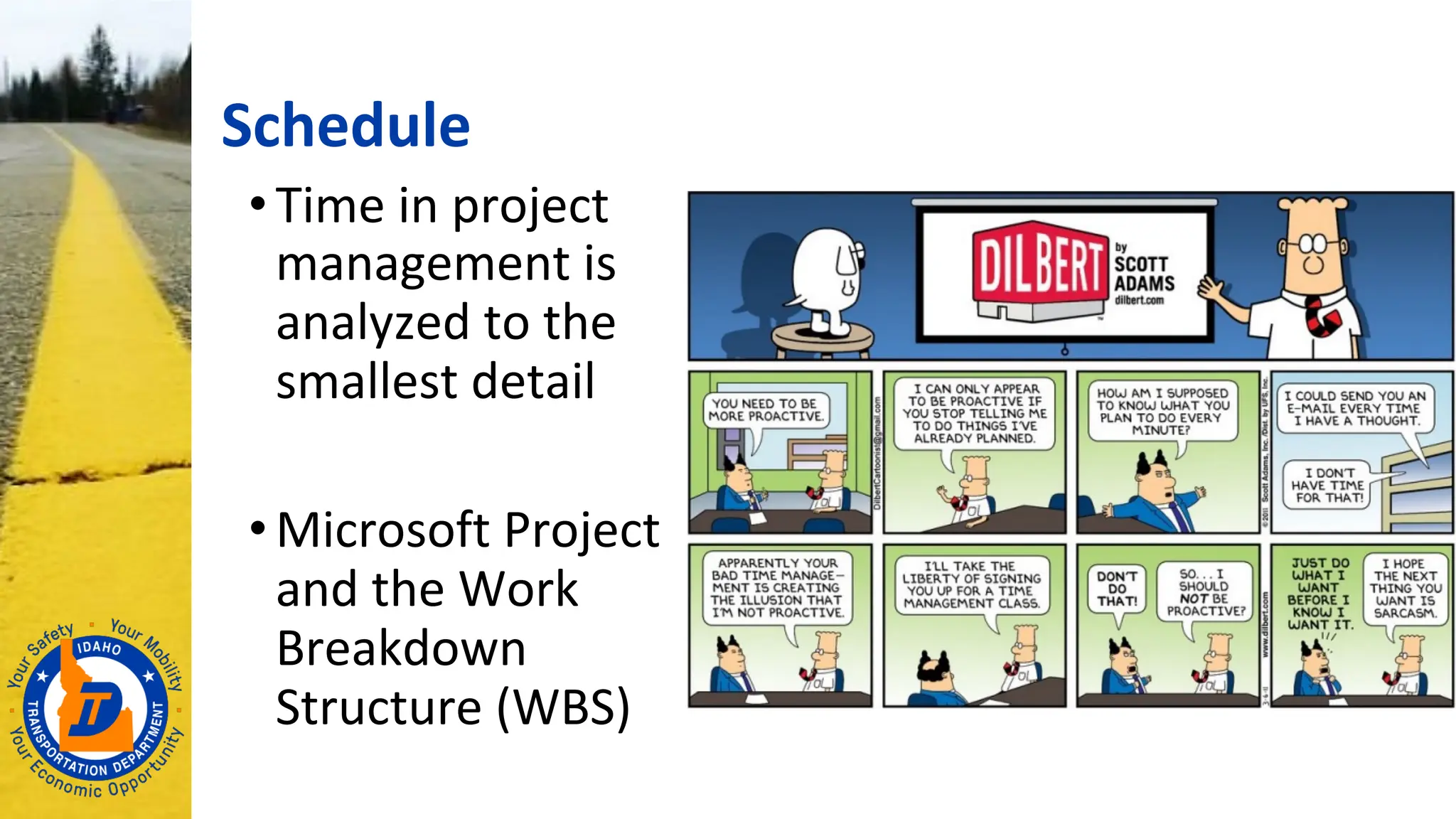
Schedule
• Time in project
management is
analyzed to the
smallest detail
• Microsoft Project
and the Work
Breakdown
Structure (WBS)
Budget
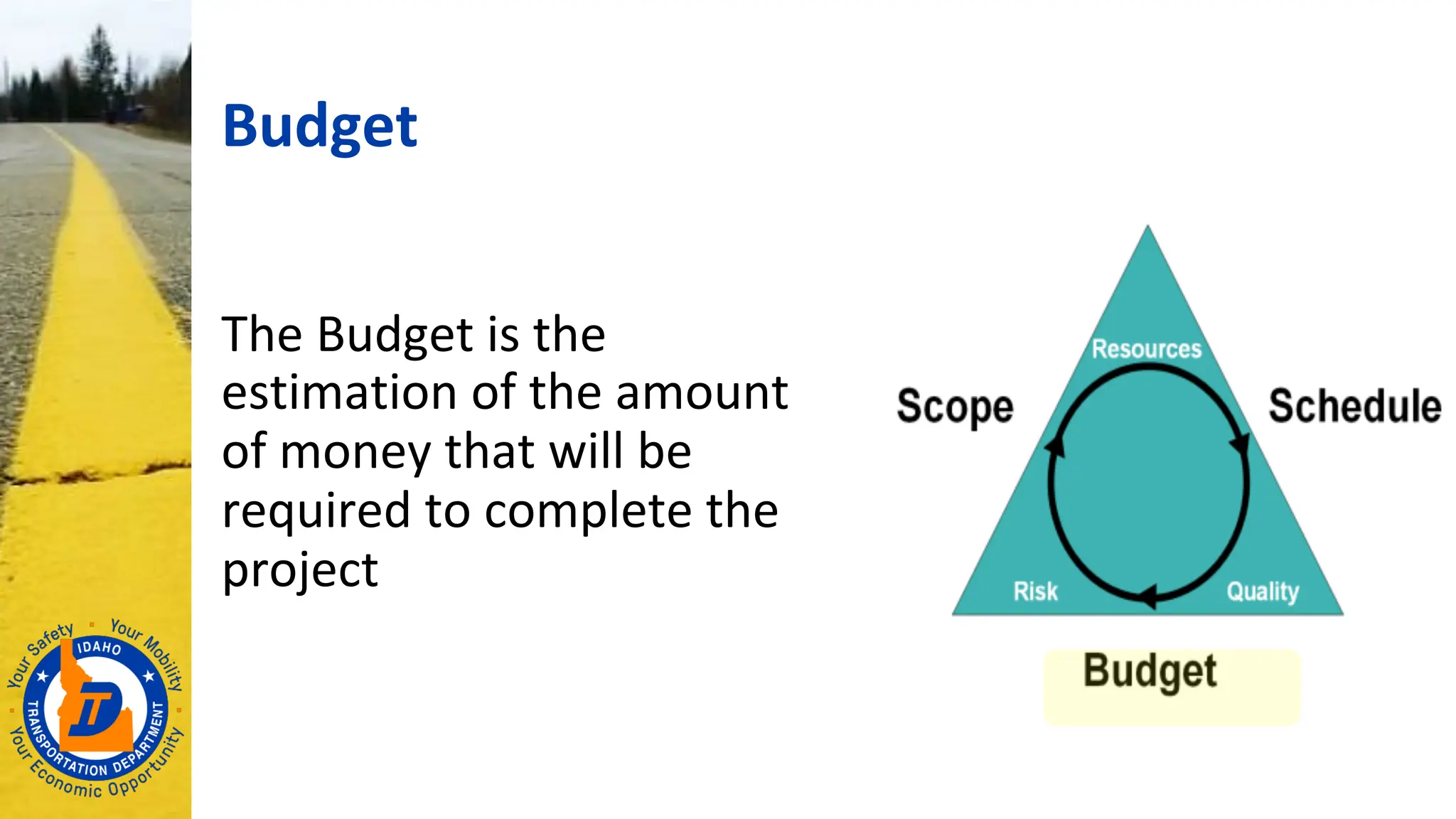
The Budget is the
estimation of the amount
of money that will be
required to complete the
project
Costs
• Cost itself encompasses
various things, such as:
• Resources (people and
things)
• Labor rates for
contractors
• Risk estimates
• Bills of materials
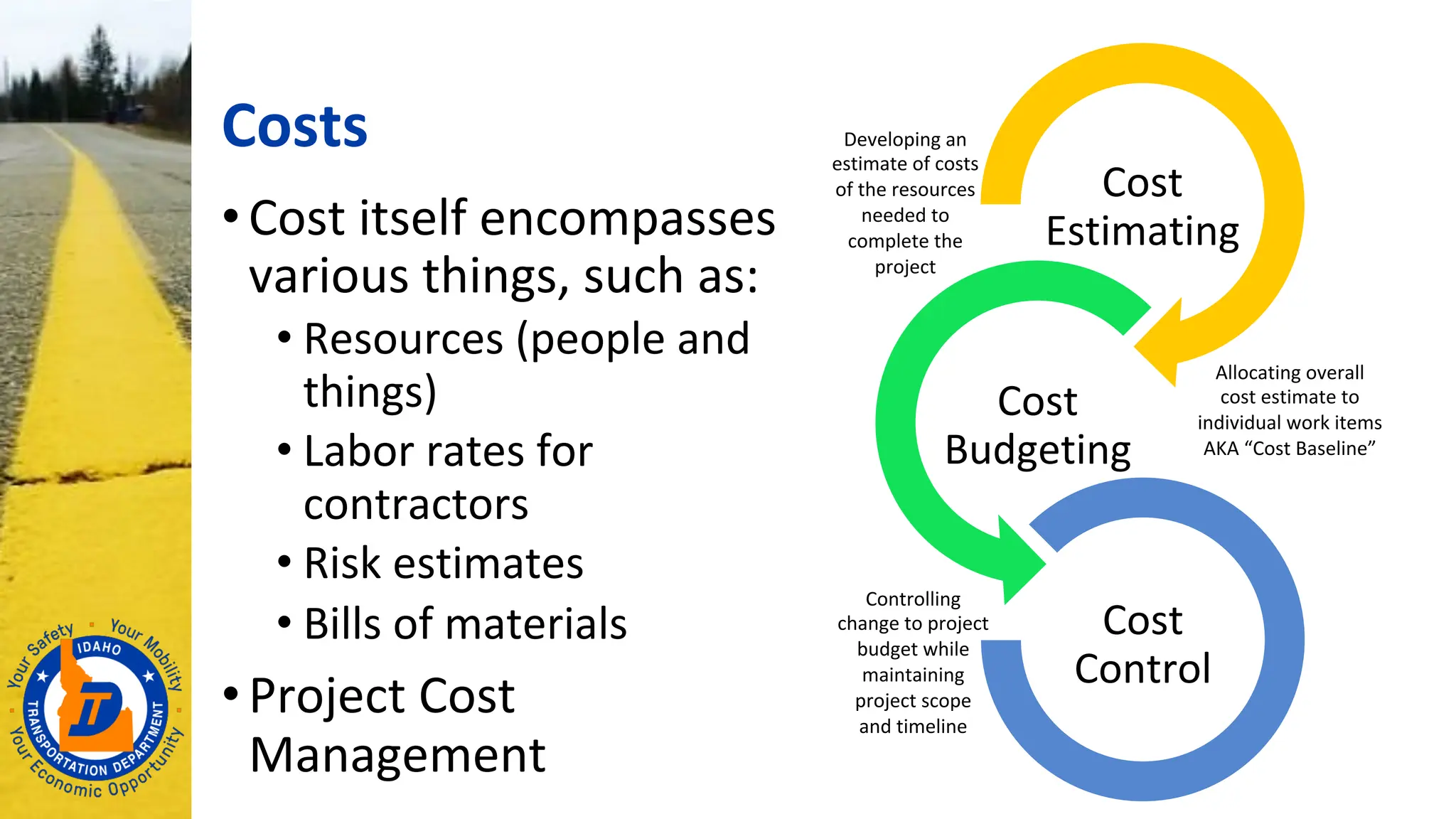
• Project Cost
Management
Cost
Estimating
Cost
Budgeting
Cost
Control
Developing an
estimate of costs
of the resources
needed to
complete the
project
Allocating overall
cost estimate to
individual work items
AKA “Cost Baseline”
Controlling
change to project
budget while
maintaining
project scope
and timeline
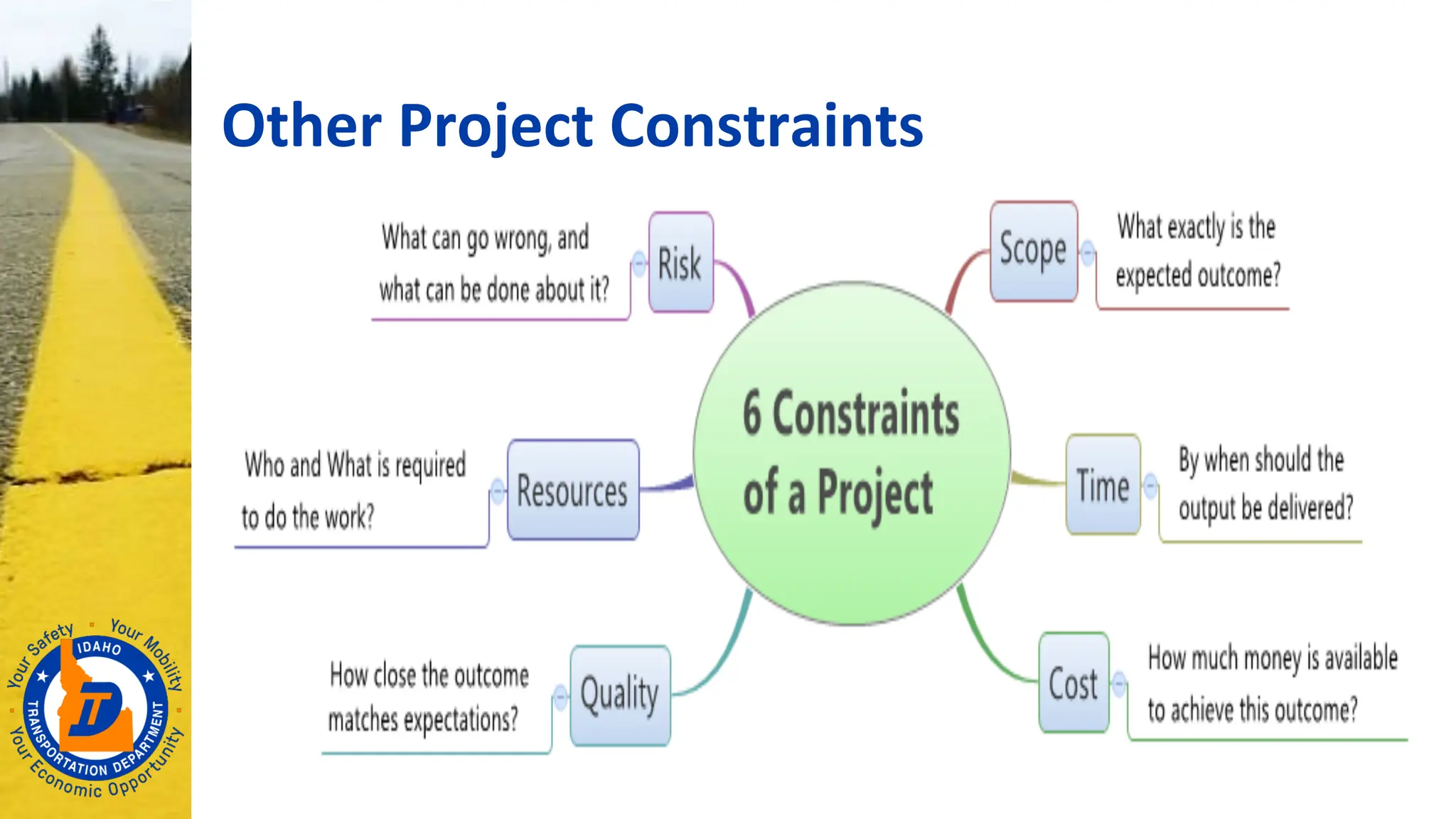
Other Project Constraints
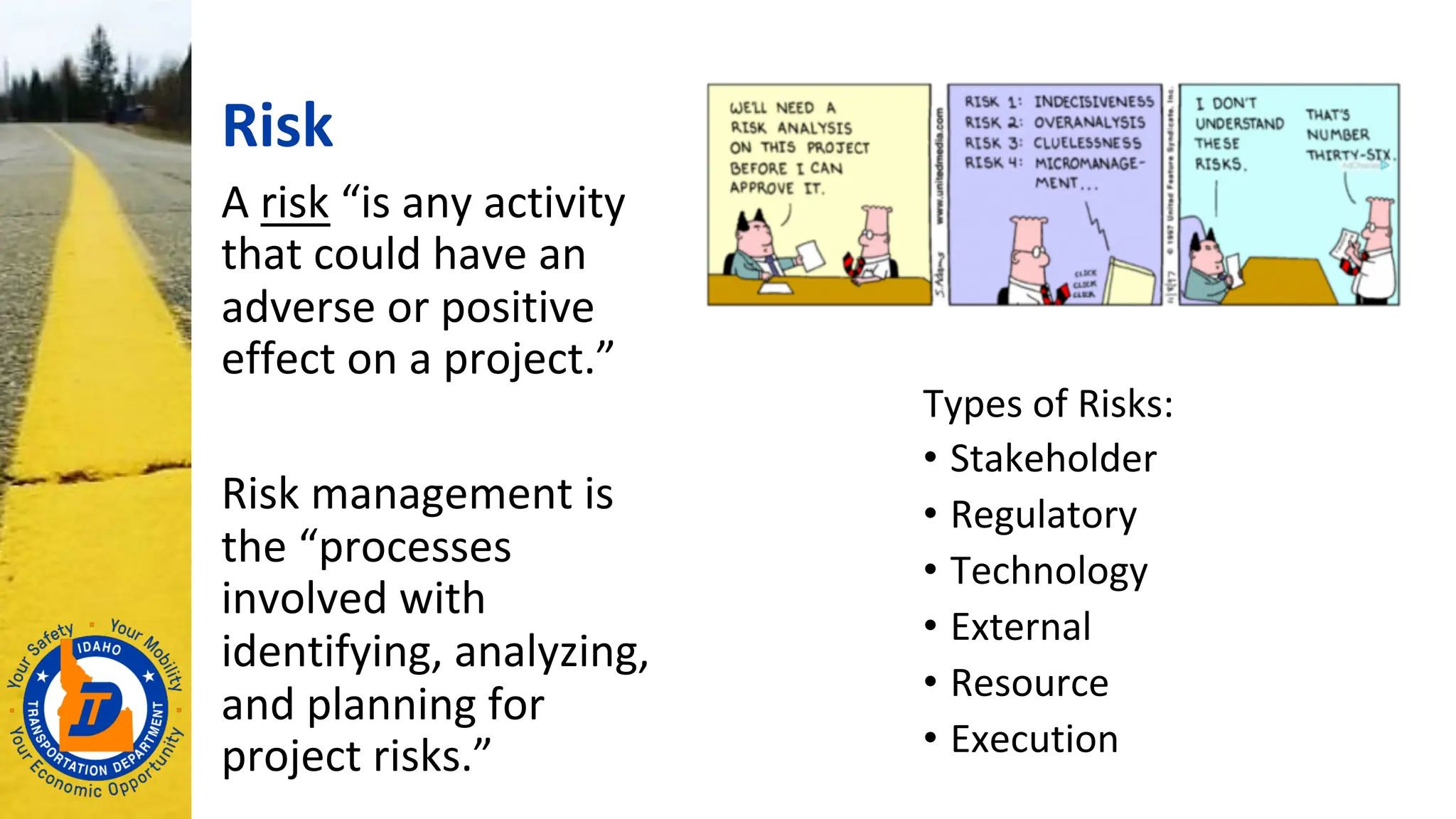
Risk
A risk “is any activity
that could have an
adverse or positive
effect on a project.”
Risk management is
the “processes
involved with
identifying, analyzing,
and planning for
project risks.”
Types of Risks:
• Stakeholder
• Regulatory
• Technology
• External
• Resource
• Execution
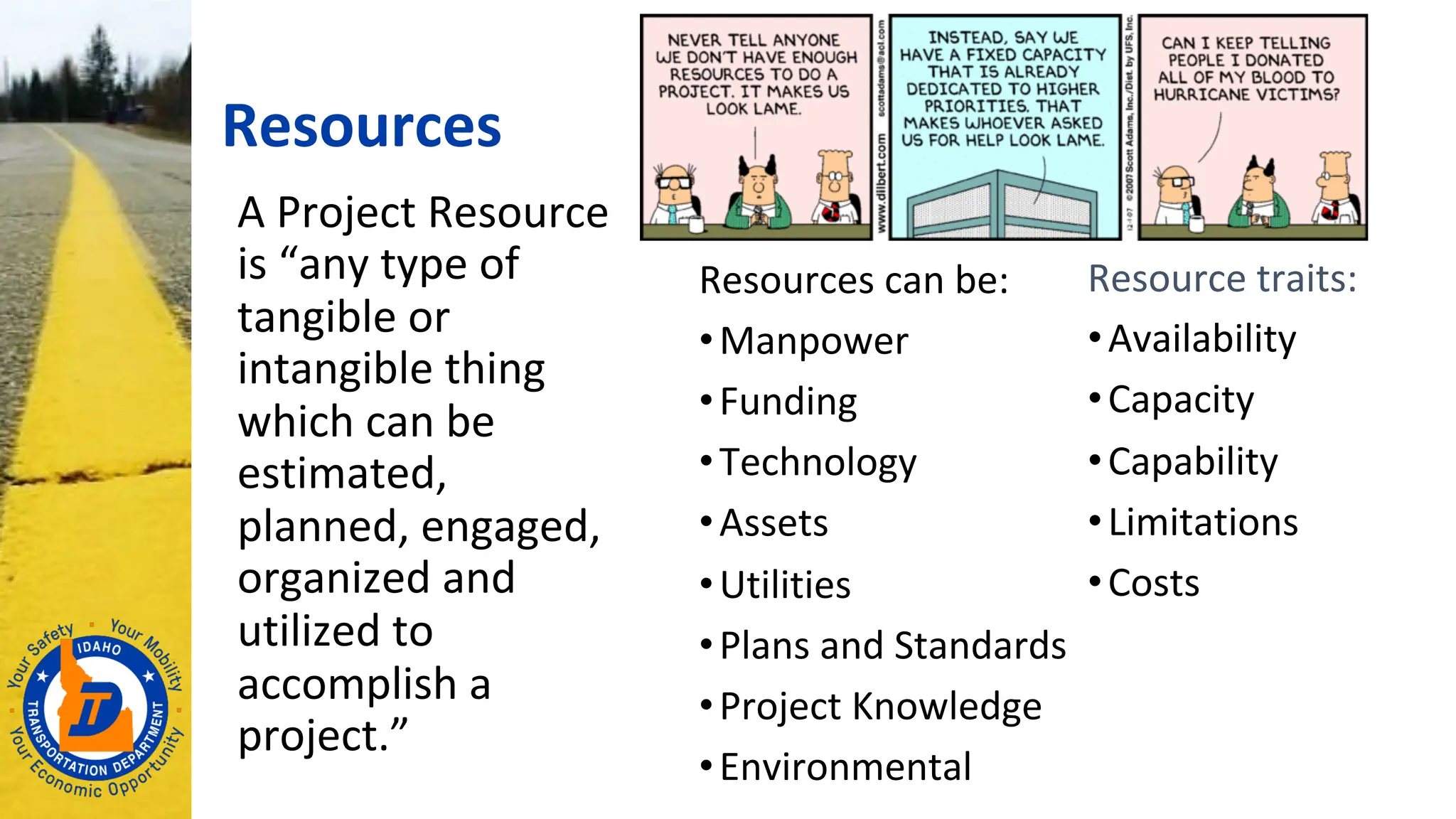
Resources
A Project Resource
is “any type of
tangible or
intangible thing
which can be
estimated,
planned, engaged,
organized and
utilized to
accomplish a
project.”
Resources can be:
•Manpower
•Funding
•Technology
•Assets
•Utilities
•Plans and Standards
•Project Knowledge
•Environmental
Resource traits:
•Availability
•Capacity
•Capability
•Limitations
•Costs
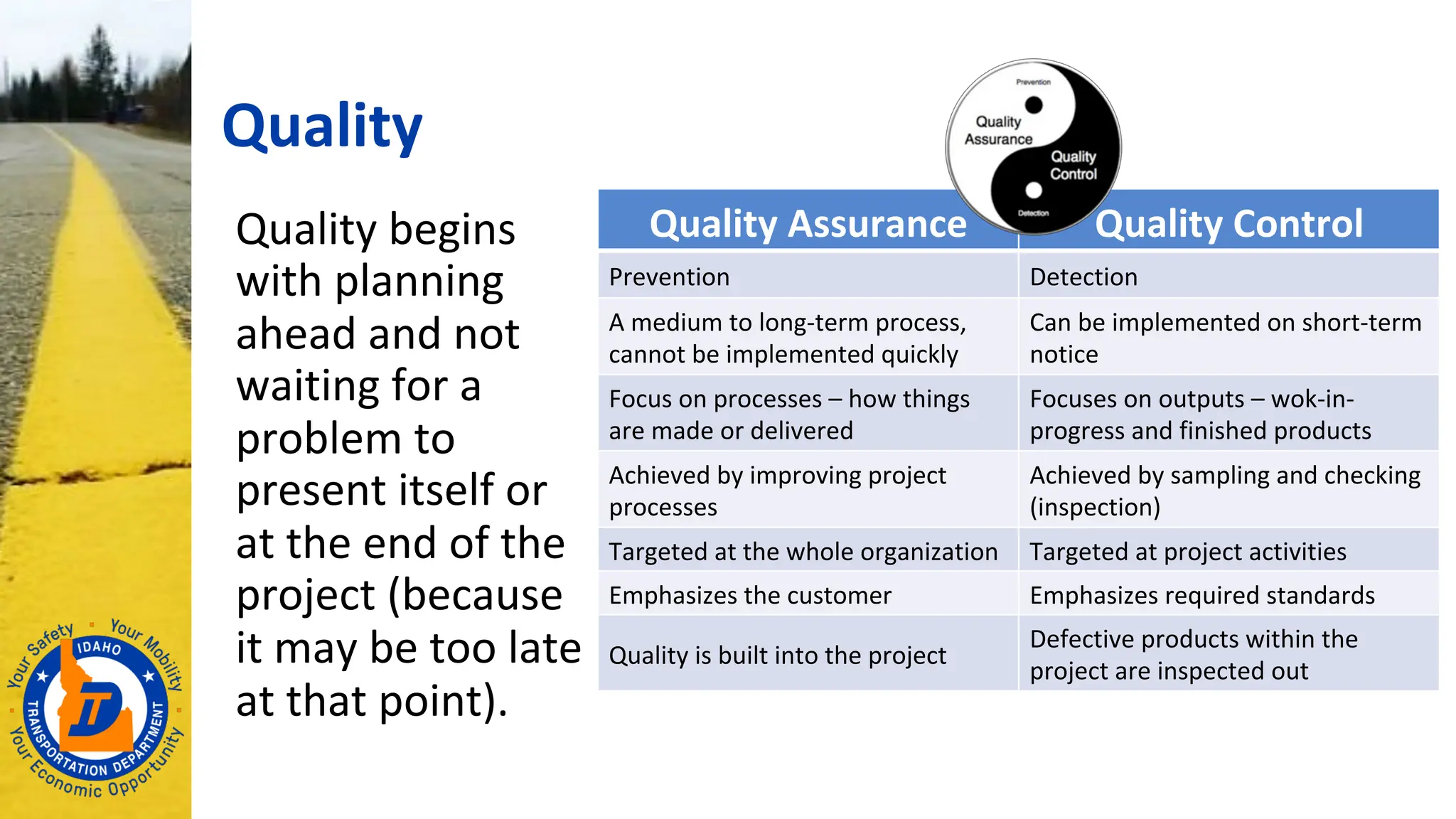
Quality
Quality begins
with planning
ahead and not
waiting for a
problem to
present itself or
at the end of the
project (because
it may be too late
at that point).
Quality Assurance Quality Control
Prevention Detection
A medium to long-term process,
cannot be implemented quickly
Can be implemented on short-term
notice
Focus on processes – how things
are made or delivered
Focuses on outputs – wok-in-
progress and finished products
Achieved by improving project
processes
Achieved by sampling and checking
(inspection)
Targeted at the whole organization Targeted at project activities
Emphasizes the customer Emphasizes required standards
Quality is built into the project
Defective products within the
project are inspected out
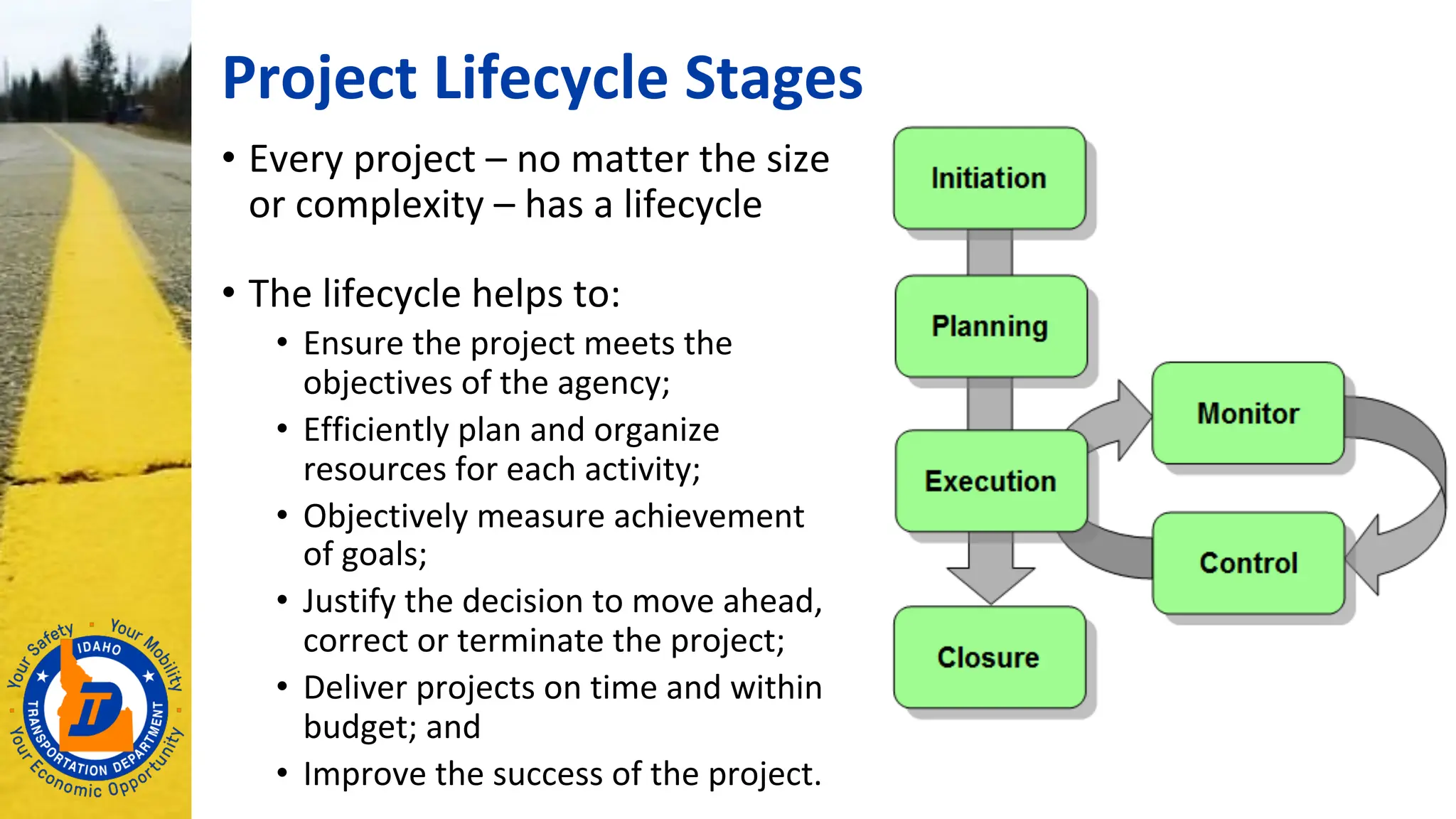
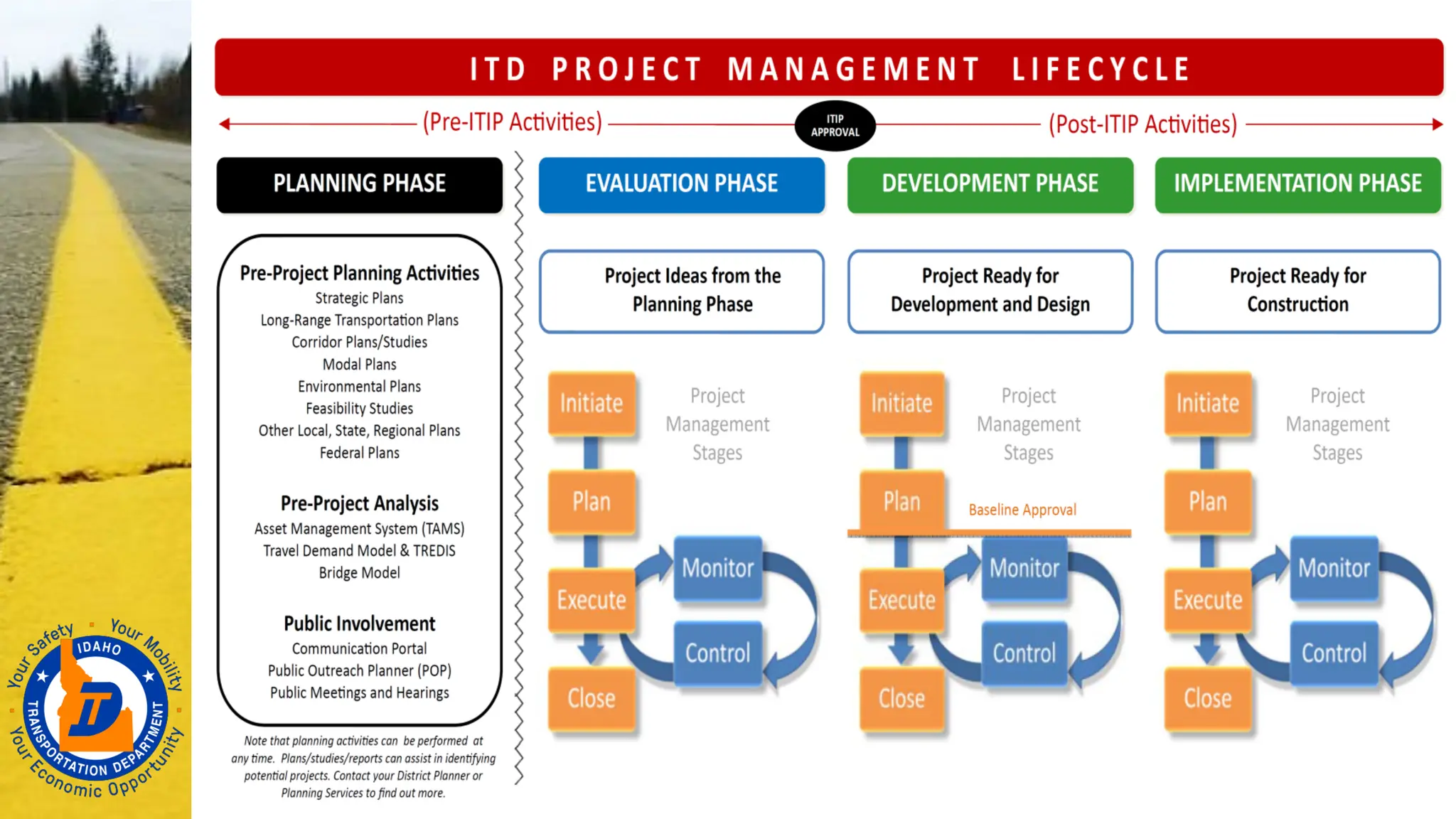
Project Lifecycle Stages
• Every project – no matter the size
or complexity – has a lifecycle
• The lifecycle helps to:
• Ensure the project meets the
objectives of the agency;
• Efficiently plan and organize
resources for each activity;
• Objectively measure achievement
of goals;
• Justify the decision to move ahead,
correct or terminate the project;
• Deliver projects on time and within
budget; and
• Improve the success of the project.
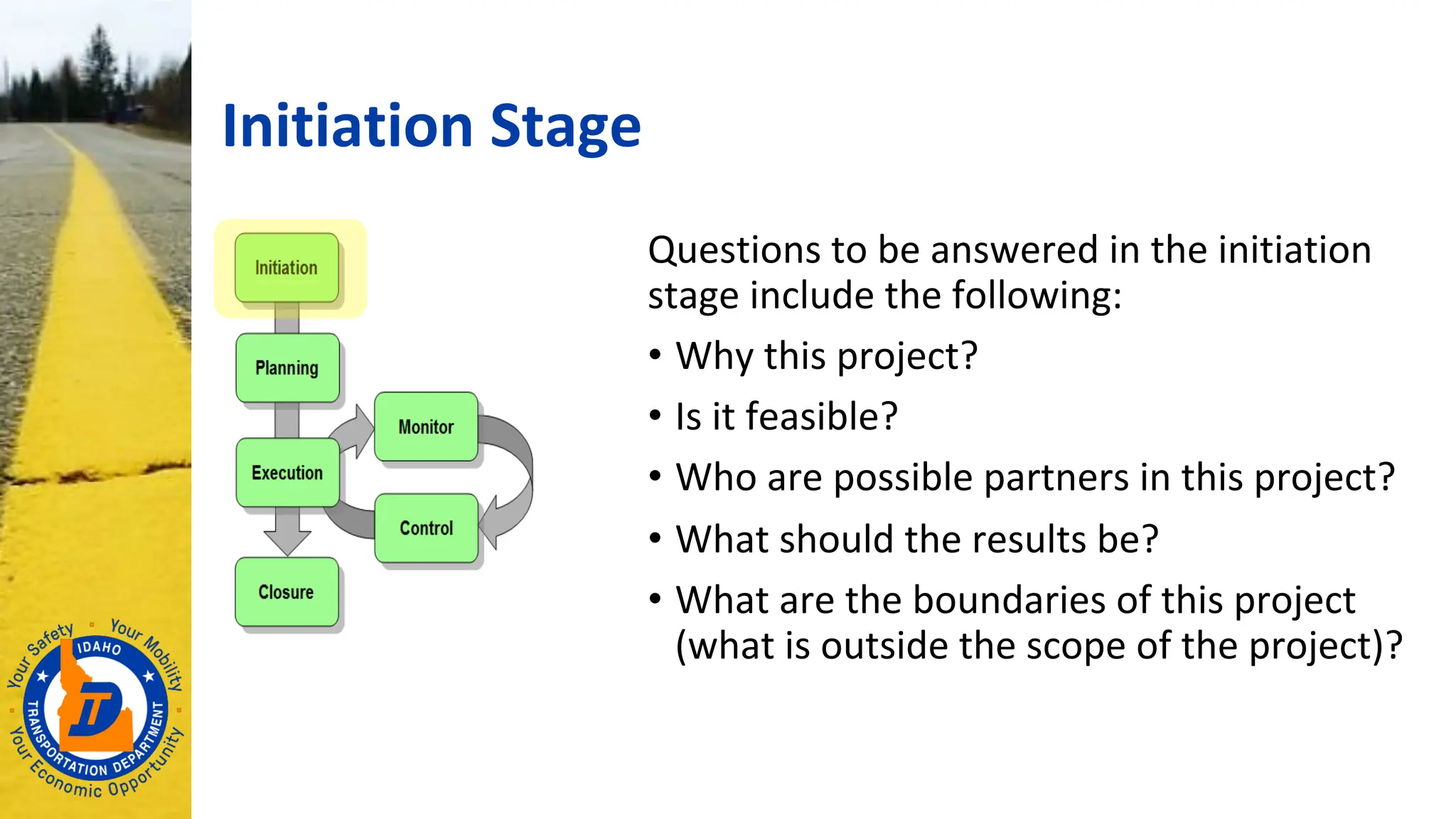
Initiation Stage
Questions to be answered in the initiation
stage include the following:
• Why this project?
• Is it feasible?
• Who are possible partners in this project?
• What should the results be?
• What are the boundaries of this project
(what is outside the scope of the project)?
Planning Stage
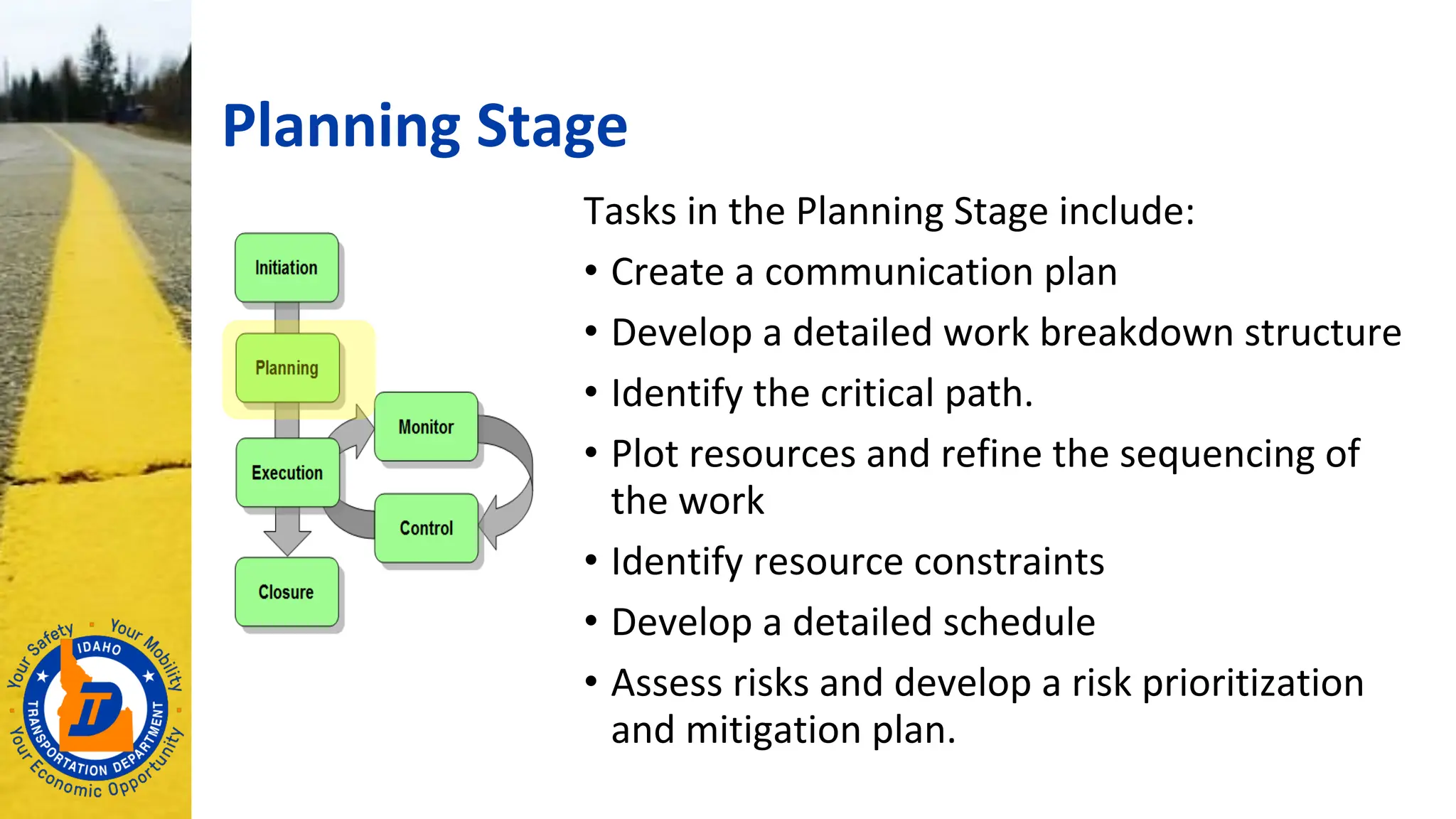
Tasks in the Planning Stage include:
• Create a communication plan
• Develop a detailed work breakdown structure
• Identify the critical path.
• Plot resources and refine the sequencing of
the work
• Identify resource constraints
• Develop a detailed schedule
• Assess risks and develop a risk prioritization
and mitigation plan.
Execution Stage
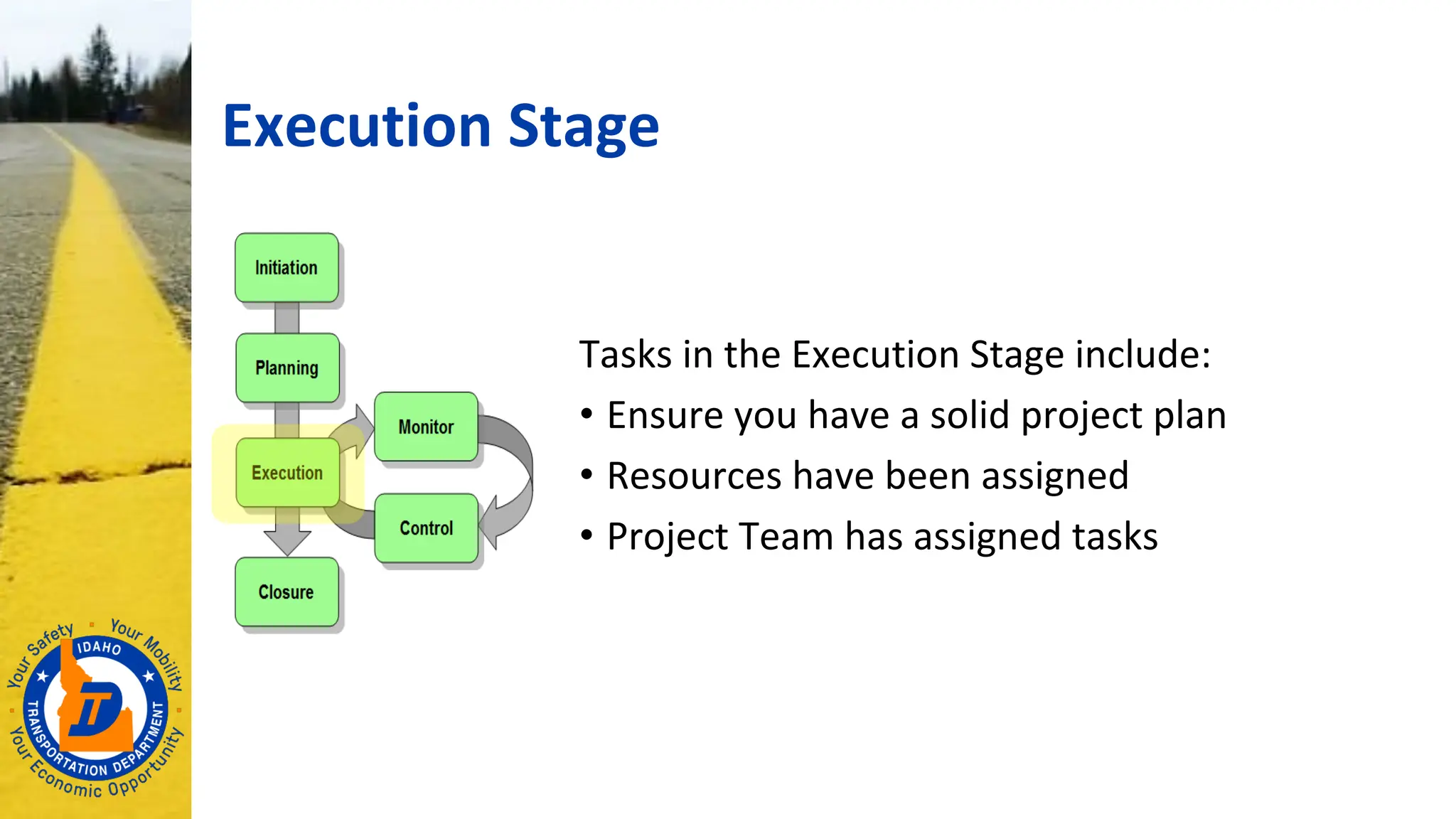
Tasks in the Execution Stage include:
• Ensure you have a solid project plan
• Resources have been assigned
• Project Team has assigned tasks
Monitor and Control Stages
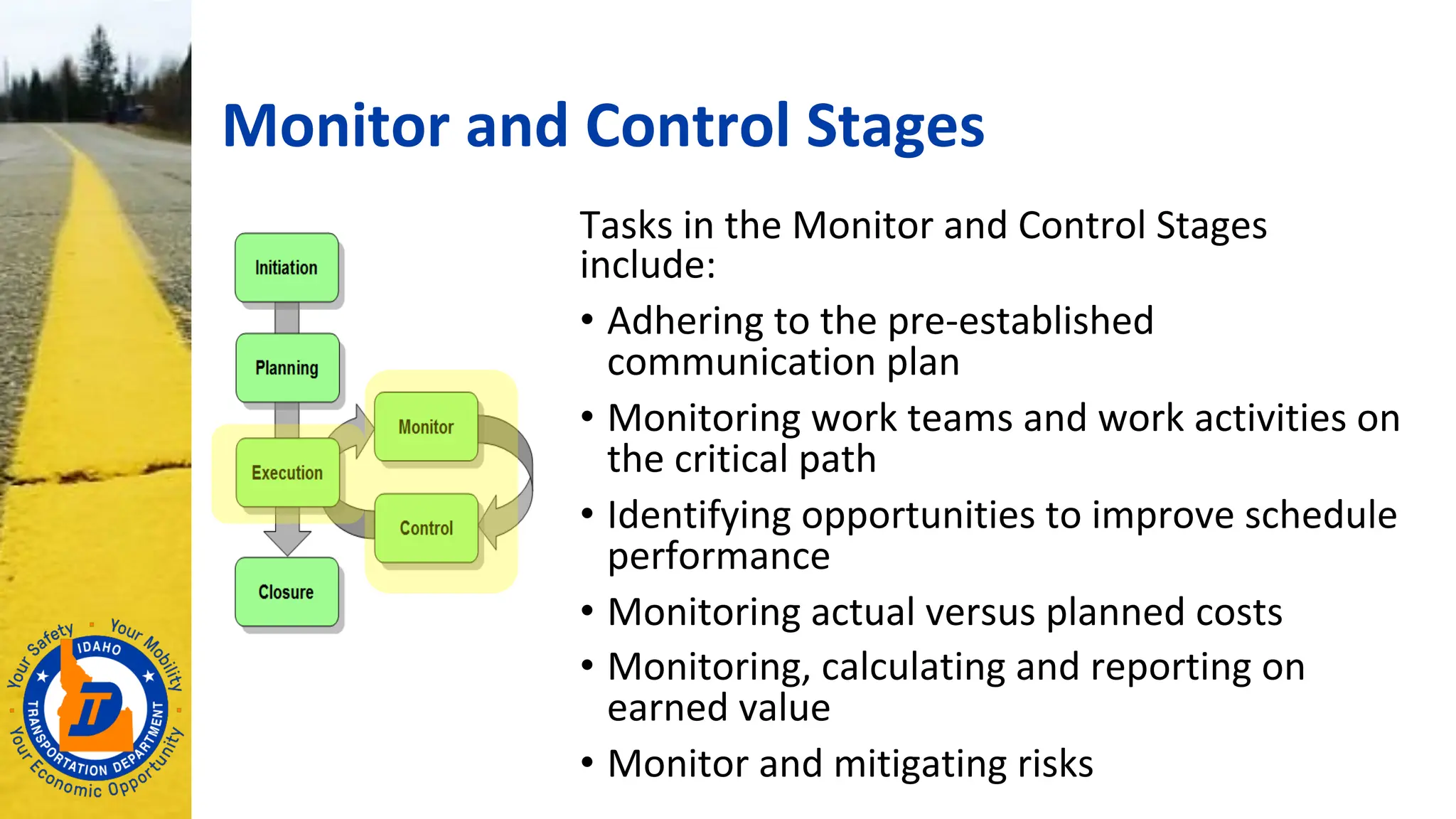
Tasks in the Monitor and Control Stages
include:
• Adhering to the pre-established
communication plan
• Monitoring work teams and work activities on
the critical path
• Identifying opportunities to improve schedule
performance
• Monitoring actual versus planned costs
• Monitoring, calculating and reporting on
earned value
• Monitor and mitigating risks
Closure Stage
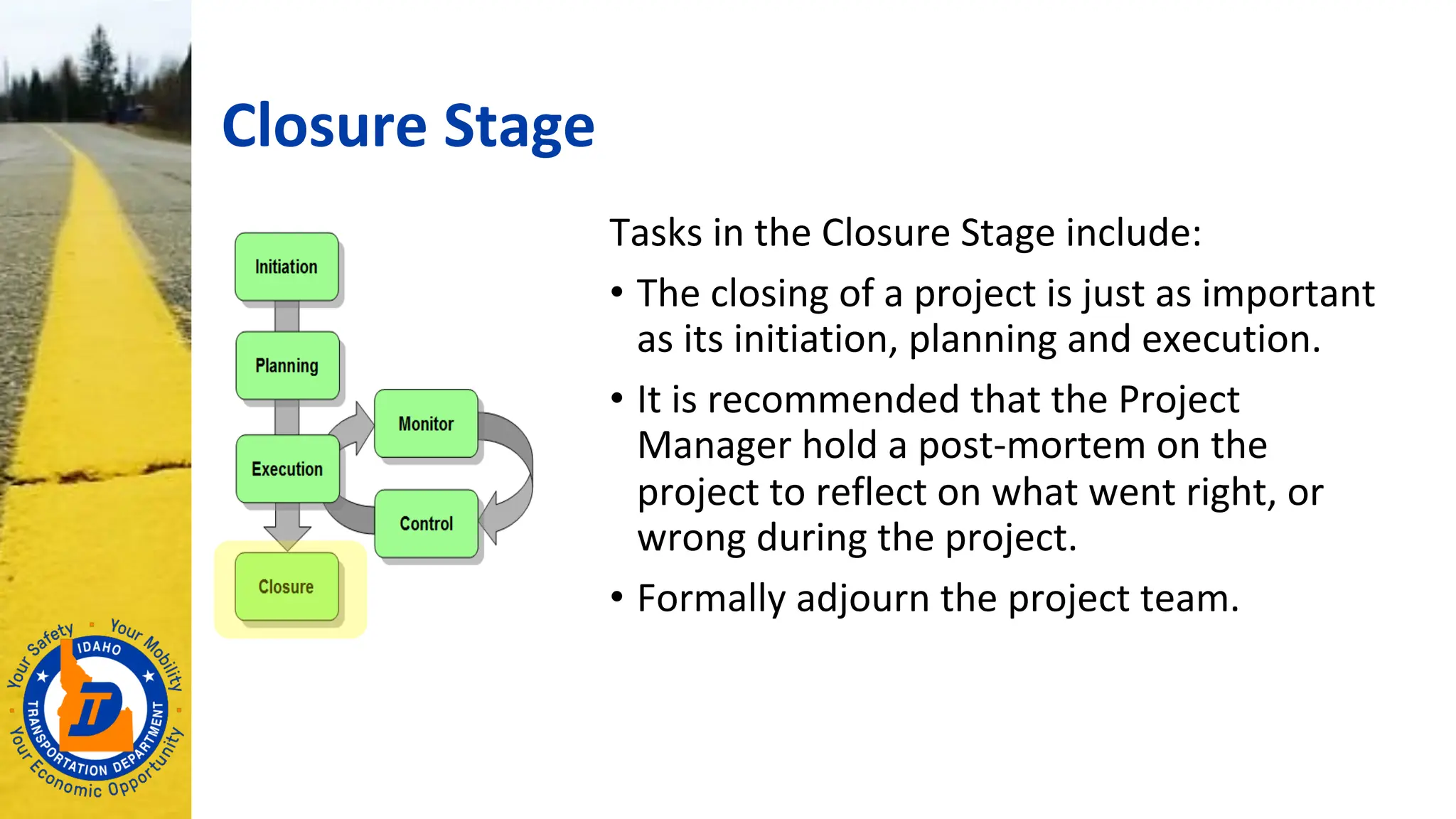
Tasks in the Closure Stage include:
• The closing of a project is just as important
as its initiation, planning and execution.
• It is recommended that the Project
Manager hold a post-mortem on the
project to reflect on what went right, or
wrong during the project.
• Formally adjourn the project team.
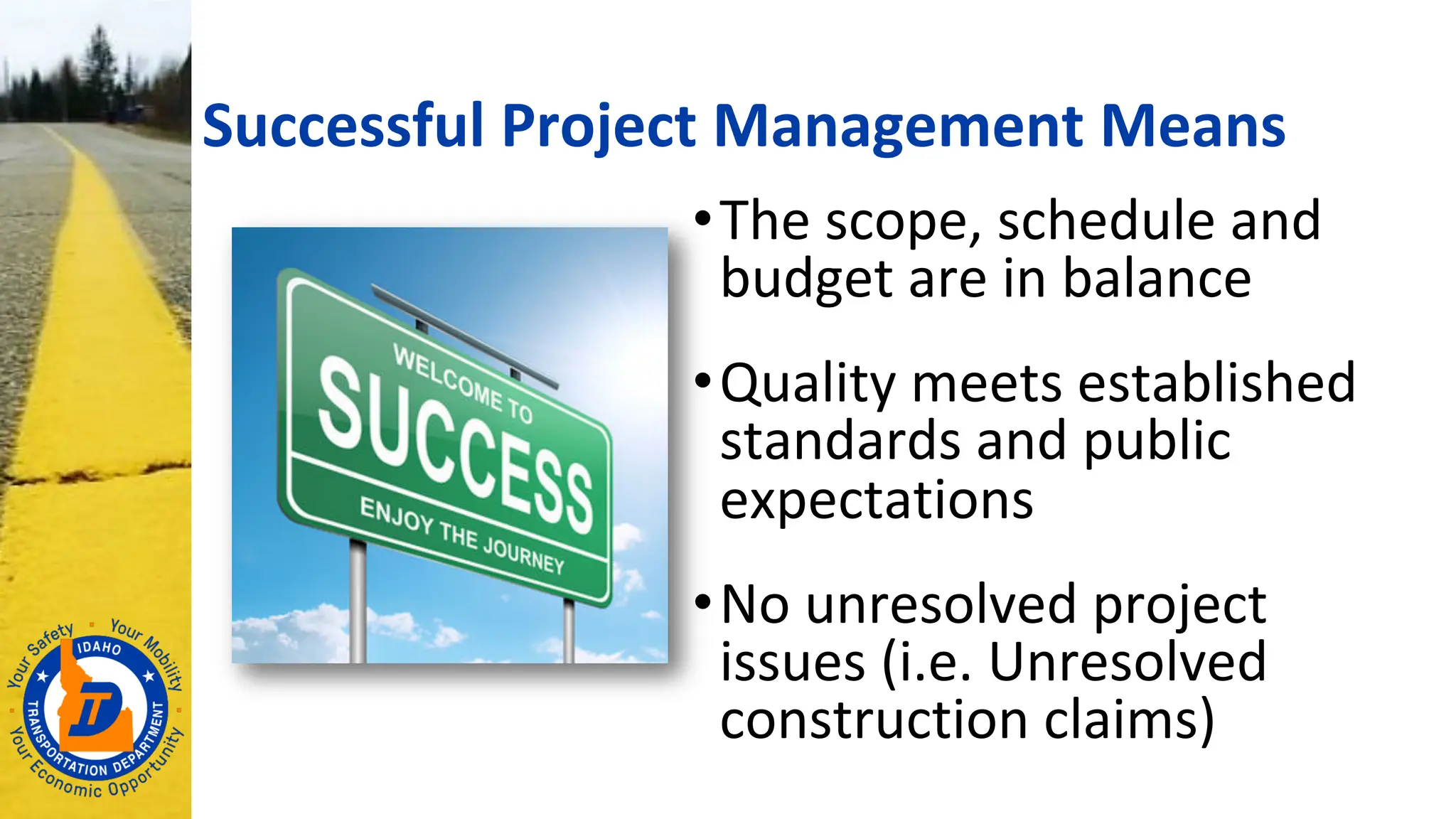
Successful Project Management Means
•The scope, schedule and
budget are in balance
•Quality meets established
standards and public
expectations
•No unresolved project
issues (i.e. Unresolved
construction claims)
Now What?
• Hire a Project Manager
• Train current staff to be Project
Managers
• Incorporate Project Management
tools and philosophies into the
organization
• Don’t quit! It will take time…
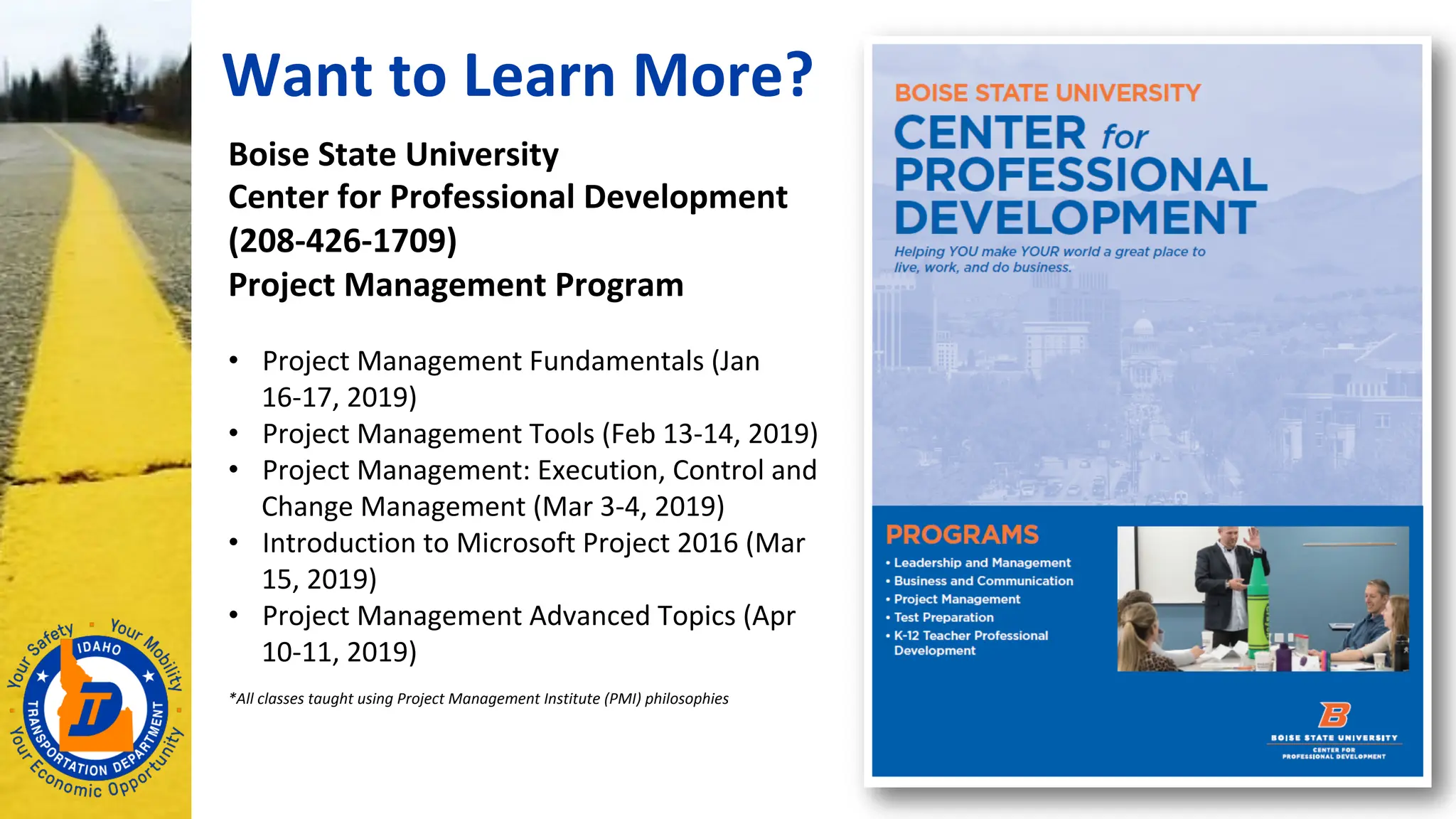
Want to Learn More?
Boise State University
Center for Professional Development
(208-426-1709)
Project Management Program
• Project Management Fundamentals (Jan
16-17, 2019)
• Project Management Tools (Feb 13-14, 2019)
• Project Management: Execution, Control and
Change Management (Mar 3-4, 2019)
• Introduction to Microsoft Project 2016 (Mar
15, 2019)
• Project Management Advanced Topics (Apr
10-11, 2019)
*All classes taught using Project Management Institute (PMI) philosophies

Introduction-to-Project-Management systems

  • 1.
    INTRODUCTION TO PROJECT MANAGEMENT SonnaLynn Fernandez Transportation Planning Project Manager
  • 2.
    Project Management helpsto answer… What are you trying to achieve? How will you know if we’ve succeeded? What resources are available to you? How should you plan and organize ourselves? Having good project management skills does not mean you have no problems. It does not mean that risks go away. It does not mean that there are no surprises. The value of good project management is that you have standard processes in place to deal with all contingencies.
  • 3.
    Fundamental Project Mistakes Don’tunderstand the requirements Lack of resources, skills and knowledge Proper management control Starting a project without a plan Poor communication Failing to learn from the past
  • 4.
    Project Management Can Reduce schedule overruns Decreaserisks to the project Diminish scope creep Increase rewards Minimize cost overruns Improve teamwork and communication
  • 5.
    PIMBOK (pim-bŏk) This bookis an internationally recognized manual that sets forth standard terminology and guidelines for project management
  • 6.
    Project management is theapplication of time tested processes, methods, knowledge, skills and experience to achieve the project’s objective. Fundamental Concepts
  • 7.
    A project isa planned set of interrelated tasks to be executed over a fixed period of time within certain costs and other limitations. Fundamental Concepts
  • 8.
    Process/Operations • Routine processthat focuses on a series of activities in a variety of locations and is event driven • Stable team that repeats the process indefinitely • Repeated work • Annual planning applied to continuous process cycles • Budget fixed with no time boundaries Project • Focusses on a desired solution for a specific location • Process ends with the project • Temporary team that lasts for one process cycle • New, original work • Time, costs, and scope constraints per process • Difficult to estimate time and budget
  • 9.
    Project management principles are theconcepts, tools, techniques, plans and forms used by the agency to manage a project Fundamental Concepts
  • 10.
    Project Management Hierarchy Project Program PortfolioITIP Bridge Program Project #1 Project #2 Highway Program Project #3
  • 11.
    Differences between Portfolio,Program and Project Management PORTFOLIO PROGRAM PROJECT WHAT It is the centralized management of one or more programs, using project management principles to control programs and other related work to achieve specific strategic business objectives. It is the process of managing several related projects, often with the intention of improving an organization’s performance. It is the discipline of planning, organizing, securing and managing recourses to achieve the successful completion of specific goals and objectives. SCOPE Contains all of the programs and projects within the department. Contains a group of related projects where doing them together provides some sort of benefit or efficiency. Is an individual project that has a well-defined scope intended to produce something tangible SCHEDULE Schedules may be updated and monitored annually or semi- annually. Schedules may be monitored and updated monthly or more. Individual project schedules are monitored almost weekly. BUDGET Large scale budgeting where funds can be easily moved between programs in order to meet the department’s mission. Programs have set budget limitations that are tied to the specific activity identified. Sometimes federal and state funding can be called out for a specific program. Each project has a budget that is set when it enters the program or portfolio. Budgets are limited and monitored heavily.
  • 12.
    Differences between Portfolio,Program and Project Management PORTFOLIO PROGRAM PROJECT PLANNING High-level planning is used to strategically align the portfolio in the direction of the department. Moderate level planning is used to set the direction of the program, identify potential project strategies as well as align the program in the direction of the department. Lowest level planning is uses to progressively elaborate high and moderate level-planning information into detailed plans throughout the project lifecycle. MONITORING Portfolio Managers monitor aggregate performance and value indicators to determine if the portfolio has an overall good return on investment (ROI). Program Managers monitor the progress of program components to ensure the overall goals, schedules, budgets, and benefits of the program will be met. Project Managers monitor and control the work of producing the products, services or results that the project was undertaken to produce. CHANGE Portfolio Managers continually monitor changes in the broad environment. Program Managers expect change (risks) from both inside and outside the program and are be prepared to manage it. Project Managers expect change (risks) and implement processes to keep change managed and controlled. SUCCESS Success is measure in terms of aggregate portfolio components. Success is measured by the degree to which the program satisfies the needs and benefits for which it was created (i.e. smooth and black). Success is measured by product and project quality, timeliness, budget compliance, and degree of customer satisfaction.
  • 13.
  • 14.
    Pre-Project Scope • ProjectGoals • Project justification • Project description • Deliverables • Time • Location • Control • Stakeholders (Internal/External) Well-defined pre-project scope planning can help with reducing scope creep, keep the budget in line and ensuring the final product is delivered on-time
  • 15.
    Scope The scope isthe work that must be performed to deliver a product, service or result with the specified features and functions.
  • 16.
    Project Charter • Projectgoal • Documents the reasons for undertaking the project in clear, concise language • Project participants • Identifies what people need to be involved in the project and clearly states their roles • Stakeholders • Identifies other people who will be directly affected by the project and need to know about the project's progress • Requirements • Identifies what resources are required for the project's objectives to be achieved • Constraints • Documents potential roadblocks or bottlenecks • Milestones • Identifies start date and completion dates as well as dates for other important checkpoints • Communication • Specifies how the project manager will communicate with project owners, participants and stakeholders through the project • Deliverables • Documents what specific products, processes or services the project will provide upon completion.
  • 17.
    Progressive Elaboration “The term‘progressive elaboration’ simply means that you do not know all of the characteristics about a product when you begin the project. Instead, they may be revisited often and refined.” Very Little Project Detail Project Name Project/Public Description Project Objective Statement Project Scope of Work Project Considerations Project Standards & Constraints Project Schedule Project Funding & Costs A Lot of Project Detail Levels of Project Detail
  • 18.
    Did You Know? Ina national NCHRP study 50% of regular transportation projects were not delivered on time or on budget Common Pitfalls How to Avoid these Pitfalls Difficulty getting right-of-way Early and consistent communication with property owners Utility conflicts or underground conditions Developing an understanding of utility organization’s processes and procedures Environmental and political issues Anticipate environmental and political issues in advance Design problems including lack of accountability and inadequate protocols Fully manage the project in all phases from pre-project planning thru construction
  • 19.
    Schedule The schedule isthe actual time required to produce a deliverable
  • 20.
    Schedule • Time inproject management is analyzed to the smallest detail • Microsoft Project and the Work Breakdown Structure (WBS)
  • 21.
    Budget The Budget isthe estimation of the amount of money that will be required to complete the project
  • 22.
    Costs • Cost itselfencompasses various things, such as: • Resources (people and things) • Labor rates for contractors • Risk estimates • Bills of materials • Project Cost Management Cost Estimating Cost Budgeting Cost Control Developing an estimate of costs of the resources needed to complete the project Allocating overall cost estimate to individual work items AKA “Cost Baseline” Controlling change to project budget while maintaining project scope and timeline
  • 23.
  • 24.
    Risk A risk “isany activity that could have an adverse or positive effect on a project.” Risk management is the “processes involved with identifying, analyzing, and planning for project risks.” Types of Risks: • Stakeholder • Regulatory • Technology • External • Resource • Execution
  • 25.
    Resources A Project Resource is“any type of tangible or intangible thing which can be estimated, planned, engaged, organized and utilized to accomplish a project.” Resources can be: •Manpower •Funding •Technology •Assets •Utilities •Plans and Standards •Project Knowledge •Environmental Resource traits: •Availability •Capacity •Capability •Limitations •Costs
  • 26.
    Quality Quality begins with planning aheadand not waiting for a problem to present itself or at the end of the project (because it may be too late at that point). Quality Assurance Quality Control Prevention Detection A medium to long-term process, cannot be implemented quickly Can be implemented on short-term notice Focus on processes – how things are made or delivered Focuses on outputs – wok-in- progress and finished products Achieved by improving project processes Achieved by sampling and checking (inspection) Targeted at the whole organization Targeted at project activities Emphasizes the customer Emphasizes required standards Quality is built into the project Defective products within the project are inspected out
  • 27.
    Project Lifecycle Stages •Every project – no matter the size or complexity – has a lifecycle • The lifecycle helps to: • Ensure the project meets the objectives of the agency; • Efficiently plan and organize resources for each activity; • Objectively measure achievement of goals; • Justify the decision to move ahead, correct or terminate the project; • Deliver projects on time and within budget; and • Improve the success of the project.
  • 28.
    Initiation Stage Questions tobe answered in the initiation stage include the following: • Why this project? • Is it feasible? • Who are possible partners in this project? • What should the results be? • What are the boundaries of this project (what is outside the scope of the project)?
  • 29.
    Planning Stage Tasks inthe Planning Stage include: • Create a communication plan • Develop a detailed work breakdown structure • Identify the critical path. • Plot resources and refine the sequencing of the work • Identify resource constraints • Develop a detailed schedule • Assess risks and develop a risk prioritization and mitigation plan.
  • 30.
    Execution Stage Tasks inthe Execution Stage include: • Ensure you have a solid project plan • Resources have been assigned • Project Team has assigned tasks
  • 31.
    Monitor and ControlStages Tasks in the Monitor and Control Stages include: • Adhering to the pre-established communication plan • Monitoring work teams and work activities on the critical path • Identifying opportunities to improve schedule performance • Monitoring actual versus planned costs • Monitoring, calculating and reporting on earned value • Monitor and mitigating risks
  • 32.
    Closure Stage Tasks inthe Closure Stage include: • The closing of a project is just as important as its initiation, planning and execution. • It is recommended that the Project Manager hold a post-mortem on the project to reflect on what went right, or wrong during the project. • Formally adjourn the project team.
  • 34.
    Successful Project ManagementMeans •The scope, schedule and budget are in balance •Quality meets established standards and public expectations •No unresolved project issues (i.e. Unresolved construction claims)
  • 35.
    Now What? • Hirea Project Manager • Train current staff to be Project Managers • Incorporate Project Management tools and philosophies into the organization • Don’t quit! It will take time…
  • 36.
    Want to LearnMore? Boise State University Center for Professional Development (208-426-1709) Project Management Program • Project Management Fundamentals (Jan 16-17, 2019) • Project Management Tools (Feb 13-14, 2019) • Project Management: Execution, Control and Change Management (Mar 3-4, 2019) • Introduction to Microsoft Project 2016 (Mar 15, 2019) • Project Management Advanced Topics (Apr 10-11, 2019) *All classes taught using Project Management Institute (PMI) philosophies