Project Management 101

     A Project Management Primer
Introduction and Purpose
   To educate and inform about project management
    disciplines, processes, and procedures.
   To define how PTI views projects.
   To help improve overall project delivery and
    efficiency.
What You Will Learn
   Basic Project Management Concepts.
       The Project Management Triad Constraints
       PDCA
       DMIAC – Quality
       CMMI
   The 5 Process Groups.
   The 9 Knowledge Areas.
Overview
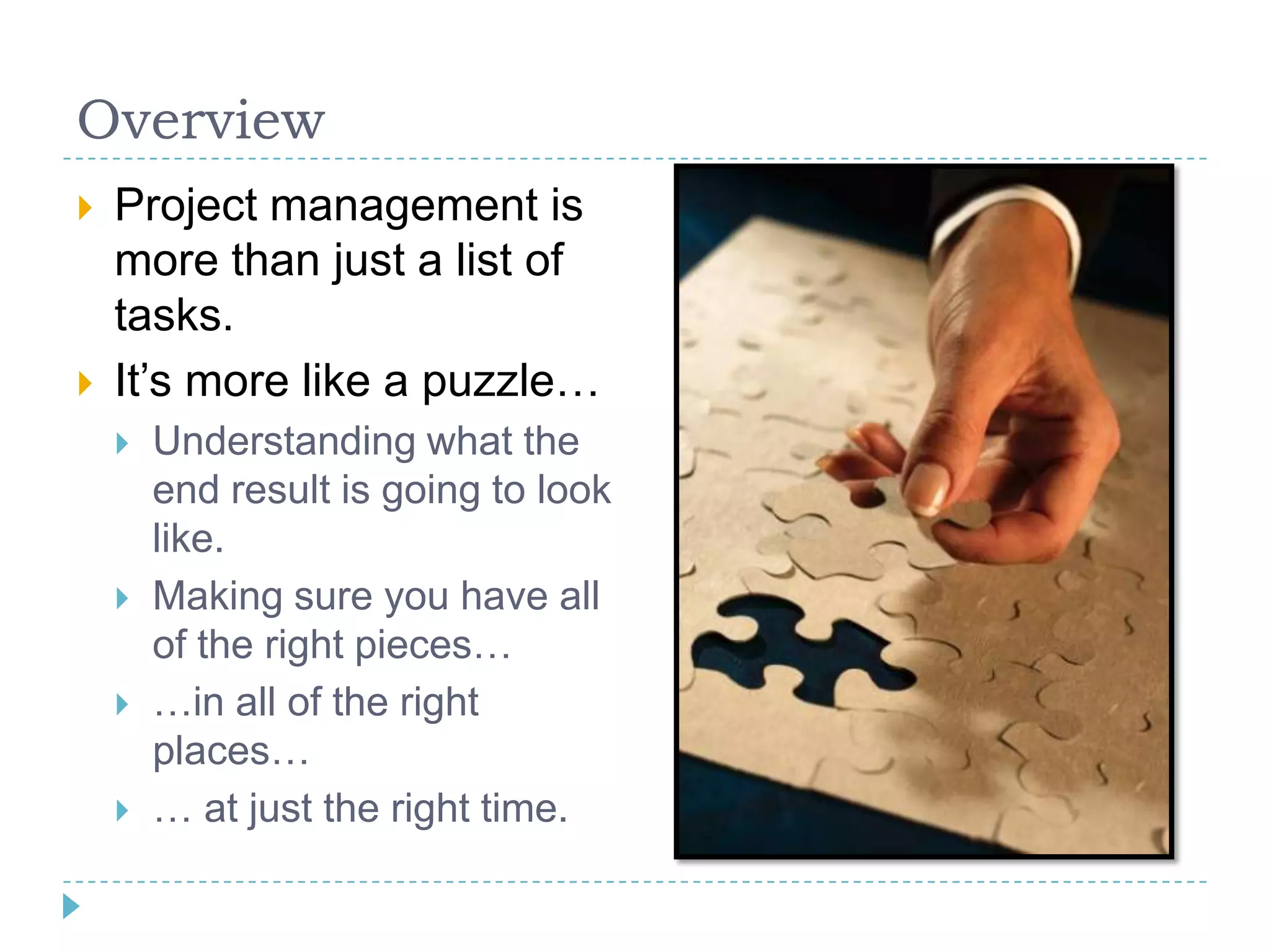
   Project management is
    more than just a list of
    tasks.
   It‟s more like a puzzle…
       Understanding what the
        end result is going to look
        like.
       Making sure you have all
        of the right pieces…
       …in all of the right
        places…
       … at just the right time.
What Is Project Management?
   Project Management is “a temporary endeavor
    undertaken to create a unique project, service, or
    result”.

   Temporary – It has a set start and finish time.
   Unique – It is not part of overall day-to-day
    operations.
   Purposeful – It has a limited and defined scope to
    accomplish a very specific task.
Definitions
   5 Process Groups
       The 5 key areas of the overall project management process.
   9 Knowledge Areas
       The 9 specific areas to be managed within a project.
   Project Management Triad of Constraints
       A model describing the constraints within a project.
   PDCA
       Plan, Do, Check, Act – A process improvement method.
   DMAIC
       Define, Measure, Analyze, Improve, Control – A project quality
        methodology.
   Scope/Project Scope
       The work that must be performed to deliver the product,
        service, or result with specified features and functions.
PDCA
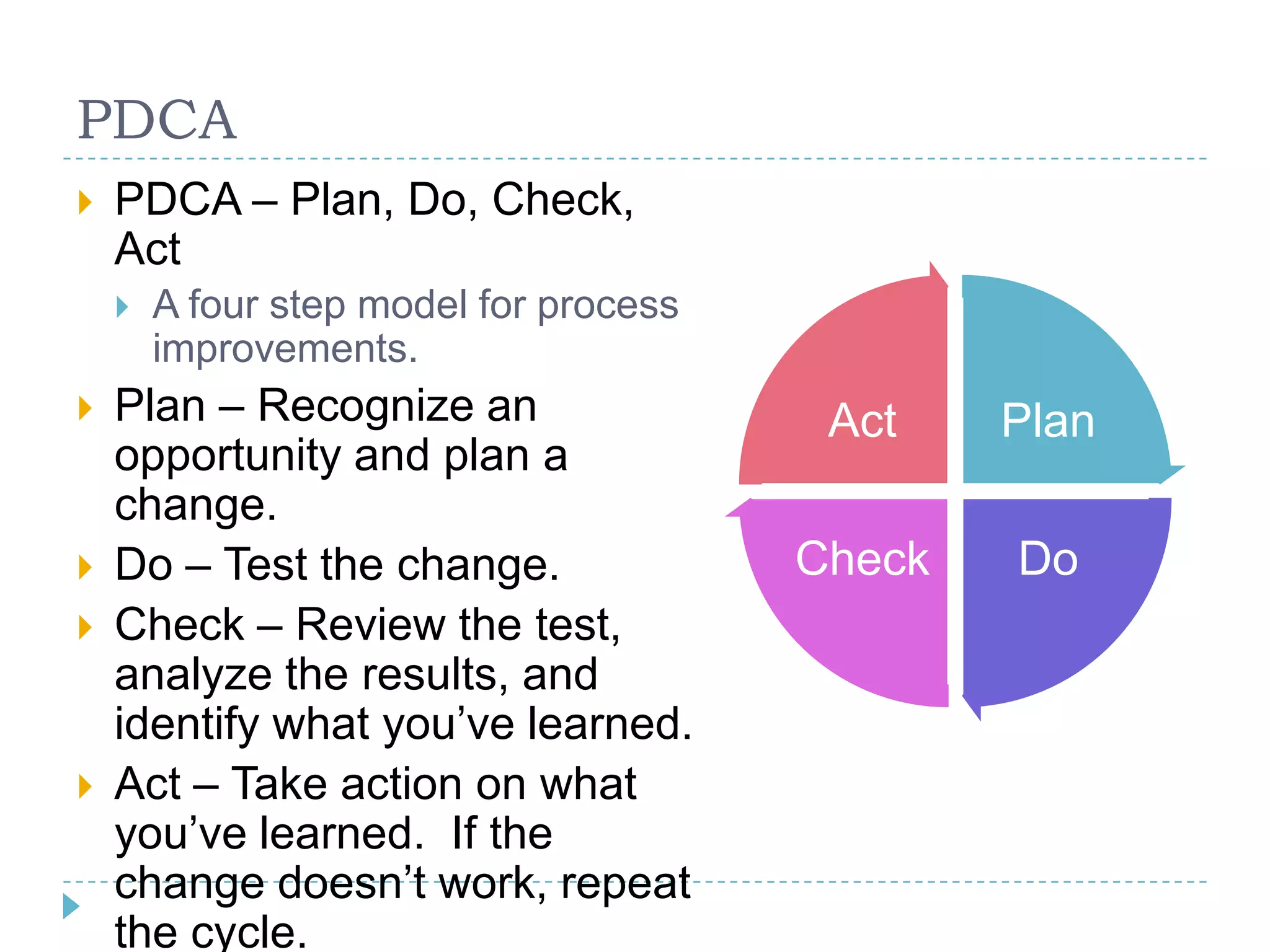
   PDCA – Plan, Do, Check,
    Act
       A four step model for process
        improvements.
   Plan – Recognize an                  Act    Plan
    opportunity and plan a
    change.
   Do – Test the change.               Check   Do
   Check – Review the test,
    analyze the results, and
    identify what you‟ve learned.
   Act – Take action on what
    you‟ve learned. If the
    change doesn‟t work, repeat
    the cycle.
Project Management Triad of Constraints
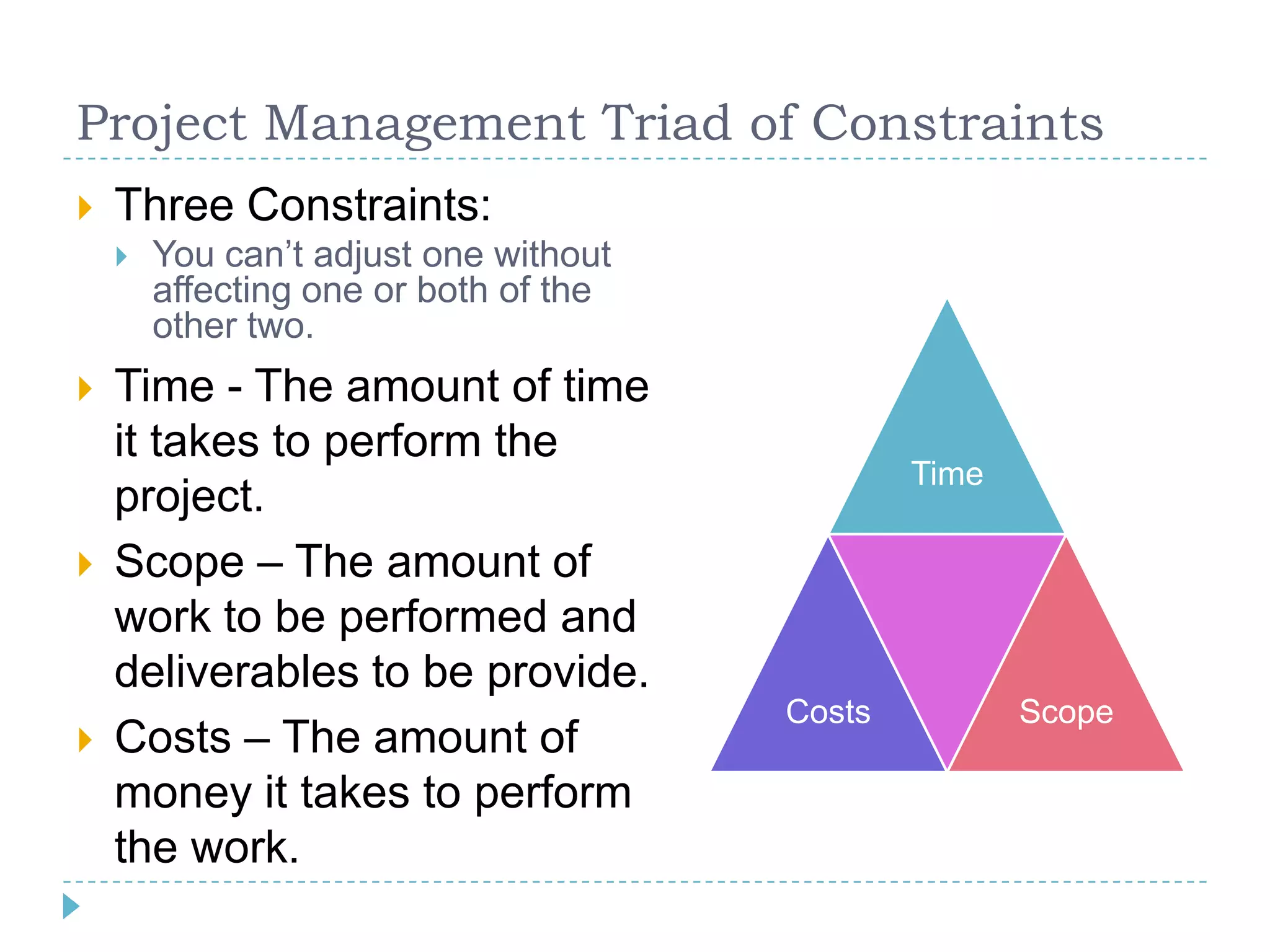
   Three Constraints:
       You can‟t adjust one without
        affecting one or both of the
        other two.
   Time - The amount of time
    it takes to perform the
                                               Time
    project.
   Scope – The amount of
    work to be performed and
    deliverables to be provide.
                                       Costs          Scope
   Costs – The amount of
    money it takes to perform
    the work.
DMAIC
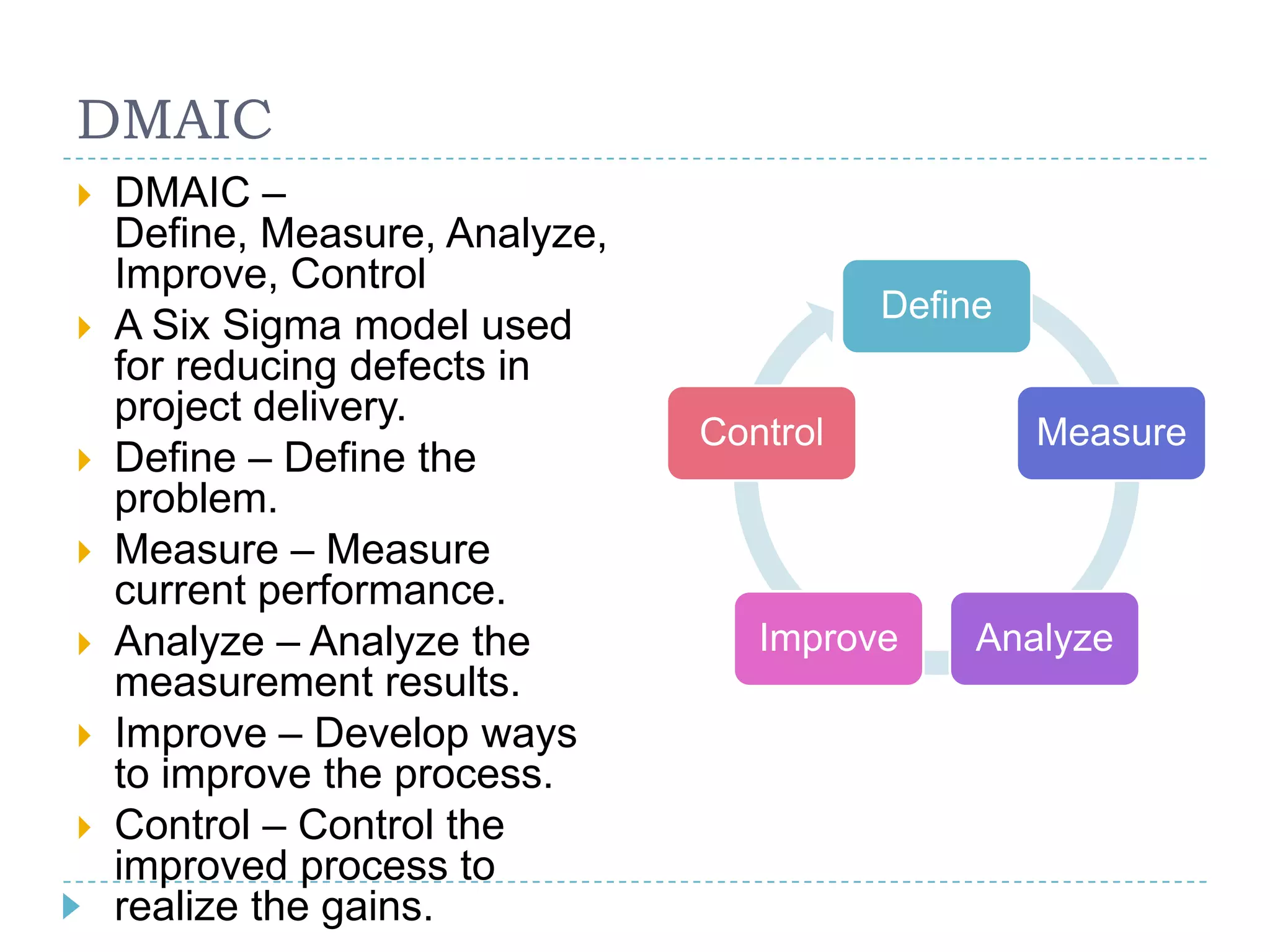
   DMAIC –
    Define, Measure, Analyze,
    Improve, Control
                                          Define
   A Six Sigma model used
    for reducing defects in
    project delivery.
                                Control            Measure
   Define – Define the
    problem.
   Measure – Measure
    current performance.
   Analyze – Analyze the          Improve     Analyze
    measurement results.
   Improve – Develop ways
    to improve the process.
   Control – Control the
    improved process to
    realize the gains.
CMMI
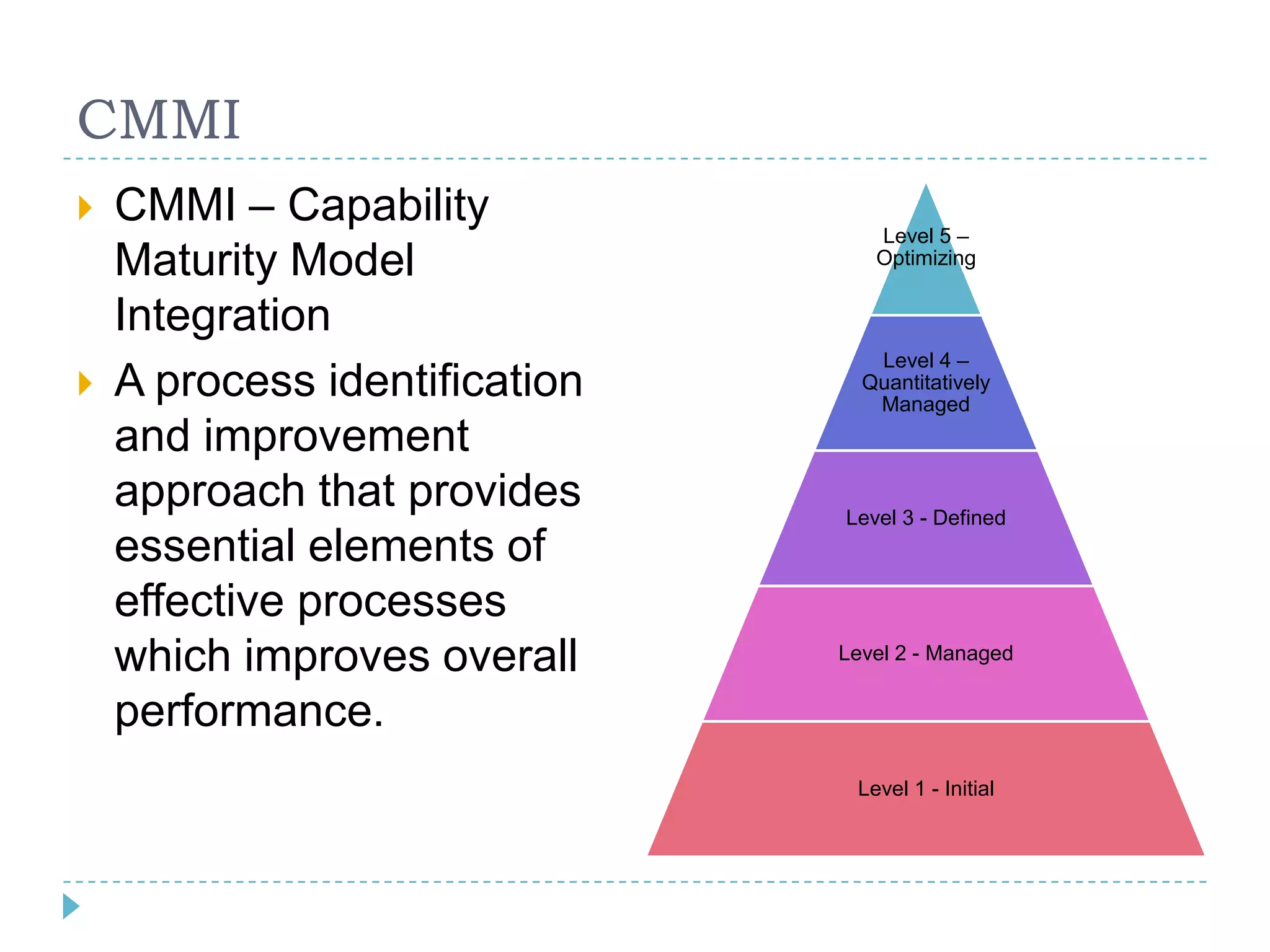
   CMMI – Capability             Level 5 –
    Maturity Model                Optimizing


    Integration
                                  Level 4 –
   A process identification     Quantitatively
                                  Managed
    and improvement
    approach that provides     Level 3 - Defined
    essential elements of
    effective processes
    which improves overall     Level 2 - Managed


    performance.
                                Level 1 - Initial
The 5 Process Groups
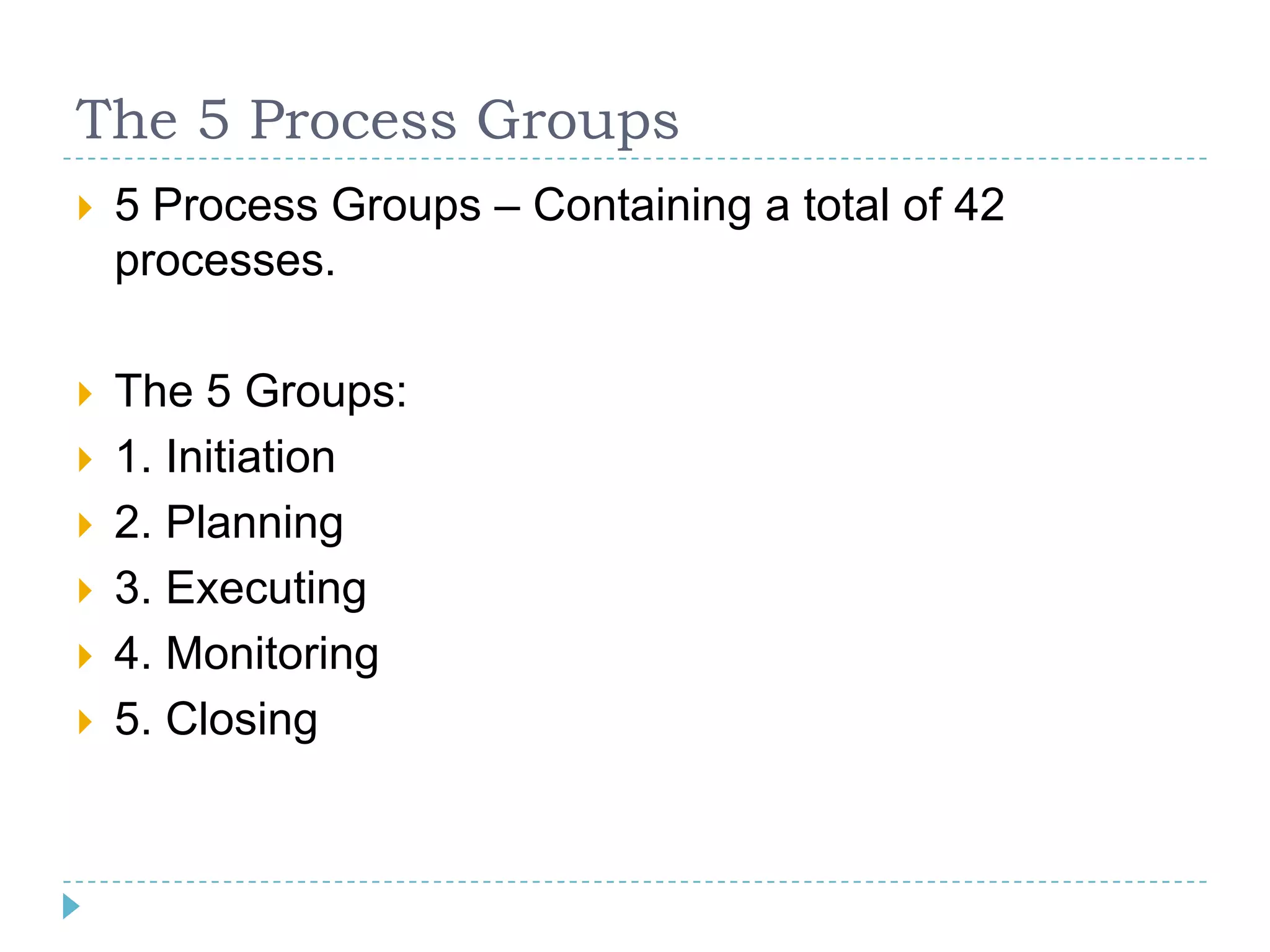
   5 Process Groups – Containing a total of 42
    processes.

   The 5 Groups:
   1. Initiation
   2. Planning
   3. Executing
   4. Monitoring
   5. Closing
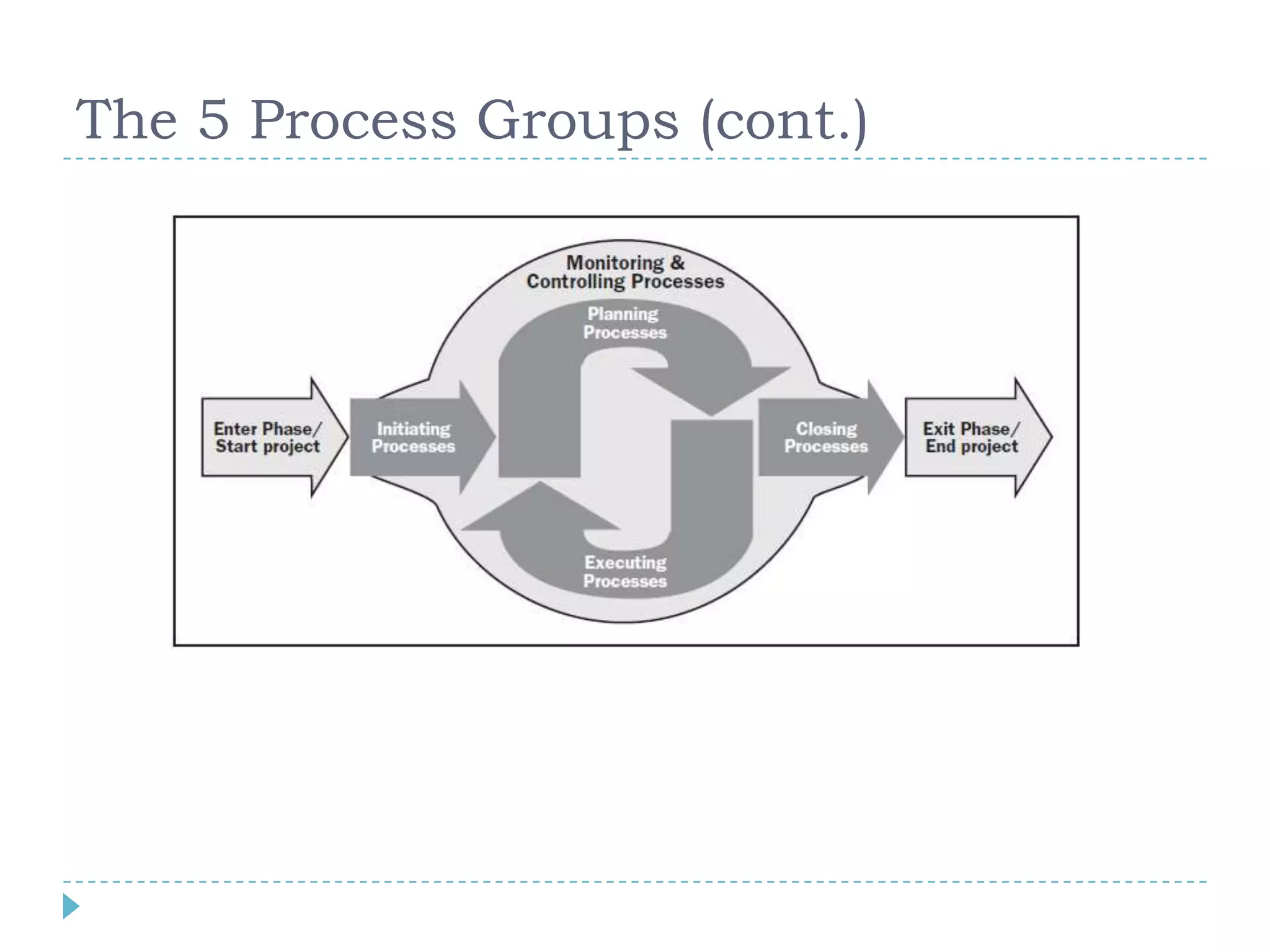
The 5 Process Groups (cont.)
Initiation
   There are two basic tasks in this process group

   Develop the Project Charter
       The Project Charter is the document that initiates the
        project. It‟s the official sign-off from management that the
        project is live.
   Identify the Project Stakeholders
       The Project Stakeholders are internal management
        personnel with budgetary authority and/or the end
        customer.
Planning
   The MOST IMPORTANT Process Group of them
    ALL!
   75% of IT projects fail
   Primary reason: Poor planning
   Planning is the only process group that touches all 9
    knowledge areas. (More on this later…)
Planning (cont.) – Key Aspects
   Overall Project Plan
   Project Scope and Definition
   Project Activities
   Project Cost and Budgets
   Project Quality
   Human Resources Plan
   Project Communications
   Project Risk Management and Mitigation
   Procurement
Execution
   Direction and Management
   Quality Assurance
   Team Acquisition, Development, and Management
   Information Distribution
   Procurement
   Stakeholder Expectations
   Work Package Execution
Monitoring
   Monitoring and Controlling Project Work
   Scope Verification and Control
       Scope Change Control
   Costs Control
   Schedule Control
   Quality Control
   Risk Control
Closing
   Closing is the most often overlooked aspect of a
    project.
   “Just because the „work‟ is done, does not mean the
    project is done.”
   Customer Acceptance
   Post-project/Post-phase Review
   Documentation of Lessons Learned
   Communicate Closure
   Archive Documentation
   Administrative and Contract Closure
The 9 Knowledge Areas
   Key management areas that must be handled.
   Spreads across the 5 process groups.

   Integration Management
   Scope Management
   Time Management
   Cost Management
   Quality Management
   Human Resources Management
   Communications Management
   Risk Management
   Procurement Management
Integration Management
   Integration management is where the different
    aspects of the process groups integrate into one
    another.
   Key areas include:
       Developing the project charter
       Developing the project management plan
       Directing and managing the project execution
       Monitoring and controlling project work and performing
        integrated change controls
Scope Management
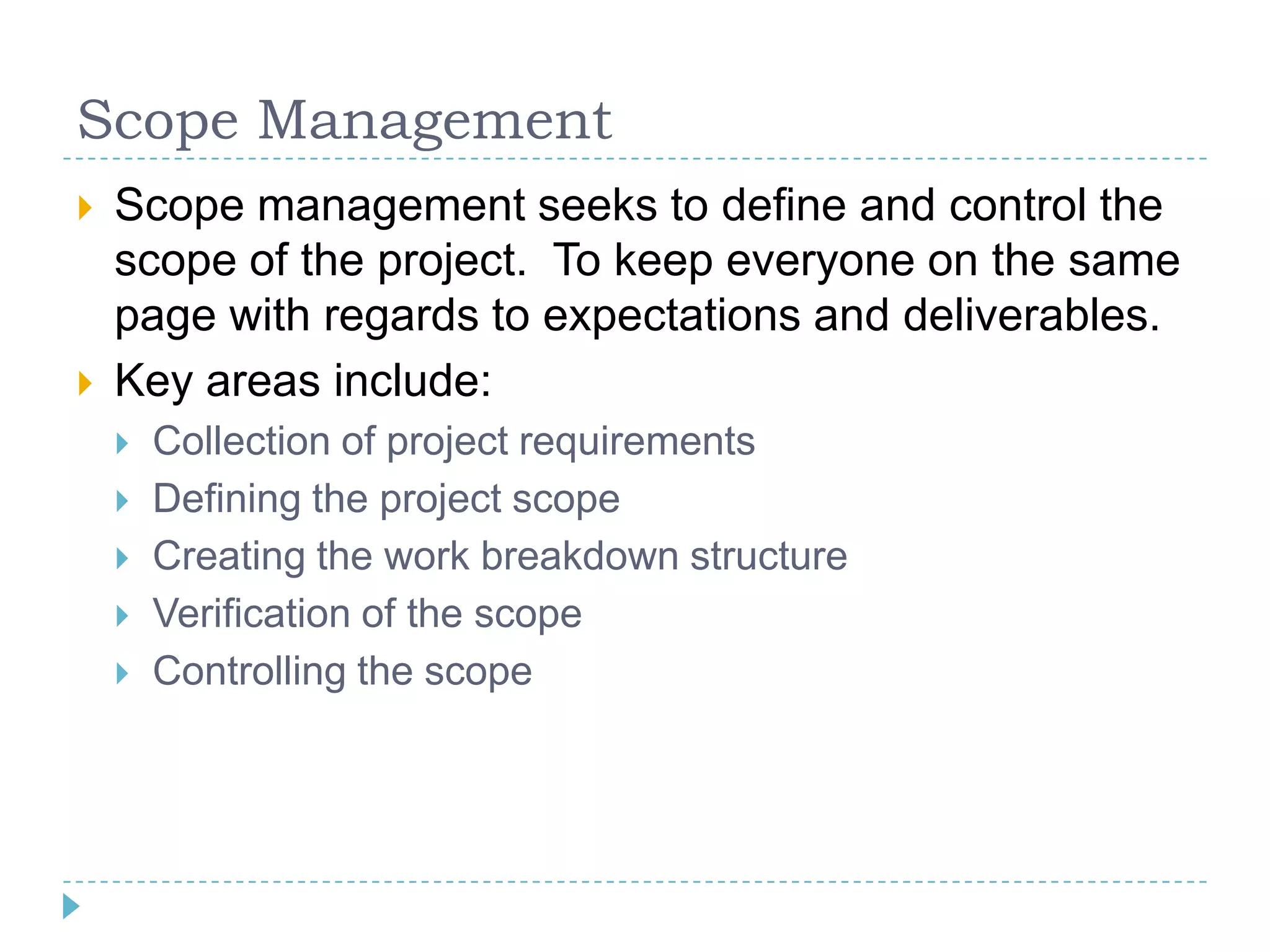
   Scope management seeks to define and control the
    scope of the project. To keep everyone on the same
    page with regards to expectations and deliverables.
   Key areas include:
       Collection of project requirements
       Defining the project scope
       Creating the work breakdown structure
       Verification of the scope
       Controlling the scope
Time Management
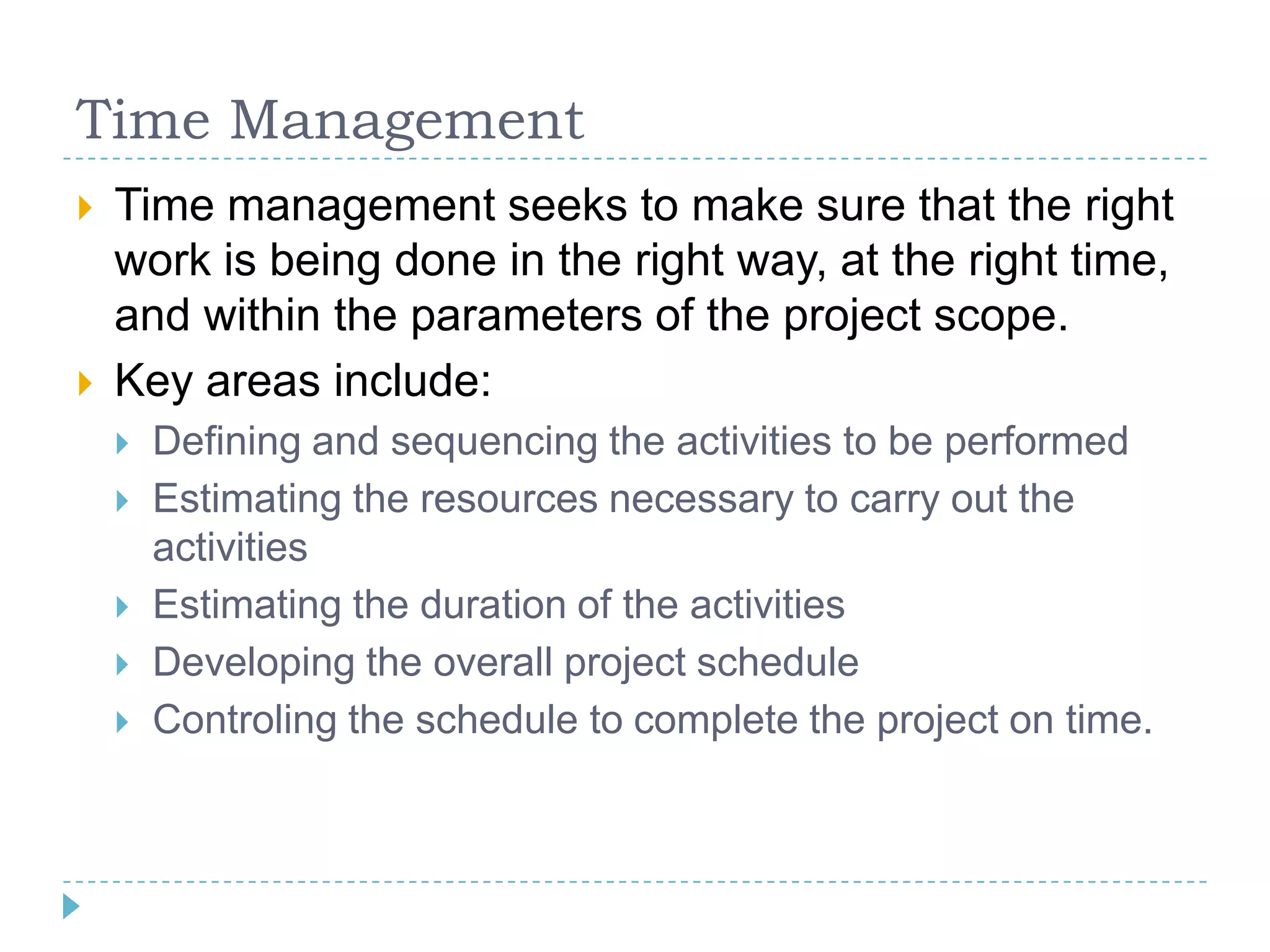
   Time management seeks to make sure that the right
    work is being done in the right way, at the right time,
    and within the parameters of the project scope.
   Key areas include:
       Defining and sequencing the activities to be performed
       Estimating the resources necessary to carry out the
        activities
       Estimating the duration of the activities
       Developing the overall project schedule
       Controling the schedule to complete the project on time.
Cost Management
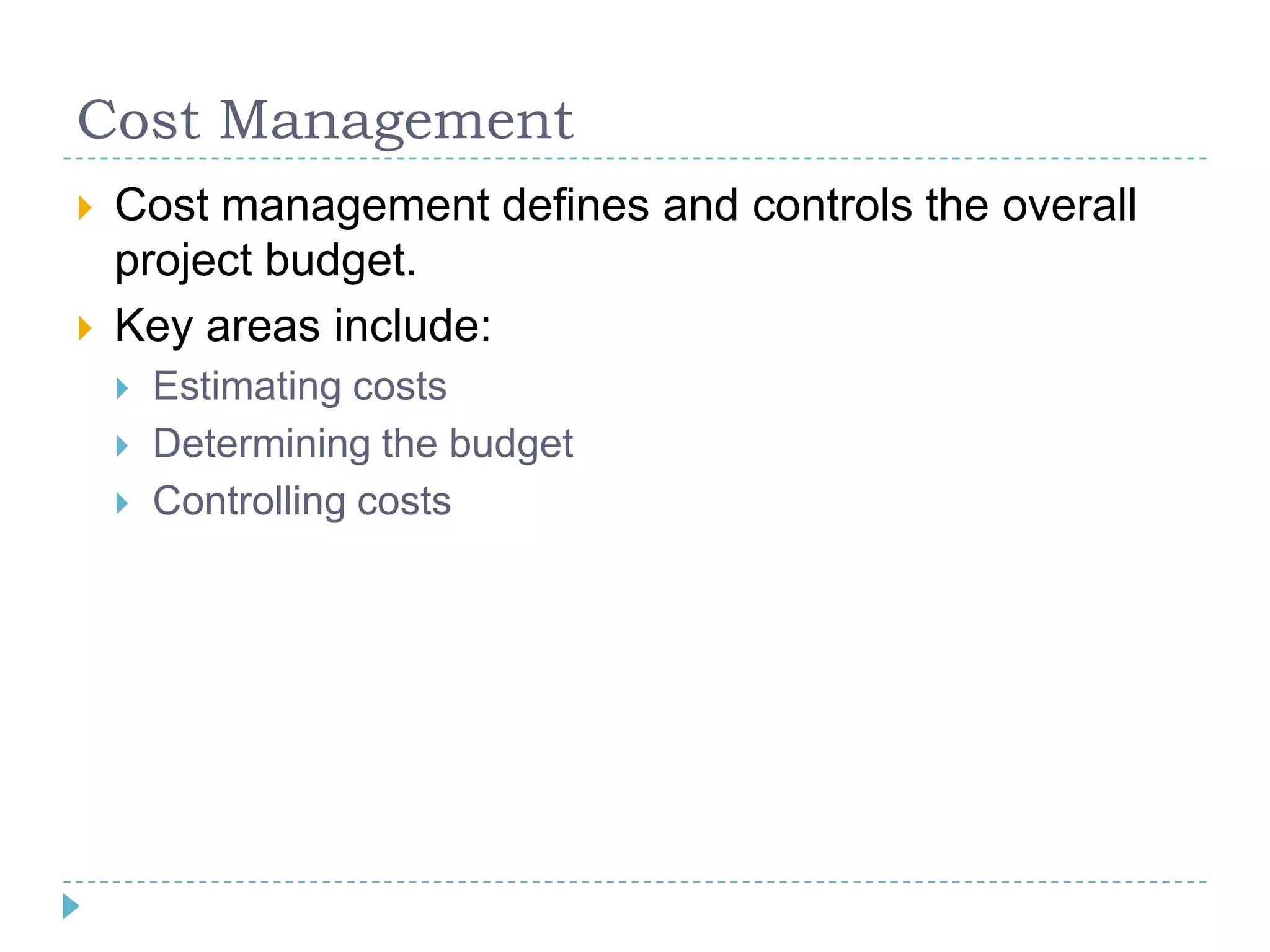
   Cost management defines and controls the overall
    project budget.
   Key areas include:
       Estimating costs
       Determining the budget
       Controlling costs
Quality Management
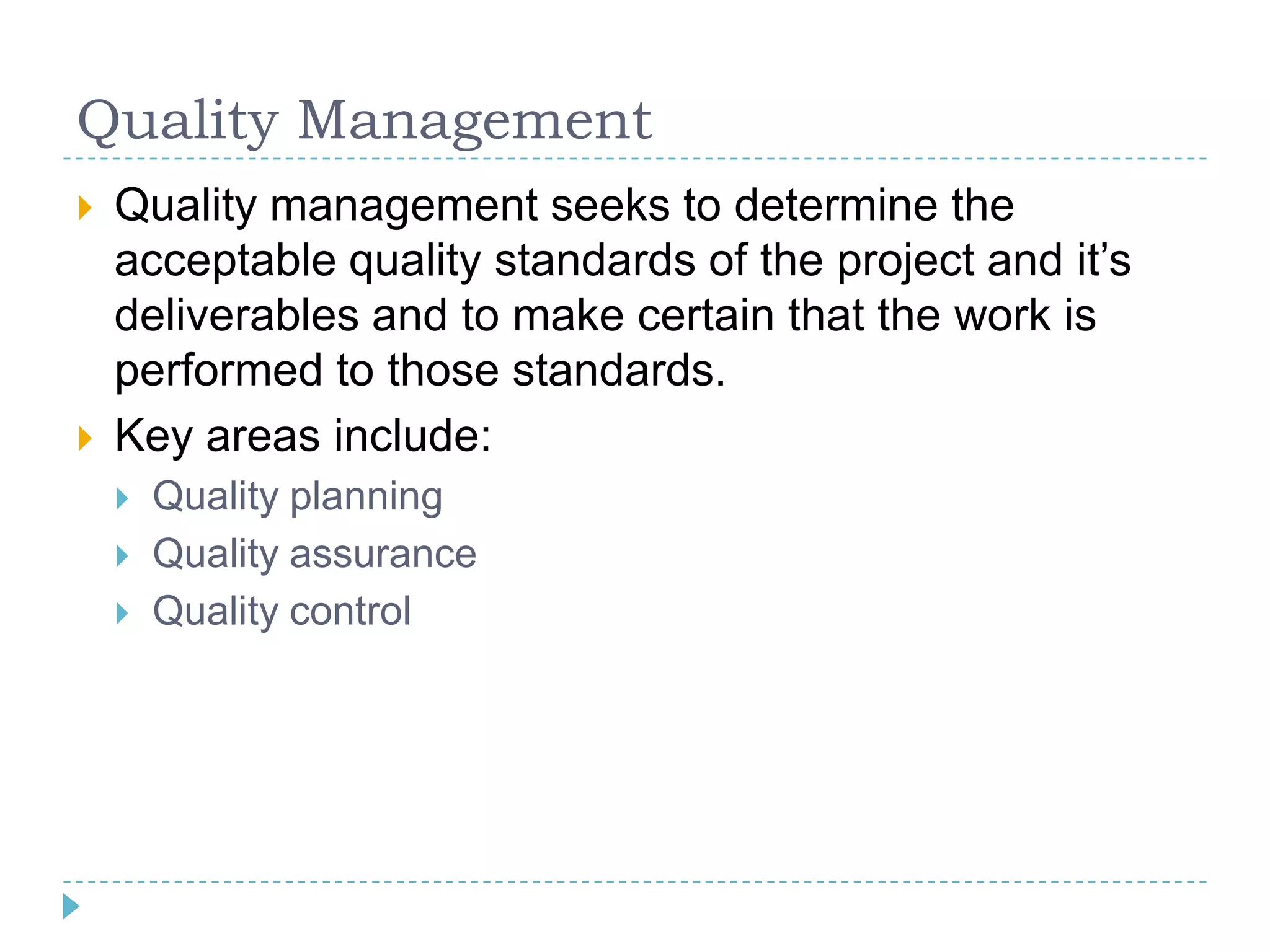
   Quality management seeks to determine the
    acceptable quality standards of the project and it‟s
    deliverables and to make certain that the work is
    performed to those standards.
   Key areas include:
       Quality planning
       Quality assurance
       Quality control
Human Resources Management
   Human resource management seeks to manage all
    aspect of human resources for the project.
   Key areas include:
       Developing the HR plan
       Acquiring the project team
       Developing and training the project team
       Managing the project team
Communications Management
   Communications management seeks to determine
    who information regarding the project is to be
    communicated and to whom.
   Key areas include:
       Stakeholder identification
       Communications plan
       Information distribution
       Stakeholder expectation management
       Project performance reporting
Risk Management
   Risk management seeks to identify, analyze, and
    develop responses for project risks.
   Key areas include:
       Risk management plan
       Risk identification
       Qualitative Risk Analysis
       Quantitative Risk Analysis
       Risk responses
       Risk monitoring and controlling
Procurement Management
   Procurement management seeks to acquire all of the
    necessary materials, services, or results needed
    from third parties to ensure project success.
   Key areas include:
       Procurement planning
       Procurement conduction
       Procurement administration
       Procurement closure
Summary
   Basic Project Management Concepts.
       What a project is.
       The Project Management Triad Constraints
       PDCA/DMIAC – Quality
   The 5 Process Groups.
   The 9 Knowledge Areas.

Project Management 101 Primer

  • 1.
    Project Management 101 A Project Management Primer
  • 2.
    Introduction and Purpose  To educate and inform about project management disciplines, processes, and procedures.  To define how PTI views projects.  To help improve overall project delivery and efficiency.
  • 3.
    What You WillLearn  Basic Project Management Concepts.  The Project Management Triad Constraints  PDCA  DMIAC – Quality  CMMI  The 5 Process Groups.  The 9 Knowledge Areas.
  • 4.
    Overview  Project management is more than just a list of tasks.  It‟s more like a puzzle…  Understanding what the end result is going to look like.  Making sure you have all of the right pieces…  …in all of the right places…  … at just the right time.
  • 5.
    What Is ProjectManagement?  Project Management is “a temporary endeavor undertaken to create a unique project, service, or result”.  Temporary – It has a set start and finish time.  Unique – It is not part of overall day-to-day operations.  Purposeful – It has a limited and defined scope to accomplish a very specific task.
  • 6.
    Definitions  5 Process Groups  The 5 key areas of the overall project management process.  9 Knowledge Areas  The 9 specific areas to be managed within a project.  Project Management Triad of Constraints  A model describing the constraints within a project.  PDCA  Plan, Do, Check, Act – A process improvement method.  DMAIC  Define, Measure, Analyze, Improve, Control – A project quality methodology.  Scope/Project Scope  The work that must be performed to deliver the product, service, or result with specified features and functions.
  • 7.
    PDCA  PDCA – Plan, Do, Check, Act  A four step model for process improvements.  Plan – Recognize an Act Plan opportunity and plan a change.  Do – Test the change. Check Do  Check – Review the test, analyze the results, and identify what you‟ve learned.  Act – Take action on what you‟ve learned. If the change doesn‟t work, repeat the cycle.
  • 8.
    Project Management Triadof Constraints  Three Constraints:  You can‟t adjust one without affecting one or both of the other two.  Time - The amount of time it takes to perform the Time project.  Scope – The amount of work to be performed and deliverables to be provide. Costs Scope  Costs – The amount of money it takes to perform the work.
  • 9.
    DMAIC  DMAIC – Define, Measure, Analyze, Improve, Control Define  A Six Sigma model used for reducing defects in project delivery. Control Measure  Define – Define the problem.  Measure – Measure current performance.  Analyze – Analyze the Improve Analyze measurement results.  Improve – Develop ways to improve the process.  Control – Control the improved process to realize the gains.
  • 10.
    CMMI  CMMI – Capability Level 5 – Maturity Model Optimizing Integration Level 4 –  A process identification Quantitatively Managed and improvement approach that provides Level 3 - Defined essential elements of effective processes which improves overall Level 2 - Managed performance. Level 1 - Initial
  • 11.
    The 5 ProcessGroups  5 Process Groups – Containing a total of 42 processes.  The 5 Groups:  1. Initiation  2. Planning  3. Executing  4. Monitoring  5. Closing
  • 12.
    The 5 ProcessGroups (cont.)
  • 13.
    Initiation  There are two basic tasks in this process group  Develop the Project Charter  The Project Charter is the document that initiates the project. It‟s the official sign-off from management that the project is live.  Identify the Project Stakeholders  The Project Stakeholders are internal management personnel with budgetary authority and/or the end customer.
  • 14.
    Planning  The MOST IMPORTANT Process Group of them ALL!  75% of IT projects fail  Primary reason: Poor planning  Planning is the only process group that touches all 9 knowledge areas. (More on this later…)
  • 15.
    Planning (cont.) –Key Aspects  Overall Project Plan  Project Scope and Definition  Project Activities  Project Cost and Budgets  Project Quality  Human Resources Plan  Project Communications  Project Risk Management and Mitigation  Procurement
  • 16.
    Execution  Direction and Management  Quality Assurance  Team Acquisition, Development, and Management  Information Distribution  Procurement  Stakeholder Expectations  Work Package Execution
  • 17.
    Monitoring  Monitoring and Controlling Project Work  Scope Verification and Control  Scope Change Control  Costs Control  Schedule Control  Quality Control  Risk Control
  • 18.
    Closing  Closing is the most often overlooked aspect of a project.  “Just because the „work‟ is done, does not mean the project is done.”  Customer Acceptance  Post-project/Post-phase Review  Documentation of Lessons Learned  Communicate Closure  Archive Documentation  Administrative and Contract Closure
  • 19.
    The 9 KnowledgeAreas  Key management areas that must be handled.  Spreads across the 5 process groups.  Integration Management  Scope Management  Time Management  Cost Management  Quality Management  Human Resources Management  Communications Management  Risk Management  Procurement Management
  • 20.
    Integration Management  Integration management is where the different aspects of the process groups integrate into one another.  Key areas include:  Developing the project charter  Developing the project management plan  Directing and managing the project execution  Monitoring and controlling project work and performing integrated change controls
  • 21.
    Scope Management  Scope management seeks to define and control the scope of the project. To keep everyone on the same page with regards to expectations and deliverables.  Key areas include:  Collection of project requirements  Defining the project scope  Creating the work breakdown structure  Verification of the scope  Controlling the scope
  • 22.
    Time Management  Time management seeks to make sure that the right work is being done in the right way, at the right time, and within the parameters of the project scope.  Key areas include:  Defining and sequencing the activities to be performed  Estimating the resources necessary to carry out the activities  Estimating the duration of the activities  Developing the overall project schedule  Controling the schedule to complete the project on time.
  • 23.
    Cost Management  Cost management defines and controls the overall project budget.  Key areas include:  Estimating costs  Determining the budget  Controlling costs
  • 24.
    Quality Management  Quality management seeks to determine the acceptable quality standards of the project and it‟s deliverables and to make certain that the work is performed to those standards.  Key areas include:  Quality planning  Quality assurance  Quality control
  • 25.
    Human Resources Management  Human resource management seeks to manage all aspect of human resources for the project.  Key areas include:  Developing the HR plan  Acquiring the project team  Developing and training the project team  Managing the project team
  • 26.
    Communications Management  Communications management seeks to determine who information regarding the project is to be communicated and to whom.  Key areas include:  Stakeholder identification  Communications plan  Information distribution  Stakeholder expectation management  Project performance reporting
  • 27.
    Risk Management  Risk management seeks to identify, analyze, and develop responses for project risks.  Key areas include:  Risk management plan  Risk identification  Qualitative Risk Analysis  Quantitative Risk Analysis  Risk responses  Risk monitoring and controlling
  • 28.
    Procurement Management  Procurement management seeks to acquire all of the necessary materials, services, or results needed from third parties to ensure project success.  Key areas include:  Procurement planning  Procurement conduction  Procurement administration  Procurement closure
  • 29.
    Summary  Basic Project Management Concepts.  What a project is.  The Project Management Triad Constraints  PDCA/DMIAC – Quality  The 5 Process Groups.  The 9 Knowledge Areas.