Project Management:
A Managerial Approach 4/e
By Jack R. Meredith and Samuel J. Mantel, Jr.
Published by John Wiley & Sons, Inc.
Presentation prepared by RTBM WebGroup
Project Management
A Managerial Approach
Chapter 5
Project Planning
Project Planning
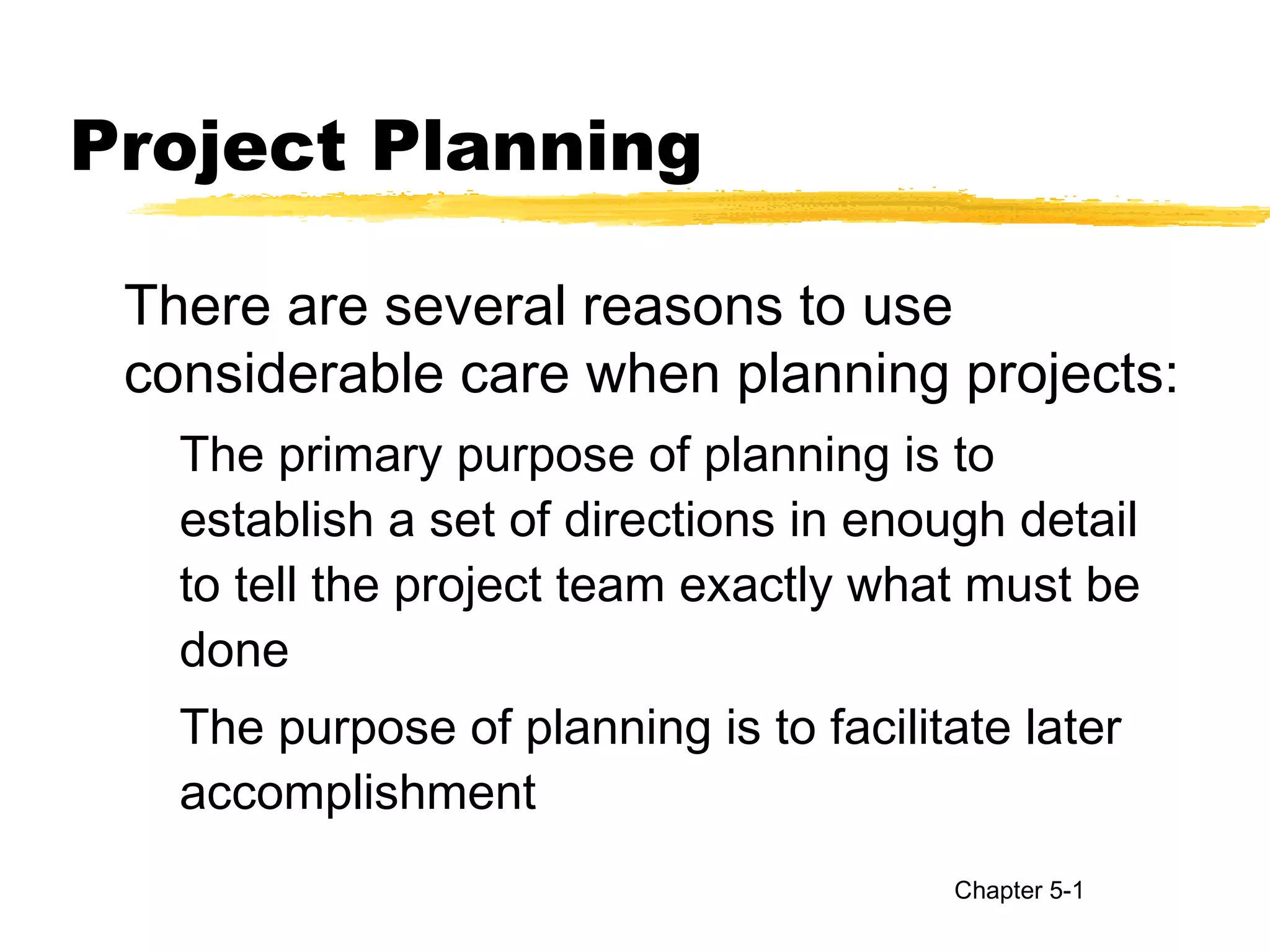
There are several reasons to use
considerable care when planning projects:
The primary purpose of planning is to
establish a set of directions in enough detail
to tell the project team exactly what must be
done
The purpose of planning is to facilitate later
accomplishment
Chapter 5-1
Initial Project Coordination
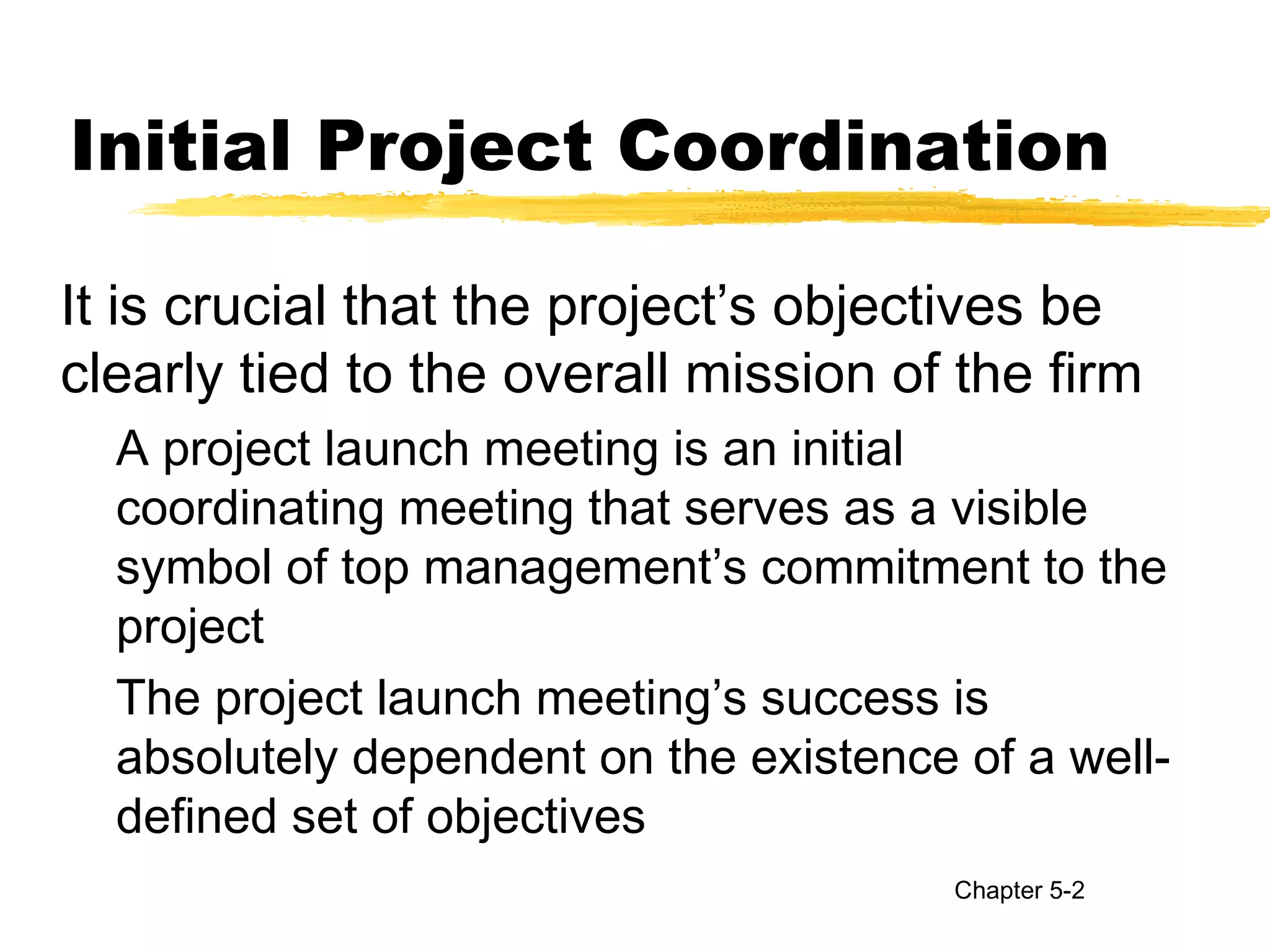
It is crucial that the project’s objectives be
clearly tied to the overall mission of the firm
A project launch meeting is an initial
coordinating meeting that serves as a visible
symbol of top management’s commitment to the
project
The project launch meeting’s success is
absolutely dependent on the existence of a well-
defined set of objectives
Chapter 5-2
Project Launch Meeting
Should not allow plans, schedules, and budgets
to go beyond the most aggregated level at the
launch meeting
The outcomes should be:
1. Technical Scope is established
2. Basic areas of performance responsibility
are accepted by the participants
3. Some tentative overall schedules and
budgets are spelled out
Chapter 5-3
Composite Plan
Each individual/unit accepting responsibility for a portion
of the project should agree to deliver a preliminary plan
about how that responsibility will be accomplished
These plans should contain descriptions of the required
tasks, and estimates of the budgets and schedules
These plans are then scrutinized by the group and
combined into a composite project plan
Chapter 5-4
Composite Plan
The composite plan, still not completely firm, is approved
by each participating group, by the project manager, and
then by senior organizational management
Each subsequent approval hardens the plan, and when
senior management has endorsed it, any further changes
in the project’s scope must be made by processing a
formal change order
Chapter 5-5
Project Plan
The final approved result of this procedure is the project
plan, also known as a Master or Baseline plan
Once planning phase is complete, it is beneficial to hold a
post-planning review
The major purpose of the review is to ensure that all
necessary elements of a project plan have been properly
developed and communicated
Chapter 5-6
Project Plan Elements
The process of developing the project plan varies
among organizations, but any project plan must
contain the following elements:
Overview - a short summary of the objectives and
scope of the project
Objectives - A more detailed statement of the general
goals noted in the overview section
General Approach - describes both the managerial
and technical approaches to the work
Chapter 5-7
Project Plan Elements
Contractual Aspects - includes a complete list and
description of all reporting requirements, customer supplied
resources, liaison arrangements, advisory committees,
project review and cancellation procedures, etc.
Schedules - this section outlines the various schedules
and lists all the milestone events
Resources - this includes the budget (both capital and
expense requirements) as well as cost monitoring and
control procedures
Chapter 5-8
Project Plan Elements
Personnel - this section lists the expected personnel
requirements of the project including special skills, training
needs, and security clearances
Evaluation Methods - every project should be evaluated
against standards and by methods established at the project’s
inception
Potential Problems - this section should include any
potential difficulties such as subcontractor default, technical
failure, tight deadlines, resource limitations and the like.
Preplanning may avert some crises
Chapter 5-9
Project Planning in Action
Project plans are usually constructed by
listing the sequence of activities required to
carry the project from start to completion,
and developing an action plan to complete
the activities
This helps the planner decide the necessary
sequence of things
Sequencing is a necessary consideration for
determining the project schedule and
duration
Chapter 5-10
Project Planning in Action
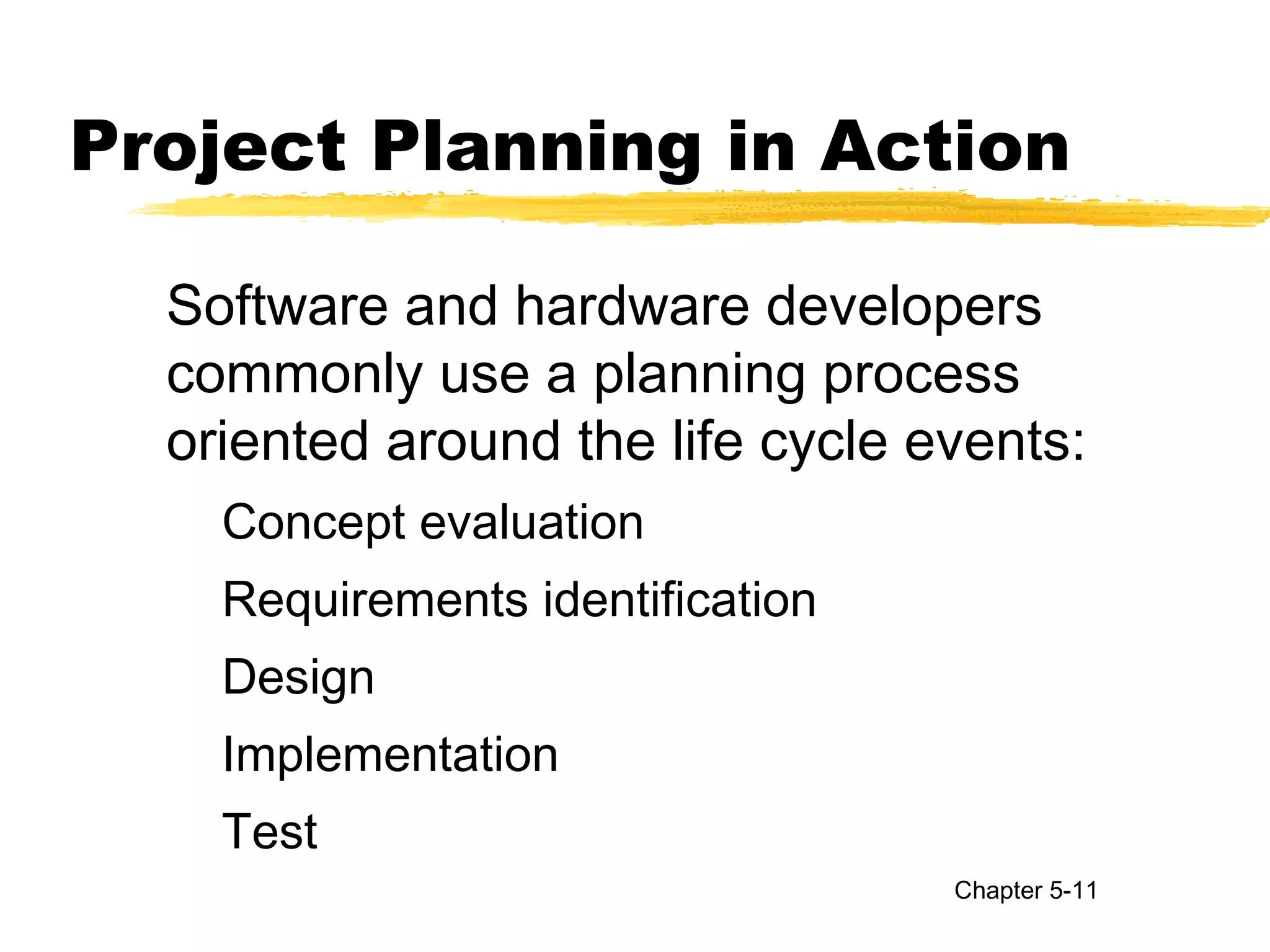
Software and hardware developers
commonly use a planning process
oriented around the life cycle events:
Concept evaluation
Requirements identification
Design
Implementation
Test
Chapter 5-11
Project Planning in Action
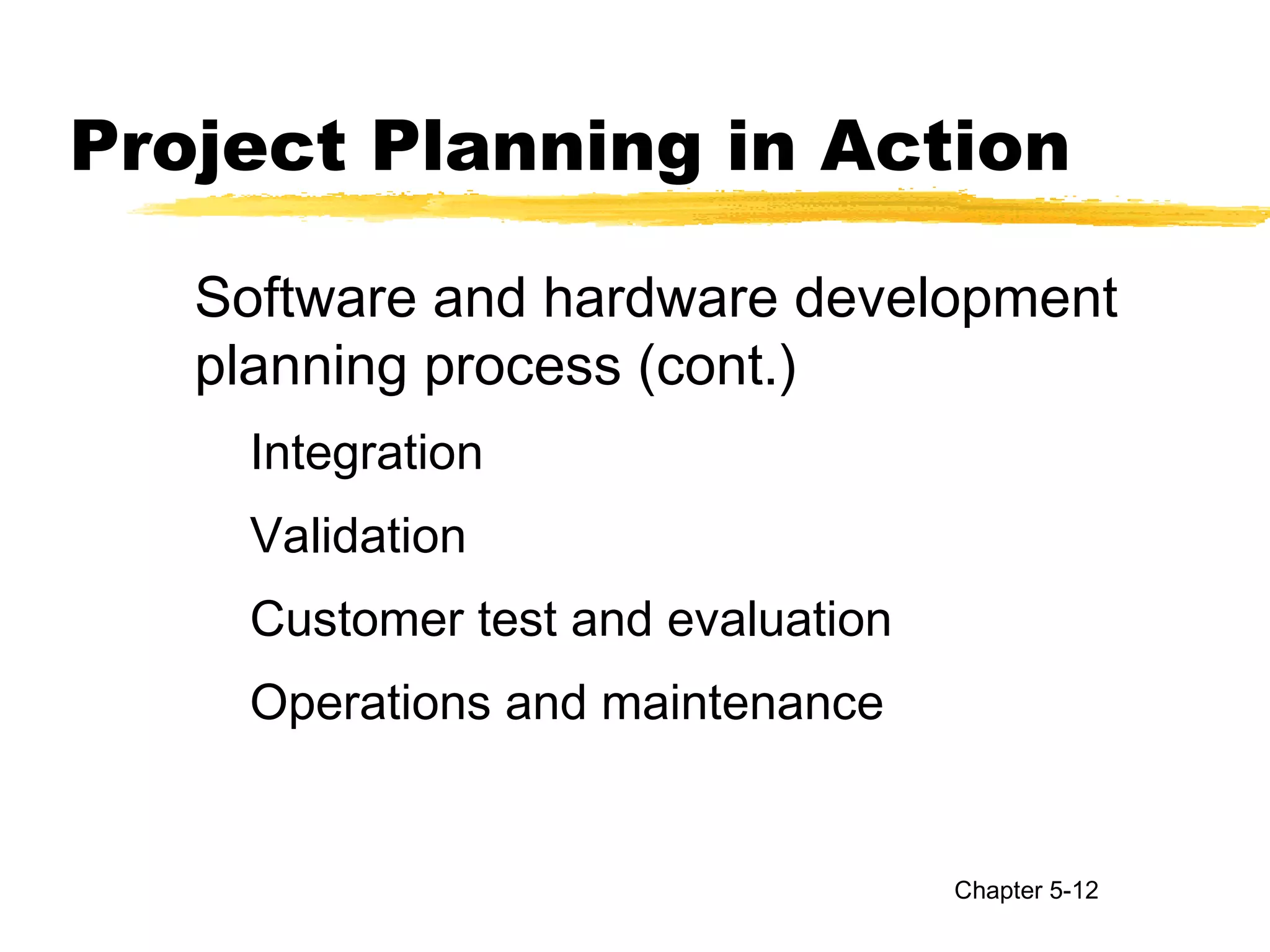
Software and hardware development
planning process (cont.)
Integration
Validation
Customer test and evaluation
Operations and maintenance
Chapter 5-12
Systems Integration
Systems Integration is one part of integration
management and plays a crucial role in the
performance aspect of the project
This includes any technical specialist in the
science or art of the project who is capable of
integrating the technical disciplines to achieve
the customer’s objectives
Chapter 5-13
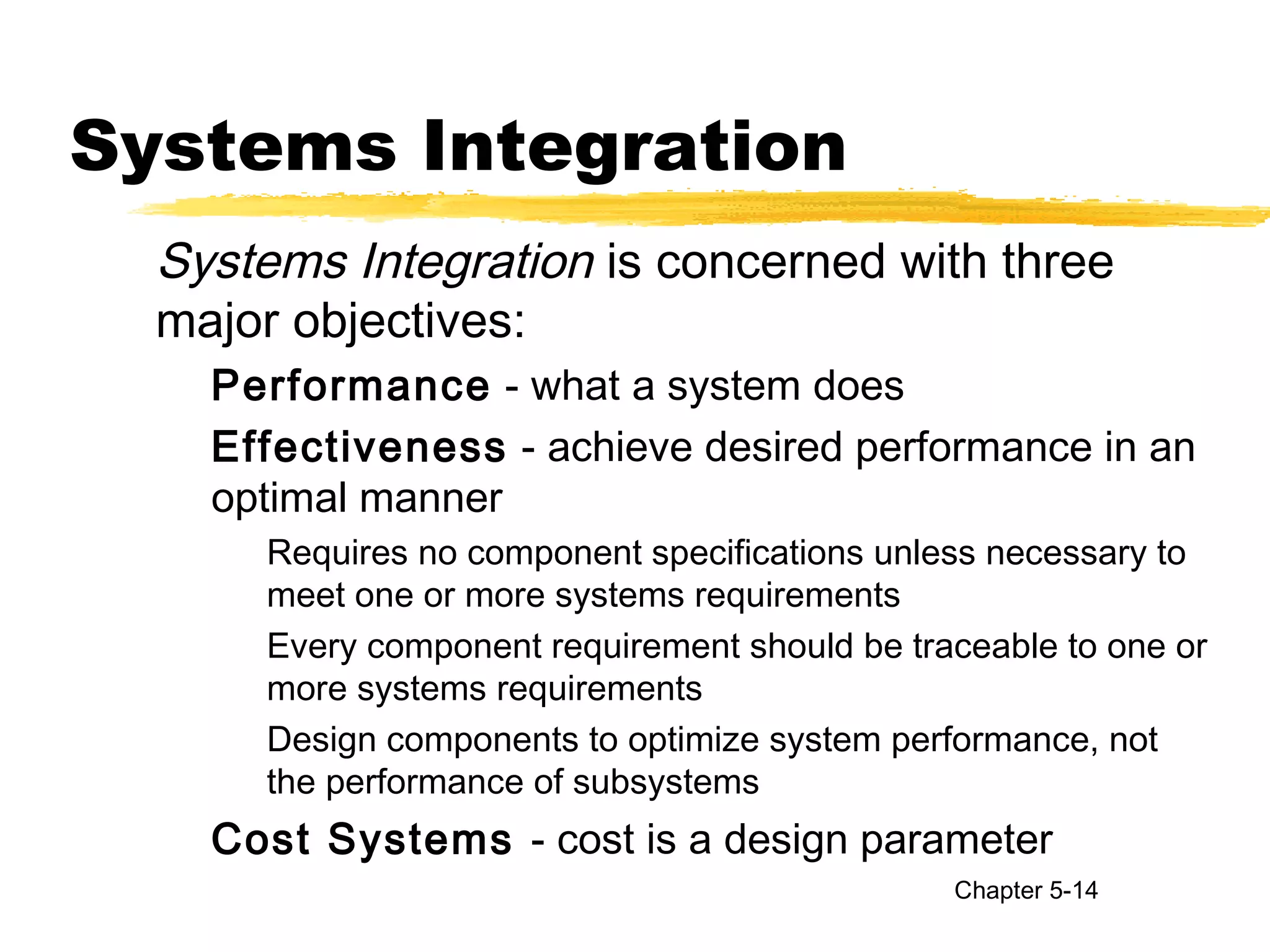
Systems Integration
Systems Integration is concerned with three
major objectives:
Performance - what a system does
Effectiveness - achieve desired performance in an
optimal manner
Requires no component specifications unless necessary to
meet one or more systems requirements
Every component requirement should be traceable to one or
more systems requirements
Design components to optimize system performance, not
the performance of subsystems
Cost Systems - cost is a design parameter
Chapter 5-14
Hierarchical Planning
System
All activities required to complete a project must
be precisely delineated, and coordinated
Some activities must be done sequentially, and
some simultaneously
Using a hierarchical planning system will allow
these activities to be identified and sorted
appropriately
Also know as the “even planning process”
Chapter 5-15
Sorting Out the Project
The importance of careful planning can scarcely
be overemphasized
Pinto and Slevin developed a list of ten factors
that should be associated with success in
implementation projects
The factors were split into strategic and tactical
clusters Chapter 5-16
Sorting Out the Project
Strategic Success Factors:
Project Mission - spell out clearly defined and agreed-
upon objectives in the project plan
Top Management Support - it is necessary for top
management to get behind the project at the outset, and
make clear to all personnel involved that they support
successful completion
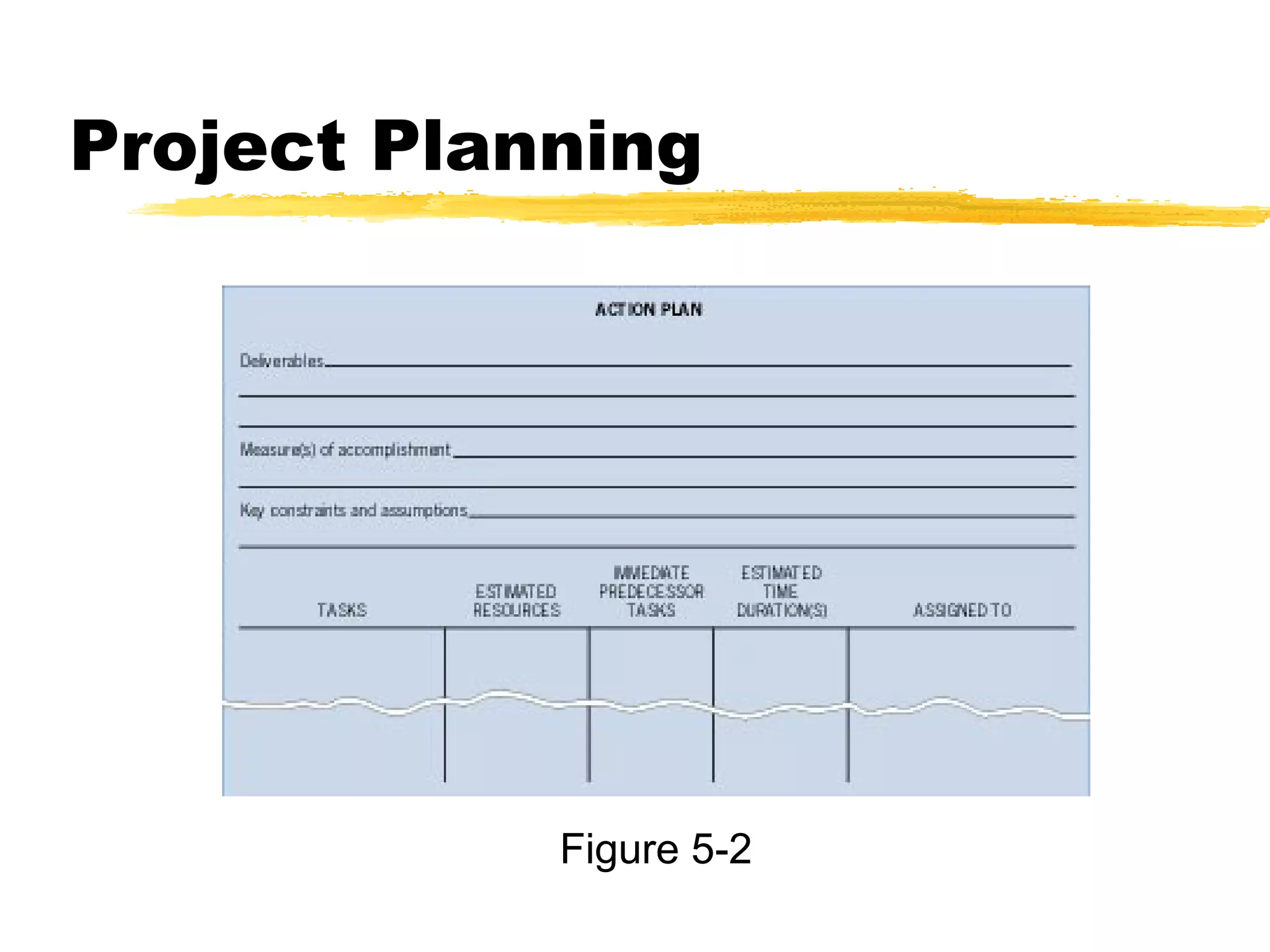
Project’s Action Plan - detailed plan of the required
steps in the implementation process needs to be
developed including all resource requirements
Chapter 5-17
The Work Breakdown Structure
The Work Breakdown Structure (WBS) can take
a variety of forms that serve a variety of
purposes
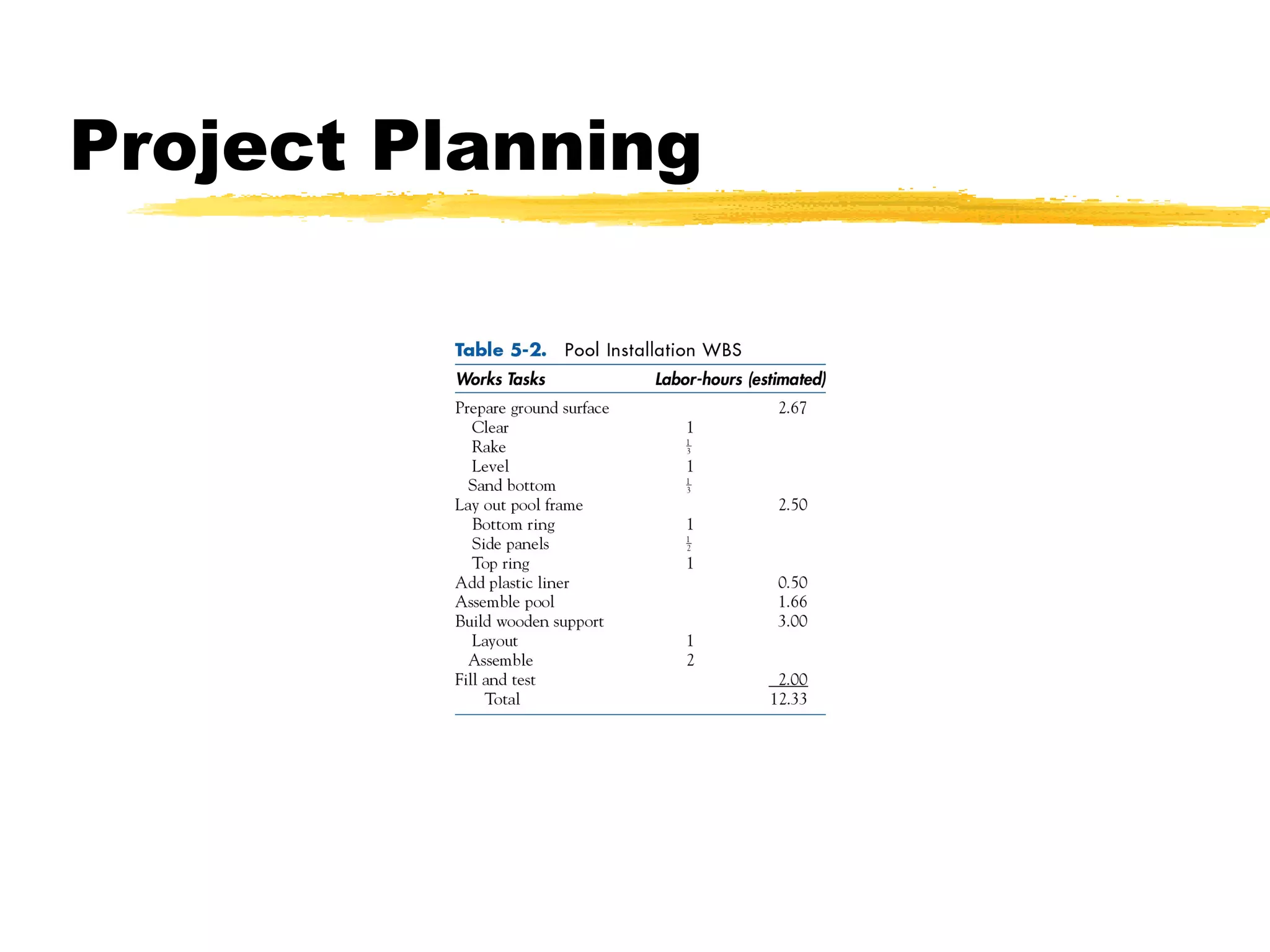
The WBS often appears as an outline with Level
I tasks on the left and successive levels
appropriately indented
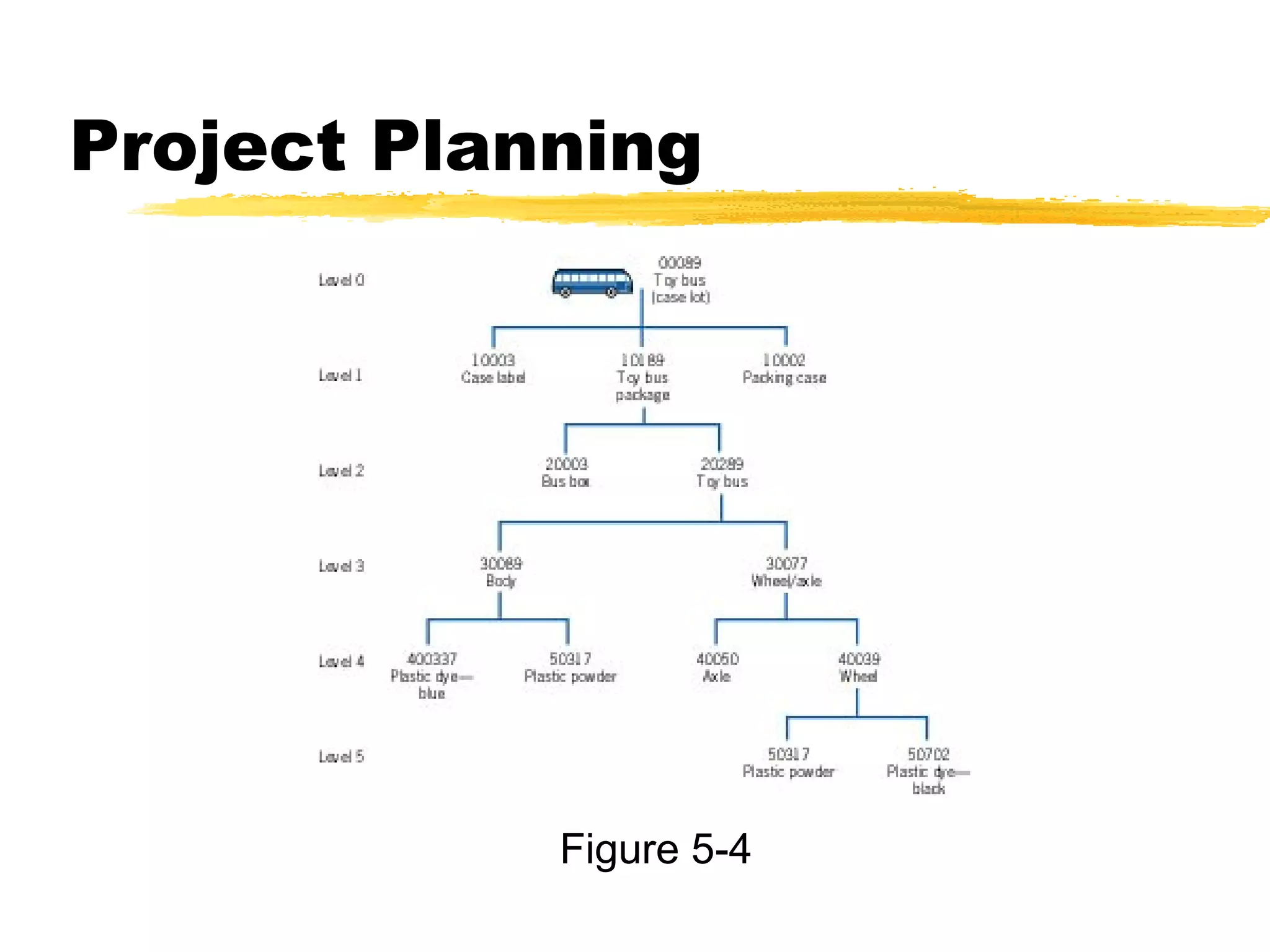
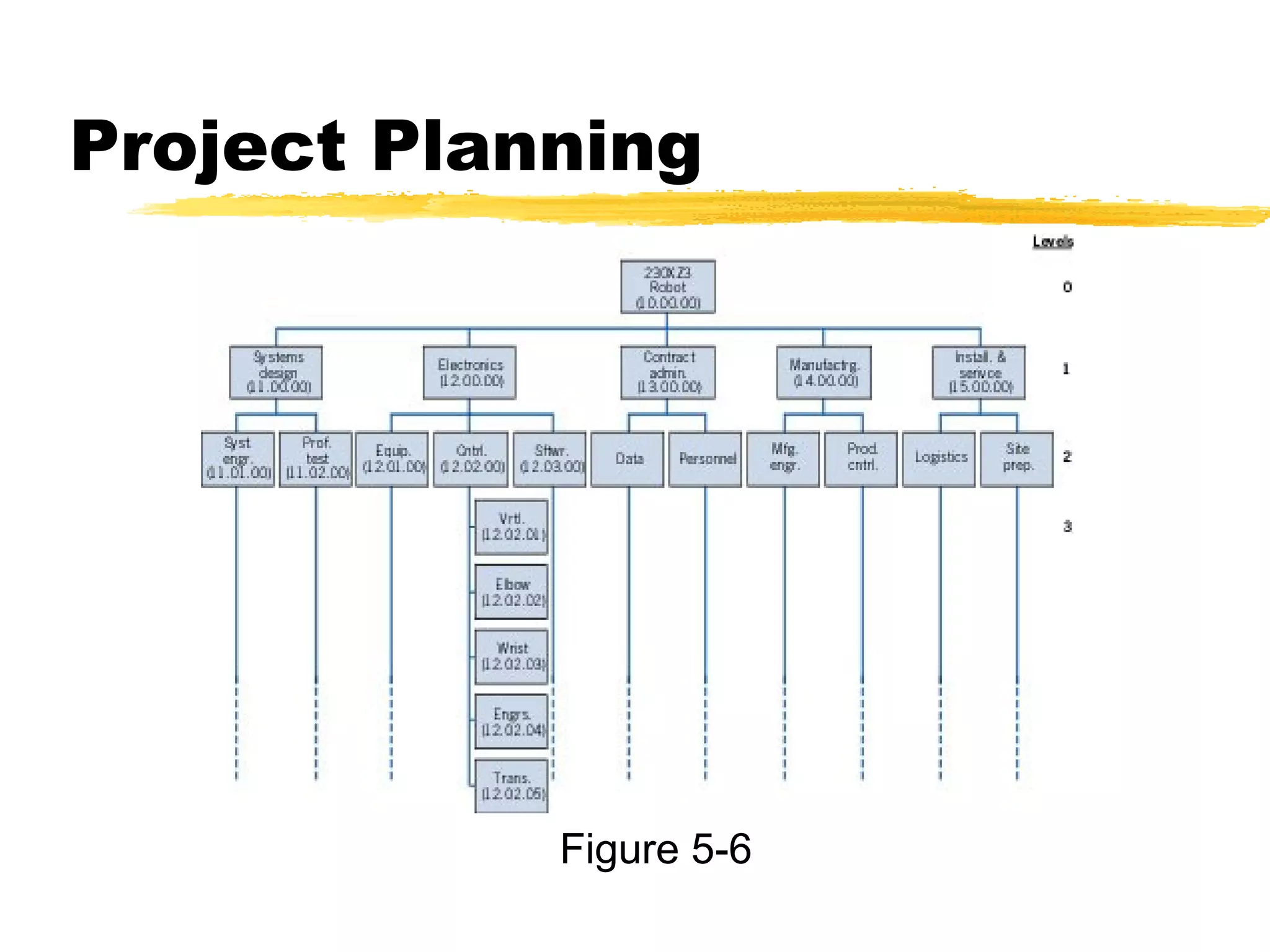
The WBS may also picture a project subdivided
into hierarchical units of tasks, subtasks, work
packages, etc.
Chapter 5-18
The Work Breakdown Structure
The WBS is an important document and can be
tailored for use in a number of different ways
It may illustrate how each piece of the project contributes to
the whole in terms of performance, responsibility, schedule,
and budget
It may list the vendors or subcontractors associated with
specific tasks
It may serve as the basis for making cost estimates or
estimates of task duration
It may be used to document that all parties have signed off
on their various commitments to the project
Chapter 5-19
The Work Breakdown Structure
General steps for designing and using the WBS:
1. Using information from the action plan, list the task
breakdown in successively finer levels of detail. Continue
until all meaningful tasks or work packages have been
identified
2. For each such work package, identify the data relevant to
the WBS. List the personnel and organizations
responsible for each task.
3. All work package information should be reviewed with
the individuals or organizations who have responsibility
for doing or supporting the work in order to verify the
accuracy of the WBS Chapter 5-20
The Work Breakdown Structure
General steps for designing and using the WBS (cont.):
4. The total project budget should consist of four elements: direct
budgets from each task; an indirect cost budget for the project; a
“contingency” reserve for unexpected emergencies; and any residual,
which includes the profit derived from the project
5. The project master schedule integrates the many different schedules
relevant to the various parts of the project
Items 1-5 focus on the WBS as a planning tool but it may also
be used to monitor and control the project
Chapter 5-21
The Work Breakdown Structure
Items 6 and 7 focus on the WBS as an aid to monitor
and control a project:
6. The project manager can examine actual resource use,
by work element, work package, task, up to the full
project level. The project manager can identify
problems, harden the estimates of final cost, and make
sure that relevant corrections have been designed and
are ready to implement
7. The project schedule may be subjected to the same
comparisons as the project budget. Actual progress is
compared to scheduled and corrective action can be
taken Chapter 5-22
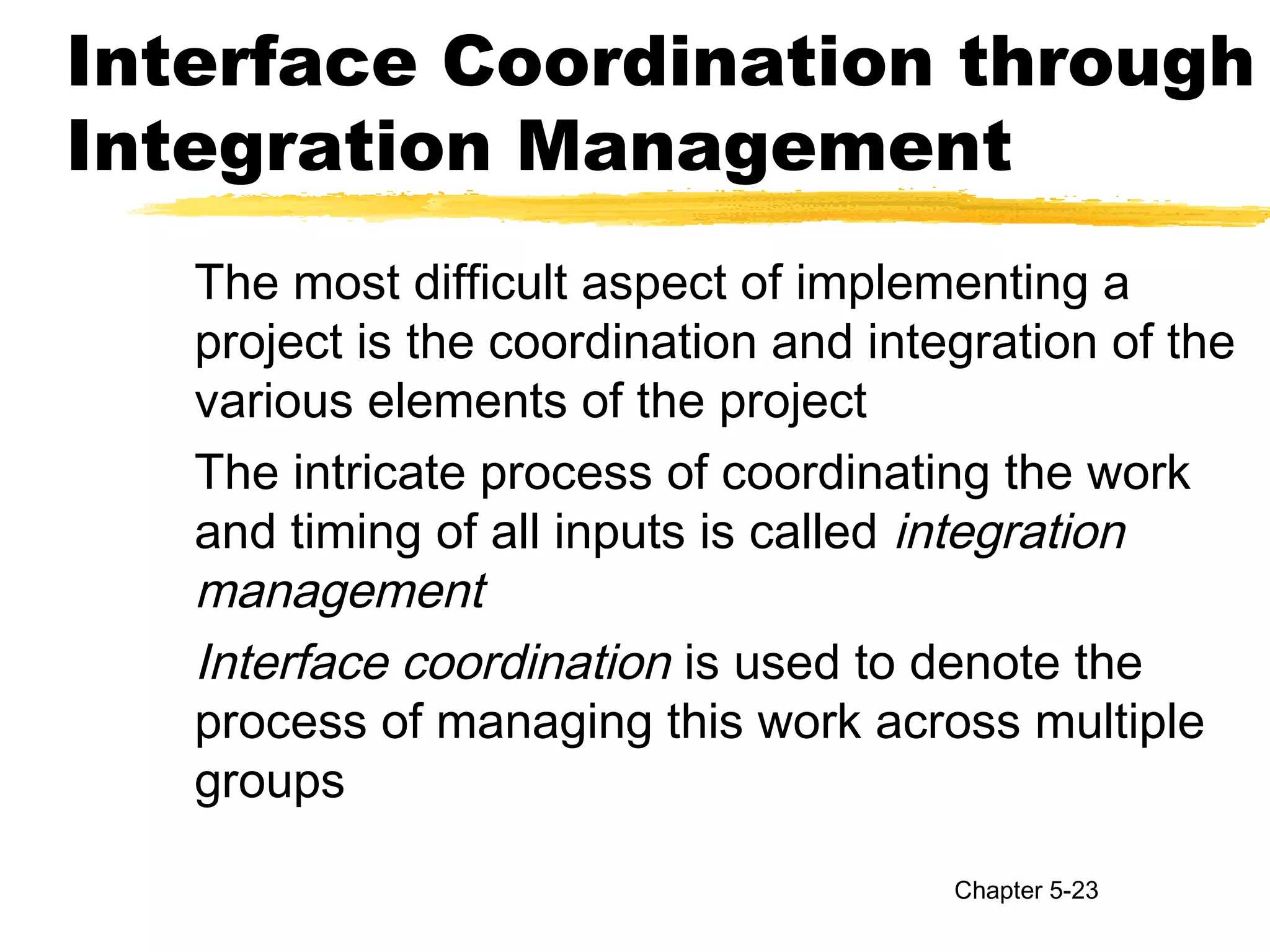
Interface Coordination through
Integration Management
The most difficult aspect of implementing a
project is the coordination and integration of the
various elements of the project
The intricate process of coordinating the work
and timing of all inputs is called integration
management
Interface coordination is used to denote the
process of managing this work across multiple
groups
Chapter 5-23
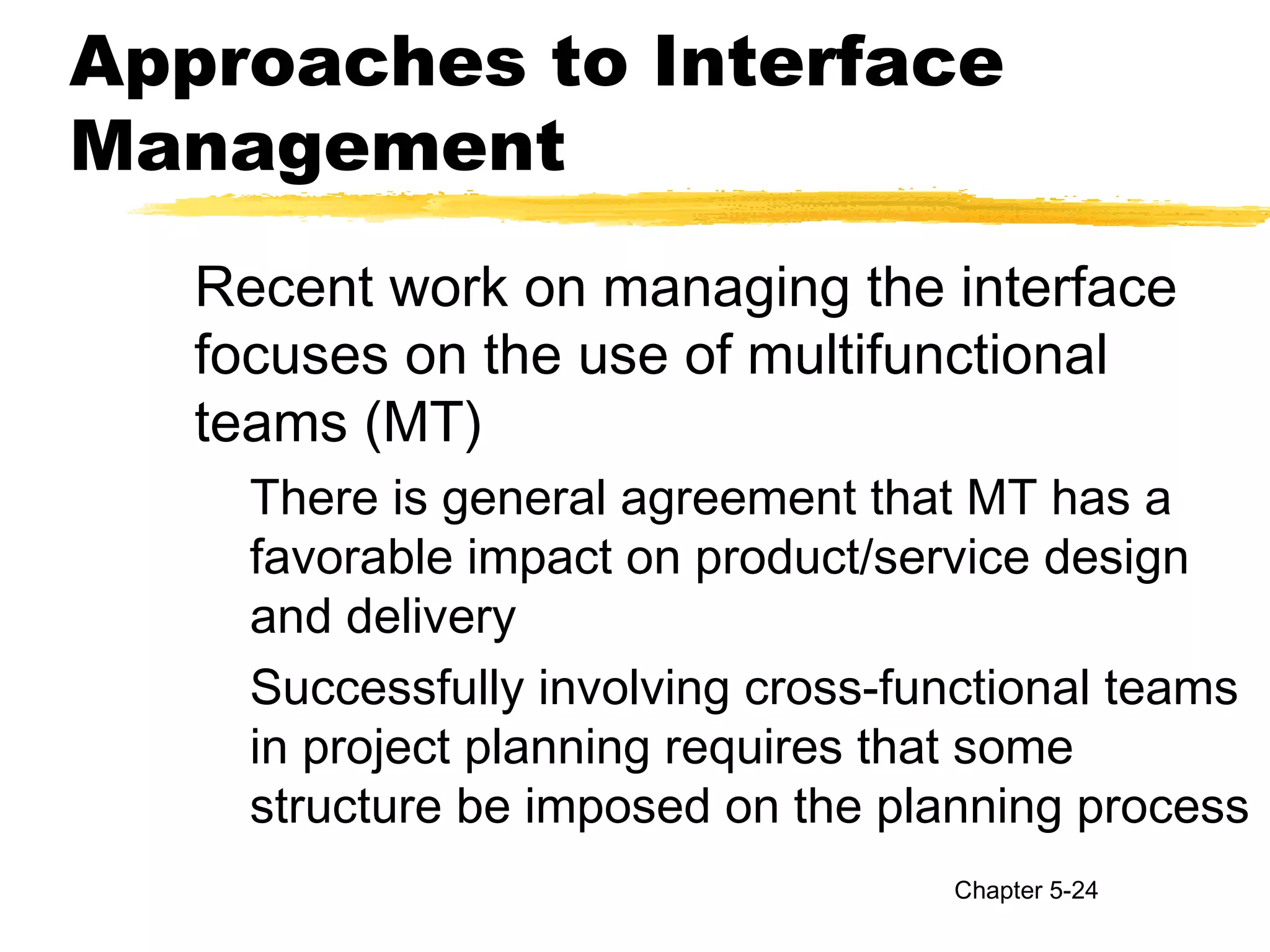
Approaches to Interface
Management
Recent work on managing the interface
focuses on the use of multifunctional
teams (MT)
There is general agreement that MT has a
favorable impact on product/service design
and delivery
Successfully involving cross-functional teams
in project planning requires that some
structure be imposed on the planning process
Chapter 5-24
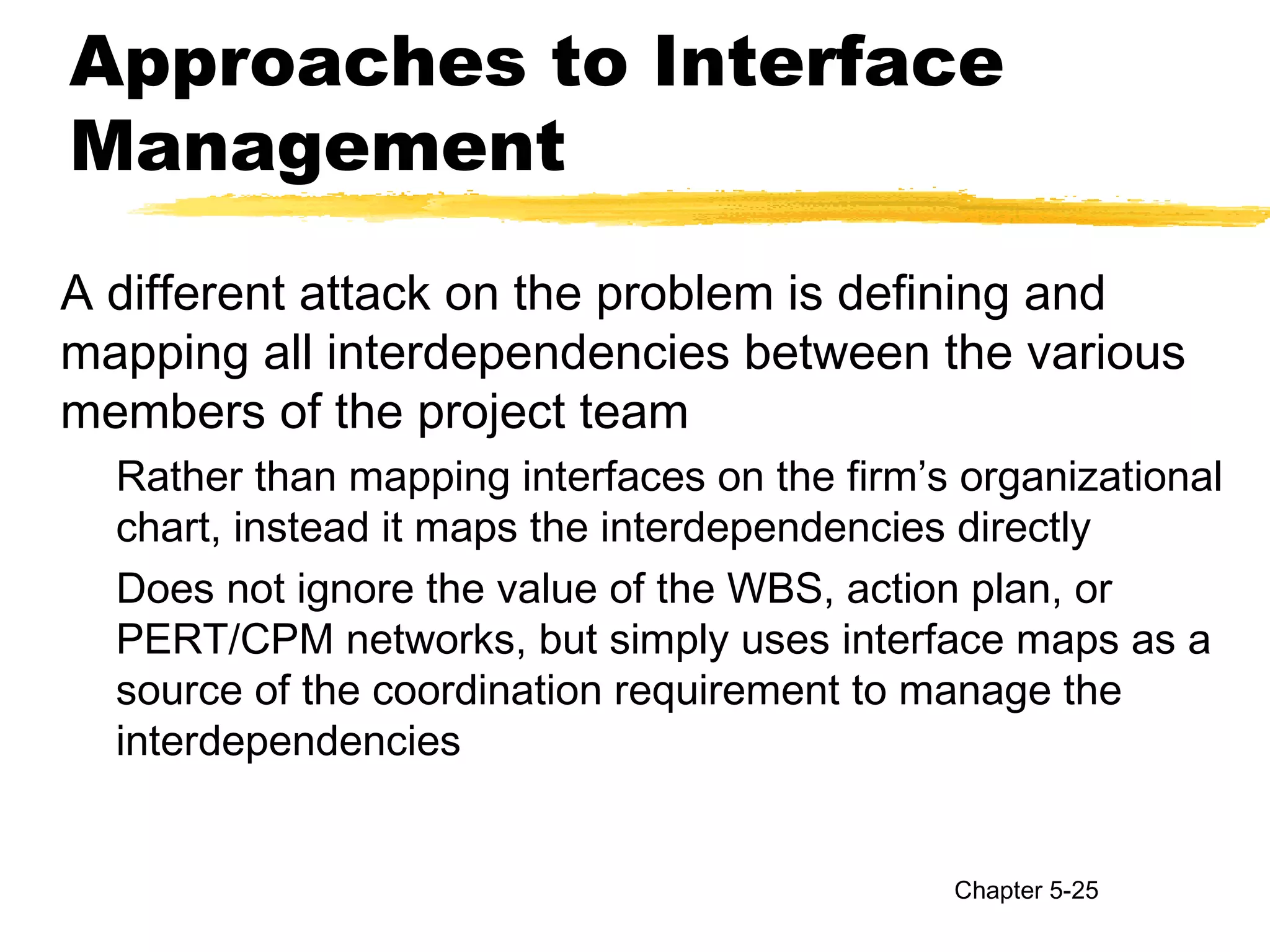
Approaches to Interface
Management
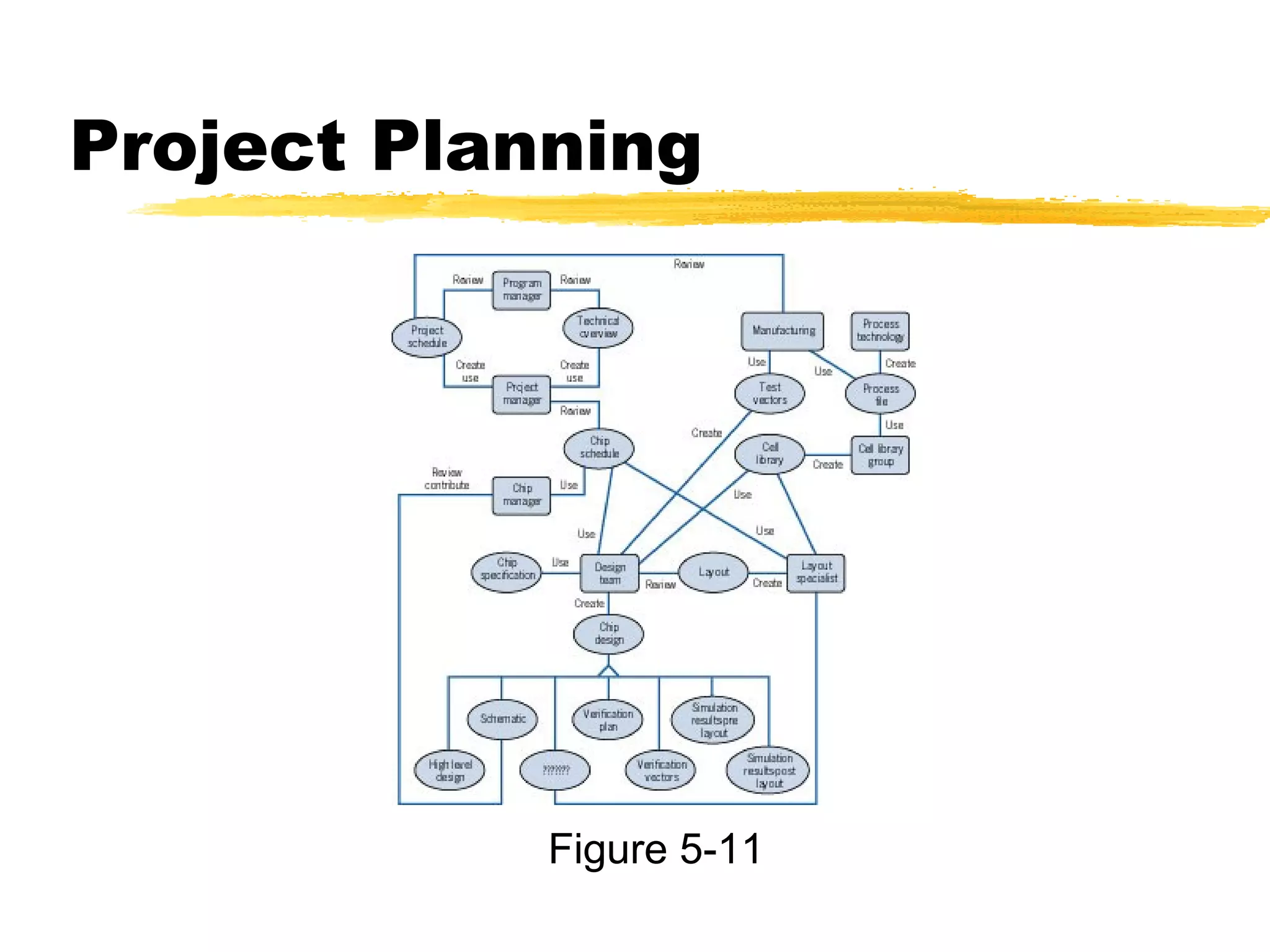
A different attack on the problem is defining and
mapping all interdependencies between the various
members of the project team
Rather than mapping interfaces on the firm’s organizational
chart, instead it maps the interdependencies directly
Does not ignore the value of the WBS, action plan, or
PERT/CPM networks, but simply uses interface maps as a
source of the coordination requirement to manage the
interdependencies
Chapter 5-25
Summary
The preliminary work plans are important
because they serve as the basis for personnel
selection, budgeting, scheduling and control
Top management should be represented in the
initial coordinating meeting where technical
objectives are established, participant
responsibility is accepted, and preliminary
budgets and schedules are defined
Chapter 5-26
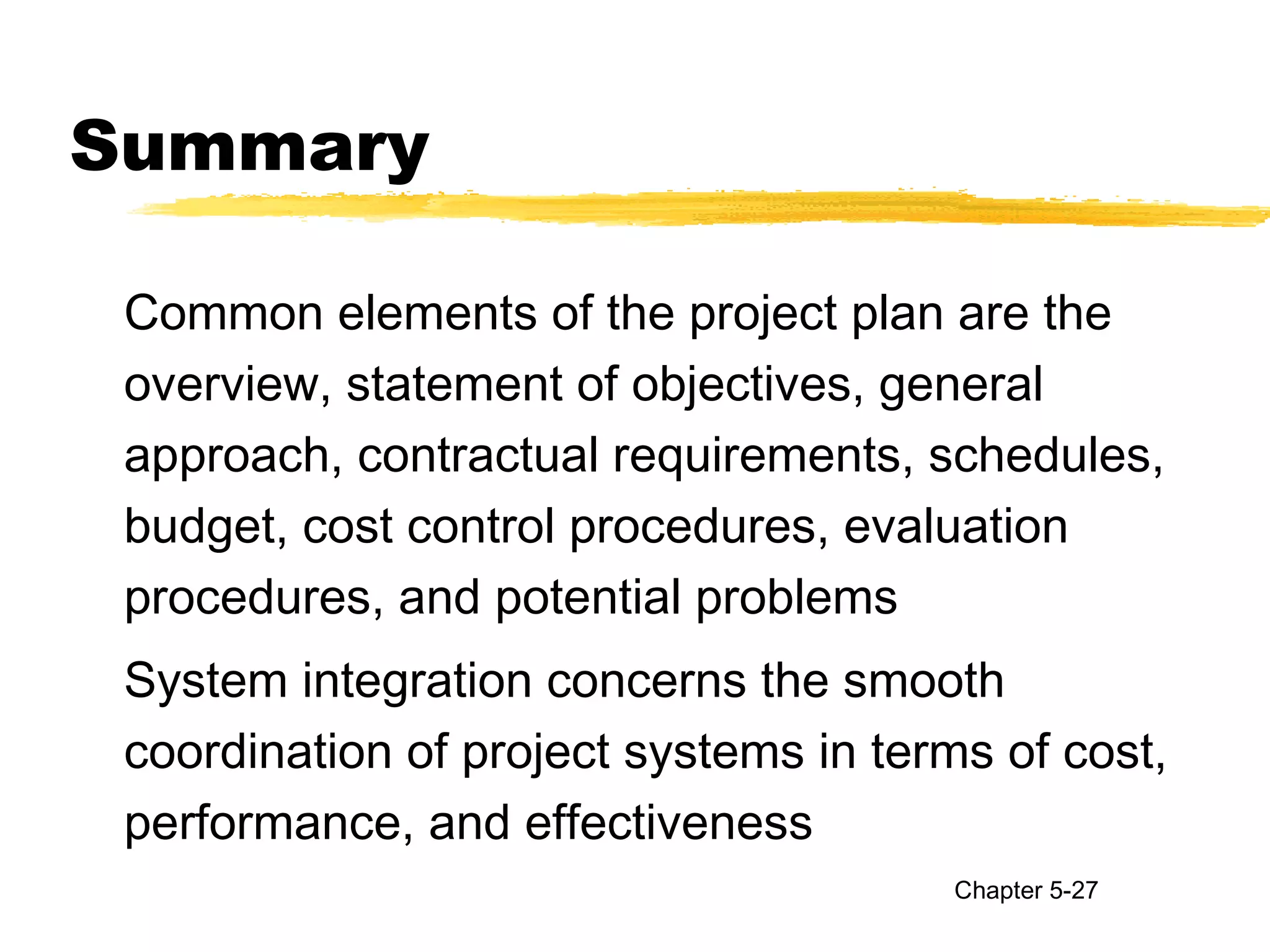
Summary
Common elements of the project plan are the
overview, statement of objectives, general
approach, contractual requirements, schedules,
budget, cost control procedures, evaluation
procedures, and potential problems
System integration concerns the smooth
coordination of project systems in terms of cost,
performance, and effectiveness
Chapter 5-27
Summary
The work breakdown structure (WBS) relates the details
of each subtask to its task and provides the final basis fir
the project budget, schedule, personnel, and control
When multifunctional teams are used to plan complex
projects their work must be integrated and coordinated.
Interface maps are a useful way of identifying the
interdependencies that must be managed
Chapter 5-28
Project Planning
Questions?
Chapter 5-29
Project Planning
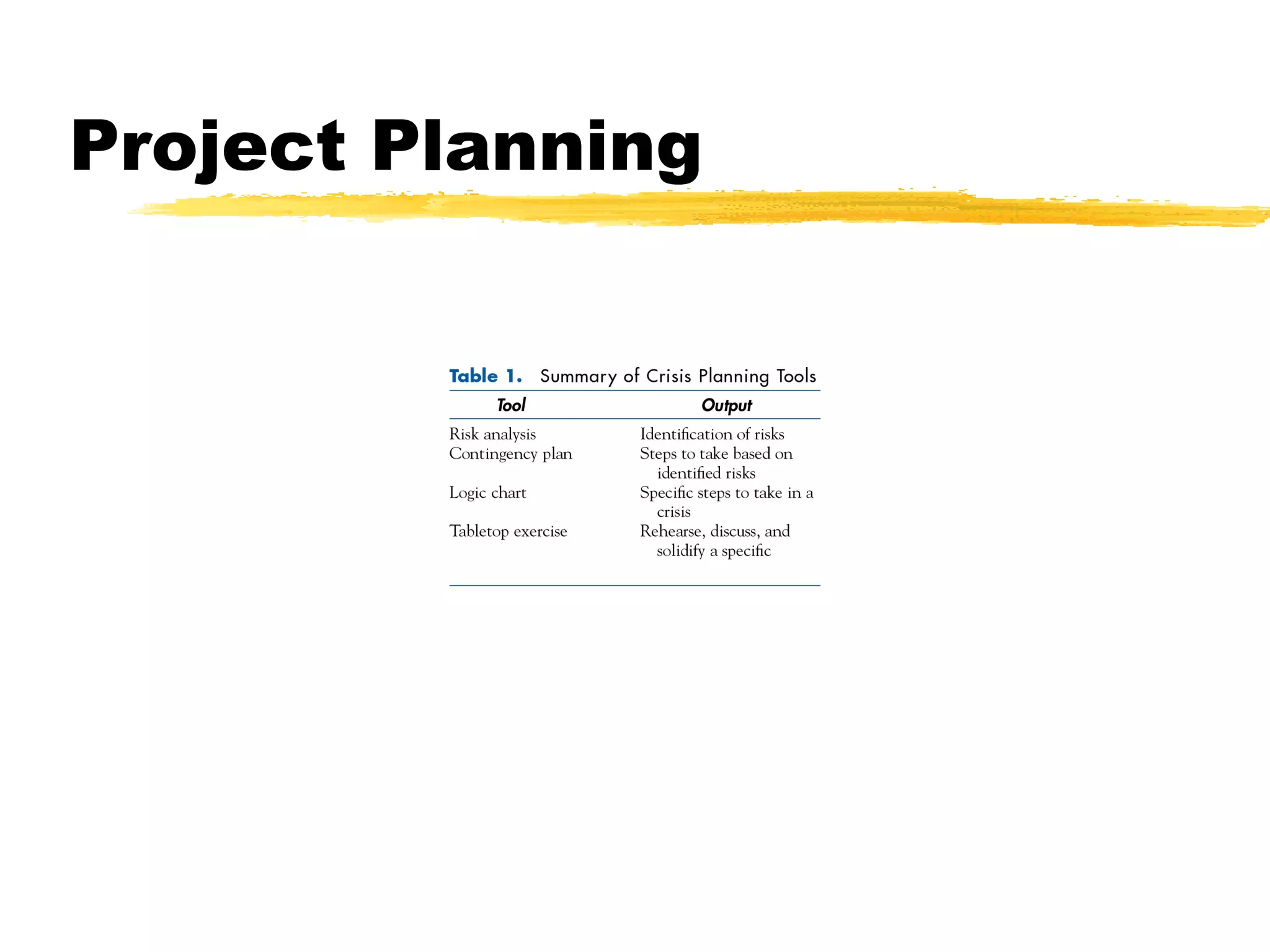
Picture Files
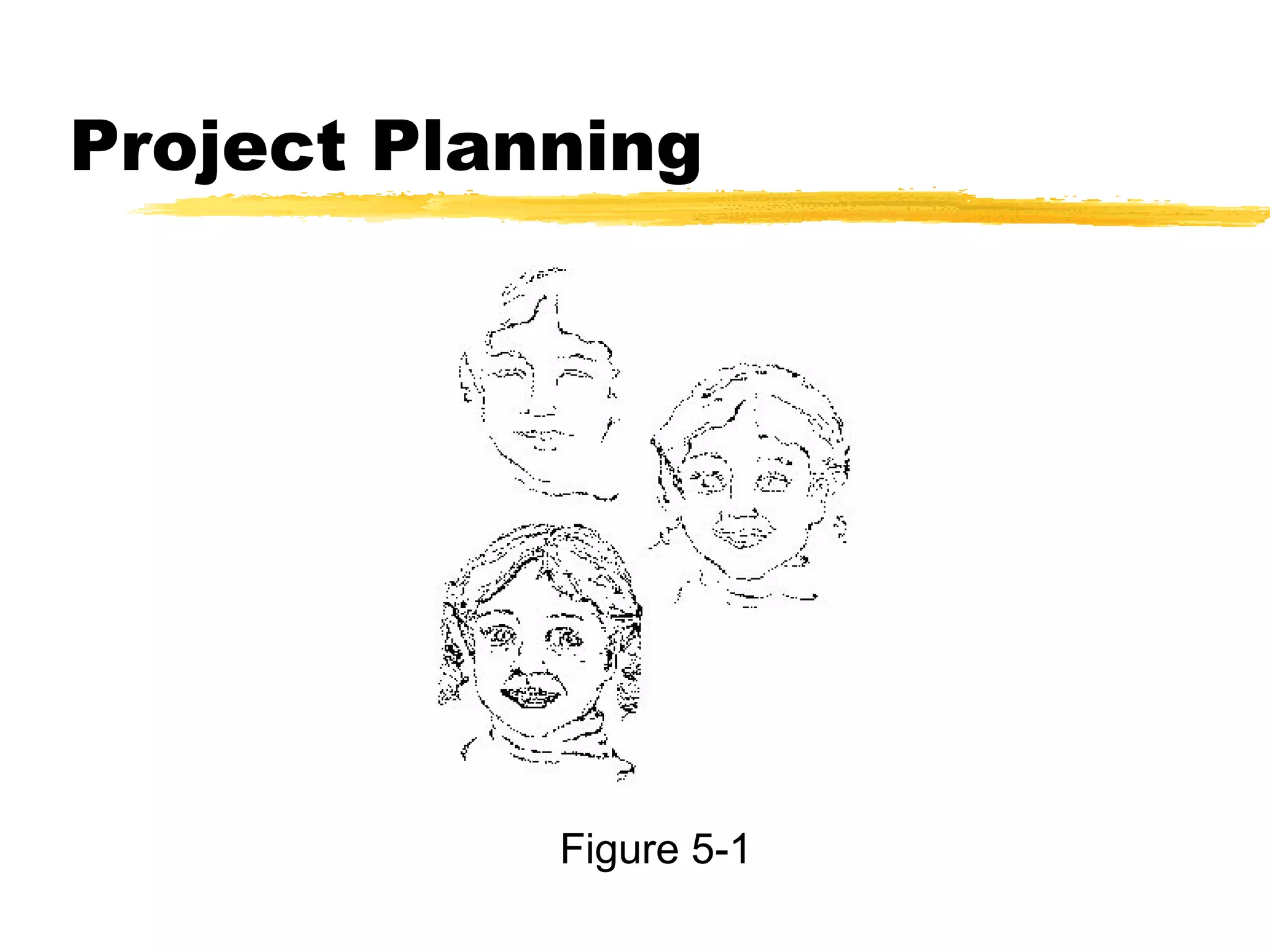
Project Planning
Figure 5-1
Project Planning
Figure 5-2
Project Planning
Figure 5-4
Project Planning
Figure 5-6
Project Planning
Figure 5-11
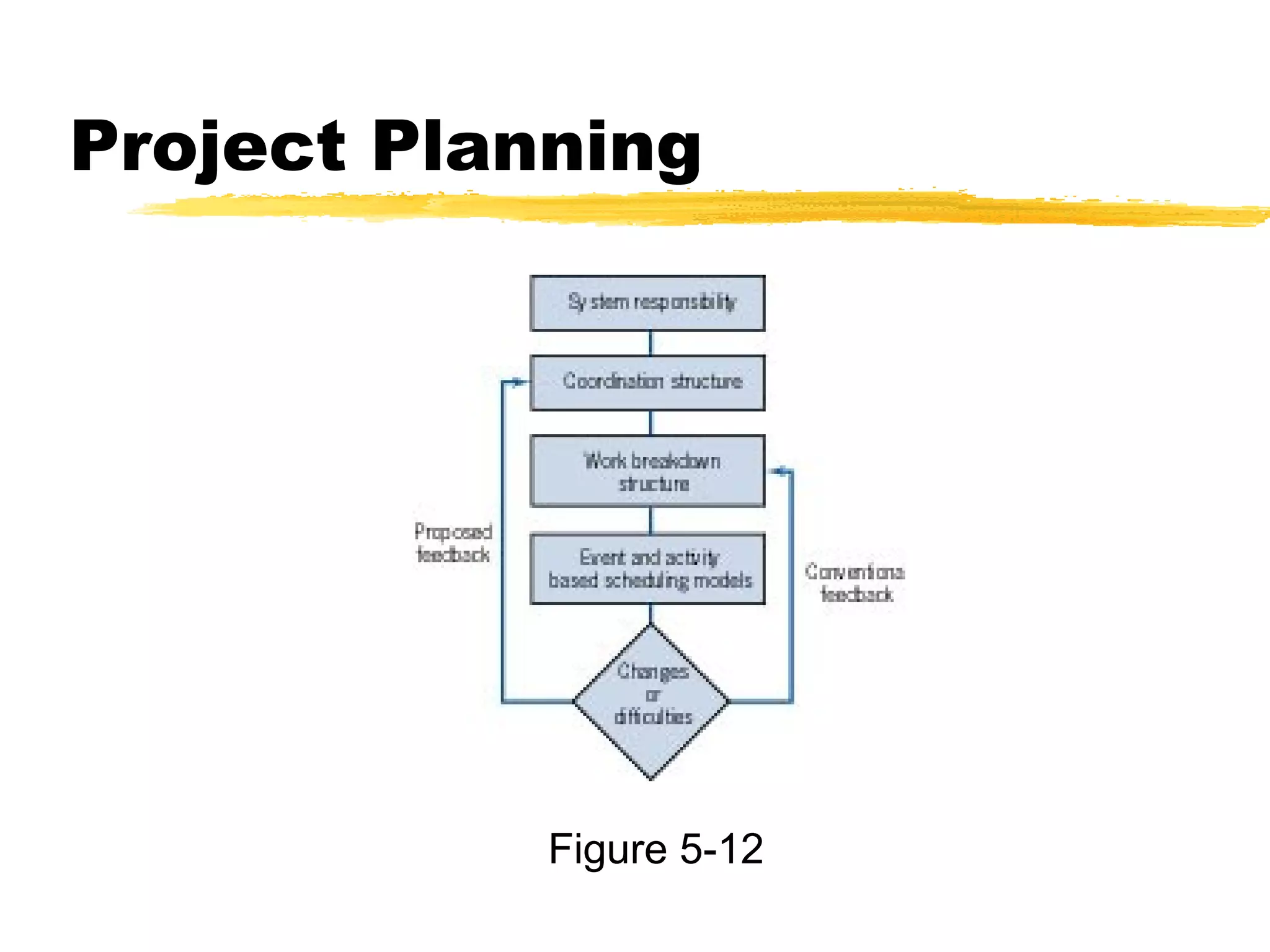
Project Planning
Figure 5-12
Project Planning
Table Files
Project Planning
Project Planning
Copyright © 2000 John Wiley & Sons, Inc. All rights
reserved. Reproduction or translation of this work
beyond that permitted in Section 117 of the 1976 United
States Copyright Act without the express written
permission of the copyright owner is unlawful. Request
for further information should be addressed to the
Permissions Department, John Wiley & Sons, Inc. The
purchaser may make back-up copies for his/her own use
only and not for distribution or resale. The Publisher
assumes no responsibility for errors, omissions, or
damages, caused by the use of these programs or from
the use of the information contained herein.

Project mgmt.

  • 1.
    Project Management: A ManagerialApproach 4/e By Jack R. Meredith and Samuel J. Mantel, Jr. Published by John Wiley & Sons, Inc. Presentation prepared by RTBM WebGroup
  • 2.
    Project Management A ManagerialApproach Chapter 5 Project Planning
  • 3.
    Project Planning There areseveral reasons to use considerable care when planning projects: The primary purpose of planning is to establish a set of directions in enough detail to tell the project team exactly what must be done The purpose of planning is to facilitate later accomplishment Chapter 5-1
  • 4.
    Initial Project Coordination Itis crucial that the project’s objectives be clearly tied to the overall mission of the firm A project launch meeting is an initial coordinating meeting that serves as a visible symbol of top management’s commitment to the project The project launch meeting’s success is absolutely dependent on the existence of a well- defined set of objectives Chapter 5-2
  • 5.
    Project Launch Meeting Shouldnot allow plans, schedules, and budgets to go beyond the most aggregated level at the launch meeting The outcomes should be: 1. Technical Scope is established 2. Basic areas of performance responsibility are accepted by the participants 3. Some tentative overall schedules and budgets are spelled out Chapter 5-3
  • 6.
    Composite Plan Each individual/unitaccepting responsibility for a portion of the project should agree to deliver a preliminary plan about how that responsibility will be accomplished These plans should contain descriptions of the required tasks, and estimates of the budgets and schedules These plans are then scrutinized by the group and combined into a composite project plan Chapter 5-4
  • 7.
    Composite Plan The compositeplan, still not completely firm, is approved by each participating group, by the project manager, and then by senior organizational management Each subsequent approval hardens the plan, and when senior management has endorsed it, any further changes in the project’s scope must be made by processing a formal change order Chapter 5-5
  • 8.
    Project Plan The finalapproved result of this procedure is the project plan, also known as a Master or Baseline plan Once planning phase is complete, it is beneficial to hold a post-planning review The major purpose of the review is to ensure that all necessary elements of a project plan have been properly developed and communicated Chapter 5-6
  • 9.
    Project Plan Elements Theprocess of developing the project plan varies among organizations, but any project plan must contain the following elements: Overview - a short summary of the objectives and scope of the project Objectives - A more detailed statement of the general goals noted in the overview section General Approach - describes both the managerial and technical approaches to the work Chapter 5-7
  • 10.
    Project Plan Elements ContractualAspects - includes a complete list and description of all reporting requirements, customer supplied resources, liaison arrangements, advisory committees, project review and cancellation procedures, etc. Schedules - this section outlines the various schedules and lists all the milestone events Resources - this includes the budget (both capital and expense requirements) as well as cost monitoring and control procedures Chapter 5-8
  • 11.
    Project Plan Elements Personnel- this section lists the expected personnel requirements of the project including special skills, training needs, and security clearances Evaluation Methods - every project should be evaluated against standards and by methods established at the project’s inception Potential Problems - this section should include any potential difficulties such as subcontractor default, technical failure, tight deadlines, resource limitations and the like. Preplanning may avert some crises Chapter 5-9
  • 12.
    Project Planning inAction Project plans are usually constructed by listing the sequence of activities required to carry the project from start to completion, and developing an action plan to complete the activities This helps the planner decide the necessary sequence of things Sequencing is a necessary consideration for determining the project schedule and duration Chapter 5-10
  • 13.
    Project Planning inAction Software and hardware developers commonly use a planning process oriented around the life cycle events: Concept evaluation Requirements identification Design Implementation Test Chapter 5-11
  • 14.
    Project Planning inAction Software and hardware development planning process (cont.) Integration Validation Customer test and evaluation Operations and maintenance Chapter 5-12
  • 15.
    Systems Integration Systems Integrationis one part of integration management and plays a crucial role in the performance aspect of the project This includes any technical specialist in the science or art of the project who is capable of integrating the technical disciplines to achieve the customer’s objectives Chapter 5-13
  • 16.
    Systems Integration Systems Integrationis concerned with three major objectives: Performance - what a system does Effectiveness - achieve desired performance in an optimal manner Requires no component specifications unless necessary to meet one or more systems requirements Every component requirement should be traceable to one or more systems requirements Design components to optimize system performance, not the performance of subsystems Cost Systems - cost is a design parameter Chapter 5-14
  • 17.
    Hierarchical Planning System All activitiesrequired to complete a project must be precisely delineated, and coordinated Some activities must be done sequentially, and some simultaneously Using a hierarchical planning system will allow these activities to be identified and sorted appropriately Also know as the “even planning process” Chapter 5-15
  • 18.
    Sorting Out theProject The importance of careful planning can scarcely be overemphasized Pinto and Slevin developed a list of ten factors that should be associated with success in implementation projects The factors were split into strategic and tactical clusters Chapter 5-16
  • 19.
    Sorting Out theProject Strategic Success Factors: Project Mission - spell out clearly defined and agreed- upon objectives in the project plan Top Management Support - it is necessary for top management to get behind the project at the outset, and make clear to all personnel involved that they support successful completion Project’s Action Plan - detailed plan of the required steps in the implementation process needs to be developed including all resource requirements Chapter 5-17
  • 20.
    The Work BreakdownStructure The Work Breakdown Structure (WBS) can take a variety of forms that serve a variety of purposes The WBS often appears as an outline with Level I tasks on the left and successive levels appropriately indented The WBS may also picture a project subdivided into hierarchical units of tasks, subtasks, work packages, etc. Chapter 5-18
  • 21.
    The Work BreakdownStructure The WBS is an important document and can be tailored for use in a number of different ways It may illustrate how each piece of the project contributes to the whole in terms of performance, responsibility, schedule, and budget It may list the vendors or subcontractors associated with specific tasks It may serve as the basis for making cost estimates or estimates of task duration It may be used to document that all parties have signed off on their various commitments to the project Chapter 5-19
  • 22.
    The Work BreakdownStructure General steps for designing and using the WBS: 1. Using information from the action plan, list the task breakdown in successively finer levels of detail. Continue until all meaningful tasks or work packages have been identified 2. For each such work package, identify the data relevant to the WBS. List the personnel and organizations responsible for each task. 3. All work package information should be reviewed with the individuals or organizations who have responsibility for doing or supporting the work in order to verify the accuracy of the WBS Chapter 5-20
  • 23.
    The Work BreakdownStructure General steps for designing and using the WBS (cont.): 4. The total project budget should consist of four elements: direct budgets from each task; an indirect cost budget for the project; a “contingency” reserve for unexpected emergencies; and any residual, which includes the profit derived from the project 5. The project master schedule integrates the many different schedules relevant to the various parts of the project Items 1-5 focus on the WBS as a planning tool but it may also be used to monitor and control the project Chapter 5-21
  • 24.
    The Work BreakdownStructure Items 6 and 7 focus on the WBS as an aid to monitor and control a project: 6. The project manager can examine actual resource use, by work element, work package, task, up to the full project level. The project manager can identify problems, harden the estimates of final cost, and make sure that relevant corrections have been designed and are ready to implement 7. The project schedule may be subjected to the same comparisons as the project budget. Actual progress is compared to scheduled and corrective action can be taken Chapter 5-22
  • 25.
    Interface Coordination through IntegrationManagement The most difficult aspect of implementing a project is the coordination and integration of the various elements of the project The intricate process of coordinating the work and timing of all inputs is called integration management Interface coordination is used to denote the process of managing this work across multiple groups Chapter 5-23
  • 26.
    Approaches to Interface Management Recentwork on managing the interface focuses on the use of multifunctional teams (MT) There is general agreement that MT has a favorable impact on product/service design and delivery Successfully involving cross-functional teams in project planning requires that some structure be imposed on the planning process Chapter 5-24
  • 27.
    Approaches to Interface Management Adifferent attack on the problem is defining and mapping all interdependencies between the various members of the project team Rather than mapping interfaces on the firm’s organizational chart, instead it maps the interdependencies directly Does not ignore the value of the WBS, action plan, or PERT/CPM networks, but simply uses interface maps as a source of the coordination requirement to manage the interdependencies Chapter 5-25
  • 28.
    Summary The preliminary workplans are important because they serve as the basis for personnel selection, budgeting, scheduling and control Top management should be represented in the initial coordinating meeting where technical objectives are established, participant responsibility is accepted, and preliminary budgets and schedules are defined Chapter 5-26
  • 29.
    Summary Common elements ofthe project plan are the overview, statement of objectives, general approach, contractual requirements, schedules, budget, cost control procedures, evaluation procedures, and potential problems System integration concerns the smooth coordination of project systems in terms of cost, performance, and effectiveness Chapter 5-27
  • 30.
    Summary The work breakdownstructure (WBS) relates the details of each subtask to its task and provides the final basis fir the project budget, schedule, personnel, and control When multifunctional teams are used to plan complex projects their work must be integrated and coordinated. Interface maps are a useful way of identifying the interdependencies that must be managed Chapter 5-28
  • 31.
  • 32.
  • 33.
  • 34.
  • 35.
  • 36.
  • 37.
  • 38.
  • 39.
  • 40.
  • 41.
  • 42.
    Copyright © 2000John Wiley & Sons, Inc. All rights reserved. Reproduction or translation of this work beyond that permitted in Section 117 of the 1976 United States Copyright Act without the express written permission of the copyright owner is unlawful. Request for further information should be addressed to the Permissions Department, John Wiley & Sons, Inc. The purchaser may make back-up copies for his/her own use only and not for distribution or resale. The Publisher assumes no responsibility for errors, omissions, or damages, caused by the use of these programs or from the use of the information contained herein.