1
Foundations of Education by Hina Jalal (PhD Scholar GCUF)
3.1Perennialism
The word “perennial” means ever-lasting. Perennialism is an educational theory that draw from realism. For
Perennialists, the aim of education is to ensure that students acquire understandings about the great ideas of
Western civilization. These ideas have the potential for solving problems in any era. Robert Maynard Hutchins
(1929-1951), Mortimer J. Adler (1902-2001), and Jacques Maritain (1882-1973) are the founders of
perennialism.
Assumptions
The basic assumptions of perennialism outlined as under:
1) Despite different environment human nature remains the same everywhere, hence education should be
same everywhere
2) Man should be direct through its instinctual nature
3) Educational task should be import eternal truth
4) Education is not an imitation of life but a preparation of life
5) Students should study the great literature of philosophy, history, and science.
6) Students should be taught certain basic subjects that will acquaint him about world permanencies
7) Education should stimulate humans to think critically and thoughtfully.
Perennialism and Curriculum
The perennialists’ curriculum is universal and based on views that human being possesses. The perennials
think that it is important for students to think deeply, analytical, flexible, and imaginatively. The curriculum
in perennialism is subject centered. The perennialists believe that students should be taught foreign languages,
logic, rhetoric, natural sciences, and mathematics. The students should be taught in liberal manners rather
conventional. The students should not be taught information that soon outdated.
Perennialism and Role of Teachers/Student
The role of teachers to present the principles of perennialism should be secondary and mandatory. Teachers
should perform more actively than the students. Teachers should act like Socrates in his universal ideas. The
students should be hard work and obedient. Students should engage themselves in debate and discussion to
clear theoretical aspects. Students should listen and follow their teachers.
Perennialism and Classroom management
The classroom management concern with the teachers to accomplish their goals. Teachers used to try the most
effective teaching methods and techniques that are beneficial to discipline the students.
Perennialism and Evaluation
The evaluation in perennialism focuses on how much a student familiarity with classics, has ability to express
oneself, and to what extent clear with great ideas of literature. Teachers made tests and standardize tests should
be used to evaluate students. With the regard to testing and evaluation, perennialists tend to use both essay
and objective written examinations to see if their students’ minds have been disciplined to clear thinking. In
addition, perennialists do oral quizzing.
2
Foundations of Education by Hina Jalal (PhD Scholar GCUF)
3.2Progressivism
This theory associated to John Dewey’s pragmatism and experimentalism. Although, it is relevant to the
pragmatism and experimentalism, yet it is different theory of education. There are three other terms are used
parallel to progressivism, as, experimentalism, instrumentalism, and functionalism.
The leading spokesman for progressivism was the academic philosopher John Dewey. In his writings, Dewey
emphasized a generalized problem-solving procedure, which is quite like the scientific method. This problem-
solving procedure is a means by which we find out what works in a given situation. Dewey saw this problem-
solving procedure as one-in-the-same with the process of education. He believed that the procedure could be
effectively applied to problems in the physical or biological sciences, or to a social problem or even to a
personal problem.
The progressivists believe that there are four basic qualities of human experiences:
1) It is dynamic and never static.
2) It emerges over period and grows.
3) It is not limited to place, and thing.
4) It has vast relation with spiritual and material, complex and simple, and emotional and intellectual.
Chief Exponents
Jane Adams, John L. Child, George Count, Boyed H. Bode, George Axtelle, William O. Stanley, Ernest
Bayles, Lawrence G. Thomes, and Fredrick C. Neff.
The Basics Principles of Progressivism
There are following three basic principles of progressivism:
1) Progressivists believe that there is no ultimate reality. When individual interact with environment the
reality changes and adopt different shapes.
2) Progressivists give more importance to experiments. The advocate that students should give opportunities
to experiment, to play, and gain knowledge by doing.
3) Progressivists suppose different people have different values in different situation and time. But, it does
not mean values changes rapidly.
General characteristic of progressivism
• Education should be life itself, not a preparation for living.
• Education should be directly related to the interest of the child.
• The school should encourage co-operation rather than competitions.
• Education focuses on real-world problem solving and individual development.
• Learning is an active, democratic, and social process.
• Knowledge is constructed by the student as they experiment and solve problems.
Progressivism and Curriculum
The curriculum in progressivism is child centered. Progressivists believe curriculum should come from
students rather than transmission. Learning could take variety of forms such as problem solving, field trips,
creative artistic expression, and projects. Above all, progressive saw the teaching learning process as active,
3
Foundations of Education by Hina Jalal (PhD Scholar GCUF)
and ever changing. The skills and experimentation of students should express. The progressive does not
encourage solving of artificial problems but new ones.
Progressivism and Role of Teachers / Student
The teacher arouses interest, and impulses in the student. Teachers should motivate student to encounter
productive learning. The role of teacher in progressivism is like a guide and a counselor. He does not present
anything to the students but motivate them to check and value. Teachers keep themselves in background and
try to provide learning environment.
Progressivists give much importance to the students in teaching-learning process. Students are active
participants. The students are active and dynamic. Students can modify behavior in the light of experiences.
The mind, intellectual, feelings, habits, and responses all are interwoven in students learning.
Progressivism and Classroom management
Progressives believe that we must have rules but that the best discipline is student-self-discipline. In their
view, self-discipline is learned gradually when the child is given opportunities to control himself, while being
prompted by a set of rules that he has had an opportunity to help formulate. Discipline for the progressive is
a learning experience. Progressives believe teachers should impose few if any rules of behavior. Ideally, a
class should discuss and adopt a set of rules by voting. Students should enforce the rules through peer pressure
and by policing each other. Progressives reason that this involves students in the moral dimension of
discipline.
In the progressive classroom, students generally are assigned no seats, so seating charts are not used. Movable
classroom furniture facilitates interaction between students in a classroom, and progressives highly value such
interaction because they believe that students can learn much from each other.
Progressivism and Evaluation
Critics of progressivism claim that it has no clear theory regarding testing and evaluation. It may be true that
this is the weakest part of the progressive platform. Generally, progressives like to ascertain how well students
can solve problems—individually or in a group context. Hence, they often evaluate student reports and
projects. Being pragmatic, however, they may occasionally use both essay and various types of objective test
questions. One way in which progressives differ a great deal from classical educators is that they often permit
some degree of student self-evaluation to figure into the grading process. Critics charge that students are not
equipped to do this fairly and objectively and that the practice demonstrates that progressives do not enforce
high academic standards.
Finally, many progressives advocate a policy of “social promotions” so that even students who fail the work
of a given grade level are passed on to the next grade level so that they can avoid being “stigmatized by
failure”, and thus remain with classmates of the same chronological age.
3.3 Essentialism
The philosophy of essentialism takes its name from the word “Essential”. Essentialists believe that there are
certain basic knowledge, skills, and understandings that needs to be transmitted to students in a systematic
way. Essentialists stated that society has found certain skills such as reading, writing, and basic mathematics
4
Foundations of Education by Hina Jalal (PhD Scholar GCUF)
(3 Rs) that needed for people to function effectively. Thus, the term “Essentialism” can be termed as “Back
to the Basics” approach of education.
Essentialists try to implant students with most essential academic knowledge. They belied that teachers should
try to set the traditional values and virtues with respect to authority, obedient to duty, and practically. The
emphasis in this conservative perspective is on intellectual and moral standards that schools should teach.
In essentialist education, students receive instruction in the basic subjects of reading, writing, mathematics,
science, history, foreign languages, and technology. Unlike, perennialism, which emphasize a canon of great
works and classics, essentialists focus on basic knowledge and skills that business and political leaders believe
members of society must know.
This approach was in reaction to progressivist approaches prevalent in the 1920s and 30s. the main exponents
are: William Bagley, Thomas Briggs, Frederick Breed, E. D. Hirsch, Isaac L. Kandal, H.H. Horne, and others
Fundamentals of Essentialists
1) Learning of its nature, involves hard work and often unwilling application. Hence, it needs disciplining
of mind.
2) Curriculum should have re-examined. It should include the essentials of knowledge beside of 3Rs.
3) The essentialists hold that racial heritage constitute the experience of the millions and it is more
important than the experience of individual.
4) Essentialism emphasizes on the retention of the traditional methods of mental disciplines such as
“method of learning”.
5) The initiatives in education should lie with teacher rather than pupil. Teacher is the center of
educational process.
6) Nothing should be imposed in the name of psychology. Essentialists asserted that psychology has not
yet attained maturity.
The basics
• Essentialism is based off the philosophies of idealism and realism
• Essentialism refers to the "traditional" or "Back to the Basics" approach to education.
• It contends that schools should not try to radically reshape society
• Its named comes from the striving to instill students with the "essentials" of academic knowledge and
character development.
• Essentialism is grounded in a conservative philosophy that accepts the social, political, and economic
structure of American society.
• It contends that schools should not try to radically reshape society.
• Essentialists believe that teachers should instill such traditional American virtues as respect for
authority, perseverance, fidelity to duty, consideration for others, and practicality.
Essentialist and Curriculum
• Essentialism is a relatively conservative stance to education that strives to teach students the knowledge
of a society and civilization through a core curriculum.
5
Foundations of Education by Hina Jalal (PhD Scholar GCUF)
• The core of the curriculum is essential knowledge and skills and academic rigor. Although this
educational philosophy is similar in some ways to Perennialism, Essentialists accept the idea that this
core curriculum may change.
• Essentialists committed to the idea that “essential core” of knowledge should imparted to the students.
Essential core of knowledge means modern sciences including physics, humanities, biology, social
sciences, and others.
• Essentialist unanimously agree to have common core of subject matter, intellectual skills, and accepted
values. School will transmit cultural heritage to the students and provide basic knowledge and skills.
• The progress of child should depend upon the mastery of essential knowledge.
• History, geography, natural sciences, foreign languages, music, fine and applied art should teach at
primary level.
• English, mathematics, history, science, foreign languages, science of man, literature, and core subject
matters should teach at high level.
Essentialism and Role of Teachers / Student
• The essentialists suggested teaching as transmitting. The art of teaching is depended on art of transmitting.
The essential knowledge, skills, and values are to be transmitted to the students. The teacher is a main agent
to transmit essential knowledge.
• Teacher should expert of content knowledge, trained, mature, and qualified to educate students.
• The teacher should have skill how to utilize the capacity, interest, and purpose of learning.
• The teacher should have great authority on curriculum construction and methods of education.
• Teacher should have essential knowledge.
• Teacher should maintain task-oriented focus in educational process.
• Role of students is to listen and learn.
• Students should be taught hard work, respect for authority, and discipline.
Essentialism and Classroom management
Schooling should be practical, preparing students to become valuable members of society. It should focus on
facts-the objective reality out there--and "the basics," training students to read, write, speak, and compute
clearly and logically. Schools should not try to set or influence policies.
The role of the teacher as the leader of the classroom is a very important tenet of Educational essentialism.
The teacher is the center of the classroom, so they should be rigid and disciplinary. Establishing order in the
classroom is crucial for student learning; effective teaching cannot take place in a loud and disorganized
environment. It is the teacher's responsibility to keep order in the classroom. The teacher must interpret
essentials of the learning process, take the leadership position and set the tone of the classroom. These needs
require an educator who is academically well-qualified with an appreciation for learning and development.
The teacher must control the students with distributions of rewards and penalties.
Classroom management for the Essentialist holds a strong hand on the core values of discipline and having
good morals. Also, they believe respect is a very important aspect. The essentialist classroom would be
considered very strict and would have high expectations of excellent behavior.
6
Foundations of Education by Hina Jalal (PhD Scholar GCUF)
Essentialism and Evaluation
The teachers also focus on achievement test scores as a means of evaluating progress. Students should
demonstrate their mastery of knowledge and skills on achievement tests, in the form of standardize tests that
are used to make local, regional, and national comparisons.
3.4 Reconstructionism
Reconstructionism is not a fully developed philosophy of life or of education. Reconstructionism emerged as
aa movement in philosophy against philosophies. Social reconstructionism is a philosophy that emphasizes
the addressing of social questions and a quest to create a better society and worldwide democracy.
This theory was developed in reaction against the realities of World War II. He recognized the potential for
either human annihilation through technology and human cruelty or the capacity to create a beneficent society
using technology and human compassion. George Counts (1889-1974) recognized that education was the
means of preparing people for creating this new social order. George Counts was the leading exponent of this
theory. However, Theodore Brameld (1904-1987) was also known as founder of social reconstructionism.
The Basics of Reconstructionism
1. Education must commit itself here and now to the creation of new social orders that fulfill basic values
of culture at the same time harmonize social and economic forces.
2. The new society must be genuine democracy, the major institutions and resources of this new society are
controlled by the people.
3. The social and cultural elements should design to effect students, society, and educational institutes.
4. The teacher must convince his students about validity and urgency of reconstructionist solution with
regards to democracy.
5. The means and ends of education must refashioned in accordance with the demand of present cultural
crises and behavior sciences.
Principles of Reconstructionism
The believers of Reconstructionism have five basic philosophies as totality, revolutionary, democracy,
selectivity, and coherence. There are two major premises of reconstructionism as:
1. Society needs constant reconstruction and change.
2. Such social change involves both reconstruction of education and use of education in reconstructing
society.
Reconstructionism and Curriculum
Curriculum should emerge with the society. The basic aim of curriculum is to give an insight about social
problems. This theory suggested that social sciences like history, economics, sociology, and psychology must
teach in teaching-learning process.
Reconstructionist educators focus on a curriculum that highlights social reform as the aim of education.
Reconstructionists suggest the curriculum based on 3 Rs (reading, writing, arithmetic), arts, sciences, and
vocational studies. Curriculum should focus on students’ experiences and take social actions on real problems
such as, violence, inflation, terrorism, inequity, and hunger.
7
Foundations of Education by Hina Jalal (PhD Scholar GCUF)
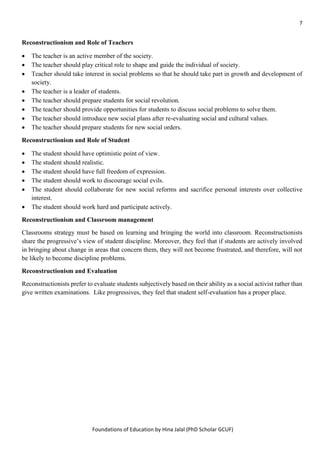
Reconstructionism and Role of Teachers
• The teacher is an active member of the society.
• The teacher should play critical role to shape and guide the individual of society.
• Teacher should take interest in social problems so that he should take part in growth and development of
society.
• The teacher is a leader of students.
• The teacher should prepare students for social revolution.
• The teacher should provide opportunities for students to discuss social problems to solve them.
• The teacher should introduce new social plans after re-evaluating social and cultural values.
• The teacher should prepare students for new social orders.
Reconstructionism and Role of Student
• The student should have optimistic point of view.
• The student should realistic.
• The student should have full freedom of expression.
• The student should work to discourage social evils.
• The student should collaborate for new social reforms and sacrifice personal interests over collective
interest.
• The student should work hard and participate actively.
Reconstructionism and Classroom management
Classrooms strategy must be based on learning and bringing the world into classroom. Reconstructionists
share the progressive’s view of student discipline. Moreover, they feel that if students are actively involved
in bringing about change in areas that concern them, they will not become frustrated, and therefore, will not
be likely to become discipline problems.
Reconstructionism and Evaluation
Reconstructionists prefer to evaluate students subjectively based on their ability as a social activist rather than
give written examinations. Like progressives, they feel that student self-evaluation has a proper place.
8
Foundations of Education by Hina Jalal (PhD Scholar GCUF)
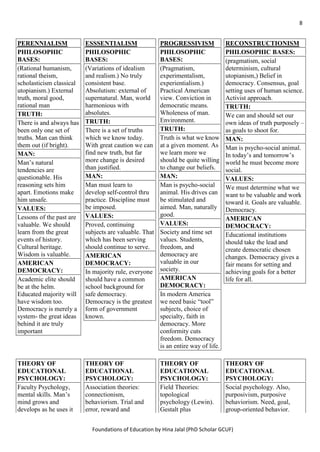
PERENNIALISM
PHILOSOPHIC
BASES:
(Rational humanism,
rational theism,
scholasticism classical
utopianism.) External
truth, moral good,
rational man
TRUTH:
There is and always has
been only one set of
truths. Man can think
them out (if bright).
MAN:
Man’s natural
tendencies are
questionable. His
reasoning sets him
apart. Emotions make
him unsafe.
VALUES:
Lessons of the past are
valuable. We should
learn from the great
events of history.
Cultural heritage.
Wisdom is valuable.
AMERICAN
DEMOCRACY:
Academic elite should
be at the helm.
Educated majority will
have wisdom too.
Democracy is merely a
system- the great ideas
behind it are truly
important
ESSSENTIALISM
PHILOSOPHIC
BASES:
(Variations of idealism
and realism.) No truly
consistent base.
Absolutism: external of
supernatural. Man, world
harmonious with
absolutes.
TRUTH:
There is a set of truths
which we know today.
With great caution we can
find new truth, but far
more change is desired
than justified.
MAN:
Man must learn to
develop self-control thru
practice. Discipline must
be imposed.
VALUES:
Proved, continuing
subjects are valuable. That
which has been serving
should continue to serve.
AMERICAN
DEMOCRACY:
In majority rule, everyone
should have a common
school background for
safe democracy.
Democracy is the greatest
form of government
known.
PROGRESSIVISM
PHILOSOPHIC
BASES:
(Pragmatism,
experimentalism,
experientialism.)
Practical American
view. Conviction in
democratic means.
Wholeness of man.
Environment.
TRUTH:
Truth is what we know
at a given moment. As
we learn more we
should be quite willing
to change our beliefs.
MAN:
Man is psycho-social
animal. His drives can
be stimulated and
aimed. Man, naturally
good.
VALUES:
Society and time set
values. Students,
freedom, and
democracy are
valuable in our
society.
AMERICAN
DEMOCRACY:
In modern America
we need basic “tool”
subjects, choice of
specialty, faith in
democracy. More
conformity cuts
freedom. Democracy
is an entire way of life.
RECONSTRUCTIONISM
PHILOSOPHIC BASES:
(pragmatism, social
determinism, cultural
utopianism,) Belief in
democracy. Consensus, goal
setting uses of human science.
Activist approach.
TRUTH:
We can and should set our
own ideas of truth purposely –
as goals to shoot for.
MAN:
Man is psycho-social animal.
In today’s and tomorrow’s
world he must become more
social.
VALUES:
We must determine what we
want to be valuable and work
toward it. Goals are valuable.
Democracy.
AMERICAN
DEMOCRACY:
Educational institutions
should take the lead and
create democratic chosen
changes. Democracy gives a
fair means for setting and
achieving goals for a better
life for all.
THEORY OF
EDUCATIONAL
PSYCHOLOGY:
Faculty Psychology,
mental skills. Man’s
mind grows and
develops as he uses it
THEORY OF
EDUCATIONAL
PSYCHOLOGY:
Association theories:
connectionism,
behaviorism. Trial and
error, reward and
THEORY OF
EDUCATIONAL
PSYCHOLOGY:
Field Theories:
topological
psychology (Lewin).
Gestalt plus
THEORY OF
EDUCATIONAL
PSYCHOLOGY:
Social psychology. Also,
purposivism, purposive
behaviorism. Need, goal,
group-oriented behavior.
9
Foundations of Education by Hina Jalal (PhD Scholar GCUF)
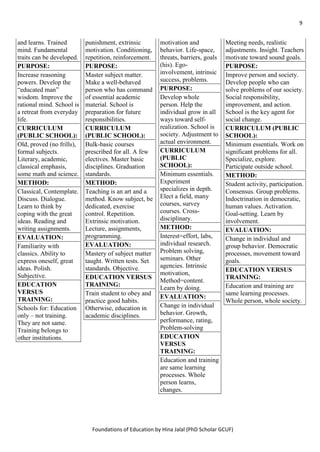
and learns. Trained
mind. Fundamental
traits can be developed.
PURPOSE:
Increase reasoning
powers. Develop the
“educated man”
wisdom. Improve the
rational mind. School is
a retreat from everyday
life.
CURRICULUM
(PUBLIC SCHOOL):
Old, proved (no frills),
formal subjects.
Literary, academic,
classical emphasis,
some math and science.
METHOD:
Classical, Contemplate.
Discuss. Dialogue.
Learn to think by
coping with the great
ideas. Reading and
writing assignments.
EVALUATION:
Familiarity with
classics. Ability to
express oneself, great
ideas. Polish.
Subjective.
EDUCATION
VERSUS
TRAINING:
Schools for: Education
only – not training.
They are not same.
Training belongs to
other institutions.
punishment, extrinsic
motivation. Conditioning,
repetition, reinforcement.
PURPOSE:
Master subject matter.
Make a well-behaved
person who has command
of essential academic
material. School is
preparation for future
responsibilities.
CURRICULUM
(PUBLIC SCHOOL):
Bulk-basic courses
prescribed for all. A few
electives. Master basic
disciplines. Graduation
standards.
METHOD:
Teaching is an art and a
method. Know subject, be
dedicated, exercise
control. Repetition.
Extrinsic motivation.
Lecture, assignments,
programming.
EVALUATION:
Mastery of subject matter
taught. Written tests. Set
standards. Objective.
EDUCATION VERSUS
TRAINING:
Train student to obey and
practice good habits.
Otherwise, education in
academic disciplines.
motivation and
behavior. Life-space,
threats, barriers, goals
(his). Ego-
involvement, intrinsic
success, problems.
PURPOSE:
Develop whole
person. Help the
individual grow in all
ways toward self-
realization. School is
society. Adjustment to
actual environment.
CURRICULUM
(PUBLIC
SCHOOL):
Minimum essentials.
Experiment
specializes in depth.
Elect a field, many
courses, survey
courses. Cross-
disciplinary.
METHOD:
Interest=effort, labs,
individual research.
Problem solving,
seminars. Other
agencies. Intrinsic
motivation,
Method=content.
Learn by doing.
EVALUATION:
Change in individual
behavior. Growth,
performance, rating,
Problem-solving
EDUCATION
VERSUS
TRAINING:
Education and training
are same learning
processes. Whole
person learns,
changes.
Meeting needs, realistic
adjustments. Insight. Teachers
motivate toward sound goals.
PURPOSE:
Improve person and society.
Develop people who can
solve problems of our society.
Social responsibility,
improvement, and action.
School is the key agent for
social change.
CURRICULUM (PUBLIC
SCHOOL):
Minimum essentials. Work on
significant problems for all.
Specialize, explore.
Participate outside school.
METHOD:
Student activity, participation.
Consensus. Group problems.
Indoctrination in democratic,
human values. Activation.
Goal-setting. Learn by
involvement.
EVALUATION:
Change in individual and
group behavior. Democratic
processes, movement toward
goals.
EDUCATION VERSUS
TRAINING:
Education and training are
same learning processes.
Whole person, whole society.
10
Foundations of Education by Hina Jalal (PhD Scholar GCUF)
11
Foundations of Education by Hina Jalal (PhD Scholar GCUF)