Progressive Education

        Presented By
       Ms. Gurkirat Kaur
Pioneers of
        Progressive Education

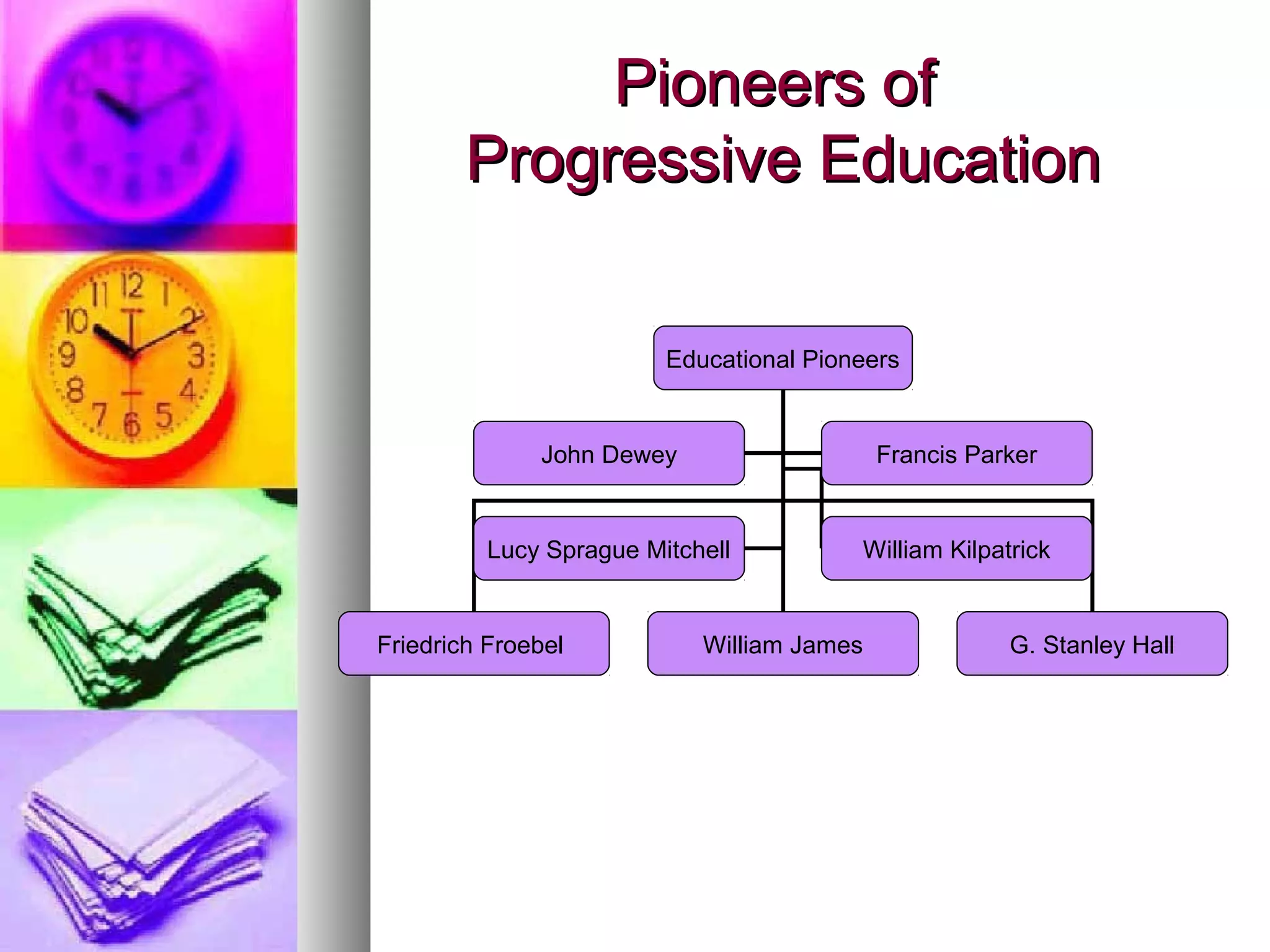
                         Educational Pioneers


              John Dewey                    Francis Parker


          Lucy Sprague Mitchell          William Kilpatrick


Friedrich Froebel           William James              G. Stanley Hall
The Progressive Education
was an attempt towards

1. The child should have freedom to develop naturally.
2. Natural interest is the best motive for work.
3. The teacher is a guide, not a taskmaster.
4. A student’s development must be measured
scientifically, not just by grades.
5. Students’ general health and physical development
require attention.
6. The school and the home must work together to meet
children’s needs.
7. The progressive school should be a leader in trying new
educational ideas”
Two main approaches of
progressive education are

  ‘child-centred’ education -
  which aims to give children the
  freedom to develop naturally in
  a democratic environment, and,
  ‘social-reconstructionism’ -
  which focuses on a curriculum
  highlighting social reform as the
  aim of education
Attributes

•Emphasis on learning by doing – hands-on
projects, expeditionary learning, experiential
learning
•Integrated curriculum focused on thematic
units
•Strong emphasis on problem solving and
critical thinking
•Group work and development of social skills
•Understanding and action as the goals of
learning as opposed to rote knowledge
Attributes

 •Collaborative and cooperative learning projects
 •Education for social responsibility and
 democracy
 •Integration of community service and service
 learning projects into the daily curriculum
 •Selection of subject content by looking forward
 to ask what skills will be needed in future society
 •De-emphasis on textbooks in favor of varied
 learning resources
 •Emphasis on lifelong learning and social skills
 •Assessment by evaluation of child’s projects
 and productions
Criticism of
       Progressive Education
   Strongest critic is E. D. Hirsch Jr.
   According to Hirsch, “from kindergarten
    through high school, our public educational
    system is among the worst in the
    developed world. For over fifty years,
    American schools have operated on the
    assumption that challenging children
    academically is unnatural for them, that
    teachers do not need to know the subjects
    they teach, that the learning ‘process’
    should be emphasized over the facts
    taught. All this is tragically wrong.”

Progressive education

  • 1.
    Progressive Education Presented By Ms. Gurkirat Kaur
  • 2.
    Pioneers of Progressive Education Educational Pioneers John Dewey Francis Parker Lucy Sprague Mitchell William Kilpatrick Friedrich Froebel William James G. Stanley Hall
  • 3.
    The Progressive Education wasan attempt towards 1. The child should have freedom to develop naturally. 2. Natural interest is the best motive for work. 3. The teacher is a guide, not a taskmaster. 4. A student’s development must be measured scientifically, not just by grades. 5. Students’ general health and physical development require attention. 6. The school and the home must work together to meet children’s needs. 7. The progressive school should be a leader in trying new educational ideas”
  • 4.
    Two main approachesof progressive education are ‘child-centred’ education - which aims to give children the freedom to develop naturally in a democratic environment, and, ‘social-reconstructionism’ - which focuses on a curriculum highlighting social reform as the aim of education
  • 5.
    Attributes •Emphasis on learningby doing – hands-on projects, expeditionary learning, experiential learning •Integrated curriculum focused on thematic units •Strong emphasis on problem solving and critical thinking •Group work and development of social skills •Understanding and action as the goals of learning as opposed to rote knowledge
  • 6.
    Attributes •Collaborative andcooperative learning projects •Education for social responsibility and democracy •Integration of community service and service learning projects into the daily curriculum •Selection of subject content by looking forward to ask what skills will be needed in future society •De-emphasis on textbooks in favor of varied learning resources •Emphasis on lifelong learning and social skills •Assessment by evaluation of child’s projects and productions
  • 7.
    Criticism of Progressive Education  Strongest critic is E. D. Hirsch Jr.  According to Hirsch, “from kindergarten through high school, our public educational system is among the worst in the developed world. For over fifty years, American schools have operated on the assumption that challenging children academically is unnatural for them, that teachers do not need to know the subjects they teach, that the learning ‘process’ should be emphasized over the facts taught. All this is tragically wrong.”

Editor's Notes