PROGRESSIVISM
Chapter Report
BOOK IDENTIFICATION
 Title of the book: Curriculum Renewal in School
foreign Language Learning.
 Title of chapter : Progressivism
 The writer : John L. Cark.
 The year of publication: 1987
 Publisher: Oxford University Press
WHAT IS PROGRESSIVISM?
 Progressivism is the educational philosophy
which is grounded in the “pure” philosophy of
pragmatism.
 Pragmatic ontology holds that reality is in the
area of everyday life, personal experience. Its
view is that ideas should be tested for their
utility.
 Progressivism focuses on real-world problem
solving and individual development.
 The leading spokesmen for progressivism were
the academic philosopher John Dewey and
Rousseau
THE FOCUS OF PROGRESSIVISM
 Individual growth from within through interaction with
a favourable environment.
 Learning through experience (learning by doing rather
than by being taught)
 A speculative view of knowledge (knowledge is never
static).
 Natural learning processes and stages of development.
 Sensitivity to the interests, rhythms, and styles of
learning of individual learners.
 The learner as a whole person
 The social nature of the learner and the development of
healthy relationship with others in the classroom
community.
 The promotion of learner responsibility and of learning
PROGRESSIVISM IN CURRICULUM DESIGN
 It is a process approach design.
 It emphasizes methodology and the need for
principles to govern the teaching/learning
process.
 The principles of process approach are designed
to promote inquiry, activity, discussion,
reflection, and open-ended personal
interpretations feature in the classroom.
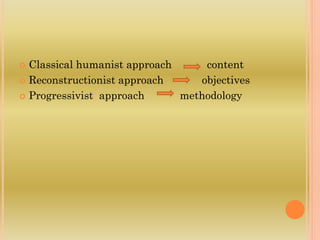
 Classical humanist approach content
 Reconstructionist approach objectives
 Progressivist approach methodology
SOME CONCRETE PROPOSALS AND
PRACTICES UNDERLYING THE
PROCESS APPROACH
1. A pre-production phase
As pointed out by Krashen and Terrel that this phase
involves little real communication. The sort of
activities suggested for this phase are indicated
below. All involve a great deal of teacher-talk.
 Commands and instruction
 Routine classroom management talk
 Descriptions of objects, people, or diagrams for pupils
to draw.
 Story-telling, with pictures to assist understanding.
2. The Procedural syllabus
 The tasks were to be selected on two principles: that
they should represent an appropriate level of challenge
(neither too easy nor too difficult) for the pupil, and
that they should engage the pupil’s mind, so that there
would be a genuine preoccupation with understanding,
thinking out, doing, or saying something.
 Brumfit has called the deep-end approach in which the
learners first communicate as far as possible with
what they can.
3. The deep-end approach
 Breen and Candlin (1980) proposed such a version of
‘process’ approach which permits concious observation
of language experienced, discovery of rules, and
metalingual discussion.
PROGRESSIVISM IN CURRICULUM RENEWAL
 Progressivist curriculum renewal is both teacher-
based and school based.
 It tends to place its emphasis on the need for
teachers to work out their own solutions to their
own curricular problems in the context of their
own school.
A CRITIQUE OF PROGRESSIVISM
 This approach has seldom been applied in any
serious way in education because it is difficult to
criticize it from an experiential viewpoint.
PROGRESSIVISM (RICHARD’S ARTICLE)
 Richards discussed the progressivism on his
article as Central Design. Curriculum
development starts with the selection of teaching
activities, techniques and methods rather than
with the elaboration of a detailed language
syllabus or specification of learning outcomes.
(Curriculum Approaches in Language
Teaching: Forward, Central, and Backward
Design)
Jack C. Richards
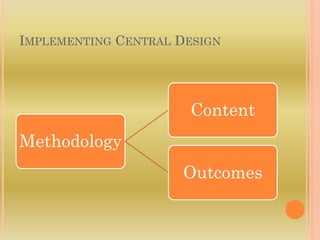
IMPLEMENTING CENTRAL DESIGN
Methodology
Content
Outcomes
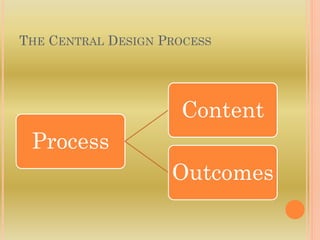
THE CENTRAL DESIGN PROCESS
Process
Content
Outcomes
PROGRESSIVISM (WINCH AND GINGELL)
 In this book, progressivism is viewed as a cluster
of doctrines concerning pedagogy, aims, and the
curriculum. It emphasizes on the individual child
as the centre of pedagogic concern.
BOOK REVIEW
 Clark’s book discusses progressivism broadly. It
presents many discussions from other
progressivists. Therefore, this book gives us more
understanding about how progressivism applied
in education system. On the other hand, there
are so many subheadings that may lead the
reader to the confusion.
 In Richard’s article on “Curriculum Approaches
in Language Teaching: Forward, Central, and
Backward Design”, progressivism is discussed
briefly in the relation of how it is applied to the
curriculum design process. This article discusses
progressivism in an easy way to understand.
 In Winch and Gingell’s book on Philosophy of
Education: The Key Concepts, they further discuss the
progressivism in relation to how the two key figures,
Rousseau and Dewey, view this doctrine. Also, they
present how progressivism is implemented in America.
CONCLUSION
 By understanding this philosophy of education,
as a teacher, we have to know which approach
can suit well to our learners’ needs. Despite of
the good points of process approach underlying
this philosophy, there are some weak points that
a teacher should be aware of.

Progressivism

  • 1.
  • 2.
    BOOK IDENTIFICATION  Titleof the book: Curriculum Renewal in School foreign Language Learning.  Title of chapter : Progressivism  The writer : John L. Cark.  The year of publication: 1987  Publisher: Oxford University Press
  • 3.
    WHAT IS PROGRESSIVISM? Progressivism is the educational philosophy which is grounded in the “pure” philosophy of pragmatism.  Pragmatic ontology holds that reality is in the area of everyday life, personal experience. Its view is that ideas should be tested for their utility.  Progressivism focuses on real-world problem solving and individual development.  The leading spokesmen for progressivism were the academic philosopher John Dewey and Rousseau
  • 4.
    THE FOCUS OFPROGRESSIVISM  Individual growth from within through interaction with a favourable environment.  Learning through experience (learning by doing rather than by being taught)  A speculative view of knowledge (knowledge is never static).  Natural learning processes and stages of development.  Sensitivity to the interests, rhythms, and styles of learning of individual learners.  The learner as a whole person  The social nature of the learner and the development of healthy relationship with others in the classroom community.  The promotion of learner responsibility and of learning
  • 5.
    PROGRESSIVISM IN CURRICULUMDESIGN  It is a process approach design.  It emphasizes methodology and the need for principles to govern the teaching/learning process.  The principles of process approach are designed to promote inquiry, activity, discussion, reflection, and open-ended personal interpretations feature in the classroom.
  • 6.
     Classical humanistapproach content  Reconstructionist approach objectives  Progressivist approach methodology
  • 7.
    SOME CONCRETE PROPOSALSAND PRACTICES UNDERLYING THE PROCESS APPROACH 1. A pre-production phase As pointed out by Krashen and Terrel that this phase involves little real communication. The sort of activities suggested for this phase are indicated below. All involve a great deal of teacher-talk.  Commands and instruction  Routine classroom management talk  Descriptions of objects, people, or diagrams for pupils to draw.  Story-telling, with pictures to assist understanding.
  • 8.
    2. The Proceduralsyllabus  The tasks were to be selected on two principles: that they should represent an appropriate level of challenge (neither too easy nor too difficult) for the pupil, and that they should engage the pupil’s mind, so that there would be a genuine preoccupation with understanding, thinking out, doing, or saying something.  Brumfit has called the deep-end approach in which the learners first communicate as far as possible with what they can.
  • 9.
    3. The deep-endapproach  Breen and Candlin (1980) proposed such a version of ‘process’ approach which permits concious observation of language experienced, discovery of rules, and metalingual discussion.
  • 10.
    PROGRESSIVISM IN CURRICULUMRENEWAL  Progressivist curriculum renewal is both teacher- based and school based.  It tends to place its emphasis on the need for teachers to work out their own solutions to their own curricular problems in the context of their own school.
  • 11.
    A CRITIQUE OFPROGRESSIVISM  This approach has seldom been applied in any serious way in education because it is difficult to criticize it from an experiential viewpoint.
  • 12.
    PROGRESSIVISM (RICHARD’S ARTICLE) Richards discussed the progressivism on his article as Central Design. Curriculum development starts with the selection of teaching activities, techniques and methods rather than with the elaboration of a detailed language syllabus or specification of learning outcomes. (Curriculum Approaches in Language Teaching: Forward, Central, and Backward Design) Jack C. Richards
  • 13.
  • 14.
    THE CENTRAL DESIGNPROCESS Process Content Outcomes
  • 15.
    PROGRESSIVISM (WINCH ANDGINGELL)  In this book, progressivism is viewed as a cluster of doctrines concerning pedagogy, aims, and the curriculum. It emphasizes on the individual child as the centre of pedagogic concern.
  • 16.
    BOOK REVIEW  Clark’sbook discusses progressivism broadly. It presents many discussions from other progressivists. Therefore, this book gives us more understanding about how progressivism applied in education system. On the other hand, there are so many subheadings that may lead the reader to the confusion.  In Richard’s article on “Curriculum Approaches in Language Teaching: Forward, Central, and Backward Design”, progressivism is discussed briefly in the relation of how it is applied to the curriculum design process. This article discusses progressivism in an easy way to understand.
  • 17.
     In Winchand Gingell’s book on Philosophy of Education: The Key Concepts, they further discuss the progressivism in relation to how the two key figures, Rousseau and Dewey, view this doctrine. Also, they present how progressivism is implemented in America.
  • 18.
    CONCLUSION  By understandingthis philosophy of education, as a teacher, we have to know which approach can suit well to our learners’ needs. Despite of the good points of process approach underlying this philosophy, there are some weak points that a teacher should be aware of.