ProductivityProductivityProductivityProductivity
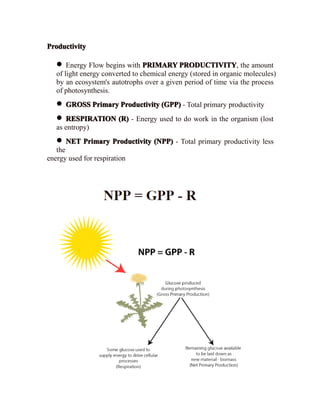
• Energy Flow begins with PRIMARYPRIMARYPRIMARYPRIMARY PRODUCTIVITYPRODUCTIVITYPRODUCTIVITYPRODUCTIVITY, the amount
of light energy converted to chemical energy (stored in organic molecules)
by an ecosystem's autotrophs over a given period of time via the process
of photosynthesis.
• GROSSGROSSGROSSGROSS PrimaryPrimaryPrimaryPrimary ProductivityProductivityProductivityProductivity (GPP)(GPP)(GPP)(GPP) - Total primary productivity
• RESPIRATIONRESPIRATIONRESPIRATIONRESPIRATION (R)(R)(R)(R) - Energy used to do work in the organism (lost
as entropy)
• NETNETNETNET PrimaryPrimaryPrimaryPrimary ProductivityProductivityProductivityProductivity (NPP)(NPP)(NPP)(NPP) - Total primary productivity less
the
energy used for respiration
Primary productivity (always expressed as a RATE) can be expressed as
• ENERGYENERGYENERGYENERGY per unit area per unit time (e.g., Joules/m2
/year)
or
• BIOMASSBIOMASSBIOMASSBIOMASS, the dry weight of vegetation added to an ecosystem per
unit area per unit time (e.g., grams/m2
/year).
STANDINGSTANDINGSTANDINGSTANDING CROPCROPCROPCROP BIOMASSBIOMASSBIOMASSBIOMASS is the dry weight of vegetation in an
ecosystem at any given "snapshot moment" in time. It is not the same as
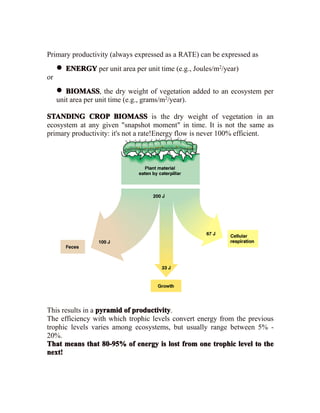
primary productivity: it's not a rate!Energy flow is never 100% efficient.
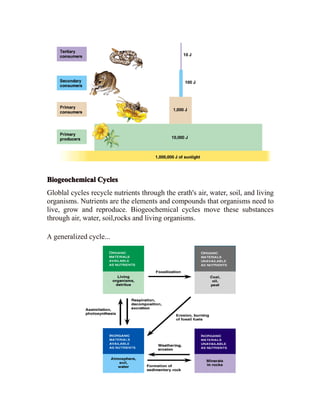
This results in a pyramidpyramidpyramidpyramid ofofofof productivityproductivityproductivityproductivity.
The efficiency with which trophic levels convert energy from the previous
trophic levels varies among ecosystems, but usually range between 5% -
20%.
ThatThatThatThat meansmeansmeansmeans thatthatthatthat 80-95%80-95%80-95%80-95% ofofofof energyenergyenergyenergy isisisis lostlostlostlost fromfromfromfrom oneoneoneone trophictrophictrophictrophic levellevellevellevel totototo thethethethe
next!next!next!next!
BiogeochemicalBiogeochemicalBiogeochemicalBiogeochemical CyclesCyclesCyclesCycles
Globlal cycles recycle nutrients through the erath's air, water, soil, and living
organisms. Nutrients are the elements and compounds that organisms need to
live, grow and reproduce. Biogeochemical cycles move these substances
through air, water, soil,rocks and living organisms.
A generalized cycle...
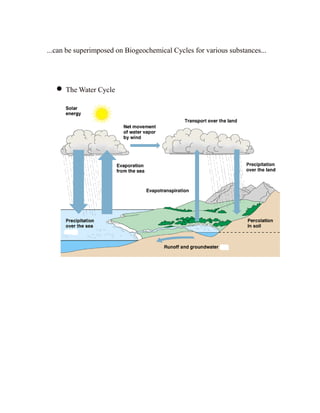
...can be superimposed on Biogeochemical Cycles for various substances...
• The Water Cycle
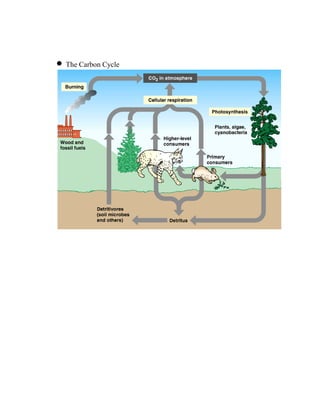
• The Carbon Cycle
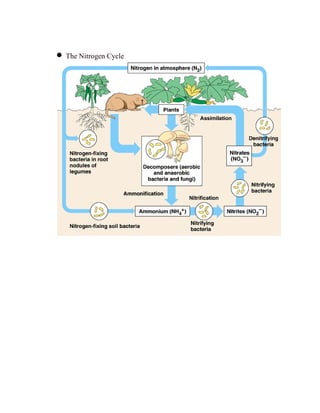
• The Nitrogen Cycle
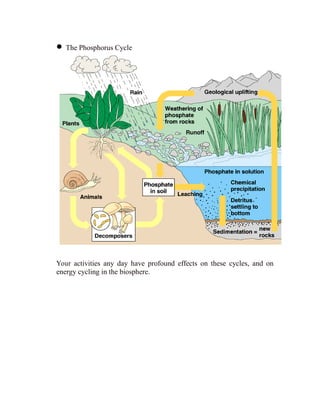
• The Phosphorus Cycle
Your activities any day have profound effects on these cycles, and on
energy cycling in the biosphere.

Productivity of ecosystem

  • 1.
    ProductivityProductivityProductivityProductivity • Energy Flowbegins with PRIMARYPRIMARYPRIMARYPRIMARY PRODUCTIVITYPRODUCTIVITYPRODUCTIVITYPRODUCTIVITY, the amount of light energy converted to chemical energy (stored in organic molecules) by an ecosystem's autotrophs over a given period of time via the process of photosynthesis. • GROSSGROSSGROSSGROSS PrimaryPrimaryPrimaryPrimary ProductivityProductivityProductivityProductivity (GPP)(GPP)(GPP)(GPP) - Total primary productivity • RESPIRATIONRESPIRATIONRESPIRATIONRESPIRATION (R)(R)(R)(R) - Energy used to do work in the organism (lost as entropy) • NETNETNETNET PrimaryPrimaryPrimaryPrimary ProductivityProductivityProductivityProductivity (NPP)(NPP)(NPP)(NPP) - Total primary productivity less the energy used for respiration
  • 2.
    Primary productivity (alwaysexpressed as a RATE) can be expressed as • ENERGYENERGYENERGYENERGY per unit area per unit time (e.g., Joules/m2 /year) or • BIOMASSBIOMASSBIOMASSBIOMASS, the dry weight of vegetation added to an ecosystem per unit area per unit time (e.g., grams/m2 /year). STANDINGSTANDINGSTANDINGSTANDING CROPCROPCROPCROP BIOMASSBIOMASSBIOMASSBIOMASS is the dry weight of vegetation in an ecosystem at any given "snapshot moment" in time. It is not the same as primary productivity: it's not a rate!Energy flow is never 100% efficient. This results in a pyramidpyramidpyramidpyramid ofofofof productivityproductivityproductivityproductivity. The efficiency with which trophic levels convert energy from the previous trophic levels varies among ecosystems, but usually range between 5% - 20%. ThatThatThatThat meansmeansmeansmeans thatthatthatthat 80-95%80-95%80-95%80-95% ofofofof energyenergyenergyenergy isisisis lostlostlostlost fromfromfromfrom oneoneoneone trophictrophictrophictrophic levellevellevellevel totototo thethethethe next!next!next!next!
  • 3.
    BiogeochemicalBiogeochemicalBiogeochemicalBiogeochemical CyclesCyclesCyclesCycles Globlal cyclesrecycle nutrients through the erath's air, water, soil, and living organisms. Nutrients are the elements and compounds that organisms need to live, grow and reproduce. Biogeochemical cycles move these substances through air, water, soil,rocks and living organisms. A generalized cycle...
  • 4.
    ...can be superimposedon Biogeochemical Cycles for various substances... • The Water Cycle
  • 5.
  • 6.
  • 7.
    • The PhosphorusCycle Your activities any day have profound effects on these cycles, and on energy cycling in the biosphere.