Definition: Productivity is a measure relating a quantity or quality of output to the inputs required
to produce it.

The amount of output per unit of input (labor, equipment, and capital). There are many different
ways of measuring productivity. For example, in a factory productivity might be measured based on
the number of hours it takes to produce a good, while in the service sector productivity might be
measured based on the revenue generated by an employee divided by his/her salary.

Productivity Concepts and Definitions

According to Fabricant productivity in the following words, “always a ratio of output and input”.

According to Kendrick and Creamer “a-Functional definitions for partial, total factor and total
productivity, b-Loose description of relationship usually in ratio form, between outputs and all of the
associated inputs in real terms”
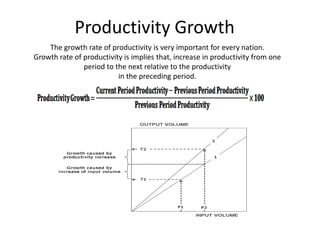
Productivity Growth
    The growth rate of productivity is very important for every nation.
Growth rate of productivity is implies that, increase in productivity from one
               period to the next relative to the productivity
                          in the preceding period.
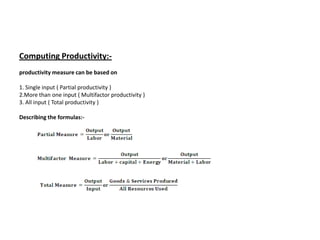
Computing Productivity:-
productivity measure can be based on

1. Single input ( Partial productivity )
2.More than one input ( Multifactor productivity )
3. All input ( Total productivity )

Describing the formulas:-
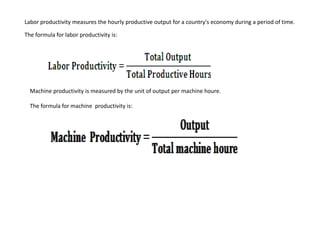
Labor productivity measures the hourly productive output for a country's economy during a period of time.

The formula for labor productivity is:


  Machine productivity is measured by the unit of output per machine houre.

  The formula for machine productivity is:
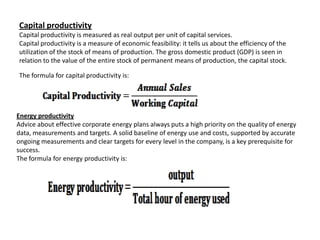
Capital productivity
Capital productivity is measured as real output per unit of capital services.
Capital productivity is a measure of economic feasibility: it tells us about the efficiency of the
utilization of the stock of means of production. The gross domestic product (GDP) is seen in
relation to the value of the entire stock of permanent means of production, the capital stock.

The formula for capital productivity is:


Energy productivity
Advice about effective corporate energy plans always puts a high priority on the quality of energy
data, measurements and targets. A solid baseline of energy use and costs, supported by accurate
ongoing measurements and clear targets for every level in the company, is a key prerequisite for
success.
The formula for energy productivity is:

Productivity

  • 2.
    Definition: Productivity isa measure relating a quantity or quality of output to the inputs required to produce it. The amount of output per unit of input (labor, equipment, and capital). There are many different ways of measuring productivity. For example, in a factory productivity might be measured based on the number of hours it takes to produce a good, while in the service sector productivity might be measured based on the revenue generated by an employee divided by his/her salary. Productivity Concepts and Definitions According to Fabricant productivity in the following words, “always a ratio of output and input”. According to Kendrick and Creamer “a-Functional definitions for partial, total factor and total productivity, b-Loose description of relationship usually in ratio form, between outputs and all of the associated inputs in real terms”
  • 3.
    Productivity Growth The growth rate of productivity is very important for every nation. Growth rate of productivity is implies that, increase in productivity from one period to the next relative to the productivity in the preceding period.
  • 4.
    Computing Productivity:- productivity measurecan be based on 1. Single input ( Partial productivity ) 2.More than one input ( Multifactor productivity ) 3. All input ( Total productivity ) Describing the formulas:-
  • 5.
    Labor productivity measuresthe hourly productive output for a country's economy during a period of time. The formula for labor productivity is: Machine productivity is measured by the unit of output per machine houre. The formula for machine productivity is:
  • 6.
    Capital productivity Capital productivityis measured as real output per unit of capital services. Capital productivity is a measure of economic feasibility: it tells us about the efficiency of the utilization of the stock of means of production. The gross domestic product (GDP) is seen in relation to the value of the entire stock of permanent means of production, the capital stock. The formula for capital productivity is: Energy productivity Advice about effective corporate energy plans always puts a high priority on the quality of energy data, measurements and targets. A solid baseline of energy use and costs, supported by accurate ongoing measurements and clear targets for every level in the company, is a key prerequisite for success. The formula for energy productivity is: