Definition of
Productivity
Productivity: Definition

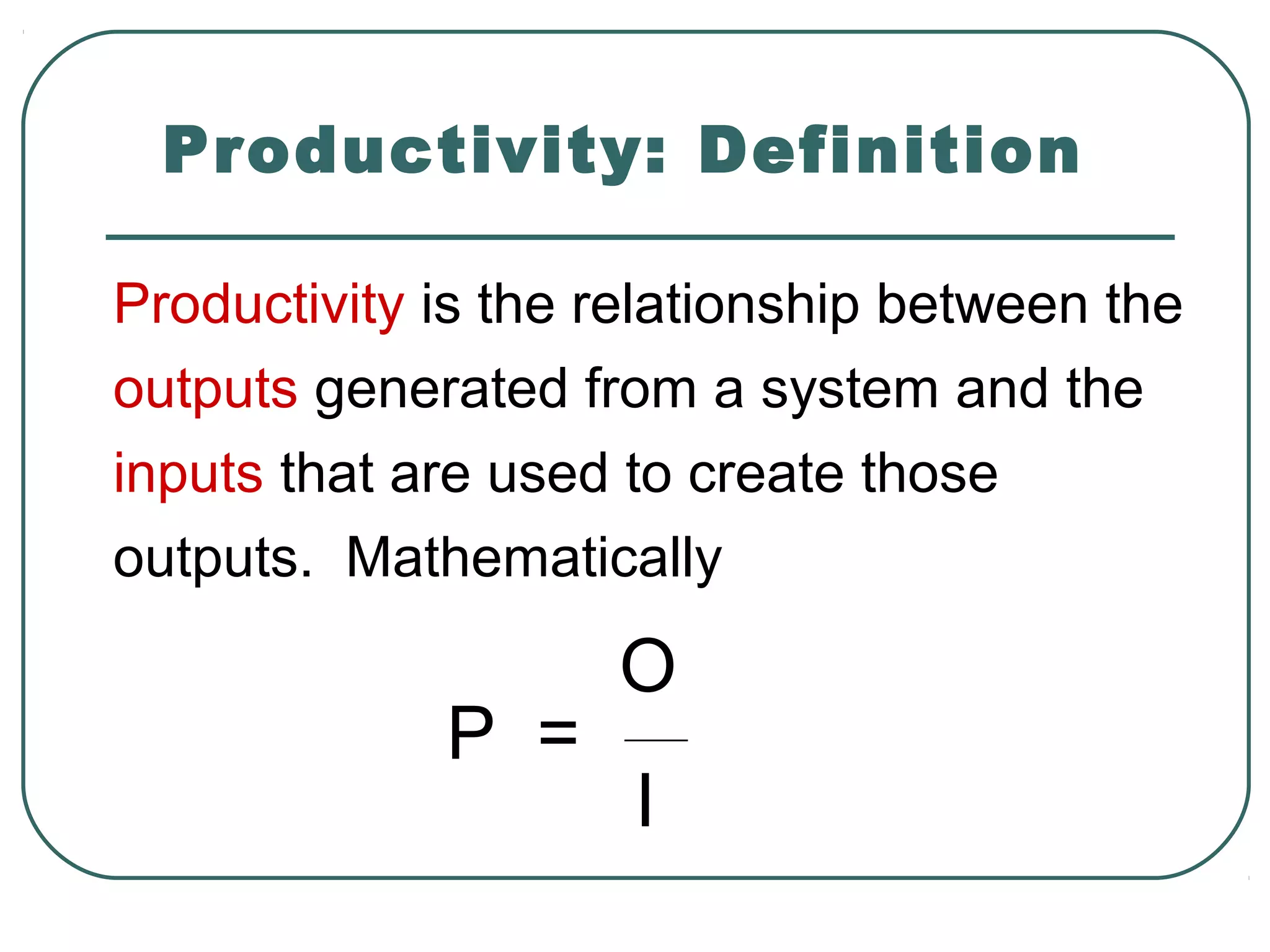
Productivity is the relationship between the
outputs generated from a system and the
inputs that are used to create those
outputs. Mathematically

                    O
             P =
                     I
Systems Concept


 inputs                            outputs
                 transformations               Customers
    Land                            Goods
   people           SYSTEM          and
   capital                          services
  facilities
 equipment
    tools              O
   energy              I
  materials
information       productivity
Mathematically, How Can We
  Increase Productivity?
Productivity Improvement

Productivity Improvement (PI) is the result of
managing and intervening in transformation
or work processes.
PI will occur if:

  O O                O O O
  I I                I I I
Measuring Productivity
 Static: P=O/I in a given period of time (t).
  Useful for benchmarking purposes.
 Dynamic:   p(1)=O(1)/I(1); p(2)=O(2)/I(2);
  then p(2)/p(1) yields a dimensionless index
  that reflects change in productivity between
  periods. ((p(2)-p(1))/p(1))*100 yields the
  percentage change between periods.
Measuring Productivity
                    (Continued)

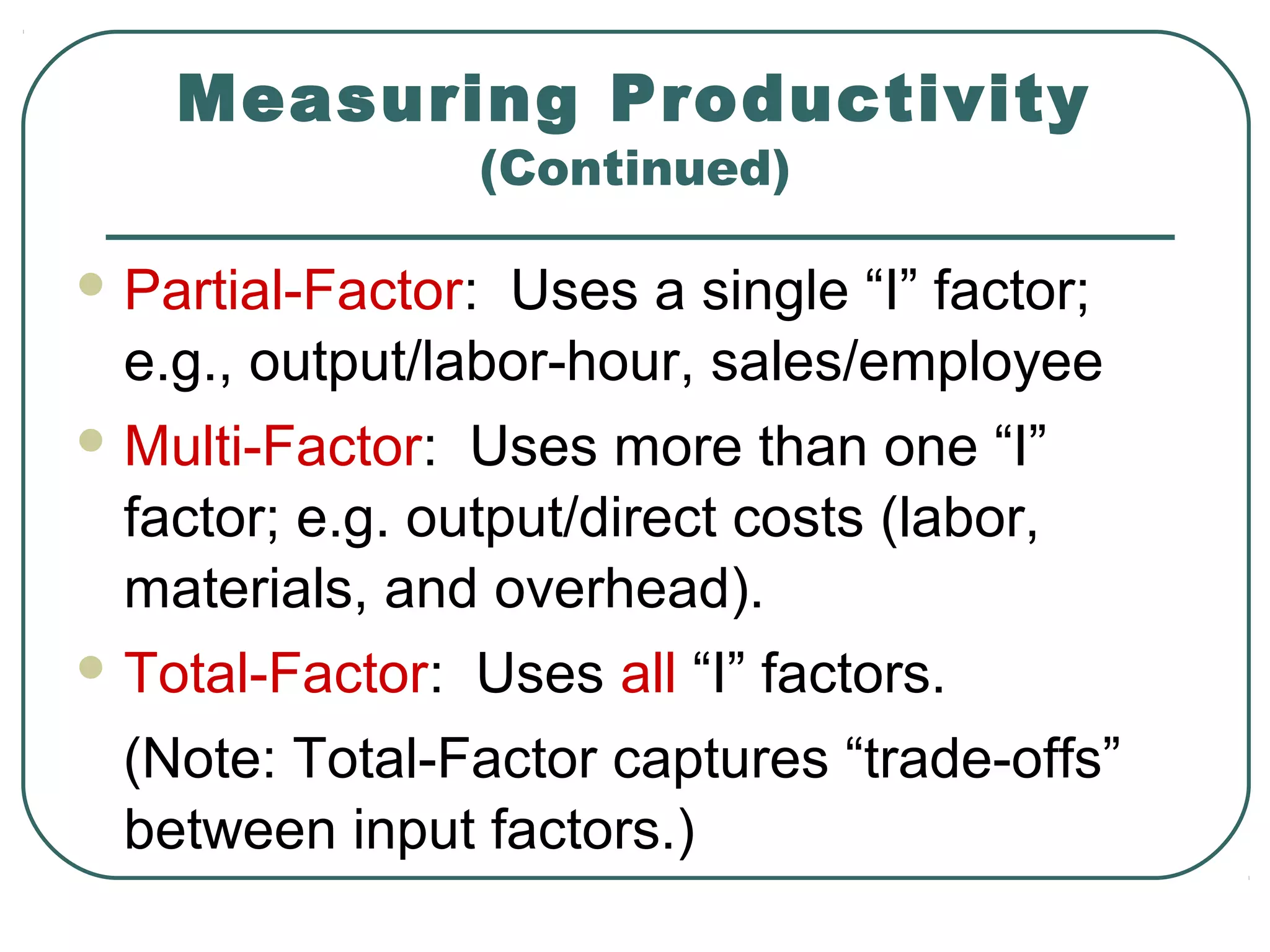
 Partial-Factor: Uses a single “I” factor;
  e.g., output/labor-hour, sales/employee
 Multi-Factor:  Uses more than one “I”
  factor; e.g. output/direct costs (labor,
  materials, and overhead).
 Total-Factor:   Uses all “I” factors.
 (Note: Total-Factor captures “trade-offs”
 between input factors.)
Measurement Problems

 Multiple   products/services (aggregation-O)
 Varied   categories, types, and levels of input
 resources (aggregation-I)
 Price/cost   changes of outputs & inputs
 Redesigned     products, services, processes
 “Hard-to-measure”    factors (e.g., quality)
Application of Productivity
         Measures

        Individual   level
        Group    level
        Department       level
        Corporate    level
        National   level
        Global   level
Global-Level Productivity

 Why   are global-level productivity measures
 important?
 How   do we compare productivity among
 nations?
 How   can a nation increase productivity in a
 global economy?
Importance of Global-Level
      Productivity Measures
 Measure
        and compare competitiveness
 among nations.
 Contribute
           to the development of a nation’s
 economic, social, and political policies.
 Develop   global cooperation among nations.
 Helpbusiness organizations make
 investment decisions.
Global-Level Productivity
             Measures
 Organisationfor Economic Co-operation
 and Development (OECD) –
 http://www.oecd.org/home/
 GDP per capita (labor productivity * fraction
 of people who work) is widely regarded as
 the best measure.
Acommon currency is used to measure the
 GDP.
Factors Affecting Productivity
 Improvement at Global Level
     Education

     Technology

     Macroeconomic     policies
     Social   and culture environments
     Foreign    aids
     Foreign    investments
     Industry   policies & competition
Why is National Productivity
        Important?
Competing on Productivity

 At   the national level, growing productivity
  • leads to a higher standard of living
  • holds inflation in check
  • enhances international competitiveness.
 The   annual GDP growth is partially due to
  • growth in productivity
  • growth in inflation
National Productivity Measures
      (http://www.bls.gov/)

 Comparisons     within a segment of
 economy over time
 Comparisons     of specific productivity
 measures
 International   comparisons
Labor Productivity -
      Percent Change from
         Previous Year
                                     1994 -
                2001   2002   2003
                                     2003

Business
                2.2    4.9    4.5    2.6
Sector

Non-Farm
                2.1    5.0    4.4    2.6
Sector

Manufacturing   2.2    7.2    5.1    4.2
Other Measures Affecting
      Productivity

      Efficiency

      Effectiveness

      Quality

      Quality   of Work Life
      Innovation
Efficiency

 Measures   the resources expected to be
 consumed to the resources actually
 consumed.
 Hence,   it focuses on the input side of the
 system. (To what degree did the system
 utilize the “right” things.)
Effectiveness

 Measures   what the system sets out to
 accomplish (objective) with what was
 actually accomplished; plan vs. actual
 Hence,   effectiveness is an output measure.
  (Is the output “right” - right quality, right
 quantity, on time, etc.)
Quality

 Degree to which the outputs (products and
 services) from the system conform to
 requirements or meet customer
 expectations.
 Thefocus is on quality attributes (e.g.,
 conformance, performance, convenience,
 responsiveness, perceived quality.)
Quality of Work Life (QWL)

 Measures the way that employees in a
 system respond to the sociotechnical
 aspects of that system.
Innovation

 Measures   the applied creativity of the
 system.
 Relates
        to the design and development of
 improved products, services, and
 processes.
How Do Those Other Measures
    Affect Productivity?

Overview -productivity management

  • 1.
  • 2.
    Productivity: Definition Productivity isthe relationship between the outputs generated from a system and the inputs that are used to create those outputs. Mathematically O P = I
  • 3.
    Systems Concept inputs outputs transformations Customers Land Goods people SYSTEM and capital services facilities equipment tools O energy I materials information productivity
  • 4.
    Mathematically, How CanWe Increase Productivity?
  • 5.
    Productivity Improvement Productivity Improvement(PI) is the result of managing and intervening in transformation or work processes. PI will occur if: O O O O O I I I I I
  • 6.
    Measuring Productivity  Static:P=O/I in a given period of time (t). Useful for benchmarking purposes.  Dynamic: p(1)=O(1)/I(1); p(2)=O(2)/I(2); then p(2)/p(1) yields a dimensionless index that reflects change in productivity between periods. ((p(2)-p(1))/p(1))*100 yields the percentage change between periods.
  • 7.
    Measuring Productivity (Continued)  Partial-Factor: Uses a single “I” factor; e.g., output/labor-hour, sales/employee  Multi-Factor: Uses more than one “I” factor; e.g. output/direct costs (labor, materials, and overhead).  Total-Factor: Uses all “I” factors. (Note: Total-Factor captures “trade-offs” between input factors.)
  • 8.
    Measurement Problems  Multiple products/services (aggregation-O)  Varied categories, types, and levels of input resources (aggregation-I)  Price/cost changes of outputs & inputs  Redesigned products, services, processes  “Hard-to-measure” factors (e.g., quality)
  • 9.
    Application of Productivity Measures  Individual level  Group level  Department level  Corporate level  National level  Global level
  • 10.
    Global-Level Productivity  Why are global-level productivity measures important?  How do we compare productivity among nations?  How can a nation increase productivity in a global economy?
  • 11.
    Importance of Global-Level Productivity Measures  Measure and compare competitiveness among nations.  Contribute to the development of a nation’s economic, social, and political policies.  Develop global cooperation among nations.  Helpbusiness organizations make investment decisions.
  • 12.
    Global-Level Productivity Measures  Organisationfor Economic Co-operation and Development (OECD) – http://www.oecd.org/home/  GDP per capita (labor productivity * fraction of people who work) is widely regarded as the best measure. Acommon currency is used to measure the GDP.
  • 13.
    Factors Affecting Productivity Improvement at Global Level  Education  Technology  Macroeconomic policies  Social and culture environments  Foreign aids  Foreign investments  Industry policies & competition
  • 14.
    Why is NationalProductivity Important?
  • 15.
    Competing on Productivity At the national level, growing productivity • leads to a higher standard of living • holds inflation in check • enhances international competitiveness.  The annual GDP growth is partially due to • growth in productivity • growth in inflation
  • 16.
    National Productivity Measures (http://www.bls.gov/)  Comparisons within a segment of economy over time  Comparisons of specific productivity measures  International comparisons
  • 17.
    Labor Productivity - Percent Change from Previous Year 1994 - 2001 2002 2003 2003 Business 2.2 4.9 4.5 2.6 Sector Non-Farm 2.1 5.0 4.4 2.6 Sector Manufacturing 2.2 7.2 5.1 4.2
  • 18.
    Other Measures Affecting Productivity  Efficiency  Effectiveness  Quality  Quality of Work Life  Innovation
  • 19.
    Efficiency  Measures the resources expected to be consumed to the resources actually consumed.  Hence, it focuses on the input side of the system. (To what degree did the system utilize the “right” things.)
  • 20.
    Effectiveness  Measures what the system sets out to accomplish (objective) with what was actually accomplished; plan vs. actual  Hence, effectiveness is an output measure. (Is the output “right” - right quality, right quantity, on time, etc.)
  • 21.
    Quality  Degree towhich the outputs (products and services) from the system conform to requirements or meet customer expectations.  Thefocus is on quality attributes (e.g., conformance, performance, convenience, responsiveness, perceived quality.)
  • 22.
    Quality of WorkLife (QWL)  Measures the way that employees in a system respond to the sociotechnical aspects of that system.
  • 23.
    Innovation  Measures the applied creativity of the system.  Relates to the design and development of improved products, services, and processes.
  • 24.
    How Do ThoseOther Measures Affect Productivity?