PRODUCTIVITY
AND QUALITY
TOOLS
Instructor: Isaiah Jacob O. Carolino
Gmail: ijocarolino@gmail.com
The productivity of a company’s workforce plays a
key role in its profitability and competitiveness. It
makes sense: Increase productivity levels and you
can expect to generate higher profits without adding
headcount. That boosts the likelihood of long-term
success in competitive markets.
So, it’s important that business leaders understand
how to measure productivity, then use that data to
identify and overcome obstacles to making their
workforces more productive.
What Is Productivity?
Productivity is a measure of economic orbusiness performance that
indicates how efficientlypeople, companies,industries and whole
economies convertinputs, such as labor and capital, into outputs, such as
goods or services.Productivity can be measured at any of these five levels:
Personal productivity:
The term “personalproductivity” is often used to describehow much
individuals can accomplishevery day in their personal lives, not just in the
workplace.
Workforce productivity:
Workforceproductivity, the focus of this article, is the aggregate
productivity of all individuals in a company’s workforce.
Sector productivity:
The aggregate productivity of all companies in an industry or sectoris an
expressionof the sector’s productivity.
Team or department productivity:
The collective output of one or more individuals united under a common
goal.
National or global productivity:
The aggregate productivity of all industries in an economyis an expression
of the economy’s productivity.
Key Takeaways
 Productivity is key to a company’s profitability and ability to thrive.
 Workforce productivity is a measure of how efficiently a company
converts inputs, such as labor or capital, into outputs, such as goods
and services.
 Obstacles to increasing productivity include too much email, too many
meetings, too many manual processes and industry-lagging technology.
Simple fixes can help address these problems.
 Identifying and tracking productivity metrics can help companies
manage and improve workforce productivity.
 Performance management software can make it easier to measure and
manage productivity.
Productivity for Businesses Explained
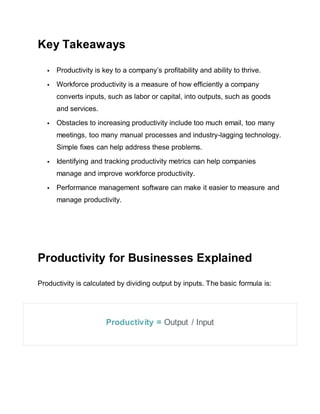
Productivity is calculated by dividing output by inputs. The basic formula is:
Productivity = Output / Input
Output is typically measured as the dollar value or the units of products and
services that a company produces. Inputs are any resource used to create
products and services. The two most common types of input are
capital — which includes investments in assets used for production, such as
manufacturing equipment and computers — and labor. Other inputs may
include energy, technology, materials and purchased services.
 Labor productivity measures the output per hour of labor.
 Capital productivity is the productivity attributable to the money
invested in assets used to produce your company’s output.
How Does Productivity Work?
Productivity goes up when output increases at a faster rate than inputs or
when a company can generate the same output with lower inputs. Here’s an
example that shows how this works, exploring the effect of different inputs.
Suppose you own an apple orchard, and you’re looking at ways to increase
the productivity of your annual apple-picking operation. Currently, your
company’s 50 workers can pick a total of 10,000 large apples per hour by
hand, on average. Your hourly labor productivity is therefore 10,000 apples/50
people = 200 apples per hour per picker. Not bad, but you see four options to
do better, beyond just pushing people to work harder:
1. Technological improvements: You can add inputs in the form of
technological improvements that expand output by more than their cost. If you
provide each apple-picker with Acme’s Super-Duper Apple-Picking Machine,
labor productivity jumps twofold: They can each pick 400 apples per hour.
2. Technical efficiency: Companies can improve technical efficiency by
using their existing technology or skills more efficiently. Perhaps your workers
can do better than 200 apples per hour if they become more skilled at picking
apples by hand.
3. Organizational improvements: You may be able to improve hourly output
by reorganizing apple-picking teams so they more efficiently cover the entire
orchard.
4. Increasing scale: You may be able to increase productivity by expanding
your operation. Doubling your apple output may require you to double the size
of your orchard, the number of pickers you employ and the number of
machines they use. But it won’t require you to build a second headquarters
building, hire twice as many administrative workers or double your marketing
and advertising budget. Your output will double, but your inputs will not.
Why Is Productivity Important?
Because it’s a measure of efficiency, productivity is key to winning in a
competitive marketplace. Increase your productivity and you can generate
higher profits — or charge lower prices and take customers away from your
competitors. On the other hand, if your productivity declines or increases more
slowly than competitors, you may be unable to operate profitably or suffer
from sluggish growth.
Benefits of Increased Productivity for
Businesses
The basic advantages of higher productivity — greater competitiveness and
profitability — can generate a broad range of additional business benefits.
They include:
 Higher customer satisfaction: Customers will be happy if your
company’s increased efficiency enables you to reduce prices or deliver
goods and services faster.
 Better terms from suppliers: If greater productivity enables the
company to increase production, it can buy raw materials and
components in larger quantities, which usually means it can obtain them
at lower prices.
 More attractive wages: Higher productivity can make it possible to pay
higher wages, which can help attract employees.
 Increased access to capital: When improved productivity translates
into higher profits, that can pave a smoother path to obtaining funding,
either by issuing equity or borrowing.
Common Business Productivity
Challenges and Pitfalls
Most companies don’t operate at maximum productivity. We’ve all heard
the stats about disengagedemployees who “work” only a few hours per
day — and that’s only one of many challenges to achieving greater
productivity. Some are easier to overcome than others.
Here are six commonpitfalls:
Achieving “busyness”rather thanproductivity. People oftentell
themselves that they are being productive because they’re working long
hours. But they may actually be working harder instead of “smarter, faster,
better,” as bestselling writer and productivity guru Charles Duhigg
describesit. Companies that reward people formerely looking busy may
not achieve high productivity. The answer is to measure outputs and focus
on improving them.
Inefficientmeetings. Inefficientand unnecessary meetings can eat into
productivity for everyone involved. Companies can increase efficiencyby
starting and ending meetings promptly, requiring a clear agenda, ensuring
all attendees come prepared and assigning a to-do list of tasks at the end.
Email. In 2019,the average office workerspent over three hours a day on
work emails — many of those messagesnot directed primarily to them.
That’s often time that could be spent more productively. Companies that
discourage unnecessary cc’s and bcc’s can reduce this problem.
Poor time management. Time spenton emails and meetings often masks
a larger time-managementproblem.If your company’s employeesdon’t
have daily to-do lists and organize their time accordingly,many will default
to being reactive — responding to a badly managed calendar, incoming
email and whoever demands their attention during the day. Some people
are good at managing their time, while others need assistance and closer
supervision.
Putting off technologyimprovements. Companies sometimesdelay
technology upgrades that can radically improve productivity. For instance,
investing in collaboration tools can help employees workproductively from
anywhere. Enterprise resource planning (ERP) systems can tie together
many business processes,automating the flow of data and reducing
manual effort.And any technology that helps companies stay abreast of
KPIs that measure productivity, such as Order Picking Accuracy in a
warehouse, will pay off.
Manualprocesses. The amount of time a worker spends importing,
exporting, entering, reconciling and manipulating data betweenone or
more information systems can slow down productivity. Additionally, the
amount of time needed to assemble reports or analyses for decision
makers can lead to less productivity.
How to Measure Productivity in the
Workplace
Speaking of KPIs, a company must be able to measure
productivityif it hopes to gauge the effectiveness of its efforts to
improve productivity.There is an enormous range of
productivity metrics in common use, depending on the industry
and the type of business function you’re measuring. Here are
some of the most common:
1. Employee turnover rate. Thisis the percentage of employees
who leave an organizationduring a certain period of time. High
turnover is often associated with low productivitydue to the
time required to find and train replacements. Fortunately,
companies can take steps to minimize employee turnover.
2. Laborutilizationrate. This ratio assesses the proportion of
workers’ time that is spent on productive tasks. It’s calculated
as the time spent on productive or billablehours dividedby the
total number of employees’ availablehours and, like revenue, is
important for services firms to track.
3. Gross profit margin. This profitabilitymetric reflects the
efficiency of a company’s core business operations. It’s
calculatedas net sales revenue minus cost of goods sold or
services delivered. A business whose gross profit margin is
consistently below others in its industry risks being overtaken
by more productivecompetitors. Thus, it’s important for all
companies to track theirgross profit margins.
4. Revenue per employee. Thisis a core productivitymeasure
for many companies. It is typicallycalculatedas the most recent
12 months of revenue dividedby the current count of full-time
equivalentemployees. Revenue per employee may be a
particularlyrelevant KPI for consulting services firms.
5. Number of parts produced. This fundamentalmeasure of
manufacturing productivityis usually measured in parts per
worker per hour.
6. Customer satisfaction score (CSAT). Thisis the average
customer rating, generally gathered from surveys and
measured on a scale that may range from 1-5 or 1-10. Low
scores may be a warning that customers will defect. CSAT is a
core element of a customer experience (CX) focused strategy.
7. Downtime. This is the percentage of time that an important
business system is unavailable.Unplanneddowntime will
compromise productivity.
Productivity and Quality Tools.docx

Productivity and Quality Tools.docx

  • 1.
    PRODUCTIVITY AND QUALITY TOOLS Instructor: IsaiahJacob O. Carolino Gmail: ijocarolino@gmail.com
  • 2.
    The productivity ofa company’s workforce plays a key role in its profitability and competitiveness. It makes sense: Increase productivity levels and you can expect to generate higher profits without adding headcount. That boosts the likelihood of long-term success in competitive markets. So, it’s important that business leaders understand how to measure productivity, then use that data to identify and overcome obstacles to making their workforces more productive.
  • 3.
    What Is Productivity? Productivityis a measure of economic orbusiness performance that indicates how efficientlypeople, companies,industries and whole economies convertinputs, such as labor and capital, into outputs, such as goods or services.Productivity can be measured at any of these five levels: Personal productivity: The term “personalproductivity” is often used to describehow much individuals can accomplishevery day in their personal lives, not just in the workplace. Workforce productivity: Workforceproductivity, the focus of this article, is the aggregate productivity of all individuals in a company’s workforce. Sector productivity: The aggregate productivity of all companies in an industry or sectoris an expressionof the sector’s productivity. Team or department productivity: The collective output of one or more individuals united under a common goal. National or global productivity: The aggregate productivity of all industries in an economyis an expression of the economy’s productivity.
  • 4.
    Key Takeaways  Productivityis key to a company’s profitability and ability to thrive.  Workforce productivity is a measure of how efficiently a company converts inputs, such as labor or capital, into outputs, such as goods and services.  Obstacles to increasing productivity include too much email, too many meetings, too many manual processes and industry-lagging technology. Simple fixes can help address these problems.  Identifying and tracking productivity metrics can help companies manage and improve workforce productivity.  Performance management software can make it easier to measure and manage productivity. Productivity for Businesses Explained Productivity is calculated by dividing output by inputs. The basic formula is: Productivity = Output / Input
  • 5.
    Output is typicallymeasured as the dollar value or the units of products and services that a company produces. Inputs are any resource used to create products and services. The two most common types of input are capital — which includes investments in assets used for production, such as manufacturing equipment and computers — and labor. Other inputs may include energy, technology, materials and purchased services.  Labor productivity measures the output per hour of labor.  Capital productivity is the productivity attributable to the money invested in assets used to produce your company’s output. How Does Productivity Work? Productivity goes up when output increases at a faster rate than inputs or when a company can generate the same output with lower inputs. Here’s an example that shows how this works, exploring the effect of different inputs. Suppose you own an apple orchard, and you’re looking at ways to increase the productivity of your annual apple-picking operation. Currently, your company’s 50 workers can pick a total of 10,000 large apples per hour by hand, on average. Your hourly labor productivity is therefore 10,000 apples/50 people = 200 apples per hour per picker. Not bad, but you see four options to do better, beyond just pushing people to work harder:
  • 6.
    1. Technological improvements:You can add inputs in the form of technological improvements that expand output by more than their cost. If you provide each apple-picker with Acme’s Super-Duper Apple-Picking Machine, labor productivity jumps twofold: They can each pick 400 apples per hour. 2. Technical efficiency: Companies can improve technical efficiency by using their existing technology or skills more efficiently. Perhaps your workers can do better than 200 apples per hour if they become more skilled at picking apples by hand. 3. Organizational improvements: You may be able to improve hourly output by reorganizing apple-picking teams so they more efficiently cover the entire orchard. 4. Increasing scale: You may be able to increase productivity by expanding your operation. Doubling your apple output may require you to double the size of your orchard, the number of pickers you employ and the number of machines they use. But it won’t require you to build a second headquarters building, hire twice as many administrative workers or double your marketing and advertising budget. Your output will double, but your inputs will not. Why Is Productivity Important? Because it’s a measure of efficiency, productivity is key to winning in a competitive marketplace. Increase your productivity and you can generate higher profits — or charge lower prices and take customers away from your competitors. On the other hand, if your productivity declines or increases more
  • 7.
    slowly than competitors,you may be unable to operate profitably or suffer from sluggish growth. Benefits of Increased Productivity for Businesses The basic advantages of higher productivity — greater competitiveness and profitability — can generate a broad range of additional business benefits. They include:  Higher customer satisfaction: Customers will be happy if your company’s increased efficiency enables you to reduce prices or deliver goods and services faster.  Better terms from suppliers: If greater productivity enables the company to increase production, it can buy raw materials and components in larger quantities, which usually means it can obtain them at lower prices.  More attractive wages: Higher productivity can make it possible to pay higher wages, which can help attract employees.  Increased access to capital: When improved productivity translates into higher profits, that can pave a smoother path to obtaining funding, either by issuing equity or borrowing.
  • 8.
    Common Business Productivity Challengesand Pitfalls Most companies don’t operate at maximum productivity. We’ve all heard the stats about disengagedemployees who “work” only a few hours per day — and that’s only one of many challenges to achieving greater productivity. Some are easier to overcome than others. Here are six commonpitfalls: Achieving “busyness”rather thanproductivity. People oftentell themselves that they are being productive because they’re working long hours. But they may actually be working harder instead of “smarter, faster, better,” as bestselling writer and productivity guru Charles Duhigg describesit. Companies that reward people formerely looking busy may not achieve high productivity. The answer is to measure outputs and focus on improving them. Inefficientmeetings. Inefficientand unnecessary meetings can eat into productivity for everyone involved. Companies can increase efficiencyby starting and ending meetings promptly, requiring a clear agenda, ensuring all attendees come prepared and assigning a to-do list of tasks at the end. Email. In 2019,the average office workerspent over three hours a day on work emails — many of those messagesnot directed primarily to them. That’s often time that could be spent more productively. Companies that discourage unnecessary cc’s and bcc’s can reduce this problem.
  • 9.
    Poor time management.Time spenton emails and meetings often masks a larger time-managementproblem.If your company’s employeesdon’t have daily to-do lists and organize their time accordingly,many will default to being reactive — responding to a badly managed calendar, incoming email and whoever demands their attention during the day. Some people are good at managing their time, while others need assistance and closer supervision. Putting off technologyimprovements. Companies sometimesdelay technology upgrades that can radically improve productivity. For instance, investing in collaboration tools can help employees workproductively from anywhere. Enterprise resource planning (ERP) systems can tie together many business processes,automating the flow of data and reducing manual effort.And any technology that helps companies stay abreast of KPIs that measure productivity, such as Order Picking Accuracy in a warehouse, will pay off. Manualprocesses. The amount of time a worker spends importing, exporting, entering, reconciling and manipulating data betweenone or more information systems can slow down productivity. Additionally, the amount of time needed to assemble reports or analyses for decision makers can lead to less productivity.
  • 10.
    How to MeasureProductivity in the Workplace Speaking of KPIs, a company must be able to measure productivityif it hopes to gauge the effectiveness of its efforts to improve productivity.There is an enormous range of productivity metrics in common use, depending on the industry and the type of business function you’re measuring. Here are some of the most common: 1. Employee turnover rate. Thisis the percentage of employees who leave an organizationduring a certain period of time. High turnover is often associated with low productivitydue to the time required to find and train replacements. Fortunately, companies can take steps to minimize employee turnover. 2. Laborutilizationrate. This ratio assesses the proportion of workers’ time that is spent on productive tasks. It’s calculated as the time spent on productive or billablehours dividedby the total number of employees’ availablehours and, like revenue, is important for services firms to track. 3. Gross profit margin. This profitabilitymetric reflects the efficiency of a company’s core business operations. It’s calculatedas net sales revenue minus cost of goods sold or
  • 11.
    services delivered. Abusiness whose gross profit margin is consistently below others in its industry risks being overtaken by more productivecompetitors. Thus, it’s important for all companies to track theirgross profit margins. 4. Revenue per employee. Thisis a core productivitymeasure for many companies. It is typicallycalculatedas the most recent 12 months of revenue dividedby the current count of full-time equivalentemployees. Revenue per employee may be a particularlyrelevant KPI for consulting services firms. 5. Number of parts produced. This fundamentalmeasure of manufacturing productivityis usually measured in parts per worker per hour. 6. Customer satisfaction score (CSAT). Thisis the average customer rating, generally gathered from surveys and measured on a scale that may range from 1-5 or 1-10. Low scores may be a warning that customers will defect. CSAT is a core element of a customer experience (CX) focused strategy. 7. Downtime. This is the percentage of time that an important business system is unavailable.Unplanneddowntime will compromise productivity.