PRODUCTION AND OPERATIONS RESEARCH
presentation
SIX SIGMA
Six Sigma is a disciplined, statistical-based, data
driven approach and continuous improvement
methodology for eliminating defects in a product,
process or service.
Six Sigma (6σ) is a set of techniques and tools for process
improvement. It was introduced by American engineer Bill
Smith while working at Motorola in 1986. A six sigma process
is one in which 99.99966% of all opportunities to produce some
feature of a part are statistically expected to be free of
defects.
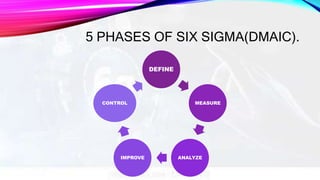
5 PHASES OF SIX SIGMA(DMAIC).
DEFINE
MEASURE
ANALYZE
IMPROVE
CONTROL
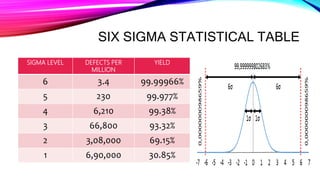
SIX SIGMA STATISTICAL TABLE
SIGMA LEVEL DEFECTS PER
MILLION
YIELD
6 3.4 99.99966%
5 230 99.977%
4 6,210 99.38%
3 66,800 93.32%
2 3,08,000 69.15%
1 6,90,000 30.85%
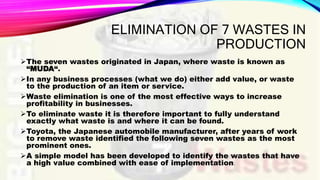
ELIMINATION OF 7 WASTES IN
PRODUCTION
The seven wastes originated in Japan, where waste is known as
“MUDA“.
In any business processes (what we do) either add value, or waste
to the production of an item or service.
Waste elimination is one of the most effective ways to increase
profitability in businesses.
To eliminate waste it is therefore important to fully understand
exactly what waste is and where it can be found.
Toyota, the Japanese automobile manufacturer, after years of work
to remove waste identified the following seven wastes as the most
prominent ones.
A simple model has been developed to identify the wastes that have
a high value combined with ease of implementation.
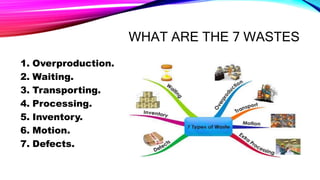
WHAT ARE THE 7 WASTES
1. Overproduction.
2. Waiting.
3. Transporting.
4. Processing.
5. Inventory.
6. Motion.
7. Defects.
1. Overproduction
 Producing more than needed or to produce it before it is required.
 'Just in Case' instead of 'Just in Time'.
2. Waiting (Inefficient use of time)
 Waiting for the next operation
– Material flow may be poor
– production run too long
– Distances between work centres are too great.
It is not unusual for a product/service to spend 99% of its time waiting.
3. Transportation
 Customers do not want to have to pay for transportation between
processes, so this is a non-valued cost.
 Every transport event is an opportunity for damage/loss to occur
4. (Inappropriate) Processing
 Using a sledge hammer to crack a nut.
 Are you using the right tool/process for the job?
 Are you using big expensive high precision equipment when simpler
tools would suffice?
 Are you using the right person for the job?
5. (Unnecessary) Inventory
 Work in Progress (WIP).
 A direct result of overproduction and waiting.
 Reducing WIP allows the other problems/inefficiencies to
surface.
6. (Unnecessary) Motions
 Related to ergonomics and is seen in all instances of bending,
stretching and reaching.
7. Defects
 Cost money either now or later and come directly from the
bottom line.
- Internal defects found before sale and incur the costs of
scrap, rework or delays added to them.
- External defects which have been delivered to customers
» warranty claims
» onsite repairs
» potential loss of customer.
LEAN OPERATIONS
Lean operations is a means of running an organization
by focusing on providing greater customer
satisfaction while using as few resources as possible.
The objective of lean operations is twofold:
Creating value for customers and eliminating waste.
Lean operations allow companies to do more with
less which creates value and increases profits.
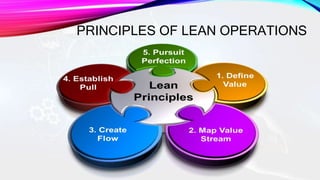
PRINCIPLES OF LEAN OPERATIONS
WHAT IS JUST-IN-TIME (JIT)?
• The just-in-time (JIT) inventory system is a
management strategy that aligns raw-material
orders from suppliers directly with production
schedules. Companies employ this inventory strategy
to increase efficiency and decrease waste by
receiving goods only as they need them for the
production process, which reduces inventory costs.
This method requires producers to forecast demand
accurately.
• JIT stands for Just in Time, is system in operation
management under which the production is made as
per the demand at a particular moment.
• There is no prior production for any anticipated
demand. This was pioneered by Toyota at their
facility.
KEY TAKEAWAYS
The just-in-time (JIT) inventory system is a management strategy
that minimizes inventory and increases efficiency.
Just-in-time manufacturing is also known as the Toyota Production
System (TPS) because the car manufacturer Toyota adopted the
system in the 1970s.
Kanban is a scheduling system often used in conjunction with JIT
to avoid overcapacity of work in process.
The success of the JIT production process relies on steady
production, high-quality workmanship, no machine breakdowns, and
reliable suppliers.
HOW DOES JUST-IN-TIME WORK?
• The just-in-time (JIT) inventory system minimizes inventory
and increases efficiency. JIT production systems cut
inventory costs because manufacturers receive materials and
parts as they are needed for production and so do not have to
pay storage costs. Manufacturers are also not left with
unwanted inventory if an order is canceled or not fulfilled.
• Example:
A car manufacturer that operates with low inventory levels
but heavily relies on its supply chain to deliver the parts it requires
to build cars, on an as-needed basis. Consequently, the manufacturer
orders the parts required to assemble the cars only after an order is
received.
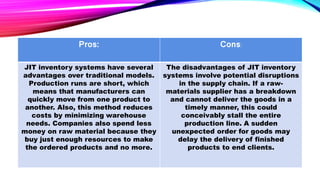
Pros: Cons:
JIT inventory systems have several
advantages over traditional models.
Production runs are short, which
means that manufacturers can
quickly move from one product to
another. Also, this method reduces
costs by minimizing warehouse
needs. Companies also spend less
money on raw material because they
buy just enough resources to make
the ordered products and no more.
The disadvantages of JIT inventory
systems involve potential disruptions
in the supply chain. If a raw-
materials supplier has a breakdown
and cannot deliver the goods in a
timely manner, this could
conceivably stall the entire
production line. A sudden
unexpected order for goods may
delay the delivery of finished
products to end clients.
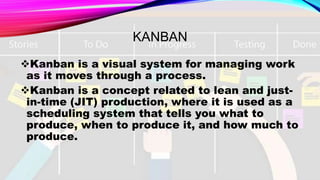
KANBAN
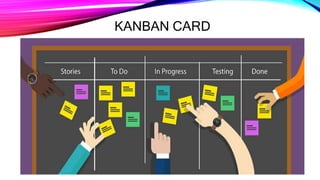
Kanban is a visual system for managing work
as it moves through a process.
Kanban is a concept related to lean and just-
in-time (JIT) production, where it is used as a
scheduling system that tells you what to
produce, when to produce it, and how much to
produce.
KANBAN CARD
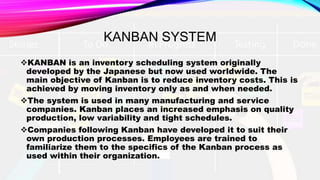
KANBAN SYSTEM
KANBAN is an inventory scheduling system originally
developed by the Japanese but now used worldwide. The
main objective of Kanban is to reduce inventory costs. This is
achieved by moving inventory only as and when needed.
The system is used in many manufacturing and service
companies. Kanban places an increased emphasis on quality
production, low variability and tight schedules.
Companies following Kanban have developed it to suit their
own production processes. Employees are trained to
familiarize them to the specifics of the Kanban process as
used within their organization.
OBJECTIVES OF KANBAN SYSTEM
1. Better visibility
2. Improved efficiency
3. Increased productivity
4. Preventing team overburden
5. Increased team focus
6. Reduced waste
7. More predictability
Production methods

Production methods

  • 1.
    PRODUCTION AND OPERATIONSRESEARCH presentation
  • 3.
    SIX SIGMA Six Sigmais a disciplined, statistical-based, data driven approach and continuous improvement methodology for eliminating defects in a product, process or service. Six Sigma (6σ) is a set of techniques and tools for process improvement. It was introduced by American engineer Bill Smith while working at Motorola in 1986. A six sigma process is one in which 99.99966% of all opportunities to produce some feature of a part are statistically expected to be free of defects.
  • 4.
    5 PHASES OFSIX SIGMA(DMAIC). DEFINE MEASURE ANALYZE IMPROVE CONTROL
  • 5.
    SIX SIGMA STATISTICALTABLE SIGMA LEVEL DEFECTS PER MILLION YIELD 6 3.4 99.99966% 5 230 99.977% 4 6,210 99.38% 3 66,800 93.32% 2 3,08,000 69.15% 1 6,90,000 30.85%
  • 8.
    ELIMINATION OF 7WASTES IN PRODUCTION The seven wastes originated in Japan, where waste is known as “MUDA“. In any business processes (what we do) either add value, or waste to the production of an item or service. Waste elimination is one of the most effective ways to increase profitability in businesses. To eliminate waste it is therefore important to fully understand exactly what waste is and where it can be found. Toyota, the Japanese automobile manufacturer, after years of work to remove waste identified the following seven wastes as the most prominent ones. A simple model has been developed to identify the wastes that have a high value combined with ease of implementation.
  • 9.
    WHAT ARE THE7 WASTES 1. Overproduction. 2. Waiting. 3. Transporting. 4. Processing. 5. Inventory. 6. Motion. 7. Defects.
  • 10.
    1. Overproduction  Producingmore than needed or to produce it before it is required.  'Just in Case' instead of 'Just in Time'. 2. Waiting (Inefficient use of time)  Waiting for the next operation – Material flow may be poor – production run too long – Distances between work centres are too great. It is not unusual for a product/service to spend 99% of its time waiting. 3. Transportation  Customers do not want to have to pay for transportation between processes, so this is a non-valued cost.  Every transport event is an opportunity for damage/loss to occur
  • 11.
    4. (Inappropriate) Processing Using a sledge hammer to crack a nut.  Are you using the right tool/process for the job?  Are you using big expensive high precision equipment when simpler tools would suffice?  Are you using the right person for the job? 5. (Unnecessary) Inventory  Work in Progress (WIP).  A direct result of overproduction and waiting.  Reducing WIP allows the other problems/inefficiencies to surface. 6. (Unnecessary) Motions  Related to ergonomics and is seen in all instances of bending, stretching and reaching.
  • 12.
    7. Defects  Costmoney either now or later and come directly from the bottom line. - Internal defects found before sale and incur the costs of scrap, rework or delays added to them. - External defects which have been delivered to customers » warranty claims » onsite repairs » potential loss of customer.
  • 14.
    LEAN OPERATIONS Lean operationsis a means of running an organization by focusing on providing greater customer satisfaction while using as few resources as possible. The objective of lean operations is twofold: Creating value for customers and eliminating waste. Lean operations allow companies to do more with less which creates value and increases profits.
  • 15.
  • 17.
    WHAT IS JUST-IN-TIME(JIT)? • The just-in-time (JIT) inventory system is a management strategy that aligns raw-material orders from suppliers directly with production schedules. Companies employ this inventory strategy to increase efficiency and decrease waste by receiving goods only as they need them for the production process, which reduces inventory costs. This method requires producers to forecast demand accurately.
  • 18.
    • JIT standsfor Just in Time, is system in operation management under which the production is made as per the demand at a particular moment. • There is no prior production for any anticipated demand. This was pioneered by Toyota at their facility.
  • 19.
    KEY TAKEAWAYS The just-in-time(JIT) inventory system is a management strategy that minimizes inventory and increases efficiency. Just-in-time manufacturing is also known as the Toyota Production System (TPS) because the car manufacturer Toyota adopted the system in the 1970s. Kanban is a scheduling system often used in conjunction with JIT to avoid overcapacity of work in process. The success of the JIT production process relies on steady production, high-quality workmanship, no machine breakdowns, and reliable suppliers.
  • 20.
    HOW DOES JUST-IN-TIMEWORK? • The just-in-time (JIT) inventory system minimizes inventory and increases efficiency. JIT production systems cut inventory costs because manufacturers receive materials and parts as they are needed for production and so do not have to pay storage costs. Manufacturers are also not left with unwanted inventory if an order is canceled or not fulfilled. • Example: A car manufacturer that operates with low inventory levels but heavily relies on its supply chain to deliver the parts it requires to build cars, on an as-needed basis. Consequently, the manufacturer orders the parts required to assemble the cars only after an order is received.
  • 21.
    Pros: Cons: JIT inventorysystems have several advantages over traditional models. Production runs are short, which means that manufacturers can quickly move from one product to another. Also, this method reduces costs by minimizing warehouse needs. Companies also spend less money on raw material because they buy just enough resources to make the ordered products and no more. The disadvantages of JIT inventory systems involve potential disruptions in the supply chain. If a raw- materials supplier has a breakdown and cannot deliver the goods in a timely manner, this could conceivably stall the entire production line. A sudden unexpected order for goods may delay the delivery of finished products to end clients.
  • 22.
    KANBAN Kanban is avisual system for managing work as it moves through a process. Kanban is a concept related to lean and just- in-time (JIT) production, where it is used as a scheduling system that tells you what to produce, when to produce it, and how much to produce.
  • 23.
  • 24.
    KANBAN SYSTEM KANBAN isan inventory scheduling system originally developed by the Japanese but now used worldwide. The main objective of Kanban is to reduce inventory costs. This is achieved by moving inventory only as and when needed. The system is used in many manufacturing and service companies. Kanban places an increased emphasis on quality production, low variability and tight schedules. Companies following Kanban have developed it to suit their own production processes. Employees are trained to familiarize them to the specifics of the Kanban process as used within their organization.
  • 25.
    OBJECTIVES OF KANBANSYSTEM 1. Better visibility 2. Improved efficiency 3. Increased productivity 4. Preventing team overburden 5. Increased team focus 6. Reduced waste 7. More predictability