MATERIALS MANAGEMENT:
JUST IN TIME TECHNIQUE
BY
ANKIT ATUL NANDGAONKAR (162030015)
CONSTRUCTION MANAGEMENT, VJTI.
1
Material management
 The process of management
 Planning
 Organizing
 Controlling
 Flow of materials
2
Necessity
 In any construction work
 Materials contributes 60 – 65 % of total value of the project
 About 10- 20 % of the delivery is the wastage
 Reduction of cost
 Without compromising quality
 Involves inventory
3
6 basics of material management
 Plannig
 Designing
 Procurement
 Vendor control
 Construction
 Closeout
4
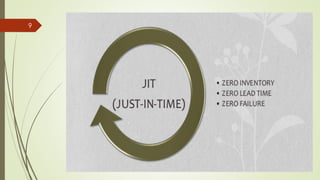
Just in time (JIT)
5
A philosophy of manufacturing on the basis
of planned eliminations of wastages and
continuous improvement of productivity…
6
History of JIT
 Evolved in Japan
 Toyoto motar company , 1970.
 Most efficient use of limited resources
 Optimal cost/Quality relationship
7
Philosophy
 Inventory takes up space and ties down capital
 In the JIT philosophy, raw materials are not stockpiled.
 right quantities
 in the right condition
 to the right place
 and at the right time for production
8
9
Do’ in JIT
❖ Eliminates waste .
❖ Achieves streamlined production .
❖ Eliminate disruptions in production … caused by poor quality,
schedule changes, late deliveries.
❖ Makes the manufacturing delivery system flexible by allowing it to
handle a variety of products and changes in the level of output.
❖ Reduces setup and delivery times .
10
Principles of JIT
❖ Total quality Management
❖ Production Management
❖ Supplier Management
❖ Inventory Management
❖ Human Resource Management
11
survey
 32 contractors were surveyed
 Few questions asked
 Answers we got from the survey we come on a conclusion
12
Buffer stocks13
Top management commitment and
employee involvement
 Continuous improvement process
 Disciplined and correct operations
 Involvement in improving current work processes
 Motivation and efforts
14
Elimination of wastes
 Waste is anything that do not add any value to final product
 Excess inventory
 Stockpiling inventory
 Waiting time
 Rectification and correction of defects
 Getting things done “First time right” is JIT
15
Underutilisation
resouces
Transportation
Waiting
Motion
Inventory
Defects
Over
production
16
Total quality control
 Acceptance of good quality material
 Rejection of material affects grievously
 Disruption of all work flow and schedule
 Wiped out all savings due to JIT
17
Single sourcing
 Only single source of supplier
 Lesser time for ordering
 Too many dealers creates confusion
 Time taken is more for ordering
 Single source good for long business perspective
18
Comparison
Traditional approach Supplier management
Buyer
Supplier
Supplier Supplier
Supplier
Supplier supplier
Buyer
supplier supplier supplier supplier
19
Storage issues
 Space constraints
 Duration of storage
 Movement of resources
 Safety measures
20
Buffer stocks
 Harsh condition
 Late deliveries
 Safe storage stock
 Work flow must not be disrupted
21
Factors for storage constraints22
23
When inventory is less24
Transportation
 Long trucks , trailers accumulate space
 Stuck into traffic
 Late deliveries
 More deliveries at a time
 Bad weather
25
Actions to be taken
 Send a letter of complaint to the pre-caster
 Learn from lesson and take preventive measures
 Impose penalty charges on the pre-caster
 Reprimand the pre-caster and then let the matter rest
 Simply ‘‘give-and-take’’ to avoid any sour relationships
26
Advantages of JIT
❖ Reduced Inventory
❖ Improved quality
❖ Lower costs
❖ Reduced space requirements
❖ Shorter lead-time
❖ Increased productivity
❖ Improved vendor relations
27
Disadvantages of JIT
❖ Danger of disrupted production due to non-arrival of supplies.
❖ Danger of lost sales.
❖ High dependence on suppliers.
❖ Less time for quality control on arrival of materials.
❖ Increased ordering and admin costs.
❖ May lose bulk-buying discounts
28
Recommendations
 Not possible to apply full JIT approach in India
 Buffer stocks should be there so that the work will not be delayed
 Slow improving process
 Training is required
 Small lot size should be implemented
29
Benefits of Small Lot Sizes
Reduced Inventory
Less Rework
Less Storage Space
Problems are more apparent
Increase Product Flexibility
Easier to balance operation
30
Conclusion
 JIT if implemented properly can be proved as best technique
 Improvement in construction industry is necessary
 Wastages becomes very low in JIT hence it’s implementation can
generate higher profits
 Very trained experienced people are required for implementing JIT
31
References
 Just in Time Management of Precast Concrete Components By Low Sui
Pheng and Choong Joo Chuan November/December 2001, Vol. 127, No. 6,
pp. 494–501.
 Low, S. P., and Chan, Y. M. (1996). ‘‘The application of just-in-time principles
to process layout for precast concrete production.’’ Singapore Mgmt. Rev.,
18, 23–39.
 Material Management A key of successful project management
Damodara U. Kini, P.E. December 2001, Vol. 127, No. 3 pp. 505–508.
 Implementations of JIT, By Ankit Saxsena, website slideshare.
 JIT operations and measurements , Journal of const engg amd
management
32
Thank You !!!33

Just in Time Technique

  • 1.
    MATERIALS MANAGEMENT: JUST INTIME TECHNIQUE BY ANKIT ATUL NANDGAONKAR (162030015) CONSTRUCTION MANAGEMENT, VJTI. 1
  • 2.
    Material management  Theprocess of management  Planning  Organizing  Controlling  Flow of materials 2
  • 3.
    Necessity  In anyconstruction work  Materials contributes 60 – 65 % of total value of the project  About 10- 20 % of the delivery is the wastage  Reduction of cost  Without compromising quality  Involves inventory 3
  • 4.
    6 basics ofmaterial management  Plannig  Designing  Procurement  Vendor control  Construction  Closeout 4
  • 5.
    Just in time(JIT) 5
  • 6.
    A philosophy ofmanufacturing on the basis of planned eliminations of wastages and continuous improvement of productivity… 6
  • 7.
    History of JIT Evolved in Japan  Toyoto motar company , 1970.  Most efficient use of limited resources  Optimal cost/Quality relationship 7
  • 8.
    Philosophy  Inventory takesup space and ties down capital  In the JIT philosophy, raw materials are not stockpiled.  right quantities  in the right condition  to the right place  and at the right time for production 8
  • 9.
  • 10.
    Do’ in JIT ❖Eliminates waste . ❖ Achieves streamlined production . ❖ Eliminate disruptions in production … caused by poor quality, schedule changes, late deliveries. ❖ Makes the manufacturing delivery system flexible by allowing it to handle a variety of products and changes in the level of output. ❖ Reduces setup and delivery times . 10
  • 11.
    Principles of JIT ❖Total quality Management ❖ Production Management ❖ Supplier Management ❖ Inventory Management ❖ Human Resource Management 11
  • 12.
    survey  32 contractorswere surveyed  Few questions asked  Answers we got from the survey we come on a conclusion 12
  • 13.
  • 14.
    Top management commitmentand employee involvement  Continuous improvement process  Disciplined and correct operations  Involvement in improving current work processes  Motivation and efforts 14
  • 15.
    Elimination of wastes Waste is anything that do not add any value to final product  Excess inventory  Stockpiling inventory  Waiting time  Rectification and correction of defects  Getting things done “First time right” is JIT 15
  • 16.
  • 17.
    Total quality control Acceptance of good quality material  Rejection of material affects grievously  Disruption of all work flow and schedule  Wiped out all savings due to JIT 17
  • 18.
    Single sourcing  Onlysingle source of supplier  Lesser time for ordering  Too many dealers creates confusion  Time taken is more for ordering  Single source good for long business perspective 18
  • 19.
    Comparison Traditional approach Suppliermanagement Buyer Supplier Supplier Supplier Supplier Supplier supplier Buyer supplier supplier supplier supplier 19
  • 20.
    Storage issues  Spaceconstraints  Duration of storage  Movement of resources  Safety measures 20
  • 21.
    Buffer stocks  Harshcondition  Late deliveries  Safe storage stock  Work flow must not be disrupted 21
  • 22.
    Factors for storageconstraints22
  • 23.
  • 24.
  • 25.
    Transportation  Long trucks, trailers accumulate space  Stuck into traffic  Late deliveries  More deliveries at a time  Bad weather 25
  • 26.
    Actions to betaken  Send a letter of complaint to the pre-caster  Learn from lesson and take preventive measures  Impose penalty charges on the pre-caster  Reprimand the pre-caster and then let the matter rest  Simply ‘‘give-and-take’’ to avoid any sour relationships 26
  • 27.
    Advantages of JIT ❖Reduced Inventory ❖ Improved quality ❖ Lower costs ❖ Reduced space requirements ❖ Shorter lead-time ❖ Increased productivity ❖ Improved vendor relations 27
  • 28.
    Disadvantages of JIT ❖Danger of disrupted production due to non-arrival of supplies. ❖ Danger of lost sales. ❖ High dependence on suppliers. ❖ Less time for quality control on arrival of materials. ❖ Increased ordering and admin costs. ❖ May lose bulk-buying discounts 28
  • 29.
    Recommendations  Not possibleto apply full JIT approach in India  Buffer stocks should be there so that the work will not be delayed  Slow improving process  Training is required  Small lot size should be implemented 29
  • 30.
    Benefits of SmallLot Sizes Reduced Inventory Less Rework Less Storage Space Problems are more apparent Increase Product Flexibility Easier to balance operation 30
  • 31.
    Conclusion  JIT ifimplemented properly can be proved as best technique  Improvement in construction industry is necessary  Wastages becomes very low in JIT hence it’s implementation can generate higher profits  Very trained experienced people are required for implementing JIT 31
  • 32.
    References  Just inTime Management of Precast Concrete Components By Low Sui Pheng and Choong Joo Chuan November/December 2001, Vol. 127, No. 6, pp. 494–501.  Low, S. P., and Chan, Y. M. (1996). ‘‘The application of just-in-time principles to process layout for precast concrete production.’’ Singapore Mgmt. Rev., 18, 23–39.  Material Management A key of successful project management Damodara U. Kini, P.E. December 2001, Vol. 127, No. 3 pp. 505–508.  Implementations of JIT, By Ankit Saxsena, website slideshare.  JIT operations and measurements , Journal of const engg amd management 32
  • 33.