Prodrug Strategy
(Concept & Applications)
Presented By: Anvita Jadhav
M.Pharm(Pharmaceutics)
1
Prodrug concept
• The concept of “prodrug” was first introduced by Adrian
Albert in 1958 to describe compounds that undergo
biotransformation prior to eliciting their pharmacological
effect.
• A prodrug is defined as a biologically inactive derivative of
a parent drug molecule that usually requires a chemical or
enzymatic transformation within the body to release the
active drug, and possess improved delivery properties over
the parent molecule.
• The development of prodrugs is now well established as a
strategy to improve the physicochemical,
biopharmaceutical or pharmacokinetic properties of
pharmacologically potent compounds, and thereby
increase usefulness of a potential drug.
2
Schematic illustration of the prodrug concept
Extracellular Fluid
Site of Action
(cell or cell surface)
Pharmacokinetic or
Physicochemical
barrier
3
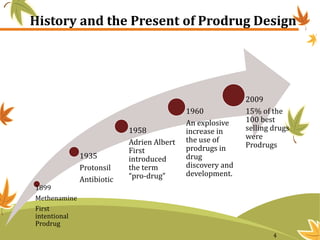
History and the Present of Prodrug Design
1899
Methenamine
First
intentional
Prodrug
1935
Protonsil
Antibiotic
1958
Adrien Albert
First
introduced
the term
“pro-drug”
1960
An explosive
increase in
the use of
prodrugs in
drug
discovery and
development.
2009
15% of the
100 best
selling drugs
were
Prodrugs
4
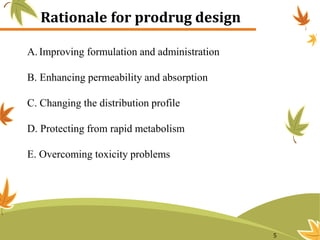
Rationale for prodrug design
A. Improving formulation and administration
B. Enhancing permeability and absorption
C. Changing the distribution profile
D. Protecting from rapid metabolism
E. Overcoming toxicity problems
5
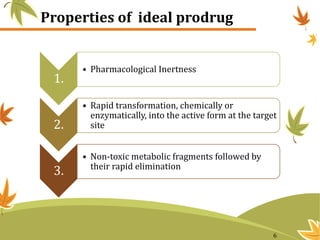
Properties of ideal prodrug
1.
• Pharmacological Inertness
2.
• Rapid transformation, chemically or
enzymatically, into the active form at the target
site
3.
• Non-toxic metabolic fragments followed by
their rapid elimination
6
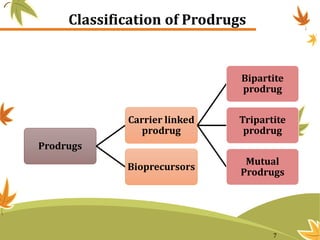
Classification of Prodrugs
Prodrugs
Carrier linked
prodrug
Bipartite
prodrug
Tripartite
prodrug
Mutual
Prodrugs
Bioprecursors
7
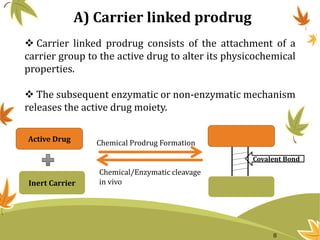
Active Drug
Inert Carrier
A) Carrier linked prodrug
Chemical Prodrug Formation
Chemical/Enzymatic cleavage
in vivo
Covalent Bond
 Carrier linked prodrug consists of the attachment of a
carrier group to the active drug to alter its physicochemical
properties.
 The subsequent enzymatic or non-enzymatic mechanism
releases the active drug moiety.
8
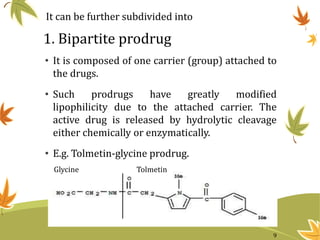
1. Bipartite prodrug
• It is composed of one carrier (group) attached to
the drugs.
• Such prodrugs have greatly modified
lipophilicity due to the attached carrier. The
active drug is released by hydrolytic cleavage
either chemically or enzymatically.
• E.g. Tolmetin-glycine prodrug.
It can be further subdivided into
TolmetinGlycine
9
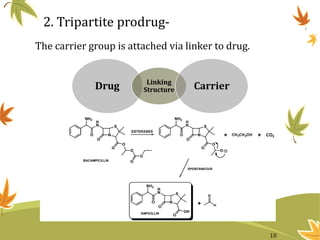
2. Tripartite prodrug-
Drug Linking
Structure Carrier
The carrier group is attached via linker to drug.
10
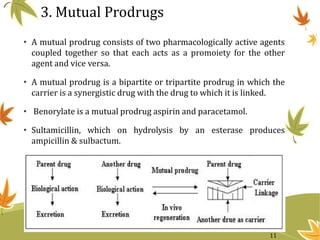
3. Mutual Prodrugs
• A mutual prodrug consists of two pharmacologically active agents
coupled together so that each acts as a promoiety for the other
agent and vice versa.
• A mutual prodrug is a bipartite or tripartite prodrug in which the
carrier is a synergistic drug with the drug to which it is linked.
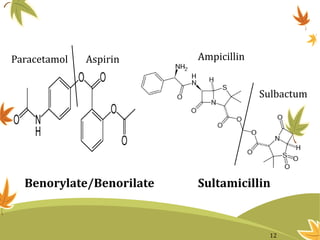
• Benorylate is a mutual prodrug aspirin and paracetamol.
• Sultamicillin, which on hydrolysis by an esterase produces
ampicillin & sulbactum.
11
AspirinParacetamol
Sulbactum
Ampicillin
Benorylate/Benorilate Sultamicillin
12
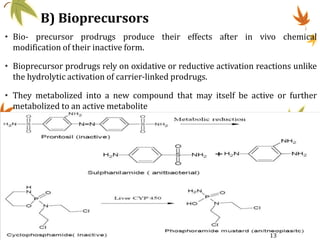
B) Bioprecursors
• Bio- precursor prodrugs produce their effects after in vivo chemical
modification of their inactive form.
• Bioprecursor prodrugs rely on oxidative or reductive activation reactions unlike
the hydrolytic activation of carrier-linked prodrugs.
• They metabolized into a new compound that may itself be active or further
metabolized to an active metabolite
13
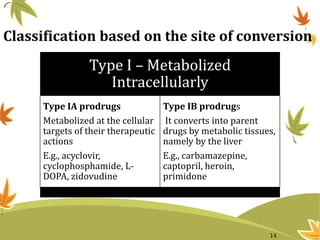
Classification based on the site of conversion
Type I – Metabolized
Intracellularly
Type IA prodrugs
Metabolized at the cellular
targets of their therapeutic
actions
E.g., acyclovir,
cyclophosphamide, L-
DOPA, zidovudine
Type IB prodrugs
It converts into parent
drugs by metabolic tissues,
namely by the liver
E.g., carbamazepine,
captopril, heroin,
primidone
14
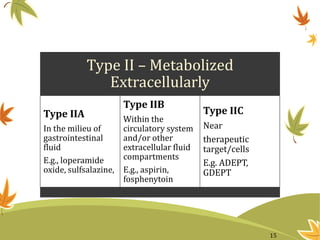
Type II – Metabolized
Extracellularly
Type IIA
In the milieu of
gastrointestinal
fluid
E.g., loperamide
oxide, sulfsalazine,
Type IIB
Within the
circulatory system
and/or other
extracellular fluid
compartments
E.g., aspirin,
fosphenytoin
Type IIC
Near
therapeutic
target/cells
E.g. ADEPT,
GDEPT
15
1. Esters as prodrugs of carboxyl, hydroxyl and thiol functionalities
• Esters are the most common prodrugs used, and it is estimated
that approximately 49% of all marketed prodrugs are activated
by enzymatic hydrolysis.
• Ester prodrugs are most often used to enhance the lipophilicity,
and thus the passive membrane permeability, of water soluble
drugs by masking charged groups such as carboxylic acids and
phosphates.
• The synthesis of an ester prodrug is often straightforward. Once
in the body, the ester bond is readily hydrolysed by ubiquitous
esterases found in the blood, liver and other organs and tissues,
including carboxyl esterases, acetylcholinesterases,
butyrylcholinesterases, paraoxonases and arylesterases.
Functional Groups Amenable to Prodrug Design
16
2. Carbonates and carbamates as prodrugs of
carboxyl, hydroxyl or amine functionalities:
• Carbonates and carbamates differ from esters by the
presence of an oxygen or nitrogen on both sides of the
carbonyl carbon.
• They are often enzymatically more stable than the
corresponding esters but are more susceptible to hydrolysis
than amides.
• Carbonates are derivatives of carboxylic acids and alcohols,
and carbamates are carboxylic acid and amine derivatives.
• The bioconversion of many carbonate and carbamate
prodrugs requires esterases for the formation of the parent
drug.
17
3. Amides as prodrugs of carboxylic acids and
amines
• Amides are derivatives of amine and carboxyl functionalities of a
molecule. In prodrug design, amides have been used only to a
limited extent owing to their relatively high enzymatic stability
in vivo.
• An amide bond is usually hydrolyzed by ubiquitous
carboxylesterases, peptidases or proteases. Amides are often
designed for enhanced oral absorption.
• Lipophilicity of various compounds like acid chlorides and acids
can be altered in many groups of compounds by amide
formation.
• This approach is successful to improve the stability of drug in
vivo in many of the pharmaceutical agents and gives targeted
drug delivery due to presence of enzyme amydase.
18
4. Oximes as derivatives of ketones, amidines and
guanidines
• Oximes (for example, ketoximes, amidoximes and
guanidoximes) are derivatives of ketones, amidines and
guanidines, thus providing an opportunity to modify
molecules that lack hydroxyl, amine or carboxyl
functionalities.
• Oximes are hydrolyzed by the versatile microsomal
cytochrome P450 (CYP450) enzymes.
• Oximes, especially strongly basic amidines and guanidoximes,
can be used to enhance the membrane permeability and
absorption of a parent drug.
19
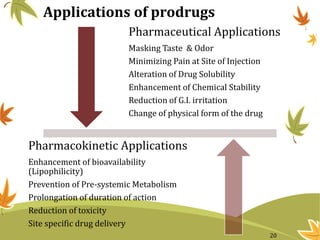
Applications of prodrugs
Pharmaceutical Applications
Masking Taste & Odor
Minimizing Pain at Site of Injection
Alteration of Drug Solubility
Enhancement of Chemical Stability
Reduction of G.I. irritation
Change of physical form of the drug
Pharmacokinetic Applications
Enhancement of bioavailability
(Lipophilicity)
Prevention of Pre-systemic Metabolism
Prolongation of duration of action
Reduction of toxicity
Site specific drug delivery
20
Masking Taste & Odor
Taste Masking:
• The undesirable taste arises due to adequate solubility and interaction
of drug with taste receptors, which can be solved by lowering the
solubility of drug or prodrug in saliva.
• Chloramphenicol, an extremely bitter drug has been derivatized to
chloramphenicol palmitate, a sparingly soluble ester.
• It possesses low aqueous solubility which makes it tasteless and later
undergoes in vivo hydrolysis to active chloramphenicol by the action of
pancreatic lipase.
Odor Masking:
• The ethyl mercaptan (tuberculostatic agent)has a boiling point of 25ºC
and a strong disagreeable odour.
• Diethyl dithio isophthalate, a prodrug of ethyl mercaptan has a higher
boiling point and is relatively odourless.
Pharmaceutical Applications
21
Minimizing Pain at Site of Injection
• Pain caused by intramuscular injection is mainly due to the
weakly acidic nature or poor aqueous solubility of drugs.
• Example, intramuscular injection of antibiotic like
clindamycin and anticonvulsant drug like phenytoin was
found painful due to poor aqueous solubility and could be
overcome by making phosphate ester prodrugs
respectively and maintaining the formulations at pH 12.
22
Alteration of Drug Solubility
• The prodrug approach can be used to increase or decrease
the solubility of a drug, depending on its ultimate use.
Example-
• The solubility of betamethasone in water is 58 μg/ml at
25⁰C. The solubility of its disodium phosphate ester (a
charged ester promoeity) is more than 100 mg/ml, an
increase in water solubility greater than 1500-fold.
• Acetylated sulfonamide moiety enhanced the aqueous
solubility of the poorly water-soluble sodium salt of the
COX-2 inhibitor Parecoxib ~300-fold.
23
Enhancement of Chemical Stability
• Although chemical unstability can be solved to a greater extent by
appropriate formulations, its failure necessitates the use of prodrug
approach. The prodrug approach is based on
1. modification of the functional group responsible for the instability or
2. by changing the physical properties of the drug resulting in the
reduction of contact between the drug and the media in which it is
unstable.
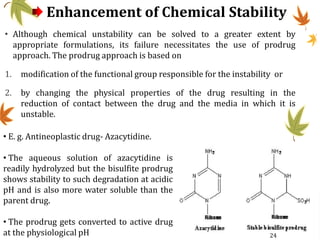
• E. g. Antineoplastic drug- Azacytidine.
• The aqueous solution of azacytidine is
readily hydrolyzed but the bisulfite prodrug
shows stability to such degradation at acidic
pH and is also more water soluble than the
parent drug.
• The prodrug gets converted to active drug
at the physiological pH 24
Reduction of G.I. irritation
• Several drugs cause irritation and damage to the gastric
mucosa through direct contact, increased stimulation of
acid secretion or through interference with protective
mucosal layer.
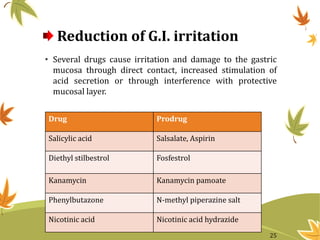
Drug Prodrug
Salicylic acid Salsalate, Aspirin
Diethyl stilbestrol Fosfestrol
Kanamycin Kanamycin pamoate
Phenylbutazone N-methyl piperazine salt
Nicotinic acid Nicotinic acid hydrazide
25
Change of physical form of the drug
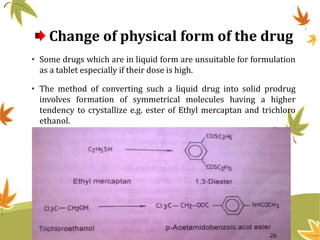
• Some drugs which are in liquid form are unsuitable for formulation
as a tablet especially if their dose is high.
• The method of converting such a liquid drug into solid prodrug
involves formation of symmetrical molecules having a higher
tendency to crystallize e.g. ester of Ethyl mercaptan and trichloro
ethanol.
26
Enhancement of bioavailability (Lipophilicity)
• Passive diffusion is the commonest pathway for transportation of
drug from site of administration to systemic circulation through a
lipoidal membrane.
• Thus improvement in the lipophilic character serves as a tool for
betterment of bioavailability. Two reasons can be attributed to the
enhanced oral bioavailability of lipophilic compound -
a) The lipophilic form of a drug has enhanced membrane /water
partition coefficient as compared to the hydrophilic form thus
favoring passive diffusion e.g. Bacampicillin prodrugs of Ampicillin
is more lipophilic, better absorbed and rapidly hydrolyzed to the
parent drug in blood.
b) The lipophilic prodrugs have poor solubility in gastric fluids and
thus greater stability and absorption e.g. ester of Erythromycin.
Pharmacokinetic Applications
27
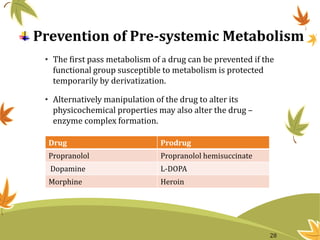
Prevention of Pre-systemic Metabolism
• The first pass metabolism of a drug can be prevented if the
functional group susceptible to metabolism is protected
temporarily by derivatization.
• Alternatively manipulation of the drug to alter its
physicochemical properties may also alter the drug –
enzyme complex formation.
Drug Prodrug
Propranolol Propranolol hemisuccinate
Dopamine L-DOPA
Morphine Heroin
28
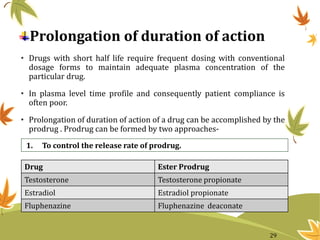
Prolongation of duration of action
• Drugs with short half life require frequent dosing with conventional
dosage forms to maintain adequate plasma concentration of the
particular drug.
• In plasma level time profile and consequently patient compliance is
often poor.
• Prolongation of duration of action of a drug can be accomplished by the
prodrug . Prodrug can be formed by two approaches-
Drug Ester Prodrug
Testosterone Testosterone propionate
Estradiol Estradiol propionate
Fluphenazine Fluphenazine deaconate
1. To control the release rate of prodrug.
29
2. To control the rate of conversion of prodrug into active
drug in the blood.
• This second approach of controlled conversion of prodrug to
active drug was difficult, it was successfully utilized to deliver
Pilocarpine to eyes in the treatment of glaucoma.
• The diesters of drug when applied as ophthalmic solution showed
better intra-ocular penetration due to improved lipophilicity and
slow conversion of the ester prodrug to active Pilocarpine resulted
into prolonged the therapeutic effect
30
Reduction of toxicity
• An important objective of drug design is to develop a moiety with
high activity and low toxicity
• NSAIDs local side effects like gastric distress with various, which can
be overcome by prodrug design.
• Another example is the bioprecursor Sulindac, as it is a sulphoxide,
it doesn’t cause any gastric irritation and also better absorbed.
• The prodrug Ibuterol is diisobutyrate ester of Terbutaline (a
selective β-agonist useful) in glaucoma. This prodrug, is 100 times
more potent, has longer duration of action and is free from both
local and systemic toxicity.
31
Site specific drug delivery
• After its absorption into the systemic circulation, the drug
is distributed to the various parts of the body including the
target site as well as the non-target tissue.
• These problems can be overcome by targeting the drug
specifically to its site of action by prodrug design
• The prodrug is converted into its active form only in the
target organ/tissue by utilizing either specific enzymes or
a pH value different from the normal pH for activation e.g.
5-amino salicylic acid.
32
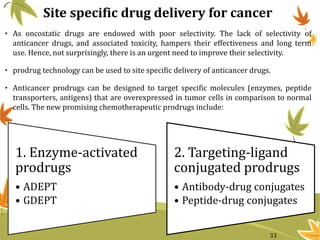
Site specific drug delivery for cancer
• As oncostatic drugs are endowed with poor selectivity. The lack of selectivity of
anticancer drugs, and associated toxicity, hampers their effectiveness and long term
use. Hence, not surprisingly, there is an urgent need to improve their selectivity.
• prodrug technology can be used to site specific delivery of anticancer drugs.
• Anticancer prodrugs can be designed to target specific molecules (enzymes, peptide
transporters, antigens) that are overexpressed in tumor cells in comparison to normal
cells. The new promising chemotherapeutic prodrugs include:
1. Enzyme-activated
prodrugs
• ADEPT
• GDEPT
2. Targeting-ligand
conjugated prodrugs
• Antibody-drug conjugates
• Peptide-drug conjugates
33
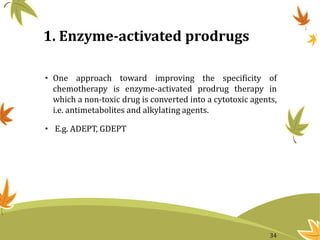
1. Enzyme-activated prodrugs
• One approach toward improving the specificity of
chemotherapy is enzyme-activated prodrug therapy in
which a non-toxic drug is converted into a cytotoxic agents,
i.e. antimetabolites and alkylating agents.
• E.g. ADEPT, GDEPT
34
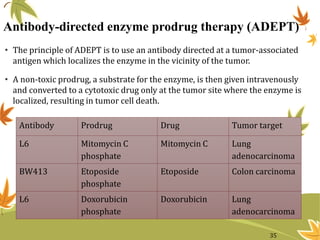
Antibody-directed enzyme prodrug therapy (ADEPT)
• The principle of ADEPT is to use an antibody directed at a tumor-associated
antigen which localizes the enzyme in the vicinity of the tumor.
• A non-toxic prodrug, a substrate for the enzyme, is then given intravenously
and converted to a cytotoxic drug only at the tumor site where the enzyme is
localized, resulting in tumor cell death.
Antibody Prodrug Drug Tumor target
L6 Mitomycin C
phosphate
Mitomycin C Lung
adenocarcinoma
BW413 Etoposide
phosphate
Etoposide Colon carcinoma
L6 Doxorubicin
phosphate
Doxorubicin Lung
adenocarcinoma
35
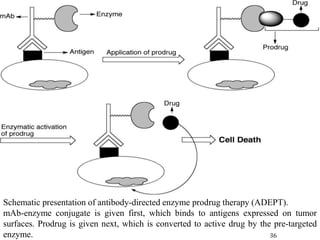
Schematic presentation of antibody-directed enzyme prodrug therapy (ADEPT).
mAb-enzyme conjugate is given first, which binds to antigens expressed on tumor
surfaces. Prodrug is given next, which is converted to active drug by the pre-targeted
enzyme. 36
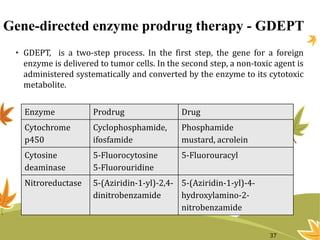
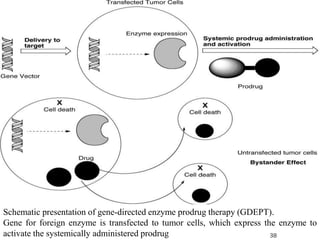
Gene-directed enzyme prodrug therapy - GDEPT
• GDEPT, is a two-step process. In the first step, the gene for a foreign
enzyme is delivered to tumor cells. In the second step, a non-toxic agent is
administered systematically and converted by the enzyme to its cytotoxic
metabolite.
Enzyme Prodrug Drug
Cytochrome
p450
Cyclophosphamide,
ifosfamide
Phosphamide
mustard, acrolein
Cytosine
deaminase
5-Fluorocytosine
5-Fluorouridine
5-Fluorouracyl
Nitroreductase 5-(Aziridin-1-yl)-2,4-
dinitrobenzamide
5-(Aziridin-1-yl)-4-
hydroxylamino-2-
nitrobenzamide
37
Schematic presentation of gene-directed enzyme prodrug therapy (GDEPT).
Gene for foreign enzyme is transfected to tumor cells, which express the enzyme to
activate the systemically administered prodrug 38
2. Targeting-ligand conjugated prodrugs
• Antibody-drug conjugates:
• Tumor-specific monoclonal antibodies (or fragments of antibodies)
are conjugated to oncostatic drugs such as antifolates, anthracyclines,
taxanes and vinca alkaloids.
• The antibody delivers the therapeutic agent to tumor cells. After
reaching its target, the conjugate is internalized through a receptor-
mediated pinocytosis, and the pharmacologically active compound is
released in the cell.
• Peptide-drug conjugates:
• Peptide-conjugated prodrugs for cancer therapy utilize peptide
ligands designed to bind with a tumor specific antigen or a peptide
transporter which is overexpressed in neoplastic cells.
• These ligands are conjugated to a chemotherapic agent either directly
or by a linker.
39
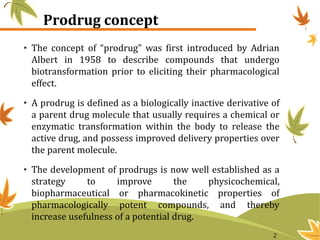
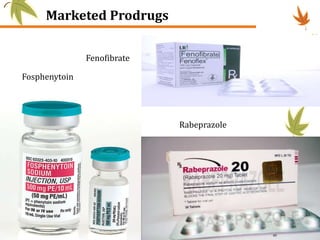
Marketed Prodrugs
Fosphenytoin
Fenofibrate
Rabeprazole
40
Limitations of Prodrug Design
• Formation of unexpected metabolite from the total
prodrug that may be toxic.
• The inert carrier generated following cleavage of prodrug
may also transform into a toxic metabolite.
• During its activation stage, the prodrug might consume a
vital cell constituent leading to its depletion.
41
CONCLUSION
Prodrug design is a part of the general drug discovery
process, in which a unique combination of therapeutically
active substances is observed to have desirable
pharmacological effects.
In human therapy prodrug designing has given successful
results in overcoming undesirable properties like
absorption, nonspecificity, and poor bioavailability and GI
toxicity.
Thus, prodrug approach offers a wide range of options in
drug design and delivery for improving the clinical and
therapeutic effectiveness of drug.
42
References:
• Patil S.J., P.J. Shirote, Prodrug Approach: An Effective Solution to Overcome
Side-effects, International Journal of Medical and Pharmaceutical Sciences, Vol
1, Issue 7, Pg. No. 1-13, 2011.
• Jolanta B. Zawilska, Jakub Wojcieszak, Agnieszka B. Olejniczak, Prodrugs: A
Challenge for the Drug Development, Pharmacological Reports, 65, Pg. No. 1-14,
2013.
• Arik Dahan, Ellen M. Zimmermann and Shimon Ben-Shabat, Modern Prodrug
Design for Targeted Oral Drug Delivery, Molecules, 19, Pg. No. 16489-16505,
2014.
• Jarkko Rautio, Hanna Kumpulainen, Tycho Heimbach, Reza Oliyai§, Dooman
Oh|, Tomi Järvinen and Jouko Savolainen, Prodrugs: design and clinical
applications, Nature Reviews: Drug Discovery, Vol.7, Pg. No.255-270, March
2008.
• Longqin Hu, The prodrug approach to better targeting,Pg. No. 28-32 August
2004.
• V.S. Tegeli, Y.S. Thorat, G.K. Chougule, U.S. Shivsharan, G.B. Gajeli, S.T. Kumbhar,
Concepts and Advances In Prodrug Technology, International Journal of Drug
Formulation & Research, Vol. 1(iii), Pg.No. 32-57, Nov.-Dec. 2010.
43
• V. Stell, Pro-drugs: An Overview and Definition, PRO-DRUGS, Pg. No. 1-115, 1975.
• Kuei-Meng Wu, A New Classification of Prodrugs: Regulatory Perspectives, Pharmaceuticals,
2, Pg. No. 77-81, 2009.
• Supriya Shirke, Sheetal Shewale and Manik Satpute, Prodrug Design: An Overview,
International Journal of Pharmaceutical, Chemical and Biological Sciences, 5(1), Pg. No. 232-
241, 2015.
• Kristiina M. Huttunen, Hannu Raunio, and Jarkko Rautio, Prodrugs—from Serendipity to
Rational Design, Pharmacological Reviews, Vol. 63, No. 3, Pg. No. 750–771, 2011.
• Yashveer Singh, Matthew Palombo, and Patrick J. Sinko, Recent Trends in Targeted Anticancer
Prodrug and Conjugate Design, Curr Med Chem, 15(18), Pg. No. 1802–1826, 2008.
• Hanna Kumpulainen, Novel Prodrug Structures for Improved Drug Delivery, Pg. No. 15-131,
2007.
• Sunil S. Jambhekar, Chapter 3 Physicochemical and Biopharmaceutical Properties of Drug
Substances and Pharmacokinetics, Foye’s Principles of Medicinal Chemistry, 7th Edition, Pg.
74-76, 2013.
• D. M. Brahmankar and Sunil B. Jaiswal, Biopharmaceutics and Pharmacokinetics – A Treatise,
Chapter 6 Prodrugs, 159 – 177, 1995.
44
45

Prodrug strategy

  • 1.
    Prodrug Strategy (Concept &Applications) Presented By: Anvita Jadhav M.Pharm(Pharmaceutics) 1
  • 2.
    Prodrug concept • Theconcept of “prodrug” was first introduced by Adrian Albert in 1958 to describe compounds that undergo biotransformation prior to eliciting their pharmacological effect. • A prodrug is defined as a biologically inactive derivative of a parent drug molecule that usually requires a chemical or enzymatic transformation within the body to release the active drug, and possess improved delivery properties over the parent molecule. • The development of prodrugs is now well established as a strategy to improve the physicochemical, biopharmaceutical or pharmacokinetic properties of pharmacologically potent compounds, and thereby increase usefulness of a potential drug. 2
  • 3.
    Schematic illustration ofthe prodrug concept Extracellular Fluid Site of Action (cell or cell surface) Pharmacokinetic or Physicochemical barrier 3
  • 4.
    History and thePresent of Prodrug Design 1899 Methenamine First intentional Prodrug 1935 Protonsil Antibiotic 1958 Adrien Albert First introduced the term “pro-drug” 1960 An explosive increase in the use of prodrugs in drug discovery and development. 2009 15% of the 100 best selling drugs were Prodrugs 4
  • 5.
    Rationale for prodrugdesign A. Improving formulation and administration B. Enhancing permeability and absorption C. Changing the distribution profile D. Protecting from rapid metabolism E. Overcoming toxicity problems 5
  • 6.
    Properties of idealprodrug 1. • Pharmacological Inertness 2. • Rapid transformation, chemically or enzymatically, into the active form at the target site 3. • Non-toxic metabolic fragments followed by their rapid elimination 6
  • 7.
    Classification of Prodrugs Prodrugs Carrierlinked prodrug Bipartite prodrug Tripartite prodrug Mutual Prodrugs Bioprecursors 7
  • 8.
    Active Drug Inert Carrier A)Carrier linked prodrug Chemical Prodrug Formation Chemical/Enzymatic cleavage in vivo Covalent Bond  Carrier linked prodrug consists of the attachment of a carrier group to the active drug to alter its physicochemical properties.  The subsequent enzymatic or non-enzymatic mechanism releases the active drug moiety. 8
  • 9.
    1. Bipartite prodrug •It is composed of one carrier (group) attached to the drugs. • Such prodrugs have greatly modified lipophilicity due to the attached carrier. The active drug is released by hydrolytic cleavage either chemically or enzymatically. • E.g. Tolmetin-glycine prodrug. It can be further subdivided into TolmetinGlycine 9
  • 10.
    2. Tripartite prodrug- DrugLinking Structure Carrier The carrier group is attached via linker to drug. 10
  • 11.
    3. Mutual Prodrugs •A mutual prodrug consists of two pharmacologically active agents coupled together so that each acts as a promoiety for the other agent and vice versa. • A mutual prodrug is a bipartite or tripartite prodrug in which the carrier is a synergistic drug with the drug to which it is linked. • Benorylate is a mutual prodrug aspirin and paracetamol. • Sultamicillin, which on hydrolysis by an esterase produces ampicillin & sulbactum. 11
  • 12.
  • 13.
    B) Bioprecursors • Bio-precursor prodrugs produce their effects after in vivo chemical modification of their inactive form. • Bioprecursor prodrugs rely on oxidative or reductive activation reactions unlike the hydrolytic activation of carrier-linked prodrugs. • They metabolized into a new compound that may itself be active or further metabolized to an active metabolite 13
  • 14.
    Classification based onthe site of conversion Type I – Metabolized Intracellularly Type IA prodrugs Metabolized at the cellular targets of their therapeutic actions E.g., acyclovir, cyclophosphamide, L- DOPA, zidovudine Type IB prodrugs It converts into parent drugs by metabolic tissues, namely by the liver E.g., carbamazepine, captopril, heroin, primidone 14
  • 15.
    Type II –Metabolized Extracellularly Type IIA In the milieu of gastrointestinal fluid E.g., loperamide oxide, sulfsalazine, Type IIB Within the circulatory system and/or other extracellular fluid compartments E.g., aspirin, fosphenytoin Type IIC Near therapeutic target/cells E.g. ADEPT, GDEPT 15
  • 16.
    1. Esters asprodrugs of carboxyl, hydroxyl and thiol functionalities • Esters are the most common prodrugs used, and it is estimated that approximately 49% of all marketed prodrugs are activated by enzymatic hydrolysis. • Ester prodrugs are most often used to enhance the lipophilicity, and thus the passive membrane permeability, of water soluble drugs by masking charged groups such as carboxylic acids and phosphates. • The synthesis of an ester prodrug is often straightforward. Once in the body, the ester bond is readily hydrolysed by ubiquitous esterases found in the blood, liver and other organs and tissues, including carboxyl esterases, acetylcholinesterases, butyrylcholinesterases, paraoxonases and arylesterases. Functional Groups Amenable to Prodrug Design 16
  • 17.
    2. Carbonates andcarbamates as prodrugs of carboxyl, hydroxyl or amine functionalities: • Carbonates and carbamates differ from esters by the presence of an oxygen or nitrogen on both sides of the carbonyl carbon. • They are often enzymatically more stable than the corresponding esters but are more susceptible to hydrolysis than amides. • Carbonates are derivatives of carboxylic acids and alcohols, and carbamates are carboxylic acid and amine derivatives. • The bioconversion of many carbonate and carbamate prodrugs requires esterases for the formation of the parent drug. 17
  • 18.
    3. Amides asprodrugs of carboxylic acids and amines • Amides are derivatives of amine and carboxyl functionalities of a molecule. In prodrug design, amides have been used only to a limited extent owing to their relatively high enzymatic stability in vivo. • An amide bond is usually hydrolyzed by ubiquitous carboxylesterases, peptidases or proteases. Amides are often designed for enhanced oral absorption. • Lipophilicity of various compounds like acid chlorides and acids can be altered in many groups of compounds by amide formation. • This approach is successful to improve the stability of drug in vivo in many of the pharmaceutical agents and gives targeted drug delivery due to presence of enzyme amydase. 18
  • 19.
    4. Oximes asderivatives of ketones, amidines and guanidines • Oximes (for example, ketoximes, amidoximes and guanidoximes) are derivatives of ketones, amidines and guanidines, thus providing an opportunity to modify molecules that lack hydroxyl, amine or carboxyl functionalities. • Oximes are hydrolyzed by the versatile microsomal cytochrome P450 (CYP450) enzymes. • Oximes, especially strongly basic amidines and guanidoximes, can be used to enhance the membrane permeability and absorption of a parent drug. 19
  • 20.
    Applications of prodrugs PharmaceuticalApplications Masking Taste & Odor Minimizing Pain at Site of Injection Alteration of Drug Solubility Enhancement of Chemical Stability Reduction of G.I. irritation Change of physical form of the drug Pharmacokinetic Applications Enhancement of bioavailability (Lipophilicity) Prevention of Pre-systemic Metabolism Prolongation of duration of action Reduction of toxicity Site specific drug delivery 20
  • 21.
    Masking Taste &Odor Taste Masking: • The undesirable taste arises due to adequate solubility and interaction of drug with taste receptors, which can be solved by lowering the solubility of drug or prodrug in saliva. • Chloramphenicol, an extremely bitter drug has been derivatized to chloramphenicol palmitate, a sparingly soluble ester. • It possesses low aqueous solubility which makes it tasteless and later undergoes in vivo hydrolysis to active chloramphenicol by the action of pancreatic lipase. Odor Masking: • The ethyl mercaptan (tuberculostatic agent)has a boiling point of 25ºC and a strong disagreeable odour. • Diethyl dithio isophthalate, a prodrug of ethyl mercaptan has a higher boiling point and is relatively odourless. Pharmaceutical Applications 21
  • 22.
    Minimizing Pain atSite of Injection • Pain caused by intramuscular injection is mainly due to the weakly acidic nature or poor aqueous solubility of drugs. • Example, intramuscular injection of antibiotic like clindamycin and anticonvulsant drug like phenytoin was found painful due to poor aqueous solubility and could be overcome by making phosphate ester prodrugs respectively and maintaining the formulations at pH 12. 22
  • 23.
    Alteration of DrugSolubility • The prodrug approach can be used to increase or decrease the solubility of a drug, depending on its ultimate use. Example- • The solubility of betamethasone in water is 58 μg/ml at 25⁰C. The solubility of its disodium phosphate ester (a charged ester promoeity) is more than 100 mg/ml, an increase in water solubility greater than 1500-fold. • Acetylated sulfonamide moiety enhanced the aqueous solubility of the poorly water-soluble sodium salt of the COX-2 inhibitor Parecoxib ~300-fold. 23
  • 24.
    Enhancement of ChemicalStability • Although chemical unstability can be solved to a greater extent by appropriate formulations, its failure necessitates the use of prodrug approach. The prodrug approach is based on 1. modification of the functional group responsible for the instability or 2. by changing the physical properties of the drug resulting in the reduction of contact between the drug and the media in which it is unstable. • E. g. Antineoplastic drug- Azacytidine. • The aqueous solution of azacytidine is readily hydrolyzed but the bisulfite prodrug shows stability to such degradation at acidic pH and is also more water soluble than the parent drug. • The prodrug gets converted to active drug at the physiological pH 24
  • 25.
    Reduction of G.I.irritation • Several drugs cause irritation and damage to the gastric mucosa through direct contact, increased stimulation of acid secretion or through interference with protective mucosal layer. Drug Prodrug Salicylic acid Salsalate, Aspirin Diethyl stilbestrol Fosfestrol Kanamycin Kanamycin pamoate Phenylbutazone N-methyl piperazine salt Nicotinic acid Nicotinic acid hydrazide 25
  • 26.
    Change of physicalform of the drug • Some drugs which are in liquid form are unsuitable for formulation as a tablet especially if their dose is high. • The method of converting such a liquid drug into solid prodrug involves formation of symmetrical molecules having a higher tendency to crystallize e.g. ester of Ethyl mercaptan and trichloro ethanol. 26
  • 27.
    Enhancement of bioavailability(Lipophilicity) • Passive diffusion is the commonest pathway for transportation of drug from site of administration to systemic circulation through a lipoidal membrane. • Thus improvement in the lipophilic character serves as a tool for betterment of bioavailability. Two reasons can be attributed to the enhanced oral bioavailability of lipophilic compound - a) The lipophilic form of a drug has enhanced membrane /water partition coefficient as compared to the hydrophilic form thus favoring passive diffusion e.g. Bacampicillin prodrugs of Ampicillin is more lipophilic, better absorbed and rapidly hydrolyzed to the parent drug in blood. b) The lipophilic prodrugs have poor solubility in gastric fluids and thus greater stability and absorption e.g. ester of Erythromycin. Pharmacokinetic Applications 27
  • 28.
    Prevention of Pre-systemicMetabolism • The first pass metabolism of a drug can be prevented if the functional group susceptible to metabolism is protected temporarily by derivatization. • Alternatively manipulation of the drug to alter its physicochemical properties may also alter the drug – enzyme complex formation. Drug Prodrug Propranolol Propranolol hemisuccinate Dopamine L-DOPA Morphine Heroin 28
  • 29.
    Prolongation of durationof action • Drugs with short half life require frequent dosing with conventional dosage forms to maintain adequate plasma concentration of the particular drug. • In plasma level time profile and consequently patient compliance is often poor. • Prolongation of duration of action of a drug can be accomplished by the prodrug . Prodrug can be formed by two approaches- Drug Ester Prodrug Testosterone Testosterone propionate Estradiol Estradiol propionate Fluphenazine Fluphenazine deaconate 1. To control the release rate of prodrug. 29
  • 30.
    2. To controlthe rate of conversion of prodrug into active drug in the blood. • This second approach of controlled conversion of prodrug to active drug was difficult, it was successfully utilized to deliver Pilocarpine to eyes in the treatment of glaucoma. • The diesters of drug when applied as ophthalmic solution showed better intra-ocular penetration due to improved lipophilicity and slow conversion of the ester prodrug to active Pilocarpine resulted into prolonged the therapeutic effect 30
  • 31.
    Reduction of toxicity •An important objective of drug design is to develop a moiety with high activity and low toxicity • NSAIDs local side effects like gastric distress with various, which can be overcome by prodrug design. • Another example is the bioprecursor Sulindac, as it is a sulphoxide, it doesn’t cause any gastric irritation and also better absorbed. • The prodrug Ibuterol is diisobutyrate ester of Terbutaline (a selective β-agonist useful) in glaucoma. This prodrug, is 100 times more potent, has longer duration of action and is free from both local and systemic toxicity. 31
  • 32.
    Site specific drugdelivery • After its absorption into the systemic circulation, the drug is distributed to the various parts of the body including the target site as well as the non-target tissue. • These problems can be overcome by targeting the drug specifically to its site of action by prodrug design • The prodrug is converted into its active form only in the target organ/tissue by utilizing either specific enzymes or a pH value different from the normal pH for activation e.g. 5-amino salicylic acid. 32
  • 33.
    Site specific drugdelivery for cancer • As oncostatic drugs are endowed with poor selectivity. The lack of selectivity of anticancer drugs, and associated toxicity, hampers their effectiveness and long term use. Hence, not surprisingly, there is an urgent need to improve their selectivity. • prodrug technology can be used to site specific delivery of anticancer drugs. • Anticancer prodrugs can be designed to target specific molecules (enzymes, peptide transporters, antigens) that are overexpressed in tumor cells in comparison to normal cells. The new promising chemotherapeutic prodrugs include: 1. Enzyme-activated prodrugs • ADEPT • GDEPT 2. Targeting-ligand conjugated prodrugs • Antibody-drug conjugates • Peptide-drug conjugates 33
  • 34.
    1. Enzyme-activated prodrugs •One approach toward improving the specificity of chemotherapy is enzyme-activated prodrug therapy in which a non-toxic drug is converted into a cytotoxic agents, i.e. antimetabolites and alkylating agents. • E.g. ADEPT, GDEPT 34
  • 35.
    Antibody-directed enzyme prodrugtherapy (ADEPT) • The principle of ADEPT is to use an antibody directed at a tumor-associated antigen which localizes the enzyme in the vicinity of the tumor. • A non-toxic prodrug, a substrate for the enzyme, is then given intravenously and converted to a cytotoxic drug only at the tumor site where the enzyme is localized, resulting in tumor cell death. Antibody Prodrug Drug Tumor target L6 Mitomycin C phosphate Mitomycin C Lung adenocarcinoma BW413 Etoposide phosphate Etoposide Colon carcinoma L6 Doxorubicin phosphate Doxorubicin Lung adenocarcinoma 35
  • 36.
    Schematic presentation ofantibody-directed enzyme prodrug therapy (ADEPT). mAb-enzyme conjugate is given first, which binds to antigens expressed on tumor surfaces. Prodrug is given next, which is converted to active drug by the pre-targeted enzyme. 36
  • 37.
    Gene-directed enzyme prodrugtherapy - GDEPT • GDEPT, is a two-step process. In the first step, the gene for a foreign enzyme is delivered to tumor cells. In the second step, a non-toxic agent is administered systematically and converted by the enzyme to its cytotoxic metabolite. Enzyme Prodrug Drug Cytochrome p450 Cyclophosphamide, ifosfamide Phosphamide mustard, acrolein Cytosine deaminase 5-Fluorocytosine 5-Fluorouridine 5-Fluorouracyl Nitroreductase 5-(Aziridin-1-yl)-2,4- dinitrobenzamide 5-(Aziridin-1-yl)-4- hydroxylamino-2- nitrobenzamide 37
  • 38.
    Schematic presentation ofgene-directed enzyme prodrug therapy (GDEPT). Gene for foreign enzyme is transfected to tumor cells, which express the enzyme to activate the systemically administered prodrug 38
  • 39.
    2. Targeting-ligand conjugatedprodrugs • Antibody-drug conjugates: • Tumor-specific monoclonal antibodies (or fragments of antibodies) are conjugated to oncostatic drugs such as antifolates, anthracyclines, taxanes and vinca alkaloids. • The antibody delivers the therapeutic agent to tumor cells. After reaching its target, the conjugate is internalized through a receptor- mediated pinocytosis, and the pharmacologically active compound is released in the cell. • Peptide-drug conjugates: • Peptide-conjugated prodrugs for cancer therapy utilize peptide ligands designed to bind with a tumor specific antigen or a peptide transporter which is overexpressed in neoplastic cells. • These ligands are conjugated to a chemotherapic agent either directly or by a linker. 39
  • 40.
  • 41.
    Limitations of ProdrugDesign • Formation of unexpected metabolite from the total prodrug that may be toxic. • The inert carrier generated following cleavage of prodrug may also transform into a toxic metabolite. • During its activation stage, the prodrug might consume a vital cell constituent leading to its depletion. 41
  • 42.
    CONCLUSION Prodrug design isa part of the general drug discovery process, in which a unique combination of therapeutically active substances is observed to have desirable pharmacological effects. In human therapy prodrug designing has given successful results in overcoming undesirable properties like absorption, nonspecificity, and poor bioavailability and GI toxicity. Thus, prodrug approach offers a wide range of options in drug design and delivery for improving the clinical and therapeutic effectiveness of drug. 42
  • 43.
    References: • Patil S.J.,P.J. Shirote, Prodrug Approach: An Effective Solution to Overcome Side-effects, International Journal of Medical and Pharmaceutical Sciences, Vol 1, Issue 7, Pg. No. 1-13, 2011. • Jolanta B. Zawilska, Jakub Wojcieszak, Agnieszka B. Olejniczak, Prodrugs: A Challenge for the Drug Development, Pharmacological Reports, 65, Pg. No. 1-14, 2013. • Arik Dahan, Ellen M. Zimmermann and Shimon Ben-Shabat, Modern Prodrug Design for Targeted Oral Drug Delivery, Molecules, 19, Pg. No. 16489-16505, 2014. • Jarkko Rautio, Hanna Kumpulainen, Tycho Heimbach, Reza Oliyai§, Dooman Oh|, Tomi Järvinen and Jouko Savolainen, Prodrugs: design and clinical applications, Nature Reviews: Drug Discovery, Vol.7, Pg. No.255-270, March 2008. • Longqin Hu, The prodrug approach to better targeting,Pg. No. 28-32 August 2004. • V.S. Tegeli, Y.S. Thorat, G.K. Chougule, U.S. Shivsharan, G.B. Gajeli, S.T. Kumbhar, Concepts and Advances In Prodrug Technology, International Journal of Drug Formulation & Research, Vol. 1(iii), Pg.No. 32-57, Nov.-Dec. 2010. 43
  • 44.
    • V. Stell,Pro-drugs: An Overview and Definition, PRO-DRUGS, Pg. No. 1-115, 1975. • Kuei-Meng Wu, A New Classification of Prodrugs: Regulatory Perspectives, Pharmaceuticals, 2, Pg. No. 77-81, 2009. • Supriya Shirke, Sheetal Shewale and Manik Satpute, Prodrug Design: An Overview, International Journal of Pharmaceutical, Chemical and Biological Sciences, 5(1), Pg. No. 232- 241, 2015. • Kristiina M. Huttunen, Hannu Raunio, and Jarkko Rautio, Prodrugs—from Serendipity to Rational Design, Pharmacological Reviews, Vol. 63, No. 3, Pg. No. 750–771, 2011. • Yashveer Singh, Matthew Palombo, and Patrick J. Sinko, Recent Trends in Targeted Anticancer Prodrug and Conjugate Design, Curr Med Chem, 15(18), Pg. No. 1802–1826, 2008. • Hanna Kumpulainen, Novel Prodrug Structures for Improved Drug Delivery, Pg. No. 15-131, 2007. • Sunil S. Jambhekar, Chapter 3 Physicochemical and Biopharmaceutical Properties of Drug Substances and Pharmacokinetics, Foye’s Principles of Medicinal Chemistry, 7th Edition, Pg. 74-76, 2013. • D. M. Brahmankar and Sunil B. Jaiswal, Biopharmaceutics and Pharmacokinetics – A Treatise, Chapter 6 Prodrugs, 159 – 177, 1995. 44
  • 45.

Editor's Notes

  • #9 the carrier linked prodrugs have a major drawback that they are linked through covalent linkage with specialized nontoxic protective groups or carriers or promoieties in a transient manner to alter or eliminate undesirable properties in the parent molecule.
  • #30 In plasma level time profile and consequently patient compliance is often poor.