DRUG DISCOVERY PROCESS
DR. VITHALRAO VIKHE PATIL FOUNDATION'S COLLEGE
OF PHARMACY, VILAD GHAT, AHEMADNAGAR
PRESENTED BY
MISS. S.R.BORUDE
M.PHARM
(SEM-2)ROLL NO.2
PHARMACOLOGY
UNDER
GUIDANCE OF
PROF.H.J.PAGAR
DEPT. OF
PHARMACOLOGY
FLOW OF SEMINAR
DR. VITHALRAO VIKHE PATIL FOUNDATION'S COLLEGE
OF PHARMACY, VILAD GHAT, AHEMADNAGAR
2
 Introduction
 Drug Discovery Process
 Phases Involved in drug discovery process
1. Target Identification
2. Target Validation
3. Lead Identification
4. Lead Optimization
5. Preclinical and Clinical Development
 References
INTRODUCTION
DR. VITHALRAO VIKHE PATIL FOUNDATION'S COLLEGE
OF PHARMACY, VILAD GHAT, AHEMADNAGAR
3
 Drug discovery is an inventive process of identifying a
compound or new medication based on knowledge of biological
target, therapeutically useful in treating and curing a disease.
 The process of drug discovery involves
 the identification of candidates,
 synthesis,
 characterization,
 screening,
 assays for therapeutic efficacy.
Once a compound has shown its value in these tests, it will begin
the process of drug development prior to clinical trials.
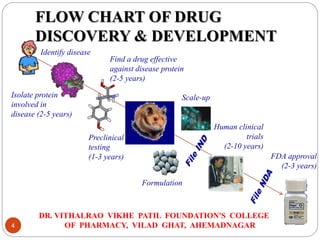
FLOW CHART OF DRUG
DISCOVERY & DEVELOPMENT
DR. VITHALRAO VIKHE PATIL FOUNDATION'S COLLEGE
OF PHARMACY, VILAD GHAT, AHEMADNAGAR
4
Identify disease
Isolate protein
involved in
disease (2-5 years)
Find a drug effective
against disease protein
(2-5 years)
Formulation
Preclinical
testing
(1-3 years)
Scale-up
FDA approval
(2-3 years)
Human clinical
trials
(2-10 years)
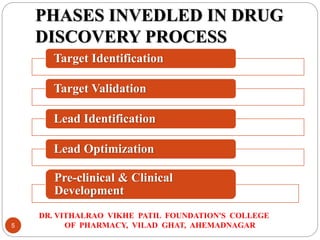
PHASES INVEDLED IN DRUG
DISCOVERY PROCESS
DR. VITHALRAO VIKHE PATIL FOUNDATION'S COLLEGE
OF PHARMACY, VILAD GHAT, AHEMADNAGAR
5
Target Identification
Target Validation
Lead Identification
Lead Optimization
Pre-clinical & Clinical
Development
PIPELINE FOR DRUG
DISCOVERY PROCESS
DR. VITHALRAO VIKHE PATIL FOUNDATION'S COLLEGE
OF PHARMACY, VILAD GHAT, AHEMADNAGAR
6
DR. VITHALRAO VIKHE PATIL FOUNDATION'S COLLEGE
OF PHARMACY, VILAD GHAT, AHEMADNAGAR
7
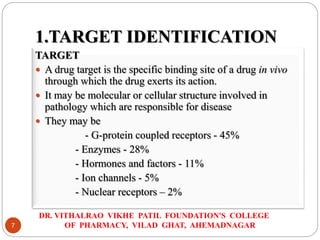
TARGET
 A drug target is the specific binding site of a drug in vivo
through which the drug exerts its action.
 It may be molecular or cellular structure involved in
pathology which are responsible for disease
 They may be
- G-protein coupled receptors - 45%
- Enzymes - 28%
- Hormones and factors - 11%
- Ion channels - 5%
- Nuclear receptors – 2%
1.TARGET IDENTIFICATION
Characteristics of target
DR. VITHALRAO VIKHE PATIL FOUNDATION'S COLLEGE
OF PHARMACY, VILAD GHAT, AHEMADNAGAR
8
 The bimolecular have special sites that match other.
 The bimolecular structure might change - when the bimolecular
binds to small molecules and the changes in structure normally
are reversible.
 Following the change in the biomolecule’s structure -
physiological responses occur and induce regulation of the cell,
organ, tissue, or body status.
 The physiological responses triggered by the changes in
bimolecular - complex regulation & therapeutic effect on
pathological conditions.
 The expression, activity, and structure of the biomolecule might
change over the duration of the pathological process.
 Small molecules binding to the bimolecular are drugs.
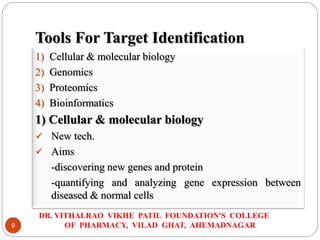
Tools For Target Identification
DR. VITHALRAO VIKHE PATIL FOUNDATION'S COLLEGE
OF PHARMACY, VILAD GHAT, AHEMADNAGAR
9
1) Cellular & molecular biology
2) Genomics
3) Proteomics
4) Bioinformatics
1) Cellular & molecular biology
 New tech.
 Aims
-discovering new genes and protein
-quantifying and analyzing gene expression between
diseased & normal cells
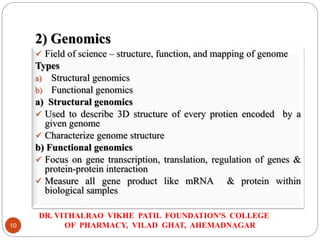
2) Genomics
DR. VITHALRAO VIKHE PATIL FOUNDATION'S COLLEGE
OF PHARMACY, VILAD GHAT, AHEMADNAGAR
10
 Field of science – structure, function, and mapping of genome
Types
a) Structural genomics
b) Functional genomics
a) Structural genomics
 Used to describe 3D structure of every protien encoded by a
given genome
 Characterize genome structure
b) Functional genomics
 Focus on gene transcription, translation, regulation of genes &
protein-protein interaction
 Measure all gene product like mRNA & protein within
biological samples
3) Proteomics
DR. VITHALRAO VIKHE PATIL FOUNDATION'S COLLEGE
OF PHARMACY, VILAD GHAT, AHEMADNAGAR
11
 Large scale study of protein & their function
 It is the study of the proteome, the complete set of proteins
produced by a species, using the technologies of large - scale
protein separation and identification.
 The analysis of proteins including protein-protein, protein
nucleic acid, and protein ligand interactions
4) Bioinformatics
 Bioinformatics is a branch of molecular biology that involves
extensive analysis of biological data using computers, for the
purpose of enhancing biological research.
 Bioinformatics methods are used to transform the raw sequence
into meaningful information (eg. genes and their encoded
proteins) and to compare whole genomes (disease vs. not).
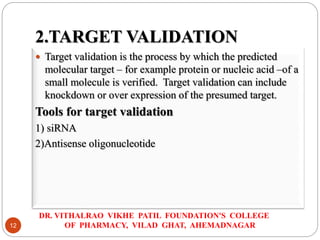
2.TARGET VALIDATION
DR. VITHALRAO VIKHE PATIL FOUNDATION'S COLLEGE
OF PHARMACY, VILAD GHAT, AHEMADNAGAR
12
 Target validation is the process by which the predicted
molecular target – for example protein or nucleic acid –of a
small molecule is verified. Target validation can include
knockdown or over expression of the presumed target.
Tools for target validation
1) siRNA
2)Antisense oligonucleotide
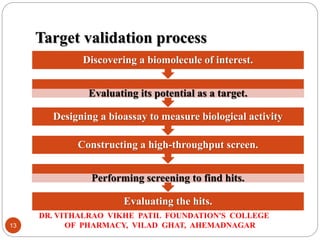
Target validation process
DR. VITHALRAO VIKHE PATIL FOUNDATION'S COLLEGE
OF PHARMACY, VILAD GHAT, AHEMADNAGAR
13
Evaluating the hits.
Performing screening to find hits.
Constructing a high-throughput screen.
Designing a bioassay to measure biological activity
Evaluating its potential as a target.
Discovering a biomolecule of interest.
1) siRNA
DR. VITHALRAO VIKHE PATIL FOUNDATION'S COLLEGE
OF PHARMACY, VILAD GHAT, AHEMADNAGAR
14
 Small (or short) interfering RNA (siRNA) is the commonly
used for RNA interference (RNAi) tool for inducing short-
term silencing of protein coding genes.
 It is a double stranded RNA molecule which interferes with
the expression of specific genes by degrading mRNA after
transcription & preventing translation.
 siRNA is double stranded RNA(dsRNA). It consist of two
RNA strands, an antisense (or guide) strand and a sense (or
passenger) strand, which form a duplex
 20-24 bp length.16
Mechanism
DR. VITHALRAO VIKHE PATIL FOUNDATION'S COLLEGE
OF PHARMACY, VILAD GHAT, AHEMADNAGAR
15
 long dsRNA is cleaved by an endo-ribonuclease called Dicer to
form short interfering RNA or siRNA.
siRNA enters the cell and
binds to Argonaute protein
to form RISC.
 siRNA is then unwinded
to form single stranded
siRNA.
 si rna and RISC complex
find their complementary
mRNA
2) Antisense Oligonucleotide
DR. VITHALRAO VIKHE PATIL FOUNDATION'S COLLEGE
OF PHARMACY, VILAD GHAT, AHEMADNAGAR
16
 Antisense technology prevent the synthesis of specific
protein.
 AS- ONS;15-20 nucleotides which are complementary to
their target mRNA.
 When these AS-ON combined with target mRNA, a
DNA/RNA hybrid form which degraded by the enzyme
RNase H.
 RNase H is a non specific endonuclease which catalyse
cleavage of RNA.
 RNase H has ribonuclease activity cleaves the 3’-O-P bond
of RNA in a DNA/RNA duplex.
Mechanism
DR. VITHALRAO VIKHE PATIL FOUNDATION'S COLLEGE
OF PHARMACY, VILAD GHAT, AHEMADNAGAR
17
Conti…
DR. VITHALRAO VIKHE PATIL FOUNDATION'S COLLEGE
OF PHARMACY, VILAD GHAT, AHEMADNAGAR
18
3. LEAD IDENTIFICATION
DR. VITHALRAO VIKHE PATIL FOUNDATION'S COLLEGE
OF PHARMACY, VILAD GHAT, AHEMADNAGAR
19
 Lead
Compounds are chemical compounds that show
desired biological or pharmacological activity and may
initiate the development of a new clinically relevant
compound.
 Organic compounds are identified which interact with the
target protein and modulate its activity by using random
(screening) or rational (design) approaches.
Approaches for lead identification
DR. VITHALRAO VIKHE PATIL FOUNDATION'S COLLEGE
OF PHARMACY, VILAD GHAT, AHEMADNAGAR
20
1)
• High Throughput screenning
2)
• Combinatorial Chemistry/synthesis
3)
• Virtual Screenning
4)
• Structure Based Drug Design
1) High throughput Screnning
DR. VITHALRAO VIKHE PATIL FOUNDATION'S COLLEGE
OF PHARMACY, VILAD GHAT, AHEMADNAGAR
21
“High throughput screening (HTS) is an
experimental process or tool that employs a group of
techniques to quickly conduct a very vast number of
chemical, pharmacological, genetic, biological tests to
identify biomolecular pathways or pharmacological actions.
 10,000 – 100,000 compounds can be screened daily.
Types of HTS assay in drug discovery
DR. VITHALRAO VIKHE PATIL FOUNDATION'S COLLEGE
OF PHARMACY, VILAD GHAT, AHEMADNAGAR
22
a) Biochemical Assay
b) Cell Based Assay
a) Biochemical Assay
 Measure function of a purified target dentify compounds
that modulate the activity of the target protein.
 Recombinant (engineered) proteins, proteins isolated from
crude cell lysates .
 Target-based
- Enzymes (e.g. kinases,proteases)
- Receptors (e.g. Nuclear receptors, Kinase GPCRs)
- Hormones
b) Cell Based Assay
DR. VITHALRAO VIKHE PATIL FOUNDATION'S COLLEGE
OF PHARMACY, VILAD GHAT, AHEMADNAGAR
23
Phenotype-based
- Transcriptional read-outs Second messenger levels
- Protein interactions
- Cell viability (cell death/apoptosis)
- Proliferation
Conti….
DR. VITHALRAO VIKHE PATIL FOUNDATION'S COLLEGE
OF PHARMACY, VILAD GHAT, AHEMADNAGAR
24
Instrumentation
DR. VITHALRAO VIKHE PATIL FOUNDATION'S COLLEGE
OF PHARMACY, VILAD GHAT, AHEMADNAGAR
25
 Microtiter plate ( Assay Plate)
 Plates/containers made of plastic, having spaced wells
– up to 384, 1536 or 3456 wells.
 They would contain solvents (e.g. DMSO + test
compounds)
 They would also contain proteins, cells, etc. to be
analysed.
 Some might be kept empty or contain pure solvents to
serve as controls.
Detectors
DR. VITHALRAO VIKHE PATIL FOUNDATION'S COLLEGE
OF PHARMACY, VILAD GHAT, AHEMADNAGAR
26
 Diverse spectromètres (fluorescence, mass, NMR, FTIR,
etc.),
 Chromatography (Gas, Liquid, Ion exchange, etc.) and
 Microscopy (Scanning tunneling microscopy, atomic force
 microscopy, confocal microscopy) and Calorimeters.
Importance and Application of HTS
DR. VITHALRAO VIKHE PATIL FOUNDATION'S COLLEGE
OF PHARMACY, VILAD GHAT, AHEMADNAGAR
27
 Selection of compounds from a vast number synthesized by
combinatorial chemistry and other methods.
 For lead generation for the treatment of a disease.
 It is an efficient tool in studying biomolecular interactions
and pathways.
 It is highly efficient, fast, accurate and dependable in
compound screening
 Useful in DNA sequencing
2)Combinatorial chemistry/synthesis
DR. VITHALRAO VIKHE PATIL FOUNDATION'S COLLEGE
OF PHARMACY, VILAD GHAT, AHEMADNAGAR
28
“ The automated synthesis of a large number of compounds in
a short time period using a defined reaction route and a
large variety of reactants, Normally carried out on small
scale using solid phase synthesis and automated synthetic
machines”
Tech used in combinatorial chemistry
A. Solid phase tech.
1] Solid phase synthesis
2] Parallel synthesis
a) Hoghton’s tea bag procedure
b) Automated parallel synthesis
Conti…
DR. VITHALRAO VIKHE PATIL FOUNDATION'S COLLEGE
OF PHARMACY, VILAD GHAT, AHEMADNAGAR
29
3] Mixed combinatorial synthesis
4] Mixed & split synthesis
 Combinatorial chemistry plays a central role because of its ability to
create and produce molecules. In addition, combinatorial chemistry is
an active participant in drug development from the synthesis of
substances until its bulk production. Combinatorial chemistry can
create large population of analogs of a given scaffold.
 The analogs are synthesize in successive steps with the use of
robotics. The analogs are included in “combinatorial libraries”
consisting of a great number of wells, each one containing in
solution several dozens of compounds.
 Only a few milligrams of compounds can be obtained by this
method, however this is generally sufficient for primary
biological screening.
3)Virtual screenning
DR. VITHALRAO VIKHE PATIL FOUNDATION'S COLLEGE
OF PHARMACY, VILAD GHAT, AHEMADNAGAR
30
 It is a computational techinque used in drug discovery to
search libraries of small molecules in order to identify
those structure which are most likely to bind to a target,
typically a protein receptor or enzyme
 Goal- Reduction of the enormous virtual chemical space,
to a manageable number of compound that would inhibit a
target protein responsible for disease and also have highest
chance to lead to a drug candidate.
4. LEAD OPTIMIZATION
DR. VITHALRAO VIKHE PATIL FOUNDATION'S COLLEGE
OF PHARMACY, VILAD GHAT, AHEMADNAGAR
31
 Lead optimization is a process that begins with a compound that
displays an interesting biological action and ends with the identification
of the best analog. Molecules are chemically modified and
subsequently characterized in order to obtain compounds with suitable
properties to become a drug. Leads are characterized with respect to
pharmacodynamic properties such as efficacy and potency in vitro and
in vivo, Physiochemical properties, pharmacokinetic properties, and
toxicological aspects.
 Potency - refers to the amount of drug required for its specific
effect to occur.
 Efficacy - measures the maximum strength of the effect itself, at
saturating drug concentrations
Conti…
DR. VITHALRAO VIKHE PATIL FOUNDATION'S COLLEGE
OF PHARMACY, VILAD GHAT, AHEMADNAGAR
32
 Pharmacokinetics - determines the fate of xenobiotics.
It explains about “What the body does to the drug”. It often
divided into areas examining the extent and rate of
adsorption, distribution, metabolism, and excretion
(ADME).
 Pharmacodynamics– It determines the biochemical
and physiological effects of drugs, the mechanism of drug
action and the relationship between drug concentration and
effect. It explains about “What the drug does to the body”.
5. PRE-CLINICAL & CLINICAL
DEVELOPMENT
DR. VITHALRAO VIKHE PATIL FOUNDATION'S COLLEGE
OF PHARMACY, VILAD GHAT, AHEMADNAGAR
33
Pre-clinical development:
The pre-clinical development includes the following: develop
large scale synthesis; animal safety studies; carcinogenicity tests;
drug delivery; elimination and metabolism studies; drug
formulation experiments; dose-ranging studies in animals. Wide
ranging dosages of the compounds are introduced to the cell line
or animal in order to obtain preliminary efficacy and
pharmacokinetic information.
Conti..
DR. VITHALRAO VIKHE PATIL FOUNDATION'S COLLEGE
OF PHARMACY, VILAD GHAT, AHEMADNAGAR
34
Clinical development
1. Treatment trials: test experimental treatments or a new
combination of drugs.
2. Prevention trials: look for ways to prevent a disease or
prevent it from returning.
3. Diagnostic trials: find better test or procedures for
diagnosing a disease.
4. Screening trials: test methods of detecting diseases.
5. Quality of life trials: explore ways to improve comfort &
quality of life for individuals with a chronic illness.
Phases of clinical trials
DR. VITHALRAO VIKHE PATIL FOUNDATION'S COLLEGE
OF PHARMACY, VILAD GHAT, AHEMADNAGAR
35
Phase 1 - A small group of healthy volunteers (20-100) are
selected to assess the safety, tolerability, pharmacokinetics,
& pharmacodynamics of a therapy. Normally include dose
ranging studies so that doses for clinical use can be
set/adjusted.[6 months-1 yr]
Phase 2- Performed on larger groups (100-200) & are
designed to assess the activity of the therapy and
effectiveness of drug & continue phase1 safety
assessments.[2-3 yrs]
Conti..
DR. VITHALRAO VIKHE PATIL FOUNDATION'S COLLEGE
OF PHARMACY, VILAD GHAT, AHEMADNAGAR
36
Phase 3 -Randomized controlled trials on large patient groups
[1000-5000] [5yr]
 assessment of the efficacy of the new therapy,
 side effects are also monitored.
 to obtain approval from the FDA This document is
submitted to the FDA for review.
Phase 4 –
 After regulatory authority approval
 Larger no. of patients.
 DDI and dose response studies & safety studies
REFERANCES
DR. VITHALRAO VIKHE PATIL FOUNDATION'S COLLEGE
OF PHARMACY, VILAD GHAT, AHEMADNAGAR
37
1. Alexander Hillisch Rolf Hilgenfeld “Modern Methods Of
Drug Discovery”, Springer edition,1-12.
2. Prakash N, Devangi P (2010) “Drug Discovery”. J Antivir
Antiretrovir 2: 063-068. doi:10.4172/jaa.1000025.
3. V. Srinivasa Rao and K. Srinivas* “Modern drug discovery
process:” An in silico approach Journal of Bioinformatics and
Sequence Analysis Vol. 2(5), pp. 89-94, June 2011.
4. Patrick Bultinck, “Computational Medicinal Chemistry for
Drug Discovery,” dekkar publication, Page No. 617-634.
Conti…
DR. VITHALRAO VIKHE PATIL FOUNDATION'S COLLEGE
OF PHARMACY, VILAD GHAT, AHEMADNAGAR
38
5. Wang S, Sim TB, Kim YS, Chang YT (2004) “Tools for target
identification and validation.” Curr Opin Chem Biol 8: 371-
377.
6. John C. Alexander and Daniel E. Salazar, “Modern
Drug Discovery and Development,” PART | VII Human
Pharmacology 361-380.
7. Alderman E, Elands J (1998) “A novel approach to ultra-
high throughput screening.” Genet Eng News Jan 18: 2.
8. http://www.combichemistry.com/drug discovery.html
Conti…
DR. VITHALRAO VIKHE PATIL FOUNDATION'S COLLEGE
OF PHARMACY, VILAD GHAT, AHEMADNAGAR
39
9. Sunil Shewale, Sharad N Shinde, Vikas G Wawlw,
“Basics of Clinical Research”, 1st edition, Prathmesh
Publication, 7-8
40

Drug discovery process.

  • 1.
    DRUG DISCOVERY PROCESS DR.VITHALRAO VIKHE PATIL FOUNDATION'S COLLEGE OF PHARMACY, VILAD GHAT, AHEMADNAGAR PRESENTED BY MISS. S.R.BORUDE M.PHARM (SEM-2)ROLL NO.2 PHARMACOLOGY UNDER GUIDANCE OF PROF.H.J.PAGAR DEPT. OF PHARMACOLOGY
  • 2.
    FLOW OF SEMINAR DR.VITHALRAO VIKHE PATIL FOUNDATION'S COLLEGE OF PHARMACY, VILAD GHAT, AHEMADNAGAR 2  Introduction  Drug Discovery Process  Phases Involved in drug discovery process 1. Target Identification 2. Target Validation 3. Lead Identification 4. Lead Optimization 5. Preclinical and Clinical Development  References
  • 3.
    INTRODUCTION DR. VITHALRAO VIKHEPATIL FOUNDATION'S COLLEGE OF PHARMACY, VILAD GHAT, AHEMADNAGAR 3  Drug discovery is an inventive process of identifying a compound or new medication based on knowledge of biological target, therapeutically useful in treating and curing a disease.  The process of drug discovery involves  the identification of candidates,  synthesis,  characterization,  screening,  assays for therapeutic efficacy. Once a compound has shown its value in these tests, it will begin the process of drug development prior to clinical trials.
  • 4.
    FLOW CHART OFDRUG DISCOVERY & DEVELOPMENT DR. VITHALRAO VIKHE PATIL FOUNDATION'S COLLEGE OF PHARMACY, VILAD GHAT, AHEMADNAGAR 4 Identify disease Isolate protein involved in disease (2-5 years) Find a drug effective against disease protein (2-5 years) Formulation Preclinical testing (1-3 years) Scale-up FDA approval (2-3 years) Human clinical trials (2-10 years)
  • 5.
    PHASES INVEDLED INDRUG DISCOVERY PROCESS DR. VITHALRAO VIKHE PATIL FOUNDATION'S COLLEGE OF PHARMACY, VILAD GHAT, AHEMADNAGAR 5 Target Identification Target Validation Lead Identification Lead Optimization Pre-clinical & Clinical Development
  • 6.
    PIPELINE FOR DRUG DISCOVERYPROCESS DR. VITHALRAO VIKHE PATIL FOUNDATION'S COLLEGE OF PHARMACY, VILAD GHAT, AHEMADNAGAR 6
  • 7.
    DR. VITHALRAO VIKHEPATIL FOUNDATION'S COLLEGE OF PHARMACY, VILAD GHAT, AHEMADNAGAR 7 TARGET  A drug target is the specific binding site of a drug in vivo through which the drug exerts its action.  It may be molecular or cellular structure involved in pathology which are responsible for disease  They may be - G-protein coupled receptors - 45% - Enzymes - 28% - Hormones and factors - 11% - Ion channels - 5% - Nuclear receptors – 2% 1.TARGET IDENTIFICATION
  • 8.
    Characteristics of target DR.VITHALRAO VIKHE PATIL FOUNDATION'S COLLEGE OF PHARMACY, VILAD GHAT, AHEMADNAGAR 8  The bimolecular have special sites that match other.  The bimolecular structure might change - when the bimolecular binds to small molecules and the changes in structure normally are reversible.  Following the change in the biomolecule’s structure - physiological responses occur and induce regulation of the cell, organ, tissue, or body status.  The physiological responses triggered by the changes in bimolecular - complex regulation & therapeutic effect on pathological conditions.  The expression, activity, and structure of the biomolecule might change over the duration of the pathological process.  Small molecules binding to the bimolecular are drugs.
  • 9.
    Tools For TargetIdentification DR. VITHALRAO VIKHE PATIL FOUNDATION'S COLLEGE OF PHARMACY, VILAD GHAT, AHEMADNAGAR 9 1) Cellular & molecular biology 2) Genomics 3) Proteomics 4) Bioinformatics 1) Cellular & molecular biology  New tech.  Aims -discovering new genes and protein -quantifying and analyzing gene expression between diseased & normal cells
  • 10.
    2) Genomics DR. VITHALRAOVIKHE PATIL FOUNDATION'S COLLEGE OF PHARMACY, VILAD GHAT, AHEMADNAGAR 10  Field of science – structure, function, and mapping of genome Types a) Structural genomics b) Functional genomics a) Structural genomics  Used to describe 3D structure of every protien encoded by a given genome  Characterize genome structure b) Functional genomics  Focus on gene transcription, translation, regulation of genes & protein-protein interaction  Measure all gene product like mRNA & protein within biological samples
  • 11.
    3) Proteomics DR. VITHALRAOVIKHE PATIL FOUNDATION'S COLLEGE OF PHARMACY, VILAD GHAT, AHEMADNAGAR 11  Large scale study of protein & their function  It is the study of the proteome, the complete set of proteins produced by a species, using the technologies of large - scale protein separation and identification.  The analysis of proteins including protein-protein, protein nucleic acid, and protein ligand interactions 4) Bioinformatics  Bioinformatics is a branch of molecular biology that involves extensive analysis of biological data using computers, for the purpose of enhancing biological research.  Bioinformatics methods are used to transform the raw sequence into meaningful information (eg. genes and their encoded proteins) and to compare whole genomes (disease vs. not).
  • 12.
    2.TARGET VALIDATION DR. VITHALRAOVIKHE PATIL FOUNDATION'S COLLEGE OF PHARMACY, VILAD GHAT, AHEMADNAGAR 12  Target validation is the process by which the predicted molecular target – for example protein or nucleic acid –of a small molecule is verified. Target validation can include knockdown or over expression of the presumed target. Tools for target validation 1) siRNA 2)Antisense oligonucleotide
  • 13.
    Target validation process DR.VITHALRAO VIKHE PATIL FOUNDATION'S COLLEGE OF PHARMACY, VILAD GHAT, AHEMADNAGAR 13 Evaluating the hits. Performing screening to find hits. Constructing a high-throughput screen. Designing a bioassay to measure biological activity Evaluating its potential as a target. Discovering a biomolecule of interest.
  • 14.
    1) siRNA DR. VITHALRAOVIKHE PATIL FOUNDATION'S COLLEGE OF PHARMACY, VILAD GHAT, AHEMADNAGAR 14  Small (or short) interfering RNA (siRNA) is the commonly used for RNA interference (RNAi) tool for inducing short- term silencing of protein coding genes.  It is a double stranded RNA molecule which interferes with the expression of specific genes by degrading mRNA after transcription & preventing translation.  siRNA is double stranded RNA(dsRNA). It consist of two RNA strands, an antisense (or guide) strand and a sense (or passenger) strand, which form a duplex  20-24 bp length.16
  • 15.
    Mechanism DR. VITHALRAO VIKHEPATIL FOUNDATION'S COLLEGE OF PHARMACY, VILAD GHAT, AHEMADNAGAR 15  long dsRNA is cleaved by an endo-ribonuclease called Dicer to form short interfering RNA or siRNA. siRNA enters the cell and binds to Argonaute protein to form RISC.  siRNA is then unwinded to form single stranded siRNA.  si rna and RISC complex find their complementary mRNA
  • 16.
    2) Antisense Oligonucleotide DR.VITHALRAO VIKHE PATIL FOUNDATION'S COLLEGE OF PHARMACY, VILAD GHAT, AHEMADNAGAR 16  Antisense technology prevent the synthesis of specific protein.  AS- ONS;15-20 nucleotides which are complementary to their target mRNA.  When these AS-ON combined with target mRNA, a DNA/RNA hybrid form which degraded by the enzyme RNase H.  RNase H is a non specific endonuclease which catalyse cleavage of RNA.  RNase H has ribonuclease activity cleaves the 3’-O-P bond of RNA in a DNA/RNA duplex.
  • 17.
    Mechanism DR. VITHALRAO VIKHEPATIL FOUNDATION'S COLLEGE OF PHARMACY, VILAD GHAT, AHEMADNAGAR 17
  • 18.
    Conti… DR. VITHALRAO VIKHEPATIL FOUNDATION'S COLLEGE OF PHARMACY, VILAD GHAT, AHEMADNAGAR 18
  • 19.
    3. LEAD IDENTIFICATION DR.VITHALRAO VIKHE PATIL FOUNDATION'S COLLEGE OF PHARMACY, VILAD GHAT, AHEMADNAGAR 19  Lead Compounds are chemical compounds that show desired biological or pharmacological activity and may initiate the development of a new clinically relevant compound.  Organic compounds are identified which interact with the target protein and modulate its activity by using random (screening) or rational (design) approaches.
  • 20.
    Approaches for leadidentification DR. VITHALRAO VIKHE PATIL FOUNDATION'S COLLEGE OF PHARMACY, VILAD GHAT, AHEMADNAGAR 20 1) • High Throughput screenning 2) • Combinatorial Chemistry/synthesis 3) • Virtual Screenning 4) • Structure Based Drug Design
  • 21.
    1) High throughputScrenning DR. VITHALRAO VIKHE PATIL FOUNDATION'S COLLEGE OF PHARMACY, VILAD GHAT, AHEMADNAGAR 21 “High throughput screening (HTS) is an experimental process or tool that employs a group of techniques to quickly conduct a very vast number of chemical, pharmacological, genetic, biological tests to identify biomolecular pathways or pharmacological actions.  10,000 – 100,000 compounds can be screened daily.
  • 22.
    Types of HTSassay in drug discovery DR. VITHALRAO VIKHE PATIL FOUNDATION'S COLLEGE OF PHARMACY, VILAD GHAT, AHEMADNAGAR 22 a) Biochemical Assay b) Cell Based Assay a) Biochemical Assay  Measure function of a purified target dentify compounds that modulate the activity of the target protein.  Recombinant (engineered) proteins, proteins isolated from crude cell lysates .  Target-based - Enzymes (e.g. kinases,proteases) - Receptors (e.g. Nuclear receptors, Kinase GPCRs) - Hormones
  • 23.
    b) Cell BasedAssay DR. VITHALRAO VIKHE PATIL FOUNDATION'S COLLEGE OF PHARMACY, VILAD GHAT, AHEMADNAGAR 23 Phenotype-based - Transcriptional read-outs Second messenger levels - Protein interactions - Cell viability (cell death/apoptosis) - Proliferation
  • 24.
    Conti…. DR. VITHALRAO VIKHEPATIL FOUNDATION'S COLLEGE OF PHARMACY, VILAD GHAT, AHEMADNAGAR 24
  • 25.
    Instrumentation DR. VITHALRAO VIKHEPATIL FOUNDATION'S COLLEGE OF PHARMACY, VILAD GHAT, AHEMADNAGAR 25  Microtiter plate ( Assay Plate)  Plates/containers made of plastic, having spaced wells – up to 384, 1536 or 3456 wells.  They would contain solvents (e.g. DMSO + test compounds)  They would also contain proteins, cells, etc. to be analysed.  Some might be kept empty or contain pure solvents to serve as controls.
  • 26.
    Detectors DR. VITHALRAO VIKHEPATIL FOUNDATION'S COLLEGE OF PHARMACY, VILAD GHAT, AHEMADNAGAR 26  Diverse spectromètres (fluorescence, mass, NMR, FTIR, etc.),  Chromatography (Gas, Liquid, Ion exchange, etc.) and  Microscopy (Scanning tunneling microscopy, atomic force  microscopy, confocal microscopy) and Calorimeters.
  • 27.
    Importance and Applicationof HTS DR. VITHALRAO VIKHE PATIL FOUNDATION'S COLLEGE OF PHARMACY, VILAD GHAT, AHEMADNAGAR 27  Selection of compounds from a vast number synthesized by combinatorial chemistry and other methods.  For lead generation for the treatment of a disease.  It is an efficient tool in studying biomolecular interactions and pathways.  It is highly efficient, fast, accurate and dependable in compound screening  Useful in DNA sequencing
  • 28.
    2)Combinatorial chemistry/synthesis DR. VITHALRAOVIKHE PATIL FOUNDATION'S COLLEGE OF PHARMACY, VILAD GHAT, AHEMADNAGAR 28 “ The automated synthesis of a large number of compounds in a short time period using a defined reaction route and a large variety of reactants, Normally carried out on small scale using solid phase synthesis and automated synthetic machines” Tech used in combinatorial chemistry A. Solid phase tech. 1] Solid phase synthesis 2] Parallel synthesis a) Hoghton’s tea bag procedure b) Automated parallel synthesis
  • 29.
    Conti… DR. VITHALRAO VIKHEPATIL FOUNDATION'S COLLEGE OF PHARMACY, VILAD GHAT, AHEMADNAGAR 29 3] Mixed combinatorial synthesis 4] Mixed & split synthesis  Combinatorial chemistry plays a central role because of its ability to create and produce molecules. In addition, combinatorial chemistry is an active participant in drug development from the synthesis of substances until its bulk production. Combinatorial chemistry can create large population of analogs of a given scaffold.  The analogs are synthesize in successive steps with the use of robotics. The analogs are included in “combinatorial libraries” consisting of a great number of wells, each one containing in solution several dozens of compounds.  Only a few milligrams of compounds can be obtained by this method, however this is generally sufficient for primary biological screening.
  • 30.
    3)Virtual screenning DR. VITHALRAOVIKHE PATIL FOUNDATION'S COLLEGE OF PHARMACY, VILAD GHAT, AHEMADNAGAR 30  It is a computational techinque used in drug discovery to search libraries of small molecules in order to identify those structure which are most likely to bind to a target, typically a protein receptor or enzyme  Goal- Reduction of the enormous virtual chemical space, to a manageable number of compound that would inhibit a target protein responsible for disease and also have highest chance to lead to a drug candidate.
  • 31.
    4. LEAD OPTIMIZATION DR.VITHALRAO VIKHE PATIL FOUNDATION'S COLLEGE OF PHARMACY, VILAD GHAT, AHEMADNAGAR 31  Lead optimization is a process that begins with a compound that displays an interesting biological action and ends with the identification of the best analog. Molecules are chemically modified and subsequently characterized in order to obtain compounds with suitable properties to become a drug. Leads are characterized with respect to pharmacodynamic properties such as efficacy and potency in vitro and in vivo, Physiochemical properties, pharmacokinetic properties, and toxicological aspects.  Potency - refers to the amount of drug required for its specific effect to occur.  Efficacy - measures the maximum strength of the effect itself, at saturating drug concentrations
  • 32.
    Conti… DR. VITHALRAO VIKHEPATIL FOUNDATION'S COLLEGE OF PHARMACY, VILAD GHAT, AHEMADNAGAR 32  Pharmacokinetics - determines the fate of xenobiotics. It explains about “What the body does to the drug”. It often divided into areas examining the extent and rate of adsorption, distribution, metabolism, and excretion (ADME).  Pharmacodynamics– It determines the biochemical and physiological effects of drugs, the mechanism of drug action and the relationship between drug concentration and effect. It explains about “What the drug does to the body”.
  • 33.
    5. PRE-CLINICAL &CLINICAL DEVELOPMENT DR. VITHALRAO VIKHE PATIL FOUNDATION'S COLLEGE OF PHARMACY, VILAD GHAT, AHEMADNAGAR 33 Pre-clinical development: The pre-clinical development includes the following: develop large scale synthesis; animal safety studies; carcinogenicity tests; drug delivery; elimination and metabolism studies; drug formulation experiments; dose-ranging studies in animals. Wide ranging dosages of the compounds are introduced to the cell line or animal in order to obtain preliminary efficacy and pharmacokinetic information.
  • 34.
    Conti.. DR. VITHALRAO VIKHEPATIL FOUNDATION'S COLLEGE OF PHARMACY, VILAD GHAT, AHEMADNAGAR 34 Clinical development 1. Treatment trials: test experimental treatments or a new combination of drugs. 2. Prevention trials: look for ways to prevent a disease or prevent it from returning. 3. Diagnostic trials: find better test or procedures for diagnosing a disease. 4. Screening trials: test methods of detecting diseases. 5. Quality of life trials: explore ways to improve comfort & quality of life for individuals with a chronic illness.
  • 35.
    Phases of clinicaltrials DR. VITHALRAO VIKHE PATIL FOUNDATION'S COLLEGE OF PHARMACY, VILAD GHAT, AHEMADNAGAR 35 Phase 1 - A small group of healthy volunteers (20-100) are selected to assess the safety, tolerability, pharmacokinetics, & pharmacodynamics of a therapy. Normally include dose ranging studies so that doses for clinical use can be set/adjusted.[6 months-1 yr] Phase 2- Performed on larger groups (100-200) & are designed to assess the activity of the therapy and effectiveness of drug & continue phase1 safety assessments.[2-3 yrs]
  • 36.
    Conti.. DR. VITHALRAO VIKHEPATIL FOUNDATION'S COLLEGE OF PHARMACY, VILAD GHAT, AHEMADNAGAR 36 Phase 3 -Randomized controlled trials on large patient groups [1000-5000] [5yr]  assessment of the efficacy of the new therapy,  side effects are also monitored.  to obtain approval from the FDA This document is submitted to the FDA for review. Phase 4 –  After regulatory authority approval  Larger no. of patients.  DDI and dose response studies & safety studies
  • 37.
    REFERANCES DR. VITHALRAO VIKHEPATIL FOUNDATION'S COLLEGE OF PHARMACY, VILAD GHAT, AHEMADNAGAR 37 1. Alexander Hillisch Rolf Hilgenfeld “Modern Methods Of Drug Discovery”, Springer edition,1-12. 2. Prakash N, Devangi P (2010) “Drug Discovery”. J Antivir Antiretrovir 2: 063-068. doi:10.4172/jaa.1000025. 3. V. Srinivasa Rao and K. Srinivas* “Modern drug discovery process:” An in silico approach Journal of Bioinformatics and Sequence Analysis Vol. 2(5), pp. 89-94, June 2011. 4. Patrick Bultinck, “Computational Medicinal Chemistry for Drug Discovery,” dekkar publication, Page No. 617-634.
  • 38.
    Conti… DR. VITHALRAO VIKHEPATIL FOUNDATION'S COLLEGE OF PHARMACY, VILAD GHAT, AHEMADNAGAR 38 5. Wang S, Sim TB, Kim YS, Chang YT (2004) “Tools for target identification and validation.” Curr Opin Chem Biol 8: 371- 377. 6. John C. Alexander and Daniel E. Salazar, “Modern Drug Discovery and Development,” PART | VII Human Pharmacology 361-380. 7. Alderman E, Elands J (1998) “A novel approach to ultra- high throughput screening.” Genet Eng News Jan 18: 2. 8. http://www.combichemistry.com/drug discovery.html
  • 39.
    Conti… DR. VITHALRAO VIKHEPATIL FOUNDATION'S COLLEGE OF PHARMACY, VILAD GHAT, AHEMADNAGAR 39 9. Sunil Shewale, Sharad N Shinde, Vikas G Wawlw, “Basics of Clinical Research”, 1st edition, Prathmesh Publication, 7-8
  • 40.