
DRUG STORE MANAGEMENT
AND INVENTORY CONTROL
DR. RUPALI A. PATIL
ASSOCIATE PROFESSOR & HEAD - PHARMACOLOGY
GES’S SIR DR. M. S. GOSAVI COLLEGE OF PHARM. EDU. & RES., NASHIK
CONTENT
• Organisation of drug store,
• Types of materials stocked and storage conditions,
• Purchase and inventory control:
• Principles,
• Purchase procedure,
• Purchase order,
• Procurement and stocking,
• Economic order quantity,
• Reorder quantity level, and
• Methods used for the analysis of the drug expenditure
DRUG STORE/PHARMACY/COMMUNITY PHARMACY/CHEMIST'S
• A retail shop which provides prescription drugs, among other products.
• At the drug store, a pharmacist oversees the fulfillment of medical
prescriptions & is available to give advice on their offerings of over-the-
counter drugs.
• A typical pharmacy would be in the commercial area of a community.
• Every hospital should have a medical store for the purpose of procuring,
stocking & distributing the drugs and medicines to various departments.
ORGANISATION OF DRUG STORE
• Stores are defined as a sub-organisation in any hospitals where materials
obtained are held in abeyance till inspected, approved and stocked.
• A store should have a standard specification of materials and since the store
procured the drugs on behalf of the department for regular flow of material,
the condition of storage should be proper.
OBJECTIVES OF DRUG STORES
1. To stock all drugs and accessories required in the hospital.
2. To procure drugs from different sources.
3. To supply drugs to the consuming departments.
4. To store drugs required in research work.
5. To preserve records of receipt and issue of drugs.
6. To maintain records of receipt and issue of drugs.
7. To carry out all operations regarding drugs economically to save revenue
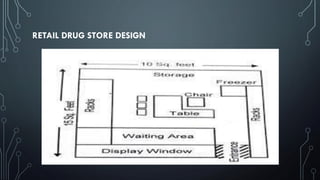
LAYOUT OF DRUG STORE
• Preferably located on the ground floor close to the pharmacy.
• Area: at least 600-1000 sq ft.
• Adequate storage facilities to avoid deterioration of the drugs, chemicals, biological etc.
by moisture or heat.
• An ideal store :
• 02entrances, one for receiving the articles and other for issue of materials.
• Racks : for storage of material made of angled iron, having partitions.
• Costly items are stored in closed bins.
• The height of racks depend up on the height of ceiling & should be above 2/3rd the height.
RETAIL DRUG STORE DESIGN
DRUG STORE
• A definite location code is to be followed in order to identify the product or
material placed in store.
• For this purpose, following system may be adapted:
(i) F S N- Fast moving, slow moving, non moving
(ii) H M L- Heavy, medium, light materials
• Fast moving materials are placed near the issue exit while
• Non-moving articles are placed far from the exit.
• Heavy items are placed at the bottom & light items on the top.
DRUG STORE…..
• Records are maintained using Bin Card system.
• A ledger or bin card has 4 codes like-
• 1 2 3 4 (1-Panel, 2-Row, 3-Rack, 4-Bin)
• A 5 B 3
This means panel A, 5th row, Rack B and Bin 3
Materials can be entered either in ledger or bin cards in Alphabetical order but
this may cause problems as number of drugs are known buy different name.
They may be categorised & stored depending up on their therapeutic effect.
TYPES OF MATERIALS STOCKED
• Sufficient number of racks should be provided for storage of drugs & supplies.
• CO2 fire extinguishers at strategic points along with fire buckets to fight sudden fires due to
stored drugs & chemical.
• Stocked Materials are:
(i) Capsules, tablets, liquid dosage form & injections etc.
(ii) Biological antibiotics in refrigerator.
(iii) Narcotic & psychotropic substances stored under lock & key.
(iv) POISOINS are stored in separate closed rack, labelled as “POISION”.
(v) Alcohol & alcohol containing preparations.
(vi) Large bulk items on bottom.
(vii)Vaccines & other thermolabile drugs @ cold store (2-10℃).
Antibiotics, vitamins liver preparations @ at cool temp (15-20℃).
(viii) To avoid pilferage, store costly drugs & prescribed schedule X drugs separately under lock & key.
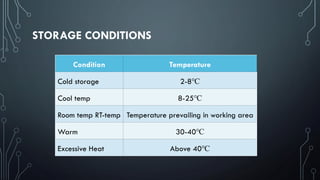
STORAGE CONDITIONS
Condition Temperature
Cold storage 2-8℃
Cool temp 8-25℃
Room temp RT-temp Temperature prevailing in working area
Warm 30-40℃
Excessive Heat Above 40℃
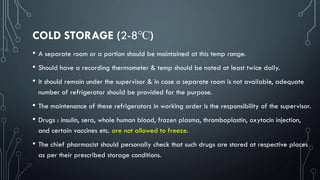
COLD STORAGE (2-8℃)
• A separate room or a portion should be maintained at this temp range.
• Should have a recording thermometer & temp should be noted at least twice daily.
• It should remain under the supervisor & in case a separate room is not available, adequate
number of refrigerator should be provided for the purpose.
• The maintenance of these refrigerators in working order is the responsibility of the supervisor.
• Drugs : insulin, sera, whole human blood, frozen plasma, thromboplastin, oxytocin injection,
and certain vaccines etc. are not allowed to freeze.
• The chief pharmacist should personally check that such drugs are stored at respective places
as per their prescribed storage conditions.
LIST A – (DRUGS REQUIRING COLD STORAGE 2-8OC)
1. Sera
2. Vaccines
3. Whole human blood
4. Concentrated human red blood corpuscles(4-6oC)
5. Normal human plasma
6. Frozenn plasma –at a temp not above -18oC
7. Thrombin
8. Tromboplastin
9. Cobra venom in solution
10. Viper venom in solution
11. Posterior pituitary injection
12. Oxytocin injection
13. Vasopressin injection
14. Corticotropin gelatin injection
15. Corticotrophin zinc oxide injection
16. Cholistin sulphamethate injection ]
17. Suxamethonium chloride injection
18. Insulin preparation
19. Human gamma globulin injection
20. Normal liquid human serum albumin
21. Schick test toxin
STORAGE AT COOL TEMPERATURE (8-25℃)
• The space of this room should be adequate considering the maximum stock of
drugs likely to be purchased by the hospital during any time of the year.
• The chief pharmacist should ensure that no drug falling in this category is stocked
away from this room.
• An inspection register should be maintained by the Chief pharmacist.
• Examples: antibiotics, vitamins, liver preparations.
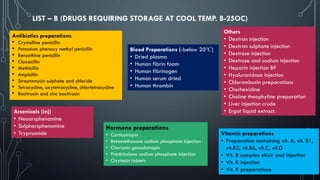
LIST – B (DRUGS REQUIRING STORAGE AT COOL TEMP. 8-25OC)
Antibiotics preparations
• Crystalline penicillin
• Potassium phenoxy methyl penicillin
• Benzethine penicillin
• Cloxacillin
• Methicillin
• Ampicillin
• Streptomycin sulphate and chloride
• Tetracycline, oxytetracycline, chlortetracycline
• Bacitracin and zinc bacitracin
Others
• Dextran injection
• Dextran sulphate injection
• Dextrose injection
• Dextrose and sodium injection
• Heparin injection BP
• Hyaluronidase injection
• Chlorambucin preparations
• Chorhexidine
• Choline theophyline preparation
• Liver injection crude
• Ergot liquid extract.
Arsenicals (inj)
• Neoarsphenamine
• Sulpharsphenamine
• Tryprsanide
Blood Preparations (-below 20℃)
• Dried plasma
• Human fibrin foam
• Human fibrinogen
• Human serum dried
• Human thrombin
Hormone preparations
• Corticotropin
• Betamethasone sodium phosphate injection
• Chorionic gonadotropin
• Prednisolone sodium phosphate injection
• Oxytocin tablets
Vitamin preparations
• Preparation containing vit. A, vit. B1,
vit.B2, vit.B6, vit.C, vit.D
• Vit. B complex elixir and injection
• Vit. K injection
• Vit. K preparations
PURCHASE AND INVENTORY CONTROL
• Basic purpose of purchases : To ensure continuous flow of raw materials of
right quality, right quantity, right price and from right sources.
Objective of purchasing : avoidance of duplication & wastage with respect to
various items purchased.
Centralized purchase by medical stores procures the drugs on behalf of all the
departments & helps in getting quality drugs at cheaper rates.
1.Right Quality - the quality which is available according to the particulars mentioned in terms of
grades, brands or trade name, physico-chemical characteristics, etc.
The quality must describe even the national standards to the extent it is possible.
2. Right Quantity - an important parameter of purchasing for continuous supply of raw materials.
“Economic order Quantity” or any other technique may be followed in order to avoid
shortage.
3. Right Price - consistent matching with the quality of drug. Generally tender system is followed in
hospitals & the lowest bidder is chosen for supplying the order.
4. Right Source -The supplier should be dependable & capable of supplying as per requirements from time
to time.
The selection of supplier requires consideration of various factors.
5. Right Time -Purchase department should have lead time information for all products.
Lead time: Total time period between the placing of order & receipt of material while doing purchases.
The purchase committee should consider emergency situations like floods, strikes, accidents, etc.
Some important terms
PURCHASE PROCEDURE
• Steps for procurement of goods:
I. Determination of Requirement- The materials to be purchased for particular
period are well planned for the purpose of their regular and continuous use.
Purchase requisition is generally prepared by departmental heads & provides
information mentioned below.
(a) Type of material to be purchased,
(b) Time of requirement,
(c) Quantity to be purchased,
II. Source of Supply- The pharmacy and therapeutic committee sets adequate
standards for the purchase of quality drugs. Procurement of stores is
generally done by following sources:
(i) Medical store depot
(ii) Directorate general supplies and disposals
(iii) Direct from wholesalers and manufacturers
(iv) By inviting tenders
(v) Emergency purchases from local market
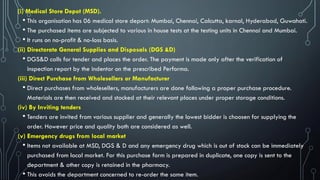
(i) Medical Store Depot (MSD).
• This organisation has 06 medical store deport: Mumbai, Chennai, Calcutta, karnal, Hyderabad, Guwahati.
• The purchased items are subjected to various in house tests at the testing units in Chennai and Mumbai.
• It runs on no-profit & no-loss basis.
(ii) Directorate General Supplies and Disposals (DGS &D)
• DGS&D calls for tender and places the order. The payment is made only after the verification of
inspection report by the indentor on the prescribed Performa.
(iii) Direct Purchase from Wholesellers or Manufacturer
• Direct purchases from wholesellers, manufacturers are done following a proper purchase procedure.
Materials are then received and stocked at their relevant places under proper storage conditions.
(iv) By Inviting tenders
• Tenders are invited from various supplier and generally the lowest bidder is choosen for supplying the
order. However price and quality both are considered as well.
(v) Emergency drugs from local market
• Items not available at MSD, DGS & D and any emergency drug which is out of stock can be immediately
purchased from local market. For this purchase form is prepared in duplicate, one copy is sent to the
department & other copy is retained in the pharmacy.
• This avoids the department concerned to re-order the same item.
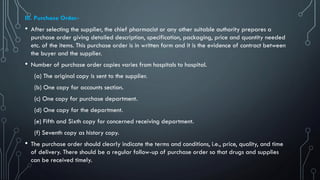
III. Purchase Order-
• After selecting the supplier, the chief pharmacist or any other suitable authority prepares a
purchase order giving detailed description, specification, packaging, price and quantity needed
etc. of the items. This purchase order is in written form and it is the evidence of contract between
the buyer and the supplier.
• Number of purchase order copies varies from hospitals to hospital.
(a) The original copy is sent to the supplier.
(b) One copy for accounts section.
(c) One copy for purchase department.
(d) One copy for the department.
(e) Fifth and Sixth copy for concerned receiving department.
(f) Seventh copy as history copy.
• The purchase order should clearly indicate the terms and conditions, i.e., price, quality, and time
of delivery. There should be a regular follow-up of purchase order so that drugs and supplies
can be received timely.
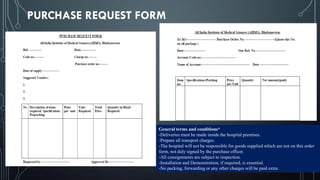
PURCHASE REQUEST FORM
General terms and conditions*
-Deliveries must be made inside the hospital premises.
-Prepare all transport charges.
-The hospital will not be responsible for goods supplied which are not on this order
form, not duly signed by the purchase officer.
-All consignments are subject to inspection.
-Installation and Demonstration, if required, is essential.
-No packing, forwarding or any other charges will be paid extra
IV. Receipt of Acknowledgment- After placing the order to supplier by sending a copy of purchase order,
the supplier in turn sends acknowledgement of the order saying that he will be able to supply the goods with
the terms and conditions which are mentioned in the purchase order.
V. Receipt of Drugs- On receipt of drugs , there should be a system in the stores whereby the supply of drugs
received in the medical stores from the manufacturer are properly checkedperson specially assigned for this
purpose. Preferably the same person is responsible for reviewing the stocks, date of expiry, description,
quantity, batch number, as mentioned in the order form.
• Random sampling can be done to make sure that products confirm to the tendered specifications like date
of expiry and visible sign of deterioration , such as change of colour , caking etc.
• If any such deterioration is observed the matter should be reported to medical superintendent and local
drug inspector. These stocks should never be used until the drug inspector’s permission is granted and even
the information should be sent to the manufacturer.
• After the thorough examination of drugs the above officer should give “No objection to accept the supply”
in writing on the hospital copies of delivery challans, Invoices by putting signature and date. The invoice
received from the supplier is sent to accounts section for accuracy along with price and quantity .After
verification ,the accounts section certifies and passes, the invoice for payment and on this basis, cashier
makes the payment either by cheque/draft.
VI. Distribution of Drugs to Wards- Drugs should be supplied in the original packing of
manufacturers. However if it is not possible to do so, then that should be supplied in clean containers
so that the integrity and original properties can be preserved. Name and quantity of the drug
should be properly labelled. It is always advisable that suitable precautions should be taken to
dispose off “Original empty containers” in order to avoid their misuse. The containers should be
destroyed in the presence of a responsible person with a written statement signed by him.
• Chief pharmacist should visit wards to check whether the drugs are properly stored under special
storage conditions like cold storage, cool temperature and at room temperature.
INVENTORY CONTROL
• Drug store management is based on principles of inventory control. mismanagement of stores &
non-applicability of Scientific & Modern techniques has been identified as the root cause of
material storage in majority of hospitals.
• Objective of Inventory Control
(i) To supply drug in time.
(ii) To reduce investment in inventories and made effective use of capital investment.
(iii) Efforts are made to procure goods at minimum price without bargaining the quality.
(iv) To avoid stock out and shortage.
(v) Wastage are avoided.
TECHNIQUES OF INVENTORY CONTROL /
METHODS USED FOR ANALYSIS OF DRUG EXPENDITURE
(i) ABC analysis
(ii) VED analysis
(iii) EOQ
(iv) Lead time
(v) Buffer stock
(i) ABC analysis
An inventory categorization technique. It is a basic tool with a selective approach for concentration upon the items.
As ABC analysis the items are divided into three categories—
• "A items" with very tight control and accurate records,
• "B items" with less tightly controlled and good records, and
• "C items" with the simplest controls possible and minimal records.
• The ABC analysis provides a mechanism for identifying items that will have a significant impact on overall inventory cost,
while also providing a mechanism for identifying different categories of stock that will require different management &
controls.
• The ABC analysis suggests that inventories of an organization are not of equal value.
Inventory is grouped into three categories (A, B, and C) in order of their estimated importance.
• 'A' items are very important for an organization. Because of the high value of these 'A' items, frequent value analysis is
required. In addition to that, an organization needs to choose an appropriate order pattern (e.g. 'just-in-time') to avoid
excess capacity. 'B' items are important, but of course less important than 'A' items and more important than 'C' items.
Therefore, 'B' items are intergroup items. 'C' items are marginally important.
• There are no fixed thresholds for each class, & different proportions can be applied based on objectives & criteria.
ABC Analysis is similar to the Pareto principle in that the 'A' items will typically account for a large proportion of the
overall value, but a small percentage of the number of items.
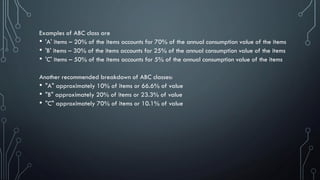
Examples of ABC class are
• 'A' items – 20% of the items accounts for 70% of the annual consumption value of the items
• 'B' items – 30% of the items accounts for 25% of the annual consumption value of the items
• 'C' items – 50% of the items accounts for 5% of the annual consumption value of the items
Another recommended breakdown of ABC classes:
• "A" approximately 10% of items or 66.6% of value
• "B" approximately 20% of items or 23.3% of value
• "C" approximately 70% of items or 10.1% of value
(ii) VED analysis is an inventory management technique that classifies inventory based on its functional importance. It categorizes
stock under three heads based on its importance and necessity for an organization for production or any of its other activities.
VED analysis stands for Vital, Essential, and Desirable.
V- Vital Category
• Includes inventory, which is necessary for production or any other process in an organization. The shortage of items under this
category can severely hamper or disrupt the proper functioning of operations. Hence, continuous checking, evaluation, and
replenishment happen for such stocks. If any of such inventories are unavailable, the entire production chain may stop. Also, a
missing essential component may be of need at the time of a breakdown. Therefore, order for such inventory should be before-
hand. Proper checks should be put in place by the management to ensure the continuous availability of items under the “vital”
category.
E- Essential category
• Includes inventory, which is next to being vital. These, too, are very important for any organization because they may lead to a
stoppage of production or hamper some other process. But the loss due to their unavailability may be temporary, or it might be
possible to repair the stock item or part.The management should ensure optimum availability and maintenance of inventory under
the “Essential” category too. The unavailability of inventory under this category should not cause any stoppage or delays.
D- Desirable Category
• It is the least important among the three, & their unavailability may result in minor stoppages in production or other processes.
Moreover, the easy replenishment of such shortages is possible in a short duration of time.
(iii) Economic order quantity (EOQ)
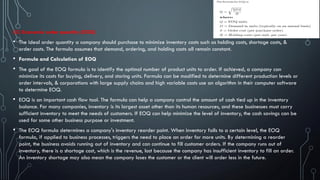
• The ideal order quantity a company should purchase to minimize inventory costs such as holding costs, shortage costs, &
order costs. The formula assumes that demand, ordering, and holding costs all remain constant.
• Formula and Calculation of EOQ
• The goal of the EOQ formula is to identify the optimal number of product units to order. If achieved, a company can
minimize its costs for buying, delivery, and storing units. Formula can be modified to determine different production levels or
order intervals, & corporations with large supply chains and high variable costs use an algorithm in their computer software
to determine EOQ.
• EOQ is an important cash flow tool. The formula can help a company control the amount of cash tied up in the inventory
balance. For many companies, inventory is its largest asset other than its human resources, and these businesses must carry
sufficient inventory to meet the needs of customers. If EOQ can help minimize the level of inventory, the cash savings can be
used for some other business purpose or investment.
• The EOQ formula determines a company's inventory reorder point. When inventory falls to a certain level, the EOQ
formula, if applied to business processes, triggers the need to place an order for more units. By determining a reorder
point, the business avoids running out of inventory and can continue to fill customer orders. If the company runs out of
inventory, there is a shortage cost, which is the revenue, lost because the company has insufficient inventory to fill an order.
An inventory shortage may also mean the company loses the customer or the client will order less in the future.
(iv) Lead time
• The lead time is the sum of the supply delay & the reordering delay.
• The lead time is the applicable duration to calculate the lead demand, the
safety stock or the reorder point through a direct quantile forecast.
• The longer the lead time, the higher the total inventory level or the larger is
the safety stock, resulting in excess of investment in inventories.
• As far as possible efforts should be made to decrease the lead time for
effective inventory control.
(V) Buffer stock
• Buffer stock is used in emergency to meet the unforeseen demands/ it refers to minimum
quantity of a particular item which must be kept in the stores of all time. Buffer stocks can be
calculated using the following formula ;
• Buffer stocks= (Maximum consumption rate/day average- consumption rate/day)X lead time
• Buffer stocks needs following factors to be taken into consideration like;
(i) Lead time
(ii) Nature of item and rate of consumption
(iii) Availability of substitutes
(iv)Re-order level
(v) Stock out cost
Modern Computerization of Inventory Control
• National information centre (NIC) is working hard to prepare software which would
facilitate proper control of inventory through the implementation of accepted
principles of material management such as ABC analysis, "Last is the first out" etc. It
would minimize the chances of validity of drugs expiring while in storage by the
transfer of stocks from the surplus to deficit depots.
• Computerization will serve following purposes:
(i) Less investment
(ii) Less storage
(iii)Fast supply of drug
(iv) Control on Issue of Drugs
(v) Minimum wastage
(vi) Prompt payments
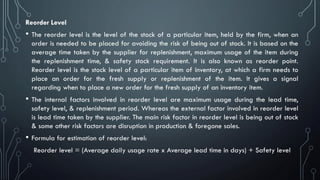
Reorder Level
• The reorder level is the level of the stock of a particular item, held by the firm, when an
order is needed to be placed for avoiding the risk of being out of stock. It is based on the
average time taken by the supplier for replenishment, maximum usage of the item during
the replenishment time, & safety stock requirement. It is also known as reorder point.
Reorder level is the stock level of a particular item of inventory, at which a firm needs to
place an order for the fresh supply or replenishment of the item. It gives a signal
regarding when to place a new order for the fresh supply of an inventory item.
• The internal factors involved in reorder level are maximum usage during the lead time,
safety level, & replenishment period. Whereas the external factor involved in reorder level
is lead time taken by the supplier. The main risk factor in reorder level is being out of stock
& some other risk factors are disruption in production & foregone sales.
• Formula for estimation of reorder level:
Reorder level = (Average daily usage rate x Average lead time in days) + Safety level
THANK YOU….

Drug store management & inventory control

  • 1.
    DRUG STORE MANAGEMENT ANDINVENTORY CONTROL DR. RUPALI A. PATIL ASSOCIATE PROFESSOR & HEAD - PHARMACOLOGY GES’S SIR DR. M. S. GOSAVI COLLEGE OF PHARM. EDU. & RES., NASHIK
  • 2.
    CONTENT • Organisation ofdrug store, • Types of materials stocked and storage conditions, • Purchase and inventory control: • Principles, • Purchase procedure, • Purchase order, • Procurement and stocking, • Economic order quantity, • Reorder quantity level, and • Methods used for the analysis of the drug expenditure
  • 3.
    DRUG STORE/PHARMACY/COMMUNITY PHARMACY/CHEMIST'S •A retail shop which provides prescription drugs, among other products. • At the drug store, a pharmacist oversees the fulfillment of medical prescriptions & is available to give advice on their offerings of over-the- counter drugs. • A typical pharmacy would be in the commercial area of a community. • Every hospital should have a medical store for the purpose of procuring, stocking & distributing the drugs and medicines to various departments.
  • 4.
    ORGANISATION OF DRUGSTORE • Stores are defined as a sub-organisation in any hospitals where materials obtained are held in abeyance till inspected, approved and stocked. • A store should have a standard specification of materials and since the store procured the drugs on behalf of the department for regular flow of material, the condition of storage should be proper.
  • 5.
    OBJECTIVES OF DRUGSTORES 1. To stock all drugs and accessories required in the hospital. 2. To procure drugs from different sources. 3. To supply drugs to the consuming departments. 4. To store drugs required in research work. 5. To preserve records of receipt and issue of drugs. 6. To maintain records of receipt and issue of drugs. 7. To carry out all operations regarding drugs economically to save revenue
  • 6.
    LAYOUT OF DRUGSTORE • Preferably located on the ground floor close to the pharmacy. • Area: at least 600-1000 sq ft. • Adequate storage facilities to avoid deterioration of the drugs, chemicals, biological etc. by moisture or heat. • An ideal store : • 02entrances, one for receiving the articles and other for issue of materials. • Racks : for storage of material made of angled iron, having partitions. • Costly items are stored in closed bins. • The height of racks depend up on the height of ceiling & should be above 2/3rd the height.
  • 7.
  • 8.
    DRUG STORE • Adefinite location code is to be followed in order to identify the product or material placed in store. • For this purpose, following system may be adapted: (i) F S N- Fast moving, slow moving, non moving (ii) H M L- Heavy, medium, light materials • Fast moving materials are placed near the issue exit while • Non-moving articles are placed far from the exit. • Heavy items are placed at the bottom & light items on the top.
  • 9.
    DRUG STORE….. • Recordsare maintained using Bin Card system. • A ledger or bin card has 4 codes like- • 1 2 3 4 (1-Panel, 2-Row, 3-Rack, 4-Bin) • A 5 B 3 This means panel A, 5th row, Rack B and Bin 3 Materials can be entered either in ledger or bin cards in Alphabetical order but this may cause problems as number of drugs are known buy different name. They may be categorised & stored depending up on their therapeutic effect.
  • 10.
    TYPES OF MATERIALSSTOCKED • Sufficient number of racks should be provided for storage of drugs & supplies. • CO2 fire extinguishers at strategic points along with fire buckets to fight sudden fires due to stored drugs & chemical. • Stocked Materials are: (i) Capsules, tablets, liquid dosage form & injections etc. (ii) Biological antibiotics in refrigerator. (iii) Narcotic & psychotropic substances stored under lock & key. (iv) POISOINS are stored in separate closed rack, labelled as “POISION”. (v) Alcohol & alcohol containing preparations. (vi) Large bulk items on bottom. (vii)Vaccines & other thermolabile drugs @ cold store (2-10℃). Antibiotics, vitamins liver preparations @ at cool temp (15-20℃). (viii) To avoid pilferage, store costly drugs & prescribed schedule X drugs separately under lock & key.
  • 11.
    STORAGE CONDITIONS Condition Temperature Coldstorage 2-8℃ Cool temp 8-25℃ Room temp RT-temp Temperature prevailing in working area Warm 30-40℃ Excessive Heat Above 40℃
  • 12.
    COLD STORAGE (2-8℃) •A separate room or a portion should be maintained at this temp range. • Should have a recording thermometer & temp should be noted at least twice daily. • It should remain under the supervisor & in case a separate room is not available, adequate number of refrigerator should be provided for the purpose. • The maintenance of these refrigerators in working order is the responsibility of the supervisor. • Drugs : insulin, sera, whole human blood, frozen plasma, thromboplastin, oxytocin injection, and certain vaccines etc. are not allowed to freeze. • The chief pharmacist should personally check that such drugs are stored at respective places as per their prescribed storage conditions.
  • 13.
    LIST A –(DRUGS REQUIRING COLD STORAGE 2-8OC) 1. Sera 2. Vaccines 3. Whole human blood 4. Concentrated human red blood corpuscles(4-6oC) 5. Normal human plasma 6. Frozenn plasma –at a temp not above -18oC 7. Thrombin 8. Tromboplastin 9. Cobra venom in solution 10. Viper venom in solution 11. Posterior pituitary injection 12. Oxytocin injection 13. Vasopressin injection 14. Corticotropin gelatin injection 15. Corticotrophin zinc oxide injection 16. Cholistin sulphamethate injection ] 17. Suxamethonium chloride injection 18. Insulin preparation 19. Human gamma globulin injection 20. Normal liquid human serum albumin 21. Schick test toxin
  • 14.
    STORAGE AT COOLTEMPERATURE (8-25℃) • The space of this room should be adequate considering the maximum stock of drugs likely to be purchased by the hospital during any time of the year. • The chief pharmacist should ensure that no drug falling in this category is stocked away from this room. • An inspection register should be maintained by the Chief pharmacist. • Examples: antibiotics, vitamins, liver preparations.
  • 15.
    LIST – B(DRUGS REQUIRING STORAGE AT COOL TEMP. 8-25OC) Antibiotics preparations • Crystalline penicillin • Potassium phenoxy methyl penicillin • Benzethine penicillin • Cloxacillin • Methicillin • Ampicillin • Streptomycin sulphate and chloride • Tetracycline, oxytetracycline, chlortetracycline • Bacitracin and zinc bacitracin Others • Dextran injection • Dextran sulphate injection • Dextrose injection • Dextrose and sodium injection • Heparin injection BP • Hyaluronidase injection • Chlorambucin preparations • Chorhexidine • Choline theophyline preparation • Liver injection crude • Ergot liquid extract. Arsenicals (inj) • Neoarsphenamine • Sulpharsphenamine • Tryprsanide Blood Preparations (-below 20℃) • Dried plasma • Human fibrin foam • Human fibrinogen • Human serum dried • Human thrombin Hormone preparations • Corticotropin • Betamethasone sodium phosphate injection • Chorionic gonadotropin • Prednisolone sodium phosphate injection • Oxytocin tablets Vitamin preparations • Preparation containing vit. A, vit. B1, vit.B2, vit.B6, vit.C, vit.D • Vit. B complex elixir and injection • Vit. K injection • Vit. K preparations
  • 16.
    PURCHASE AND INVENTORYCONTROL • Basic purpose of purchases : To ensure continuous flow of raw materials of right quality, right quantity, right price and from right sources. Objective of purchasing : avoidance of duplication & wastage with respect to various items purchased. Centralized purchase by medical stores procures the drugs on behalf of all the departments & helps in getting quality drugs at cheaper rates.
  • 17.
    1.Right Quality -the quality which is available according to the particulars mentioned in terms of grades, brands or trade name, physico-chemical characteristics, etc. The quality must describe even the national standards to the extent it is possible. 2. Right Quantity - an important parameter of purchasing for continuous supply of raw materials. “Economic order Quantity” or any other technique may be followed in order to avoid shortage. 3. Right Price - consistent matching with the quality of drug. Generally tender system is followed in hospitals & the lowest bidder is chosen for supplying the order. 4. Right Source -The supplier should be dependable & capable of supplying as per requirements from time to time. The selection of supplier requires consideration of various factors. 5. Right Time -Purchase department should have lead time information for all products. Lead time: Total time period between the placing of order & receipt of material while doing purchases. The purchase committee should consider emergency situations like floods, strikes, accidents, etc. Some important terms
  • 18.
    PURCHASE PROCEDURE • Stepsfor procurement of goods: I. Determination of Requirement- The materials to be purchased for particular period are well planned for the purpose of their regular and continuous use. Purchase requisition is generally prepared by departmental heads & provides information mentioned below. (a) Type of material to be purchased, (b) Time of requirement, (c) Quantity to be purchased,
  • 19.
    II. Source ofSupply- The pharmacy and therapeutic committee sets adequate standards for the purchase of quality drugs. Procurement of stores is generally done by following sources: (i) Medical store depot (ii) Directorate general supplies and disposals (iii) Direct from wholesalers and manufacturers (iv) By inviting tenders (v) Emergency purchases from local market
  • 20.
    (i) Medical StoreDepot (MSD). • This organisation has 06 medical store deport: Mumbai, Chennai, Calcutta, karnal, Hyderabad, Guwahati. • The purchased items are subjected to various in house tests at the testing units in Chennai and Mumbai. • It runs on no-profit & no-loss basis. (ii) Directorate General Supplies and Disposals (DGS &D) • DGS&D calls for tender and places the order. The payment is made only after the verification of inspection report by the indentor on the prescribed Performa. (iii) Direct Purchase from Wholesellers or Manufacturer • Direct purchases from wholesellers, manufacturers are done following a proper purchase procedure. Materials are then received and stocked at their relevant places under proper storage conditions. (iv) By Inviting tenders • Tenders are invited from various supplier and generally the lowest bidder is choosen for supplying the order. However price and quality both are considered as well. (v) Emergency drugs from local market • Items not available at MSD, DGS & D and any emergency drug which is out of stock can be immediately purchased from local market. For this purchase form is prepared in duplicate, one copy is sent to the department & other copy is retained in the pharmacy. • This avoids the department concerned to re-order the same item.
  • 21.
    III. Purchase Order- •After selecting the supplier, the chief pharmacist or any other suitable authority prepares a purchase order giving detailed description, specification, packaging, price and quantity needed etc. of the items. This purchase order is in written form and it is the evidence of contract between the buyer and the supplier. • Number of purchase order copies varies from hospitals to hospital. (a) The original copy is sent to the supplier. (b) One copy for accounts section. (c) One copy for purchase department. (d) One copy for the department. (e) Fifth and Sixth copy for concerned receiving department. (f) Seventh copy as history copy. • The purchase order should clearly indicate the terms and conditions, i.e., price, quality, and time of delivery. There should be a regular follow-up of purchase order so that drugs and supplies can be received timely.
  • 22.
    PURCHASE REQUEST FORM Generalterms and conditions* -Deliveries must be made inside the hospital premises. -Prepare all transport charges. -The hospital will not be responsible for goods supplied which are not on this order form, not duly signed by the purchase officer. -All consignments are subject to inspection. -Installation and Demonstration, if required, is essential. -No packing, forwarding or any other charges will be paid extra
  • 23.
    IV. Receipt ofAcknowledgment- After placing the order to supplier by sending a copy of purchase order, the supplier in turn sends acknowledgement of the order saying that he will be able to supply the goods with the terms and conditions which are mentioned in the purchase order. V. Receipt of Drugs- On receipt of drugs , there should be a system in the stores whereby the supply of drugs received in the medical stores from the manufacturer are properly checkedperson specially assigned for this purpose. Preferably the same person is responsible for reviewing the stocks, date of expiry, description, quantity, batch number, as mentioned in the order form. • Random sampling can be done to make sure that products confirm to the tendered specifications like date of expiry and visible sign of deterioration , such as change of colour , caking etc. • If any such deterioration is observed the matter should be reported to medical superintendent and local drug inspector. These stocks should never be used until the drug inspector’s permission is granted and even the information should be sent to the manufacturer. • After the thorough examination of drugs the above officer should give “No objection to accept the supply” in writing on the hospital copies of delivery challans, Invoices by putting signature and date. The invoice received from the supplier is sent to accounts section for accuracy along with price and quantity .After verification ,the accounts section certifies and passes, the invoice for payment and on this basis, cashier makes the payment either by cheque/draft.
  • 24.
    VI. Distribution ofDrugs to Wards- Drugs should be supplied in the original packing of manufacturers. However if it is not possible to do so, then that should be supplied in clean containers so that the integrity and original properties can be preserved. Name and quantity of the drug should be properly labelled. It is always advisable that suitable precautions should be taken to dispose off “Original empty containers” in order to avoid their misuse. The containers should be destroyed in the presence of a responsible person with a written statement signed by him. • Chief pharmacist should visit wards to check whether the drugs are properly stored under special storage conditions like cold storage, cool temperature and at room temperature.
  • 25.
    INVENTORY CONTROL • Drugstore management is based on principles of inventory control. mismanagement of stores & non-applicability of Scientific & Modern techniques has been identified as the root cause of material storage in majority of hospitals. • Objective of Inventory Control (i) To supply drug in time. (ii) To reduce investment in inventories and made effective use of capital investment. (iii) Efforts are made to procure goods at minimum price without bargaining the quality. (iv) To avoid stock out and shortage. (v) Wastage are avoided.
  • 26.
    TECHNIQUES OF INVENTORYCONTROL / METHODS USED FOR ANALYSIS OF DRUG EXPENDITURE (i) ABC analysis (ii) VED analysis (iii) EOQ (iv) Lead time (v) Buffer stock
  • 27.
    (i) ABC analysis Aninventory categorization technique. It is a basic tool with a selective approach for concentration upon the items. As ABC analysis the items are divided into three categories— • "A items" with very tight control and accurate records, • "B items" with less tightly controlled and good records, and • "C items" with the simplest controls possible and minimal records. • The ABC analysis provides a mechanism for identifying items that will have a significant impact on overall inventory cost, while also providing a mechanism for identifying different categories of stock that will require different management & controls. • The ABC analysis suggests that inventories of an organization are not of equal value. Inventory is grouped into three categories (A, B, and C) in order of their estimated importance. • 'A' items are very important for an organization. Because of the high value of these 'A' items, frequent value analysis is required. In addition to that, an organization needs to choose an appropriate order pattern (e.g. 'just-in-time') to avoid excess capacity. 'B' items are important, but of course less important than 'A' items and more important than 'C' items. Therefore, 'B' items are intergroup items. 'C' items are marginally important. • There are no fixed thresholds for each class, & different proportions can be applied based on objectives & criteria. ABC Analysis is similar to the Pareto principle in that the 'A' items will typically account for a large proportion of the overall value, but a small percentage of the number of items.
  • 28.
    Examples of ABCclass are • 'A' items – 20% of the items accounts for 70% of the annual consumption value of the items • 'B' items – 30% of the items accounts for 25% of the annual consumption value of the items • 'C' items – 50% of the items accounts for 5% of the annual consumption value of the items Another recommended breakdown of ABC classes: • "A" approximately 10% of items or 66.6% of value • "B" approximately 20% of items or 23.3% of value • "C" approximately 70% of items or 10.1% of value
  • 29.
    (ii) VED analysisis an inventory management technique that classifies inventory based on its functional importance. It categorizes stock under three heads based on its importance and necessity for an organization for production or any of its other activities. VED analysis stands for Vital, Essential, and Desirable. V- Vital Category • Includes inventory, which is necessary for production or any other process in an organization. The shortage of items under this category can severely hamper or disrupt the proper functioning of operations. Hence, continuous checking, evaluation, and replenishment happen for such stocks. If any of such inventories are unavailable, the entire production chain may stop. Also, a missing essential component may be of need at the time of a breakdown. Therefore, order for such inventory should be before- hand. Proper checks should be put in place by the management to ensure the continuous availability of items under the “vital” category. E- Essential category • Includes inventory, which is next to being vital. These, too, are very important for any organization because they may lead to a stoppage of production or hamper some other process. But the loss due to their unavailability may be temporary, or it might be possible to repair the stock item or part.The management should ensure optimum availability and maintenance of inventory under the “Essential” category too. The unavailability of inventory under this category should not cause any stoppage or delays. D- Desirable Category • It is the least important among the three, & their unavailability may result in minor stoppages in production or other processes. Moreover, the easy replenishment of such shortages is possible in a short duration of time.
  • 30.
    (iii) Economic orderquantity (EOQ) • The ideal order quantity a company should purchase to minimize inventory costs such as holding costs, shortage costs, & order costs. The formula assumes that demand, ordering, and holding costs all remain constant. • Formula and Calculation of EOQ • The goal of the EOQ formula is to identify the optimal number of product units to order. If achieved, a company can minimize its costs for buying, delivery, and storing units. Formula can be modified to determine different production levels or order intervals, & corporations with large supply chains and high variable costs use an algorithm in their computer software to determine EOQ. • EOQ is an important cash flow tool. The formula can help a company control the amount of cash tied up in the inventory balance. For many companies, inventory is its largest asset other than its human resources, and these businesses must carry sufficient inventory to meet the needs of customers. If EOQ can help minimize the level of inventory, the cash savings can be used for some other business purpose or investment. • The EOQ formula determines a company's inventory reorder point. When inventory falls to a certain level, the EOQ formula, if applied to business processes, triggers the need to place an order for more units. By determining a reorder point, the business avoids running out of inventory and can continue to fill customer orders. If the company runs out of inventory, there is a shortage cost, which is the revenue, lost because the company has insufficient inventory to fill an order. An inventory shortage may also mean the company loses the customer or the client will order less in the future.
  • 31.
    (iv) Lead time •The lead time is the sum of the supply delay & the reordering delay. • The lead time is the applicable duration to calculate the lead demand, the safety stock or the reorder point through a direct quantile forecast. • The longer the lead time, the higher the total inventory level or the larger is the safety stock, resulting in excess of investment in inventories. • As far as possible efforts should be made to decrease the lead time for effective inventory control.
  • 32.
    (V) Buffer stock •Buffer stock is used in emergency to meet the unforeseen demands/ it refers to minimum quantity of a particular item which must be kept in the stores of all time. Buffer stocks can be calculated using the following formula ; • Buffer stocks= (Maximum consumption rate/day average- consumption rate/day)X lead time • Buffer stocks needs following factors to be taken into consideration like; (i) Lead time (ii) Nature of item and rate of consumption (iii) Availability of substitutes (iv)Re-order level (v) Stock out cost
  • 33.
    Modern Computerization ofInventory Control • National information centre (NIC) is working hard to prepare software which would facilitate proper control of inventory through the implementation of accepted principles of material management such as ABC analysis, "Last is the first out" etc. It would minimize the chances of validity of drugs expiring while in storage by the transfer of stocks from the surplus to deficit depots. • Computerization will serve following purposes: (i) Less investment (ii) Less storage (iii)Fast supply of drug (iv) Control on Issue of Drugs (v) Minimum wastage (vi) Prompt payments
  • 34.
    Reorder Level • Thereorder level is the level of the stock of a particular item, held by the firm, when an order is needed to be placed for avoiding the risk of being out of stock. It is based on the average time taken by the supplier for replenishment, maximum usage of the item during the replenishment time, & safety stock requirement. It is also known as reorder point. Reorder level is the stock level of a particular item of inventory, at which a firm needs to place an order for the fresh supply or replenishment of the item. It gives a signal regarding when to place a new order for the fresh supply of an inventory item. • The internal factors involved in reorder level are maximum usage during the lead time, safety level, & replenishment period. Whereas the external factor involved in reorder level is lead time taken by the supplier. The main risk factor in reorder level is being out of stock & some other risk factors are disruption in production & foregone sales. • Formula for estimation of reorder level: Reorder level = (Average daily usage rate x Average lead time in days) + Safety level
  • 35.