Hospital Pharmacy
 An Introduction
   Anas Bahnassi
Lecture Objectives
• Define Hospital, and Hospital Pharmacy.
• Determine the organizational goals of hospital
  pharmacy as a department and a service.
• Identify the pharmaceutical service component
  in hospital pharmacy.
• Acknowledge the minimum standards required
  to fulfill the pharmaceutical service component in
  hospital pharmacy.
• Identify the role of pharmacy technicians in
  hospital settings.
Hospital and Hospital Pharmacy
• The hospital is a healthcare unit which incorporates a
  combination of specialized scientific equipment, and
  functioning through trained and certified healthcare
  professionals working as a team for the common
  purpose of providing medical services to the population.

• Hospital Pharmacy is a department or service in a
  hospital, responsible for the supply of medications to
  hospital wards as well as ambulatory patients, The
  department is headed by professionally competent,
  legally qualified pharmacist who directly supervises and
  ensures the correct dispensing, compounding, and
  distribution of medication to in and out-patients.
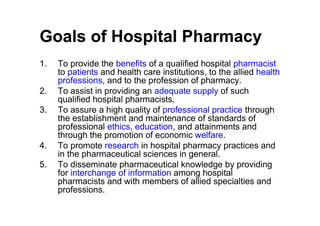
Goals of Hospital Pharmacy
1.   To provide the benefits of a qualified hospital pharmacist
     to patients and health care institutions, to the allied health
     professions, and to the profession of pharmacy.
2.   To assist in providing an adequate supply of such
     qualified hospital pharmacists.
3.   To assure a high quality of professional practice through
     the establishment and maintenance of standards of
     professional ethics, education, and attainments and
     through the promotion of economic welfare.
4.   To promote research in hospital pharmacy practices and
     in the pharmaceutical sciences in general.
5.   To disseminate pharmaceutical knowledge by providing
     for interchange of information among hospital
     pharmacists and with members of allied specialties and
     professions.
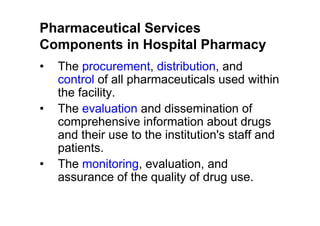
Pharmaceutical Services
Components in Hospital Pharmacy
•   The procurement, distribution, and
    control of all pharmaceuticals used within
    the facility.
•   The evaluation and dissemination of
    comprehensive information about drugs
    and their use to the institution's staff and
    patients.
•   The monitoring, evaluation, and
    assurance of the quality of drug use.
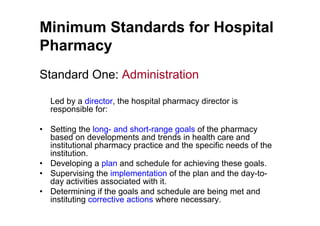
Minimum Standards for Hospital
Pharmacy
Standard One: Administration

  Led by a director, the hospital pharmacy director is
  responsible for:

• Setting the long- and short-range goals of the pharmacy
  based on developments and trends in health care and
  institutional pharmacy practice and the specific needs of the
  institution.
• Developing a plan and schedule for achieving these goals.
• Supervising the implementation of the plan and the day-to-
  day activities associated with it.
• Determining if the goals and schedule are being met and
  instituting corrective actions where necessary.
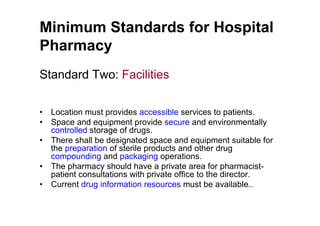
Minimum Standards for Hospital
Pharmacy
Standard Two: Facilities

•   Location must provides accessible services to patients.
•   Space and equipment provide secure and environmentally
    controlled storage of drugs.
•   There shall be designated space and equipment suitable for
    the preparation of sterile products and other drug
    compounding and packaging operations.
•   The pharmacy should have a private area for pharmacist-
    patient consultations with private office to the director.
•   Current drug information resources must be available..
Minimum Standards for Hospital
Pharmacy

Standard Three: Drug Distribution and Control

•   The pharmacy shall be responsible for the procurement,
    distribution, and control of all drugs used within the institution.
•   This responsibility extends to drugs and related services
    provided to ambulatory patients.
•   Policies and procedures governing these functions shall be
    developed by the pharmacist with input from other involved
    hospital staff and committees ..
Minimum Standards for Hospital
Pharmacy

Standard Four: Drug Information

•   The pharmacy is responsible for providing the institution's
    staff and patients with accurate, comprehensive information
    about drugs and their use and shall serve as its center for
    drug information ..
Minimum Standards for Hospital
Pharmacy

Standard Five: Assuring Rational Drug Therapy

•   An important aspect of pharmaceutical services is that of
    maximizing rational drug use.
•   In this regard, the pharmacist, in concert with the medical
    staff, must develop policies and procedures for assuring the
    quality of drug therapy..
Minimum Standards for Hospital
Pharmacy

Standard Six: Research

•   The pharmacist should conduct, participate in, and support
    medical and pharmaceutical research appropriate to the
    goals, objectives, and resources of the pharmacy and the
    institution.
Role of Pharmacy Technicians in
Pharmaceutical Services
1.  Receiving written prescriptions or requests for prescription
    refills from patients or their caregivers.
2. Verifying that the information on the prescription is complete
    and accurate.
3. Counting, weighing, measuring, and mixing the medication
4. Preparing prescription labels and selecting the container
5. Establishing and maintaining patient profiles
6. Ordering and stocking prescription and over-the-counter
    medications
7. Assisting with drug studies
8. Taking prescriptions over the telephone????
9. Transferring prescriptions
10. Tracking and reporting errors
11. “tech check tech” in preparation of medicine carts.
Questions to Ponder
5-min Presentations.
• What are the different responsibilities of
  hospital pharmacist?
• How can we ensure rational drug therapy
  in hospital settings?
• What type of drug information resources
  are required to be available in hospital
  pharmacy settings?
• What are the components of a drug
  information center.?
Hospital Pharmacy

Anas Bahnassi PhD RPh

                          abahnassi@gmail.com

            http://www.linkedin.com/in/abahnassi

             http://www.slideshare.net/abahnassi

        http://www.udemy.com/hospital_pharmacy

                      http://twitter.com/abahnassi

        attribution – non-commercial – share alike

Introduction to hospital pharmacy

  • 1.
    Hospital Pharmacy AnIntroduction Anas Bahnassi
  • 2.
    Lecture Objectives • DefineHospital, and Hospital Pharmacy. • Determine the organizational goals of hospital pharmacy as a department and a service. • Identify the pharmaceutical service component in hospital pharmacy. • Acknowledge the minimum standards required to fulfill the pharmaceutical service component in hospital pharmacy. • Identify the role of pharmacy technicians in hospital settings.
  • 3.
    Hospital and HospitalPharmacy • The hospital is a healthcare unit which incorporates a combination of specialized scientific equipment, and functioning through trained and certified healthcare professionals working as a team for the common purpose of providing medical services to the population. • Hospital Pharmacy is a department or service in a hospital, responsible for the supply of medications to hospital wards as well as ambulatory patients, The department is headed by professionally competent, legally qualified pharmacist who directly supervises and ensures the correct dispensing, compounding, and distribution of medication to in and out-patients.
  • 4.
    Goals of HospitalPharmacy 1. To provide the benefits of a qualified hospital pharmacist to patients and health care institutions, to the allied health professions, and to the profession of pharmacy. 2. To assist in providing an adequate supply of such qualified hospital pharmacists. 3. To assure a high quality of professional practice through the establishment and maintenance of standards of professional ethics, education, and attainments and through the promotion of economic welfare. 4. To promote research in hospital pharmacy practices and in the pharmaceutical sciences in general. 5. To disseminate pharmaceutical knowledge by providing for interchange of information among hospital pharmacists and with members of allied specialties and professions.
  • 5.
    Pharmaceutical Services Components inHospital Pharmacy • The procurement, distribution, and control of all pharmaceuticals used within the facility. • The evaluation and dissemination of comprehensive information about drugs and their use to the institution's staff and patients. • The monitoring, evaluation, and assurance of the quality of drug use.
  • 6.
    Minimum Standards forHospital Pharmacy Standard One: Administration Led by a director, the hospital pharmacy director is responsible for: • Setting the long- and short-range goals of the pharmacy based on developments and trends in health care and institutional pharmacy practice and the specific needs of the institution. • Developing a plan and schedule for achieving these goals. • Supervising the implementation of the plan and the day-to- day activities associated with it. • Determining if the goals and schedule are being met and instituting corrective actions where necessary.
  • 7.
    Minimum Standards forHospital Pharmacy Standard Two: Facilities • Location must provides accessible services to patients. • Space and equipment provide secure and environmentally controlled storage of drugs. • There shall be designated space and equipment suitable for the preparation of sterile products and other drug compounding and packaging operations. • The pharmacy should have a private area for pharmacist- patient consultations with private office to the director. • Current drug information resources must be available..
  • 8.
    Minimum Standards forHospital Pharmacy Standard Three: Drug Distribution and Control • The pharmacy shall be responsible for the procurement, distribution, and control of all drugs used within the institution. • This responsibility extends to drugs and related services provided to ambulatory patients. • Policies and procedures governing these functions shall be developed by the pharmacist with input from other involved hospital staff and committees ..
  • 9.
    Minimum Standards forHospital Pharmacy Standard Four: Drug Information • The pharmacy is responsible for providing the institution's staff and patients with accurate, comprehensive information about drugs and their use and shall serve as its center for drug information ..
  • 10.
    Minimum Standards forHospital Pharmacy Standard Five: Assuring Rational Drug Therapy • An important aspect of pharmaceutical services is that of maximizing rational drug use. • In this regard, the pharmacist, in concert with the medical staff, must develop policies and procedures for assuring the quality of drug therapy..
  • 11.
    Minimum Standards forHospital Pharmacy Standard Six: Research • The pharmacist should conduct, participate in, and support medical and pharmaceutical research appropriate to the goals, objectives, and resources of the pharmacy and the institution.
  • 12.
    Role of PharmacyTechnicians in Pharmaceutical Services 1. Receiving written prescriptions or requests for prescription refills from patients or their caregivers. 2. Verifying that the information on the prescription is complete and accurate. 3. Counting, weighing, measuring, and mixing the medication 4. Preparing prescription labels and selecting the container 5. Establishing and maintaining patient profiles 6. Ordering and stocking prescription and over-the-counter medications 7. Assisting with drug studies 8. Taking prescriptions over the telephone???? 9. Transferring prescriptions 10. Tracking and reporting errors 11. “tech check tech” in preparation of medicine carts.
  • 13.
    Questions to Ponder 5-minPresentations. • What are the different responsibilities of hospital pharmacist? • How can we ensure rational drug therapy in hospital settings? • What type of drug information resources are required to be available in hospital pharmacy settings? • What are the components of a drug information center.?
  • 14.
    Hospital Pharmacy Anas BahnassiPhD RPh abahnassi@gmail.com http://www.linkedin.com/in/abahnassi http://www.slideshare.net/abahnassi http://www.udemy.com/hospital_pharmacy http://twitter.com/abahnassi attribution – non-commercial – share alike