•Procurement & store of pharmaceuticals
•By MN, au
by MN, AU, procurement 1
Definition of procurement.
Objectives of procurement.
 six rights of procurement.
 Procurement chain.
 Conflicting objectives of procurement.
 Procurement strategy
 Quantifying drug requirement
 Why should procurement be a challenging problem?
Definition of Purchasing.
Differences between procurement and purchasing.
by MN, AU, procurement 2
Act of obtaining/buying goods & services from external
source which ensures that buyer receives goods,
services at the best possible price.
by MN, AU, procurement 3
• Primary purpose is to satisfy the customer needs.
• Others are :
 Pay the right price.
Save time.
Avoid overlooking vital steps in the process.
 Minimize the risk of making a costly mistake.
by MN, AU, procurement 4
Selection &
Quantification
Management
Support
Distribution
ProcurementUse
Policy and Legal Framework
M&E
M&E
M&E
M&E
by MN, AU, procurement 5
Distribution
Procurement
Selection
Management
Support
Use
Policy and Legal Framework
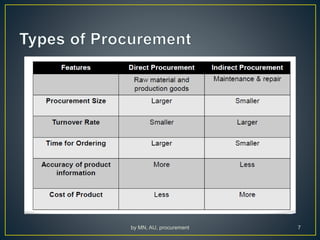
• Quantity needed
• Cost
• Quality: packaging,
cold chain
• Shelf life
• Supplier performance
• Management
information system
(MIS) to monitor
consumption
• Medical Supplies e.g.
BP machines
by MN, AU, procurement 7
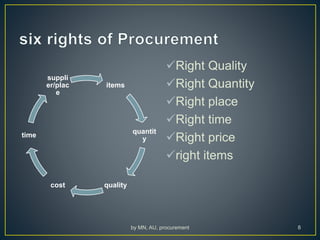
items
quantit
y
qualitycost
time
suppli
er/plac
e
Right Quality
Right Quantity
Right place
Right time
Right price
right items
by MN, AU, procurement 8
• Right Quality
 Satisfactory quality & fit for their purpose.
 Otherwise may damage production machinery & increase the
production cost.
• Right Quantity
 Meet demands.
 Lack of stock may cause shutdowns in production, time waste
& late delivery.
 Too much stock may cause waste of storage space & risk of
deterioration.
• Right place
 Delivery to the correct delivery point & ensure their safe
arrival.
 Otherwise may cause unnecessary transport and handling
costs.
by MN, AU, procurement 9
• Procurement chain network is often very complex.
• Procurement chain partners have conflicting objectives.
• Consequently, making everyone to agree is not an easy
task
by MN, AU, procurement 10
Procurement Limited to Formulary List
 Order Quantities Based on Reliable Estimate of Actual
Need
Reliable payment and Good Financial Management
Transparency and Written Procedures
 Product Quality Assurance
 Regular reporting on Procurement performance
by MN, AU, procurement 11
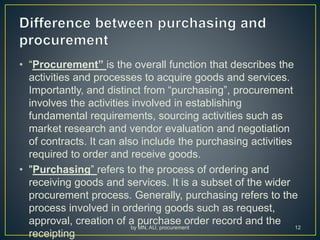
• “Procurement” is the overall function that describes the
activities and processes to acquire goods and services.
Importantly, and distinct from “purchasing”, procurement
involves the activities involved in establishing
fundamental requirements, sourcing activities such as
market research and vendor evaluation and negotiation
of contracts. It can also include the purchasing activities
required to order and receive goods.
• "Purchasing” refers to the process of ordering and
receiving goods and services. It is a subset of the wider
procurement process. Generally, purchasing refers to the
process involved in ordering goods such as request,
approval, creation of a purchase order record and the
receipting
by MN, AU, procurement 12
A. Exchange functions
 Buying
Selling
B. Physical supply functions
Storage
 Transportation
C. Ancillary functions
 Standardization and grading
 Financing
 Risk-bearing
 Market information and research and related service
by MN, AU, procurement 13
Review Drug Selections Determine Quantities
Reconcile Needs and Funds
Choose Procurement Method
Locate and Select Suppliers
Specify Contract Terms
Monitor Order Status
Receive and Check Drugs
Make Payment
Distribute Drugs
Collect Consumption
Information
by MN, AU, procurement 14
 Review selection
 Determine needed quantities
 Reconcile needs & funds
 Choose procurement method
 Select suppliers
 Specify contract terms
 Monitor order status
 Receipt & inspection
Procurement cycle
by MN, AU, procurement 15
by MN, AU, procurement 16
•Quantification of
medicines needs
by MN, AU, procurement 17
• A process that involves estimating—
• Quantities of a specific item needed for a procurement
• Financial requirements needed to purchase the items
• Estimating needs within a given context—
• Finances
• Human resources capacity
• Storage capacity
• Capacity to deliver services
by MN, AU, procurement 18
• Why we need to quantify the medicines need?
To ensure Available of good quality, safe and less
expensive medicines all the time
Part of a sequence of interdependent steps in the
medicines supply management system.
by MN, AU, procurement 19
• Main components are
Selection
Quantification
Procurement
Distribution
Use
by MN, AU, procurement 20
• Imbalance in quantification could lead to
High inventory
Stock outs
• Stock outs lead to
Local purchases
Poor image of the facility
by MN, AU, procurement 21
• Consumption method
• Morbidity method
• Adjusted-consumption method
• Service-level projection
by MN, AU, procurement 22
1. The patient morbidity-standard treatment method
(morbidity method).
2. The adjusted consumption method (consumption
method).
by MN, AU, procurement 23
Method Advantages Disadvantages
Consumption  Morbidity data not
required
 Requires less detailed
calculations
Difficult to
review prescribing
habits
Difficult to get
consumption data
for new facilities
-Good for hospitals
(because
Treatment is more
complex)
Does not encourage
good morbidity recording
Reliable if consumption is
well recorded and stable
Unreliable if there have been
long stock-outs
by MN, AU, procurement 24
Method Advantages Disadvantages
Morbidity  Consumption data not
required
 Good for new services
 More detailed
calculation required
 Morbidity/STG
required
 Based on rational prescribing
 Motivate morbidity recording
Results may differ from
actual supply
Estimate only the
quantities needed
by MN, AU, procurement 25
Preparing an action plan for quantification.
Using centralized or Decentralized quantification.
Using manual or Computerized methods for
Quantification.
 Estimating the Time required.
Developing the drug list.
 Estimating Total procurement Cost.
by MN, AU, procurement 26
• This method starts from two sets of data:
The number of episodes of each health problem
treated by the type or types of facilities.
Standard treatment schedules agreed for each health
problem.
by MN, AU, procurement 27
• Total quantity of a drug required for a given health
problem =
by MN, AU, procurement 28
The stock in hand consists of two components, the
working stock and the safety stock
 Working stock varies from zero to the order quantity (Q)
and represents the stock which is used to satisfy demand
between deliveries
 Safety stock (S) exists to protect against stock outs,
which would otherwise occur when deliveries are
delayed, or when demand is unexpectedly high.
by MN, AU, procurement 29
by MN, AU, procurement 30
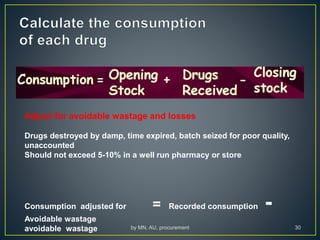
Adjust for avoidable wastage and losses
Drugs destroyed by damp, time expired, batch seized for poor quality,
unaccounted
Should not exceed 5-10% in a well run pharmacy or store
Consumption adjusted for = Recorded consumption -
Avoidable wastage
avoidable wastage
• Safety stock is the quantity of stock used on average
during the average lead time from the current
supplier.
• For calculation: SS = LT X CA
Where SS=Safety stock
LT=Lead Time
CA=Average Consumption
by MN, AU, procurement 31
V- Vital (Fixed item & amt)
E- Essential (Fixed item)
N- Non-Essential
by MN, AU, procurement 32
VED ANALYSIS
• Based on critical value & shortage cost of an item
–It is a subjective analysis.
•Items are classified into:
Vital:
•Shortage cannot be tolerated.
Essential:
•Shortage can be tolerated for a short period.
Desirable:
Shortage will not adversely affect, but may be using more
resources. These must be strictly Scrutinized
V E D ITEM COST
A AV AE AD CATEGORY 1 10 70%
B BV BE BD CATEGORY 2 20 20%
C CV CE CD CATEGORY 3 70 10%
CATEGORY 1 - NEEDS CLOSE MONITORING & CONTROL
CATEGORY 2 - MODERATE CONTROL.
CATEGORY 3 - NO NEED FOR CONTROL
by MN, AU, procurement 33
• ABC was on the basis of value of consumption to value.
In most of the cases 10 to 20 % of the inventory account
for 70 to 80% of the annual activity.
 A typical manufacturing operation shows that the top
15% of the line items, in terms of annual rupees usage,
represent 80% of total annual rupees usage.(class A)
 Next 15% of items reflect 15% of annual rupees (classs
B)
Next 70% accounts only for 5% usage (class C)
by MN, AU, procurement 34
HML Classification
 XYZ Classification
FSN Classification
 SDF Classification
 GOLF Classification
 SOS Classification
by MN, AU, procurement 35
• According to the consumption pattern
• To combat obsolete items
• F – Fast moving
• S – Slow moving
• N – Non Moving
by MN, AU, procurement 36
• Based on source of procurement
• S – Scarce, D- Difficult, E- Easy.
GOLF
• G – Government, O – Ordinary, L – Local, F– Foreign.
by MN, AU, procurement 37
• FOR Raw materials especially for agriculture units
• S – Seasonal
• OS – Off seasonal
by MN, AU, procurement 38
Assumption
 Seasonal fluctuation in demand are ruled out
 Zero lead time – Time lapsed between purchase order
and inventory usage
 Cost of placing an order and receiving are same and
independent of the units ordered
 Annual cost of carrying the inventory is constant
 Total inventory cost = Ordering cost + carrying cost
by MN, AU, procurement 39
Trial and Error method
Order-formula approach
Graphical approach
by MN, AU, procurement 40
• Assumptions:-
• Annual requirement (C)=1200 units
• Carrying cost (I) = Rs.1
• Ordering cost (O) =Rs.37.5
by MN, AU, procurement 41
• EOQ =(2CO/I)
• C = Annual demand
• O = Ordering cost per order
• I = Carrying cost per unit
• EOQ =(2*1200*37.5/1) = 300 units
by MN, AU, procurement 42
by MN, AU, procurement 43
by MN, AU, procurement 44
by MN, AU, procurement 45
• End !!
by MN, AU, procurement 46

Procurement lecture milla

  • 1.
    •Procurement & storeof pharmaceuticals •By MN, au by MN, AU, procurement 1
  • 2.
    Definition of procurement. Objectivesof procurement.  six rights of procurement.  Procurement chain.  Conflicting objectives of procurement.  Procurement strategy  Quantifying drug requirement  Why should procurement be a challenging problem? Definition of Purchasing. Differences between procurement and purchasing. by MN, AU, procurement 2
  • 3.
    Act of obtaining/buyinggoods & services from external source which ensures that buyer receives goods, services at the best possible price. by MN, AU, procurement 3
  • 4.
    • Primary purposeis to satisfy the customer needs. • Others are :  Pay the right price. Save time. Avoid overlooking vital steps in the process.  Minimize the risk of making a costly mistake. by MN, AU, procurement 4
  • 5.
    Selection & Quantification Management Support Distribution ProcurementUse Policy andLegal Framework M&E M&E M&E M&E by MN, AU, procurement 5
  • 6.
    Distribution Procurement Selection Management Support Use Policy and LegalFramework • Quantity needed • Cost • Quality: packaging, cold chain • Shelf life • Supplier performance • Management information system (MIS) to monitor consumption • Medical Supplies e.g. BP machines
  • 7.
    by MN, AU,procurement 7
  • 8.
    items quantit y qualitycost time suppli er/plac e Right Quality Right Quantity Rightplace Right time Right price right items by MN, AU, procurement 8
  • 9.
    • Right Quality Satisfactory quality & fit for their purpose.  Otherwise may damage production machinery & increase the production cost. • Right Quantity  Meet demands.  Lack of stock may cause shutdowns in production, time waste & late delivery.  Too much stock may cause waste of storage space & risk of deterioration. • Right place  Delivery to the correct delivery point & ensure their safe arrival.  Otherwise may cause unnecessary transport and handling costs. by MN, AU, procurement 9
  • 10.
    • Procurement chainnetwork is often very complex. • Procurement chain partners have conflicting objectives. • Consequently, making everyone to agree is not an easy task by MN, AU, procurement 10
  • 11.
    Procurement Limited toFormulary List  Order Quantities Based on Reliable Estimate of Actual Need Reliable payment and Good Financial Management Transparency and Written Procedures  Product Quality Assurance  Regular reporting on Procurement performance by MN, AU, procurement 11
  • 12.
    • “Procurement” isthe overall function that describes the activities and processes to acquire goods and services. Importantly, and distinct from “purchasing”, procurement involves the activities involved in establishing fundamental requirements, sourcing activities such as market research and vendor evaluation and negotiation of contracts. It can also include the purchasing activities required to order and receive goods. • "Purchasing” refers to the process of ordering and receiving goods and services. It is a subset of the wider procurement process. Generally, purchasing refers to the process involved in ordering goods such as request, approval, creation of a purchase order record and the receipting by MN, AU, procurement 12
  • 13.
    A. Exchange functions Buying Selling B. Physical supply functions Storage  Transportation C. Ancillary functions  Standardization and grading  Financing  Risk-bearing  Market information and research and related service by MN, AU, procurement 13
  • 14.
    Review Drug SelectionsDetermine Quantities Reconcile Needs and Funds Choose Procurement Method Locate and Select Suppliers Specify Contract Terms Monitor Order Status Receive and Check Drugs Make Payment Distribute Drugs Collect Consumption Information by MN, AU, procurement 14
  • 15.
     Review selection Determine needed quantities  Reconcile needs & funds  Choose procurement method  Select suppliers  Specify contract terms  Monitor order status  Receipt & inspection Procurement cycle by MN, AU, procurement 15
  • 16.
    by MN, AU,procurement 16
  • 17.
  • 18.
    • A processthat involves estimating— • Quantities of a specific item needed for a procurement • Financial requirements needed to purchase the items • Estimating needs within a given context— • Finances • Human resources capacity • Storage capacity • Capacity to deliver services by MN, AU, procurement 18
  • 19.
    • Why weneed to quantify the medicines need? To ensure Available of good quality, safe and less expensive medicines all the time Part of a sequence of interdependent steps in the medicines supply management system. by MN, AU, procurement 19
  • 20.
    • Main componentsare Selection Quantification Procurement Distribution Use by MN, AU, procurement 20
  • 21.
    • Imbalance inquantification could lead to High inventory Stock outs • Stock outs lead to Local purchases Poor image of the facility by MN, AU, procurement 21
  • 22.
    • Consumption method •Morbidity method • Adjusted-consumption method • Service-level projection by MN, AU, procurement 22
  • 23.
    1. The patientmorbidity-standard treatment method (morbidity method). 2. The adjusted consumption method (consumption method). by MN, AU, procurement 23
  • 24.
    Method Advantages Disadvantages Consumption Morbidity data not required  Requires less detailed calculations Difficult to review prescribing habits Difficult to get consumption data for new facilities -Good for hospitals (because Treatment is more complex) Does not encourage good morbidity recording Reliable if consumption is well recorded and stable Unreliable if there have been long stock-outs by MN, AU, procurement 24
  • 25.
    Method Advantages Disadvantages Morbidity Consumption data not required  Good for new services  More detailed calculation required  Morbidity/STG required  Based on rational prescribing  Motivate morbidity recording Results may differ from actual supply Estimate only the quantities needed by MN, AU, procurement 25
  • 26.
    Preparing an actionplan for quantification. Using centralized or Decentralized quantification. Using manual or Computerized methods for Quantification.  Estimating the Time required. Developing the drug list.  Estimating Total procurement Cost. by MN, AU, procurement 26
  • 27.
    • This methodstarts from two sets of data: The number of episodes of each health problem treated by the type or types of facilities. Standard treatment schedules agreed for each health problem. by MN, AU, procurement 27
  • 28.
    • Total quantityof a drug required for a given health problem = by MN, AU, procurement 28
  • 29.
    The stock inhand consists of two components, the working stock and the safety stock  Working stock varies from zero to the order quantity (Q) and represents the stock which is used to satisfy demand between deliveries  Safety stock (S) exists to protect against stock outs, which would otherwise occur when deliveries are delayed, or when demand is unexpectedly high. by MN, AU, procurement 29
  • 30.
    by MN, AU,procurement 30 Adjust for avoidable wastage and losses Drugs destroyed by damp, time expired, batch seized for poor quality, unaccounted Should not exceed 5-10% in a well run pharmacy or store Consumption adjusted for = Recorded consumption - Avoidable wastage avoidable wastage
  • 31.
    • Safety stockis the quantity of stock used on average during the average lead time from the current supplier. • For calculation: SS = LT X CA Where SS=Safety stock LT=Lead Time CA=Average Consumption by MN, AU, procurement 31
  • 32.
    V- Vital (Fixeditem & amt) E- Essential (Fixed item) N- Non-Essential by MN, AU, procurement 32
  • 33.
    VED ANALYSIS • Basedon critical value & shortage cost of an item –It is a subjective analysis. •Items are classified into: Vital: •Shortage cannot be tolerated. Essential: •Shortage can be tolerated for a short period. Desirable: Shortage will not adversely affect, but may be using more resources. These must be strictly Scrutinized V E D ITEM COST A AV AE AD CATEGORY 1 10 70% B BV BE BD CATEGORY 2 20 20% C CV CE CD CATEGORY 3 70 10% CATEGORY 1 - NEEDS CLOSE MONITORING & CONTROL CATEGORY 2 - MODERATE CONTROL. CATEGORY 3 - NO NEED FOR CONTROL by MN, AU, procurement 33
  • 34.
    • ABC wason the basis of value of consumption to value. In most of the cases 10 to 20 % of the inventory account for 70 to 80% of the annual activity.  A typical manufacturing operation shows that the top 15% of the line items, in terms of annual rupees usage, represent 80% of total annual rupees usage.(class A)  Next 15% of items reflect 15% of annual rupees (classs B) Next 70% accounts only for 5% usage (class C) by MN, AU, procurement 34
  • 35.
    HML Classification  XYZClassification FSN Classification  SDF Classification  GOLF Classification  SOS Classification by MN, AU, procurement 35
  • 36.
    • According tothe consumption pattern • To combat obsolete items • F – Fast moving • S – Slow moving • N – Non Moving by MN, AU, procurement 36
  • 37.
    • Based onsource of procurement • S – Scarce, D- Difficult, E- Easy. GOLF • G – Government, O – Ordinary, L – Local, F– Foreign. by MN, AU, procurement 37
  • 38.
    • FOR Rawmaterials especially for agriculture units • S – Seasonal • OS – Off seasonal by MN, AU, procurement 38
  • 39.
    Assumption  Seasonal fluctuationin demand are ruled out  Zero lead time – Time lapsed between purchase order and inventory usage  Cost of placing an order and receiving are same and independent of the units ordered  Annual cost of carrying the inventory is constant  Total inventory cost = Ordering cost + carrying cost by MN, AU, procurement 39
  • 40.
    Trial and Errormethod Order-formula approach Graphical approach by MN, AU, procurement 40
  • 41.
    • Assumptions:- • Annualrequirement (C)=1200 units • Carrying cost (I) = Rs.1 • Ordering cost (O) =Rs.37.5 by MN, AU, procurement 41
  • 42.
    • EOQ =(2CO/I) •C = Annual demand • O = Ordering cost per order • I = Carrying cost per unit • EOQ =(2*1200*37.5/1) = 300 units by MN, AU, procurement 42
  • 43.
    by MN, AU,procurement 43
  • 44.
    by MN, AU,procurement 44
  • 45.
    by MN, AU,procurement 45
  • 46.
    • End !! byMN, AU, procurement 46

Editor's Notes