Postpartum Haemorrhage (PPH)
By Ezmeer Emiral
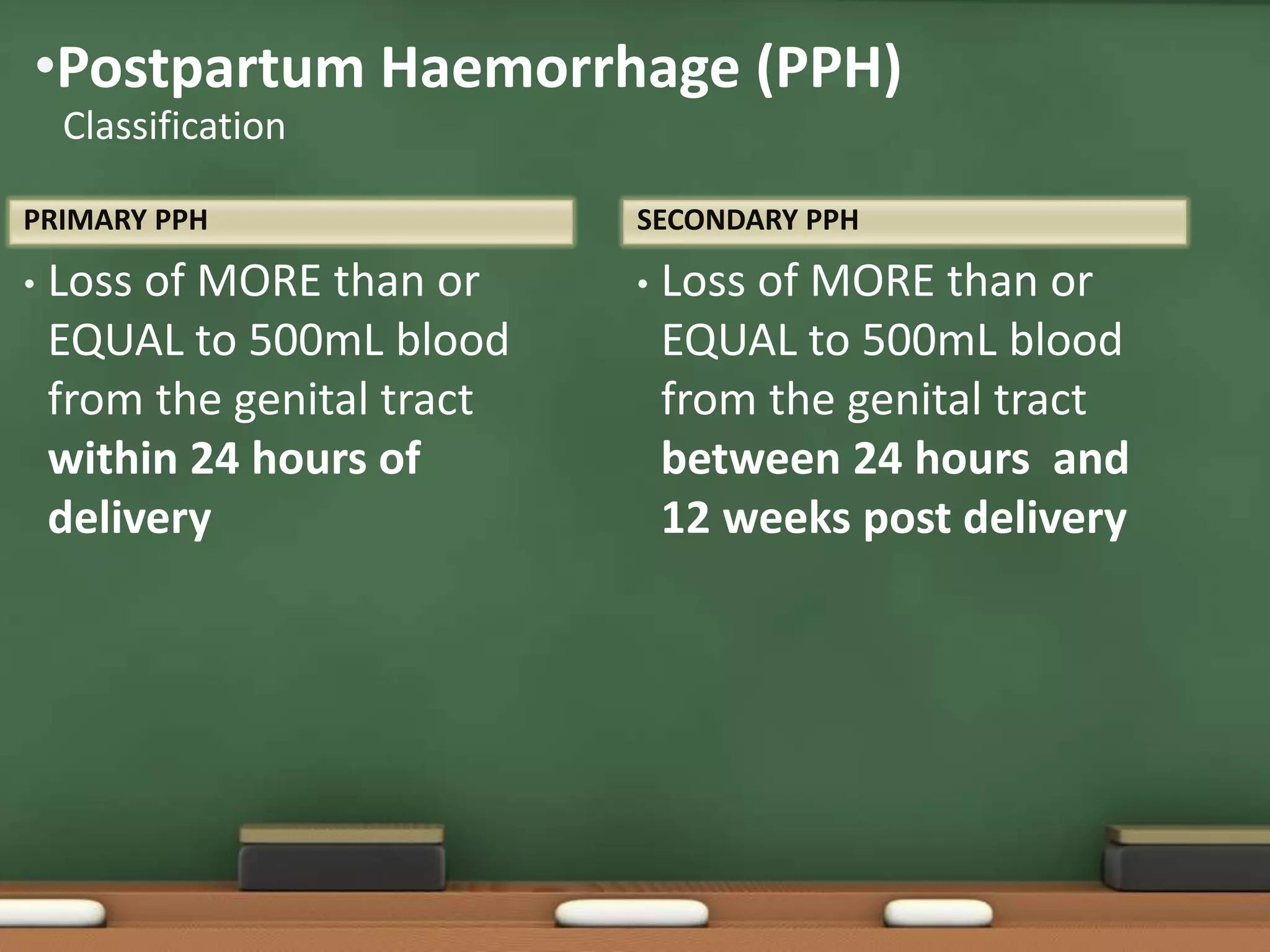
PRIMARY PPH
• Loss of MORE than or
EQUAL to 500mL blood
from the genital tract
within 24 hours of
delivery
• Loss of MORE than or
EQUAL to 500mL blood
from the genital tract
between 24 hours and
12 weeks post delivery
SECONDARY PPH
•Postpartum Haemorrhage (PPH)
Classification
•Aetiology
5 “T”s
Uterine atony
Retained placenta and/or membranes
Clotting disorder
Uterine inversion
Tone
Tissue
Trauma
Thrombin
Injury to vagina, perineum ad uterine tears
at Caesarean section
Traction
3.Genital tract laceration
•Causes
1.Uterine atony
2.Retained placenta
4.Coagulopathy
5.Acute inversion of uterus
• Can be predict.
• Predisposing conditions:
• Multiparity(Fibrosis of uterine
muscle)
• Over distension of uterus(eg:
Macrosomia,polyhydramnios)
• Prolong labour (uterine inertia)
• Fibroid
• Placenta previa
• Oxytocin induce labour
•Uterine Atony
Uterus fails to contract following delivery of placenta.
3.Genital tract laceration
•Causes
1.Uterine atony
2.Retained placenta
4.Coagulopathy
5.Acute inversion of uterus
• Causes:
• Placenta separated but undelivered
• Placenta partly or wholly attached
• Placenta accreta
•Retained Placenta
Prevent a uterus from contracting efficiently
3.Genital tract laceration
•Causes
1.Uterine atony
2.Retained placenta
4.Coagulopathy
5.Acute inversion of uterus
• Causes:
• Intsrumental delivery (Cervical
tears)
• Episiotomy can extend upwards
• Uterine rupture
•Genital Tract Lacerations
Perineal or vaginal tears.
3.Genital tract laceration
•Causes
1.Uterine atony
2.Retained placenta
4.Coagulopathy
5.Acute inversion of uterus
• Causes:
• Von Willebrand's Disease, Platelet
disorder
• Placenta Abruptio-Retroplacental
clot leads to consumptive
coagulopathy
• Unidentified dead fetus
• Amniotic fluid embolus-amniotic
fluid entering maternal circulation
•Clotting disorder
3.Genital tract laceration
•Causes
1.Uterine atony
2.Retained placenta
4.Coagulopathy
5.Acute inversion of uterus
• Caused by traction on the
umbilical cord before
placenta has separated.
• Associated factors:
-Fundal placenta
-Short cord
-Morbidly adherent placenta
• Cardiovascular collapse &
shock.
•Acute Inversion of Uterus
Uterus is pulled ‘inside out’ and the fundus at the introitus.
Third Degree Uterine Inversion
•Uterine Inversion
Stages/Classification
• First Degree (Incomplete)-inverted fundus
reached the external os.
• Second Degree (Complete)-whole body of the
uterus is inverted and protrudes into the
vagina
• Third Degree – prolapse of inverted uterus,
cervix and vagina outside the vulva
• (A)The protruding fundus is
grasped with fingers directed
toward the posterior fornix.
• (B, C) The uterus is returned to
position by pushing it through
the pelvis and into the abdomen
with steady pressure towards
the umbilicus.
• Acute inversion of uterus-
reduced manually or O’Sullivan
(hydrostatic pressure) or
surgery.
•Johnson’s Method
• Circulatory collapse ► shock,
organ failure, stroke,death
• Sheehan’s syndrome –
damage to pituitary –
pituitary necrosis
• Puerperal anaemia
• Fear of further pregnancies
•Complications of PPH
• ABC,fluid resuscitation
• Feel abdomen-uterus poorly
contracted
• Rub the fundus gently –see
wether uterus contract and
bleeding arrested
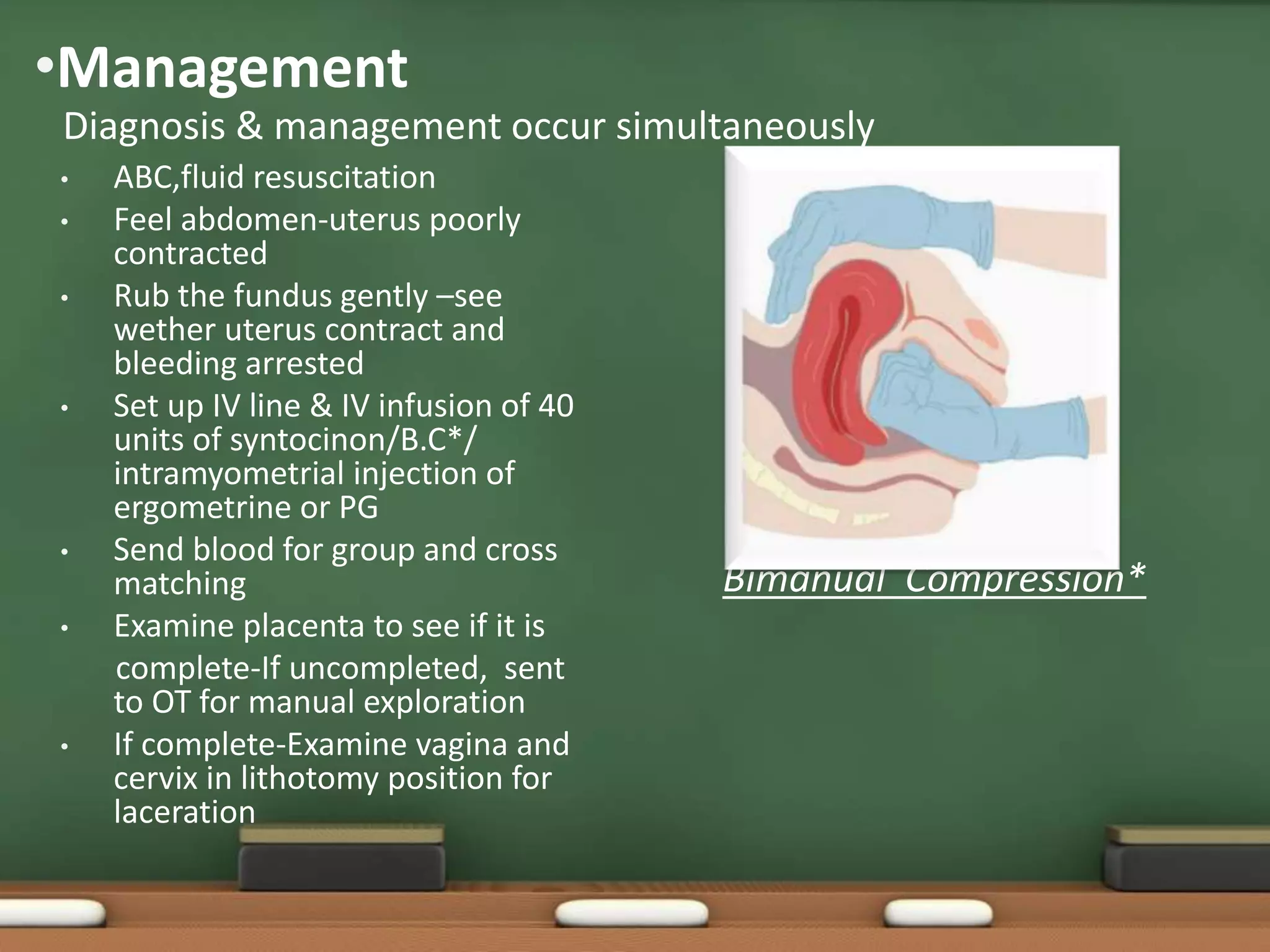
• Set up IV line & IV infusion of 40
units of syntocinon/B.C*/
intramyometrial injection of
ergometrine or PG
• Send blood for group and cross
matching
• Examine placenta to see if it is
complete-If uncompleted, sent
to OT for manual exploration
• If complete-Examine vagina and
cervix in lithotomy position for
laceration
•Management
Diagnosis & management occur simultaneously
Bimanual Compression*
• No laceration?-Examination
under anaesthesia(allow
further measures eg:uterine
tamponade,radioloical
occlusion)
• Exploratory Laporotomy(iliac
artery ligation,sutures)
• Hysterectomy
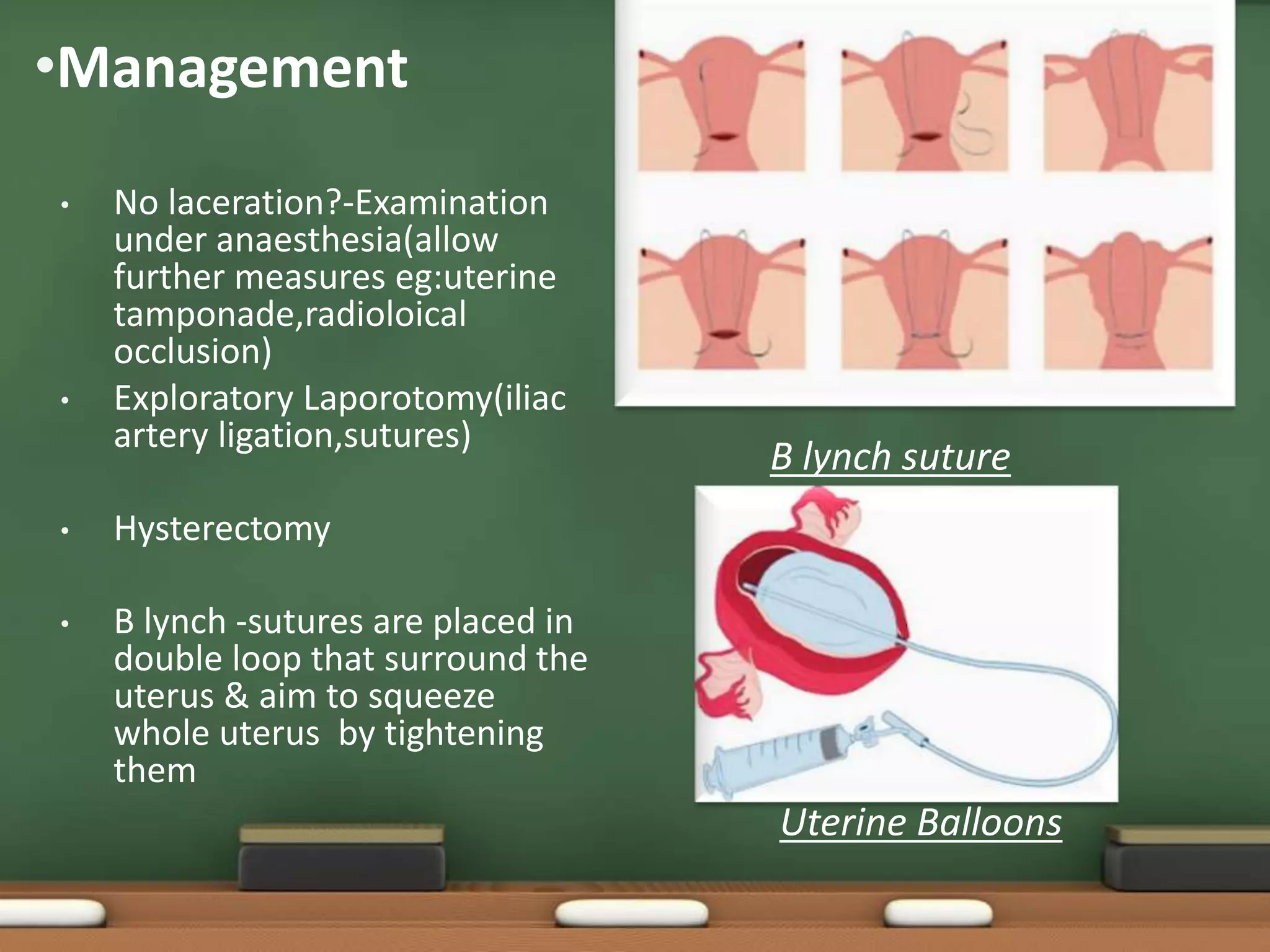
• B lynch -sutures are placed in
double loop that surround the
uterus & aim to squeeze
whole uterus by tightening
them
•Management
B lynch suture
Uterine Balloons
PRIMARY PPH
• Loss of MORE than or
EQUAL to 500mL blood
from the genital tract
within 24 hours of
delivery
• Loss of MORE than or
EQUAL to 500mL blood
from the genital tract
between 24 hours and
12 weeks post delivery
SECONDARY PPH
•Postpartum Haemorrhage (PPH)
Classification
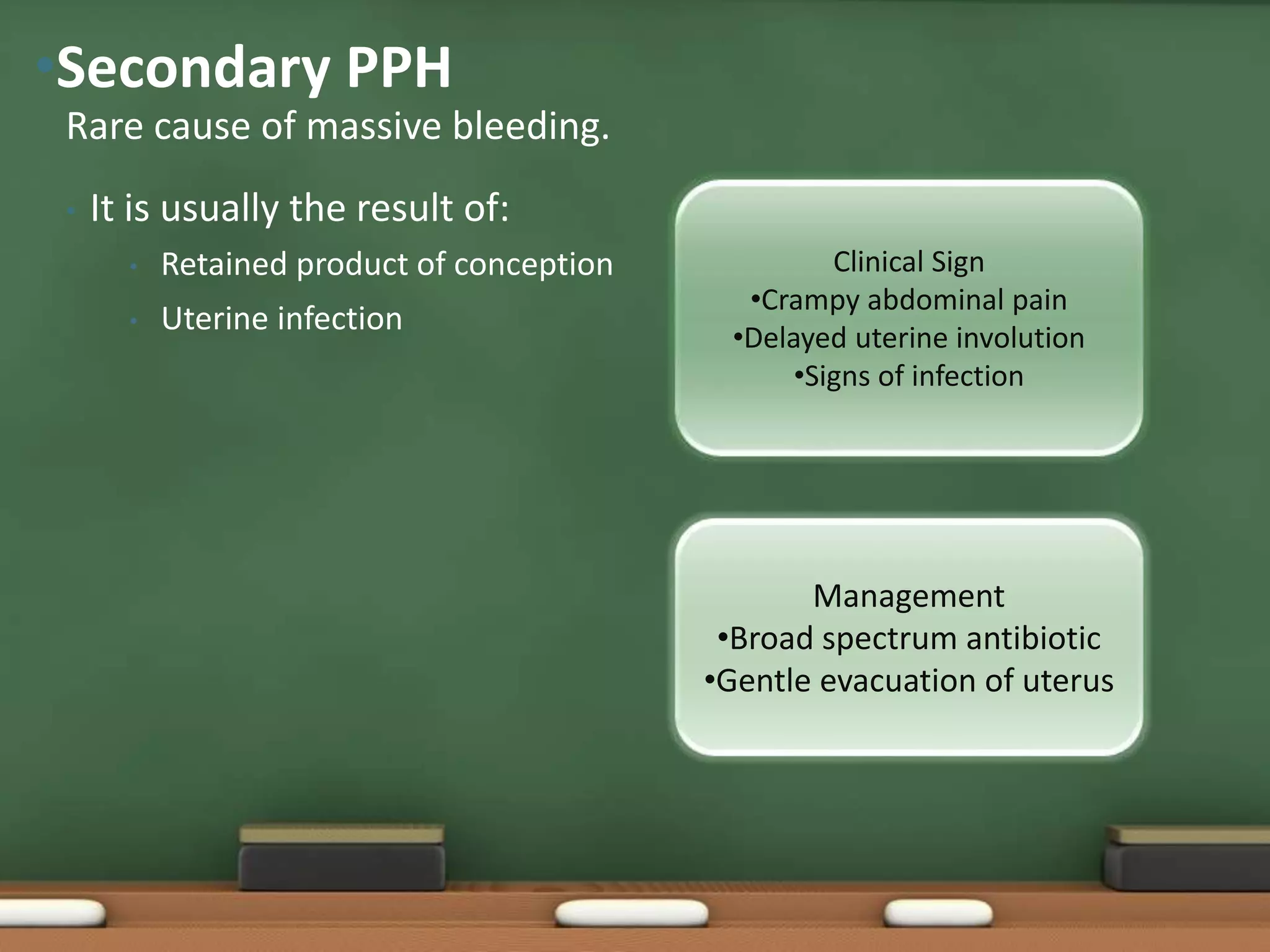
• It is usually the result of:
• Retained product of conception
• Uterine infection
Rare cause of massive bleeding.
•Secondary PPH
Management
•Broad spectrum antibiotic
•Gentle evacuation of uterus
Clinical Sign
•Crampy abdominal pain
•Delayed uterine involution
•Signs of infection
Thank You for Your Attention
Questions?

Postpartum haemorrhage (pph)

  • 1.
  • 2.
    PRIMARY PPH • Lossof MORE than or EQUAL to 500mL blood from the genital tract within 24 hours of delivery • Loss of MORE than or EQUAL to 500mL blood from the genital tract between 24 hours and 12 weeks post delivery SECONDARY PPH •Postpartum Haemorrhage (PPH) Classification
  • 3.
    •Aetiology 5 “T”s Uterine atony Retainedplacenta and/or membranes Clotting disorder Uterine inversion Tone Tissue Trauma Thrombin Injury to vagina, perineum ad uterine tears at Caesarean section Traction
  • 4.
    3.Genital tract laceration •Causes 1.Uterineatony 2.Retained placenta 4.Coagulopathy 5.Acute inversion of uterus
  • 5.
    • Can bepredict. • Predisposing conditions: • Multiparity(Fibrosis of uterine muscle) • Over distension of uterus(eg: Macrosomia,polyhydramnios) • Prolong labour (uterine inertia) • Fibroid • Placenta previa • Oxytocin induce labour •Uterine Atony Uterus fails to contract following delivery of placenta.
  • 6.
    3.Genital tract laceration •Causes 1.Uterineatony 2.Retained placenta 4.Coagulopathy 5.Acute inversion of uterus
  • 7.
    • Causes: • Placentaseparated but undelivered • Placenta partly or wholly attached • Placenta accreta •Retained Placenta Prevent a uterus from contracting efficiently
  • 8.
    3.Genital tract laceration •Causes 1.Uterineatony 2.Retained placenta 4.Coagulopathy 5.Acute inversion of uterus
  • 9.
    • Causes: • Intsrumentaldelivery (Cervical tears) • Episiotomy can extend upwards • Uterine rupture •Genital Tract Lacerations Perineal or vaginal tears.
  • 10.
    3.Genital tract laceration •Causes 1.Uterineatony 2.Retained placenta 4.Coagulopathy 5.Acute inversion of uterus
  • 11.
    • Causes: • VonWillebrand's Disease, Platelet disorder • Placenta Abruptio-Retroplacental clot leads to consumptive coagulopathy • Unidentified dead fetus • Amniotic fluid embolus-amniotic fluid entering maternal circulation •Clotting disorder
  • 12.
    3.Genital tract laceration •Causes 1.Uterineatony 2.Retained placenta 4.Coagulopathy 5.Acute inversion of uterus
  • 13.
    • Caused bytraction on the umbilical cord before placenta has separated. • Associated factors: -Fundal placenta -Short cord -Morbidly adherent placenta • Cardiovascular collapse & shock. •Acute Inversion of Uterus Uterus is pulled ‘inside out’ and the fundus at the introitus. Third Degree Uterine Inversion
  • 14.
    •Uterine Inversion Stages/Classification • FirstDegree (Incomplete)-inverted fundus reached the external os. • Second Degree (Complete)-whole body of the uterus is inverted and protrudes into the vagina • Third Degree – prolapse of inverted uterus, cervix and vagina outside the vulva
  • 15.
    • (A)The protrudingfundus is grasped with fingers directed toward the posterior fornix. • (B, C) The uterus is returned to position by pushing it through the pelvis and into the abdomen with steady pressure towards the umbilicus. • Acute inversion of uterus- reduced manually or O’Sullivan (hydrostatic pressure) or surgery. •Johnson’s Method
  • 16.
    • Circulatory collapse► shock, organ failure, stroke,death • Sheehan’s syndrome – damage to pituitary – pituitary necrosis • Puerperal anaemia • Fear of further pregnancies •Complications of PPH
  • 17.
    • ABC,fluid resuscitation •Feel abdomen-uterus poorly contracted • Rub the fundus gently –see wether uterus contract and bleeding arrested • Set up IV line & IV infusion of 40 units of syntocinon/B.C*/ intramyometrial injection of ergometrine or PG • Send blood for group and cross matching • Examine placenta to see if it is complete-If uncompleted, sent to OT for manual exploration • If complete-Examine vagina and cervix in lithotomy position for laceration •Management Diagnosis & management occur simultaneously Bimanual Compression*
  • 18.
    • No laceration?-Examination underanaesthesia(allow further measures eg:uterine tamponade,radioloical occlusion) • Exploratory Laporotomy(iliac artery ligation,sutures) • Hysterectomy • B lynch -sutures are placed in double loop that surround the uterus & aim to squeeze whole uterus by tightening them •Management B lynch suture Uterine Balloons
  • 19.
    PRIMARY PPH • Lossof MORE than or EQUAL to 500mL blood from the genital tract within 24 hours of delivery • Loss of MORE than or EQUAL to 500mL blood from the genital tract between 24 hours and 12 weeks post delivery SECONDARY PPH •Postpartum Haemorrhage (PPH) Classification
  • 20.
    • It isusually the result of: • Retained product of conception • Uterine infection Rare cause of massive bleeding. •Secondary PPH Management •Broad spectrum antibiotic •Gentle evacuation of uterus Clinical Sign •Crampy abdominal pain •Delayed uterine involution •Signs of infection
  • 21.
    Thank You forYour Attention Questions?