




SUPERVISED BY / DR.SAMAR AFFIFY
In- process quality control
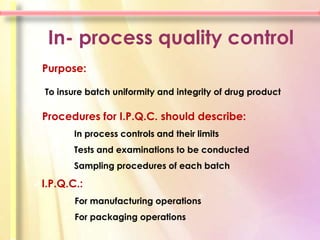
 Purpose:

  To insure batch uniformity and integrity of drug product

 Procedures for I.P.Q.C. should describe:
      • In process controls and their limits
      • Tests and examinations to be conducted
      • Sampling procedures of each batch

I.P.Q.C.:
      • For manufacturing operations
      • For packaging operations
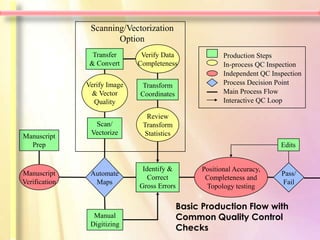
Scanning/Vectorization
                       Option
                 Transfer      Verify Data                Production Steps
                & Convert     Completeness                In-process QC Inspection
                                                          Independent QC Inspection
               Verify Image    Transform                  Process Decision Point
                & Vector      Coordinates                 Main Process Flow
                 Quality                                  Interactive QC Loop

                                Review
                 Scan/         Transform
                Vectorize      Statistics
Manuscript
  Prep                                                                      Edits


                               Identify &          Positional Accuracy,
Manuscript      Automate                                                    Pass/
                                 Correct            Completeness and
Verification     Maps                                                       Fail
                              Gross Errors          Topology testing

                                             Basic Production Flow with
                 Manual                      Common Quality Control
                Digitizing
                                             Checks
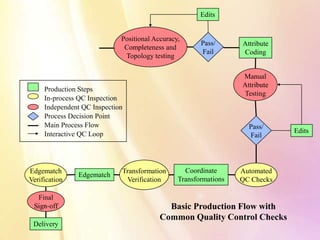
Edits


                             Positional Accuracy,
                                                       Pass/      Attribute
                              Completeness and
                                                       Fail       Coding
                              Topology testing

                                                                  Manual
                                                                  Attribute
     Production Steps
                                                                  Testing
     In-process QC Inspection
     Independent QC Inspection
     Process Decision Point
     Main Process Flow                                              Pass/
     Interactive QC Loop                                                      Edits
                                                                    Fail


Edgematch                    Transformation       Coordinate      Automated
               Edgematch
Verification                  Verification      Transformations   QC Checks

  Final
 Sign-off                                   Basic Production Flow with
                                          Common Quality Control Checks
 Delivery
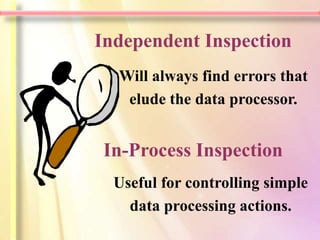
Independent Inspection
  Will always find errors that
   elude the data processor.


In-Process Inspection
  Useful for controlling simple
    data processing actions.
General Guidelines
for Cost-Effective Error Checking
    Re-work is always more costly
    than doing it right the first time.
    Check everything once, and then
    concentrate on maintaining data
    integrity through the remaining
    processes.
    Minimize the amount of materials
    that have to be handled.

6
QUALITY MANAGEMENT
     Data Quality Control is Process Control
    Documentation
       Record existence of anomalous conditions
       Maintain a complete data dictionary
      (including data extraction rules)
       Always provide staff (or vendor) with
      detailed written procedures plus diagrams
      describing graphic decision rules
7
QUALITY MANAGEMENT
Data Quality Control is Process Control
Communication
   Develop formal mechanisms
  (i.e., standard symbols/colors for errors)
   Conduct frequent coordination and status
  meetings
   Provide honest opinions and feedback
IN-PROCESS EVALUATION

 Process parameters should be evaluated
 and optimized.

 For example : Mixing
 Order of addition
 Mixing speed
 Mixing time
 Rate of addition etc.,
Chemical weigh sheet
 Identify the chemicals
 Its quantity
 The order of using

  The sampling directions
  Process specifications
  Should be in understandable language
  In process and finished product
  specifications
  Proper documentation required
GMP CONSIDERATIONS
Process Validation
Regular process review and
revalidation
Relevant written Standard Operating
Procedures
Equipment Qualification
Regularly scheduled preventive
maintenance
Validated cleaning procedures
An orderly arrangement of equipment so as
to ease material flow and prevent cross-
contamination
A well defined technology transfer system
The use of competent, technically qualified
personnel
Adequate provision for training of personnel
MATERIAL/POWDER HANDLING
Two primary concerns : Achieving reliable
flow and maintaining blend uniformity.

Segregation leads to poor product uniformity.

Handling system :
  - Must deliver the accurate amount of the
      ingredient
   - Material loss should be less
   - There should be no cross contamination
Avoiding segregation …..
Modify the powder in a way to reduce its inherent
tendency to segregate

Change the particle size such that the active
segregation mechanism becomes less dominant

Change the cohesiveness of the powder such that
the particles in a bed of powder are less likely to
move independent of each other

Modify the equipment to reduce forces that act to
segregate the powder
Change the equipment to provide remixing
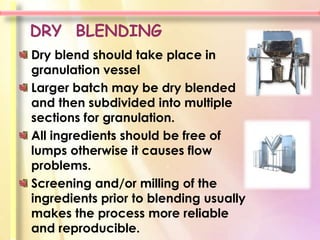
DRY BLENDING
Dry blend should take place in
granulation vessel
Larger batch may be dry blended
and then subdivided into multiple
sections for granulation.
All ingredients should be free of
lumps otherwise it causes flow
problems.
Screening and/or milling of the
ingredients prior to blending usually
makes the process more reliable
and reproducible.
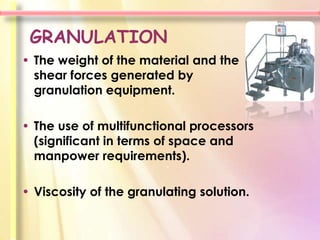
GRANULATION
• The weight of the material and the
  shear forces generated by
  granulation equipment.

• The use of multifunctional processors
  (significant in terms of space and
  manpower requirements).

• Viscosity of the granulating solution.
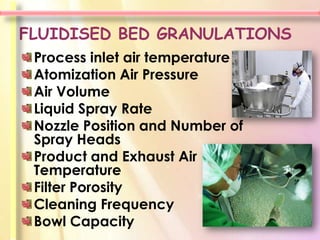
FLUIDISED BED GRANULATIONS
 Process inlet air temperature
 Atomization Air Pressure
 Air Volume
 Liquid Spray Rate
 Nozzle Position and Number of
 Spray Heads
 Product and Exhaust Air
 Temperature
 Filter Porosity
 Cleaning Frequency
 Bowl Capacity
DRYING

         • HOT AIR OVEN

    • FLUIDIZED BED DRYER
Hot Air Oven
Air flow
Air Temperature
Depth of the granulation on the trays
Monitoring of the drying process by the
use of moisture and temperature probes
Drying times at specified temperatures
and air flow
   rates for each product
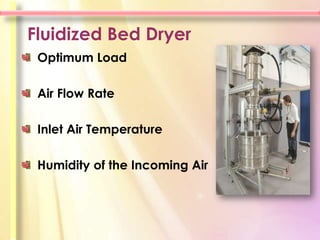
Fluidized Bed Dryer
 Optimum Load

 Air Flow Rate

 Inlet Air Temperature

 Humidity of the Incoming Air
PARTICLE SIZE REDUCTION
Sizing plays a key role in achieving uniformity.
There are two ways of sizing : Particle size separation
and Particle size reduction.
Major Factor – Feed rate of the material.
As the feed rate is increased so is residence time
with in the chamber of the equipment which in turn
results in finer distribution.
During scale up, overhead feeding equipment is
incorporated to mimic large scale production.
BLENDING
Blender loads
Blender size
Mixing speed
Mixing time
Bulk density of the raw material (considered
in selecting blender and in determining
optimum load)
Characteristics of the material
SPECIALISED GRANULATION
PROCEDURES


• Dry Blending and Direct Compression

     • Slugging (Dry Granulation)
Dry Blending and Direct Compression

The order of addition of components to the blender
The blender load
The mixing speed
The mixing time
The use of auxiliary dispersion equipment within the
mixer
The mixing action
Compression force
Slugging (Dry Granulation)
Forces used for slugging operation

The diameter of the punches

Subsequent sizing and screening operations
GRANULATION HANDLING
  AND FEED SYSTEM
Evaluation of vacuum automated
handling systems and mechanical
systems
Segregation : Due to static charges
built up due to vacuum can alter
material flow property
The effect of above system on the
content uniformity of the drug and on
the particle size
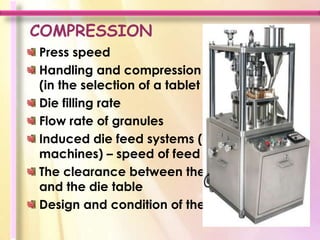
COMPRESSION
Press speed
Handling and compression characteristics
(in the selection of a tablet press)
Die filling rate
Flow rate of granules
Induced die feed systems (for high speed
machines) – speed of feed paddles
The clearance between the scraper blade
and the die table
Design and condition of the punches
TABLET COATING (FILM COATING)


            Pan Coating

        Fluidized Bed Coating
Pan and Fluidized Coating
 Optimum tablet load
 Operating tablet bed temperature
 Drying airflow rate and temperature
 The solution application rate
 The size and shape of the nozzle aperture
 (for airless sprayer)
 The atomizing air pressure and the liquid
 flow rate (for air atomized sprayers)
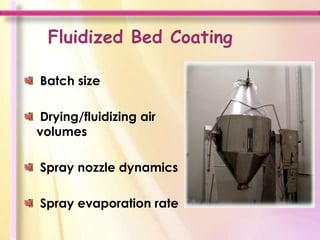
Fluidized Bed Coating

Batch size

Drying/fluidizing air
volumes

Spray nozzle dynamics

Spray evaporation rate
In process quality control

In process quality control

  • 1.
    SUPERVISED BY /DR.SAMAR AFFIFY
  • 2.
    In- process qualitycontrol  Purpose: To insure batch uniformity and integrity of drug product  Procedures for I.P.Q.C. should describe: • In process controls and their limits • Tests and examinations to be conducted • Sampling procedures of each batch I.P.Q.C.: • For manufacturing operations • For packaging operations
  • 3.
    Scanning/Vectorization Option Transfer Verify Data Production Steps & Convert Completeness In-process QC Inspection Independent QC Inspection Verify Image Transform Process Decision Point & Vector Coordinates Main Process Flow Quality Interactive QC Loop Review Scan/ Transform Vectorize Statistics Manuscript Prep Edits Identify & Positional Accuracy, Manuscript Automate Pass/ Correct Completeness and Verification Maps Fail Gross Errors Topology testing Basic Production Flow with Manual Common Quality Control Digitizing Checks
  • 4.
    Edits Positional Accuracy, Pass/ Attribute Completeness and Fail Coding Topology testing Manual Attribute Production Steps Testing In-process QC Inspection Independent QC Inspection Process Decision Point Main Process Flow Pass/ Interactive QC Loop Edits Fail Edgematch Transformation Coordinate Automated Edgematch Verification Verification Transformations QC Checks Final Sign-off Basic Production Flow with Common Quality Control Checks Delivery
  • 5.
    Independent Inspection Will always find errors that elude the data processor. In-Process Inspection Useful for controlling simple data processing actions.
  • 6.
    General Guidelines for Cost-EffectiveError Checking Re-work is always more costly than doing it right the first time. Check everything once, and then concentrate on maintaining data integrity through the remaining processes. Minimize the amount of materials that have to be handled. 6
  • 7.
    QUALITY MANAGEMENT Data Quality Control is Process Control Documentation Record existence of anomalous conditions Maintain a complete data dictionary (including data extraction rules) Always provide staff (or vendor) with detailed written procedures plus diagrams describing graphic decision rules 7
  • 8.
    QUALITY MANAGEMENT Data QualityControl is Process Control Communication Develop formal mechanisms (i.e., standard symbols/colors for errors) Conduct frequent coordination and status meetings Provide honest opinions and feedback
  • 9.
    IN-PROCESS EVALUATION Processparameters should be evaluated and optimized. For example : Mixing Order of addition Mixing speed Mixing time Rate of addition etc.,
  • 10.
    Chemical weigh sheet Identify the chemicals  Its quantity  The order of using The sampling directions Process specifications Should be in understandable language In process and finished product specifications Proper documentation required
  • 11.
    GMP CONSIDERATIONS Process Validation Regularprocess review and revalidation Relevant written Standard Operating Procedures Equipment Qualification Regularly scheduled preventive maintenance
  • 12.
    Validated cleaning procedures Anorderly arrangement of equipment so as to ease material flow and prevent cross- contamination A well defined technology transfer system The use of competent, technically qualified personnel Adequate provision for training of personnel
  • 13.
    MATERIAL/POWDER HANDLING Two primaryconcerns : Achieving reliable flow and maintaining blend uniformity. Segregation leads to poor product uniformity. Handling system : - Must deliver the accurate amount of the ingredient - Material loss should be less - There should be no cross contamination
  • 14.
    Avoiding segregation ….. Modifythe powder in a way to reduce its inherent tendency to segregate Change the particle size such that the active segregation mechanism becomes less dominant Change the cohesiveness of the powder such that the particles in a bed of powder are less likely to move independent of each other Modify the equipment to reduce forces that act to segregate the powder Change the equipment to provide remixing
  • 15.
    DRY BLENDING Dry blendshould take place in granulation vessel Larger batch may be dry blended and then subdivided into multiple sections for granulation. All ingredients should be free of lumps otherwise it causes flow problems. Screening and/or milling of the ingredients prior to blending usually makes the process more reliable and reproducible.
  • 16.
    GRANULATION • The weightof the material and the shear forces generated by granulation equipment. • The use of multifunctional processors (significant in terms of space and manpower requirements). • Viscosity of the granulating solution.
  • 17.
    FLUIDISED BED GRANULATIONS Process inlet air temperature Atomization Air Pressure Air Volume Liquid Spray Rate Nozzle Position and Number of Spray Heads Product and Exhaust Air Temperature Filter Porosity Cleaning Frequency Bowl Capacity
  • 18.
    DRYING • HOT AIR OVEN • FLUIDIZED BED DRYER
  • 19.
    Hot Air Oven Airflow Air Temperature Depth of the granulation on the trays Monitoring of the drying process by the use of moisture and temperature probes Drying times at specified temperatures and air flow rates for each product
  • 20.
    Fluidized Bed Dryer Optimum Load Air Flow Rate Inlet Air Temperature Humidity of the Incoming Air
  • 21.
    PARTICLE SIZE REDUCTION Sizingplays a key role in achieving uniformity. There are two ways of sizing : Particle size separation and Particle size reduction. Major Factor – Feed rate of the material. As the feed rate is increased so is residence time with in the chamber of the equipment which in turn results in finer distribution. During scale up, overhead feeding equipment is incorporated to mimic large scale production.
  • 22.
    BLENDING Blender loads Blender size Mixingspeed Mixing time Bulk density of the raw material (considered in selecting blender and in determining optimum load) Characteristics of the material
  • 23.
    SPECIALISED GRANULATION PROCEDURES • DryBlending and Direct Compression • Slugging (Dry Granulation)
  • 24.
    Dry Blending andDirect Compression The order of addition of components to the blender The blender load The mixing speed The mixing time The use of auxiliary dispersion equipment within the mixer The mixing action Compression force
  • 25.
    Slugging (Dry Granulation) Forcesused for slugging operation The diameter of the punches Subsequent sizing and screening operations
  • 26.
    GRANULATION HANDLING AND FEED SYSTEM Evaluation of vacuum automated handling systems and mechanical systems Segregation : Due to static charges built up due to vacuum can alter material flow property The effect of above system on the content uniformity of the drug and on the particle size
  • 27.
    COMPRESSION Press speed Handling andcompression characteristics (in the selection of a tablet press) Die filling rate Flow rate of granules Induced die feed systems (for high speed machines) – speed of feed paddles The clearance between the scraper blade and the die table Design and condition of the punches
  • 28.
    TABLET COATING (FILMCOATING)  Pan Coating  Fluidized Bed Coating
  • 29.
    Pan and FluidizedCoating Optimum tablet load Operating tablet bed temperature Drying airflow rate and temperature The solution application rate The size and shape of the nozzle aperture (for airless sprayer) The atomizing air pressure and the liquid flow rate (for air atomized sprayers)
  • 30.
    Fluidized Bed Coating Batchsize Drying/fluidizing air volumes Spray nozzle dynamics Spray evaporation rate