PROCESS COSTING
Dr. NGPASC
COIMBATORE | INDIA
Dr. N.G.P. ARTS AND SCIENCE COLLEGE
(An Autonomous Institution, Affiliated to Bharathiar University, Coimbatore)
Approved by Government of Tamil Nadu and Accredited by NAAC with 'A' Grade (2nd Cycle)
Dr. N.G.P.- Kalapatti Road, Coimbatore-641048, Tamil Nadu, India
Web: www.drngpasc.ac.in | Email: info@drngpasc.ac.in | Phone: +91-422-2369100
RAJAKRISHNAN M
Assistant Professor in Commerce CA
Dr. NGPASC
COIMBATORE | INDIA
PROCESS ?
Dr. NGPASC
COIMBATORE | INDIA
PROCESS ?
Dr. NGPASC
COIMBATORE | INDIA
PROCESS ?
Dr. NGPASC
COIMBATORE | INDIA
PROCESS ?
MEANING:
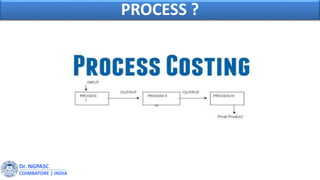
Charles T. Horngren says “Process Costing deals
with the mass production of like units usually pass
in continuous fashion through a series of
production steps called operations or processes.”
Dr. NGPASC
COIMBATORE | INDIA
Features of Process Costing
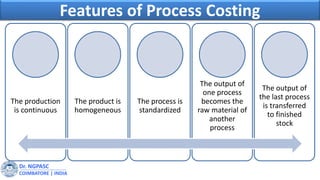
The production
is continuous
The product is
homogeneous
The process is
standardized
The output of
one process
becomes the
raw material of
another
process
The output of
the last process
is transferred
to finished
stock
Dr. NGPASC
COIMBATORE | INDIA
Features of Process Costing
Costs are collected
process-wise
Both direct and
indirect costs are
accumulated in each
process
If there is a stock of
semi-finished goods, it
is expressed in terms
of equivalent units
The total cost of each
process is divided by
the normal output of
that process to find
out the cost per unit of
that process.
Dr. NGPASC
COIMBATORE | INDIA
Process Costing - Types of industries
Chemical
works,
textile,
weaving,
spinning,
etc.
Gas,
electricity,
water, ice,
steel,
paper,
cement,
rubber,
bread, etc.
Bakeries,
confection
ery, flour
mills,
canners,
manufactu
rers of
medicine,
fabricators,
etc.
Foundries,
laundries,
dyers,
cleaners,
etc.
Spare
parts,
fittings,
equipment
, fertilizer
industries,
etc.
Box
making,
paper
mills,
biscuit
factories,
oil refining,
milk dairy,
meat
product
factory.
Dr. NGPASC
COIMBATORE | INDIA
Advantages
Costs are be computed periodically at the end of a particular period
It is simple and involves less clerical work than job costing
It is easy to allocate the expenses to processes to have accurate costs.
Use of standard costing systems in very effective in process costing
situations.
Process costing helps in the preparation of tender quotations.
Since cost data is available for each process, operation and department,
good managerial control is possible.
Dr. NGPASC
COIMBATORE | INDIA
Job costing and process costing
Basis of Distinction Job order costing Process costing
Specific order Performed against specific
orders
Production is contentious
Nature Each job may be different. The product is homogeneous
and Standardized.
Cost determination Cost is determined for each
job separately.
Costs are complied with for
each process for the
department on a time basis,
i.e., for a given accounting
period.
Dr. NGPASC
COIMBATORE | INDIA
Job costing and process costing
Basis of Distinction Job order costing Process costing
Cost calculations Cost complies when a job is
completed.
Cost is calculated at the end
of the cost period.
Control Proper control is
comparatively difficult as each
product unit is different, and
the production is not
continuous.
Proper control is
comparatively easier as the
production is standardized
and is more suitable.
Transfer There is usually not transfer
from one job to another
unless there is some surplus
work.
The output of one process is
transferred to another
process as input.
Dr. NGPASC
COIMBATORE | INDIA
Job costing and process costing
Basis of Distinction Job order costing Process costing
Work-in-progress There may or may not be
work-in-progress.
There is always some work-
in-progress because of
continuous production.
Suitability Suitable to industries where
production is intermittent,
and customer orders can be
identified in the value of
production.
Suitable where goods are
made for stock and
production is continuous.
Dr. NGPASC
COIMBATORE | INDIA
Normal Loss
•This loss of
units is
categorized as
normal and
abnormal loss.
Shrinkage, seepage,
evaporation, weight
loss and use of
inefficient
equipment often
cause a loss or
spoilage of units in
processing
departments.
Dr. NGPASC
COIMBATORE | INDIA
Normal Loss
The normal loss is the unavoidable
loss of units in a processing
department that occurs majorly
due to the nature of production
operation or the nature of raw
materials being processed.
This loss cannot be avoided under
normal and efficient production
environment and is considered
within the normal or acceptable
tolerance limit for machines and
human errors.
Dr. NGPASC
COIMBATORE | INDIA
Abnormal Loss
Loss or spoilage of units in a
processing department that should
not occur under normal and efficient
working conditions.
The abnormal loss signifies that the
production operation has one or more
serious issues that need to be
identified and fixed quickly.
Major factors that may contribute
towards the occurrence of abnormal
loss in a production process include
use of faulty equipment, unskilled or
untrained workers, use of substandard
raw materials, improper supervision,
frequent electricity breakdown and
working conditions with a lot of room
for improvements etc.
Dr. NGPASC
COIMBATORE | INDIA
Difference between normal and abnormal loss
The core factor considered for differentiating between normal and abnormal loss or
spoilage is the degree of controllability. The degree of controllability in case of a
normal loss is much smaller than in case of an abnormal loss.
Normal loss is referred to as uncontrollable because it is inherently attached to
certain production processes and can’t be avoided even under most efficient working
conditions. Examples of such losses include weight loss, evaporation and shrinkage of
materials. We can’t do too much to stop these losses from occurring as the degree of
controllability is usually very small to zero in case of normal losses.
The abnormal loss, on the other hand, is referred to as controllable loss because it
can be avoided under normal and efficient working conditions. It is essentially an
unnecessary loss because it occurs due to carelessness, use of low quality materials,
use of inefficient or faulty machines in manufacturing process and other similar
factors that are controllable in nature.
17

Process Costing

  • 1.
    PROCESS COSTING Dr. NGPASC COIMBATORE| INDIA Dr. N.G.P. ARTS AND SCIENCE COLLEGE (An Autonomous Institution, Affiliated to Bharathiar University, Coimbatore) Approved by Government of Tamil Nadu and Accredited by NAAC with 'A' Grade (2nd Cycle) Dr. N.G.P.- Kalapatti Road, Coimbatore-641048, Tamil Nadu, India Web: www.drngpasc.ac.in | Email: info@drngpasc.ac.in | Phone: +91-422-2369100 RAJAKRISHNAN M Assistant Professor in Commerce CA
  • 2.
    Dr. NGPASC COIMBATORE |INDIA PROCESS ?
  • 3.
    Dr. NGPASC COIMBATORE |INDIA PROCESS ?
  • 4.
    Dr. NGPASC COIMBATORE |INDIA PROCESS ?
  • 5.
    Dr. NGPASC COIMBATORE |INDIA PROCESS ? MEANING: Charles T. Horngren says “Process Costing deals with the mass production of like units usually pass in continuous fashion through a series of production steps called operations or processes.”
  • 6.
    Dr. NGPASC COIMBATORE |INDIA Features of Process Costing The production is continuous The product is homogeneous The process is standardized The output of one process becomes the raw material of another process The output of the last process is transferred to finished stock
  • 7.
    Dr. NGPASC COIMBATORE |INDIA Features of Process Costing Costs are collected process-wise Both direct and indirect costs are accumulated in each process If there is a stock of semi-finished goods, it is expressed in terms of equivalent units The total cost of each process is divided by the normal output of that process to find out the cost per unit of that process.
  • 8.
    Dr. NGPASC COIMBATORE |INDIA Process Costing - Types of industries Chemical works, textile, weaving, spinning, etc. Gas, electricity, water, ice, steel, paper, cement, rubber, bread, etc. Bakeries, confection ery, flour mills, canners, manufactu rers of medicine, fabricators, etc. Foundries, laundries, dyers, cleaners, etc. Spare parts, fittings, equipment , fertilizer industries, etc. Box making, paper mills, biscuit factories, oil refining, milk dairy, meat product factory.
  • 9.
    Dr. NGPASC COIMBATORE |INDIA Advantages Costs are be computed periodically at the end of a particular period It is simple and involves less clerical work than job costing It is easy to allocate the expenses to processes to have accurate costs. Use of standard costing systems in very effective in process costing situations. Process costing helps in the preparation of tender quotations. Since cost data is available for each process, operation and department, good managerial control is possible.
  • 10.
    Dr. NGPASC COIMBATORE |INDIA Job costing and process costing Basis of Distinction Job order costing Process costing Specific order Performed against specific orders Production is contentious Nature Each job may be different. The product is homogeneous and Standardized. Cost determination Cost is determined for each job separately. Costs are complied with for each process for the department on a time basis, i.e., for a given accounting period.
  • 11.
    Dr. NGPASC COIMBATORE |INDIA Job costing and process costing Basis of Distinction Job order costing Process costing Cost calculations Cost complies when a job is completed. Cost is calculated at the end of the cost period. Control Proper control is comparatively difficult as each product unit is different, and the production is not continuous. Proper control is comparatively easier as the production is standardized and is more suitable. Transfer There is usually not transfer from one job to another unless there is some surplus work. The output of one process is transferred to another process as input.
  • 12.
    Dr. NGPASC COIMBATORE |INDIA Job costing and process costing Basis of Distinction Job order costing Process costing Work-in-progress There may or may not be work-in-progress. There is always some work- in-progress because of continuous production. Suitability Suitable to industries where production is intermittent, and customer orders can be identified in the value of production. Suitable where goods are made for stock and production is continuous.
  • 13.
    Dr. NGPASC COIMBATORE |INDIA Normal Loss •This loss of units is categorized as normal and abnormal loss. Shrinkage, seepage, evaporation, weight loss and use of inefficient equipment often cause a loss or spoilage of units in processing departments.
  • 14.
    Dr. NGPASC COIMBATORE |INDIA Normal Loss The normal loss is the unavoidable loss of units in a processing department that occurs majorly due to the nature of production operation or the nature of raw materials being processed. This loss cannot be avoided under normal and efficient production environment and is considered within the normal or acceptable tolerance limit for machines and human errors.
  • 15.
    Dr. NGPASC COIMBATORE |INDIA Abnormal Loss Loss or spoilage of units in a processing department that should not occur under normal and efficient working conditions. The abnormal loss signifies that the production operation has one or more serious issues that need to be identified and fixed quickly. Major factors that may contribute towards the occurrence of abnormal loss in a production process include use of faulty equipment, unskilled or untrained workers, use of substandard raw materials, improper supervision, frequent electricity breakdown and working conditions with a lot of room for improvements etc.
  • 16.
    Dr. NGPASC COIMBATORE |INDIA Difference between normal and abnormal loss The core factor considered for differentiating between normal and abnormal loss or spoilage is the degree of controllability. The degree of controllability in case of a normal loss is much smaller than in case of an abnormal loss. Normal loss is referred to as uncontrollable because it is inherently attached to certain production processes and can’t be avoided even under most efficient working conditions. Examples of such losses include weight loss, evaporation and shrinkage of materials. We can’t do too much to stop these losses from occurring as the degree of controllability is usually very small to zero in case of normal losses. The abnormal loss, on the other hand, is referred to as controllable loss because it can be avoided under normal and efficient working conditions. It is essentially an unnecessary loss because it occurs due to carelessness, use of low quality materials, use of inefficient or faulty machines in manufacturing process and other similar factors that are controllable in nature.
  • 17.