DEEPIKA.M
21BCC508
21BCC508
INTERORGANIZATIONAL
E-COMMERCE
MEANING
 ‘Inter’ means ‘between’ or ‘across’.
 Inter organization means between two organizations.
“Therefore, inter organizational procedures occur when two
or more organizations join together and share information or
collaborate.
 Examples of this might include the government and local
non-profit organizations working together to help the
community.” “In Encyclopedia of Networked and Virtual
Organization (Putnik & Cunha, Eds., 2008), ‘Inter-
organizational System’ is defined as:”
LEVELS OF IOS
 Individual Organizations:
For individual organizations, their networks influence their
power position within a sector, influence the access to new
knowledge, and generally determine opportunities and
constraints.
 The Networks Themselves:
For the networks themselves (network level outcomes), how
they are structured and governed influences to a great extent
what outcomes they produce and in case of engineered
networks to what extent they are able to achieve their goals.
 The Wider Community or Society:
For the wider community or society, the way they are
structured and governed determines the positive or negative
effects these networks might have, for example, in terms of
innovative spillovers or policy making.”
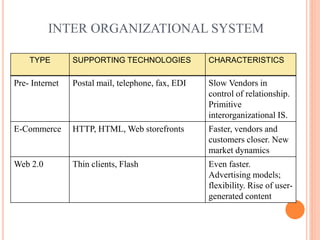
INTER ORGANIZATIONAL SYSTEM
TYPE SUPPORTING TECHNOLOGIES CHARACTERISTICS
Pre- Internet Postal mail, telephone, fax, EDI Slow Vendors in
control of relationship.
Primitive
interorganizational IS.
E-Commerce HTTP, HTML, Web storefronts Faster, vendors and
customers closer. New
market dynamics
Web 2.0 Thin clients, Flash Even faster.
Advertising models;
flexibility. Rise of user-
generated content
IOS BARRIERS
 Lack of peer pressure
 Power
 Trust
 Culture
REASONS TO PURSUE IOS
An Interorganizational system is an information system shared by one
or more suppliers and customers. Organizations might pursue an
interorganizational system for the following reasons:
 Reduce the risk in the organization
 Pursue economies of scale
 Benefit from the exchange of technologies
 Increase competitiveness
 Overcome investment barriers
 Encourage global communication
 Manage buyer-supplier relationships
 Supply-chain management system
 Information exchange among business partners
BENEFITS
 Businesses that sell similar items or services, or require the
help of other businesses to complete the sale of a product are
undeniably linked in the market.
I. EFFICIENT SCM
II. TECHNOLOGY EXCHANGE
III. GLOBAL COMMUNICATION
IV. REDUCE BUSINESS RISKS
EFFICIENT SCM
Supply chain management, SCM, refers to the network and
communication between interconnected businesses that depend on one
another to deliver a product or service to the public. An interorganizational
system creates automated communication between interconnected
businesses, or information that is programmed to update itself, with minimal
manual operation from a worker.
TECHNOLOGY EXCHANGE
Running an IOS requires the use of technology. Phones, computers,
internet and intelligent computer programs and software are used to send
and receive messages and store and interpret data. When one company
implements and uses a new technology in an IOS system, partnering
companies automatically benefit from this discovery. Technology is
exchanged easily and encourages creators to develop new products and
programs.
GLOBAL COMMUNICATION
IOS makes communication available at a global level. A business
implementing this system for the first time may start at a local level. Once
the business understands its capacity for an IOS system, it can implement
new technological tools, hire new employees and seek to incorporate
businesses at a national and global level. The wider the network of
communication, the more businesses have a chance to learn new tactics
from one another and increase productivity.
REDUCE BUSINESS RISKS
Every business takes risks during the process of production. These
risks include safety, financial and operational risks. An effective ISO
system reduces these risks, making sure each aspect of the business is
being watched. The system provides checks and balances that hold each
aspect of the company accountable to one another and partnering
companies.
THANK YOU!

Inter Organizational e-commerce

  • 1.
  • 2.
    MEANING  ‘Inter’ means‘between’ or ‘across’.  Inter organization means between two organizations. “Therefore, inter organizational procedures occur when two or more organizations join together and share information or collaborate.  Examples of this might include the government and local non-profit organizations working together to help the community.” “In Encyclopedia of Networked and Virtual Organization (Putnik & Cunha, Eds., 2008), ‘Inter- organizational System’ is defined as:”
  • 3.
    LEVELS OF IOS Individual Organizations: For individual organizations, their networks influence their power position within a sector, influence the access to new knowledge, and generally determine opportunities and constraints.  The Networks Themselves: For the networks themselves (network level outcomes), how they are structured and governed influences to a great extent what outcomes they produce and in case of engineered networks to what extent they are able to achieve their goals.
  • 4.
     The WiderCommunity or Society: For the wider community or society, the way they are structured and governed determines the positive or negative effects these networks might have, for example, in terms of innovative spillovers or policy making.”
  • 5.
    INTER ORGANIZATIONAL SYSTEM TYPESUPPORTING TECHNOLOGIES CHARACTERISTICS Pre- Internet Postal mail, telephone, fax, EDI Slow Vendors in control of relationship. Primitive interorganizational IS. E-Commerce HTTP, HTML, Web storefronts Faster, vendors and customers closer. New market dynamics Web 2.0 Thin clients, Flash Even faster. Advertising models; flexibility. Rise of user- generated content
  • 6.
    IOS BARRIERS  Lackof peer pressure  Power  Trust  Culture
  • 7.
    REASONS TO PURSUEIOS An Interorganizational system is an information system shared by one or more suppliers and customers. Organizations might pursue an interorganizational system for the following reasons:  Reduce the risk in the organization  Pursue economies of scale  Benefit from the exchange of technologies  Increase competitiveness  Overcome investment barriers  Encourage global communication  Manage buyer-supplier relationships  Supply-chain management system  Information exchange among business partners
  • 8.
    BENEFITS  Businesses thatsell similar items or services, or require the help of other businesses to complete the sale of a product are undeniably linked in the market. I. EFFICIENT SCM II. TECHNOLOGY EXCHANGE III. GLOBAL COMMUNICATION IV. REDUCE BUSINESS RISKS
  • 9.
    EFFICIENT SCM Supply chainmanagement, SCM, refers to the network and communication between interconnected businesses that depend on one another to deliver a product or service to the public. An interorganizational system creates automated communication between interconnected businesses, or information that is programmed to update itself, with minimal manual operation from a worker. TECHNOLOGY EXCHANGE Running an IOS requires the use of technology. Phones, computers, internet and intelligent computer programs and software are used to send and receive messages and store and interpret data. When one company implements and uses a new technology in an IOS system, partnering companies automatically benefit from this discovery. Technology is exchanged easily and encourages creators to develop new products and programs.
  • 10.
    GLOBAL COMMUNICATION IOS makescommunication available at a global level. A business implementing this system for the first time may start at a local level. Once the business understands its capacity for an IOS system, it can implement new technological tools, hire new employees and seek to incorporate businesses at a national and global level. The wider the network of communication, the more businesses have a chance to learn new tactics from one another and increase productivity. REDUCE BUSINESS RISKS Every business takes risks during the process of production. These risks include safety, financial and operational risks. An effective ISO system reduces these risks, making sure each aspect of the business is being watched. The system provides checks and balances that hold each aspect of the company accountable to one another and partnering companies.
  • 11.