E-COMMERCE
INTRODUCTION
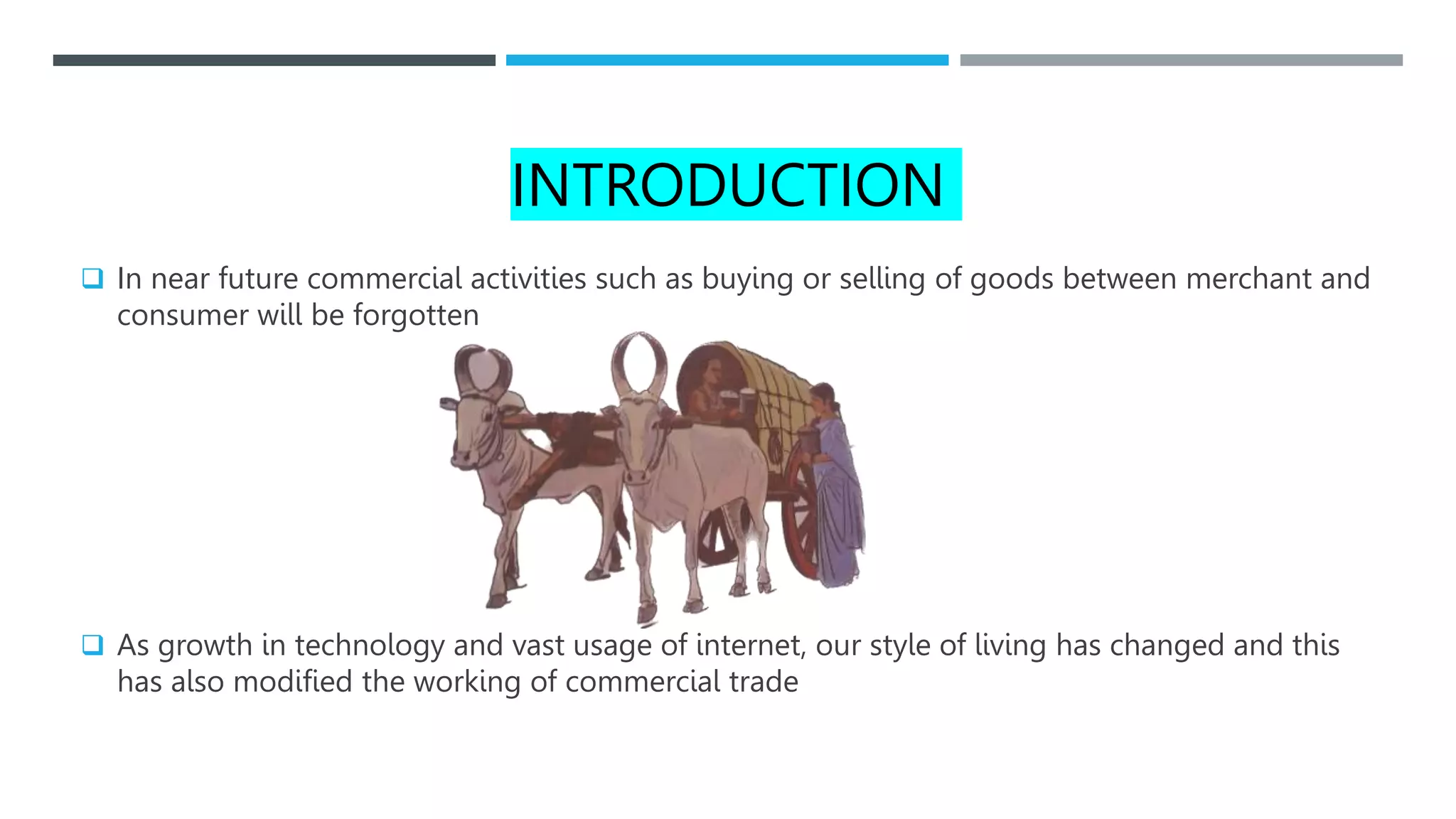
 In near future commercial activities such as buying or selling of goods between merchant and
consumer will be forgotten
 As growth in technology and vast usage of internet, our style of living has changed and this
has also modified the working of commercial trade
DEFINITION OF E-COMMERCE
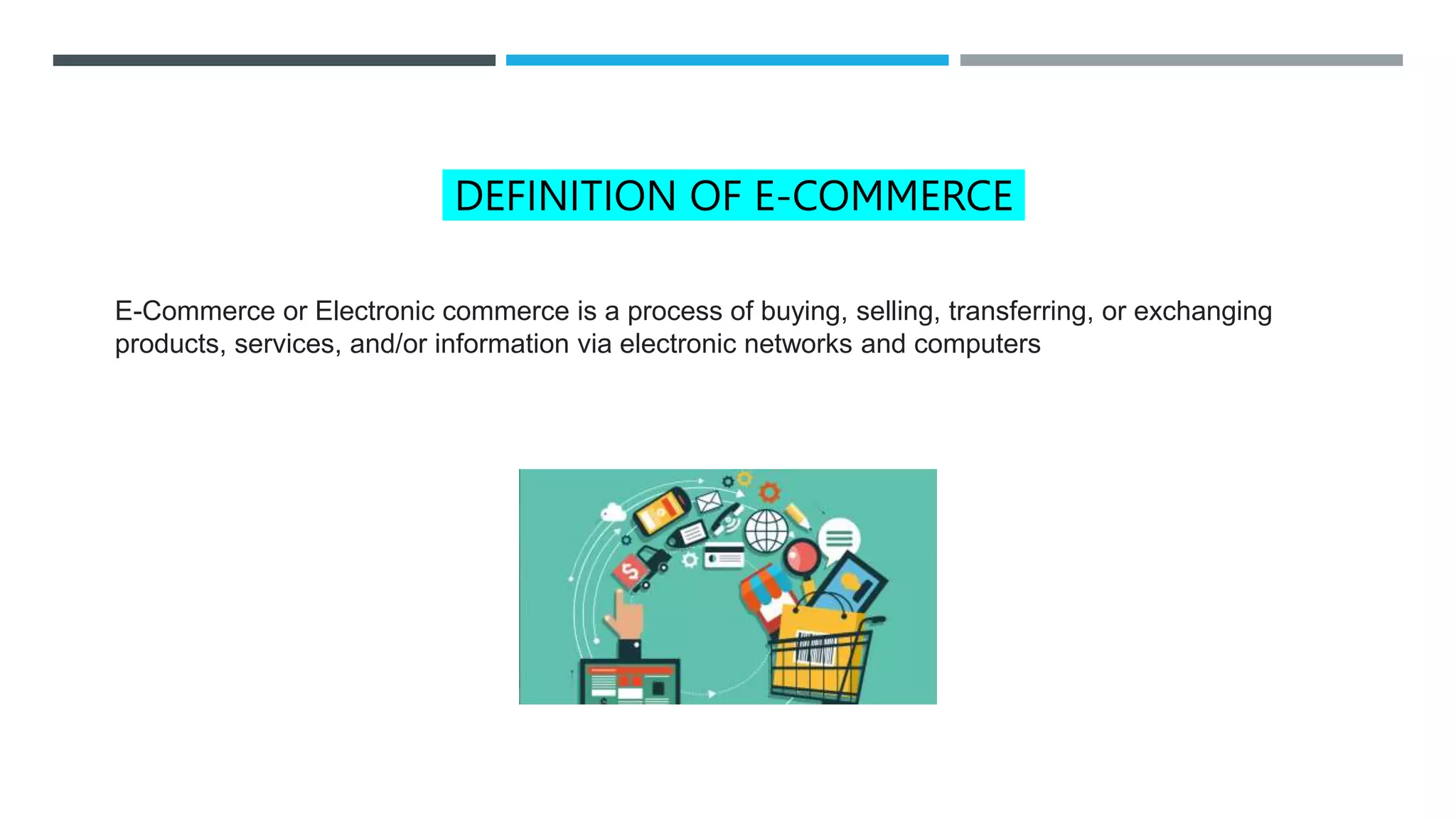
E-Commerce or Electronic commerce is a process of buying, selling, transferring, or exchanging
products, services, and/or information via electronic networks and computers
RELATIONSHIP BETWEEN E-COM AND E-BUSINESS
 E-Commerce is commercial transaction through Internet, but E- Business entirely depends
on the Internet for its every intra-company and inter-company activities such as procurement
of raw materials, marketing, finance, manufacturing, selling and negotiation.
 E-Commerce is a narrow concept and it is considered as a subset of E-
Business.
MEANING OF E-COMMERCE
 E-Commerce is currently one of the most important aspects of the Internet era, the prefix ‘e’
( stands for electronic ) Commerce and Internet makes E-Commerce. It also allows the
consumers to exchange goods and services with no barrier of time or distance. Electronic
commerce has expanded rapidly over the past few years and is predicted to accelerate.
 E-Commerce can be described as the process of buying or selling products, services or
information via computer networks.
EVOLUTION OF ELECTRONIC COMMERCE
 E-Commerce is not a completely new type of commerce. The dawn of E-Commerce started
few decades ago and continues to grow exponentially. It first emerged on private networks in
1970s. Electronic Data Interchanges and teleshopping together paved the way for the E-
Commerce.)
 1979: Michael Aldrich invents electronic shopping and makes the first electronic transaction.
 1982: World’s first eCommerce company, Boston Computer Exchange, is started.
 1991: The world wide web is invented.
 1992: First eCommerce website – an online bookstore – Book Stacks Unlimited is launched.
 Online shopping started to grow when National Science Foundation opened the Internet to the
public in 1991.
ADVANTAGES OF ECOMMERCE
 A Larger Market
 Lower Cost
 More Opportunities For “Selling”
 Ease of purchasing
DISADVANTAGES OF E-COMMERCE
 Lack of Personal Touch
 Product and Price Comparison
 Security Issues
 No guarantee for quality of the product
E-Commerce and E- Businesss

E-Commerce and E- Businesss

  • 1.
  • 2.
    INTRODUCTION  In nearfuture commercial activities such as buying or selling of goods between merchant and consumer will be forgotten  As growth in technology and vast usage of internet, our style of living has changed and this has also modified the working of commercial trade
  • 3.
    DEFINITION OF E-COMMERCE E-Commerceor Electronic commerce is a process of buying, selling, transferring, or exchanging products, services, and/or information via electronic networks and computers
  • 4.
    RELATIONSHIP BETWEEN E-COMAND E-BUSINESS  E-Commerce is commercial transaction through Internet, but E- Business entirely depends on the Internet for its every intra-company and inter-company activities such as procurement of raw materials, marketing, finance, manufacturing, selling and negotiation.  E-Commerce is a narrow concept and it is considered as a subset of E- Business.
  • 5.
    MEANING OF E-COMMERCE E-Commerce is currently one of the most important aspects of the Internet era, the prefix ‘e’ ( stands for electronic ) Commerce and Internet makes E-Commerce. It also allows the consumers to exchange goods and services with no barrier of time or distance. Electronic commerce has expanded rapidly over the past few years and is predicted to accelerate.  E-Commerce can be described as the process of buying or selling products, services or information via computer networks.
  • 6.
    EVOLUTION OF ELECTRONICCOMMERCE  E-Commerce is not a completely new type of commerce. The dawn of E-Commerce started few decades ago and continues to grow exponentially. It first emerged on private networks in 1970s. Electronic Data Interchanges and teleshopping together paved the way for the E- Commerce.)  1979: Michael Aldrich invents electronic shopping and makes the first electronic transaction.  1982: World’s first eCommerce company, Boston Computer Exchange, is started.  1991: The world wide web is invented.  1992: First eCommerce website – an online bookstore – Book Stacks Unlimited is launched.  Online shopping started to grow when National Science Foundation opened the Internet to the public in 1991.
  • 7.
    ADVANTAGES OF ECOMMERCE A Larger Market  Lower Cost  More Opportunities For “Selling”  Ease of purchasing
  • 8.
    DISADVANTAGES OF E-COMMERCE Lack of Personal Touch  Product and Price Comparison  Security Issues  No guarantee for quality of the product