TECHNIQUES FOR
MEASUREMENT OF
PRODUCTIVITY:
ANSHUL AHUJA
(MM-662-2K15)
Er. SAHIL SHARMA
(MM-670-2K15)
Productivity
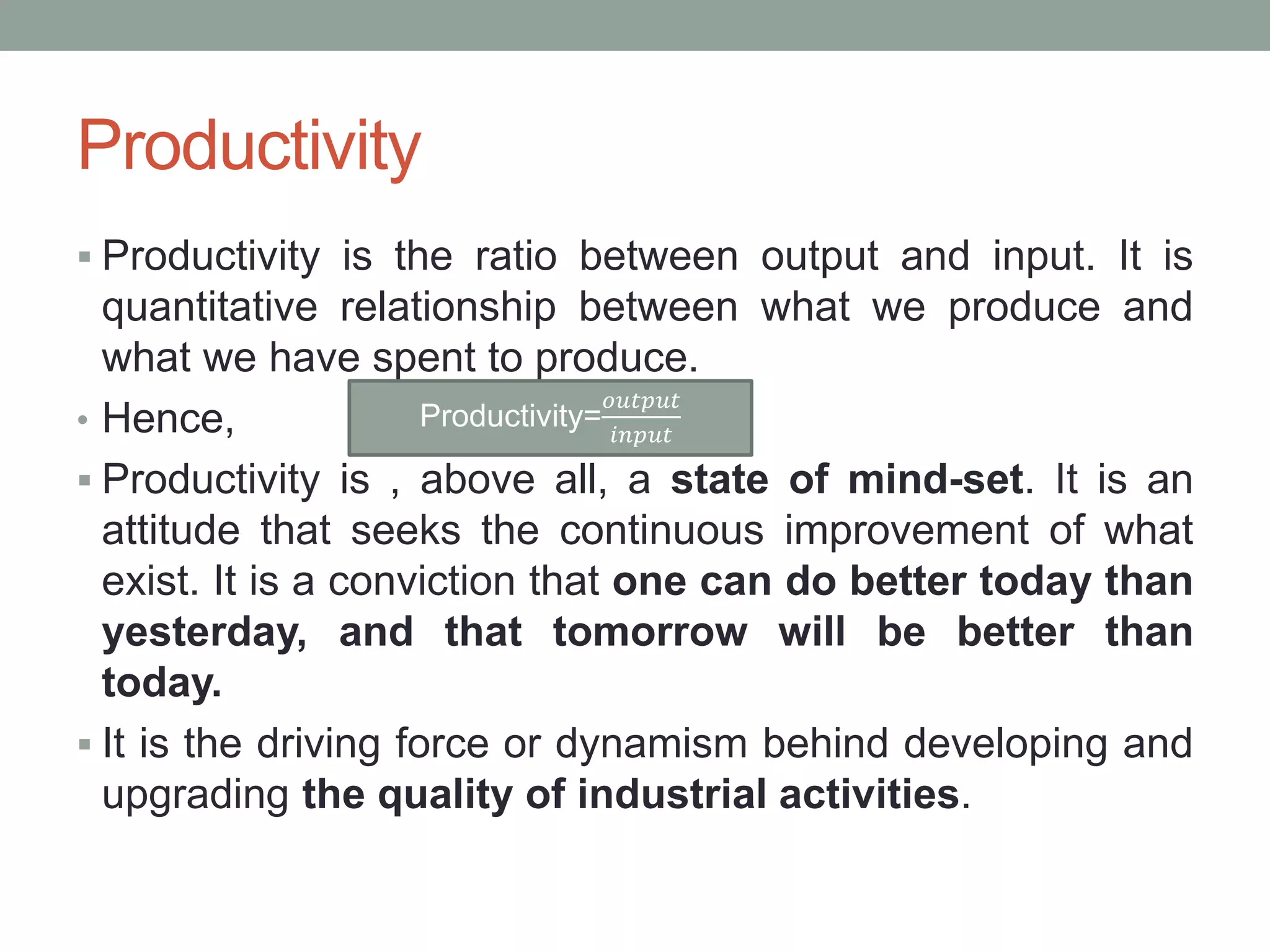
 Productivity is the ratio between output and input. It is
quantitative relationship between what we produce and
what we have spent to produce.
• Hence,
 Productivity is , above all, a state of mind-set. It is an
attitude that seeks the continuous improvement of what
exist. It is a conviction that one can do better today than
yesterday, and that tomorrow will be better than
today.
 It is the driving force or dynamism behind developing and
upgrading the quality of industrial activities.
Productivity=
𝑜𝑢𝑡𝑝𝑢𝑡
𝑖𝑛𝑝𝑢𝑡
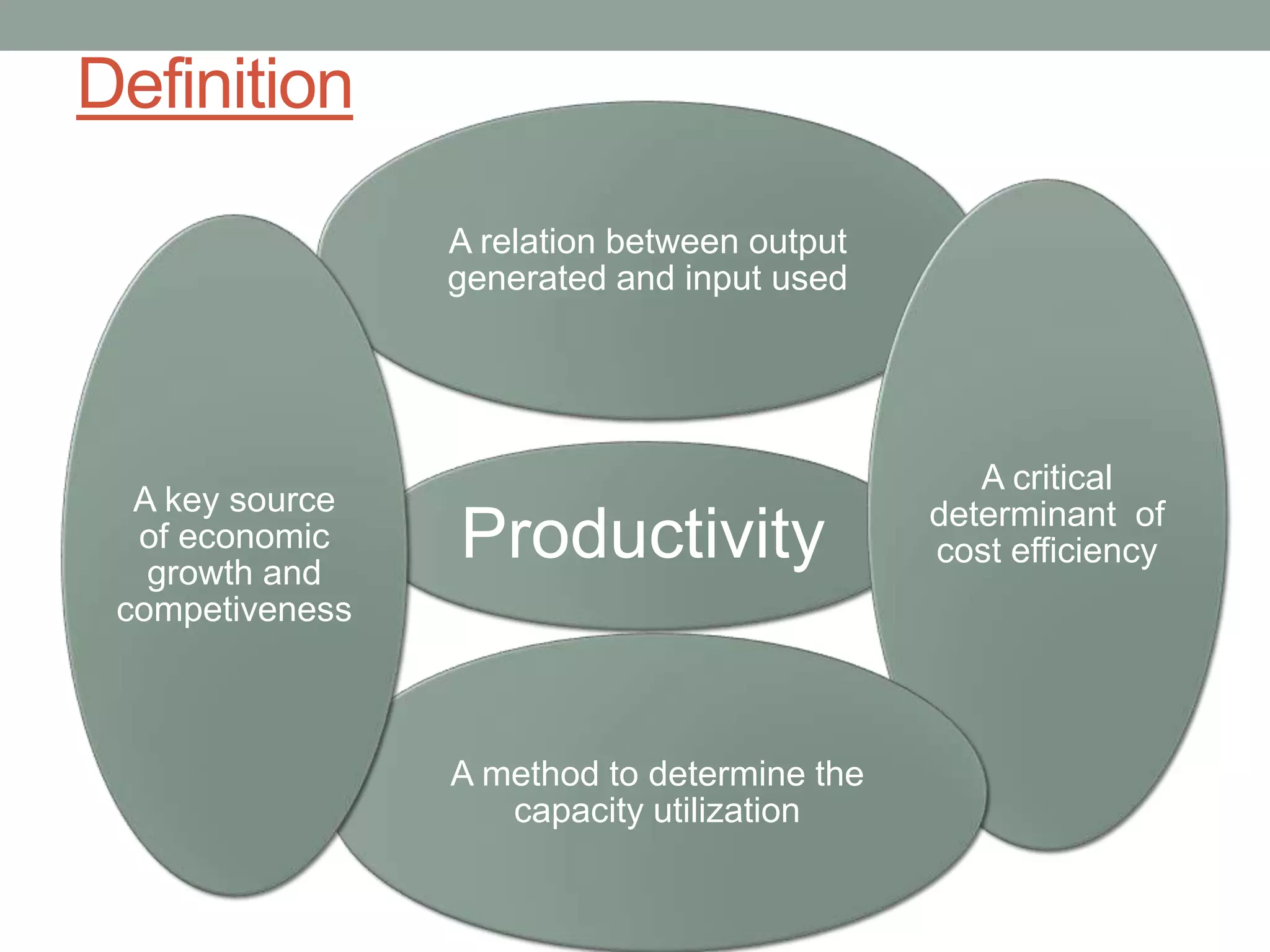
Productivity
A relation between output
generated and input used
A critical
determinant of
cost efficiency
A method to determine the
capacity utilization
A key source
of economic
growth and
competiveness
Definition
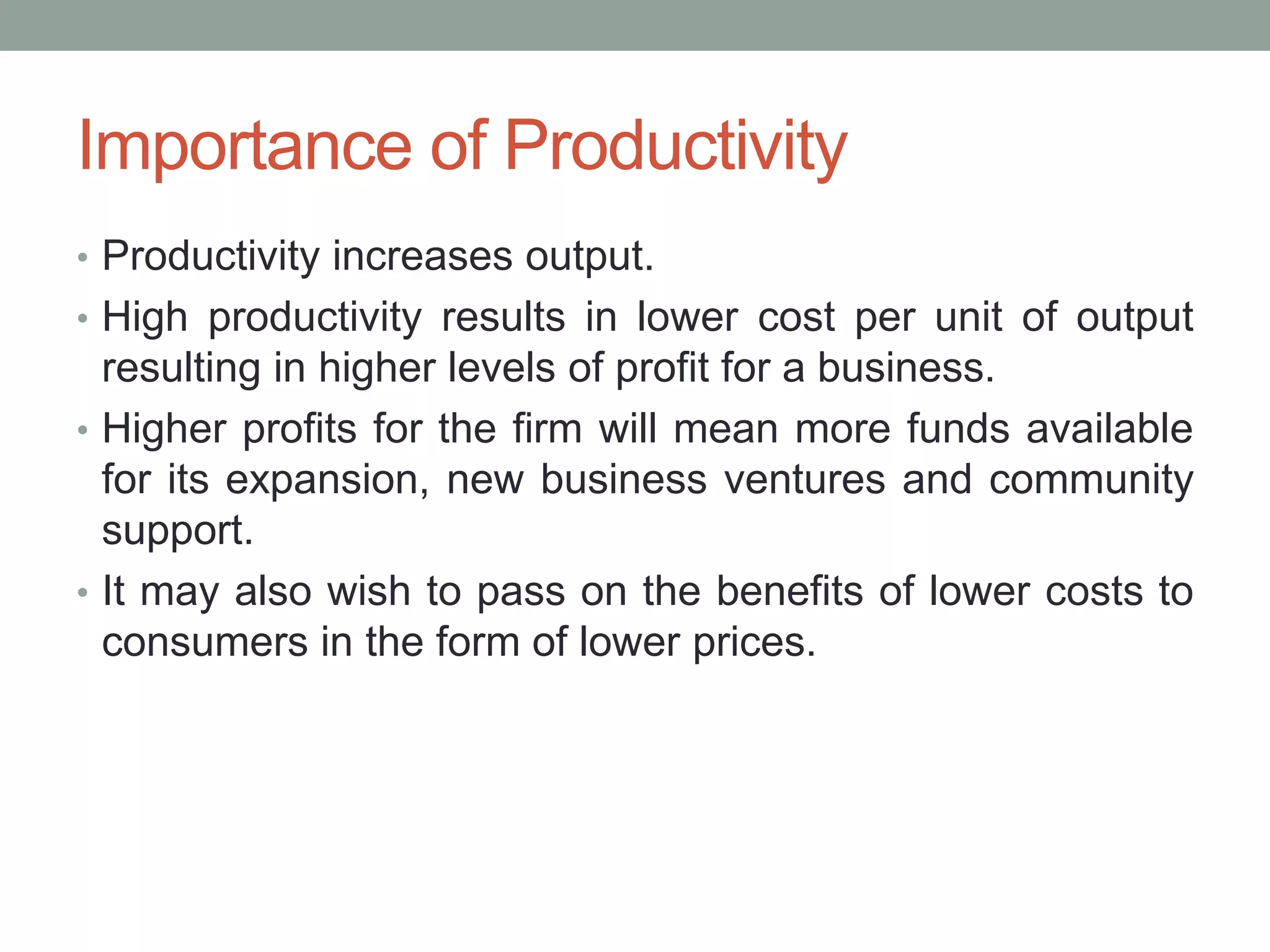
• Productivity increases output.
• High productivity results in lower cost per unit of output
resulting in higher levels of profit for a business.
• Higher profits for the firm will mean more funds available
for its expansion, new business ventures and community
support.
• It may also wish to pass on the benefits of lower costs to
consumers in the form of lower prices.
Importance of Productivity
Diff. between Production and Productivity
Production Productivity
Definition It is defined as the act of
manufacturing goods for
their use or sale.
it is defined as the rate at
which goods are produced.
Use It is the actual process of
conversion.
It is the utilization of
resources to form goods.
Work done It is the amount of work
done or manufactured that
is the output.
It is the amount of work one
gets for a certain spending
cost.
Measurement It is the measure of
produced goods.
It is the measure of
efficiency.
Important Note!
Production is a measure of output only and not a
measure of efficiency
Measurement in Productivity and
why ????
• Set overall productivity goals for organization
• Raise awareness among employees
Establish productivity
management function
• Access your company current performance
• Identify the gaps and areas of improvement
Diagnose
• Set targets and formulate strategy
• Implement specification
Develop road map
Implement
measurement system
• Link effort and reward to employees
• Monitor the review parts
Implement performance
management system
Techniques for Measurement of Productivity:
PRODUCTIVITY
AGGREGATE
BASIS
TOTAL
PRODUCTIVITY
INDIVIDUAL
BASIS
PARTIAL
PRODUCTIVITY
OR FACTOR
PRODUCTIVITY
Aggregate Basis
• On aggregate basis, output is compared with all inputs taken
(added) together. This is called as Total Productivity.
Hence,
• Where Total Output=Total production of goods and services and
Total Input= Labor + Material + Capital + Energy.
• This index measures the productivity of the entire
organization with use of all resources. It is a way of
evaluating efficiency of entire plant or firm.
Total Productivity Index =
Total output
Total input
9
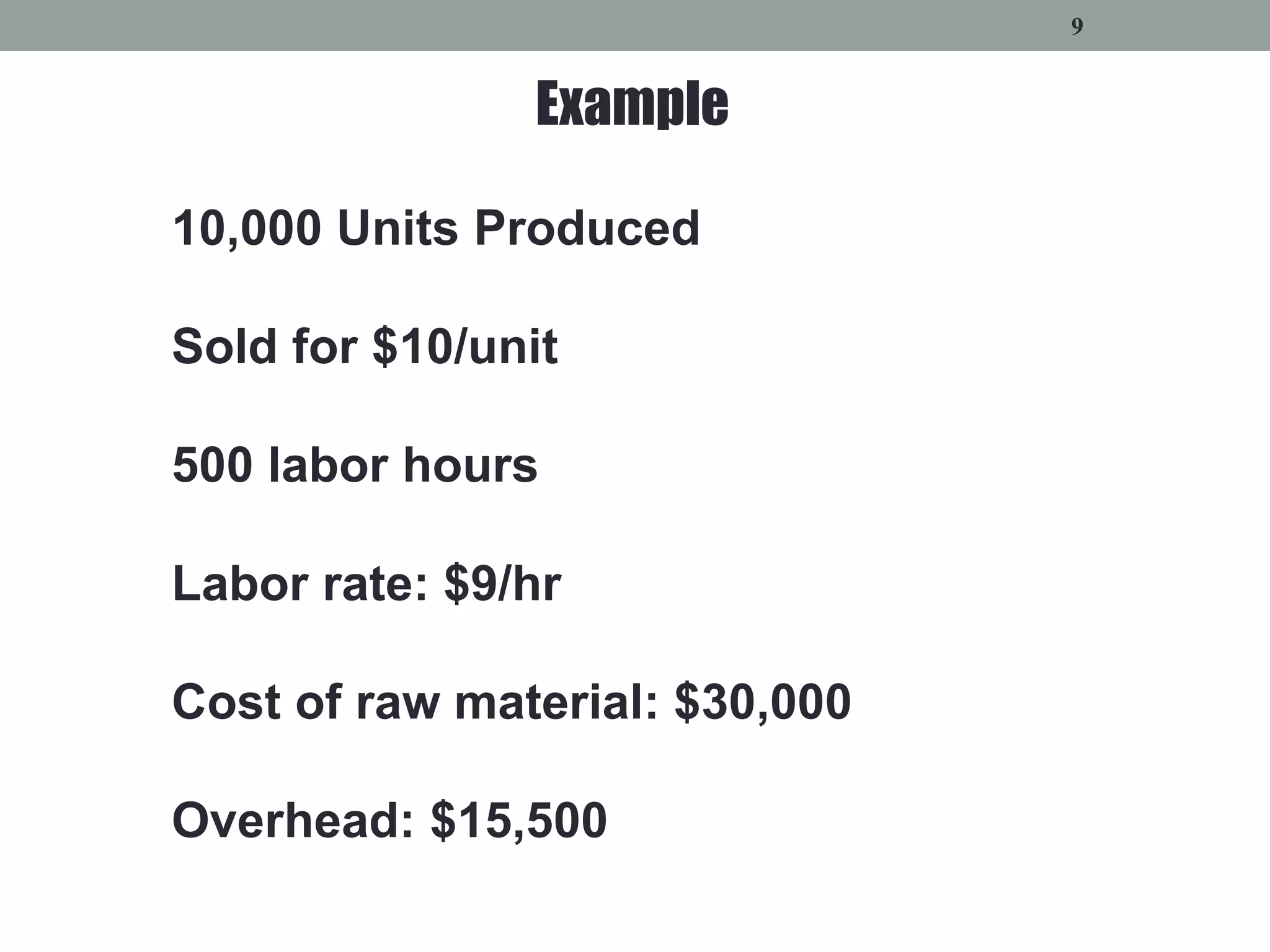
10,000 Units Produced
Sold for $10/unit
500 labor hours
Labor rate: $9/hr
Cost of raw material: $30,000
Overhead: $15,500
Example
10
Output
Labor + Materials + Overhead
(10,000 units) * ($10)
(500)*($9) + ($30,000) + ($15,500)
TP = 2.0
Example : Total Productivity
TP =
TP =
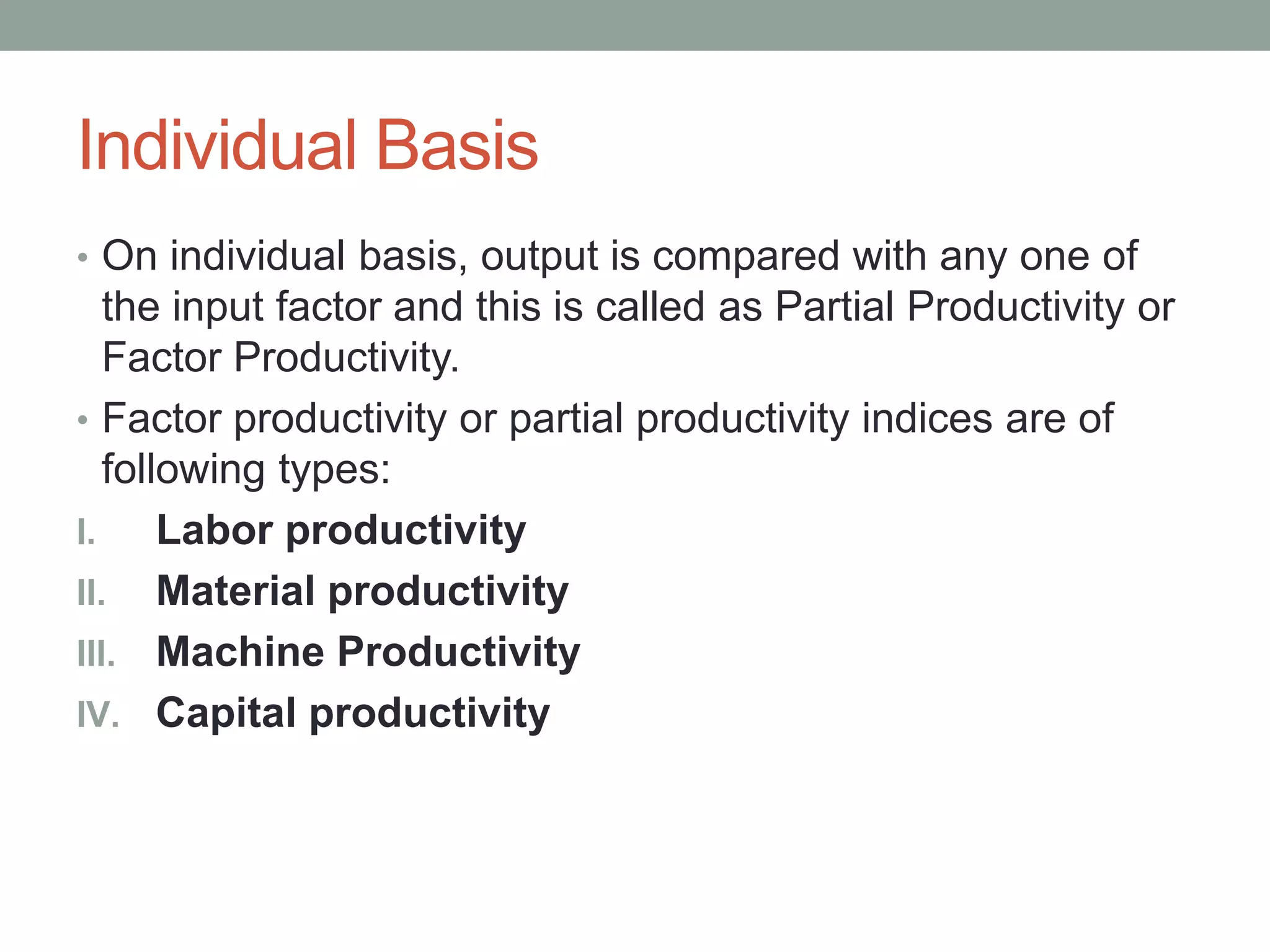
Individual Basis
• On individual basis, output is compared with any one of
the input factor and this is called as Partial Productivity or
Factor Productivity.
• Factor productivity or partial productivity indices are of
following types:
I. Labor productivity
II. Material productivity
III. Machine Productivity
IV. Capital productivity
Labor Productivity
• Labor productivity is simply defined as the ratio of Total output to the
Labour input i.e.
• Labor productivity depends upon how labors are utilized.
• Labor productivity can be higher or lower depending on factors
like availability of work load, material, working tools,
availability of power, work efficiency, level of motivation, level
of training, level of working condition (comfortable or poor)
etc.
Labor Productivity =
𝑻𝑶𝑻𝑨𝑳 𝑶𝑼𝑻𝑷𝑼𝑻
𝑳𝑨𝑩𝑶𝑼𝑹 𝑰𝑵𝑷𝑼𝑻
Example
• 10,000 Units Produced
• Sold for $10/unit
• 500 labor hours
• Labor rate: $9/hr
What is the
labor productivity?
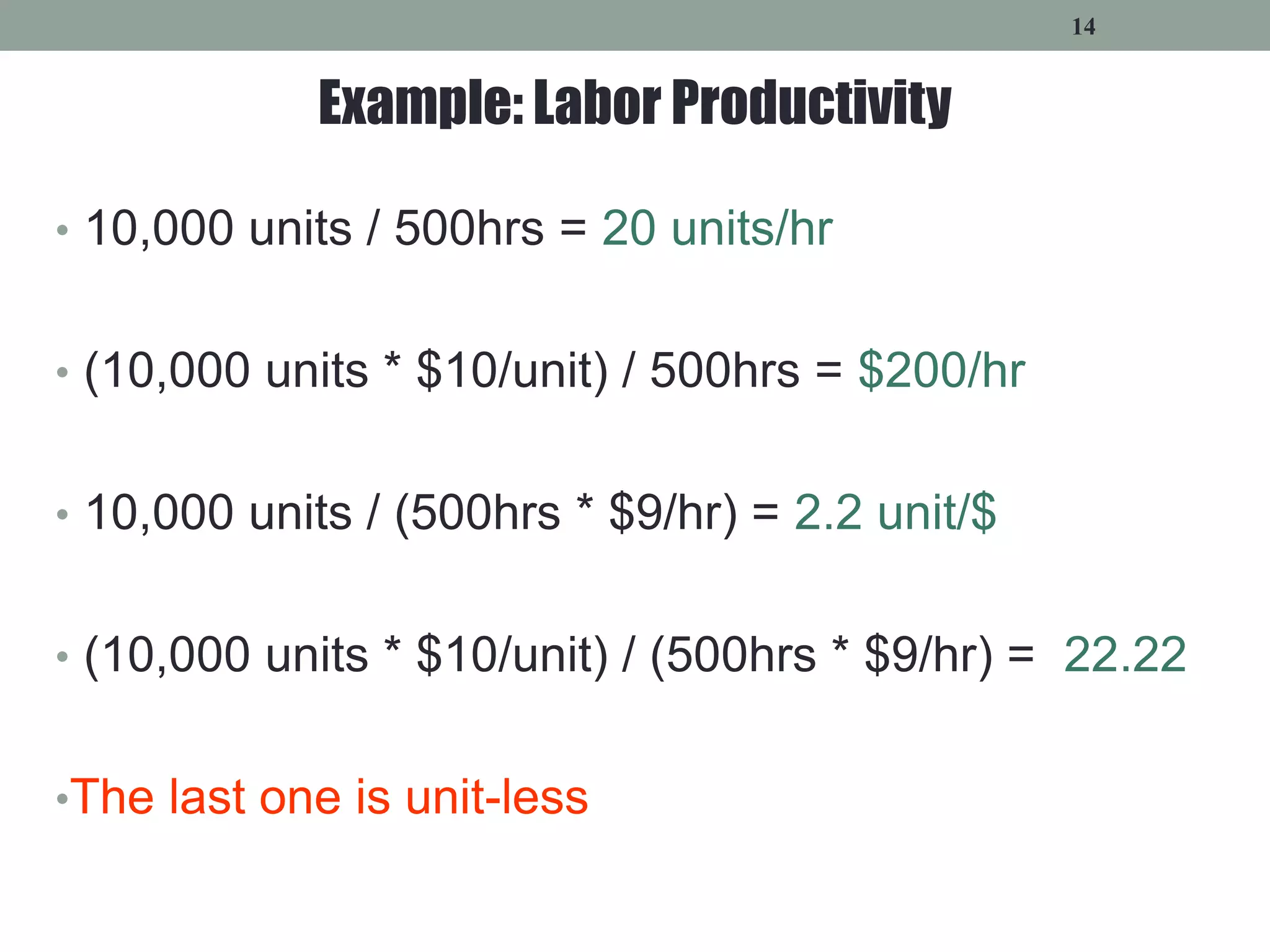
• 10,000 units / 500hrs = 20 units/hr
• (10,000 units * $10/unit) / 500hrs = $200/hr
• 10,000 units / (500hrs * $9/hr) = 2.2 unit/$
• (10,000 units * $10/unit) / (500hrs * $9/hr) = 22.22
•The last one is unit-less
14
Example: Labor Productivity
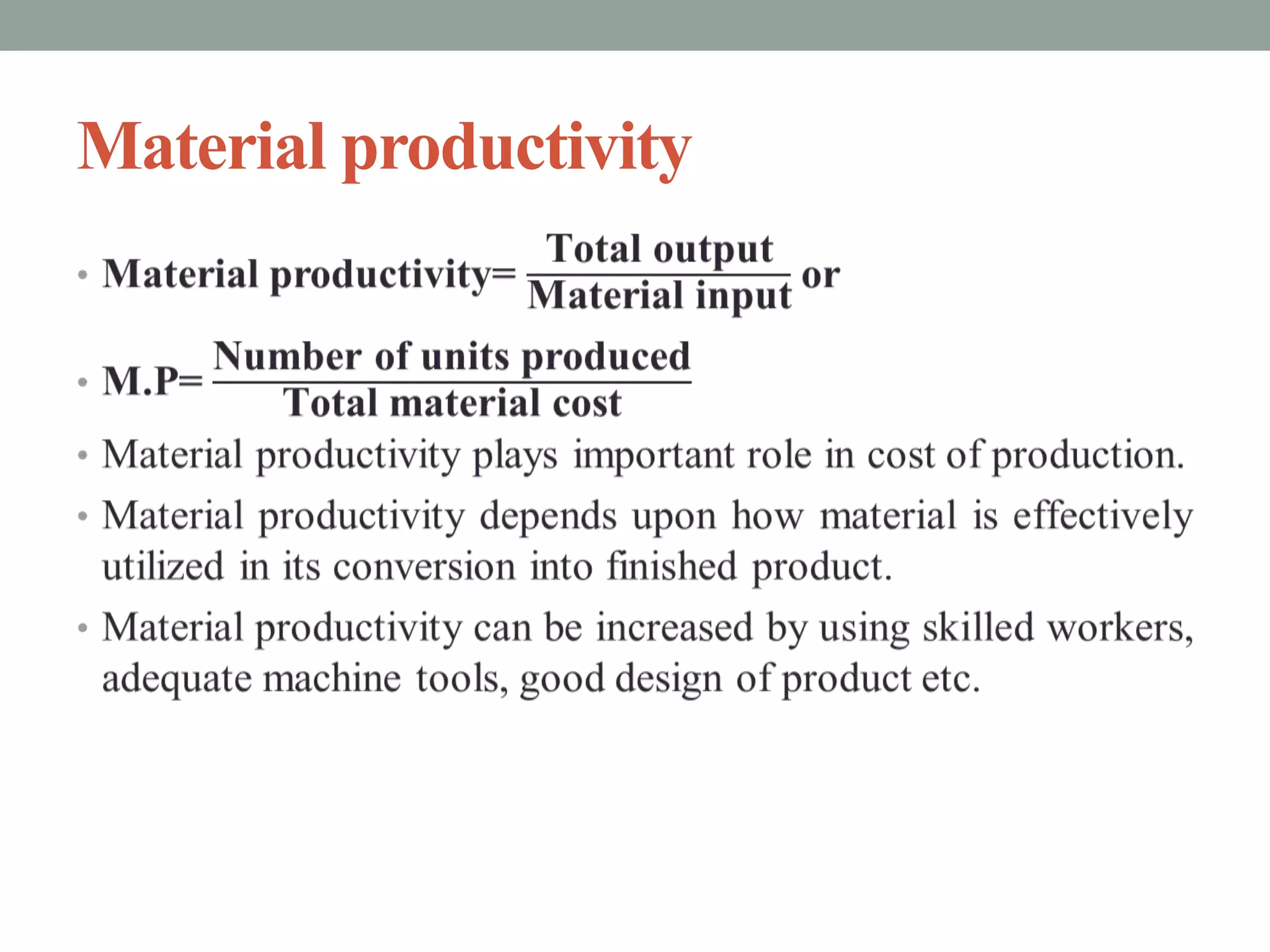
Material productivity
Machine Productivity
• Production system converts raw material into finished
product through mechanical or chemical process with the
help of machines and equipment's.
• Machine productivity=
Total output
Machine input
or
• M.P=
Output in standard hours
Actual machine hours
• Machine productivity depends upon availability of raw material,
power, skill of workers, machine layout etc.
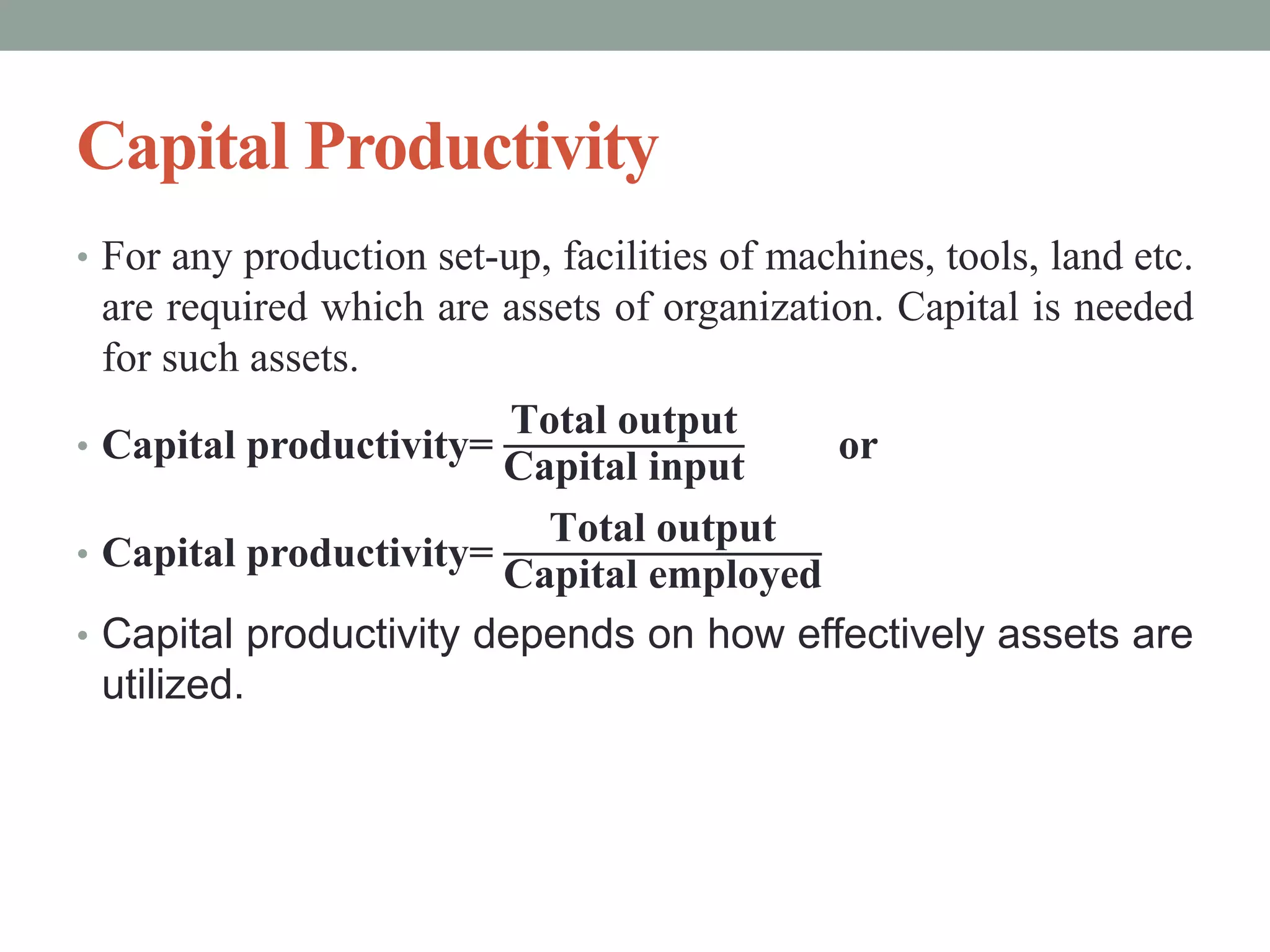
Capital Productivity
• For any production set-up, facilities of machines, tools, land etc.
are required which are assets of organization. Capital is needed
for such assets.
• Capital productivity=
Total output
Capital input
or
• Capital productivity=
Total output
Capital employed
• Capital productivity depends on how effectively assets are
utilized.
18
Training Methods
Technology Management
What are the factors that affect productivity?
Employ Based Technique
1. Financial incentives
2. Fringe benefits
3. Employ promotion
4. Job rotation
5. Education
6. Zero defects
7. Quality circle
8. Communication
9. Working environment
10. Punishment
11. Zero defect
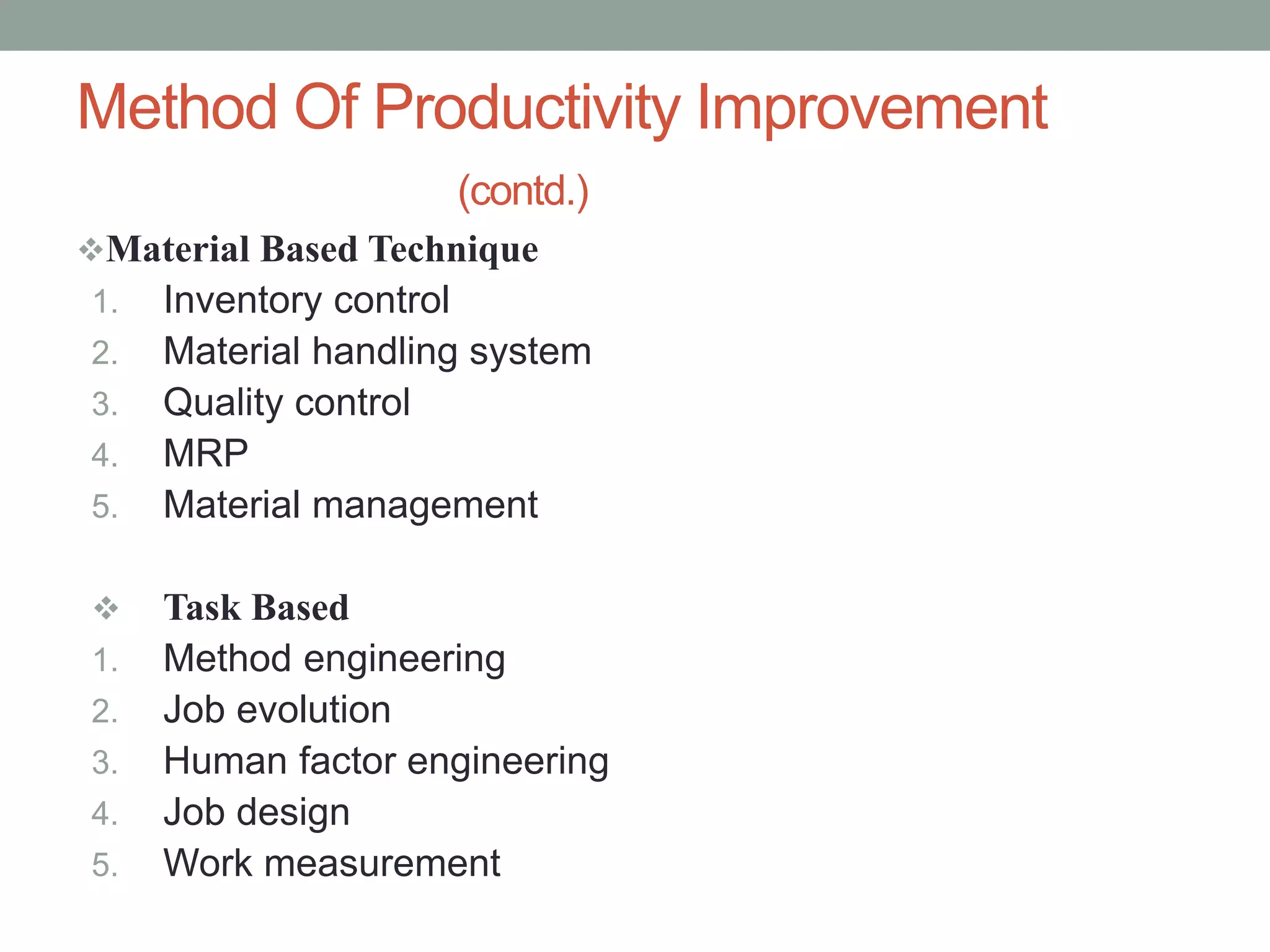
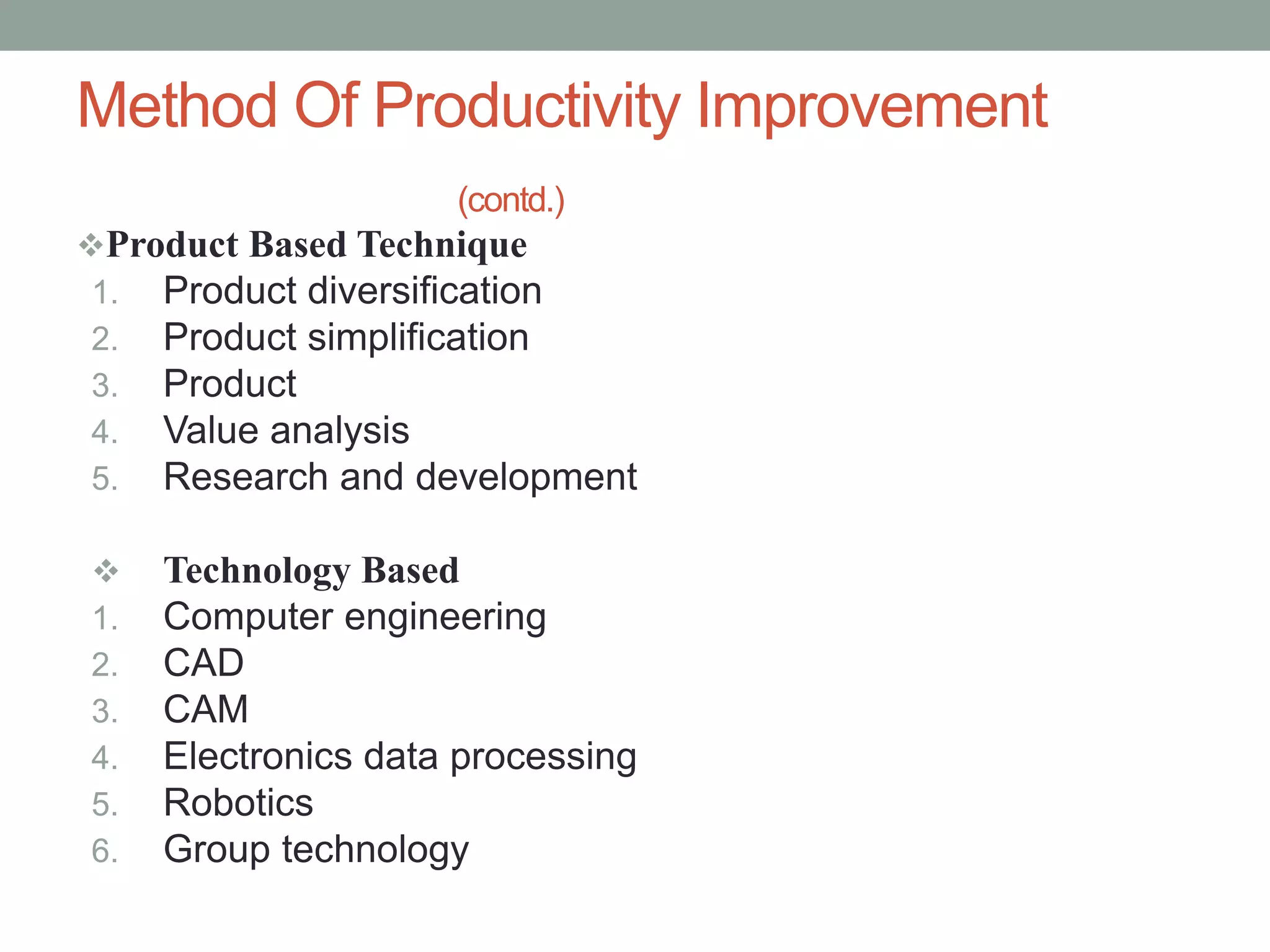
Method Of Productivity Improvement
Material Based Technique
1. Inventory control
2. Material handling system
3. Quality control
4. MRP
5. Material management
 Task Based
1. Method engineering
2. Job evolution
3. Human factor engineering
4. Job design
5. Work measurement
Method Of Productivity Improvement
(contd.)
Product Based Technique
1. Product diversification
2. Product simplification
3. Product
4. Value analysis
5. Research and development
 Technology Based
1. Computer engineering
2. CAD
3. CAM
4. Electronics data processing
5. Robotics
6. Group technology
Method Of Productivity Improvement
(contd.)
© 2011 Pearson Education, Inc. publishing as
Prentice Hall
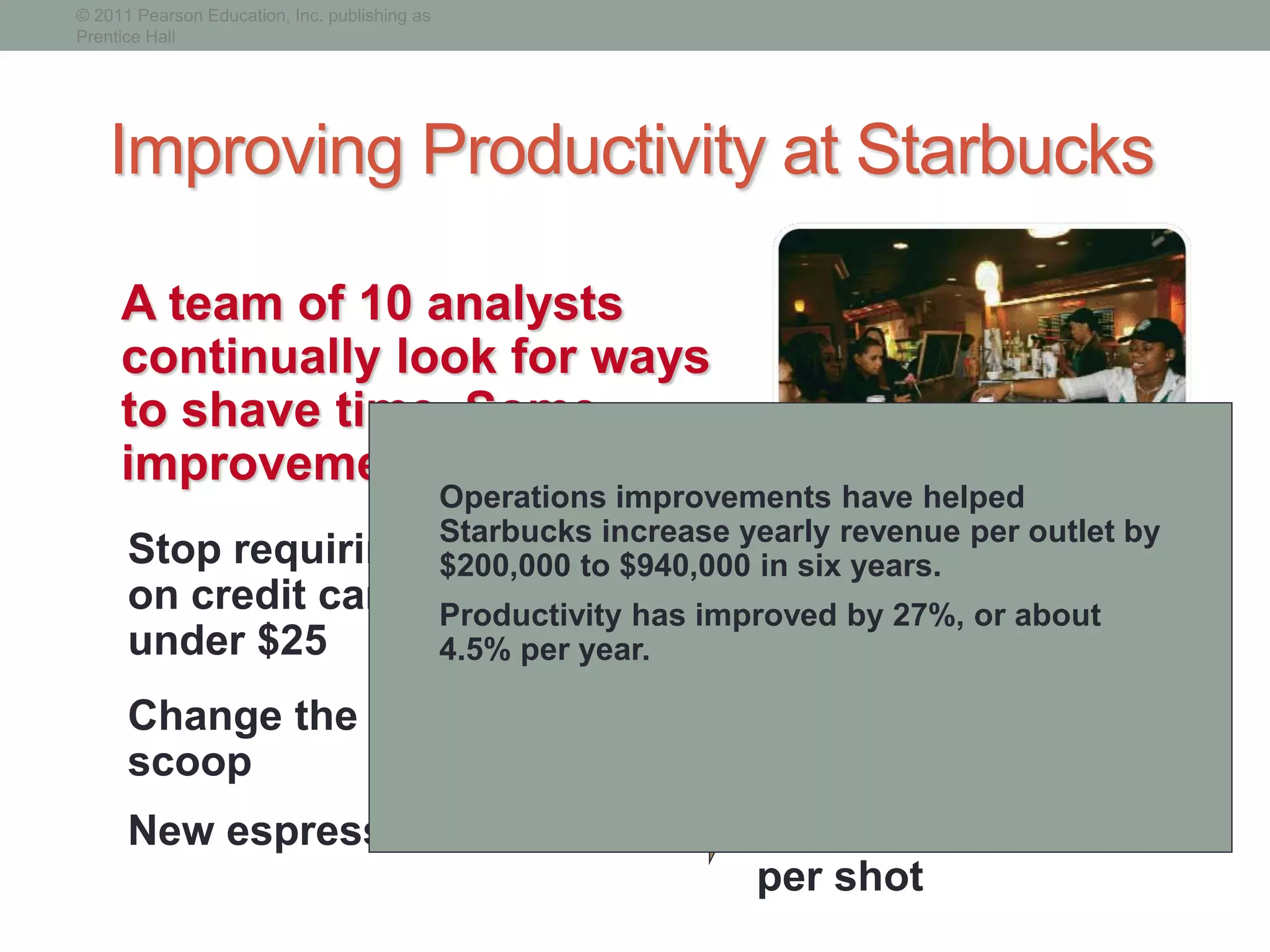
Improving Productivity at Starbucks
A team of 10 analysts
continually look for ways
to shave time. Some
improvements:
Stop requiring signatures
on credit card purchases
under $25
Saved 8 seconds
per transaction
Change the size of the ice
scoop
Saved 14 seconds
per drink
New espresso machines Saved 12 seconds
per shot
© 2011 Pearson Education, Inc. publishing as
Prentice Hall
Improving Productivity at Starbucks
A team of 10 analysts
continually look for ways
to shave time. Some
improvements:
Stop requiring signatures
on credit card purchases
under $25
Saved 8 seconds
per transaction
Change the size of the ice
scoop
Saved 14 seconds
per drink
New espresso machines Saved 12 seconds
per shot
Operations improvements have helped
Starbucks increase yearly revenue per outlet by
$200,000 to $940,000 in six years.
Productivity has improved by 27%, or about
4.5% per year.
• To procure raw material at low cost.
• To maintain consistent quality.
• To ensure continuous supply of raw material.
• To minimize the carrying costs and ordering costs.
• To maintain good relationship with supplier.
• Efficient record-keeping and prompt reporting.
• To develop new sources and new materials.
• Training and development of personnel.
Role Of Material Management
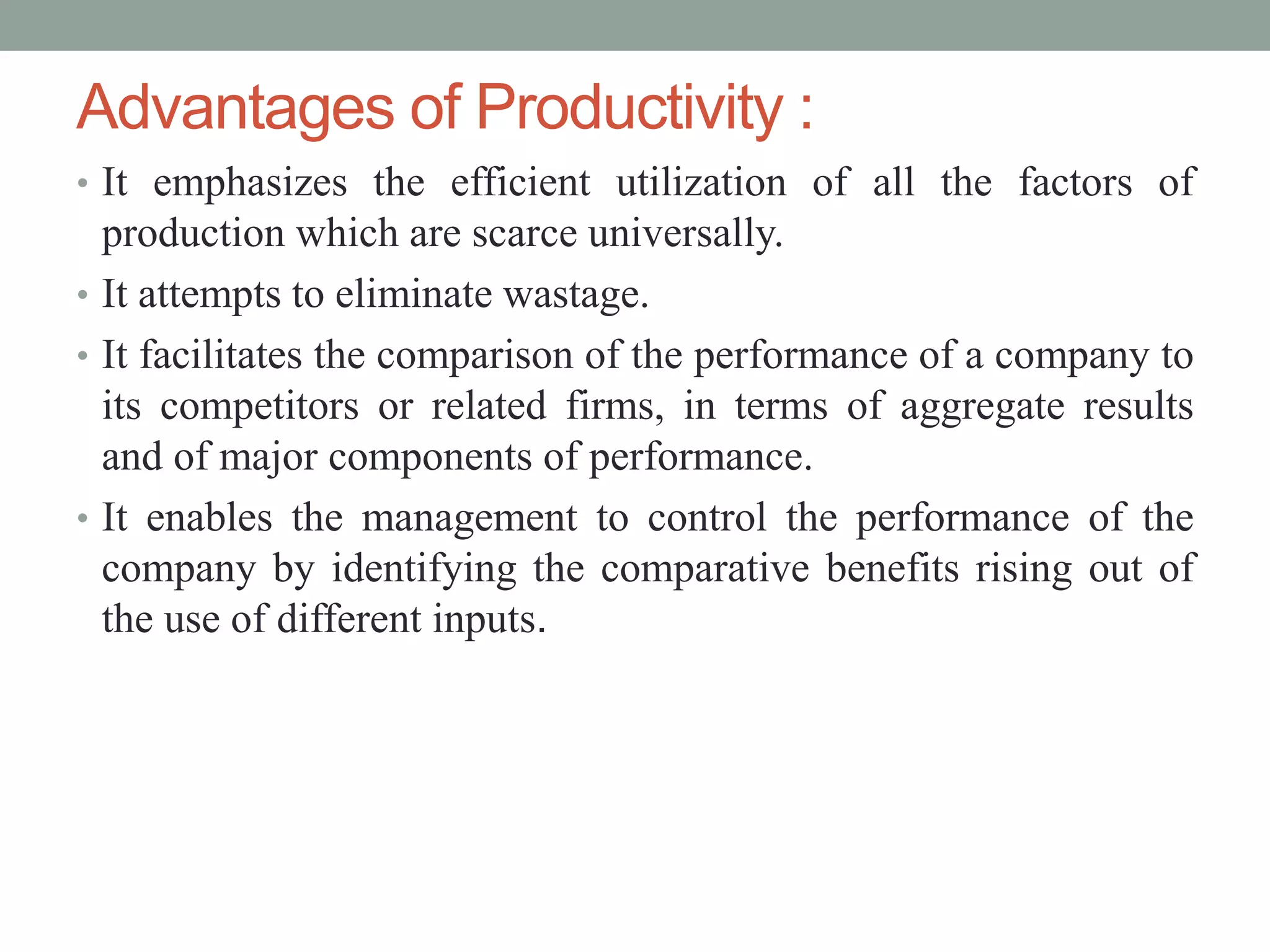
• It emphasizes the efficient utilization of all the factors of
production which are scarce universally.
• It attempts to eliminate wastage.
• It facilitates the comparison of the performance of a company to
its competitors or related firms, in terms of aggregate results
and of major components of performance.
• It enables the management to control the performance of the
company by identifying the comparative benefits rising out of
the use of different inputs.
Advantages of Productivity :
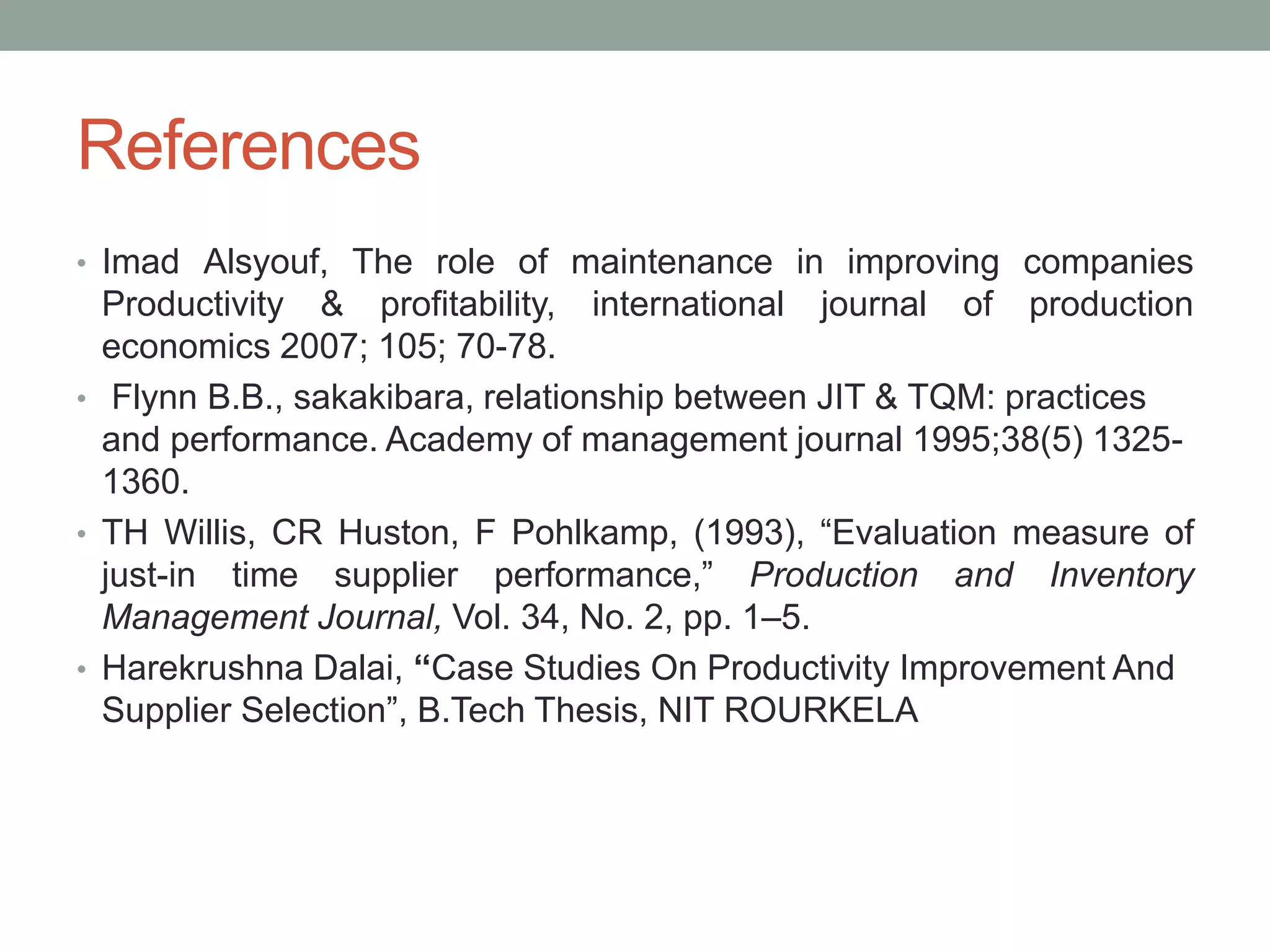
References
• Imad Alsyouf, The role of maintenance in improving companies
Productivity & profitability, international journal of production
economics 2007; 105; 70-78.
• Flynn B.B., sakakibara, relationship between JIT & TQM: practices
and performance. Academy of management journal 1995;38(5) 1325-
1360.
• TH Willis, CR Huston, F Pohlkamp, (1993), “Evaluation measure of
just-in time supplier performance,” Production and Inventory
Management Journal, Vol. 34, No. 2, pp. 1–5.
• Harekrushna Dalai, “Case Studies On Productivity Improvement And
Supplier Selection”, B.Tech Thesis, NIT ROURKELA

Techniques for measurement of productivity

  • 1.
    TECHNIQUES FOR MEASUREMENT OF PRODUCTIVITY: ANSHULAHUJA (MM-662-2K15) Er. SAHIL SHARMA (MM-670-2K15)
  • 2.
    Productivity  Productivity isthe ratio between output and input. It is quantitative relationship between what we produce and what we have spent to produce. • Hence,  Productivity is , above all, a state of mind-set. It is an attitude that seeks the continuous improvement of what exist. It is a conviction that one can do better today than yesterday, and that tomorrow will be better than today.  It is the driving force or dynamism behind developing and upgrading the quality of industrial activities. Productivity= 𝑜𝑢𝑡𝑝𝑢𝑡 𝑖𝑛𝑝𝑢𝑡
  • 3.
    Productivity A relation betweenoutput generated and input used A critical determinant of cost efficiency A method to determine the capacity utilization A key source of economic growth and competiveness Definition
  • 4.
    • Productivity increasesoutput. • High productivity results in lower cost per unit of output resulting in higher levels of profit for a business. • Higher profits for the firm will mean more funds available for its expansion, new business ventures and community support. • It may also wish to pass on the benefits of lower costs to consumers in the form of lower prices. Importance of Productivity
  • 5.
    Diff. between Productionand Productivity Production Productivity Definition It is defined as the act of manufacturing goods for their use or sale. it is defined as the rate at which goods are produced. Use It is the actual process of conversion. It is the utilization of resources to form goods. Work done It is the amount of work done or manufactured that is the output. It is the amount of work one gets for a certain spending cost. Measurement It is the measure of produced goods. It is the measure of efficiency. Important Note! Production is a measure of output only and not a measure of efficiency
  • 6.
    Measurement in Productivityand why ???? • Set overall productivity goals for organization • Raise awareness among employees Establish productivity management function • Access your company current performance • Identify the gaps and areas of improvement Diagnose • Set targets and formulate strategy • Implement specification Develop road map Implement measurement system • Link effort and reward to employees • Monitor the review parts Implement performance management system
  • 7.
    Techniques for Measurementof Productivity: PRODUCTIVITY AGGREGATE BASIS TOTAL PRODUCTIVITY INDIVIDUAL BASIS PARTIAL PRODUCTIVITY OR FACTOR PRODUCTIVITY
  • 8.
    Aggregate Basis • Onaggregate basis, output is compared with all inputs taken (added) together. This is called as Total Productivity. Hence, • Where Total Output=Total production of goods and services and Total Input= Labor + Material + Capital + Energy. • This index measures the productivity of the entire organization with use of all resources. It is a way of evaluating efficiency of entire plant or firm. Total Productivity Index = Total output Total input
  • 9.
    9 10,000 Units Produced Soldfor $10/unit 500 labor hours Labor rate: $9/hr Cost of raw material: $30,000 Overhead: $15,500 Example
  • 10.
    10 Output Labor + Materials+ Overhead (10,000 units) * ($10) (500)*($9) + ($30,000) + ($15,500) TP = 2.0 Example : Total Productivity TP = TP =
  • 11.
    Individual Basis • Onindividual basis, output is compared with any one of the input factor and this is called as Partial Productivity or Factor Productivity. • Factor productivity or partial productivity indices are of following types: I. Labor productivity II. Material productivity III. Machine Productivity IV. Capital productivity
  • 12.
    Labor Productivity • Laborproductivity is simply defined as the ratio of Total output to the Labour input i.e. • Labor productivity depends upon how labors are utilized. • Labor productivity can be higher or lower depending on factors like availability of work load, material, working tools, availability of power, work efficiency, level of motivation, level of training, level of working condition (comfortable or poor) etc. Labor Productivity = 𝑻𝑶𝑻𝑨𝑳 𝑶𝑼𝑻𝑷𝑼𝑻 𝑳𝑨𝑩𝑶𝑼𝑹 𝑰𝑵𝑷𝑼𝑻
  • 13.
    Example • 10,000 UnitsProduced • Sold for $10/unit • 500 labor hours • Labor rate: $9/hr What is the labor productivity?
  • 14.
    • 10,000 units/ 500hrs = 20 units/hr • (10,000 units * $10/unit) / 500hrs = $200/hr • 10,000 units / (500hrs * $9/hr) = 2.2 unit/$ • (10,000 units * $10/unit) / (500hrs * $9/hr) = 22.22 •The last one is unit-less 14 Example: Labor Productivity
  • 15.
  • 16.
    Machine Productivity • Productionsystem converts raw material into finished product through mechanical or chemical process with the help of machines and equipment's. • Machine productivity= Total output Machine input or • M.P= Output in standard hours Actual machine hours • Machine productivity depends upon availability of raw material, power, skill of workers, machine layout etc.
  • 17.
    Capital Productivity • Forany production set-up, facilities of machines, tools, land etc. are required which are assets of organization. Capital is needed for such assets. • Capital productivity= Total output Capital input or • Capital productivity= Total output Capital employed • Capital productivity depends on how effectively assets are utilized.
  • 18.
    18 Training Methods Technology Management Whatare the factors that affect productivity?
  • 19.
    Employ Based Technique 1.Financial incentives 2. Fringe benefits 3. Employ promotion 4. Job rotation 5. Education 6. Zero defects 7. Quality circle 8. Communication 9. Working environment 10. Punishment 11. Zero defect Method Of Productivity Improvement
  • 20.
    Material Based Technique 1.Inventory control 2. Material handling system 3. Quality control 4. MRP 5. Material management  Task Based 1. Method engineering 2. Job evolution 3. Human factor engineering 4. Job design 5. Work measurement Method Of Productivity Improvement (contd.)
  • 21.
    Product Based Technique 1.Product diversification 2. Product simplification 3. Product 4. Value analysis 5. Research and development  Technology Based 1. Computer engineering 2. CAD 3. CAM 4. Electronics data processing 5. Robotics 6. Group technology Method Of Productivity Improvement (contd.)
  • 22.
    © 2011 PearsonEducation, Inc. publishing as Prentice Hall Improving Productivity at Starbucks A team of 10 analysts continually look for ways to shave time. Some improvements: Stop requiring signatures on credit card purchases under $25 Saved 8 seconds per transaction Change the size of the ice scoop Saved 14 seconds per drink New espresso machines Saved 12 seconds per shot
  • 23.
    © 2011 PearsonEducation, Inc. publishing as Prentice Hall Improving Productivity at Starbucks A team of 10 analysts continually look for ways to shave time. Some improvements: Stop requiring signatures on credit card purchases under $25 Saved 8 seconds per transaction Change the size of the ice scoop Saved 14 seconds per drink New espresso machines Saved 12 seconds per shot Operations improvements have helped Starbucks increase yearly revenue per outlet by $200,000 to $940,000 in six years. Productivity has improved by 27%, or about 4.5% per year.
  • 24.
    • To procureraw material at low cost. • To maintain consistent quality. • To ensure continuous supply of raw material. • To minimize the carrying costs and ordering costs. • To maintain good relationship with supplier. • Efficient record-keeping and prompt reporting. • To develop new sources and new materials. • Training and development of personnel. Role Of Material Management
  • 25.
    • It emphasizesthe efficient utilization of all the factors of production which are scarce universally. • It attempts to eliminate wastage. • It facilitates the comparison of the performance of a company to its competitors or related firms, in terms of aggregate results and of major components of performance. • It enables the management to control the performance of the company by identifying the comparative benefits rising out of the use of different inputs. Advantages of Productivity :
  • 26.
    References • Imad Alsyouf,The role of maintenance in improving companies Productivity & profitability, international journal of production economics 2007; 105; 70-78. • Flynn B.B., sakakibara, relationship between JIT & TQM: practices and performance. Academy of management journal 1995;38(5) 1325- 1360. • TH Willis, CR Huston, F Pohlkamp, (1993), “Evaluation measure of just-in time supplier performance,” Production and Inventory Management Journal, Vol. 34, No. 2, pp. 1–5. • Harekrushna Dalai, “Case Studies On Productivity Improvement And Supplier Selection”, B.Tech Thesis, NIT ROURKELA