E-commerce project
Bachelors of Commerce (University of Calcutta)
Scan to open on Studocu
Studocu is not sponsored or endorsed by any college or university
E-commerce project
Bachelors of Commerce (University of Calcutta)
Scan to open on Studocu
Studocu is not sponsored or endorsed by any college or university
Downloaded by Ambika shaw (ambikashaw123@gmail.com)
lOMoARcPSD|43948530
Page | 1
Project Report
(Submitted for the Degree of B.COM Honours in
Accounting and Finance under the University of Calcutta)
Title of the Project:
E-COMMERCE
Submitted by:
Name of the Candidate: BAZIL NEYAZ
Registration No.:201011-21-0158
CU Roll No.: 011-1111-0316-20
Name of the College: AJC BOSE COLLEGE
College ID : 20201515
Supervised by
Name of the Supervisor:Prof. SRIJIT SEAL
Name of the College: AJC BOSE COLLEGE
Name of the HOD:SUPRATIM DEY
May 2023
Downloaded by Ambika shaw (ambikashaw123@gmail.com)
lOMoARcPSD|43948530
Page | 2
STUDENT'S DECLARATION
I hereby declare that the Project Work with the title E-Commerce submitted by
me for the partial fulfillment of the degree of B.Com. Honours in Accounting &
Finance under the University of Calcutta is my original work and has not been
submitted earlier to any other University /Institution for the fulfilment of the
requirement for any course of study.
I also declare that no chapter of this manuscript in whole or in part has
been incorporated in this report from any earlier work done by others or by me.
However, extracts of any literature which has been used for this report has been
duly acknowledged providing details of such literature in the references.
Signature:
Name:Bazil Neyaz
Address: Kolkata
Place: Kolkata
Date:
Downloaded by Ambika shaw (ambikashaw123@gmail.com)
lOMoARcPSD|43948530
Page | 3
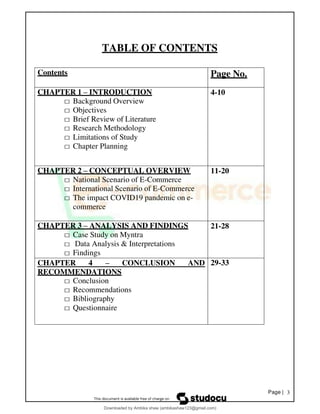
TABLE OF CONTENTS
Contents Page No.
CHAPTER 1 – INTRODUCTION
□ Background Overview
□ Objectives
□ Brief Review of Literature
□ Research Methodology
□ Limitations of Study
□ Chapter Planning
4-10
CHAPTER 2 – CONCEPTUAL OVERVIEW
□ National Scenario of E-Commerce
□ International Scenario of E-Commerce
□ The impact COVID19 pandemic on e-
commerce
11-20
CHAPTER 3 – ANALYSIS AND FINDINGS
□ Case Study on Myntra
□ Data Analysis & Interpretations
□ Findings
21-28
CHAPTER 4 – CONCLUSION AND
RECOMMENDATIONS
□ Conclusion
□ Recommendations
□ Bibliography
□ Questionnaire
29-33
Downloaded by Ambika shaw (ambikashaw123@gmail.com)
lOMoARcPSD|43948530
Page | 4
CHAPTER 1 – INTRODUCTION
Electronic commerce or e-commerce has become the new mantra of modern day business world. It
has emerged as the major technological development in the corporate world and has completely changed
the way people do business today. The advent of internet in mid nineties has dramatically changed the socio-
economic lifestyle of the entire world. The 2 telecommunication revolution and globalization also added to
the changed perspective of human behaviour. With the rapid growth in internet applications and recent
advancement in wireless and communication technology, more and more people are indulging in electronic
form of business transactions. In order to cope with this modern trend of online business, the business
organizations worldwide are forced to start e-commerce operations and thus increasing the scope and
demand of e-commerce to a great extent.
E-commerce (electronic commerce) is the activity of electronically buying or selling of products on
online services or over the Internet. Electronic commerce draws on technologies such as mobile commerce,
electronic funds transfer, supply chain management, Internet marketing, online transaction processing,
electronic data interchange (EDI), inventory management systems, and automated data collection systems.
E-commerce is in turn driven by the technological advances of the semiconductor industry, and is the largest
sector of the electronics industry. Modern electronic commerce typically uses the World Wide Web for at
least one part of the transaction's life cycle although it may also use other technologies such as e-mail.
Electronic commerce is generally considered to be the sales aspect of e-business. It also consists of the
exchange of data to facilitate the financing and payment aspects of business transactions. This is an effective
and efficient way of communicating within an organization and one of the most effective and useful ways
of conducting business.
The Indian ecommerce industry is worth billions of dollars and has the potential for exponential
growth, but there are some obstacles ahead. In 2020, the sector is likely to see challenges in policy even as
it marches ahead to explore newer categories and ways to increase the appeal of online shopping. According
to a report by India Brand Equity Foundation (IBEF), the ecommerce market in India is expected to reach
$200 billion by 2027 from $38.5 billion in 2017, and the number of online shoppers may reach 220 million
by 2025.
Downloaded by Ambika shaw (ambikashaw123@gmail.com)
lOMoARcPSD|43948530
Page | 5
• Background Overview
Every Individual of company that wants to make money and become the next Microsoft needs to
understand the market potential, business implication and technological foundation of electronic commerce.
But what is electronic commerce everybody is technical and business skills are needed to be successful?
Companies and consumers are discovering that global networking and other technological
innovations are powerful assets if used as competitive weapons in their day to day activities.
India has always been a land of great potential. The socioeconomic condition of the country has
improved many folds after independence and India is now emerging as one of the leading countries in the
world. Moreover with a population of over 100 crore and a growth rate of above 6%, it can be compared to
a marketing giant. Hence it can be well judged why online shopping in India is rising at fast pace over the
days. As technology is spreading to the remotest villages and many job opportunities are presenting
themselves to the unemployed youth more and more people are gaining awareness and the money to
purchase expensive and luxurious items over the internet. In the push to reduce prices, more and retailers
are turning to overseas suppliers in part because of cheaper labour cost. Retail is the immediate line of fire
and had to do the cost cutting. They put the pressure on the manufacturer and then the supplier end of the
pipeline. Electronic Commerce is forcing companies to rethink the existing ways of doing target marketing,
relationship marketing and even event marketing. Adaptation would include moving towards computerized
“Paperless” operations to, reduce trading cost and facilitate the adoption of new business process. Japanese
approach JIT (Just in Time) system, total quality control and quality circles are focused now for delivery
of goods through electronic commerce.
The business phenomenon that we now call electronic commerce has an interesting history. From
humble beginnings in the mid-1990s, electronic commerce grew rapidly until 2000, when a major downturn
occurred. Many people have seen news stories about the ‘dot-com boom’ followed by the ‘dot-com bust’
or the ‘dot-bomb’. In the years 2000 to 2003, many industry observers were writing obituaries for electronic
commerce. Just as the unreasonable expectations for immediate success fuelled the high expectations during
the boom years, overly gloomy news reports coloured perceptions during this time. Although the rapid
expansion and high levels of investment of the boom years are not likely to be repeated, the second wave
of electronic commerce is well under way.
Downloaded by Ambika shaw (ambikashaw123@gmail.com)
lOMoARcPSD|43948530
Page | 6
• Objective
• To understand the evolution of E-Commerce;
• To describe the conceptual framework of E-Commerce in India;
• To analyse the present trends of E-Commerce in India;
• To examine the barriers of E-Commerce in India;
• To predict future of E-commerce.
Nowadays retail stores are facing more competition in retailing business. Good store design
increase the visiting of more customers in to the store and increase the store goodwill, and price also plays
major factor to use the customer giving preference and selection of the store. And as industry research has
shown, there is much need to know the customer expectations, customer preferences and their store
choice’s(features) and we will find out solutions for designing effective store which will getting more
customers and getting more profits. Electronic Commerce (E-commerce) seems to be everywhere these
days. It’s nearly impossible to read a magazine or newspaper without coming across an article about how e-
commerce is going to change and affect our lives. It is widely accepted that e-commerce and Internet
technologies can benefit an organization but still there are very few studies about e-commerce adoption in
India. In addition to that, there isn’t any detailed recent study about of e-commerce in India incorporating
latest factual data and trends relating to its various aspects at all. So, I have proposed to study this area to
investigate the extent of India’s involvement with e-commerce applications, its detailed conceptual
framework, evolution, stories of top Indian players in this field and find a set of guidelines or
recommendations on the best practices of e-commerce adoption which might help the Indian e-commerce
firms.
In terms of communications, electronic commerce is the means to deliver the goods, services,
information or payments over computer networks or any other computer device. The business perspective,
electronic commerce offers to buy and sell products, services and information on the Internet and through
other online services. A service perspective, EC is a tool that has been in operation for the purposes of
governments, institutions, consumers and managers, Reduce service costs and at the same time, increased
quality and customer service and helps accelerate the delivery time. The educational perspective and e-
commerce may be made online learning helps to teach in schools, universities and other organizations
including commercial entities. Participation of view is an electronic commerce framework for cooperation
within the organization and among different organizations. E-commerce is based on processing and
transmitting electronic data including text, audio and video. Electronic commerce encompasses a variety
of activities such as electronic funds transactions, electronic stock exchange, an electronic bill of lading,
commercial projects, government purchases, direct marketing and after sales service.
Downloaded by Ambika shaw (ambikashaw123@gmail.com)
lOMoARcPSD|43948530
Page | 7
• Literature Review
The Indian ecommerce industry is worth billions of dollars and has the potential for exponential
growth, but there are some obstacles ahead. In 2020, the sector is likely to see challenges in policy even as
it marches ahead to explore newer categories and ways to increase the appeal of online shopping.
H arsha Razdan, Partner and Head, Consumer Markets and Internet Business, KPMG India, says,“The
digital space has undergone rapid colonisation, thus resulting in intense competition and at times,
unregulated use of personal data in the ecommerce space. In the coming year, we expect the government to
roll out the ecommerce policy based on the recommendations of various industry stakeholders, keeping
consumer interests at the centre.”
The ecommerce industry in India is not just made up of only large players as Flipkart and Amazon have
extended cooperation to small and medium enterprises .It is very clear that if the industry has to become
truly large and the participation of SMEs is critical, and this is only going to intensify in next year.
M ishra & Kotkar (2015) trace the timeline and development “A Study on Current Status of E-
Commerce in India: A Comparative Analysis of Flipkart and Amazon” with its inception in the mid 1990s
through the advent of matrimonial and job portals. However, due to limited internet accessibility, weak
online payment systems and lack of awareness, the progress was very slow. The Indian B2C e-commerce
industry got a major boost in mid 2000s with the expansion of online services to travel and hotel bookings
which continue to be major contributors even today.Das & Ara(2015) observe in “Growth of E-Commerce
in India” that though online travel and hotel bookings still control the lion’s share of e-commerce market,
their share has comparatively fallen over the years due to the recent augmentation and consequent rise of e-
tailing services. There has been a tremendous surge in the volume of investment in this sector. With the e-
commerce markets in the west reaching their saturation, investors see tremendous potential in the Indian
market, in the light of which, many start ups have received funding from venture capitalists and private
equity firms. China's Alibaba Group and affiliate Ant Financial became the largest shareholders of One97
Communications, the parent of Indian e-tailer Paytm, by investing $680 million, in 2015 (Aulakh, 2015).
V.Kumar and Denish Shah 2011 have published research paper entitled “Pushing and Pulling on the
Internet “The internet is fast emerging as a domain sales channel. The Internet is expanding& it
influences consumer which shifts the consumer behaviour. It has changed the way product awareness,
developed new modes of product consideration.
JK Corley, Z Jourdan, 2013, The amount of research related to Internet marketing has grown rapidly
since the dawn of the Internet Age. A review of the literature base will help identify the topics that have
been explored as well as identify topics for the further research.
J Suresh Reddy, 2014 has published article “Impact of E-commerce on marketing”.
Marketing is one of the business function most dramatically affected by emerging information technologies.
Internet is providing companies new channels of communication and interaction. It can create closer
Downloaded by Ambika shaw (ambikashaw123@gmail.com)
lOMoARcPSD|43948530
Page | 8
yet more cost effective relationships with customers in sales, marketing and customer support. Companies
can use web to provide ongoing information, service and support. It also creates positive interaction with
customers that can serve as the foundation for long term relationships and encourage repeat purchases.
T. Shenbhagavadivu , 2015 has published the article " A Study on Customer Satisfaction
towards online shopping " focused on understanding the consumer's attitudes towards online
shopping , making improvement in the factors that influence consumers to shop online and
working on factors that affect consumers to shop online will help marketers to gain the competitive
edge over others.
• Research Methodology
Research Design The type of design being used for making this project is Meta-Analysis Design.
Meta-analysis is an analytical methodology designed to systematically evaluate and summarize the results
from a number of individual studies, thereby, increasing the overall sample size and the ability of the
researcher to study effects of interest.
• Primary Research-Research was conducted with the help of Google forms in which people
responded to the questions and response to the answers are illustrated in chapter 3.
• Secondary Research- Secondary data was collected thorough various sites and articles available on
the internet.
Sampling Size
Sample size: For the research the sample size of:-
100 respondents were taken out of which 94% of the population are frequent users of online
shopping.
The geographical area is covered
Sampling Procedure To obtain the representative sample, a non-probability sample
can be drawn. In this study the method of selecting samples is Convenience sampling.
Downloaded by Ambika shaw (ambikashaw123@gmail.com)
lOMoARcPSD|43948530
Page | 9
• Limitations Of Study
Some businesses are less suitable for electronic commerce. Such businesses may be involved in the
selling of items which are perishable or high-cost, or which require inspection before purchasing. Most of
the disadvantages of electronic commerce today, however, stem from the newness and rapidly developing
pace of the underlying technologies. These disadvantages will disappear as electronic commerce matures
and becomes more available to and accepted by the general population
• Security The biggest drawback of e-commerce is the issue of security.People fear to provide
personal and financial information, even though several improvements have been made in relation
to data encryption..
• Tax issue Tax is another bigger issue when the buyer and seller are situated in different locations.
Another factor is that physical stores will lose business if web purchases are free from tax.
• Product suitability People have to rely on electronic images to purchase products. The lack of
‘touch and feel’ prevent people from online shopping.
• Cultural obstacles E-commerce attracts customers from all over the world. They also pose
linguistic problems.
• Legal issues The cyber laws that govern the e-commerce transactions are not very clear and vary
from country to country. These legal issues prevent people from entering into electronic contracts.
• Huge technological cost It is difficult to merge electronic business with traditional business .
Technological infrastructure may be expensive and huge cost has to be incurred to keep pace with
ever changing technology. It is necessary to allocate more funds for technological advancement to
remain competitive in the electronic world.
• Chapter planning
The project is organized as follows:
Chapter 2: Will give an overview about the concept of E Commerce, its importance, methods, and its
future, national and international scenario.
Chapter 3: Will contain the methodology of preparing the data and data analysis and findings based on a
designed questionnaire.
Chapter4: Will provide the conclusion of the research and recommendations.
Downloaded by Ambika shaw (ambikashaw123@gmail.com)
lOMoARcPSD|43948530
Page |10
CHAPTER 2: Conceptual Framework of E-Commerce In India
• National Scenario of E-Commerce
The online business industry is well established in India. And, everyday some or the other new player is
taking a plunge. Though, a major contribution to its growth is provided by e-commerce industry. Even so,
not many understand the intricacies involved in e-commerce industry.
With the evolution of technology and increase in consumerism all over India, e-commerce is riding
the high tide in online business. Today, the total number of internet users in the world is close to 3 billion,
out of this India has a total of 259.14 million internet and broadband subscribers. Easy access to internet
via mobile devices coupled with increasing confidence of the customers to purchase online is leading the
way. Because of this, increasing number of people are registering on e-commerce websites and purchasing
products through the use of cell phones. According to a report, annual growth rates in leading e-commerce
markets of Japan, South Korea and Australia will run at 11% to 12% over the few years. In retrospect, the
rapidly growing market of China and India is 25% and 57% respectively.
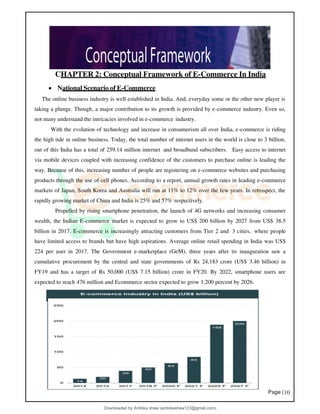
Propelled by rising smartphone penetration, the launch of 4G networks and increasing consumer
wealth, the Indian E-commerce market is expected to grow to US$ 200 billion by 2027 from US$ 38.5
billion in 2017. E-commerce is increasingly attracting customers from Tier 2 and 3 cities, where people
have limited access to brands but have high aspirations. Average online retail spending in India was US$
224 per user in 2017. The Government e-marketplace (GeM), three years after its inauguration saw a
cumulative procurement by the central and state governments of Rs 24,183 crore (US$ 3.46 billion) in
FY19 and has a target of Rs 50,000 (US$ 7.15 billion) crore in FY20. By 2022, smartphone users are
expected to reach 476 million and Ecommerce sector expected to grow 1,200 percent by 2026.
Downloaded by Ambika shaw (ambikashaw123@gmail.com)
lOMoARcPSD|43948530
Page |11
GROWTH DRIVERS FOR E-COMMERCE
Over 120 million people are expected to shop online in 2018 and this number is expected to go up
to 175 million by 2020. Mobile-savvy shoppers are the backbone of India’s online shopping industry. Men
in India are more avid shoppers than women in part because of demographic and cultural differences. Metro
cities like Bengaluru, Mumbai, and Delhi, with population greater than 100,000, accounted for most online
shopping in absolute numbers. E-commerce business of several companies like ShopClues, Craftsvilla, etc.,
has observed crisis in tier II cities, after racking up around US$ 400 million in investor capital. Less densely
populated regions generated a larger proportion of online sales. Nearly 60 per cent of Snapdeal’s purchases
came from cities classified as tier II and III. Flipkart also noted that “sales of branded products across
categories saw a sharp increase, as more of tier 2 and tier 3 Indian towns took to shopping online. Although
shoppers between 25 and 34 years of age were most active on E-commerce portals, a surprising number of
older people also shopped online in 2016. However, the age group of 15-34 years are the major consumers
of E-commerce. The popularity of web series among millennials is growing immensely. Discounts and
EMIs added with a comfort of sitting at home and purchasing has become an effective driving factor of E-
commerce. Availability of various websites gives customers a lot of options to choose from. Chatbots and
personal assistance apps have made transactions seamless. One can get several brands and products from
different sellers at one place. Also, one can get in on the latest international trends without spending money
on travel; you can shop from retailers in other parts of the country or even the world without being limited
by geographic area.
Online retailers see this emergent segment as a new growth driver as the incremental growth in mobile
subscribers can be credited mainly to people who are comfortable with languages other than English. Indian
language users on the internet are expected to reach 540 million by 2021. In August 2018, Flipkart acquired
an artificial intelligence company, which converts speech to text in 10 Indian languages. Reverie Language
Technologies is expected to raise US$ 20 million to achieve its vision to create language equality on the
internet.
The e-commerce industry been directly impacting the micro, small & medium enterprises (MSME)
in India by providing means of financing, technology and training and has a favourable cascading effect on
other industries as well. The Indian e-commerce industry has been on an upward growth trajectory and is
expected to surpass the US to become the second largest e-commerce market in the world by
2034. Technology enabled innovations like digital payments, hyper-local logistics, analytics driven
customer engagement and digital advertisements will likely support the growth in the sector. The growth
in e-commerce sector will also boost employment, increase revenues from export, increase tax collection
by ex-chequers, and provide better products and services to customers in the long-term. Rise in smartphone
usage is expected to rise 84 per cent to reach 859 million by 2022.
Downloaded by Ambika shaw (ambikashaw123@gmail.com)
lOMoARcPSD|43948530
Page |12
• International Scenario of E-Commerce
International e-commerce is the business of selling a product through an e-commerce website to buyers
in foreign countries. As the proliferation of digital tools increases internet availability worldwide, any
company can sell online, making international e-commerce easier than ever before for both pure play
companies and brick and mortars. For traditional retailers, e-commerce can also serve as a testing ground
to determine whether new, foreign markets will be successful before opening a physical location there.
While it’s tempting for e-commerce professionals to assume expansion into a country with a similar
culture will require less work, the word “international” is key. No matter how much countries have in
common, each one is unique. Canada is not the United States, Belgium is not France. Every global market
deserves its own methodical planning and consideration.
Business models across the world also continue to change drastically with the advent of E-Commerce
and this change is not just restricted to USA. Other countries are also contributing to the growth of E-
Commerce. For example, the United Kingdom has the biggest e-commerce market in the world when
measured by the amount spent per capita, even higher than the USA. This has led to changing dynamics for
the advertising industry .Amongst emerging economies, China's E-Commerce presence continues to
expand. With 384 million internet users, China’s online shopping sales rose to $36.6 billion in 2009 and
one of the reasons behind the huge growth has been the improved trust level for shoppers. The Chinese
retailers have been able to help consumers feel more comfortable shopping online. E-Commerce is also
expanding across the Middle East. Having recorded the world’s fastest growth in internet usage between
2000 and 2009, the region is now home to more than 60 million internet users. Retail, travel and gaming
are the region’s top E-Commerce segments, in spite of difficulties such as the lack of region-wide legal
frameworks and logistical problems in cross-border transportation. E-Commerce has become an important
tool for businesses worldwide not only to sell to customers but also to engage them.
The global ecommerce market is in a state of both expansion and consolidation. More consumers than
ever before are buying digitally, and worldwide retail ecommerce sales are rising. At the same time, major
international players like Amazon and Alibaba are widening their reach by buying up smaller local
platforms, especially in burgeoning ecommerce markets eMarketer estimates that worldwide retail
ecommerce sales will increase from $2.290 trillion in 2017 to $4.479 trillion by the end of 2021, equating
to 16.1% of total retail sales.
Alibaba executive said more than business-to-consumer commerce, the company would focus on
leveraging the payments business to seek success in India. "I strongly believe that we don't want to repeat
the traditional e-commerce models like consumer-to-consumer or business-to-consumer in India. I think
the best way to unlock the India opportunity is through how we leverage the payments on ground," Daniel
Zhang, CEO of the Alibaba Group.
Downloaded by Ambika shaw (ambikashaw123@gmail.com)
lOMoARcPSD|43948530
Page |13
• THE IMPACT COVID19 PANDEMIC ON E-COMMERCE
E-commerce had been steadily gaining momentum — the world over and also in India much before
COVID19 happened. By and large the onset of the pandemic and the ensuing lockdown has thrown the
progression of online purchasing off balance because of restrictions on eligible items to essentials and due
to the limitations placed on physical movement directly impacting deliveries. Nevertheless, experiences of
life during the lockdown may result in nudging attitudes towards opting for e-commerce once things are
back to normal.
Prior to the pandemic, attitudes towards shopping online had broadly clear distinctions between those
for whom it was a matter of convenience whether it be groceries and staples or recreational items; and those
for whom it was imperative to shop from physical markets and brick and mortar stores because they are a
more active process. The pandemic has c reated a shift in the way consumers behave and carry out their
activities, directly affecting the e-commerce industry. The situation that only essentials and especially
medical supplies are being made available and also people are not inclined to spend money beyond their
necessities, offers both challenges as well as opportunities.
Based on a market research before the Covid outbreak, it was predicted that the growth in the e-
commerce market in India would reach 200 billion US dollars by the year 2026. Post the outbreak, recent
trends suggest that the goal of 200 Billion U.S. Dollars may be reached a lot sooner than originally predicted
spurred by a jump in consumers opting for online deliveries amid fears of possible infection if they step out
of their homes. The e-commerce sector is being impacted on the supply as well as the demand side and
while some companies are able to adapt and respond to the changes, others are not able to because of the
nature of limitations that have been imposed.
In the short term there will likely be a boost to some sectors of e-commerce as people would continue
to be apprehensive of stepping out frequently even after the lockdown ends. But again, in the short term,
scaling up of the supply chain in keeping with requisite safety measures will be a challenge. While it is safe
to say that the entire e-commerce industry will not be seeing a positive net change, the fact that it shall
surely thrive more than brick and mortar stores can be relatively safe assumption. In the long term, however,
the growth of e-commerce would depend on how efficiently they provide and adapt their services in
accordance with general consumer psyche. Probably, companies which are able to respond better during
this period will be able to better tap into the potential shifts in attitudes towards online purchasing. At the
same time however, hyper-local shops like kirana stores are not likely to be endangered but rather
transform their services with the help of digital logistics platforms.
While many of the trends being mapped at the moment may be temporary, they will nonetheless have an
impact on the attitudes of people towards online shopping with the possibility that a greater percentage of
people (than what was prevalent before the pandemic but less than the percentage during the same period)
opting for the convenience offered by online platforms.
Downloaded by Ambika shaw (ambikashaw123@gmail.com)
lOMoARcPSD|43948530
Page |14
Chapter 3: Case Study on Myntra
Online Shopping !
Which company flashes in your mind first?
Well, let us talk about the home-grown, Indian, e-commerce site ‘MYNTRA’
Myntra.com is India’s top e-commerce company for fashion and lifestyle products, headquartered in
Bangalore, Karnataka. It provides the widest range of brands and products on its portal. It offers an array
of latest and trendiest products bringing the power of fashion to its shoppers. Myntra allows shoppers to
choose apparel, accessories, cosmetics and footwear from over 500 leading Indian and international brands.
They are in the lead in changing the face of retail and shopping in India. The brand is attempting to convey
the energy of design to customers with a variety of the most recent and trendiest items accessible in the
nation.
Myntra is a one stop shop for all your fashion and lifestyle needs. Being India's largest e-commerce
store for fashion and lifestyle products, Myntra aims at providing a hassle free and enjoyable shopping
experience to shoppers across the country with the widest range of brands and products on its portal. The
brand is making a conscious effort to bring the power of fashion to shoppers with an array of the latest and
trendiest products available in the country.
Myntra was established by Mukesh Bansal, Ashutosh Lawania and Vineet Saxena in February 2007.
All three are IIT alumni and have been associated with several start-ups. Myntra is headquartered in
Bangalore with regional offices in New Delhi, Mumbai and Chennai. It began its operations in the B2B
(business to business) segment with the personalization of gifts, which included T-shirts, mugs and caps to
name a few. However, in 2010, the company shifted its strategy to becoming a B2C (business to customer)
oriented firm, expanding its catalogue to fashion and lifestyle products.
Myntra. com is ranked among the top 10 e-commerce companies in India and is scaling rapidly.
Building on the success of personalization Myntra expanded into broader Lifestyle/Fashion retailing.
Prominent brands include Adidas, Nike, Puma, Catwalk, Inc 5, United Colors of Benetton, FCUK,
Timberland, Avirate, FabIndia and Biba to name a few. You can also shop from some recently introduced
labels such as - Roadster, Sher Singh, Dressberry, Kook N Keech and ETC. Myntra recently gone for app
only mode leaving its conventional website style. The company has recently gone app only where it has
received mixed reviews. So the company needs to analyze the consumer responsiveness towards the apparel
Downloaded by Ambika shaw (ambikashaw123@gmail.com)
lOMoARcPSD|43948530
Page |15
merchandiser, post the big step it has taken. For doing so, Myntra can launch this survey and see how the
customer is acting towards the company.
Success Story
Success story of Myntra.com is incredible. Myntra is one of India’s rapidly growing e-commerce portal
with the focus on fashion and lifestyle. The company has created a niche in the area of online shopping and
a subtle trust from people. Now people look for new fashion values, and Myntra has a vital role to play in
increasing their fashion sense. Myntra surely matches the success story of any entrepreneur you can think
of.
How It All Started
The company started as an online seller of personalized merchandise and even invested on kiosk selling
key chains and t-shirts. With popularity and added profits, the company started to conglomerate bigger
known brands. Also, there weren’t much people on board at that time. The hiring bar increased with the
increase in the workforce. Earlier there were many employers who can’t even receive their customers well.
From the very beginning Myntra never looked into the technology background for sales performance. From
the very first day, Myntra looked upon the vision of the company and its clarity in terms of goals and
metrics, following up key initiatives and keeping a vigilant eye on the consumer experience front.
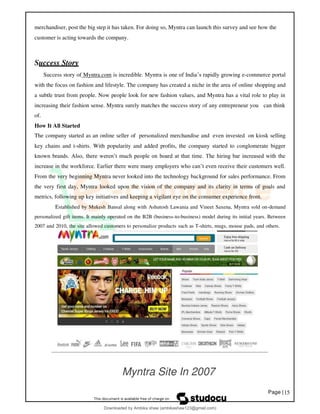
Established by Mukesh Bansal along with Ashutosh Lawania and Vineet Saxena, Myntra sold on-demand
personalized gift items. It mainly operated on the B2B (business-to-business) model during its initial years. Between
2007 and 2010, the site allowed customers to personalize products such as T-shirts, mugs, mouse pads, and others.
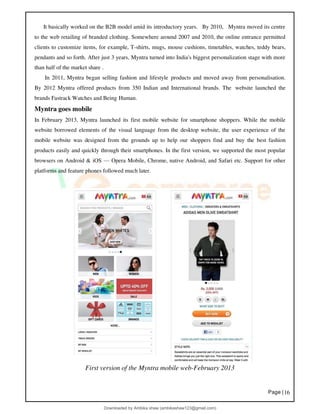
Myntra Site In 2007
Downloaded by Ambika shaw (ambikashaw123@gmail.com)
lOMoARcPSD|43948530
Page |16
It basically worked on the B2B model amid its introductory years. By 2010, Myntra moved its centre
to the web retailing of branded clothing. Somewhere around 2007 and 2010, the online entrance permitted
clients to customize items, for example, T-shirts, mugs, mouse cushions, timetables, watches, teddy bears,
pendants and so forth. After just 3 years, Myntra turned into India's biggest personalization stage with more
than half of the market share .
In 2011, Myntra began selling fashion and lifestyle products and moved away from personalisation.
By 2012 Myntra offered products from 350 Indian and International brands. The website launched the
brands Fastrack Watches and Being Human.
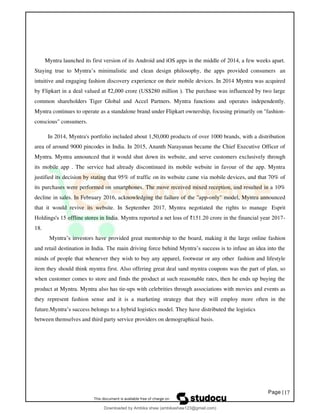
Myntra goes mobile
In February 2013, Myntra launched its first mobile website for smartphone shoppers. While the mobile
website borrowed elements of the visual language from the desktop website, the user experience of the
mobile website was designed from the grounds up to help our shoppers find and buy the best fashion
products easily and quickly through their smartphones. In the first version, we supported the most popular
browsers on Android & iOS — Opera Mobile, Chrome, native Android, and Safari etc. Support for other
platforms and feature phones followed much later.
First version of the Myntra mobile web-February 2013
Downloaded by Ambika shaw (ambikashaw123@gmail.com)
lOMoARcPSD|43948530
Page |17
Myntra launched its first version of its Android and iOS apps in the middle of 2014, a few weeks apart.
Staying true to Myntra’s minimalistic and clean design philosophy, the apps provided consumers an
intuitive and engaging fashion discovery experience on their mobile devices. In 2014 Myntra was acquired
by Flipkart in a deal valued at ₹2,000 crore (US$280 million ). The purchase was influenced by two large
common shareholders Tiger Global and Accel Partners. Myntra functions and operates independently.
Myntra continues to operate as a standalone brand under Flipkart ownership, focusing primarily on "fashion-
conscious" consumers.
In 2014, Myntra's portfolio included about 1,50,000 products of over 1000 brands, with a distribution
area of around 9000 pincodes in India. In 2015, Ananth Narayanan became the Chief Executive Officer of
Myntra. Myntra announced that it would shut down its website, and serve customers exclusively through
its mobile app . The service had already discontinued its mobile website in favour of the app. Myntra
justified its decision by stating that 95% of traffic on its website came via mobile devices, and that 70% of
its purchases were performed on smartphones. The move received mixed reception, and resulted in a 10%
decline in sales. In February 2016, acknowledging the failure of the "app-only" model, Myntra announced
that it would revive its website. In September 2017, Myntra negotiated the rights to manage Esprit
Holdings's 15 offline stores in India. Myntra reported a net loss of ₹151.20 crore in the financial year 2017-
18.
Myntra’s investors have provided great mentorship to the board, making it the large online fashion
and retail destination in India. The main driving force behind Myntra’s success is to infuse an idea into the
minds of people that whenever they wish to buy any apparel, footwear or any other fashion and lifestyle
item they should think myntra first. Also offering great deal sand myntra coupons was the part of plan, so
when customer comes to store and finds the product at such reasonable rates, then he ends up buying the
product at Myntra. Myntra also has tie-ups with celebrities through associations with movies and events as
they represent fashion sense and it is a marketing strategy that they will employ more often in the
future.Myntra’s success belongs to a hybrid logistics model. They have distributed the logistics
between themselves and third party service providers on demographical basis.
Downloaded by Ambika shaw (ambikashaw123@gmail.com)
lOMoARcPSD|43948530
Page |18
Marketing Strategy of Myntra that brought them Immense Success
➢ Myntra has been founded by some IIT passed out graduates in the year 2007. It was not the first company
in India to work on the e-commerce platform. So, the competition was high. The strategy it pulled up for
success had been their marketing mix. They worked on the niche of garments and fashion. Gradually they
covered all segments of the same and created a completed coverage of all lifestyle items. It made them a
brand in Indian Market by 2014.
➢ Technology has been another great area that Myntra worked on. Starting initially at the online platform,
they continued to upgrade themselves with technology. Understanding the trend of users, they switched to
Mobile app version swiftly. It gave a big thrust to its competitors by 2016.
➢ Logistics had remained the key success area for Myntra too. They expanded fast to cover around 9000
Pin codes in India and thus created a sensation to its competitors. The distance between physical buying
and buying from an e-commerce platform can be shortened with a highly nurtured logistics. Myntra ensured
the same to retain its supremacy in the Fashion world of India.
➢ In terms of promotion, Myntra never left out any platform for its success. However, their approach was
not like the other competitors. A perfect strategy has been knitted every time by them in social network
marketing. Marketing on Facebook, YouTube, and Twitter was focussed but was not made rigorous to
disturb the users. Solution providing attitude has been maintained to reach users every moment. Most of
the time, their advertisement strategy remained targeted at the core competency. They held over the
competitors – and thereby placed their style statement prominently.
➢ In the case of physical marketing, Myntra never targeted to cover the Metropolitan cities with banners
and hoardings. Rather, they took up the matter seriously and strategically. Personalized sports Jersey of
Team India, IPL or FIFA has been a well-thought promotion plan from Myntra. It placed them differently
above all its rivals.
➢ The inclusion of style icons in Advertisements and Promotion has not been ignored for expansion. But
here too, they marked themselves different, by choosing the style icons. With most of the Bollywood
superstars as their brand ambassadors, they also pulled in sports personalities.
➢ Their strategy of marketing, the promotion was backed up highly by the huge stock of over 150000
products from over 1000 brands. This made them awarded to be the best e-retailer in the year 2012 and
again in 2013.
Downloaded by Ambika shaw (ambikashaw123@gmail.com)
lOMoARcPSD|43948530
Page |19
FUTURE ROAD MAP
According to Nandan Nilekani, , five years down the line the entire ecosystem of business and
technology is going to become very relevant for the retail business, especially ecommerce players
like Myntra. “Think of a world in 2020. Almost everyone will have a bank account to transact from; most
people will have a digital identity in the form of an Aadhar card; and, 600-700m people will have
smartphones. It is a very different world. In this world, the way we do business, the way we transact and
do commerce, the way we entertain and the way we educate – everything is going to be different.”
At the same time, Ananth Narayanan, CEO of Myntra, their growth in the next five years. “Online
fashion consumers are largely brand seeking. Brands will grow and define the future of fashion. We expect
the branded fashion market to grow twice as fast as the overall fashion market in the next five years.” In
fact, version 2.0 of the Myntra App is going to do just that. Watch this space for more details on the new
version of the app.
Summing up everything, a clear story of Myntra can be sketched – Success from day one! Yes, this
has been possible only because of change adaptability. Myntra remained an icon on e-commerce platform
in India, recognized for the random and rapid changes. It changed its strategy in marketing and promotions,
from time to time and worked intelligently there.
It changed its platform from B2B to B2C at the right time, when the expansion was knocking at their door.
They opened up the windows to the government for making a partnership, to giant e-commerce platforms
like Flipkart. They actually offered for a merger and even to hundreds of brands to increase their gallery
size.
In one word, they proved themselves as the leader of the e-commerce fashion world in the Indian market.
Myntra is a perfect example for all companies with their clear message. They could make them realize that
well-knitted strategy and flexibility in approach can easily transform a company to Monopoly.
Downloaded by Ambika shaw (ambikashaw123@gmail.com)
lOMoARcPSD|43948530
Page |20
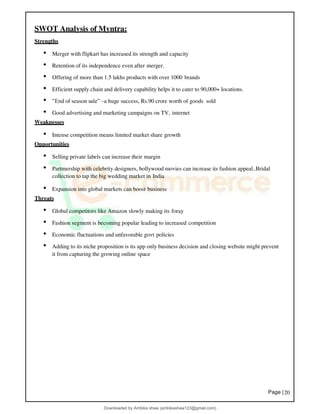
SWOT Analysis of Myntra:
Strengths
• Merger with flipkart has increased its strength and capacity
• Retention of its independence even after merger.
• Offering of more than 1.5 lakhs products with over 1000 brands
• Efficient supply chain and delivery capability helps it to cater to 90,000+ locations.
• ”End of season sale” –a huge success, Rs.90 crore worth of goods sold
• Good advertising and marketing campaigns on TV, internet
Weaknesses
• Intense competition means limited market share growth
Opportunities
• Selling private labels can increase their margin
• Partmership with celebrity designers, bollywood movies can increase its fashion appeal..Bridal
collection to tap the big wedding market in India
• Expansion into global markets can boost business
Threats
• Global competitors like Amazon slowly making its foray
• Fashion segment is becoming popular leading to increased competition
• Economic fluctuations and unfavorable govt policies
• Adding to its niche proposition is its app only business decision and closing website might prevent
it from capturing the growing online space
Downloaded by Ambika shaw (ambikashaw123@gmail.com)
lOMoARcPSD|43948530
Page |21
Presentation of Data & Analysis
I had conducted a survey in which people were questioned .The survey was conducted on E-Commerce
to enlighten us what kind of online services are required by most of the citizens,whether they are satisfied
by services given to them . The people selected for the survey belonged to different cities in India, had
different educational background.
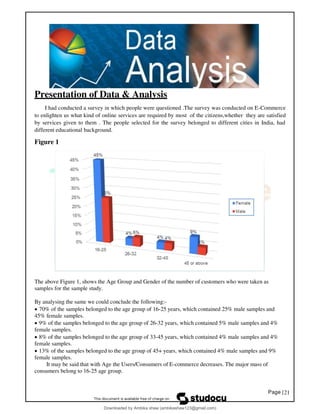
Figure 1
The above Figure 1, shows the Age Group and Gender of the number of customers who were taken as
samples for the sample study.
By analysing the same we could conclude the following:-
• 70% of the samples belonged to the age group of 16-25 years, which contained 25% male samples and
45% female samples.
• 9% of the samples belonged to the age group of 26-32 years, which contained 5% male samples and 4%
female samples.
• 8% of the samples belonged to the age group of 33-45 years, which contained 4% male samples and 4%
female samples.
• 13% of the samples belonged to the age group of 45+ years, which contained 4% male samples and 9%
female samples.
It may be said that with Age the Users/Consumers of E-commerce decreases. The major mass of
consumers belong to 16-25 age group.
Downloaded by Ambika shaw (ambikashaw123@gmail.com)
lOMoARcPSD|43948530
Page |22
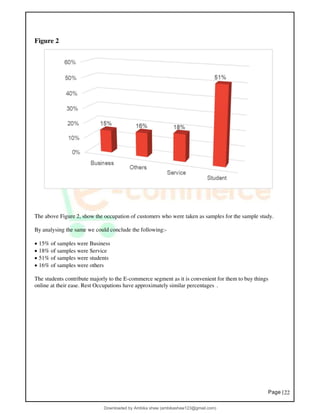
Figure 2
The above Figure 2, show the occupation of customers who were taken as samples for the sample study.
By analysing the same we could conclude the following:-
• 15% of samples were Business
• 18% of samples were Service
• 51% of samples were students
• 16% of samples were others
The students contribute majorly to the E-commerce segment as it is convenient for them to buy things
online at their ease. Rest Occupations have approximately similar percentages .
Downloaded by Ambika shaw (ambikashaw123@gmail.com)
lOMoARcPSD|43948530
Page |23
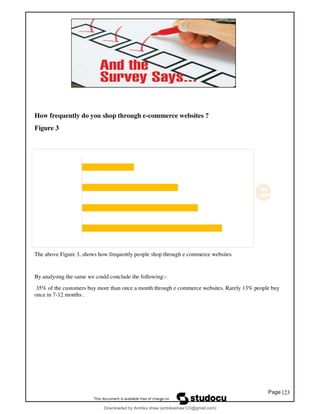
How frequently do you shop through e-commerce websites ?
Figure 3
The above Figure 3, shows how frequently people shop through e commerce websites
By analysing the same we could conclude the following:-
35% of the customers buy more than once a month through e commerce websites. Rarely 13% people buy
once in 7-12 months .
Downloaded by Ambika shaw (ambikashaw123@gmail.com)
lOMoARcPSD|43948530
Page |24
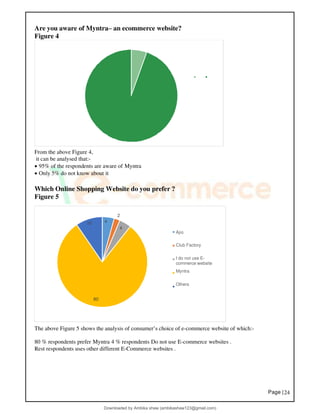
Are you aware of Myntra– an ecommerce website?
Figure 4
From the above Figure 4,
it can be analysed that:-
• 95% of the respondents are aware of Myntra
• Only 5% do not know about it
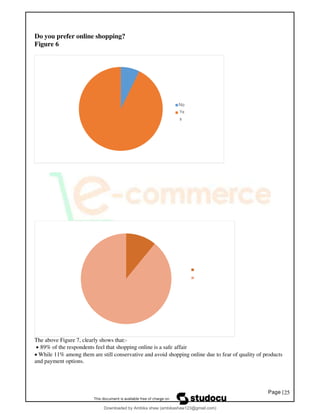
Which Online Shopping Website do you prefer ?
Figure 5
2
10 4
4
Ajio
Club Factory
I do not use E-
commerce website
Myntra
Others
80
The above Figure 5 shows the analysis of consumer’s choice of e-commerce website of which:-
80 % respondents prefer Myntra 4 % respondents Do not use E-commerce websites .
Rest respondents uses other different E-Commerce websites .
Downloaded by Ambika shaw (ambikashaw123@gmail.com)
lOMoARcPSD|43948530
Page |25
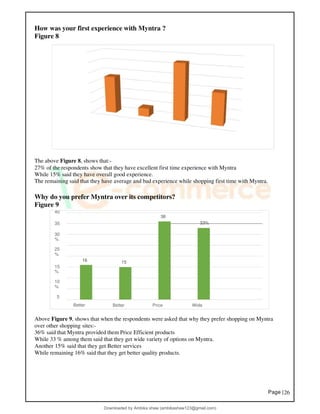
Do you prefer online shopping?
Figure 6
No
Ye
s
The above Figure 7, clearly shows that:-
• 89% of the respondents feel that shopping online is a safe affair
• While 11% among them are still conservative and avoid shopping online due to fear of quality of products
and payment options.
Downloaded by Ambika shaw (ambikashaw123@gmail.com)
lOMoARcPSD|43948530
Page |26
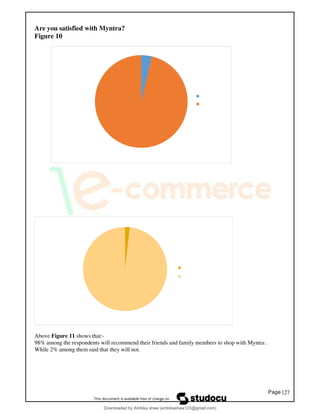
How was your first experience with Myntra ?
Figure 8
The above Figure 8, shows that:-
27% of the respondents show that they have excellent first time experience with Myntra
While 15% said they have overall good experience.
The remaining said that they have average and bad experience while shopping first time with Myntra.
Why do you prefer Myntra over its competitors?
Figure 9
40
36
35 33%
30
%
25
%
16 15
15
%
10
%
5
Better Better Price Wide
Above Figure 9, shows that when the respondents were asked that why they prefer shopping on Myntra
over other shopping sites:-
36% said that Myntra provided them Price Efficient products
While 33 % among them said that they get wide variety of options on Myntra.
Another 15% said that they get Better services
While remaining 16% said that they get better quality products.
Downloaded by Ambika shaw (ambikashaw123@gmail.com)
lOMoARcPSD|43948530
Page |27
Are you satisfied with Myntra?
Figure 10
Above Figure 11 shows that:-
98% among the respondents will recommend their friends and family members to shop with Myntra .
While 2% among them said that they will not.
Downloaded by Ambika shaw (ambikashaw123@gmail.com)
lOMoARcPSD|43948530
Page |28
Findings from the Survey:
1) 89% of respondents feel safe in online shopping they have no fear and have started shopping online
while still 11% are hesitant of shopping online they are the late majority type of customers who adopt the
technology and advancement in later stage.
2) 85% of respondents prefer online shopping as they get variety of products of good quality and price
efficient at one place while remaining respondents feel that they prefer shopping in stores in which they get
opportunity to physically observed the products and then buy .
3) Even though Myntra doesn’t have a big list of competitors but there are stores which have grabbed
attention of buyers namely Jabong, eBay,Flipcart, Amazon, Zovi
4) 55% of the respondents said that they have excellent first time experience with Myntra while 15 % said
they have overall good and remaining said that they have average experience while shopping first time with
Myntra.
5) More than majority of respondents had an amazing first experience with the site and prefer Myntra over
its competitors due to the quick services, wide variety safety reasons , cash on delivery facility, low prices
and most importantly being an Indian venture which as wide availability of products .
6) Respondents are satisfied by the business model of Myntra as it is a very systematic organization.
7) Myntra is a very price efficient company because offers the products directly from the manufacture and
eliminates the profit margin of the mediators’ Products at prices lower than the market price
8) The respondents is very satisfied with the homogeneous list and options Myntra offers to its customers
9) More than 50% of the consumers feel that products of by Myntra are of excellent quality, durable and
worth the cost
10) Myntra is a consumer friendly site and offers special after sale services which includes replacement of
goods in 30 days
11) Myntra offers warranty for its goods, depending on the type of product. Myntra is very punctual in
delivery their goods on time but a very small percentage of respondents have faced problems regarding the
timely delivery of goods. Similarly regarding the return policy a small percentage of the respondents have
faced delays but the larger section of the respondents had a great experience regarding the returns policy of
the goods
12) On a scale of 10, Myntra users have rated its behaviour 6 points to 9.5 points depending on their personal
experiences
13) Myntra users are not hesitant in recommending the site to any friends
14) 4% of customers had a bad experience with Myntra, regarding the timely delivery and the delay in
return of goods, which is not a bad ratio and can be improved further.
Downloaded by Ambika shaw (ambikashaw123@gmail.com)
lOMoARcPSD|43948530
Page |29
Chapter 4: Conclusion and Recommendation
E-Commerce is not just about conducting business transactions via the Internet. Its impact will be
far-reaching, and more prominent then we know currently. This is because the revolution in information
technology is happening simultaneously with other developments, especially the globalization of the
business. The new age of global e-commerce is creating entirely new economy and that will tremendously
change our lives, will reshape the competition in various industries, and alter the economy globally. As
companies are gaining high profits, more and more other companies are developing their websites to
increase their profits. Since more businesses are being held online resulting in high economy development
and emergence of a more innovative and advanced technology
In general, today’s businesses must always strive to create the next best thing that consumers will want
because consumers continue to desire their products, services etc. to continuously be better, faster, and
cheaper. In this world of new technology, businesses need to accommodate to the new types of consumer
needs and trends because it will prove to be vital to their business’ success and survival. E-commerce is
continuously progressing and is becoming more and more important to businesses as technology continues
to advance and is something that should be taken advantage of and implemented. From the inception of
the Internet and e-commerce, the possibilities have become endless for both businesses and
consumers. Creating more opportunities for profit and advancements for businesses, while creating more
options for consumers. However, just like anything else, e-commerce has its disadvantages including
consumer uncertainties, but nothing that can not be resolved or avoided by good decision-making and
business practices.
There are several factors and variables that need to be considered and decided upon when starting an e-
commerce business. Some of these include: types of e-commerce, marketing strategies, and countless
more. If the correct methods and practices are followed, a business will prosper in an e-commerce setting
with much success and profitability
By looking at the popularity of Myntra we can conclude that Myntra is doing a much better job in
Marketing & providing its services to customer. From the above findings we can
easily conclude that Myntra has more competitive advantage, not only with price and quality but with the
perception of the consumer as well.
Downloaded by Ambika shaw (ambikashaw123@gmail.com)
lOMoARcPSD|43948530
Page |30
Recommendation
It is my opinion that this general lack of trust is the primary barrier that is impeding the
growth of E-Commerce with in India. Here are some of the practical techniques that online
retailers can employ to improve this level of trust and build an environment where customers feel safe in
clicking that “Proceed to Checkout” button.
□ Customer Reviews: Customer’s trust for an online retailer will increase if the retailer
offers an ability to let customers share their positive as well as Negative reviews about products or
vendors.
□ Price Match Guarantee :A Price Match Guarantee (PMG) is a store policy which
entitles a customer to a refund of the Difference between the stores’ asking price and a competitor’s
price.
□ Well trained call center :It is more impotent that the call center agents be trained to
have Good problem solving skills.
□ Fraud Protection: Not only should an online retailer ensure that the appropriate
security certificates are setup to Handle checkout related transactions.
□ Real time inventory updates: Retailers must invest in building automated capabilities
that keep an up to date record of how much inventory is available for all their products.
E-Commerce will see a significant growth in India. However, the chasm between the early
Adopters of E-Commerce and the ones who are waiting can only be crossed by building a
Strong level of trust with customers – and winning them, one customer at a time.
Downloaded by Ambika shaw (ambikashaw123@gmail.com)
lOMoARcPSD|43948530
Page |31
Bibliography/ References
Information and data related to the project has been taken from the sources below, special
thanks to the editors for making the task easier:-
• https://www.slideshare.net/ifourvineela/success-mantra-of-myntra-ecommerce-
portal
• https://en.m.wikipedia.org/wiki/E-commerce
• https://www.techtarget.com/searchcio/definition/e-commerce
• https://www.google.com/amp/s/www.orchestrate.com/blog/4-technological-
advances-taking-ecommerce-next-level/%3famp=1
Downloaded by Ambika shaw (ambikashaw123@gmail.com)
lOMoARcPSD|43948530
Page |32
Questions
Respected Sir/ Madam,
I am a student, pursuing B.com from The Bhawanipur Education Society College. I am doing project on “E-
Commerce-” about the success story of Myntra and Online shopping. I kindly request you to co-operate in
my research study by kindly filling up the following questionnaire.
1. Please tick the age group you belong to
16-2 [ ]
26-32 [ ]
32-45 [ ]
45 or above [ ]
2. Gender
Male [ ]
Female [ ]
3. Please tick your occupation
Business [ ]
Service [ ]
Student [ ]
Others [ ]
4. How frequently do you shop through e-commerce websites
More than once a Month [ ]
Once in 1-2 Months [ ]
Once in 3-6 Months[ ]
Once in 7-12 Months [ ]
5. Which is your most preferred e-commerce website
Ajio[ ]
Myntra[ ]
Club Factory[ ]
Others [ ]
I do not use e-commerce websites [ ]
6. Are you aware of Myntra– an ecommerce website
Yes [ ]
No [ ]
7. How frequently have you used the ecommerce website for getting information before shopping
at a physical store
Always [ ]
Most Often [ ]
Often [ ]
Quite rarely [ ]
Rarely [ ]
Never [ ]
Product specifications [ ]
Price comparison among products [ ]
8. Do you prefer online shopping?
Yes [ ]
No [ ]
Downloaded by Ambika shaw (ambikashaw123@gmail.com)
lOMoARcPSD|43948530
Page |33
9. Do you consider online shopping safe?
Yes [ ]
No [ ]
10. Tick all the product varieties that you generally prefer buying online
Clothing [ ]
Personal products (perfumes, beauty creams, razors, toothbrush) [ ]
Books [ ]
Cosmetics and Accessories [ ]
11. How was your first experience with Myntra?
Excellent [ ]
Good [ ]
Average [ ]
Bad [ ]
12. Why do you prefer Myntra over its competitors?
Wide Variety [ ]
Price Efficient [ ]
Better Service [ ]
Better Quality [ ]
13. Will you recommend Myntra to your friends and family members?
Yes [ ]
No [ ]
14. Are you satisfied with Myntra?
Yes [ ]
No [ ]
Downloaded by Ambika shaw (ambikashaw123@gmail.com)
lOMoARcPSD|43948530
Page |34
ANNEXURE-IA
Supervisor's Certificate
This is to certify that Mr./Ms.....................................................................................a student of
B.Com. Honours in Accounting & Finance/ Marketing / Taxation / E-Business of
.......................(Name of the College) under the University of Calcutta has worked under my supervision
and guidance for his/her Project Work and prepared a Project Report with the title
…………………………………………….......... which he/she is submitting, is his/her genuine and original
work to the best of my knowledge.
Place:
Date:
Designation:
Signature Name:
Name of the College
Annexure-IB
Student's Declaration
I hereby declare that the Project Work with the title (in block letters) ..................................... submitted by
me for the partial fulfilment of the degree of B.Com. Honors in Accounting & Finance / Marketing /
Taxation / E-Business under the University of Calcutta is my original work and has not been submitted
earlier to any other University /Institution for the fulfilment of the requirement for any course of study.
I also declare that no chapter of this manuscript in whole or in part has been incorporated in this report from
any earlier work done by others or by me. However, extracts of any literature which has been used for this
report has been duly acknowledged providing details of such literature in the references.
Registration No.
Place:
Date:
Signature
Name:
Address:
Downloaded by Ambika shaw (ambikashaw123@gmail.com)
lOMoARcPSD|43948530

e-commerce-project_240hsunsnjsjsnejsjsjsnsjjssjs

  • 1.
    E-commerce project Bachelors ofCommerce (University of Calcutta) Scan to open on Studocu Studocu is not sponsored or endorsed by any college or university E-commerce project Bachelors of Commerce (University of Calcutta) Scan to open on Studocu Studocu is not sponsored or endorsed by any college or university Downloaded by Ambika shaw (ambikashaw123@gmail.com) lOMoARcPSD|43948530
  • 2.
    Page | 1 ProjectReport (Submitted for the Degree of B.COM Honours in Accounting and Finance under the University of Calcutta) Title of the Project: E-COMMERCE Submitted by: Name of the Candidate: BAZIL NEYAZ Registration No.:201011-21-0158 CU Roll No.: 011-1111-0316-20 Name of the College: AJC BOSE COLLEGE College ID : 20201515 Supervised by Name of the Supervisor:Prof. SRIJIT SEAL Name of the College: AJC BOSE COLLEGE Name of the HOD:SUPRATIM DEY May 2023 Downloaded by Ambika shaw (ambikashaw123@gmail.com) lOMoARcPSD|43948530
  • 3.
    Page | 2 STUDENT'SDECLARATION I hereby declare that the Project Work with the title E-Commerce submitted by me for the partial fulfillment of the degree of B.Com. Honours in Accounting & Finance under the University of Calcutta is my original work and has not been submitted earlier to any other University /Institution for the fulfilment of the requirement for any course of study. I also declare that no chapter of this manuscript in whole or in part has been incorporated in this report from any earlier work done by others or by me. However, extracts of any literature which has been used for this report has been duly acknowledged providing details of such literature in the references. Signature: Name:Bazil Neyaz Address: Kolkata Place: Kolkata Date: Downloaded by Ambika shaw (ambikashaw123@gmail.com) lOMoARcPSD|43948530
  • 4.
    Page | 3 TABLEOF CONTENTS Contents Page No. CHAPTER 1 – INTRODUCTION □ Background Overview □ Objectives □ Brief Review of Literature □ Research Methodology □ Limitations of Study □ Chapter Planning 4-10 CHAPTER 2 – CONCEPTUAL OVERVIEW □ National Scenario of E-Commerce □ International Scenario of E-Commerce □ The impact COVID19 pandemic on e- commerce 11-20 CHAPTER 3 – ANALYSIS AND FINDINGS □ Case Study on Myntra □ Data Analysis & Interpretations □ Findings 21-28 CHAPTER 4 – CONCLUSION AND RECOMMENDATIONS □ Conclusion □ Recommendations □ Bibliography □ Questionnaire 29-33 Downloaded by Ambika shaw (ambikashaw123@gmail.com) lOMoARcPSD|43948530
  • 5.
    Page | 4 CHAPTER1 – INTRODUCTION Electronic commerce or e-commerce has become the new mantra of modern day business world. It has emerged as the major technological development in the corporate world and has completely changed the way people do business today. The advent of internet in mid nineties has dramatically changed the socio- economic lifestyle of the entire world. The 2 telecommunication revolution and globalization also added to the changed perspective of human behaviour. With the rapid growth in internet applications and recent advancement in wireless and communication technology, more and more people are indulging in electronic form of business transactions. In order to cope with this modern trend of online business, the business organizations worldwide are forced to start e-commerce operations and thus increasing the scope and demand of e-commerce to a great extent. E-commerce (electronic commerce) is the activity of electronically buying or selling of products on online services or over the Internet. Electronic commerce draws on technologies such as mobile commerce, electronic funds transfer, supply chain management, Internet marketing, online transaction processing, electronic data interchange (EDI), inventory management systems, and automated data collection systems. E-commerce is in turn driven by the technological advances of the semiconductor industry, and is the largest sector of the electronics industry. Modern electronic commerce typically uses the World Wide Web for at least one part of the transaction's life cycle although it may also use other technologies such as e-mail. Electronic commerce is generally considered to be the sales aspect of e-business. It also consists of the exchange of data to facilitate the financing and payment aspects of business transactions. This is an effective and efficient way of communicating within an organization and one of the most effective and useful ways of conducting business. The Indian ecommerce industry is worth billions of dollars and has the potential for exponential growth, but there are some obstacles ahead. In 2020, the sector is likely to see challenges in policy even as it marches ahead to explore newer categories and ways to increase the appeal of online shopping. According to a report by India Brand Equity Foundation (IBEF), the ecommerce market in India is expected to reach $200 billion by 2027 from $38.5 billion in 2017, and the number of online shoppers may reach 220 million by 2025. Downloaded by Ambika shaw (ambikashaw123@gmail.com) lOMoARcPSD|43948530
  • 6.
    Page | 5 •Background Overview Every Individual of company that wants to make money and become the next Microsoft needs to understand the market potential, business implication and technological foundation of electronic commerce. But what is electronic commerce everybody is technical and business skills are needed to be successful? Companies and consumers are discovering that global networking and other technological innovations are powerful assets if used as competitive weapons in their day to day activities. India has always been a land of great potential. The socioeconomic condition of the country has improved many folds after independence and India is now emerging as one of the leading countries in the world. Moreover with a population of over 100 crore and a growth rate of above 6%, it can be compared to a marketing giant. Hence it can be well judged why online shopping in India is rising at fast pace over the days. As technology is spreading to the remotest villages and many job opportunities are presenting themselves to the unemployed youth more and more people are gaining awareness and the money to purchase expensive and luxurious items over the internet. In the push to reduce prices, more and retailers are turning to overseas suppliers in part because of cheaper labour cost. Retail is the immediate line of fire and had to do the cost cutting. They put the pressure on the manufacturer and then the supplier end of the pipeline. Electronic Commerce is forcing companies to rethink the existing ways of doing target marketing, relationship marketing and even event marketing. Adaptation would include moving towards computerized “Paperless” operations to, reduce trading cost and facilitate the adoption of new business process. Japanese approach JIT (Just in Time) system, total quality control and quality circles are focused now for delivery of goods through electronic commerce. The business phenomenon that we now call electronic commerce has an interesting history. From humble beginnings in the mid-1990s, electronic commerce grew rapidly until 2000, when a major downturn occurred. Many people have seen news stories about the ‘dot-com boom’ followed by the ‘dot-com bust’ or the ‘dot-bomb’. In the years 2000 to 2003, many industry observers were writing obituaries for electronic commerce. Just as the unreasonable expectations for immediate success fuelled the high expectations during the boom years, overly gloomy news reports coloured perceptions during this time. Although the rapid expansion and high levels of investment of the boom years are not likely to be repeated, the second wave of electronic commerce is well under way. Downloaded by Ambika shaw (ambikashaw123@gmail.com) lOMoARcPSD|43948530
  • 7.
    Page | 6 •Objective • To understand the evolution of E-Commerce; • To describe the conceptual framework of E-Commerce in India; • To analyse the present trends of E-Commerce in India; • To examine the barriers of E-Commerce in India; • To predict future of E-commerce. Nowadays retail stores are facing more competition in retailing business. Good store design increase the visiting of more customers in to the store and increase the store goodwill, and price also plays major factor to use the customer giving preference and selection of the store. And as industry research has shown, there is much need to know the customer expectations, customer preferences and their store choice’s(features) and we will find out solutions for designing effective store which will getting more customers and getting more profits. Electronic Commerce (E-commerce) seems to be everywhere these days. It’s nearly impossible to read a magazine or newspaper without coming across an article about how e- commerce is going to change and affect our lives. It is widely accepted that e-commerce and Internet technologies can benefit an organization but still there are very few studies about e-commerce adoption in India. In addition to that, there isn’t any detailed recent study about of e-commerce in India incorporating latest factual data and trends relating to its various aspects at all. So, I have proposed to study this area to investigate the extent of India’s involvement with e-commerce applications, its detailed conceptual framework, evolution, stories of top Indian players in this field and find a set of guidelines or recommendations on the best practices of e-commerce adoption which might help the Indian e-commerce firms. In terms of communications, electronic commerce is the means to deliver the goods, services, information or payments over computer networks or any other computer device. The business perspective, electronic commerce offers to buy and sell products, services and information on the Internet and through other online services. A service perspective, EC is a tool that has been in operation for the purposes of governments, institutions, consumers and managers, Reduce service costs and at the same time, increased quality and customer service and helps accelerate the delivery time. The educational perspective and e- commerce may be made online learning helps to teach in schools, universities and other organizations including commercial entities. Participation of view is an electronic commerce framework for cooperation within the organization and among different organizations. E-commerce is based on processing and transmitting electronic data including text, audio and video. Electronic commerce encompasses a variety of activities such as electronic funds transactions, electronic stock exchange, an electronic bill of lading, commercial projects, government purchases, direct marketing and after sales service. Downloaded by Ambika shaw (ambikashaw123@gmail.com) lOMoARcPSD|43948530
  • 8.
    Page | 7 •Literature Review The Indian ecommerce industry is worth billions of dollars and has the potential for exponential growth, but there are some obstacles ahead. In 2020, the sector is likely to see challenges in policy even as it marches ahead to explore newer categories and ways to increase the appeal of online shopping. H arsha Razdan, Partner and Head, Consumer Markets and Internet Business, KPMG India, says,“The digital space has undergone rapid colonisation, thus resulting in intense competition and at times, unregulated use of personal data in the ecommerce space. In the coming year, we expect the government to roll out the ecommerce policy based on the recommendations of various industry stakeholders, keeping consumer interests at the centre.” The ecommerce industry in India is not just made up of only large players as Flipkart and Amazon have extended cooperation to small and medium enterprises .It is very clear that if the industry has to become truly large and the participation of SMEs is critical, and this is only going to intensify in next year. M ishra & Kotkar (2015) trace the timeline and development “A Study on Current Status of E- Commerce in India: A Comparative Analysis of Flipkart and Amazon” with its inception in the mid 1990s through the advent of matrimonial and job portals. However, due to limited internet accessibility, weak online payment systems and lack of awareness, the progress was very slow. The Indian B2C e-commerce industry got a major boost in mid 2000s with the expansion of online services to travel and hotel bookings which continue to be major contributors even today.Das & Ara(2015) observe in “Growth of E-Commerce in India” that though online travel and hotel bookings still control the lion’s share of e-commerce market, their share has comparatively fallen over the years due to the recent augmentation and consequent rise of e- tailing services. There has been a tremendous surge in the volume of investment in this sector. With the e- commerce markets in the west reaching their saturation, investors see tremendous potential in the Indian market, in the light of which, many start ups have received funding from venture capitalists and private equity firms. China's Alibaba Group and affiliate Ant Financial became the largest shareholders of One97 Communications, the parent of Indian e-tailer Paytm, by investing $680 million, in 2015 (Aulakh, 2015). V.Kumar and Denish Shah 2011 have published research paper entitled “Pushing and Pulling on the Internet “The internet is fast emerging as a domain sales channel. The Internet is expanding& it influences consumer which shifts the consumer behaviour. It has changed the way product awareness, developed new modes of product consideration. JK Corley, Z Jourdan, 2013, The amount of research related to Internet marketing has grown rapidly since the dawn of the Internet Age. A review of the literature base will help identify the topics that have been explored as well as identify topics for the further research. J Suresh Reddy, 2014 has published article “Impact of E-commerce on marketing”. Marketing is one of the business function most dramatically affected by emerging information technologies. Internet is providing companies new channels of communication and interaction. It can create closer Downloaded by Ambika shaw (ambikashaw123@gmail.com) lOMoARcPSD|43948530
  • 9.
    Page | 8 yetmore cost effective relationships with customers in sales, marketing and customer support. Companies can use web to provide ongoing information, service and support. It also creates positive interaction with customers that can serve as the foundation for long term relationships and encourage repeat purchases. T. Shenbhagavadivu , 2015 has published the article " A Study on Customer Satisfaction towards online shopping " focused on understanding the consumer's attitudes towards online shopping , making improvement in the factors that influence consumers to shop online and working on factors that affect consumers to shop online will help marketers to gain the competitive edge over others. • Research Methodology Research Design The type of design being used for making this project is Meta-Analysis Design. Meta-analysis is an analytical methodology designed to systematically evaluate and summarize the results from a number of individual studies, thereby, increasing the overall sample size and the ability of the researcher to study effects of interest. • Primary Research-Research was conducted with the help of Google forms in which people responded to the questions and response to the answers are illustrated in chapter 3. • Secondary Research- Secondary data was collected thorough various sites and articles available on the internet. Sampling Size Sample size: For the research the sample size of:- 100 respondents were taken out of which 94% of the population are frequent users of online shopping. The geographical area is covered Sampling Procedure To obtain the representative sample, a non-probability sample can be drawn. In this study the method of selecting samples is Convenience sampling. Downloaded by Ambika shaw (ambikashaw123@gmail.com) lOMoARcPSD|43948530
  • 10.
    Page | 9 •Limitations Of Study Some businesses are less suitable for electronic commerce. Such businesses may be involved in the selling of items which are perishable or high-cost, or which require inspection before purchasing. Most of the disadvantages of electronic commerce today, however, stem from the newness and rapidly developing pace of the underlying technologies. These disadvantages will disappear as electronic commerce matures and becomes more available to and accepted by the general population • Security The biggest drawback of e-commerce is the issue of security.People fear to provide personal and financial information, even though several improvements have been made in relation to data encryption.. • Tax issue Tax is another bigger issue when the buyer and seller are situated in different locations. Another factor is that physical stores will lose business if web purchases are free from tax. • Product suitability People have to rely on electronic images to purchase products. The lack of ‘touch and feel’ prevent people from online shopping. • Cultural obstacles E-commerce attracts customers from all over the world. They also pose linguistic problems. • Legal issues The cyber laws that govern the e-commerce transactions are not very clear and vary from country to country. These legal issues prevent people from entering into electronic contracts. • Huge technological cost It is difficult to merge electronic business with traditional business . Technological infrastructure may be expensive and huge cost has to be incurred to keep pace with ever changing technology. It is necessary to allocate more funds for technological advancement to remain competitive in the electronic world. • Chapter planning The project is organized as follows: Chapter 2: Will give an overview about the concept of E Commerce, its importance, methods, and its future, national and international scenario. Chapter 3: Will contain the methodology of preparing the data and data analysis and findings based on a designed questionnaire. Chapter4: Will provide the conclusion of the research and recommendations. Downloaded by Ambika shaw (ambikashaw123@gmail.com) lOMoARcPSD|43948530
  • 11.
    Page |10 CHAPTER 2:Conceptual Framework of E-Commerce In India • National Scenario of E-Commerce The online business industry is well established in India. And, everyday some or the other new player is taking a plunge. Though, a major contribution to its growth is provided by e-commerce industry. Even so, not many understand the intricacies involved in e-commerce industry. With the evolution of technology and increase in consumerism all over India, e-commerce is riding the high tide in online business. Today, the total number of internet users in the world is close to 3 billion, out of this India has a total of 259.14 million internet and broadband subscribers. Easy access to internet via mobile devices coupled with increasing confidence of the customers to purchase online is leading the way. Because of this, increasing number of people are registering on e-commerce websites and purchasing products through the use of cell phones. According to a report, annual growth rates in leading e-commerce markets of Japan, South Korea and Australia will run at 11% to 12% over the few years. In retrospect, the rapidly growing market of China and India is 25% and 57% respectively. Propelled by rising smartphone penetration, the launch of 4G networks and increasing consumer wealth, the Indian E-commerce market is expected to grow to US$ 200 billion by 2027 from US$ 38.5 billion in 2017. E-commerce is increasingly attracting customers from Tier 2 and 3 cities, where people have limited access to brands but have high aspirations. Average online retail spending in India was US$ 224 per user in 2017. The Government e-marketplace (GeM), three years after its inauguration saw a cumulative procurement by the central and state governments of Rs 24,183 crore (US$ 3.46 billion) in FY19 and has a target of Rs 50,000 (US$ 7.15 billion) crore in FY20. By 2022, smartphone users are expected to reach 476 million and Ecommerce sector expected to grow 1,200 percent by 2026. Downloaded by Ambika shaw (ambikashaw123@gmail.com) lOMoARcPSD|43948530
  • 12.
    Page |11 GROWTH DRIVERSFOR E-COMMERCE Over 120 million people are expected to shop online in 2018 and this number is expected to go up to 175 million by 2020. Mobile-savvy shoppers are the backbone of India’s online shopping industry. Men in India are more avid shoppers than women in part because of demographic and cultural differences. Metro cities like Bengaluru, Mumbai, and Delhi, with population greater than 100,000, accounted for most online shopping in absolute numbers. E-commerce business of several companies like ShopClues, Craftsvilla, etc., has observed crisis in tier II cities, after racking up around US$ 400 million in investor capital. Less densely populated regions generated a larger proportion of online sales. Nearly 60 per cent of Snapdeal’s purchases came from cities classified as tier II and III. Flipkart also noted that “sales of branded products across categories saw a sharp increase, as more of tier 2 and tier 3 Indian towns took to shopping online. Although shoppers between 25 and 34 years of age were most active on E-commerce portals, a surprising number of older people also shopped online in 2016. However, the age group of 15-34 years are the major consumers of E-commerce. The popularity of web series among millennials is growing immensely. Discounts and EMIs added with a comfort of sitting at home and purchasing has become an effective driving factor of E- commerce. Availability of various websites gives customers a lot of options to choose from. Chatbots and personal assistance apps have made transactions seamless. One can get several brands and products from different sellers at one place. Also, one can get in on the latest international trends without spending money on travel; you can shop from retailers in other parts of the country or even the world without being limited by geographic area. Online retailers see this emergent segment as a new growth driver as the incremental growth in mobile subscribers can be credited mainly to people who are comfortable with languages other than English. Indian language users on the internet are expected to reach 540 million by 2021. In August 2018, Flipkart acquired an artificial intelligence company, which converts speech to text in 10 Indian languages. Reverie Language Technologies is expected to raise US$ 20 million to achieve its vision to create language equality on the internet. The e-commerce industry been directly impacting the micro, small & medium enterprises (MSME) in India by providing means of financing, technology and training and has a favourable cascading effect on other industries as well. The Indian e-commerce industry has been on an upward growth trajectory and is expected to surpass the US to become the second largest e-commerce market in the world by 2034. Technology enabled innovations like digital payments, hyper-local logistics, analytics driven customer engagement and digital advertisements will likely support the growth in the sector. The growth in e-commerce sector will also boost employment, increase revenues from export, increase tax collection by ex-chequers, and provide better products and services to customers in the long-term. Rise in smartphone usage is expected to rise 84 per cent to reach 859 million by 2022. Downloaded by Ambika shaw (ambikashaw123@gmail.com) lOMoARcPSD|43948530
  • 13.
    Page |12 • InternationalScenario of E-Commerce International e-commerce is the business of selling a product through an e-commerce website to buyers in foreign countries. As the proliferation of digital tools increases internet availability worldwide, any company can sell online, making international e-commerce easier than ever before for both pure play companies and brick and mortars. For traditional retailers, e-commerce can also serve as a testing ground to determine whether new, foreign markets will be successful before opening a physical location there. While it’s tempting for e-commerce professionals to assume expansion into a country with a similar culture will require less work, the word “international” is key. No matter how much countries have in common, each one is unique. Canada is not the United States, Belgium is not France. Every global market deserves its own methodical planning and consideration. Business models across the world also continue to change drastically with the advent of E-Commerce and this change is not just restricted to USA. Other countries are also contributing to the growth of E- Commerce. For example, the United Kingdom has the biggest e-commerce market in the world when measured by the amount spent per capita, even higher than the USA. This has led to changing dynamics for the advertising industry .Amongst emerging economies, China's E-Commerce presence continues to expand. With 384 million internet users, China’s online shopping sales rose to $36.6 billion in 2009 and one of the reasons behind the huge growth has been the improved trust level for shoppers. The Chinese retailers have been able to help consumers feel more comfortable shopping online. E-Commerce is also expanding across the Middle East. Having recorded the world’s fastest growth in internet usage between 2000 and 2009, the region is now home to more than 60 million internet users. Retail, travel and gaming are the region’s top E-Commerce segments, in spite of difficulties such as the lack of region-wide legal frameworks and logistical problems in cross-border transportation. E-Commerce has become an important tool for businesses worldwide not only to sell to customers but also to engage them. The global ecommerce market is in a state of both expansion and consolidation. More consumers than ever before are buying digitally, and worldwide retail ecommerce sales are rising. At the same time, major international players like Amazon and Alibaba are widening their reach by buying up smaller local platforms, especially in burgeoning ecommerce markets eMarketer estimates that worldwide retail ecommerce sales will increase from $2.290 trillion in 2017 to $4.479 trillion by the end of 2021, equating to 16.1% of total retail sales. Alibaba executive said more than business-to-consumer commerce, the company would focus on leveraging the payments business to seek success in India. "I strongly believe that we don't want to repeat the traditional e-commerce models like consumer-to-consumer or business-to-consumer in India. I think the best way to unlock the India opportunity is through how we leverage the payments on ground," Daniel Zhang, CEO of the Alibaba Group. Downloaded by Ambika shaw (ambikashaw123@gmail.com) lOMoARcPSD|43948530
  • 14.
    Page |13 • THEIMPACT COVID19 PANDEMIC ON E-COMMERCE E-commerce had been steadily gaining momentum — the world over and also in India much before COVID19 happened. By and large the onset of the pandemic and the ensuing lockdown has thrown the progression of online purchasing off balance because of restrictions on eligible items to essentials and due to the limitations placed on physical movement directly impacting deliveries. Nevertheless, experiences of life during the lockdown may result in nudging attitudes towards opting for e-commerce once things are back to normal. Prior to the pandemic, attitudes towards shopping online had broadly clear distinctions between those for whom it was a matter of convenience whether it be groceries and staples or recreational items; and those for whom it was imperative to shop from physical markets and brick and mortar stores because they are a more active process. The pandemic has c reated a shift in the way consumers behave and carry out their activities, directly affecting the e-commerce industry. The situation that only essentials and especially medical supplies are being made available and also people are not inclined to spend money beyond their necessities, offers both challenges as well as opportunities. Based on a market research before the Covid outbreak, it was predicted that the growth in the e- commerce market in India would reach 200 billion US dollars by the year 2026. Post the outbreak, recent trends suggest that the goal of 200 Billion U.S. Dollars may be reached a lot sooner than originally predicted spurred by a jump in consumers opting for online deliveries amid fears of possible infection if they step out of their homes. The e-commerce sector is being impacted on the supply as well as the demand side and while some companies are able to adapt and respond to the changes, others are not able to because of the nature of limitations that have been imposed. In the short term there will likely be a boost to some sectors of e-commerce as people would continue to be apprehensive of stepping out frequently even after the lockdown ends. But again, in the short term, scaling up of the supply chain in keeping with requisite safety measures will be a challenge. While it is safe to say that the entire e-commerce industry will not be seeing a positive net change, the fact that it shall surely thrive more than brick and mortar stores can be relatively safe assumption. In the long term, however, the growth of e-commerce would depend on how efficiently they provide and adapt their services in accordance with general consumer psyche. Probably, companies which are able to respond better during this period will be able to better tap into the potential shifts in attitudes towards online purchasing. At the same time however, hyper-local shops like kirana stores are not likely to be endangered but rather transform their services with the help of digital logistics platforms. While many of the trends being mapped at the moment may be temporary, they will nonetheless have an impact on the attitudes of people towards online shopping with the possibility that a greater percentage of people (than what was prevalent before the pandemic but less than the percentage during the same period) opting for the convenience offered by online platforms. Downloaded by Ambika shaw (ambikashaw123@gmail.com) lOMoARcPSD|43948530
  • 15.
    Page |14 Chapter 3:Case Study on Myntra Online Shopping ! Which company flashes in your mind first? Well, let us talk about the home-grown, Indian, e-commerce site ‘MYNTRA’ Myntra.com is India’s top e-commerce company for fashion and lifestyle products, headquartered in Bangalore, Karnataka. It provides the widest range of brands and products on its portal. It offers an array of latest and trendiest products bringing the power of fashion to its shoppers. Myntra allows shoppers to choose apparel, accessories, cosmetics and footwear from over 500 leading Indian and international brands. They are in the lead in changing the face of retail and shopping in India. The brand is attempting to convey the energy of design to customers with a variety of the most recent and trendiest items accessible in the nation. Myntra is a one stop shop for all your fashion and lifestyle needs. Being India's largest e-commerce store for fashion and lifestyle products, Myntra aims at providing a hassle free and enjoyable shopping experience to shoppers across the country with the widest range of brands and products on its portal. The brand is making a conscious effort to bring the power of fashion to shoppers with an array of the latest and trendiest products available in the country. Myntra was established by Mukesh Bansal, Ashutosh Lawania and Vineet Saxena in February 2007. All three are IIT alumni and have been associated with several start-ups. Myntra is headquartered in Bangalore with regional offices in New Delhi, Mumbai and Chennai. It began its operations in the B2B (business to business) segment with the personalization of gifts, which included T-shirts, mugs and caps to name a few. However, in 2010, the company shifted its strategy to becoming a B2C (business to customer) oriented firm, expanding its catalogue to fashion and lifestyle products. Myntra. com is ranked among the top 10 e-commerce companies in India and is scaling rapidly. Building on the success of personalization Myntra expanded into broader Lifestyle/Fashion retailing. Prominent brands include Adidas, Nike, Puma, Catwalk, Inc 5, United Colors of Benetton, FCUK, Timberland, Avirate, FabIndia and Biba to name a few. You can also shop from some recently introduced labels such as - Roadster, Sher Singh, Dressberry, Kook N Keech and ETC. Myntra recently gone for app only mode leaving its conventional website style. The company has recently gone app only where it has received mixed reviews. So the company needs to analyze the consumer responsiveness towards the apparel Downloaded by Ambika shaw (ambikashaw123@gmail.com) lOMoARcPSD|43948530
  • 16.
    Page |15 merchandiser, postthe big step it has taken. For doing so, Myntra can launch this survey and see how the customer is acting towards the company. Success Story Success story of Myntra.com is incredible. Myntra is one of India’s rapidly growing e-commerce portal with the focus on fashion and lifestyle. The company has created a niche in the area of online shopping and a subtle trust from people. Now people look for new fashion values, and Myntra has a vital role to play in increasing their fashion sense. Myntra surely matches the success story of any entrepreneur you can think of. How It All Started The company started as an online seller of personalized merchandise and even invested on kiosk selling key chains and t-shirts. With popularity and added profits, the company started to conglomerate bigger known brands. Also, there weren’t much people on board at that time. The hiring bar increased with the increase in the workforce. Earlier there were many employers who can’t even receive their customers well. From the very beginning Myntra never looked into the technology background for sales performance. From the very first day, Myntra looked upon the vision of the company and its clarity in terms of goals and metrics, following up key initiatives and keeping a vigilant eye on the consumer experience front. Established by Mukesh Bansal along with Ashutosh Lawania and Vineet Saxena, Myntra sold on-demand personalized gift items. It mainly operated on the B2B (business-to-business) model during its initial years. Between 2007 and 2010, the site allowed customers to personalize products such as T-shirts, mugs, mouse pads, and others. Myntra Site In 2007 Downloaded by Ambika shaw (ambikashaw123@gmail.com) lOMoARcPSD|43948530
  • 17.
    Page |16 It basicallyworked on the B2B model amid its introductory years. By 2010, Myntra moved its centre to the web retailing of branded clothing. Somewhere around 2007 and 2010, the online entrance permitted clients to customize items, for example, T-shirts, mugs, mouse cushions, timetables, watches, teddy bears, pendants and so forth. After just 3 years, Myntra turned into India's biggest personalization stage with more than half of the market share . In 2011, Myntra began selling fashion and lifestyle products and moved away from personalisation. By 2012 Myntra offered products from 350 Indian and International brands. The website launched the brands Fastrack Watches and Being Human. Myntra goes mobile In February 2013, Myntra launched its first mobile website for smartphone shoppers. While the mobile website borrowed elements of the visual language from the desktop website, the user experience of the mobile website was designed from the grounds up to help our shoppers find and buy the best fashion products easily and quickly through their smartphones. In the first version, we supported the most popular browsers on Android & iOS — Opera Mobile, Chrome, native Android, and Safari etc. Support for other platforms and feature phones followed much later. First version of the Myntra mobile web-February 2013 Downloaded by Ambika shaw (ambikashaw123@gmail.com) lOMoARcPSD|43948530
  • 18.
    Page |17 Myntra launchedits first version of its Android and iOS apps in the middle of 2014, a few weeks apart. Staying true to Myntra’s minimalistic and clean design philosophy, the apps provided consumers an intuitive and engaging fashion discovery experience on their mobile devices. In 2014 Myntra was acquired by Flipkart in a deal valued at ₹2,000 crore (US$280 million ). The purchase was influenced by two large common shareholders Tiger Global and Accel Partners. Myntra functions and operates independently. Myntra continues to operate as a standalone brand under Flipkart ownership, focusing primarily on "fashion- conscious" consumers. In 2014, Myntra's portfolio included about 1,50,000 products of over 1000 brands, with a distribution area of around 9000 pincodes in India. In 2015, Ananth Narayanan became the Chief Executive Officer of Myntra. Myntra announced that it would shut down its website, and serve customers exclusively through its mobile app . The service had already discontinued its mobile website in favour of the app. Myntra justified its decision by stating that 95% of traffic on its website came via mobile devices, and that 70% of its purchases were performed on smartphones. The move received mixed reception, and resulted in a 10% decline in sales. In February 2016, acknowledging the failure of the "app-only" model, Myntra announced that it would revive its website. In September 2017, Myntra negotiated the rights to manage Esprit Holdings's 15 offline stores in India. Myntra reported a net loss of ₹151.20 crore in the financial year 2017- 18. Myntra’s investors have provided great mentorship to the board, making it the large online fashion and retail destination in India. The main driving force behind Myntra’s success is to infuse an idea into the minds of people that whenever they wish to buy any apparel, footwear or any other fashion and lifestyle item they should think myntra first. Also offering great deal sand myntra coupons was the part of plan, so when customer comes to store and finds the product at such reasonable rates, then he ends up buying the product at Myntra. Myntra also has tie-ups with celebrities through associations with movies and events as they represent fashion sense and it is a marketing strategy that they will employ more often in the future.Myntra’s success belongs to a hybrid logistics model. They have distributed the logistics between themselves and third party service providers on demographical basis. Downloaded by Ambika shaw (ambikashaw123@gmail.com) lOMoARcPSD|43948530
  • 19.
    Page |18 Marketing Strategyof Myntra that brought them Immense Success ➢ Myntra has been founded by some IIT passed out graduates in the year 2007. It was not the first company in India to work on the e-commerce platform. So, the competition was high. The strategy it pulled up for success had been their marketing mix. They worked on the niche of garments and fashion. Gradually they covered all segments of the same and created a completed coverage of all lifestyle items. It made them a brand in Indian Market by 2014. ➢ Technology has been another great area that Myntra worked on. Starting initially at the online platform, they continued to upgrade themselves with technology. Understanding the trend of users, they switched to Mobile app version swiftly. It gave a big thrust to its competitors by 2016. ➢ Logistics had remained the key success area for Myntra too. They expanded fast to cover around 9000 Pin codes in India and thus created a sensation to its competitors. The distance between physical buying and buying from an e-commerce platform can be shortened with a highly nurtured logistics. Myntra ensured the same to retain its supremacy in the Fashion world of India. ➢ In terms of promotion, Myntra never left out any platform for its success. However, their approach was not like the other competitors. A perfect strategy has been knitted every time by them in social network marketing. Marketing on Facebook, YouTube, and Twitter was focussed but was not made rigorous to disturb the users. Solution providing attitude has been maintained to reach users every moment. Most of the time, their advertisement strategy remained targeted at the core competency. They held over the competitors – and thereby placed their style statement prominently. ➢ In the case of physical marketing, Myntra never targeted to cover the Metropolitan cities with banners and hoardings. Rather, they took up the matter seriously and strategically. Personalized sports Jersey of Team India, IPL or FIFA has been a well-thought promotion plan from Myntra. It placed them differently above all its rivals. ➢ The inclusion of style icons in Advertisements and Promotion has not been ignored for expansion. But here too, they marked themselves different, by choosing the style icons. With most of the Bollywood superstars as their brand ambassadors, they also pulled in sports personalities. ➢ Their strategy of marketing, the promotion was backed up highly by the huge stock of over 150000 products from over 1000 brands. This made them awarded to be the best e-retailer in the year 2012 and again in 2013. Downloaded by Ambika shaw (ambikashaw123@gmail.com) lOMoARcPSD|43948530
  • 20.
    Page |19 FUTURE ROADMAP According to Nandan Nilekani, , five years down the line the entire ecosystem of business and technology is going to become very relevant for the retail business, especially ecommerce players like Myntra. “Think of a world in 2020. Almost everyone will have a bank account to transact from; most people will have a digital identity in the form of an Aadhar card; and, 600-700m people will have smartphones. It is a very different world. In this world, the way we do business, the way we transact and do commerce, the way we entertain and the way we educate – everything is going to be different.” At the same time, Ananth Narayanan, CEO of Myntra, their growth in the next five years. “Online fashion consumers are largely brand seeking. Brands will grow and define the future of fashion. We expect the branded fashion market to grow twice as fast as the overall fashion market in the next five years.” In fact, version 2.0 of the Myntra App is going to do just that. Watch this space for more details on the new version of the app. Summing up everything, a clear story of Myntra can be sketched – Success from day one! Yes, this has been possible only because of change adaptability. Myntra remained an icon on e-commerce platform in India, recognized for the random and rapid changes. It changed its strategy in marketing and promotions, from time to time and worked intelligently there. It changed its platform from B2B to B2C at the right time, when the expansion was knocking at their door. They opened up the windows to the government for making a partnership, to giant e-commerce platforms like Flipkart. They actually offered for a merger and even to hundreds of brands to increase their gallery size. In one word, they proved themselves as the leader of the e-commerce fashion world in the Indian market. Myntra is a perfect example for all companies with their clear message. They could make them realize that well-knitted strategy and flexibility in approach can easily transform a company to Monopoly. Downloaded by Ambika shaw (ambikashaw123@gmail.com) lOMoARcPSD|43948530
  • 21.
    Page |20 SWOT Analysisof Myntra: Strengths • Merger with flipkart has increased its strength and capacity • Retention of its independence even after merger. • Offering of more than 1.5 lakhs products with over 1000 brands • Efficient supply chain and delivery capability helps it to cater to 90,000+ locations. • ”End of season sale” –a huge success, Rs.90 crore worth of goods sold • Good advertising and marketing campaigns on TV, internet Weaknesses • Intense competition means limited market share growth Opportunities • Selling private labels can increase their margin • Partmership with celebrity designers, bollywood movies can increase its fashion appeal..Bridal collection to tap the big wedding market in India • Expansion into global markets can boost business Threats • Global competitors like Amazon slowly making its foray • Fashion segment is becoming popular leading to increased competition • Economic fluctuations and unfavorable govt policies • Adding to its niche proposition is its app only business decision and closing website might prevent it from capturing the growing online space Downloaded by Ambika shaw (ambikashaw123@gmail.com) lOMoARcPSD|43948530
  • 22.
    Page |21 Presentation ofData & Analysis I had conducted a survey in which people were questioned .The survey was conducted on E-Commerce to enlighten us what kind of online services are required by most of the citizens,whether they are satisfied by services given to them . The people selected for the survey belonged to different cities in India, had different educational background. Figure 1 The above Figure 1, shows the Age Group and Gender of the number of customers who were taken as samples for the sample study. By analysing the same we could conclude the following:- • 70% of the samples belonged to the age group of 16-25 years, which contained 25% male samples and 45% female samples. • 9% of the samples belonged to the age group of 26-32 years, which contained 5% male samples and 4% female samples. • 8% of the samples belonged to the age group of 33-45 years, which contained 4% male samples and 4% female samples. • 13% of the samples belonged to the age group of 45+ years, which contained 4% male samples and 9% female samples. It may be said that with Age the Users/Consumers of E-commerce decreases. The major mass of consumers belong to 16-25 age group. Downloaded by Ambika shaw (ambikashaw123@gmail.com) lOMoARcPSD|43948530
  • 23.
    Page |22 Figure 2 Theabove Figure 2, show the occupation of customers who were taken as samples for the sample study. By analysing the same we could conclude the following:- • 15% of samples were Business • 18% of samples were Service • 51% of samples were students • 16% of samples were others The students contribute majorly to the E-commerce segment as it is convenient for them to buy things online at their ease. Rest Occupations have approximately similar percentages . Downloaded by Ambika shaw (ambikashaw123@gmail.com) lOMoARcPSD|43948530
  • 24.
    Page |23 How frequentlydo you shop through e-commerce websites ? Figure 3 The above Figure 3, shows how frequently people shop through e commerce websites By analysing the same we could conclude the following:- 35% of the customers buy more than once a month through e commerce websites. Rarely 13% people buy once in 7-12 months . Downloaded by Ambika shaw (ambikashaw123@gmail.com) lOMoARcPSD|43948530
  • 25.
    Page |24 Are youaware of Myntra– an ecommerce website? Figure 4 From the above Figure 4, it can be analysed that:- • 95% of the respondents are aware of Myntra • Only 5% do not know about it Which Online Shopping Website do you prefer ? Figure 5 2 10 4 4 Ajio Club Factory I do not use E- commerce website Myntra Others 80 The above Figure 5 shows the analysis of consumer’s choice of e-commerce website of which:- 80 % respondents prefer Myntra 4 % respondents Do not use E-commerce websites . Rest respondents uses other different E-Commerce websites . Downloaded by Ambika shaw (ambikashaw123@gmail.com) lOMoARcPSD|43948530
  • 26.
    Page |25 Do youprefer online shopping? Figure 6 No Ye s The above Figure 7, clearly shows that:- • 89% of the respondents feel that shopping online is a safe affair • While 11% among them are still conservative and avoid shopping online due to fear of quality of products and payment options. Downloaded by Ambika shaw (ambikashaw123@gmail.com) lOMoARcPSD|43948530
  • 27.
    Page |26 How wasyour first experience with Myntra ? Figure 8 The above Figure 8, shows that:- 27% of the respondents show that they have excellent first time experience with Myntra While 15% said they have overall good experience. The remaining said that they have average and bad experience while shopping first time with Myntra. Why do you prefer Myntra over its competitors? Figure 9 40 36 35 33% 30 % 25 % 16 15 15 % 10 % 5 Better Better Price Wide Above Figure 9, shows that when the respondents were asked that why they prefer shopping on Myntra over other shopping sites:- 36% said that Myntra provided them Price Efficient products While 33 % among them said that they get wide variety of options on Myntra. Another 15% said that they get Better services While remaining 16% said that they get better quality products. Downloaded by Ambika shaw (ambikashaw123@gmail.com) lOMoARcPSD|43948530
  • 28.
    Page |27 Are yousatisfied with Myntra? Figure 10 Above Figure 11 shows that:- 98% among the respondents will recommend their friends and family members to shop with Myntra . While 2% among them said that they will not. Downloaded by Ambika shaw (ambikashaw123@gmail.com) lOMoARcPSD|43948530
  • 29.
    Page |28 Findings fromthe Survey: 1) 89% of respondents feel safe in online shopping they have no fear and have started shopping online while still 11% are hesitant of shopping online they are the late majority type of customers who adopt the technology and advancement in later stage. 2) 85% of respondents prefer online shopping as they get variety of products of good quality and price efficient at one place while remaining respondents feel that they prefer shopping in stores in which they get opportunity to physically observed the products and then buy . 3) Even though Myntra doesn’t have a big list of competitors but there are stores which have grabbed attention of buyers namely Jabong, eBay,Flipcart, Amazon, Zovi 4) 55% of the respondents said that they have excellent first time experience with Myntra while 15 % said they have overall good and remaining said that they have average experience while shopping first time with Myntra. 5) More than majority of respondents had an amazing first experience with the site and prefer Myntra over its competitors due to the quick services, wide variety safety reasons , cash on delivery facility, low prices and most importantly being an Indian venture which as wide availability of products . 6) Respondents are satisfied by the business model of Myntra as it is a very systematic organization. 7) Myntra is a very price efficient company because offers the products directly from the manufacture and eliminates the profit margin of the mediators’ Products at prices lower than the market price 8) The respondents is very satisfied with the homogeneous list and options Myntra offers to its customers 9) More than 50% of the consumers feel that products of by Myntra are of excellent quality, durable and worth the cost 10) Myntra is a consumer friendly site and offers special after sale services which includes replacement of goods in 30 days 11) Myntra offers warranty for its goods, depending on the type of product. Myntra is very punctual in delivery their goods on time but a very small percentage of respondents have faced problems regarding the timely delivery of goods. Similarly regarding the return policy a small percentage of the respondents have faced delays but the larger section of the respondents had a great experience regarding the returns policy of the goods 12) On a scale of 10, Myntra users have rated its behaviour 6 points to 9.5 points depending on their personal experiences 13) Myntra users are not hesitant in recommending the site to any friends 14) 4% of customers had a bad experience with Myntra, regarding the timely delivery and the delay in return of goods, which is not a bad ratio and can be improved further. Downloaded by Ambika shaw (ambikashaw123@gmail.com) lOMoARcPSD|43948530
  • 30.
    Page |29 Chapter 4:Conclusion and Recommendation E-Commerce is not just about conducting business transactions via the Internet. Its impact will be far-reaching, and more prominent then we know currently. This is because the revolution in information technology is happening simultaneously with other developments, especially the globalization of the business. The new age of global e-commerce is creating entirely new economy and that will tremendously change our lives, will reshape the competition in various industries, and alter the economy globally. As companies are gaining high profits, more and more other companies are developing their websites to increase their profits. Since more businesses are being held online resulting in high economy development and emergence of a more innovative and advanced technology In general, today’s businesses must always strive to create the next best thing that consumers will want because consumers continue to desire their products, services etc. to continuously be better, faster, and cheaper. In this world of new technology, businesses need to accommodate to the new types of consumer needs and trends because it will prove to be vital to their business’ success and survival. E-commerce is continuously progressing and is becoming more and more important to businesses as technology continues to advance and is something that should be taken advantage of and implemented. From the inception of the Internet and e-commerce, the possibilities have become endless for both businesses and consumers. Creating more opportunities for profit and advancements for businesses, while creating more options for consumers. However, just like anything else, e-commerce has its disadvantages including consumer uncertainties, but nothing that can not be resolved or avoided by good decision-making and business practices. There are several factors and variables that need to be considered and decided upon when starting an e- commerce business. Some of these include: types of e-commerce, marketing strategies, and countless more. If the correct methods and practices are followed, a business will prosper in an e-commerce setting with much success and profitability By looking at the popularity of Myntra we can conclude that Myntra is doing a much better job in Marketing & providing its services to customer. From the above findings we can easily conclude that Myntra has more competitive advantage, not only with price and quality but with the perception of the consumer as well. Downloaded by Ambika shaw (ambikashaw123@gmail.com) lOMoARcPSD|43948530
  • 31.
    Page |30 Recommendation It ismy opinion that this general lack of trust is the primary barrier that is impeding the growth of E-Commerce with in India. Here are some of the practical techniques that online retailers can employ to improve this level of trust and build an environment where customers feel safe in clicking that “Proceed to Checkout” button. □ Customer Reviews: Customer’s trust for an online retailer will increase if the retailer offers an ability to let customers share their positive as well as Negative reviews about products or vendors. □ Price Match Guarantee :A Price Match Guarantee (PMG) is a store policy which entitles a customer to a refund of the Difference between the stores’ asking price and a competitor’s price. □ Well trained call center :It is more impotent that the call center agents be trained to have Good problem solving skills. □ Fraud Protection: Not only should an online retailer ensure that the appropriate security certificates are setup to Handle checkout related transactions. □ Real time inventory updates: Retailers must invest in building automated capabilities that keep an up to date record of how much inventory is available for all their products. E-Commerce will see a significant growth in India. However, the chasm between the early Adopters of E-Commerce and the ones who are waiting can only be crossed by building a Strong level of trust with customers – and winning them, one customer at a time. Downloaded by Ambika shaw (ambikashaw123@gmail.com) lOMoARcPSD|43948530
  • 32.
    Page |31 Bibliography/ References Informationand data related to the project has been taken from the sources below, special thanks to the editors for making the task easier:- • https://www.slideshare.net/ifourvineela/success-mantra-of-myntra-ecommerce- portal • https://en.m.wikipedia.org/wiki/E-commerce • https://www.techtarget.com/searchcio/definition/e-commerce • https://www.google.com/amp/s/www.orchestrate.com/blog/4-technological- advances-taking-ecommerce-next-level/%3famp=1 Downloaded by Ambika shaw (ambikashaw123@gmail.com) lOMoARcPSD|43948530
  • 33.
    Page |32 Questions Respected Sir/Madam, I am a student, pursuing B.com from The Bhawanipur Education Society College. I am doing project on “E- Commerce-” about the success story of Myntra and Online shopping. I kindly request you to co-operate in my research study by kindly filling up the following questionnaire. 1. Please tick the age group you belong to 16-2 [ ] 26-32 [ ] 32-45 [ ] 45 or above [ ] 2. Gender Male [ ] Female [ ] 3. Please tick your occupation Business [ ] Service [ ] Student [ ] Others [ ] 4. How frequently do you shop through e-commerce websites More than once a Month [ ] Once in 1-2 Months [ ] Once in 3-6 Months[ ] Once in 7-12 Months [ ] 5. Which is your most preferred e-commerce website Ajio[ ] Myntra[ ] Club Factory[ ] Others [ ] I do not use e-commerce websites [ ] 6. Are you aware of Myntra– an ecommerce website Yes [ ] No [ ] 7. How frequently have you used the ecommerce website for getting information before shopping at a physical store Always [ ] Most Often [ ] Often [ ] Quite rarely [ ] Rarely [ ] Never [ ] Product specifications [ ] Price comparison among products [ ] 8. Do you prefer online shopping? Yes [ ] No [ ] Downloaded by Ambika shaw (ambikashaw123@gmail.com) lOMoARcPSD|43948530
  • 34.
    Page |33 9. Doyou consider online shopping safe? Yes [ ] No [ ] 10. Tick all the product varieties that you generally prefer buying online Clothing [ ] Personal products (perfumes, beauty creams, razors, toothbrush) [ ] Books [ ] Cosmetics and Accessories [ ] 11. How was your first experience with Myntra? Excellent [ ] Good [ ] Average [ ] Bad [ ] 12. Why do you prefer Myntra over its competitors? Wide Variety [ ] Price Efficient [ ] Better Service [ ] Better Quality [ ] 13. Will you recommend Myntra to your friends and family members? Yes [ ] No [ ] 14. Are you satisfied with Myntra? Yes [ ] No [ ] Downloaded by Ambika shaw (ambikashaw123@gmail.com) lOMoARcPSD|43948530
  • 35.
    Page |34 ANNEXURE-IA Supervisor's Certificate Thisis to certify that Mr./Ms.....................................................................................a student of B.Com. Honours in Accounting & Finance/ Marketing / Taxation / E-Business of .......................(Name of the College) under the University of Calcutta has worked under my supervision and guidance for his/her Project Work and prepared a Project Report with the title …………………………………………….......... which he/she is submitting, is his/her genuine and original work to the best of my knowledge. Place: Date: Designation: Signature Name: Name of the College Annexure-IB Student's Declaration I hereby declare that the Project Work with the title (in block letters) ..................................... submitted by me for the partial fulfilment of the degree of B.Com. Honors in Accounting & Finance / Marketing / Taxation / E-Business under the University of Calcutta is my original work and has not been submitted earlier to any other University /Institution for the fulfilment of the requirement for any course of study. I also declare that no chapter of this manuscript in whole or in part has been incorporated in this report from any earlier work done by others or by me. However, extracts of any literature which has been used for this report has been duly acknowledged providing details of such literature in the references. Registration No. Place: Date: Signature Name: Address: Downloaded by Ambika shaw (ambikashaw123@gmail.com) lOMoARcPSD|43948530