ECOMMERCE
PRESENTATION BY:-
SAURABH TYAGI – 132
VAIBHAV KANSAL – 131
AKASH VERMA – 133
MOHD. SAIF ALAM – 130
INTRODUCTION
E-commerce (electronic commerce or
EC) is the buying and selling of goods
and services, or the transmitting of
funds or data, over an electronic
network, primarily the internet.
INTRODUCTION TO
ECOMMERCE:-
The beginning of e-commerce can be traced
to the 1960s, when businesses started
using Electronic Data Interchange (EDI) to
share business documents with other
companies.
In 1979, the American National Standards
Institute developed ASC X12 as a universal
standard for businesses to share documents
through electronic networks.
HISTORY OF
ECOMMERCE:-
In 1990s the rise of eBay and
Amazon revolutionized the e-commerce
industry. Consumers can now purchase
endless amounts of items online, both from
typical brick and mortar stores with e-
commerce capabilities and one another.
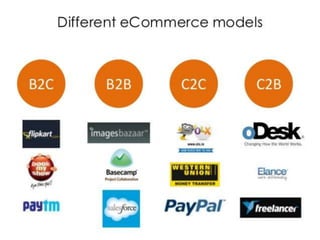
B2B - Business to Business
( Example - Intel to Dell )
B2C - Business to Consumer
( Example – e.bay, Amazon )
C2B - Consumer to Business
( Example – Freelancer )
C2C - Consumer to Consumer
( Example – OLX )
THERE ARE DIFFERENT
TYPES OF ECOMMERCE:-
SCOPE OF E-COMMERCE
BUSINESS
SCOPE OF
ECOMMERCE:-
The scope of E-commerce Business in India is
undoubtedly going to increase year after year. A
recent report by the Internet and Mobile Association of
India shows that a fast-paced growth of around 50%
is to be expected in the coming five years. The
primary attribute to this growth is undoubtedly the rise
of 3G/4G mobile internet users and a large number of
smartphone users
Another significant contributor to the growth of
ecommerce in India in the future is the e-tailing
industry which largely deals in providing jewelry,
apparel and kitchen appliances online.
SCOPE OF E-
COMMERCE:-
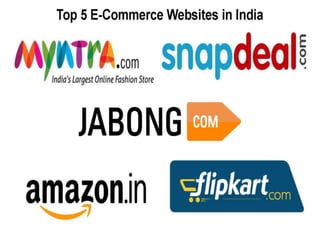
Websites like flipkart, myntra, Amazon, snapdeal,
jabong, etc. are all examples of the enormous success
of ecommerce in India. Due to these firms, India is one
of the fastest growing ecommerce markets in
Asia/Pacific
Reduction in cost of broadband internet facilities to
ensure more people come online.
Encouraging more domain registrations and letting e-
commerce websites maintain them at cheaper rates (at
least till they make substantial profits).
Encouraging innovative schemes such as the COD
(Cash on Delivery) in a country where credit card use is
not prominent shows how we have eased into this
particular niche.
REASONS WHY E-
COMMERCE GROWS DAY-
BY-DAY:-
Critical mass of Internet users: With more than 100
million Internet users, the country is beginning to
achieve a critical mass of users who are familiar with
web services.
Rising middle class with disposable
income: Throughout India’s short history, the country
has been a land of “haves” and “have-
nots”. However, with the rise of small and medium
enterprises, foreign direct investment, and India’s own
powerful multinational corporations creating millions of
new jobs, a new generation of globally-minded Indian
consumers has been created.
REASONS WHY E-COMMERCE
GROWS DAY-BY-DAY:-
User Experience: The number of e-commerce
companies has grown, companies have started to
investing more in the user experience which including
merchandising, customer service, user interface
design, and guaranteed delivery and return policy to
his customers.
Payment gateways: The E-commerce company has
been working on the policy of payment system they
started the cod (cash on Delivery ) services for there
customer for easy payment for there purchase.
ADVANTAGES OF
ECOMMERCE
ADVANTAGES OF E-
COMMERCE:-
E-Commerce advantages can be
broadly classified in three major
categories :
Advantages to organization:
1. Expansion of market.
2. Better customer services.
3. No need of physical company
setups.
2. ADVANTAGES TO
CUSTOMERS:-
1. 24 * 7 service.
2. Cheaper goods and better options
3. Customer can see the reviews before
purchasing the product.
4. Faster buying/selling procedure, as well as
easy to find products.
5. Customers can easily select products from
different providers without moving around
physically.
3. ADVANTAGES TO
SOCIETY:-
1. Customers need not travel to shop a product,
thus less traffic on road and low air pollution.
2. E-commerce helps in reducing the cost of
products, so less affluent people can also afford
the products.
3. E-commerce has enabled rural areas to access
services and products, which are otherwise not
available to them.
4. E-commerce helps the government to deliver
public services such as healthcare, education,
social services at a reduced cost and in an
improved manner.
THE DISADVANTAGES OF
ECOMMERCE CAN BE
BROADLY CLASSIFIED INTO
TWO MAJOR CATEGORIES −
TECHNICAL DISADVANTAGES
NON-TECHNICAL
DISADVANTAGES
TECHNICAL
DISADVANTAGES:-
1. There can be lack of system security,
reliability or standards owing to poor
implementation of e-commerce.
2. The software development industry is still
evolving and keeps changing rapidly.In many
countries, network bandwidth might cause an
issue.
3. Special types of web servers or other
software might be required by the vendor,
setting the e-commerce environment apart from
network servers.
4. Sometimes, it becomes difficult to integrate an
e-commerce software or website with existing
applications or databases.
5. There could be software/hardware
compatibility issues, as some e-commerce
software may be incompatible with some
operating system or any other component.
6. Mechanical failures can cause unpredictable
effects on the total processes.
NON-TECHNICAL
DISADVANTAGES:-
1. As there is minimum chance of direct customer
to company interactions, customer loyalty is
always on a check.
2. There are many hackers who look for
opportunities, and thus an ecommerce site,
service, payment gateways, all are always prone
to attack.
3. Users may not trust the site being an unknown
faceless seller. Such mistrust makes it difficult to
convince traditional users to switch from
physical stores to online/virtual stores.
4. E-commerce applications are still evolving and
changing rapidly.
5. Internet access is still not cheaper and is
inconvenient to use for many potential customers, for
example, those living in remote villages.
6. Any one, good or bad, can easily start a business.
And there are many bad sites which eat up
customers’ money.
7. There is no guarantee of product quality.
8. It is difficult to ensure the security or privacy on
online transactions.
9. Lack of touch or feel of products during online
shopping is a drawback.
THANK YOU FOR WATCHING

E-Commerce / Online Shopping

  • 2.
    ECOMMERCE PRESENTATION BY:- SAURABH TYAGI– 132 VAIBHAV KANSAL – 131 AKASH VERMA – 133 MOHD. SAIF ALAM – 130
  • 4.
  • 5.
    E-commerce (electronic commerceor EC) is the buying and selling of goods and services, or the transmitting of funds or data, over an electronic network, primarily the internet. INTRODUCTION TO ECOMMERCE:-
  • 6.
    The beginning ofe-commerce can be traced to the 1960s, when businesses started using Electronic Data Interchange (EDI) to share business documents with other companies. In 1979, the American National Standards Institute developed ASC X12 as a universal standard for businesses to share documents through electronic networks. HISTORY OF ECOMMERCE:-
  • 7.
    In 1990s therise of eBay and Amazon revolutionized the e-commerce industry. Consumers can now purchase endless amounts of items online, both from typical brick and mortar stores with e- commerce capabilities and one another.
  • 9.
    B2B - Businessto Business ( Example - Intel to Dell ) B2C - Business to Consumer ( Example – e.bay, Amazon ) C2B - Consumer to Business ( Example – Freelancer ) C2C - Consumer to Consumer ( Example – OLX ) THERE ARE DIFFERENT TYPES OF ECOMMERCE:-
  • 11.
  • 12.
    SCOPE OF ECOMMERCE:- The scopeof E-commerce Business in India is undoubtedly going to increase year after year. A recent report by the Internet and Mobile Association of India shows that a fast-paced growth of around 50% is to be expected in the coming five years. The primary attribute to this growth is undoubtedly the rise of 3G/4G mobile internet users and a large number of smartphone users Another significant contributor to the growth of ecommerce in India in the future is the e-tailing industry which largely deals in providing jewelry, apparel and kitchen appliances online.
  • 13.
    SCOPE OF E- COMMERCE:- Websiteslike flipkart, myntra, Amazon, snapdeal, jabong, etc. are all examples of the enormous success of ecommerce in India. Due to these firms, India is one of the fastest growing ecommerce markets in Asia/Pacific Reduction in cost of broadband internet facilities to ensure more people come online. Encouraging more domain registrations and letting e- commerce websites maintain them at cheaper rates (at least till they make substantial profits). Encouraging innovative schemes such as the COD (Cash on Delivery) in a country where credit card use is not prominent shows how we have eased into this particular niche.
  • 14.
    REASONS WHY E- COMMERCEGROWS DAY- BY-DAY:- Critical mass of Internet users: With more than 100 million Internet users, the country is beginning to achieve a critical mass of users who are familiar with web services. Rising middle class with disposable income: Throughout India’s short history, the country has been a land of “haves” and “have- nots”. However, with the rise of small and medium enterprises, foreign direct investment, and India’s own powerful multinational corporations creating millions of new jobs, a new generation of globally-minded Indian consumers has been created.
  • 15.
    REASONS WHY E-COMMERCE GROWSDAY-BY-DAY:- User Experience: The number of e-commerce companies has grown, companies have started to investing more in the user experience which including merchandising, customer service, user interface design, and guaranteed delivery and return policy to his customers. Payment gateways: The E-commerce company has been working on the policy of payment system they started the cod (cash on Delivery ) services for there customer for easy payment for there purchase.
  • 16.
  • 17.
    ADVANTAGES OF E- COMMERCE:- E-Commerceadvantages can be broadly classified in three major categories : Advantages to organization: 1. Expansion of market. 2. Better customer services. 3. No need of physical company setups.
  • 18.
    2. ADVANTAGES TO CUSTOMERS:- 1.24 * 7 service. 2. Cheaper goods and better options 3. Customer can see the reviews before purchasing the product. 4. Faster buying/selling procedure, as well as easy to find products. 5. Customers can easily select products from different providers without moving around physically.
  • 19.
    3. ADVANTAGES TO SOCIETY:- 1.Customers need not travel to shop a product, thus less traffic on road and low air pollution. 2. E-commerce helps in reducing the cost of products, so less affluent people can also afford the products. 3. E-commerce has enabled rural areas to access services and products, which are otherwise not available to them. 4. E-commerce helps the government to deliver public services such as healthcare, education, social services at a reduced cost and in an improved manner.
  • 20.
    THE DISADVANTAGES OF ECOMMERCECAN BE BROADLY CLASSIFIED INTO TWO MAJOR CATEGORIES − TECHNICAL DISADVANTAGES NON-TECHNICAL DISADVANTAGES
  • 21.
    TECHNICAL DISADVANTAGES:- 1. There canbe lack of system security, reliability or standards owing to poor implementation of e-commerce. 2. The software development industry is still evolving and keeps changing rapidly.In many countries, network bandwidth might cause an issue. 3. Special types of web servers or other software might be required by the vendor, setting the e-commerce environment apart from network servers.
  • 22.
    4. Sometimes, itbecomes difficult to integrate an e-commerce software or website with existing applications or databases. 5. There could be software/hardware compatibility issues, as some e-commerce software may be incompatible with some operating system or any other component. 6. Mechanical failures can cause unpredictable effects on the total processes.
  • 23.
    NON-TECHNICAL DISADVANTAGES:- 1. As thereis minimum chance of direct customer to company interactions, customer loyalty is always on a check. 2. There are many hackers who look for opportunities, and thus an ecommerce site, service, payment gateways, all are always prone to attack. 3. Users may not trust the site being an unknown faceless seller. Such mistrust makes it difficult to convince traditional users to switch from physical stores to online/virtual stores.
  • 24.
    4. E-commerce applicationsare still evolving and changing rapidly. 5. Internet access is still not cheaper and is inconvenient to use for many potential customers, for example, those living in remote villages. 6. Any one, good or bad, can easily start a business. And there are many bad sites which eat up customers’ money. 7. There is no guarantee of product quality. 8. It is difficult to ensure the security or privacy on online transactions. 9. Lack of touch or feel of products during online shopping is a drawback.
  • 25.
    THANK YOU FORWATCHING