E-Commerce 
BY IRANNA TEGGI
Contents 
 What is Commerce? 
 What is e-commerce? 
 The process of e-commerce 
 History of e-commerce 
 Different Types of e-commerce 
 Advantages of e-commerce 
 Disadvantages of e-commerce 
 Future of e-commerce
“I think a simple rule of business is, 
if you do the things that are easier 
first, then you can actually make 
a lot of progress.” 
Mark Zuckerberg
What is Commerce? 
 According to Wiki, commerce is defined as 
Commerce is the whole system of an economy that constitutes an 
environment for business. The system includes legal, economic, political, 
social, cultural and technological systems that are in operation in any 
country. 
 As per businessdictionary.com, 
Exchange of goods or services for money or in kind, usually on 
a scale large enough to require transportation from place to place or 
across city, state, or national boundaries.
What is e-commerce? 
 Electronic commerce, commonly known as e-commerce or e- 
Commerce, is a type of industry where the buying and selling of products 
or services is conducted over electronic systems such as the Internet and 
other computer networks. 
 E-commerce draws on technologies such as mobile commerce, 
electronic funds transfer, supply chain management, Internet marketing, 
online transaction processing, electronic data interchange (EDI), 
inventory management systems, and automated data collection systems. 
 Modern electronic commerce typically uses the World Wide Web at least 
at one point in the transaction's life-cycle, although it may encompass a 
wider range of technologies such as e-mail, mobile devices, social media, 
and telephones as well
The process of e-commerce
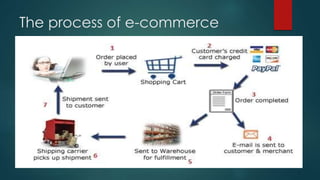
The process of e-commerce 
1. Customer can browse through e-commerce and add the selected 
products to virtual shopping cart. And Order can be placed via 
internet or phone call. 
2. Customer shall be charged for Order. 
3. After successful payment, Order is confirmed for further processing. 
4. Email containing Ordered product’s details will be sent to Customer 
and Merchant. 
5. Further Order is sent to Warehouse for order fulfillment. 
6. After the shipment is ready from Warehouse, it is picked by Shipping 
carrier. 
7. Shipment is sent to Customer and Order is completed.
History of e-commerce 
 1979: Michael Aldrich demonstrates the first online shopping system. 
 1981: Thomson Holidays UK is first business-to-business online shopping system to be 
installed. 
 1995: Jeff Bezos launches Amazon.com and the first commercial-free 24-hour, 
internet-only radio stations, Radio HK and NetRadio start broadcasting. Dell and 
Cisco begin to aggressively use Internet for commercial transactions. eBay is 
founded by computer programmer Pierre Omidyar as AuctionWeb. 
 1996: IndiaMART B2B marketplace established in India. 
 2000: The dot-com bust. 
 2012: US eCommerce and Online Retail sales projected to reach $226 billion, an 
increase of 12 percent over 2011 
 2012: US eCommerce and Online Retail holiday sales reach $33.8 billion, up 13 
percent. 
 2014: India’s e-commerce industry is estimated to have grown more than 30% from a 
year earlier to $12.6 billion in 2013
Different Types of e-commerce 
 Business-to-Business (B2B) 
 Business-to-Consumer (B2C) 
 Business-to-government (B2G) 
 Consumer-to-Consumer (C2C) 
 Mobile-Commerce (m-Commerce)
Business-to-Business (B2B) 
 Business-to-business (B2B) describes commerce transactions 
between businesses, such as between a manufacturer and a 
wholesaler, or between a wholesaler and a retailer. 
 An example that illustrates the business to business concept is 
automobile manufacturing. Many of a vehicle's components are 
manufactured independently and the auto manufacturer must 
purchase these parts separately. For instance, the tires, batteries, 
electronics, hoses and door locks may be manufactured elsewhere 
and sold directly to the automobile manufacturer. 
 Ex: McMaster-Carr, Fastenal, Grainger, Quill
Business-to-Consumer (B2C) 
 B2C e-commerce is a business-to-consumer type of e-commerce 
where a consumer in the general public can simply purchase a 
product or a service that is advertised on a catalogue placed on a 
website. 
 Few examples of B2C Comemerce 
 Retail: amazon.com, ebay.com, flipkart.com 
 Services: (Online travel reservations) redbus.in, makemytrip.com 
 Financial Services: Online banking, Telephone banking.
Business-to-government (B2G) 
 Business-to-government (B2G) is a business model that refers to 
businesses selling products, services or information to governments 
or government agencies. 
 For example, a Web site offering B2G services could provide 
businesses with a single place to locate applications and tax forms 
for one or more levels of government (city, state or province, 
country, and so forth); provide the ability to send in filled-out forms 
and payments; update corporate information; request answers to 
specific questions; and so forth. B2G may also include e-procurement 
services, in which businesses learn about the 
purchasing needs of agencies and agencies request proposal 
responses. 
 B2G is sometimes called e-government.
Consumer-to-Consumer (C2C) 
 Customer to Customer (C2C) markets are innovative ways to allow 
customers to interact with each other. 
 Website following C2C business model helps consumer to sell their 
assets like residential property, cars, motorcycles etc. or rent a room 
by publishing their information on the website. Website may or may 
not charge the consumer for its services. Another consumer may opt 
to buy the product of the first customer by viewing the 
post/advertisement on the website. 
 Example: olx.in, quikr.com
Mobile-Commerce (m-Commerce) 
 Also known as Mobile E-Commerce 
 Mobile e-commerce (m-commerce) is a term that describes online 
sales transactions that use wireless electronic devices such as hand-held 
computers, mobile phones or laptops. 
 Mobile e-commerce is just one of the many subsets of electronic 
commerce.
Advantages of e-commerce 
 Faster buying/selling procedure, as well as easy to find products. 
 Buying/selling 24/7. 
 More reach to customers, there is no theoretical geographic 
limitations. 
 No need of physical company set-ups. 
 Easy to start and manage a business. 
 Customers can easily select products from different providers 
without moving around physically. 
 Low operational costs and better quality of services.
Disadvantages of e-commerce 
 Lack of Personal Touch 
 Inability to Experience the Product Before Purchase 
 Need for an Internet Access Device 
 Need for an Internet Connection 
 Any one, good or bad, can easily start a business. And there are 
many bad sites which eat up customers’ money. 
 There are many hackers who look for opportunities, and thus an 
ecommerce site, service, payment gateways, all are always prone 
to attack. 
 As there is minimum chance of direct customer to company 
interactions, customer loyalty is always on a check.
Future of e-commerce 
 Credit cards will soon become a thing of the past. In the future, e-wallets 
will be synched to an individual’s fingerprint, making the 
online checkout process streamlined, safe, secure and easy. 
 Customers are your best salespeople. Social media is growing in 
importance for big and small business alike. 
 Online purchases are delivered in 30 minutes…faster than a pizza. 
 Companies like Corning Glass are revolutionizing the tech industry 
by pioneering responsive, touch-driven display glass that will soon 
be used to make just about everything in our lives interactive. 
 Another key area is 3-D printing in the future of ecommerce. Pretty 
soon we should be able to offer the option where customers can 
actually print out their own clothing. This is very much in the early 
stages but we could definitely see this happening within the next 2 
to 5 years.
Thank-You

e-Commerce

  • 1.
  • 2.
    Contents  Whatis Commerce?  What is e-commerce?  The process of e-commerce  History of e-commerce  Different Types of e-commerce  Advantages of e-commerce  Disadvantages of e-commerce  Future of e-commerce
  • 3.
    “I think asimple rule of business is, if you do the things that are easier first, then you can actually make a lot of progress.” Mark Zuckerberg
  • 4.
    What is Commerce?  According to Wiki, commerce is defined as Commerce is the whole system of an economy that constitutes an environment for business. The system includes legal, economic, political, social, cultural and technological systems that are in operation in any country.  As per businessdictionary.com, Exchange of goods or services for money or in kind, usually on a scale large enough to require transportation from place to place or across city, state, or national boundaries.
  • 5.
    What is e-commerce?  Electronic commerce, commonly known as e-commerce or e- Commerce, is a type of industry where the buying and selling of products or services is conducted over electronic systems such as the Internet and other computer networks.  E-commerce draws on technologies such as mobile commerce, electronic funds transfer, supply chain management, Internet marketing, online transaction processing, electronic data interchange (EDI), inventory management systems, and automated data collection systems.  Modern electronic commerce typically uses the World Wide Web at least at one point in the transaction's life-cycle, although it may encompass a wider range of technologies such as e-mail, mobile devices, social media, and telephones as well
  • 6.
    The process ofe-commerce
  • 7.
    The process ofe-commerce 1. Customer can browse through e-commerce and add the selected products to virtual shopping cart. And Order can be placed via internet or phone call. 2. Customer shall be charged for Order. 3. After successful payment, Order is confirmed for further processing. 4. Email containing Ordered product’s details will be sent to Customer and Merchant. 5. Further Order is sent to Warehouse for order fulfillment. 6. After the shipment is ready from Warehouse, it is picked by Shipping carrier. 7. Shipment is sent to Customer and Order is completed.
  • 8.
    History of e-commerce  1979: Michael Aldrich demonstrates the first online shopping system.  1981: Thomson Holidays UK is first business-to-business online shopping system to be installed.  1995: Jeff Bezos launches Amazon.com and the first commercial-free 24-hour, internet-only radio stations, Radio HK and NetRadio start broadcasting. Dell and Cisco begin to aggressively use Internet for commercial transactions. eBay is founded by computer programmer Pierre Omidyar as AuctionWeb.  1996: IndiaMART B2B marketplace established in India.  2000: The dot-com bust.  2012: US eCommerce and Online Retail sales projected to reach $226 billion, an increase of 12 percent over 2011  2012: US eCommerce and Online Retail holiday sales reach $33.8 billion, up 13 percent.  2014: India’s e-commerce industry is estimated to have grown more than 30% from a year earlier to $12.6 billion in 2013
  • 9.
    Different Types ofe-commerce  Business-to-Business (B2B)  Business-to-Consumer (B2C)  Business-to-government (B2G)  Consumer-to-Consumer (C2C)  Mobile-Commerce (m-Commerce)
  • 10.
    Business-to-Business (B2B) Business-to-business (B2B) describes commerce transactions between businesses, such as between a manufacturer and a wholesaler, or between a wholesaler and a retailer.  An example that illustrates the business to business concept is automobile manufacturing. Many of a vehicle's components are manufactured independently and the auto manufacturer must purchase these parts separately. For instance, the tires, batteries, electronics, hoses and door locks may be manufactured elsewhere and sold directly to the automobile manufacturer.  Ex: McMaster-Carr, Fastenal, Grainger, Quill
  • 11.
    Business-to-Consumer (B2C) B2C e-commerce is a business-to-consumer type of e-commerce where a consumer in the general public can simply purchase a product or a service that is advertised on a catalogue placed on a website.  Few examples of B2C Comemerce  Retail: amazon.com, ebay.com, flipkart.com  Services: (Online travel reservations) redbus.in, makemytrip.com  Financial Services: Online banking, Telephone banking.
  • 12.
    Business-to-government (B2G) Business-to-government (B2G) is a business model that refers to businesses selling products, services or information to governments or government agencies.  For example, a Web site offering B2G services could provide businesses with a single place to locate applications and tax forms for one or more levels of government (city, state or province, country, and so forth); provide the ability to send in filled-out forms and payments; update corporate information; request answers to specific questions; and so forth. B2G may also include e-procurement services, in which businesses learn about the purchasing needs of agencies and agencies request proposal responses.  B2G is sometimes called e-government.
  • 13.
    Consumer-to-Consumer (C2C) Customer to Customer (C2C) markets are innovative ways to allow customers to interact with each other.  Website following C2C business model helps consumer to sell their assets like residential property, cars, motorcycles etc. or rent a room by publishing their information on the website. Website may or may not charge the consumer for its services. Another consumer may opt to buy the product of the first customer by viewing the post/advertisement on the website.  Example: olx.in, quikr.com
  • 14.
    Mobile-Commerce (m-Commerce) Also known as Mobile E-Commerce  Mobile e-commerce (m-commerce) is a term that describes online sales transactions that use wireless electronic devices such as hand-held computers, mobile phones or laptops.  Mobile e-commerce is just one of the many subsets of electronic commerce.
  • 15.
    Advantages of e-commerce  Faster buying/selling procedure, as well as easy to find products.  Buying/selling 24/7.  More reach to customers, there is no theoretical geographic limitations.  No need of physical company set-ups.  Easy to start and manage a business.  Customers can easily select products from different providers without moving around physically.  Low operational costs and better quality of services.
  • 16.
    Disadvantages of e-commerce  Lack of Personal Touch  Inability to Experience the Product Before Purchase  Need for an Internet Access Device  Need for an Internet Connection  Any one, good or bad, can easily start a business. And there are many bad sites which eat up customers’ money.  There are many hackers who look for opportunities, and thus an ecommerce site, service, payment gateways, all are always prone to attack.  As there is minimum chance of direct customer to company interactions, customer loyalty is always on a check.
  • 17.
    Future of e-commerce  Credit cards will soon become a thing of the past. In the future, e-wallets will be synched to an individual’s fingerprint, making the online checkout process streamlined, safe, secure and easy.  Customers are your best salespeople. Social media is growing in importance for big and small business alike.  Online purchases are delivered in 30 minutes…faster than a pizza.  Companies like Corning Glass are revolutionizing the tech industry by pioneering responsive, touch-driven display glass that will soon be used to make just about everything in our lives interactive.  Another key area is 3-D printing in the future of ecommerce. Pretty soon we should be able to offer the option where customers can actually print out their own clothing. This is very much in the early stages but we could definitely see this happening within the next 2 to 5 years.
  • 18.