IntroductionE – CommerceCassandra Mecca, Yan RaoApril. 13/2011
Table of Contents1.	E-commerce  		-1.1 Definition  		-1.2 Major Categories2.Online shopping 		-2.1 Online shopping overview		-2.2 Online shopping statistics 		-2.3 Types of online shopping		-2.4 Payment methods 3.Pros and Cons
4.Summary and conclusion
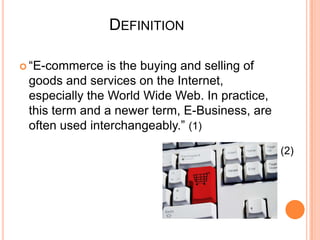
5. ReferencesDefinition“E-commerce is the buying and selling of goods and services on the Internet, especially the World Wide Web. In practice, this term and a newer term, E-Business, are often used interchangeably.” (1) (2)
Major Categories of E-commerce Business-to-Consumer (B2C)Any business that sells product/service over the internet. Direct sale between supplier and consumer. 1995- Ebay.com & Amazon.com (3)(6)
Major Categories of E-commerce  cont. Business-to-Business (B2B)Online transactions between businesses. Companies that specialize in: -Marketing strategies 	-Advertising-Email companies-Website development Online magazines (E-commerce times, BtoBOnline.com) (3)(7)
Major Categories of E-commerce  cont. Consumer-to-Consumer / Peer-to-Peer (C2C,P2P)Exchanges between consumers. Can involve third-party.Examples: E-bay, KijijiBid or sell items for any given price. (3)(8)
Major Categories of E-commerce  cont. Consumer-to-Business (C2B)Consumers present themselves as a buyer group.Examples: CTB, Speakout.comSites provide consumer with market strategies.Businesses gain insight into consumer wants. (3)
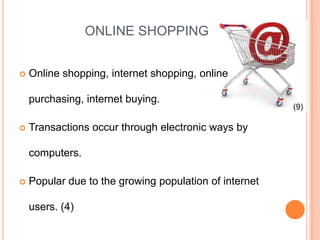
ONLINE SHOPPING Online shopping, internet shopping, online purchasing, internet buying. Transactions occur through electronic ways by computers. Popular due to the growing population of internet users. (4)(9)
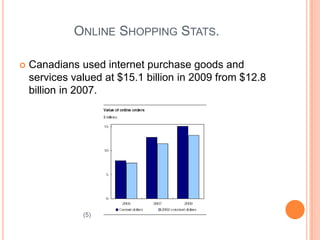
Online Shopping Stats. Canadians used internet purchase goods and services valued at $15.1 billion in 2009 from $12.8 billion in 2007. (5)
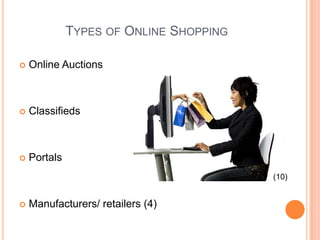
Types of Online Shopping Online AuctionsClassifieds Portals Manufacturers/ retailers (4)(10)
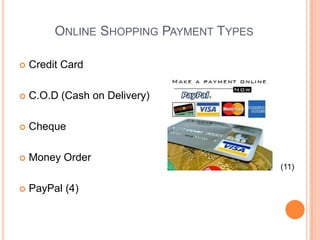
    Online Shopping Payment Types Credit CardC.O.D (Cash on Delivery) ChequeMoney Order PayPal (4) (11)
Online Shopping Pros and Cons Pros For ConsumerLower prices Wider selection of productProducts are easy to find in categories and easy to be comparedInternational customer accessNo inventory needed Shop in the comfort of your own home 24/7 business hours (12)(14)
Online Shopping Pros and Cons cont.Pros for BusinessIncrease market shareEnable access to an international market Increase productivity (12)
Online Shopping Pros and Cons cont.Cons for Consumer Cannot feel, touch, or try on items. Shipping Costs Required credit card for security purposesDistribution of private information. (Name, Address, ect.)  (13)(14)
Online Shopping Pros and Cons cont.Cons for BusinessesCost to build a webset that has certain hardware and software required Difficult to build customer trust (13)
Summary & Conclusion E-commerce is a great way for businesses and consumers to interact internationally. The future of E-commerce will drastically progress over the years as the amount of internet users among businesses and consumers grows drastically every year. (15)

E commerce

  • 1.
    IntroductionE – CommerceCassandraMecca, Yan RaoApril. 13/2011
  • 2.
    Table of Contents1. E-commerce -1.1 Definition -1.2 Major Categories2.Online shopping -2.1 Online shopping overview -2.2 Online shopping statistics -2.3 Types of online shopping -2.4 Payment methods 3.Pros and Cons
  • 3.
  • 4.
    5. ReferencesDefinition“E-commerce isthe buying and selling of goods and services on the Internet, especially the World Wide Web. In practice, this term and a newer term, E-Business, are often used interchangeably.” (1) (2)
  • 5.
    Major Categories ofE-commerce Business-to-Consumer (B2C)Any business that sells product/service over the internet. Direct sale between supplier and consumer. 1995- Ebay.com & Amazon.com (3)(6)
  • 6.
    Major Categories ofE-commerce cont. Business-to-Business (B2B)Online transactions between businesses. Companies that specialize in: -Marketing strategies -Advertising-Email companies-Website development Online magazines (E-commerce times, BtoBOnline.com) (3)(7)
  • 7.
    Major Categories ofE-commerce cont. Consumer-to-Consumer / Peer-to-Peer (C2C,P2P)Exchanges between consumers. Can involve third-party.Examples: E-bay, KijijiBid or sell items for any given price. (3)(8)
  • 8.
    Major Categories ofE-commerce cont. Consumer-to-Business (C2B)Consumers present themselves as a buyer group.Examples: CTB, Speakout.comSites provide consumer with market strategies.Businesses gain insight into consumer wants. (3)
  • 9.
    ONLINE SHOPPING Onlineshopping, internet shopping, online purchasing, internet buying. Transactions occur through electronic ways by computers. Popular due to the growing population of internet users. (4)(9)
  • 10.
    Online Shopping Stats.Canadians used internet purchase goods and services valued at $15.1 billion in 2009 from $12.8 billion in 2007. (5)
  • 11.
    Types of OnlineShopping Online AuctionsClassifieds Portals Manufacturers/ retailers (4)(10)
  • 12.
    Online Shopping Payment Types Credit CardC.O.D (Cash on Delivery) ChequeMoney Order PayPal (4) (11)
  • 13.
    Online Shopping Prosand Cons Pros For ConsumerLower prices Wider selection of productProducts are easy to find in categories and easy to be comparedInternational customer accessNo inventory needed Shop in the comfort of your own home 24/7 business hours (12)(14)
  • 14.
    Online Shopping Prosand Cons cont.Pros for BusinessIncrease market shareEnable access to an international market Increase productivity (12)
  • 15.
    Online Shopping Prosand Cons cont.Cons for Consumer Cannot feel, touch, or try on items. Shipping Costs Required credit card for security purposesDistribution of private information. (Name, Address, ect.) (13)(14)
  • 16.
    Online Shopping Prosand Cons cont.Cons for BusinessesCost to build a webset that has certain hardware and software required Difficult to build customer trust (13)
  • 17.
    Summary & ConclusionE-commerce is a great way for businesses and consumers to interact internationally. The future of E-commerce will drastically progress over the years as the amount of internet users among businesses and consumers grows drastically every year. (15)