
GOVT. S.P.M.R COLLEGE OF COMMERCE
SEMINAR PRESENTATION
SUBMITTED BY:
RESHAV MAHAJAN
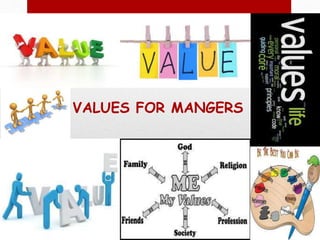
VALUES FOR MANGERS
“If you stand for
nothing.
You fall for anything.”
WHAT ARE VALUES????
• Qualities, characteristics, or ideas about which we feel
strongly.
• Our values affect our decisions, goals and behavior.
• A belief or feeling that someone or something is
worthwhile.
• Values define what is of worth, what is beneficial, and what
is harmful
• Values are standards to guide your action, judgments, and
attitudes.
CONTD…
• Values are ideals that guide or qualify your personal
conduct, interaction with others, and involvement in your
career. Like morals, they
• help you to distinguish what is right from what is wrong
and
• inform you on how you can conduct your life in a
meaningful way.
TYPES OF VALUES
• Theoretical : interested in the discovery of truth through
reasoning and systematic thinking .
• Economic: interest in usefulness and practicality, including the
accumulation of wealth.
• Social: interest in people and love as a human relationship.
• Political: interest in gaining power and influencing people.
• Religious: interest in unity and understanding the cosmos as a
whole.
DIRECTION:
VALUES – GOALS – BEHAVIOR –
SELF-VALUE
• Values give direction and consistency to behavior.
• Values help you know what to and not to make time
for.
• Values establish a relationship between you and the
world.
• Values set the direction for one’s life.
YOUR AGE WILL GREATLY INFLUENCE
YOUR VALUES. DIFFERENT PEOPLE AND
THINGS INFLUENCE YOU AT DIFFERENT
AGES:
• Ages 1-7 --- parents
• Ages 8-13 --- teachers, heroes (sports, rocks, TV)
• Ages 14-20 --- peers (values because of peers or peers
because of values?)
• Ages 21+ your values are established, but you may
test your values from time to time.
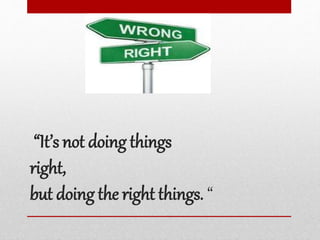
“It’s not doing things
right,
but doing the right things. “
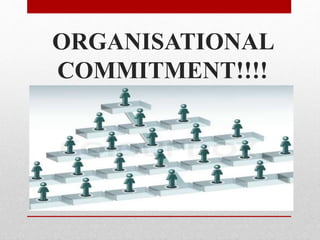
ORGANISATIONAL
COMMITMENT!!!!
ORGANIZATIONAL COMMITMENT
• An employee’s loyalty to the organization, willingness
to exert effort on behalf of the organization, associated
with the acceptance of the organization’s goal and
values and desire to maintain membership.
• A worker’s feeling and attitudes about the entire work
organizations.
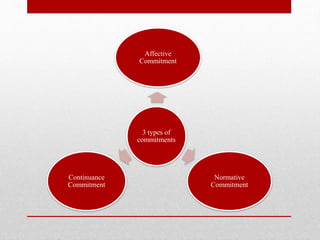
3 types of
commitments
Affective
Commitment
Normative
Commitment
Continuance
Commitment
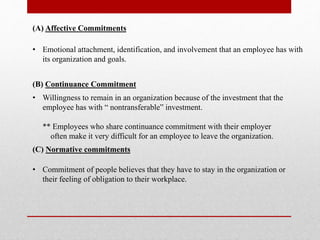
(A) Affective Commitments
• Emotional attachment, identification, and involvement that an employee has with
its organization and goals.
(B) Continuance Commitment
• Willingness to remain in an organization because of the investment that the
employee has with “ nontransferable” investment.
** Employees who share continuance commitment with their employer
often make it very difficult for an employee to leave the organization.
(C) Normative commitments
• Commitment of people believes that they have to stay in the organization or
their feeling of obligation to their workplace.
In order to make this clear , those employee’s with a strong affective
commitment will remain with an organization because they want to,
those with a strong continuance commitment remain because they have
to, and those with a normative commitment remain because they fell that
they have to.
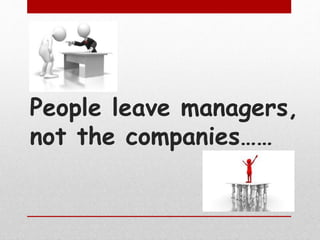
People leave managers,
not the companies……
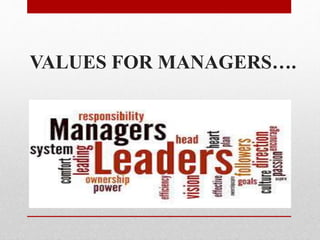
VALUES FOR MANAGERS….
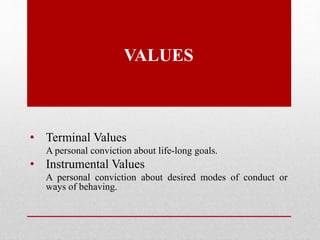
VALUES
• Terminal Values
A personal conviction about life-long goals.
• Instrumental Values
A personal conviction about desired modes of conduct or
ways of behaving.
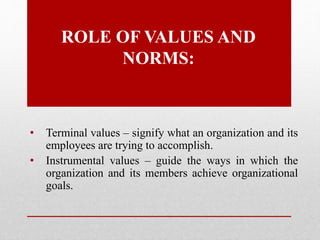
ROLE OF VALUES AND
NORMS:
• Terminal values – signify what an organization and its
employees are trying to accomplish.
• Instrumental values – guide the ways in which the
organization and its members achieve organizational
goals.
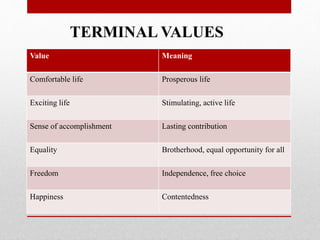
Value Meaning
Comfortable life Prosperous life
Exciting life Stimulating, active life
Sense of accomplishment Lasting contribution
Equality Brotherhood, equal opportunity for all
Freedom Independence, free choice
Happiness Contentedness
TERMINAL VALUES
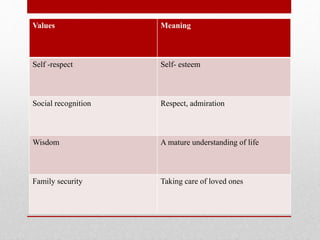
Values Meaning
Self -respect Self- esteem
Social recognition Respect, admiration
Wisdom A mature understanding of life
Family security Taking care of loved ones
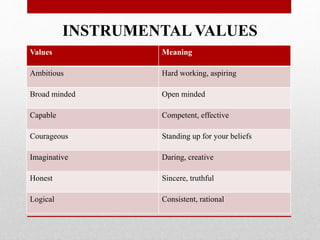
Values Meaning
Ambitious Hard working, aspiring
Broad minded Open minded
Capable Competent, effective
Courageous Standing up for your beliefs
Imaginative Daring, creative
Honest Sincere, truthful
Logical Consistent, rational
INSTRUMENTAL VALUES
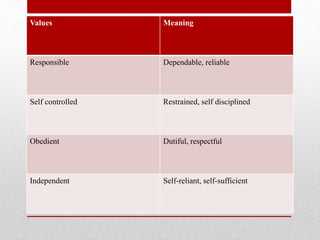
Values Meaning
Responsible Dependable, reliable
Self controlled Restrained, self disciplined
Obedient Dutiful, respectful
Independent Self-reliant, self-sufficient
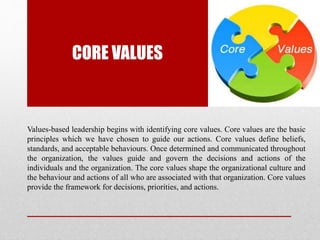
CORE VALUES
Values-based leadership begins with identifying core values. Core values are the basic
principles which we have chosen to guide our actions. Core values define beliefs,
standards, and acceptable behaviours. Once determined and communicated throughout
the organization, the values guide and govern the decisions and actions of the
individuals and the organization. The core values shape the organizational culture and
the behaviour and actions of all who are associated with that organization. Core values
provide the framework for decisions, priorities, and actions.
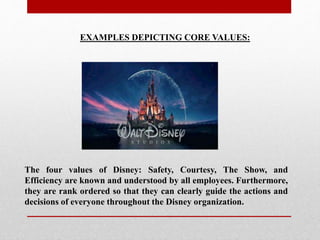
The four values of Disney: Safety, Courtesy, The Show, and
Efficiency are known and understood by all employees. Furthermore,
they are rank ordered so that they can clearly guide the actions and
decisions of everyone throughout the Disney organization.
EXAMPLES DEPICTING CORE VALUES:
The Quality Principle of Mars, Inc., “The consumer is our boss,
quality is our work, and value for the money is our goal,”has the
same benefit for everyone who is associated with that company.
Top 6 qualities of a good
manager????????
a) Creativity: Creativity is what separates competence from excellence.
Creativity is the spark that propels projects forward and that captures
peoples' attention.
b) Knowledge: A thorough knowledge base is essential. The knowledge
base must be so ingrained and integrated into their being that they
become ‘transparent’, focusing on the employee and what she/he needs to
learn, versus focusing on the knowledge base.
c) Commitment: A manager is committed to the success of the project and
of all team members. She/he holds the vision for the collective team and
moves the team closer to the end result.
d) Being Human: Employees value leaders who are human and who
don't hide behind their authority. The best leaders are those who aren't
afraid to be themselves.
e)Versatility: Flexibility and versatility are valuable qualities in a
manager. Beneath the flexibility and versatility is an ability to be both
non-reactive and not attached to how things have to be.
f) Discipline/Focus:Discipline is the ability to choose and live from
what one pays attention to. Discipline as self-mastery can be
exhilarating! Role model the ability to live from your intention
consistently and you'll role model an important leadership quality.
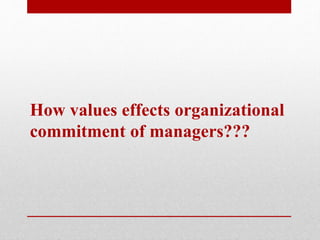
How values effects organizational
commitment of managers???
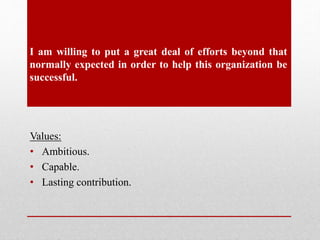
I am willing to put a great deal of efforts beyond that
normally expected in order to help this organization be
successful.
Values:
• Ambitious.
• Capable.
• Lasting contribution.
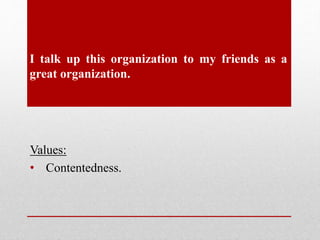
I talk up this organization to my friends as a
great organization.
Values:
• Contentedness.
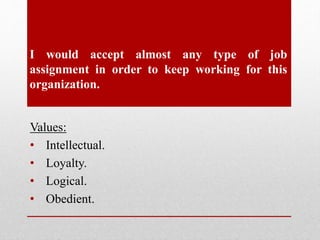
I would accept almost any type of job
assignment in order to keep working for this
organization.
Values:
• Intellectual.
• Loyalty.
• Logical.
• Obedient.
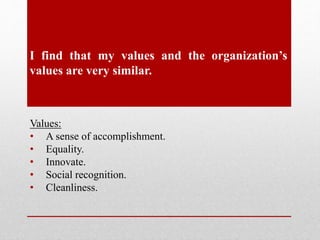
I find that my values and the organization’s
values are very similar.
Values:
• A sense of accomplishment.
• Equality.
• Innovate.
• Social recognition.
• Cleanliness.
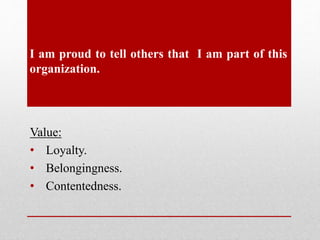
I am proud to tell others that I am part of this
organization.
Value:
• Loyalty.
• Belongingness.
• Contentedness.
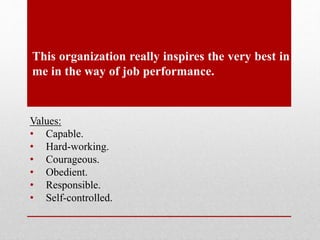
This organization really inspires the very best in
me in the way of job performance.
Values:
• Capable.
• Hard-working.
• Courageous.
• Obedient.
• Responsible.
• Self-controlled.
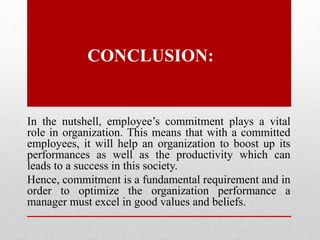
CONCLUSION:
In the nutshell, employee’s commitment plays a vital
role in organization. This means that with a committed
employees, it will help an organization to boost up its
performances as well as the productivity which can
leads to a success in this society.
Hence, commitment is a fundamental requirement and in
order to optimize the organization performance a
manager must excel in good values and beliefs.
Hidden values game!!!
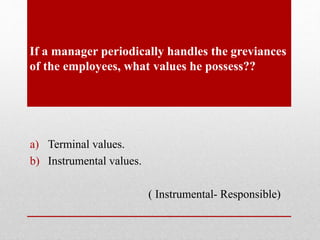
If a manager periodically handles the greviances
of the employees, what values he possess??
a) Terminal values.
b) Instrumental values.
( Instrumental- Responsible)
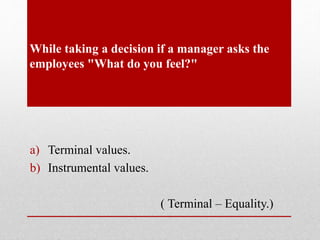
While taking a decision if a manager asks the
employees "What do you feel?"
a) Terminal values.
b) Instrumental values.
( Terminal – Equality.)
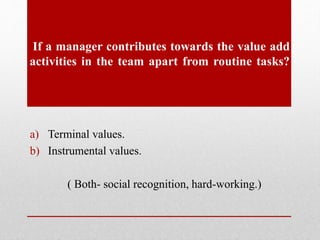
If a manager contributes towards the value add
activities in the team apart from routine tasks?
a) Terminal values.
b) Instrumental values.
( Both- social recognition, hard-working.)
Do you make sure the person whom you are
allocating the task has the necessary competency to
execute that?
a) Terminal values.
b) Instrumental values.
( Instrumental- Daring.)
If a manager says what he wants to say without
spoiling the relationship?
a) Terminal values.
b) Instrumental values.
( Terminal – wisdom.)
THANK YOU!!!!

What are values

  • 1.
    GOVT. S.P.M.R COLLEGEOF COMMERCE SEMINAR PRESENTATION SUBMITTED BY: RESHAV MAHAJAN
  • 2.
  • 3.
    “If you standfor nothing. You fall for anything.”
  • 4.
    WHAT ARE VALUES???? •Qualities, characteristics, or ideas about which we feel strongly. • Our values affect our decisions, goals and behavior. • A belief or feeling that someone or something is worthwhile. • Values define what is of worth, what is beneficial, and what is harmful • Values are standards to guide your action, judgments, and attitudes.
  • 5.
    CONTD… • Values areideals that guide or qualify your personal conduct, interaction with others, and involvement in your career. Like morals, they • help you to distinguish what is right from what is wrong and • inform you on how you can conduct your life in a meaningful way.
  • 6.
    TYPES OF VALUES •Theoretical : interested in the discovery of truth through reasoning and systematic thinking . • Economic: interest in usefulness and practicality, including the accumulation of wealth. • Social: interest in people and love as a human relationship. • Political: interest in gaining power and influencing people. • Religious: interest in unity and understanding the cosmos as a whole.
  • 7.
    DIRECTION: VALUES – GOALS– BEHAVIOR – SELF-VALUE • Values give direction and consistency to behavior. • Values help you know what to and not to make time for. • Values establish a relationship between you and the world. • Values set the direction for one’s life.
  • 8.
    YOUR AGE WILLGREATLY INFLUENCE YOUR VALUES. DIFFERENT PEOPLE AND THINGS INFLUENCE YOU AT DIFFERENT AGES: • Ages 1-7 --- parents • Ages 8-13 --- teachers, heroes (sports, rocks, TV) • Ages 14-20 --- peers (values because of peers or peers because of values?) • Ages 21+ your values are established, but you may test your values from time to time.
  • 9.
    “It’s not doingthings right, but doing the right things. “
  • 10.
  • 11.
    ORGANIZATIONAL COMMITMENT • Anemployee’s loyalty to the organization, willingness to exert effort on behalf of the organization, associated with the acceptance of the organization’s goal and values and desire to maintain membership. • A worker’s feeling and attitudes about the entire work organizations.
  • 12.
  • 13.
    (A) Affective Commitments •Emotional attachment, identification, and involvement that an employee has with its organization and goals. (B) Continuance Commitment • Willingness to remain in an organization because of the investment that the employee has with “ nontransferable” investment. ** Employees who share continuance commitment with their employer often make it very difficult for an employee to leave the organization. (C) Normative commitments • Commitment of people believes that they have to stay in the organization or their feeling of obligation to their workplace.
  • 14.
    In order tomake this clear , those employee’s with a strong affective commitment will remain with an organization because they want to, those with a strong continuance commitment remain because they have to, and those with a normative commitment remain because they fell that they have to.
  • 15.
    People leave managers, notthe companies……
  • 16.
  • 17.
    VALUES • Terminal Values Apersonal conviction about life-long goals. • Instrumental Values A personal conviction about desired modes of conduct or ways of behaving.
  • 18.
    ROLE OF VALUESAND NORMS: • Terminal values – signify what an organization and its employees are trying to accomplish. • Instrumental values – guide the ways in which the organization and its members achieve organizational goals.
  • 19.
    Value Meaning Comfortable lifeProsperous life Exciting life Stimulating, active life Sense of accomplishment Lasting contribution Equality Brotherhood, equal opportunity for all Freedom Independence, free choice Happiness Contentedness TERMINAL VALUES
  • 20.
    Values Meaning Self -respectSelf- esteem Social recognition Respect, admiration Wisdom A mature understanding of life Family security Taking care of loved ones
  • 21.
    Values Meaning Ambitious Hardworking, aspiring Broad minded Open minded Capable Competent, effective Courageous Standing up for your beliefs Imaginative Daring, creative Honest Sincere, truthful Logical Consistent, rational INSTRUMENTAL VALUES
  • 22.
    Values Meaning Responsible Dependable,reliable Self controlled Restrained, self disciplined Obedient Dutiful, respectful Independent Self-reliant, self-sufficient
  • 23.
    CORE VALUES Values-based leadershipbegins with identifying core values. Core values are the basic principles which we have chosen to guide our actions. Core values define beliefs, standards, and acceptable behaviours. Once determined and communicated throughout the organization, the values guide and govern the decisions and actions of the individuals and the organization. The core values shape the organizational culture and the behaviour and actions of all who are associated with that organization. Core values provide the framework for decisions, priorities, and actions.
  • 24.
    The four valuesof Disney: Safety, Courtesy, The Show, and Efficiency are known and understood by all employees. Furthermore, they are rank ordered so that they can clearly guide the actions and decisions of everyone throughout the Disney organization. EXAMPLES DEPICTING CORE VALUES:
  • 25.
    The Quality Principleof Mars, Inc., “The consumer is our boss, quality is our work, and value for the money is our goal,”has the same benefit for everyone who is associated with that company.
  • 26.
    Top 6 qualitiesof a good manager????????
  • 27.
    a) Creativity: Creativityis what separates competence from excellence. Creativity is the spark that propels projects forward and that captures peoples' attention. b) Knowledge: A thorough knowledge base is essential. The knowledge base must be so ingrained and integrated into their being that they become ‘transparent’, focusing on the employee and what she/he needs to learn, versus focusing on the knowledge base. c) Commitment: A manager is committed to the success of the project and of all team members. She/he holds the vision for the collective team and moves the team closer to the end result.
  • 28.
    d) Being Human:Employees value leaders who are human and who don't hide behind their authority. The best leaders are those who aren't afraid to be themselves. e)Versatility: Flexibility and versatility are valuable qualities in a manager. Beneath the flexibility and versatility is an ability to be both non-reactive and not attached to how things have to be. f) Discipline/Focus:Discipline is the ability to choose and live from what one pays attention to. Discipline as self-mastery can be exhilarating! Role model the ability to live from your intention consistently and you'll role model an important leadership quality.
  • 29.
    How values effectsorganizational commitment of managers???
  • 30.
    I am willingto put a great deal of efforts beyond that normally expected in order to help this organization be successful. Values: • Ambitious. • Capable. • Lasting contribution.
  • 31.
    I talk upthis organization to my friends as a great organization. Values: • Contentedness.
  • 32.
    I would acceptalmost any type of job assignment in order to keep working for this organization. Values: • Intellectual. • Loyalty. • Logical. • Obedient.
  • 33.
    I find thatmy values and the organization’s values are very similar. Values: • A sense of accomplishment. • Equality. • Innovate. • Social recognition. • Cleanliness.
  • 34.
    I am proudto tell others that I am part of this organization. Value: • Loyalty. • Belongingness. • Contentedness.
  • 35.
    This organization reallyinspires the very best in me in the way of job performance. Values: • Capable. • Hard-working. • Courageous. • Obedient. • Responsible. • Self-controlled.
  • 36.
    CONCLUSION: In the nutshell,employee’s commitment plays a vital role in organization. This means that with a committed employees, it will help an organization to boost up its performances as well as the productivity which can leads to a success in this society. Hence, commitment is a fundamental requirement and in order to optimize the organization performance a manager must excel in good values and beliefs.
  • 37.
  • 38.
    If a managerperiodically handles the greviances of the employees, what values he possess?? a) Terminal values. b) Instrumental values. ( Instrumental- Responsible)
  • 39.
    While taking adecision if a manager asks the employees "What do you feel?" a) Terminal values. b) Instrumental values. ( Terminal – Equality.)
  • 40.
    If a managercontributes towards the value add activities in the team apart from routine tasks? a) Terminal values. b) Instrumental values. ( Both- social recognition, hard-working.)
  • 41.
    Do you makesure the person whom you are allocating the task has the necessary competency to execute that? a) Terminal values. b) Instrumental values. ( Instrumental- Daring.)
  • 42.
    If a managersays what he wants to say without spoiling the relationship? a) Terminal values. b) Instrumental values. ( Terminal – wisdom.)
  • 43.