E-Commerce Business Models
Kyle, Allison, & Leah
What is e-commerce?
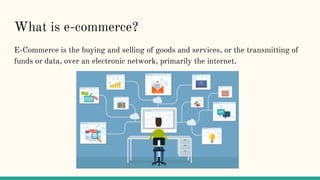
E-Commerce is the buying and selling of goods and services, or the transmitting of
funds or data, over an electronic network, primarily the internet.
The Growth of E-Commerce
❖E-Commerce has roots in society as early as 1995.
❖One of the strengths of e-commerce is its 24/7, 365 days a year availability.
➢ Businesses and customers alike are able to access online buying and selling of products and
services at any time, as opposed to the traditional mall or retail setting.
❖The advancement of technology such as personal computers and mobile devices
alongside the decrease in prices of that technology allow for millions of
individuals to gain access to the internet and E-commerce activities.
❖The span of E-commerce is world wide.
❖E-commerce also acts as an interactive entity.
Photo courtesy google images
Types of e-
commerce
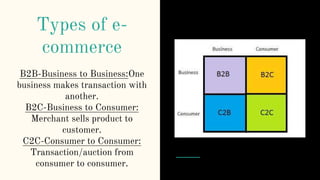
B2B-Business to Business:One
business makes transaction with
another.
B2C-Business to Consumer:
Merchant sells product to
customer.
C2C-Consumer to Consumer:
Transaction/auction from
consumer to consumer.
C2C Business Model
Examples of C2C Businesses
Market Creator
❖Provides a digital environment where buyers and sellers can meet, search for
products, display products, and establish prices for those products.
❖Value proposition is they provide a platform where sellers can easily display
products and purchasers can buys directly from sellers.
❖Generates revenue from transaction fees.
F Business Model
“eBay’s product is the collective activity of all it’s users.”
❖Brokerage
➢ Provides an online forum or marketspace where sellers can display their wares for buyers to
purchase
➢ Generates income from fees a seller pays for posting and selling items
➢ Gains collective intelligence from community discussion boards to improve their services
➢ Global reach which allows a seller to develop a niche
B Business Model
❖Browsing/bidding on auctions are free, but sellers are charged transaction fees
for the right to sell their goods on eBay.
➢ Original Transaction Fees:
■ Insertion Fee-When an item is listed, nonrefundable fee is charged
based on the seller’s opening bid on the item.
■ Final Value Fee- Once the auction is completed, a fee is charged-
ranges from 1.25%-5% of final sale price.
■ Upsells Listing Fees-Enhanced auction features-highlighted or bold
B Business Model
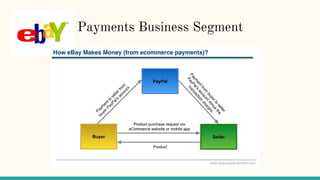
❖ PayPal- Money/Payment website
➢ 2.9%+$0.30 fee for each sale
➢ $150.00 sale: $4.65 fees, total profit: $145.35
❖ Current Transaction Fees:
➢ Regular Sellers- 20 free listings, final value fee- flat 10% of selling price.
➢ Power Sellers- Subscription package- between 150-2500 free listings, final value fee of 4%-9%
➢ Upgrade Listings- More pictures, search optimization and fixed prices.
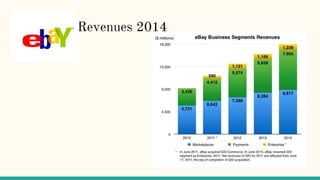
Revenue Model:
3 Business Segments
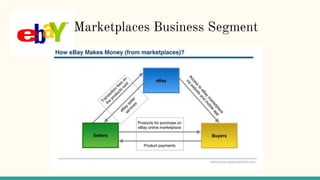
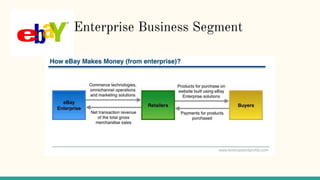
Marketplaces Business Segment
Payments Business Segment
Enterprise Business Segment
Revenues 2014
B2C Business Model
Business to Consumer Model
❖Before E-Commerce, B2C was represented by a consumer shopping and
purchasing goods at a mall or other retailer location.
❖Today, B2C often refers to the various retailers who offer online shopping
services.
❖Most retailers have both physical and online stores; and many offer exclusive
products and offers to customers who shop online.
❖B2C makes revenue through direct sales to customers, as well as shipping for
some retailers, such as Amazon, which has its own shipping methods.
Examples of B2C Businesses
Virtual Storefront
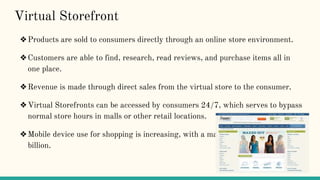
❖Products are sold to consumers directly through an online store environment.
❖Customers are able to find, research, read reviews, and purchase items all in
one place.
❖Revenue is made through direct sales from the virtual store to the consumer.
❖Virtual Storefronts can be accessed by consumers 24/7, which serves to bypass
normal store hours in malls or other retail locations.
❖Mobile device use for shopping is increasing, with a market value of $630
billion.
Examples of Virtual Storefronts
Barnes & Noble.com
❖Barnes & Noble began selling online in the 1990s
❖Barnes & Noble.com allowed the company to reach more consumers while also
increasing revenue per book sale.
➢ Selling additional online books costs much less for the company than producing more physical
books to be sold in store.
❖The retailer has closed multiple retail locations in order to sell more exclusively
online and combat losses.
Amazon.com
❖ Amazon.com represents a B2C business and is also a virtual storefront.
❖ C2C, B2C, and B2B models are all represented as forms of revenue for Amazon.
❖ Revenue is made in multiple ways: Amazon sells its own products, and serves as a
platform for other businesses with virtual storefronts.
➢ Other business can advertise and sell products and services directly to their customers on Amazon.
➢ Businesses pay $39.99 per month to sell, in addition to selling fees.
➢ Amazon ships the products sold by the businesses that work with them, for additional fees
❖ As an Example, the business HotChocolateDesign sells directly to its customers
from Amazon and uses the site as a virtual storefront.
Problems with the Virtual Storefront
❖Search Engine Marketing (SEM): Companies need to reach consumers through
popular web search browsers.
❖Search Engine Marketing can be very expensive for small virtual storefronts
who do not have a large customer base and high revenue.
❖Payment Processing:
➢ Some customers are hesitant to use their payment information online.
➢ PayPal helps to ease concerns about online payments, with over 232 million accounts.
❖Many businesses who use virtual storefronts have to use other trusted
businesses to sell such as amazon and paypal.
B2B Business Model
B2B E-Commerce
B2B is when both parties in a transaction are businesses
E-Commerce B2B is the electronic exchange of business documents among
businesses for the purpose of conducting commerce
Used for contract manufacturing, customs declarations, global trade compliance, order management
and supply-chain logistics
By using e-commerce B2B, companies can improve communications among partners and enhance
the purchasing experience from business to business
E-Commerce B2B is also used to facilitate the transfer of raw materials, parts,
and components from which additional profit is derived, through manufacturing
or final sales to consumers
Business Models
B2B business are also called “e-tailers”, which are companies that sell physical
products directly to consumers or to individual businesses
Most B2B e-tailers use the sales revenue model to bring in money
Using, the sales revenue model companies derive revenue by selling goods, information or services
On the company's website the company can sell directly to other businesses
B2B Business Model Types
Supplier Oriented
A common marketplace provided by supplier is used by both individual customers as well as
business users
Buyer Oriented
Buyer has his/her own marketplace or e-market, he/she invited suppliers to bid on product’s
catalog
Intermediary Oriented
An intermediary company runs a marketplace where business buyers and sellers can transact with
each other
B2B E-Commerce Businesses
Quill.com
Office supplies, owned by Staples
Ferguson.com
Bath, kitchen, and lighting supplies
Grainger.com
Contracting tools and supplies
Works Cited
❖ https://www.allbusiness.com/the-ebay-business-model-3251-1.html
❖ http://www.investopedia.com/articles/investing/052615/ebay-vs-amazon-business-model.asp#
❖ http://www.tutorialspoint.com/e_commerce/e_commerce_business_models.htm
❖ Hom, Elaine J. “What is B2C?” Business News Daily. 11 Sept. 2013. Web. 17 Apr 2016.
❖ Laudon, Kenneth C. & Jane P. Laudon. Management Information Systems: Managing the Digital Firm. ed 11. Pearson. New Jersey, 2010. Print.
❖ http://techcrunch.com/2009/09/04/ebay-acquisition-map-shows-where-it-got-on-the-wrong-track/
❖ http://net205nectarines.wikispaces.com/03.+Business+Model+of+eBay
❖ http://net205nectarines.wikispaces.com/01.+Introduction
❖ https://services.amazon.com/content/sell-on-amazon.htm/ref=azus_soa_seeall_Lm_minC?ld=AZUSSOA-seeall_minSeeC
❖ http://smallbusiness.chron.com/business-model-barnes-noble-13655.html
❖ http://ecommerce.about.com/od/eCommerce-Trends-and-Issues/a/Business-To-Business-Ecommerce.htm
❖ http://www.businessnewsdaily.com/5000-what-is-b2b.html
❖ http://www.tutorialspoint.com/e_commerce/e_commerce_b2b_mode.htm

E-commerce Business Models

  • 1.
  • 2.
    What is e-commerce? E-Commerceis the buying and selling of goods and services, or the transmitting of funds or data, over an electronic network, primarily the internet.
  • 3.
    The Growth ofE-Commerce ❖E-Commerce has roots in society as early as 1995. ❖One of the strengths of e-commerce is its 24/7, 365 days a year availability. ➢ Businesses and customers alike are able to access online buying and selling of products and services at any time, as opposed to the traditional mall or retail setting. ❖The advancement of technology such as personal computers and mobile devices alongside the decrease in prices of that technology allow for millions of individuals to gain access to the internet and E-commerce activities. ❖The span of E-commerce is world wide. ❖E-commerce also acts as an interactive entity. Photo courtesy google images
  • 4.
    Types of e- commerce B2B-Businessto Business:One business makes transaction with another. B2C-Business to Consumer: Merchant sells product to customer. C2C-Consumer to Consumer: Transaction/auction from consumer to consumer.
  • 5.
  • 6.
    Examples of C2CBusinesses
  • 7.
    Market Creator ❖Provides adigital environment where buyers and sellers can meet, search for products, display products, and establish prices for those products. ❖Value proposition is they provide a platform where sellers can easily display products and purchasers can buys directly from sellers. ❖Generates revenue from transaction fees.
  • 8.
    F Business Model “eBay’sproduct is the collective activity of all it’s users.” ❖Brokerage ➢ Provides an online forum or marketspace where sellers can display their wares for buyers to purchase ➢ Generates income from fees a seller pays for posting and selling items ➢ Gains collective intelligence from community discussion boards to improve their services ➢ Global reach which allows a seller to develop a niche
  • 9.
    B Business Model ❖Browsing/biddingon auctions are free, but sellers are charged transaction fees for the right to sell their goods on eBay. ➢ Original Transaction Fees: ■ Insertion Fee-When an item is listed, nonrefundable fee is charged based on the seller’s opening bid on the item. ■ Final Value Fee- Once the auction is completed, a fee is charged- ranges from 1.25%-5% of final sale price. ■ Upsells Listing Fees-Enhanced auction features-highlighted or bold
  • 10.
    B Business Model ❖PayPal- Money/Payment website ➢ 2.9%+$0.30 fee for each sale ➢ $150.00 sale: $4.65 fees, total profit: $145.35 ❖ Current Transaction Fees: ➢ Regular Sellers- 20 free listings, final value fee- flat 10% of selling price. ➢ Power Sellers- Subscription package- between 150-2500 free listings, final value fee of 4%-9% ➢ Upgrade Listings- More pictures, search optimization and fixed prices.
  • 11.
  • 12.
  • 13.
  • 14.
  • 15.
  • 16.
  • 17.
    Business to ConsumerModel ❖Before E-Commerce, B2C was represented by a consumer shopping and purchasing goods at a mall or other retailer location. ❖Today, B2C often refers to the various retailers who offer online shopping services. ❖Most retailers have both physical and online stores; and many offer exclusive products and offers to customers who shop online. ❖B2C makes revenue through direct sales to customers, as well as shipping for some retailers, such as Amazon, which has its own shipping methods.
  • 18.
    Examples of B2CBusinesses
  • 19.
    Virtual Storefront ❖Products aresold to consumers directly through an online store environment. ❖Customers are able to find, research, read reviews, and purchase items all in one place. ❖Revenue is made through direct sales from the virtual store to the consumer. ❖Virtual Storefronts can be accessed by consumers 24/7, which serves to bypass normal store hours in malls or other retail locations. ❖Mobile device use for shopping is increasing, with a market value of $630 billion.
  • 20.
  • 21.
    Barnes & Noble.com ❖Barnes& Noble began selling online in the 1990s ❖Barnes & Noble.com allowed the company to reach more consumers while also increasing revenue per book sale. ➢ Selling additional online books costs much less for the company than producing more physical books to be sold in store. ❖The retailer has closed multiple retail locations in order to sell more exclusively online and combat losses.
  • 22.
    Amazon.com ❖ Amazon.com representsa B2C business and is also a virtual storefront. ❖ C2C, B2C, and B2B models are all represented as forms of revenue for Amazon. ❖ Revenue is made in multiple ways: Amazon sells its own products, and serves as a platform for other businesses with virtual storefronts. ➢ Other business can advertise and sell products and services directly to their customers on Amazon. ➢ Businesses pay $39.99 per month to sell, in addition to selling fees. ➢ Amazon ships the products sold by the businesses that work with them, for additional fees ❖ As an Example, the business HotChocolateDesign sells directly to its customers from Amazon and uses the site as a virtual storefront.
  • 23.
    Problems with theVirtual Storefront ❖Search Engine Marketing (SEM): Companies need to reach consumers through popular web search browsers. ❖Search Engine Marketing can be very expensive for small virtual storefronts who do not have a large customer base and high revenue. ❖Payment Processing: ➢ Some customers are hesitant to use their payment information online. ➢ PayPal helps to ease concerns about online payments, with over 232 million accounts. ❖Many businesses who use virtual storefronts have to use other trusted businesses to sell such as amazon and paypal.
  • 24.
  • 25.
    B2B E-Commerce B2B iswhen both parties in a transaction are businesses E-Commerce B2B is the electronic exchange of business documents among businesses for the purpose of conducting commerce Used for contract manufacturing, customs declarations, global trade compliance, order management and supply-chain logistics By using e-commerce B2B, companies can improve communications among partners and enhance the purchasing experience from business to business E-Commerce B2B is also used to facilitate the transfer of raw materials, parts, and components from which additional profit is derived, through manufacturing or final sales to consumers
  • 26.
    Business Models B2B businessare also called “e-tailers”, which are companies that sell physical products directly to consumers or to individual businesses Most B2B e-tailers use the sales revenue model to bring in money Using, the sales revenue model companies derive revenue by selling goods, information or services On the company's website the company can sell directly to other businesses
  • 27.
    B2B Business ModelTypes Supplier Oriented A common marketplace provided by supplier is used by both individual customers as well as business users Buyer Oriented Buyer has his/her own marketplace or e-market, he/she invited suppliers to bid on product’s catalog Intermediary Oriented An intermediary company runs a marketplace where business buyers and sellers can transact with each other
  • 28.
    B2B E-Commerce Businesses Quill.com Officesupplies, owned by Staples Ferguson.com Bath, kitchen, and lighting supplies Grainger.com Contracting tools and supplies
  • 29.
    Works Cited ❖ https://www.allbusiness.com/the-ebay-business-model-3251-1.html ❖http://www.investopedia.com/articles/investing/052615/ebay-vs-amazon-business-model.asp# ❖ http://www.tutorialspoint.com/e_commerce/e_commerce_business_models.htm ❖ Hom, Elaine J. “What is B2C?” Business News Daily. 11 Sept. 2013. Web. 17 Apr 2016. ❖ Laudon, Kenneth C. & Jane P. Laudon. Management Information Systems: Managing the Digital Firm. ed 11. Pearson. New Jersey, 2010. Print. ❖ http://techcrunch.com/2009/09/04/ebay-acquisition-map-shows-where-it-got-on-the-wrong-track/ ❖ http://net205nectarines.wikispaces.com/03.+Business+Model+of+eBay ❖ http://net205nectarines.wikispaces.com/01.+Introduction ❖ https://services.amazon.com/content/sell-on-amazon.htm/ref=azus_soa_seeall_Lm_minC?ld=AZUSSOA-seeall_minSeeC ❖ http://smallbusiness.chron.com/business-model-barnes-noble-13655.html ❖ http://ecommerce.about.com/od/eCommerce-Trends-and-Issues/a/Business-To-Business-Ecommerce.htm ❖ http://www.businessnewsdaily.com/5000-what-is-b2b.html ❖ http://www.tutorialspoint.com/e_commerce/e_commerce_b2b_mode.htm