Reshav Mahajan
Content !!
Introduction
Region
Religion
Economy
Languages
Music
Dance
Cuisines
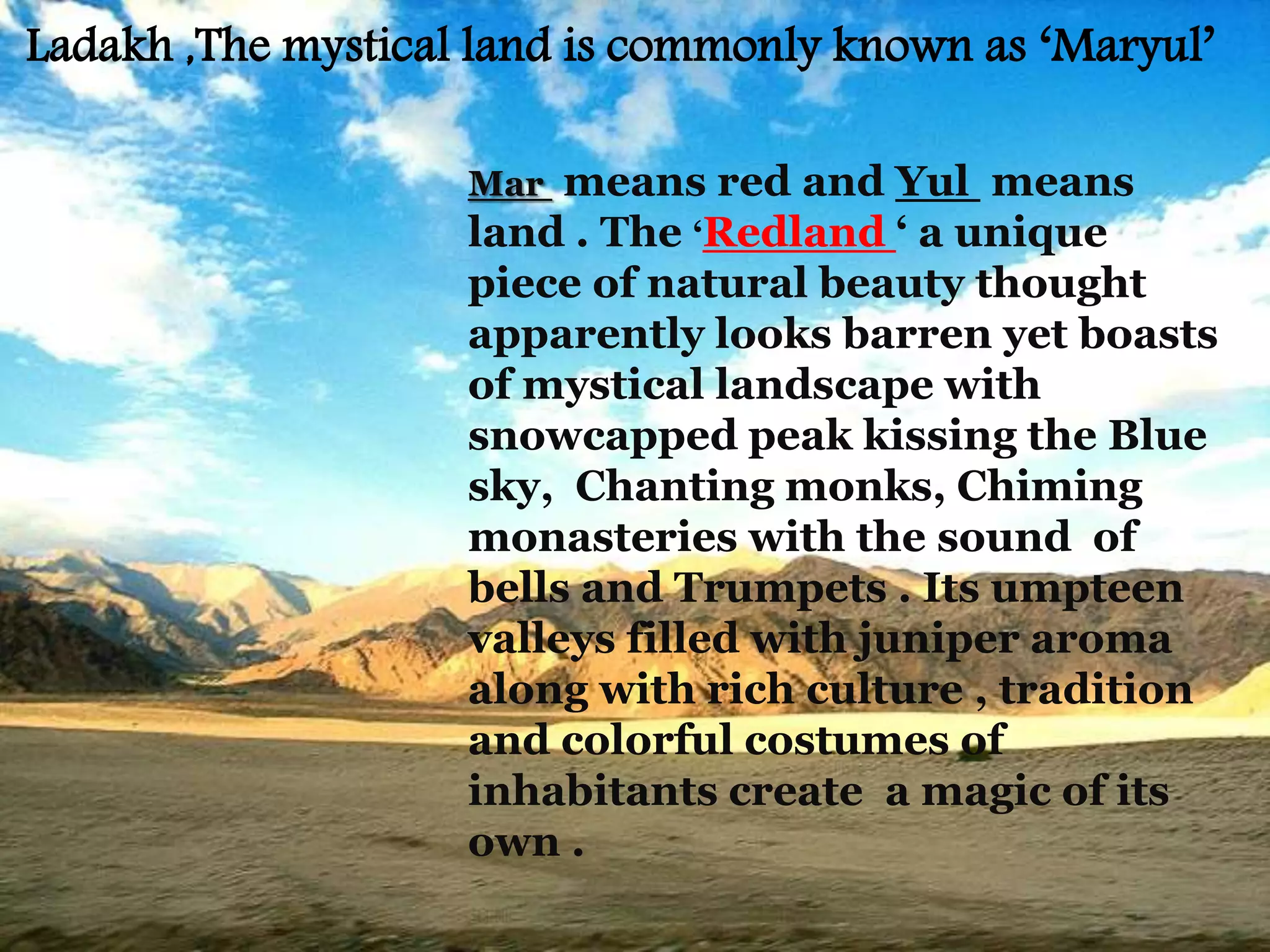
Mar means red and Yul means
land . The ‘Redland ‘ a unique
piece of natural beauty thought
apparently looks barren yet boasts
of mystical landscape with
snowcapped peak kissing the Blue
sky, Chanting monks, Chiming
monasteries with the sound of
bells and Trumpets . Its umpteen
valleys filled with juniper aroma
along with rich culture , tradition
and colorful costumes of
inhabitants create a magic of its
own .
Ladakh ,The mystical land is commonly known as ‘Maryul’
Region
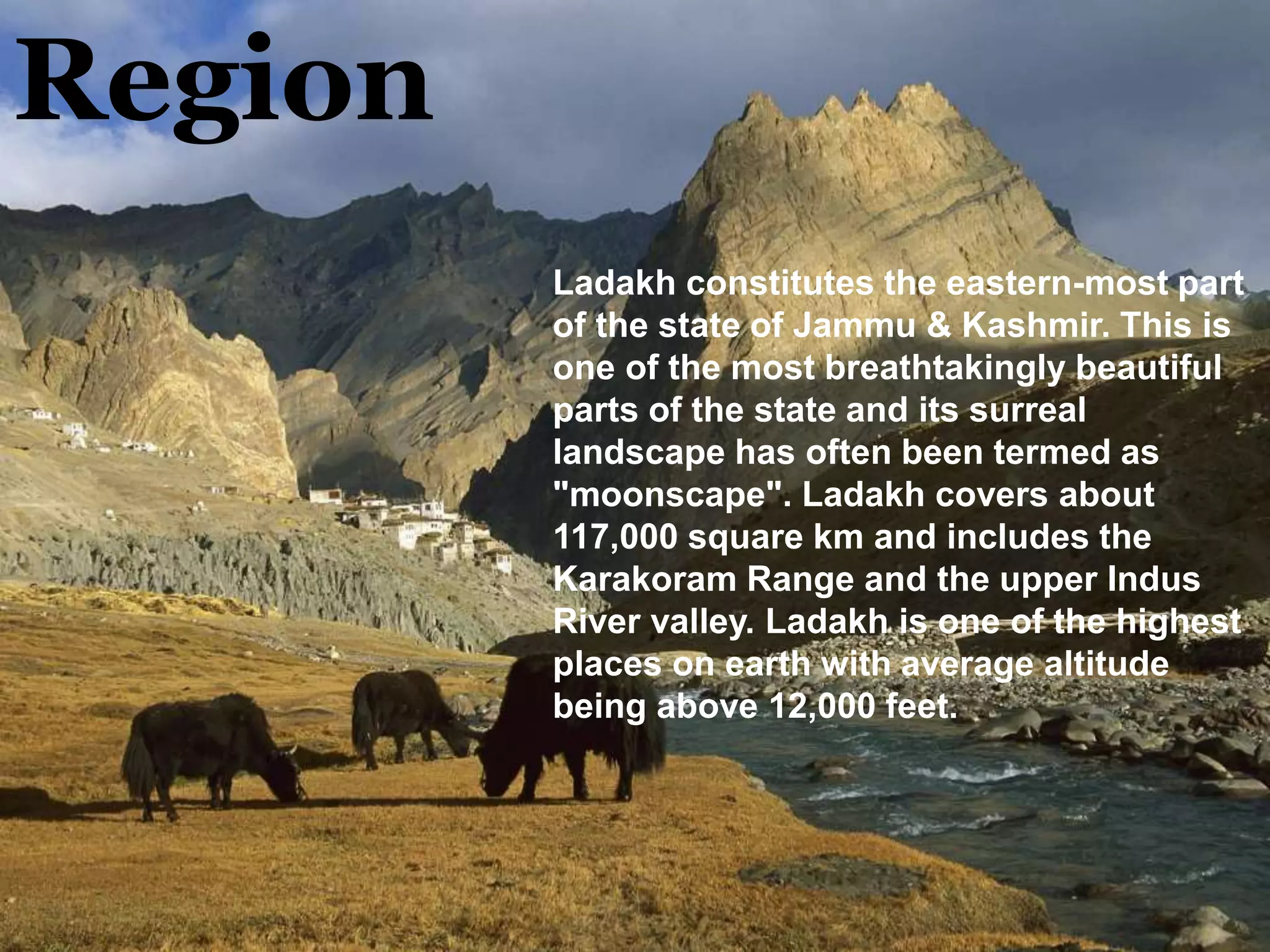
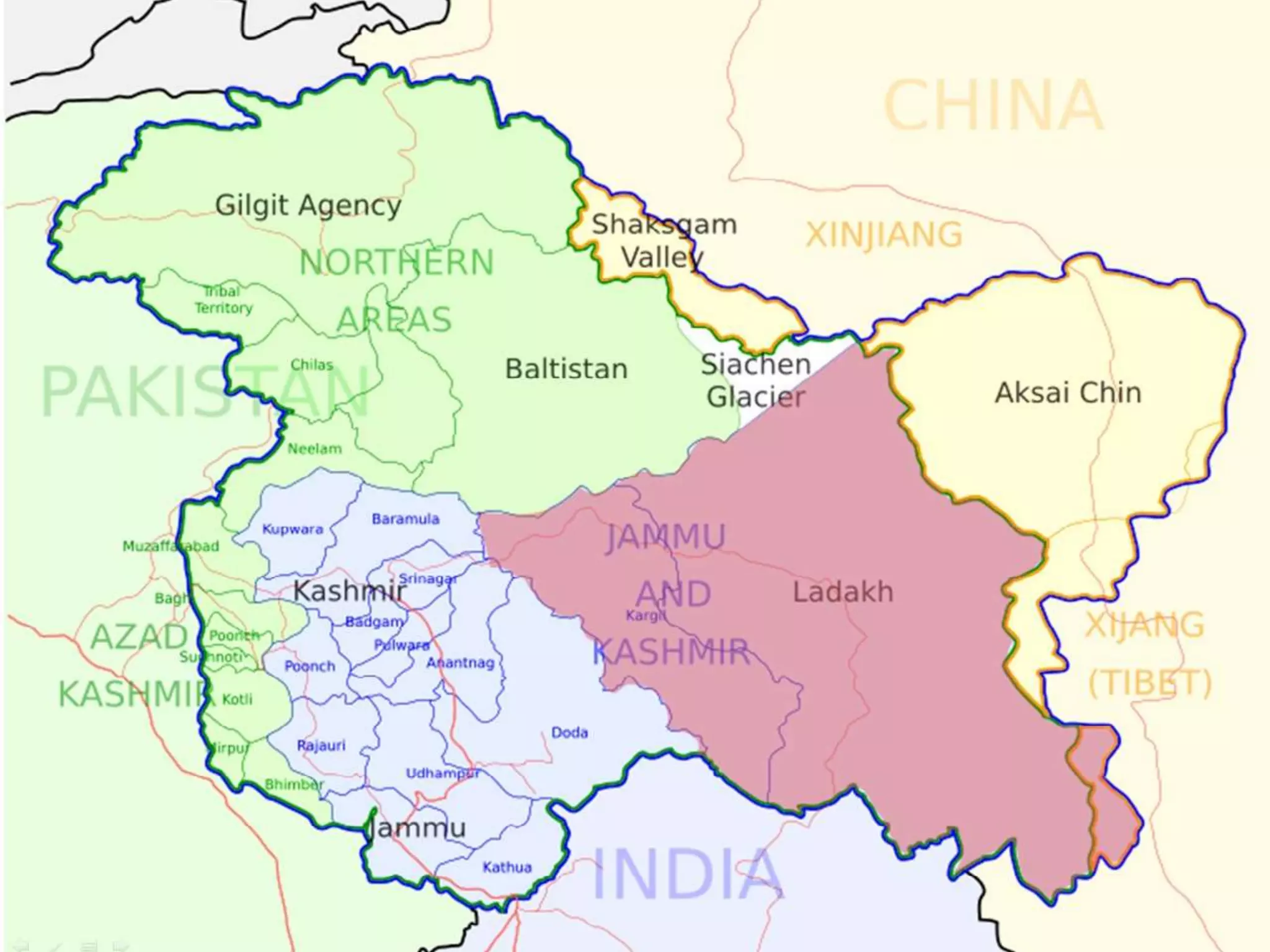
Ladakh constitutes the eastern-most part
of the state of Jammu & Kashmir. This is
one of the most breathtakingly beautiful
parts of the state and its surreal
landscape has often been termed as
"moonscape". Ladakh covers about
117,000 square km and includes the
Karakoram Range and the upper Indus
River valley. Ladakh is one of the highest
places on earth with average altitude
being above 12,000 feet.
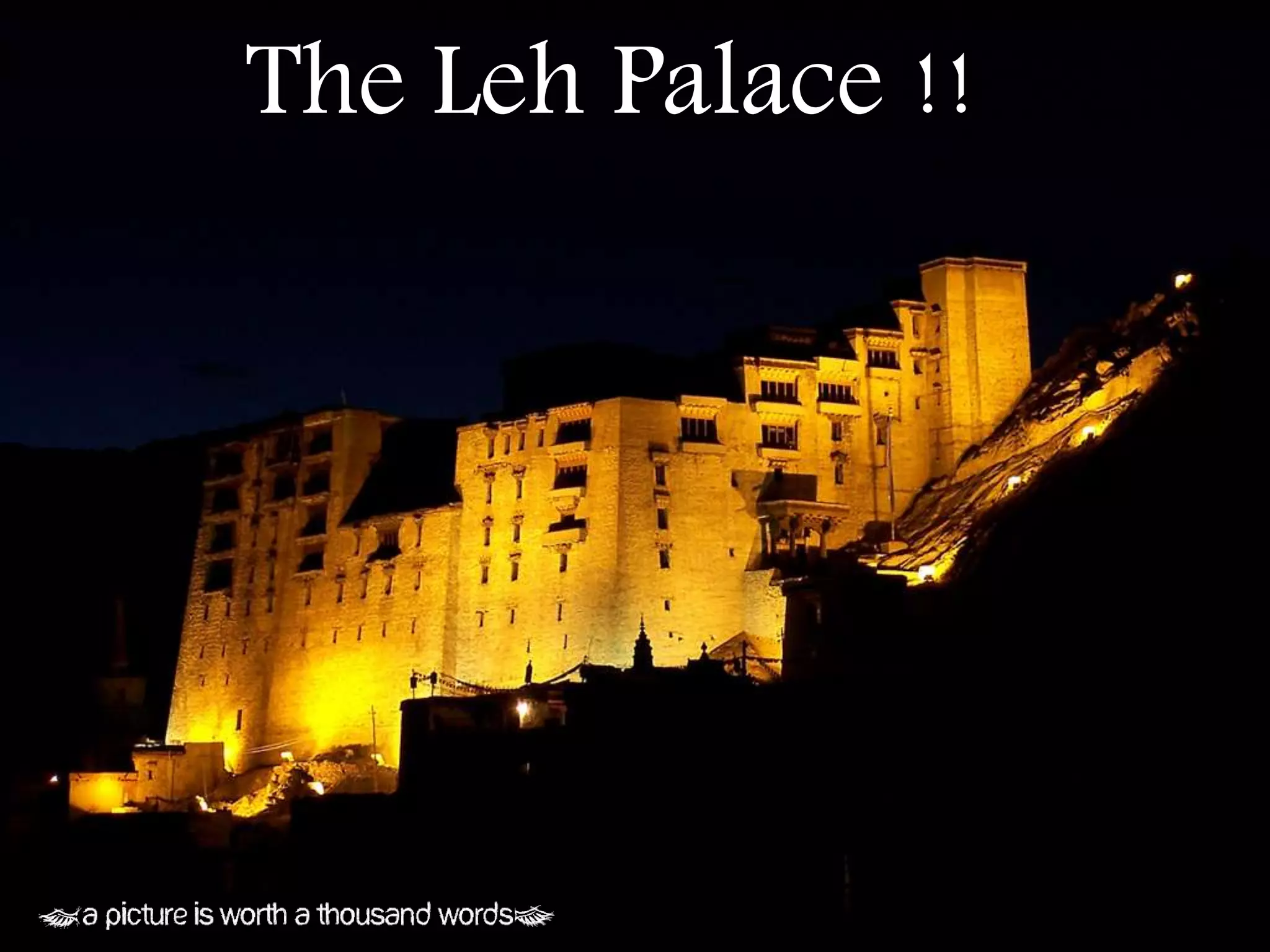
The Leh Palace !!
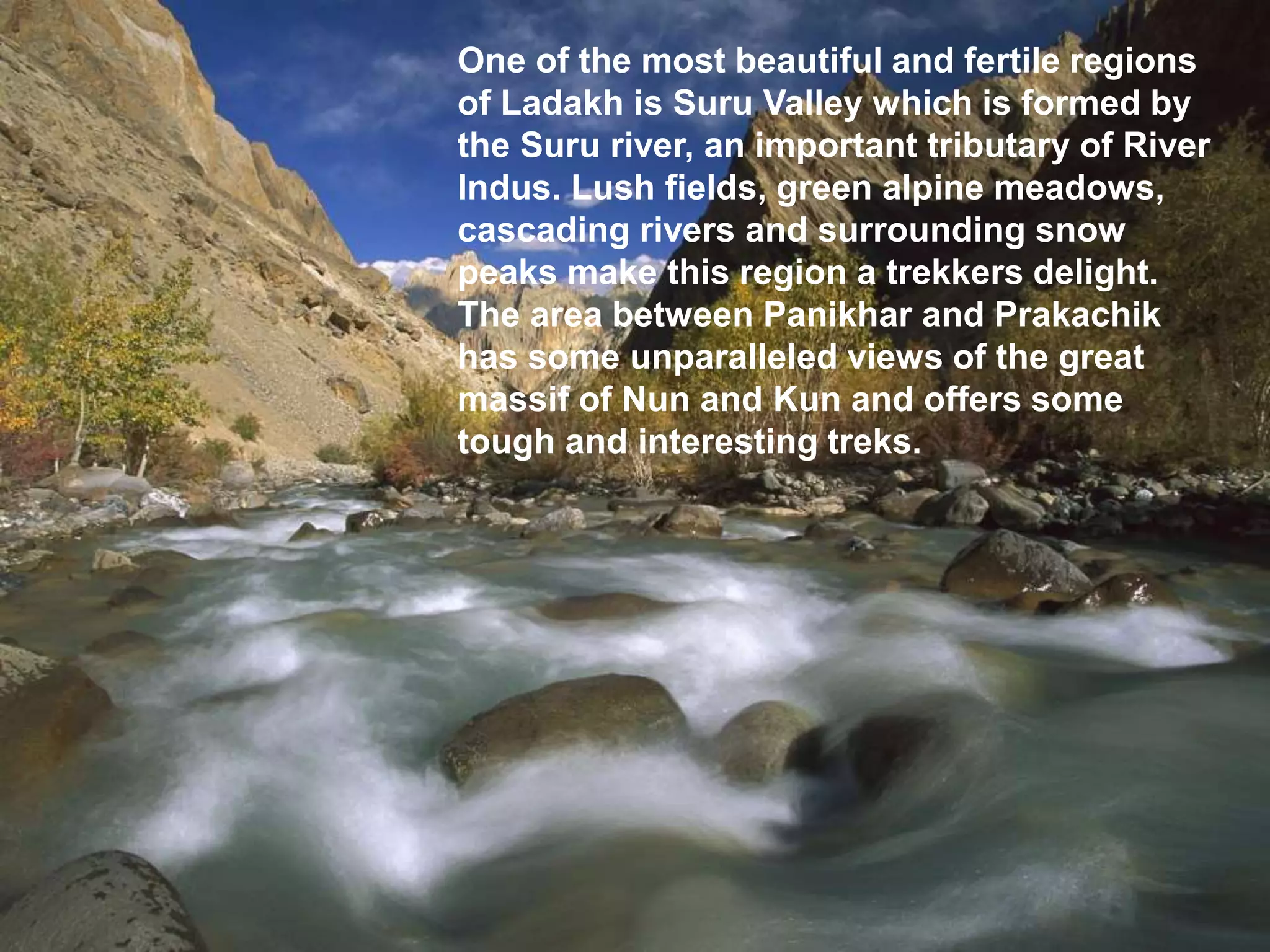
One of the most beautiful and fertile regions
of Ladakh is Suru Valley which is formed by
the Suru river, an important tributary of River
Indus. Lush fields, green alpine meadows,
cascading rivers and surrounding snow
peaks make this region a trekkers delight.
The area between Panikhar and Prakachik
has some unparalleled views of the great
massif of Nun and Kun and offers some
tough and interesting treks.
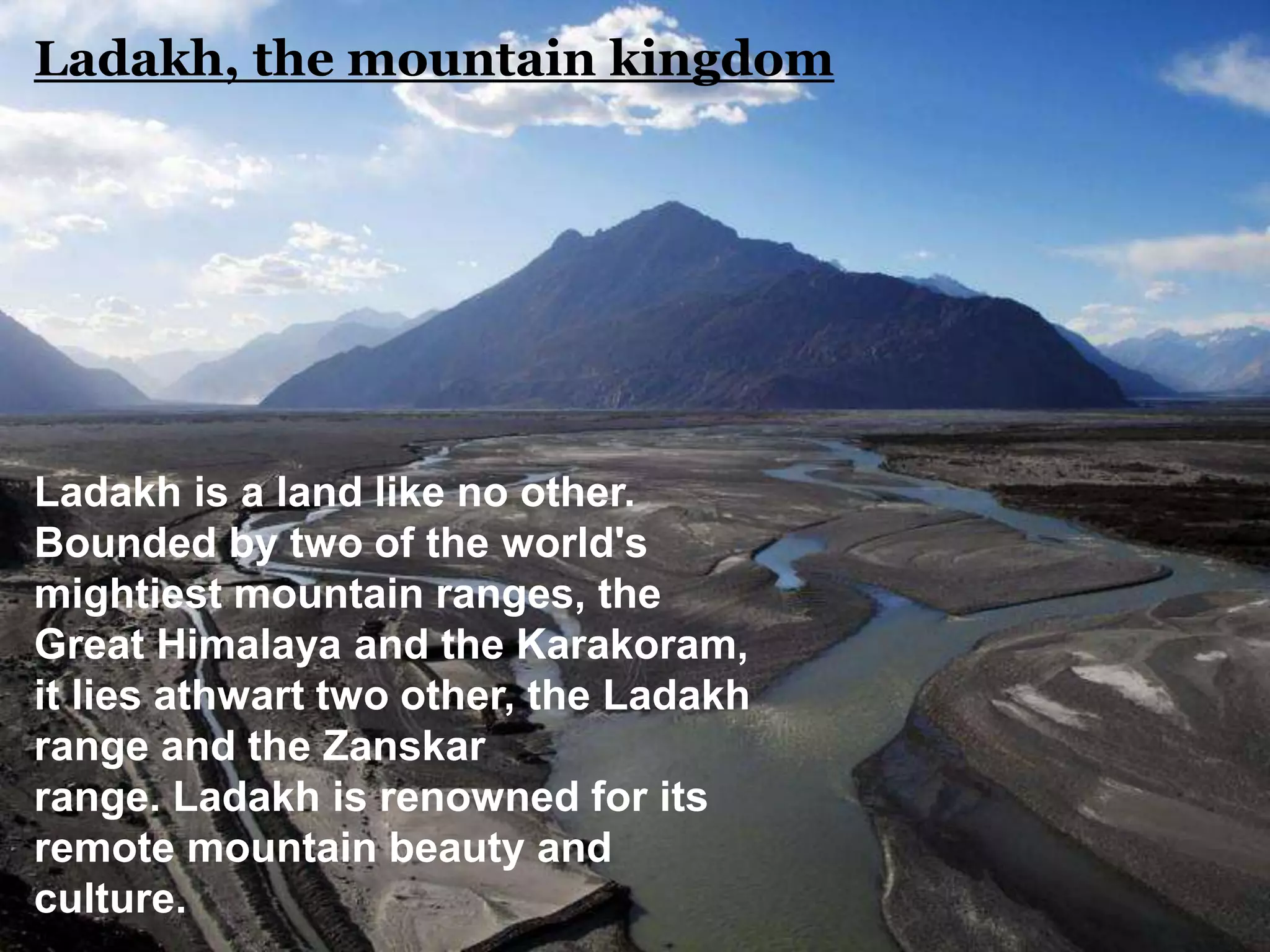
Ladakh is a land like no other.
Bounded by two of the world's
mightiest mountain ranges, the
Great Himalaya and the Karakoram,
it lies athwart two other, the Ladakh
range and the Zanskar
range. Ladakh is renowned for its
remote mountain beauty and
culture.
Ladakh, the mountain kingdom
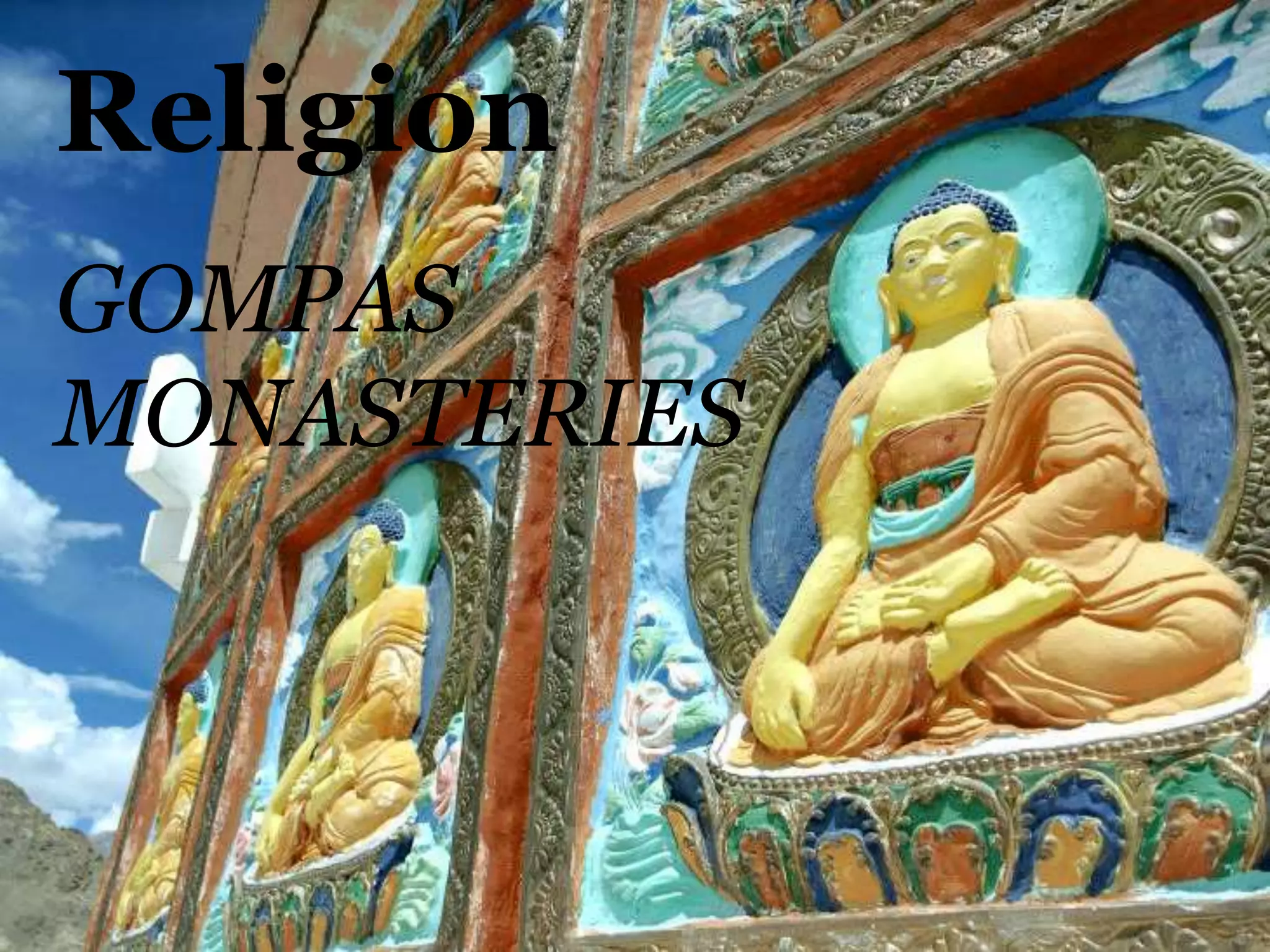
Religion
GOMPAS
MONASTERIES
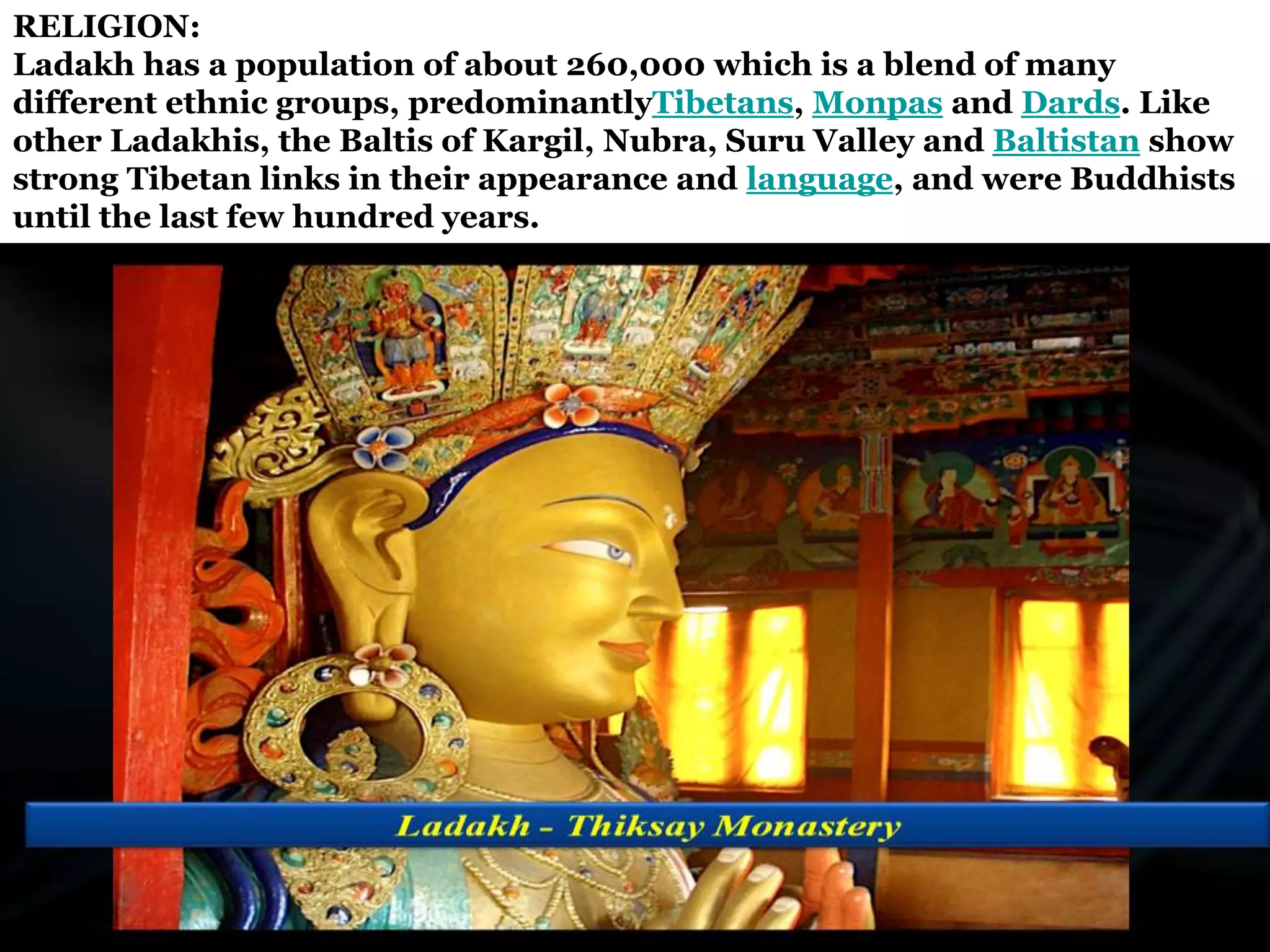
RELIGION:
Ladakh has a population of about 260,000 which is a blend of many
different ethnic groups, predominantlyTibetans, Monpas and Dards. Like
other Ladakhis, the Baltis of Kargil, Nubra, Suru Valley and Baltistan show
strong Tibetan links in their appearance and language, and were Buddhists
until the last few hundred years.
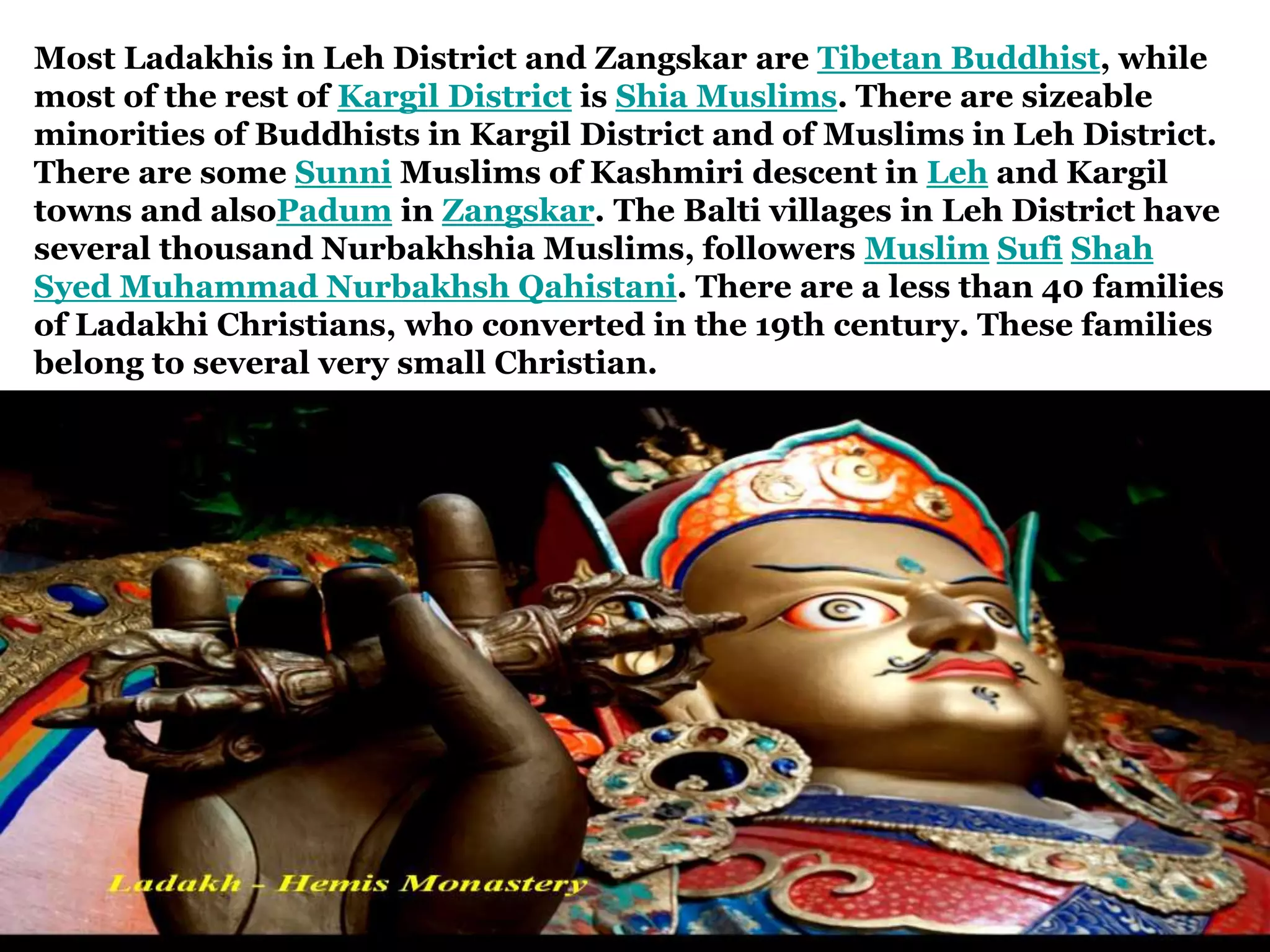
Most Ladakhis in Leh District and Zangskar are Tibetan Buddhist, while
most of the rest of Kargil District is Shia Muslims. There are sizeable
minorities of Buddhists in Kargil District and of Muslims in Leh District.
There are some Sunni Muslims of Kashmiri descent in Leh and Kargil
towns and alsoPadum in Zangskar. The Balti villages in Leh District have
several thousand Nurbakhshia Muslims, followers Muslim Sufi Shah
Syed Muhammad Nurbakhsh Qahistani. There are a less than 40 families
of Ladakhi Christians, who converted in the 19th century. These families
belong to several very small Christian.
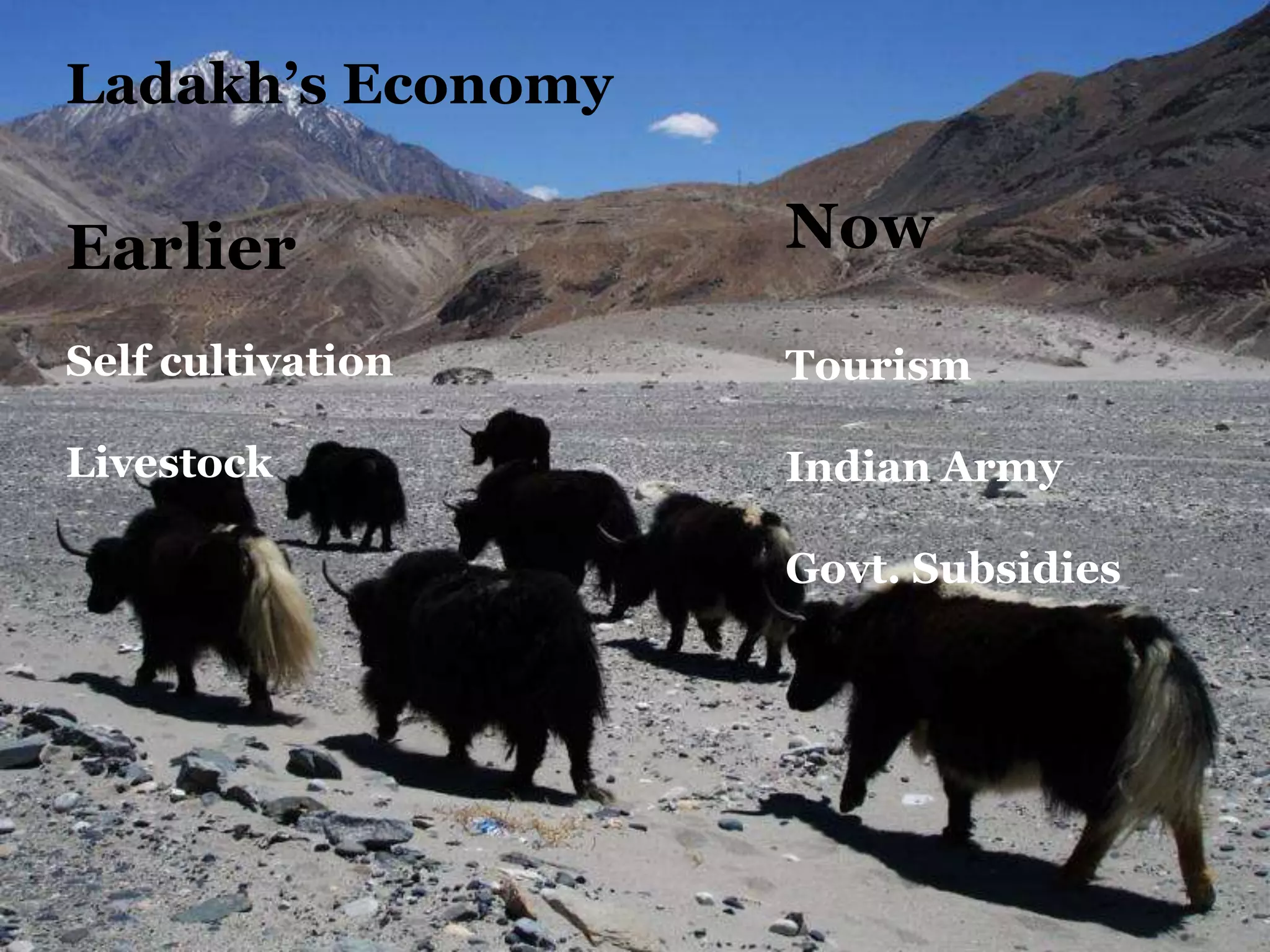
Ladakh’s Economy
Earlier
Self cultivation
Livestock
Now
Tourism
Indian Army
Govt. Subsidies
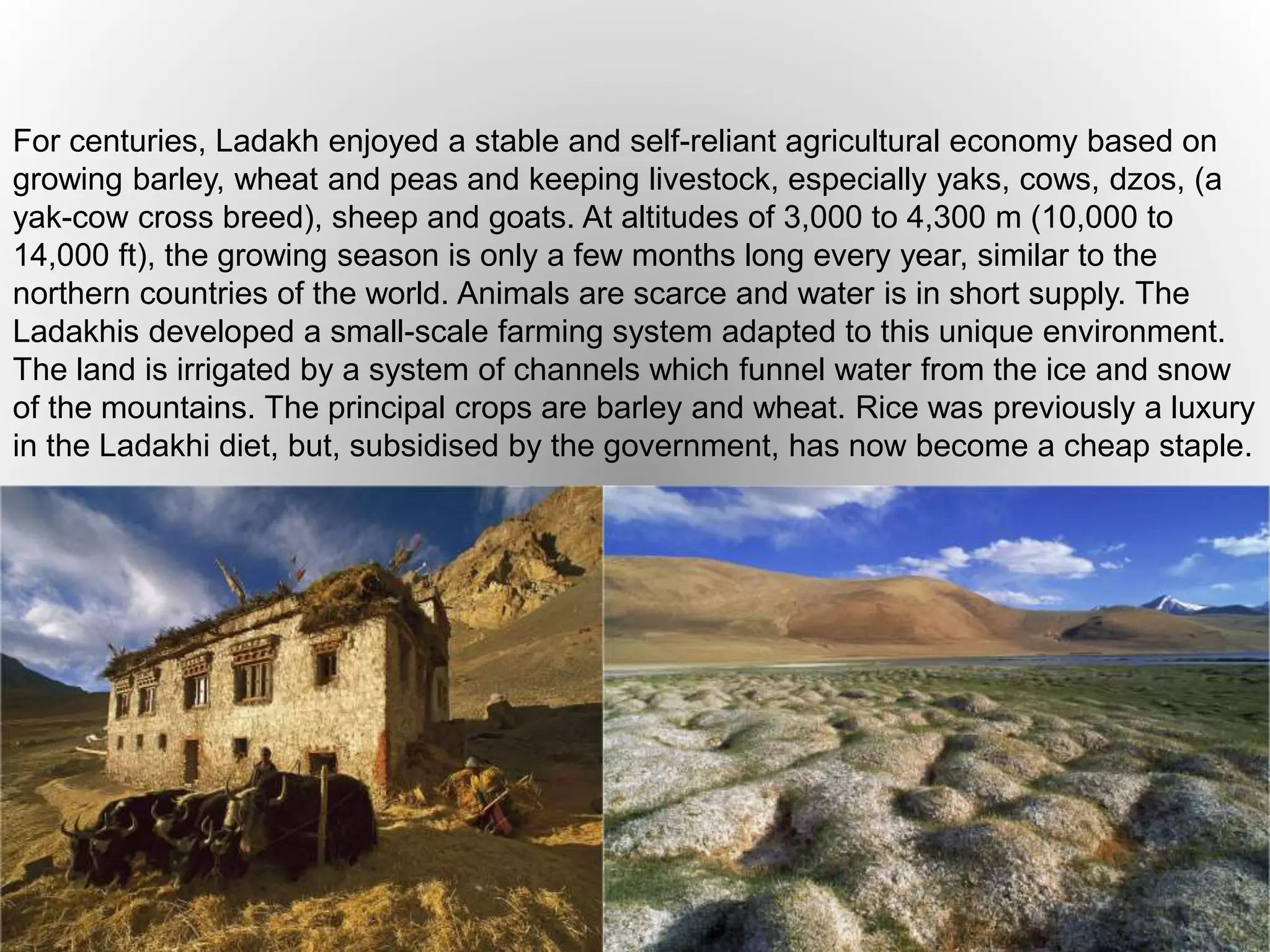
For centuries, Ladakh enjoyed a stable and self-reliant agricultural economy based on
growing barley, wheat and peas and keeping livestock, especially yaks, cows, dzos, (a
yak-cow cross breed), sheep and goats. At altitudes of 3,000 to 4,300 m (10,000 to
14,000 ft), the growing season is only a few months long every year, similar to the
northern countries of the world. Animals are scarce and water is in short supply. The
Ladakhis developed a small-scale farming system adapted to this unique environment.
The land is irrigated by a system of channels which funnel water from the ice and snow
of the mountains. The principal crops are barley and wheat. Rice was previously a luxury
in the Ladakhi diet, but, subsidised by the government, has now become a cheap staple.
LanguagesLanguages
The Ladakhi language also
called Bhoti, is the
predominant language in
the Ladakh region of
the Jammu & Kashmir state
of India. Ladakhi is closely
related to Tibetan, and the
Ladakhi people share cultural
similarities with Tibetans,
including Tibetan Budhism.
Ladakhi and Central
Tibetan are not mutually
intelligible, though they share
a written form dating back
to Old Tibetan.
Ladakhi has several
dialects, Ladakhi proper
(also called Lehskat after
the capital of Ladakh,Leh,
where it is
spoken); Shamskat,
spoken to the northwest of
Leh; Stotskat, spoken to
the southeast in the Indus
valley; and Nubra, spoken
in the north. The varieties
spoken in Upper Ladakh
and zangskari in zanskar
The principal language of Ladakh is Ladakhi, a Tibetan language.
Educated Ladakhis usually know Hindi, Urdu and often English.
Within Ladakh, there is a range of dialects, so that the language of the
Chang-pa people may differ markedly from that of the Purig-pa in
Kargil, or the Zangskaris, but they are all mutually comprehensible.
Due to its position on important trade routes, the language of Leh is
enriched with foreign words. Traditionally, Ladakhi had no written
form distinct from classical Tibetan, but recently a number of Ladakhi
writers have started using the Tibetan script to write the colloquial
tongue. Administrative work and education are carried out in English;
although Urdu was used to a great extent in the past, now only land
records and some police records are kept in Urdu.
Ladakhi is usually written using Tibetan script with the pronunciation of
Ladakhi being much closer to written Tibetan . Ladakhis pronounce
many of the prefix, suffix and head letters that are silent in Tibetan. This
tendency is more pronounced to the west of Leh, and on the Pakistani
side of theLine of Control, in Baltistan. For example, a Tibetan would
pronounce sta 'axe' as [tá], but a Ladakhi would say [sta]. While a
Tibetan would pronounce ’bras 'rice' as Ladakhis say [dras], and
the Kargilpa (Burig) say [bras].
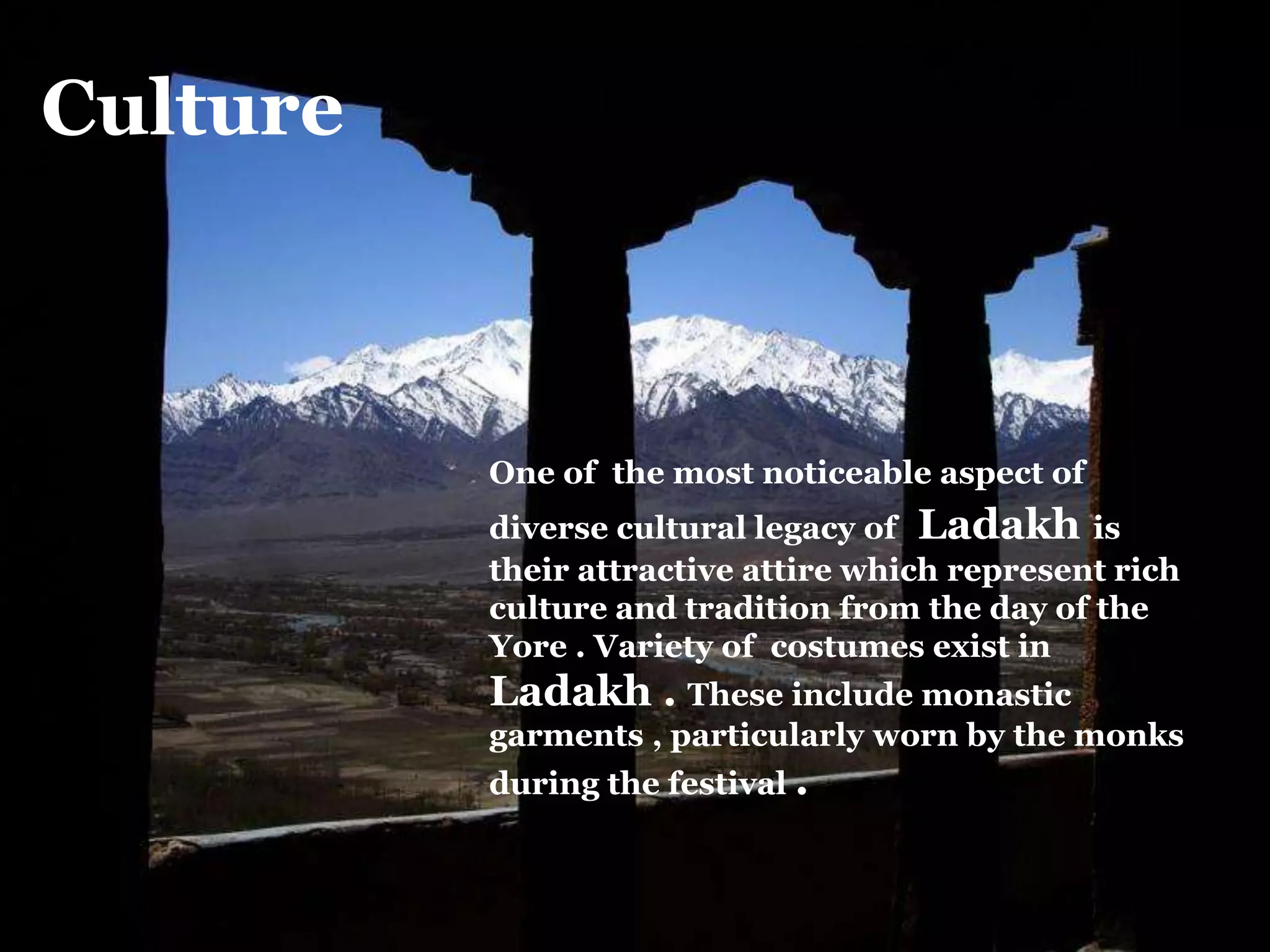
Culture
One of the most noticeable aspect of
diverse cultural legacy of Ladakh is
their attractive attire which represent rich
culture and tradition from the day of the
Yore . Variety of costumes exist in
Ladakh . These include monastic
garments , particularly worn by the monks
during the festival .
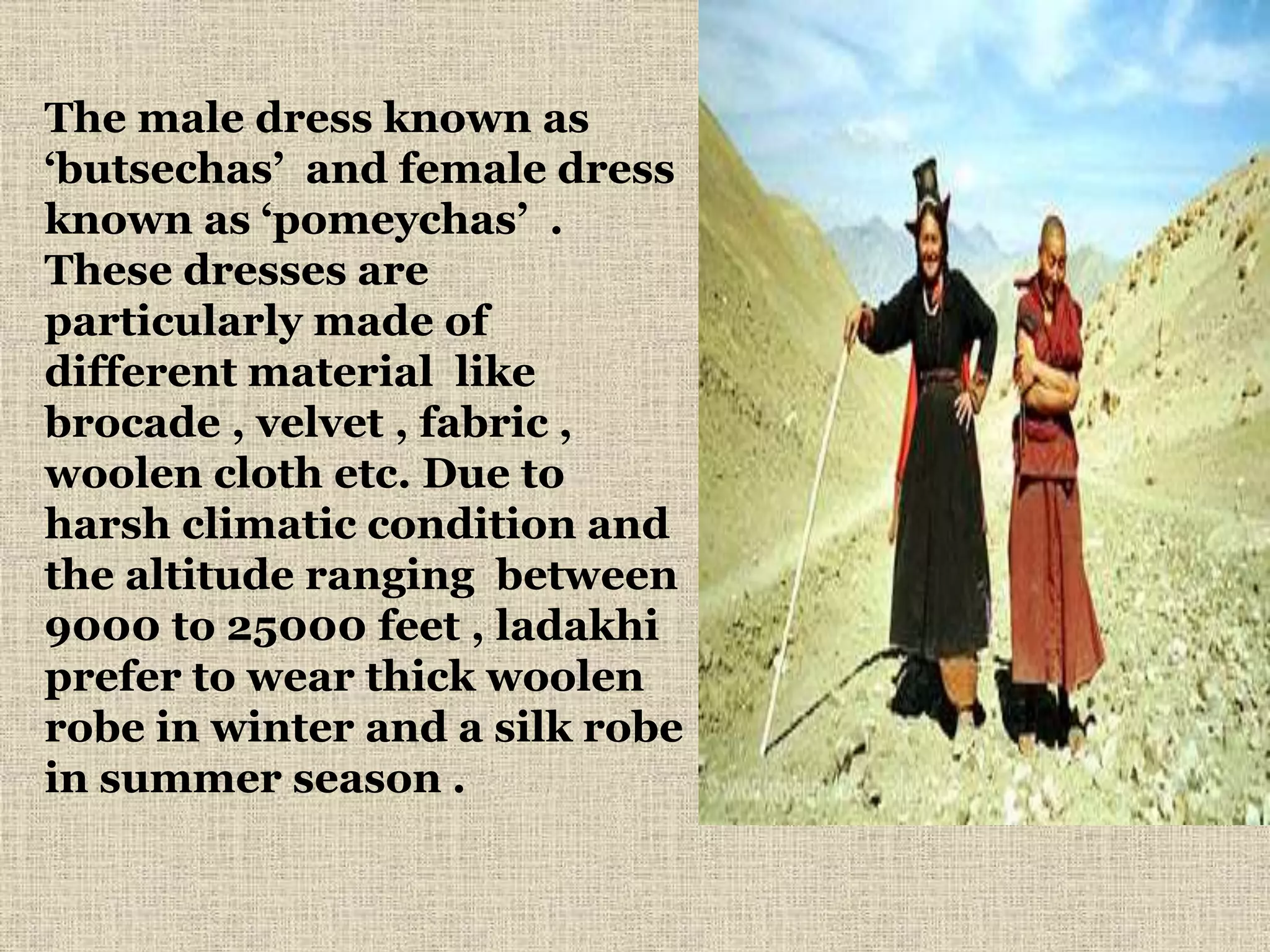
The male dress known as
‘butsechas’ and female dress
known as ‘pomeychas’ .
These dresses are
particularly made of
different material like
brocade , velvet , fabric ,
woolen cloth etc. Due to
harsh climatic condition and
the altitude ranging between
9000 to 25000 feet , ladakhi
prefer to wear thick woolen
robe in winter and a silk robe
in summer season .
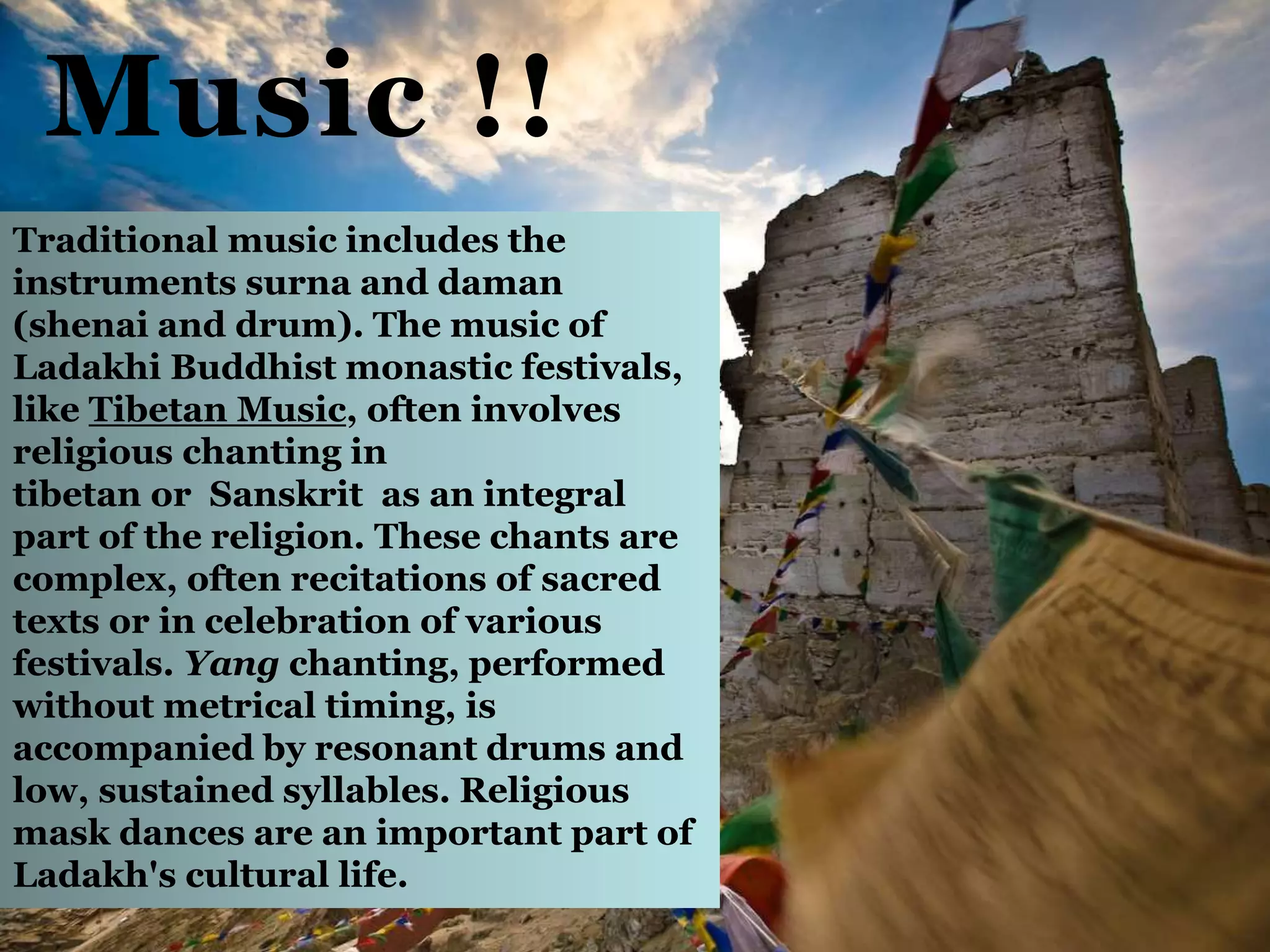
Music !!
Traditional music includes the
instruments surna and daman
(shenai and drum). The music of
Ladakhi Buddhist monastic festivals,
like Tibetan Music, often involves
religious chanting in
tibetan or Sanskrit as an integral
part of the religion. These chants are
complex, often recitations of sacred
texts or in celebration of various
festivals. Yang chanting, performed
without metrical timing, is
accompanied by resonant drums and
low, sustained syllables. Religious
mask dances are an important part of
Ladakh's cultural life.
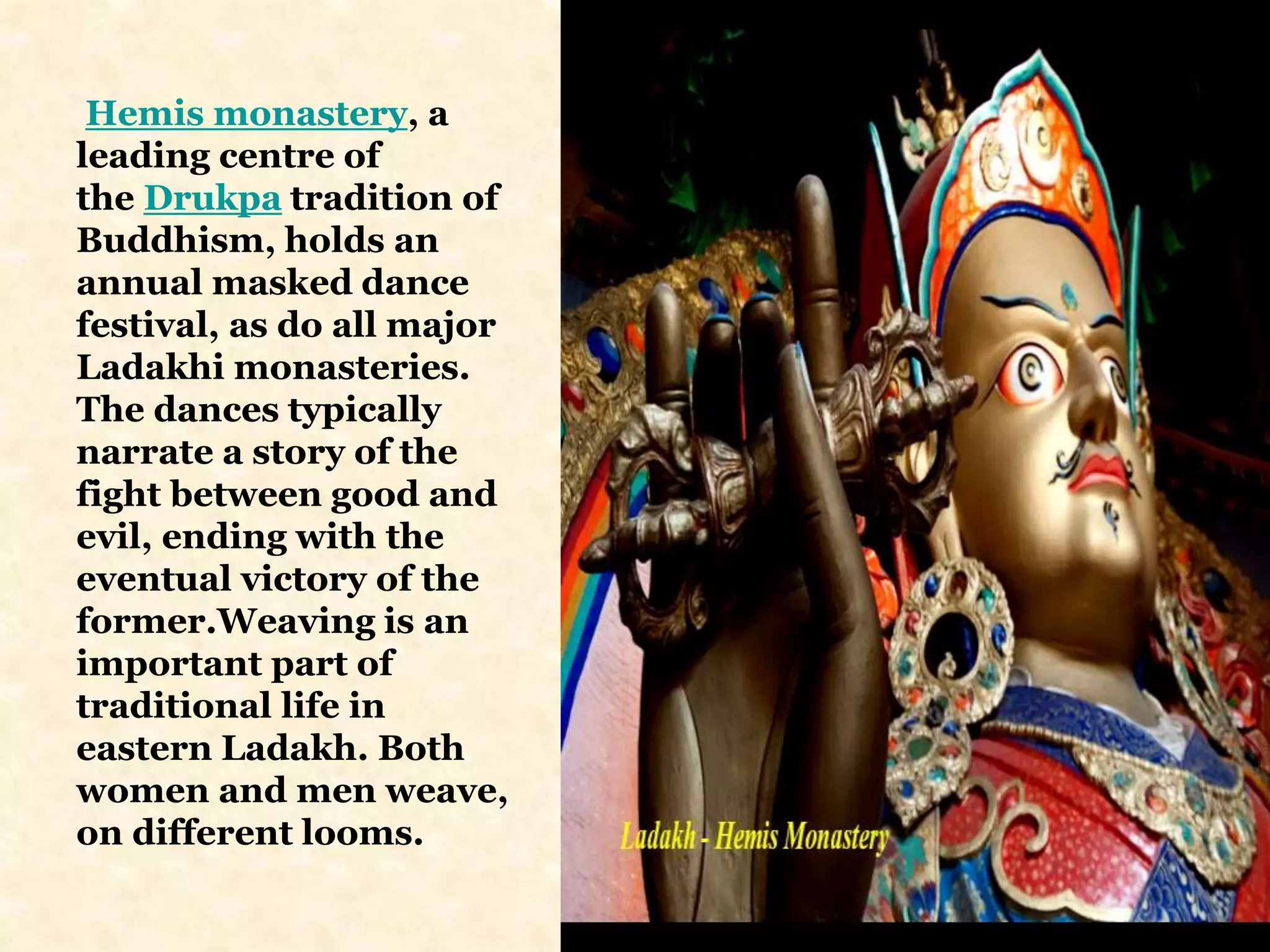
Hemis monastery, a
leading centre of
the Drukpa tradition of
Buddhism, holds an
annual masked dance
festival, as do all major
Ladakhi monasteries.
The dances typically
narrate a story of the
fight between good and
evil, ending with the
eventual victory of the
former.Weaving is an
important part of
traditional life in
eastern Ladakh. Both
women and men weave,
on different looms.
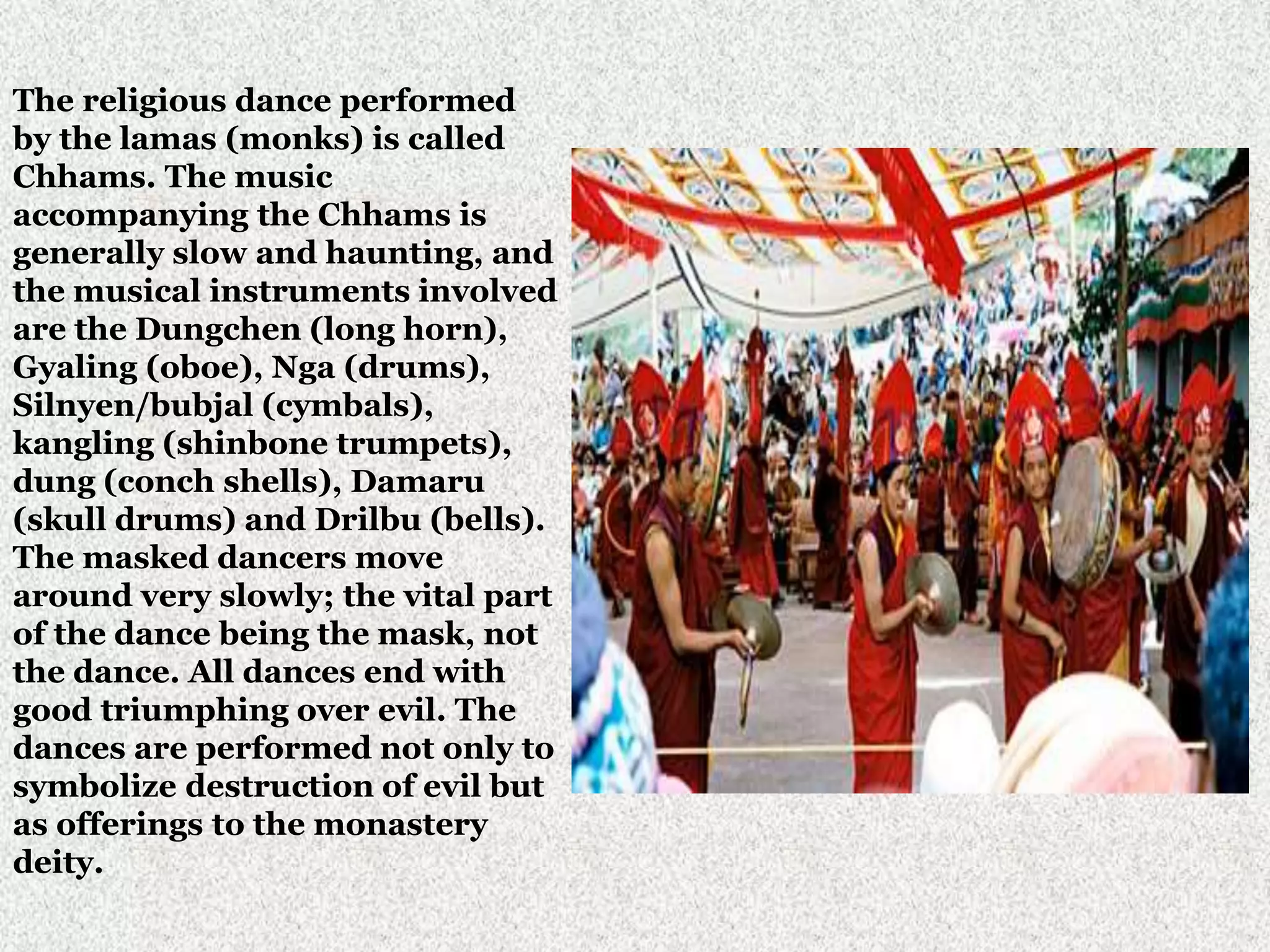
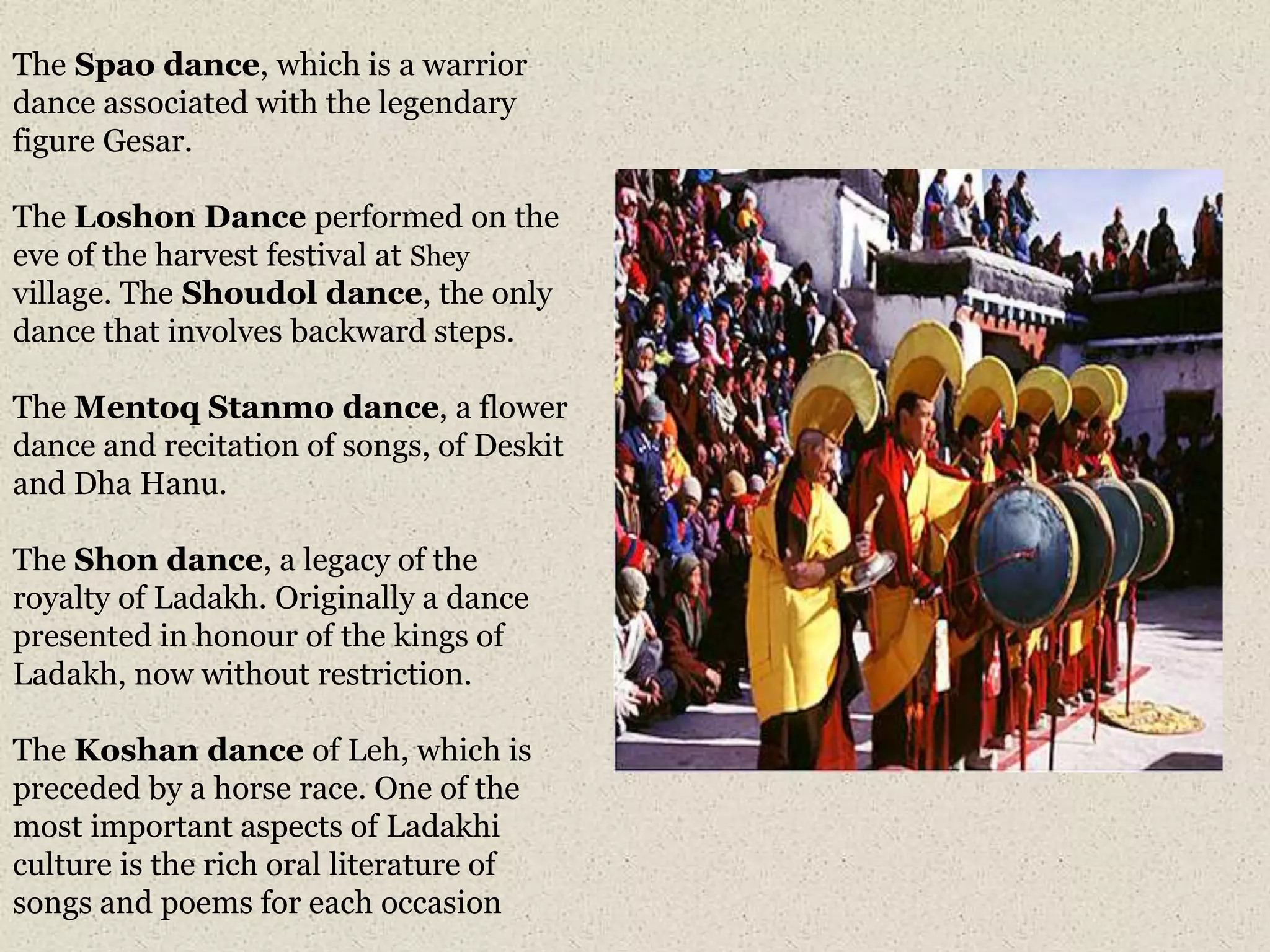
The religious dance performed
by the lamas (monks) is called
Chhams. The music
accompanying the Chhams is
generally slow and haunting, and
the musical instruments involved
are the Dungchen (long horn),
Gyaling (oboe), Nga (drums),
Silnyen/bubjal (cymbals),
kangling (shinbone trumpets),
dung (conch shells), Damaru
(skull drums) and Drilbu (bells).
The masked dancers move
around very slowly; the vital part
of the dance being the mask, not
the dance. All dances end with
good triumphing over evil. The
dances are performed not only to
symbolize destruction of evil but
as offerings to the monastery
deity.
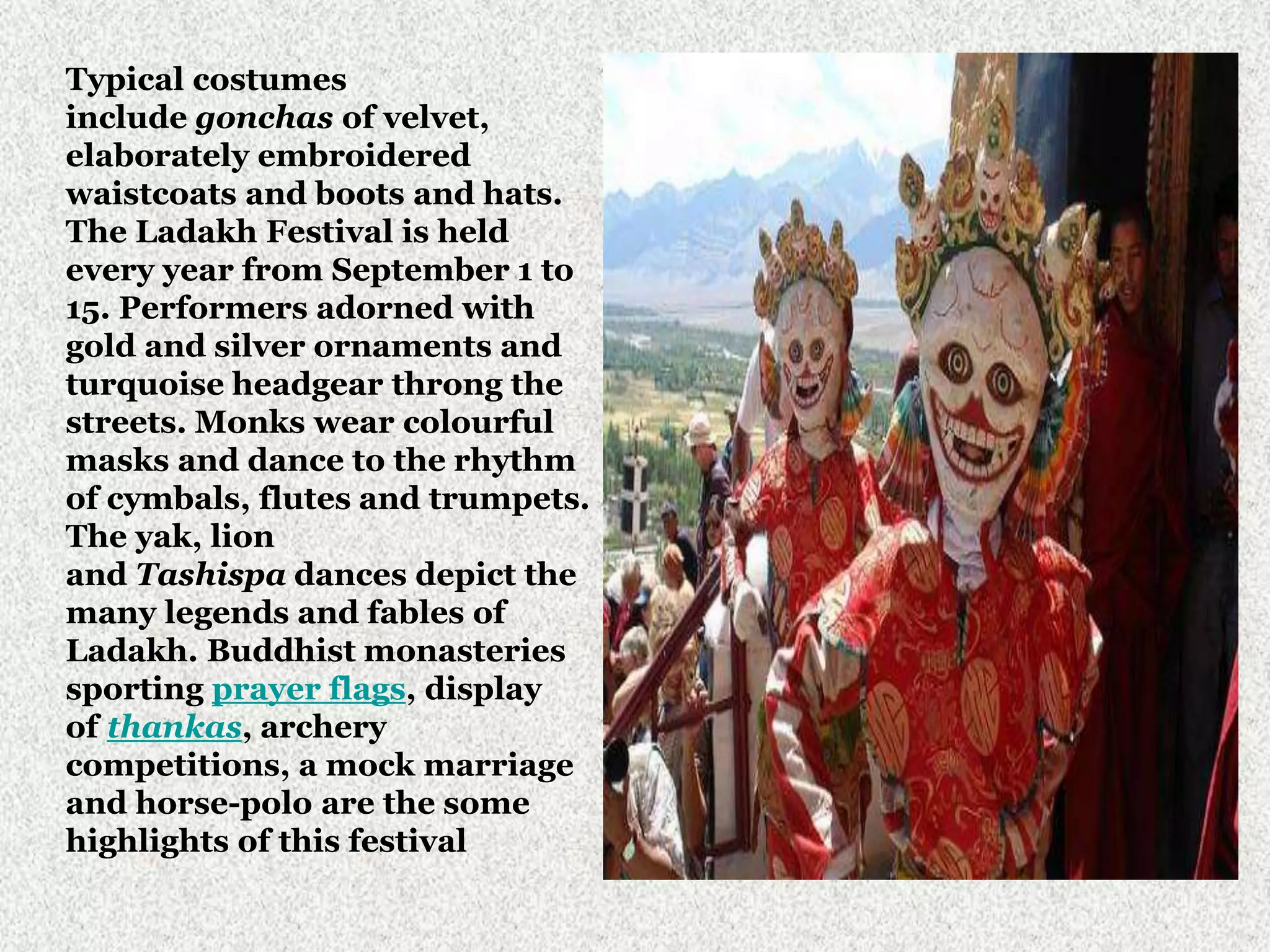
Typical costumes
include gonchas of velvet,
elaborately embroidered
waistcoats and boots and hats.
The Ladakh Festival is held
every year from September 1 to
15. Performers adorned with
gold and silver ornaments and
turquoise headgear throng the
streets. Monks wear colourful
masks and dance to the rhythm
of cymbals, flutes and trumpets.
The yak, lion
and Tashispa dances depict the
many legends and fables of
Ladakh. Buddhist monasteries
sporting prayer flags, display
of thankas, archery
competitions, a mock marriage
and horse-polo are the some
highlights of this festival
Dance !!
Jabro Dance
Tukhstanmo dance
Spao dance
Loshon Dance
Mentoq Stanmo dance
Shon dance
Koshan dance of Leh
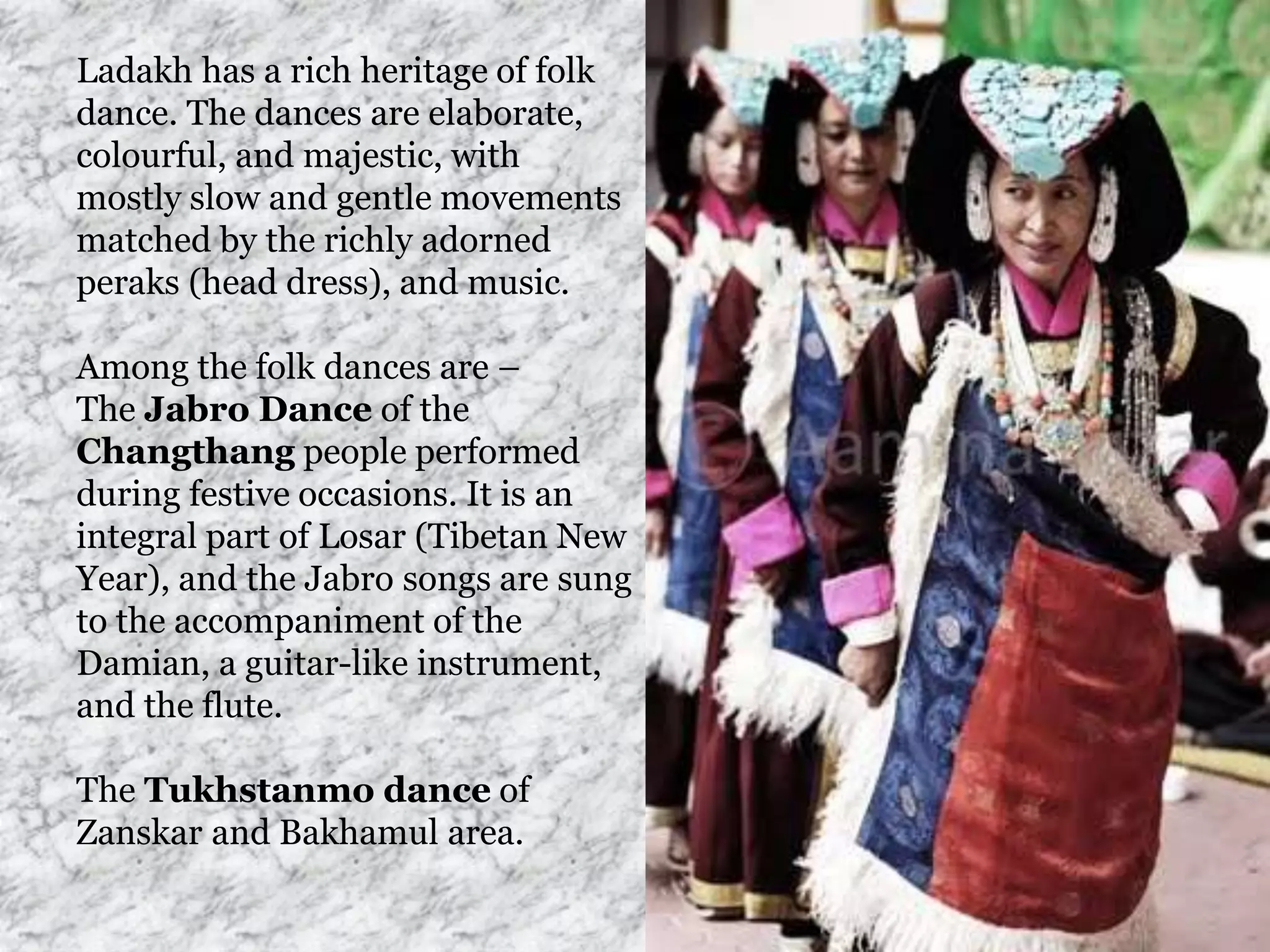
Ladakh has a rich heritage of folk
dance. The dances are elaborate,
colourful, and majestic, with
mostly slow and gentle movements
matched by the richly adorned
peraks (head dress), and music.
Among the folk dances are –
The Jabro Dance of the
Changthang people performed
during festive occasions. It is an
integral part of Losar (Tibetan New
Year), and the Jabro songs are sung
to the accompaniment of the
Damian, a guitar-like instrument,
and the flute.
The Tukhstanmo dance of
Zanskar and Bakhamul area.
The Spao dance, which is a warrior
dance associated with the legendary
figure Gesar.
The Loshon Dance performed on the
eve of the harvest festival at Shey
village. The Shoudol dance, the only
dance that involves backward steps.
The Mentoq Stanmo dance, a flower
dance and recitation of songs, of Deskit
and Dha Hanu.
The Shon dance, a legacy of the
royalty of Ladakh. Originally a dance
presented in honour of the kings of
Ladakh, now without restriction.
The Koshan dance of Leh, which is
preceded by a horse race. One of the
most important aspects of Ladakhi
culture is the rich oral literature of
songs and poems for each occasion
Cuisines!!
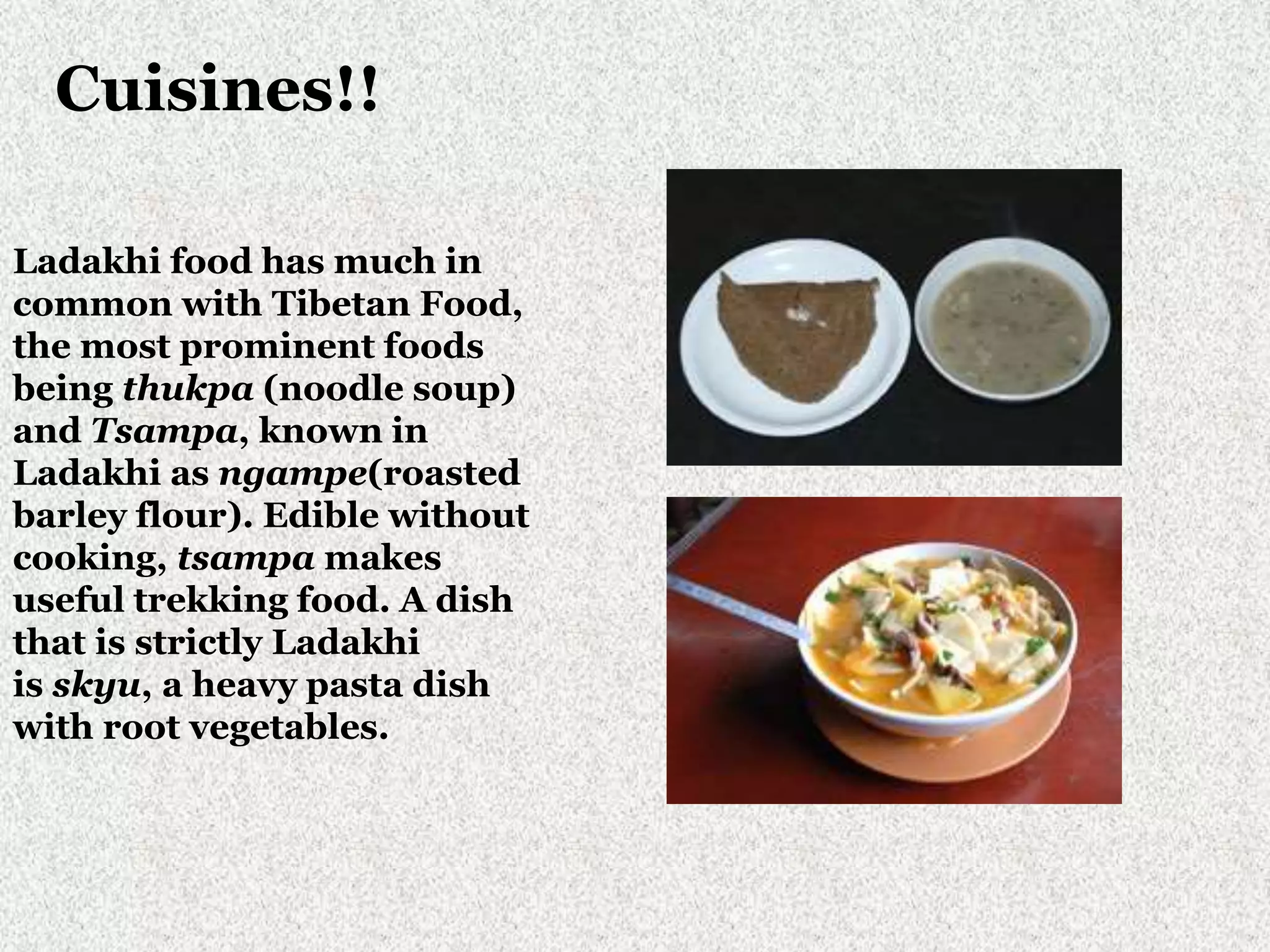
Ladakhi food has much in
common with Tibetan Food,
the most prominent foods
being thukpa (noodle soup)
and Tsampa, known in
Ladakhi as ngampe(roasted
barley flour). Edible without
cooking, tsampa makes
useful trekking food. A dish
that is strictly Ladakhi
is skyu, a heavy pasta dish
with root vegetables.
As Ladakh moves toward a
cash-based economy, foods
from the plains of India are
becoming more common. As
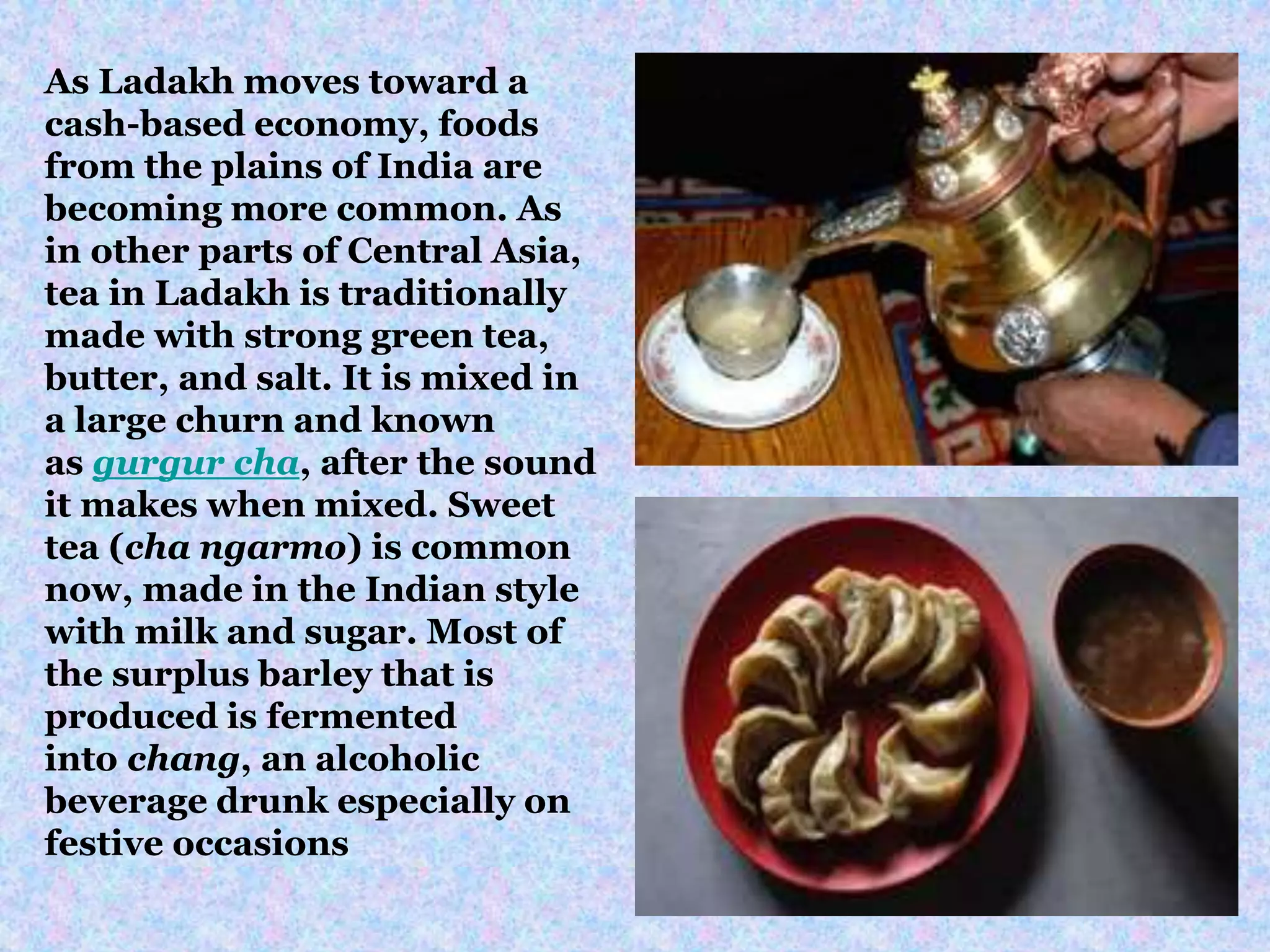
in other parts of Central Asia,
tea in Ladakh is traditionally
made with strong green tea,
butter, and salt. It is mixed in
a large churn and known
as gurgur cha, after the sound
it makes when mixed. Sweet
tea (cha ngarmo) is common
now, made in the Indian style
with milk and sugar. Most of
the surplus barley that is
produced is fermented
into chang, an alcoholic
beverage drunk especially on
festive occasions
CUISINE SPECIALTIES
Ruchotse or Momos:
Ruchotse or momos in soup and
chowmein are the other speciality
dishes here.
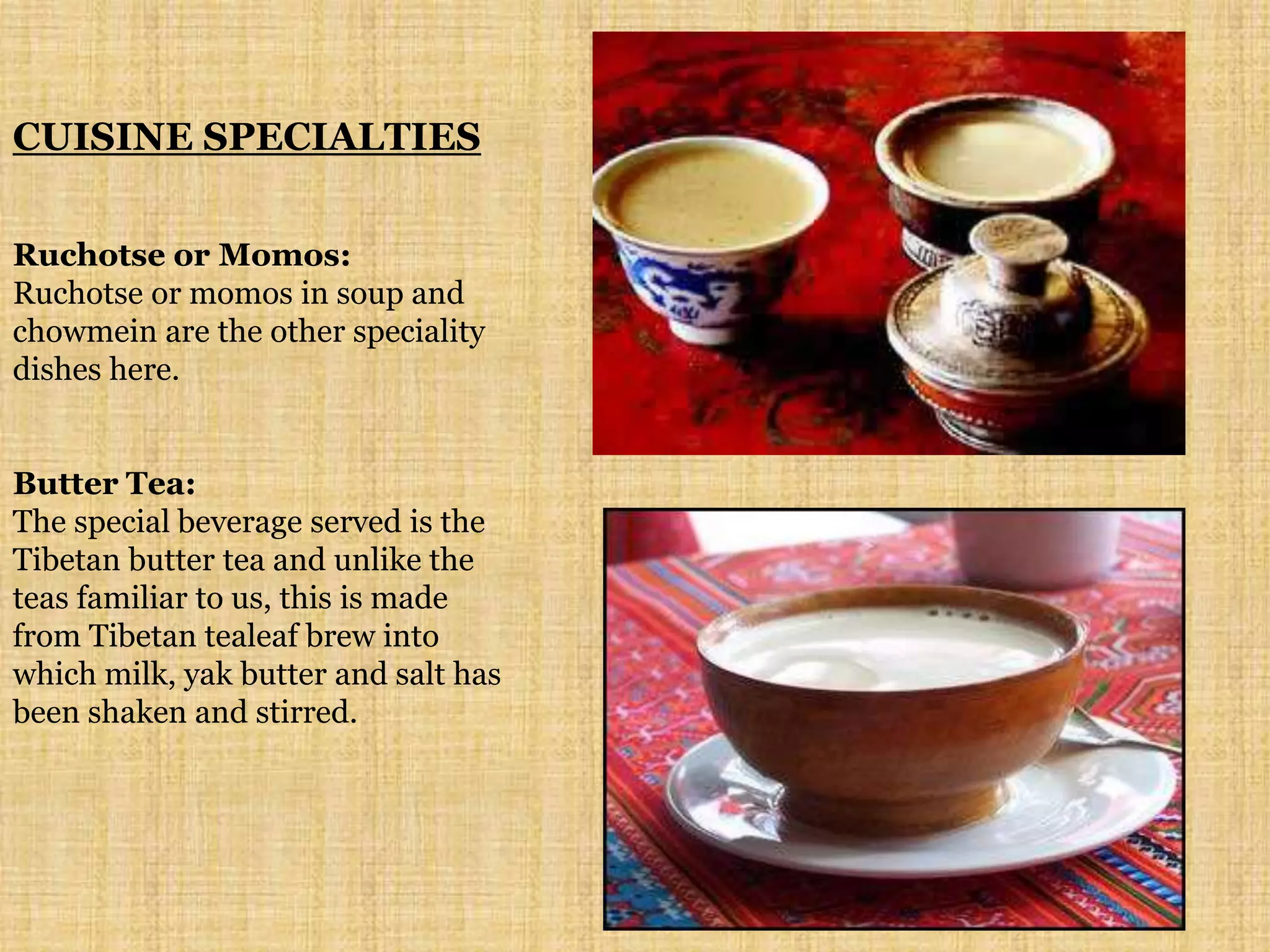
Butter Tea:
The special beverage served is the
Tibetan butter tea and unlike the
teas familiar to us, this is made
from Tibetan tealeaf brew into
which milk, yak butter and salt has
been shaken and stirred.
Tsampa:
A nutritious powder
eaten for breakfast, given
mainly to children and
the old, is the other
typical Tibetan food that
the ladies have brought
along. Tenzin is also an
expert at making Ting
Mo that is similar to
momos but is shaped
into different designs
and boiled or fried.
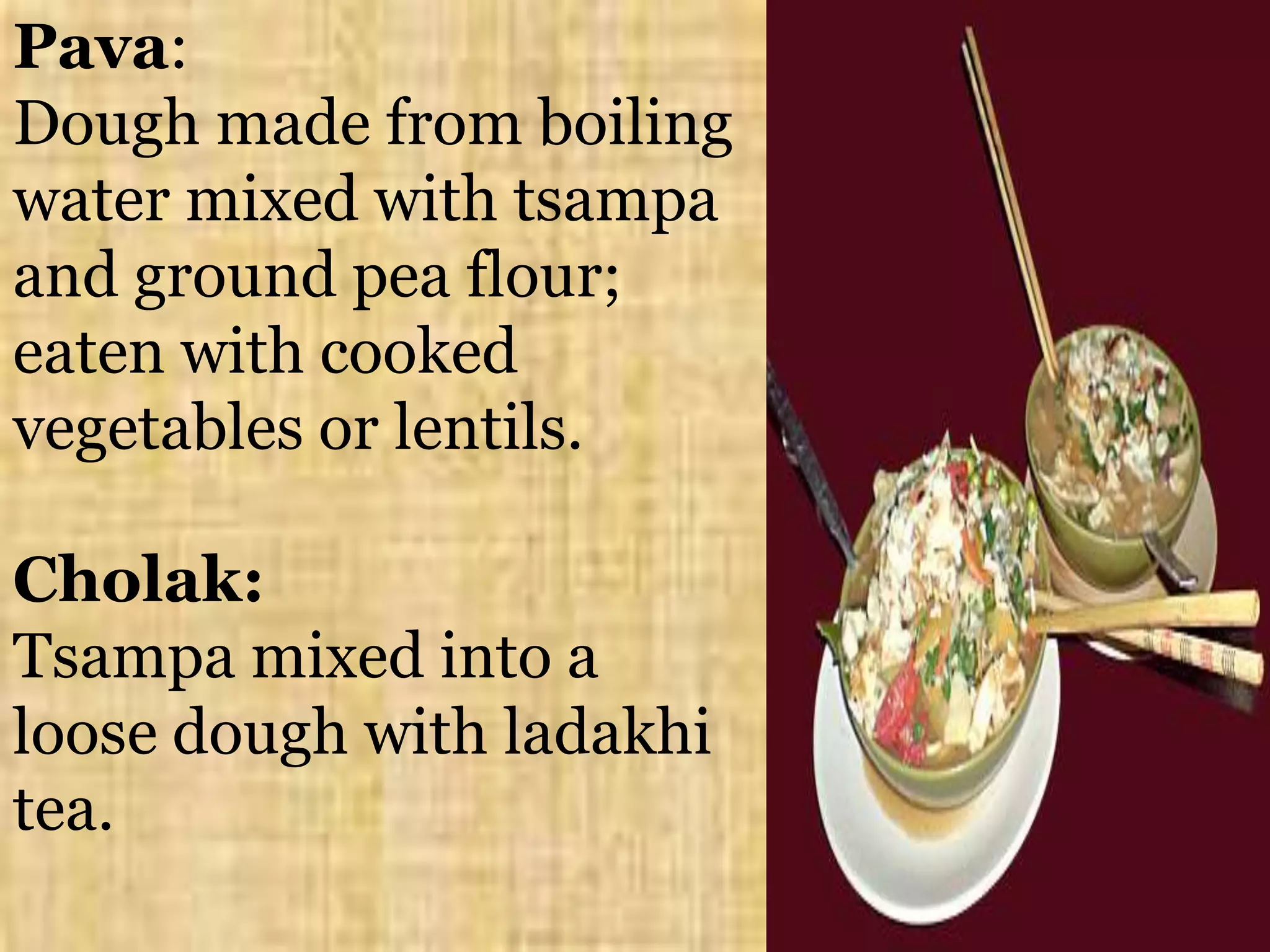
Pava:
Dough made from boiling
water mixed with tsampa
and ground pea flour;
eaten with cooked
vegetables or lentils.
Cholak:
Tsampa mixed into a
loose dough with ladakhi
tea.
THANK YOU

Ladakh

  • 1.
  • 2.
  • 3.
    Mar means redand Yul means land . The ‘Redland ‘ a unique piece of natural beauty thought apparently looks barren yet boasts of mystical landscape with snowcapped peak kissing the Blue sky, Chanting monks, Chiming monasteries with the sound of bells and Trumpets . Its umpteen valleys filled with juniper aroma along with rich culture , tradition and colorful costumes of inhabitants create a magic of its own . Ladakh ,The mystical land is commonly known as ‘Maryul’
  • 4.
    Region Ladakh constitutes theeastern-most part of the state of Jammu & Kashmir. This is one of the most breathtakingly beautiful parts of the state and its surreal landscape has often been termed as "moonscape". Ladakh covers about 117,000 square km and includes the Karakoram Range and the upper Indus River valley. Ladakh is one of the highest places on earth with average altitude being above 12,000 feet.
  • 6.
  • 7.
    One of themost beautiful and fertile regions of Ladakh is Suru Valley which is formed by the Suru river, an important tributary of River Indus. Lush fields, green alpine meadows, cascading rivers and surrounding snow peaks make this region a trekkers delight. The area between Panikhar and Prakachik has some unparalleled views of the great massif of Nun and Kun and offers some tough and interesting treks.
  • 8.
    Ladakh is aland like no other. Bounded by two of the world's mightiest mountain ranges, the Great Himalaya and the Karakoram, it lies athwart two other, the Ladakh range and the Zanskar range. Ladakh is renowned for its remote mountain beauty and culture. Ladakh, the mountain kingdom
  • 9.
  • 10.
    RELIGION: Ladakh has apopulation of about 260,000 which is a blend of many different ethnic groups, predominantlyTibetans, Monpas and Dards. Like other Ladakhis, the Baltis of Kargil, Nubra, Suru Valley and Baltistan show strong Tibetan links in their appearance and language, and were Buddhists until the last few hundred years.
  • 11.
    Most Ladakhis inLeh District and Zangskar are Tibetan Buddhist, while most of the rest of Kargil District is Shia Muslims. There are sizeable minorities of Buddhists in Kargil District and of Muslims in Leh District. There are some Sunni Muslims of Kashmiri descent in Leh and Kargil towns and alsoPadum in Zangskar. The Balti villages in Leh District have several thousand Nurbakhshia Muslims, followers Muslim Sufi Shah Syed Muhammad Nurbakhsh Qahistani. There are a less than 40 families of Ladakhi Christians, who converted in the 19th century. These families belong to several very small Christian.
  • 12.
  • 13.
    For centuries, Ladakhenjoyed a stable and self-reliant agricultural economy based on growing barley, wheat and peas and keeping livestock, especially yaks, cows, dzos, (a yak-cow cross breed), sheep and goats. At altitudes of 3,000 to 4,300 m (10,000 to 14,000 ft), the growing season is only a few months long every year, similar to the northern countries of the world. Animals are scarce and water is in short supply. The Ladakhis developed a small-scale farming system adapted to this unique environment. The land is irrigated by a system of channels which funnel water from the ice and snow of the mountains. The principal crops are barley and wheat. Rice was previously a luxury in the Ladakhi diet, but, subsidised by the government, has now become a cheap staple.
  • 14.
    LanguagesLanguages The Ladakhi languagealso called Bhoti, is the predominant language in the Ladakh region of the Jammu & Kashmir state of India. Ladakhi is closely related to Tibetan, and the Ladakhi people share cultural similarities with Tibetans, including Tibetan Budhism. Ladakhi and Central Tibetan are not mutually intelligible, though they share a written form dating back to Old Tibetan. Ladakhi has several dialects, Ladakhi proper (also called Lehskat after the capital of Ladakh,Leh, where it is spoken); Shamskat, spoken to the northwest of Leh; Stotskat, spoken to the southeast in the Indus valley; and Nubra, spoken in the north. The varieties spoken in Upper Ladakh and zangskari in zanskar
  • 15.
    The principal languageof Ladakh is Ladakhi, a Tibetan language. Educated Ladakhis usually know Hindi, Urdu and often English. Within Ladakh, there is a range of dialects, so that the language of the Chang-pa people may differ markedly from that of the Purig-pa in Kargil, or the Zangskaris, but they are all mutually comprehensible. Due to its position on important trade routes, the language of Leh is enriched with foreign words. Traditionally, Ladakhi had no written form distinct from classical Tibetan, but recently a number of Ladakhi writers have started using the Tibetan script to write the colloquial tongue. Administrative work and education are carried out in English; although Urdu was used to a great extent in the past, now only land records and some police records are kept in Urdu.
  • 16.
    Ladakhi is usuallywritten using Tibetan script with the pronunciation of Ladakhi being much closer to written Tibetan . Ladakhis pronounce many of the prefix, suffix and head letters that are silent in Tibetan. This tendency is more pronounced to the west of Leh, and on the Pakistani side of theLine of Control, in Baltistan. For example, a Tibetan would pronounce sta 'axe' as [tá], but a Ladakhi would say [sta]. While a Tibetan would pronounce ’bras 'rice' as Ladakhis say [dras], and the Kargilpa (Burig) say [bras].
  • 17.
    Culture One of themost noticeable aspect of diverse cultural legacy of Ladakh is their attractive attire which represent rich culture and tradition from the day of the Yore . Variety of costumes exist in Ladakh . These include monastic garments , particularly worn by the monks during the festival .
  • 18.
    The male dressknown as ‘butsechas’ and female dress known as ‘pomeychas’ . These dresses are particularly made of different material like brocade , velvet , fabric , woolen cloth etc. Due to harsh climatic condition and the altitude ranging between 9000 to 25000 feet , ladakhi prefer to wear thick woolen robe in winter and a silk robe in summer season .
  • 19.
    Music !! Traditional musicincludes the instruments surna and daman (shenai and drum). The music of Ladakhi Buddhist monastic festivals, like Tibetan Music, often involves religious chanting in tibetan or Sanskrit as an integral part of the religion. These chants are complex, often recitations of sacred texts or in celebration of various festivals. Yang chanting, performed without metrical timing, is accompanied by resonant drums and low, sustained syllables. Religious mask dances are an important part of Ladakh's cultural life.
  • 20.
    Hemis monastery, a leadingcentre of the Drukpa tradition of Buddhism, holds an annual masked dance festival, as do all major Ladakhi monasteries. The dances typically narrate a story of the fight between good and evil, ending with the eventual victory of the former.Weaving is an important part of traditional life in eastern Ladakh. Both women and men weave, on different looms.
  • 21.
    The religious danceperformed by the lamas (monks) is called Chhams. The music accompanying the Chhams is generally slow and haunting, and the musical instruments involved are the Dungchen (long horn), Gyaling (oboe), Nga (drums), Silnyen/bubjal (cymbals), kangling (shinbone trumpets), dung (conch shells), Damaru (skull drums) and Drilbu (bells). The masked dancers move around very slowly; the vital part of the dance being the mask, not the dance. All dances end with good triumphing over evil. The dances are performed not only to symbolize destruction of evil but as offerings to the monastery deity.
  • 22.
    Typical costumes include gonchasof velvet, elaborately embroidered waistcoats and boots and hats. The Ladakh Festival is held every year from September 1 to 15. Performers adorned with gold and silver ornaments and turquoise headgear throng the streets. Monks wear colourful masks and dance to the rhythm of cymbals, flutes and trumpets. The yak, lion and Tashispa dances depict the many legends and fables of Ladakh. Buddhist monasteries sporting prayer flags, display of thankas, archery competitions, a mock marriage and horse-polo are the some highlights of this festival
  • 23.
    Dance !! Jabro Dance Tukhstanmodance Spao dance Loshon Dance Mentoq Stanmo dance Shon dance Koshan dance of Leh
  • 24.
    Ladakh has arich heritage of folk dance. The dances are elaborate, colourful, and majestic, with mostly slow and gentle movements matched by the richly adorned peraks (head dress), and music. Among the folk dances are – The Jabro Dance of the Changthang people performed during festive occasions. It is an integral part of Losar (Tibetan New Year), and the Jabro songs are sung to the accompaniment of the Damian, a guitar-like instrument, and the flute. The Tukhstanmo dance of Zanskar and Bakhamul area.
  • 25.
    The Spao dance,which is a warrior dance associated with the legendary figure Gesar. The Loshon Dance performed on the eve of the harvest festival at Shey village. The Shoudol dance, the only dance that involves backward steps. The Mentoq Stanmo dance, a flower dance and recitation of songs, of Deskit and Dha Hanu. The Shon dance, a legacy of the royalty of Ladakh. Originally a dance presented in honour of the kings of Ladakh, now without restriction. The Koshan dance of Leh, which is preceded by a horse race. One of the most important aspects of Ladakhi culture is the rich oral literature of songs and poems for each occasion
  • 26.
    Cuisines!! Ladakhi food hasmuch in common with Tibetan Food, the most prominent foods being thukpa (noodle soup) and Tsampa, known in Ladakhi as ngampe(roasted barley flour). Edible without cooking, tsampa makes useful trekking food. A dish that is strictly Ladakhi is skyu, a heavy pasta dish with root vegetables.
  • 27.
    As Ladakh movestoward a cash-based economy, foods from the plains of India are becoming more common. As in other parts of Central Asia, tea in Ladakh is traditionally made with strong green tea, butter, and salt. It is mixed in a large churn and known as gurgur cha, after the sound it makes when mixed. Sweet tea (cha ngarmo) is common now, made in the Indian style with milk and sugar. Most of the surplus barley that is produced is fermented into chang, an alcoholic beverage drunk especially on festive occasions
  • 28.
    CUISINE SPECIALTIES Ruchotse orMomos: Ruchotse or momos in soup and chowmein are the other speciality dishes here. Butter Tea: The special beverage served is the Tibetan butter tea and unlike the teas familiar to us, this is made from Tibetan tealeaf brew into which milk, yak butter and salt has been shaken and stirred.
  • 29.
    Tsampa: A nutritious powder eatenfor breakfast, given mainly to children and the old, is the other typical Tibetan food that the ladies have brought along. Tenzin is also an expert at making Ting Mo that is similar to momos but is shaped into different designs and boiled or fried.
  • 30.
    Pava: Dough made fromboiling water mixed with tsampa and ground pea flour; eaten with cooked vegetables or lentils. Cholak: Tsampa mixed into a loose dough with ladakhi tea.
  • 31.