E-commerce
By: Sumati Joshi
What is E-commerce?
Electronic commerce, commonly known
as e-commerce or eCommerce, is a type
of industry where the buying and selling
of products or services is conducted over
electronic systems such as the Internet
and other computer networks.
What is involved in E-commerce
TYPES OF E-COMMERCE
Business-to-Business (B2B)
B2B e-commerce is simply defined as
e-commerce between companies.
This is the type of e-commerce that deals
with relationships between and among
businesses.
About 80% of e-commerce is of this type,
and most experts predict that B2B e
commerce will continue to grow faster than
the B2C segment.
The B2B market has two primary
components: e-frastructure and e-markets.

For
example, a
tire
manufacturer
might sell to
a car
manufacturer
Business-to-Consumer (B2C)
Business-to-consumer e-commerce, or
commerce between companies and
consumers, involves customers gathering
information; purchasing physical goods (i.e.,
tangibles such as books or consumer
products) or information goods (or goods of
electronic material or digitized content, such
as software, or e-books); and, for information
goods, receiving products over an electronic
network. It is the second largest and the
earliest form of e-commerce.
Business-to-Government (B2G)
Business-to-government e-commerce or B2G is
generally defined as commerce between companies
and the public sector. It refers to the use of the
Internet for public procurement, licensing procedures,
and other government related operations. This kind of
e-commerce has two features:
first, the public sector assumes a pilot/leading role in
establishing e-commerce; and
second, it is assumed that the public sector has the
greatest need for making its procurement system
more effective.

Web-based
purchasing policies
increase the
transparency of
the procurement
process (and
reduces the risk of
irregularities). To
date, however, the
size of the B2G e
commerce market
as a component of
total e-commerce is
insignificant, as
government eprocurement
systems remain
undeveloped.
Consumer-to-Consumer (C2C)
Consumer-to-consumer e-commerce or C2C is simply
commerce between private individuals or consumers. This
type of e-commerce is characterized by the growth of
electronic marketplaces and online auctions, particularly in
vertical industries where firms/businesses can bid for what
they want from among multiple suppliers. It perhaps has the
greatest potential for developing new markets.
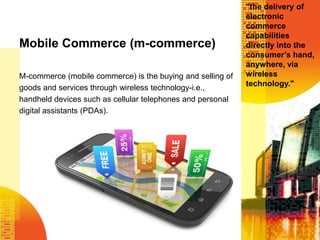
Mobile Commerce (m-commerce)
M-commerce (mobile commerce) is the buying and selling of
goods and services through wireless technology-i.e.,
handheld devices such as cellular telephones and personal
digital assistants (PDAs).

"the delivery of
electronic
commerce
capabilities
directly into the
consumer’s hand,
anywhere, via
wireless
technology."
Some common applications related to electronic commerce

BUSINESS APPLICATIONS
Some common applications related
to electronic commerce are the
following:
•
•
•
•
•
•
•
•
•
•
•
•
•
•

Document automation in supply chain and logistics
Domestic and international Payment systems
Enterprise content management
Group buying
Automated online assistants
Instant messaging
Newsgroups
Online shopping and order tracking
Online banking
Online office suites
Shopping cart software
Teleconferencing
Electronic tickets
Social-networking
CONCLUSION
"E-commerce is an evolution"
• By using electronic technology through the
internet, it achieved.
• More competitions, more marketplaces,
faster transactions, and more advanced
technologies
• To make activities between customers and
producers more active.
• We as customers and internet users are
responsible to keep our e-commerce healthy
and safe so that e-business can be more
reliable in the future
E commerce

E commerce

  • 1.
  • 2.
    What is E-commerce? Electroniccommerce, commonly known as e-commerce or eCommerce, is a type of industry where the buying and selling of products or services is conducted over electronic systems such as the Internet and other computer networks.
  • 3.
    What is involvedin E-commerce
  • 4.
  • 5.
    Business-to-Business (B2B) B2B e-commerceis simply defined as e-commerce between companies. This is the type of e-commerce that deals with relationships between and among businesses. About 80% of e-commerce is of this type, and most experts predict that B2B e commerce will continue to grow faster than the B2C segment. The B2B market has two primary components: e-frastructure and e-markets. For example, a tire manufacturer might sell to a car manufacturer
  • 6.
    Business-to-Consumer (B2C) Business-to-consumer e-commerce,or commerce between companies and consumers, involves customers gathering information; purchasing physical goods (i.e., tangibles such as books or consumer products) or information goods (or goods of electronic material or digitized content, such as software, or e-books); and, for information goods, receiving products over an electronic network. It is the second largest and the earliest form of e-commerce.
  • 7.
    Business-to-Government (B2G) Business-to-government e-commerceor B2G is generally defined as commerce between companies and the public sector. It refers to the use of the Internet for public procurement, licensing procedures, and other government related operations. This kind of e-commerce has two features: first, the public sector assumes a pilot/leading role in establishing e-commerce; and second, it is assumed that the public sector has the greatest need for making its procurement system more effective. Web-based purchasing policies increase the transparency of the procurement process (and reduces the risk of irregularities). To date, however, the size of the B2G e commerce market as a component of total e-commerce is insignificant, as government eprocurement systems remain undeveloped.
  • 8.
    Consumer-to-Consumer (C2C) Consumer-to-consumer e-commerceor C2C is simply commerce between private individuals or consumers. This type of e-commerce is characterized by the growth of electronic marketplaces and online auctions, particularly in vertical industries where firms/businesses can bid for what they want from among multiple suppliers. It perhaps has the greatest potential for developing new markets.
  • 9.
    Mobile Commerce (m-commerce) M-commerce(mobile commerce) is the buying and selling of goods and services through wireless technology-i.e., handheld devices such as cellular telephones and personal digital assistants (PDAs). "the delivery of electronic commerce capabilities directly into the consumer’s hand, anywhere, via wireless technology."
  • 10.
    Some common applicationsrelated to electronic commerce BUSINESS APPLICATIONS
  • 11.
    Some common applicationsrelated to electronic commerce are the following: • • • • • • • • • • • • • • Document automation in supply chain and logistics Domestic and international Payment systems Enterprise content management Group buying Automated online assistants Instant messaging Newsgroups Online shopping and order tracking Online banking Online office suites Shopping cart software Teleconferencing Electronic tickets Social-networking
  • 12.
  • 13.
    "E-commerce is anevolution" • By using electronic technology through the internet, it achieved. • More competitions, more marketplaces, faster transactions, and more advanced technologies • To make activities between customers and producers more active. • We as customers and internet users are responsible to keep our e-commerce healthy and safe so that e-business can be more reliable in the future