DEFINITION:
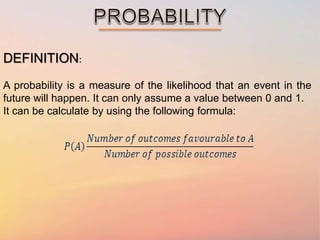
A probability is a measure of the likelihood that an event in the
future will happen. It can only assume a value between 0 and 1.
It can be calculate by using the following formula:
If the probability of an event occurring is 0, then it is an
impossible event means it will never happen.
If the probability of an event occurring is 1, then it is a
certain event, means it will definitely happen.
EXAMPLE:
six faced cubical dice is thrown once, what is the probability of
getting an even number?
SOLUTION:
Number of possible outcomes= 6 {1, 2, 3, 4, 5, 6}
Number of targeted outcomes (even numbers)= 3 {2, 4, 6}
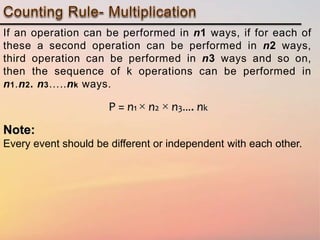
If an operation can be performed in n1 ways, if for each of
these a second operation can be performed in n2 ways,
third operation can be performed in n3 ways and so on,
then the sequence of k operations can be performed in
n1.n2. n3…..nk ways.
P = n1 × n2 × n3…. nk
Note:
Every event should be different or independent with each other.
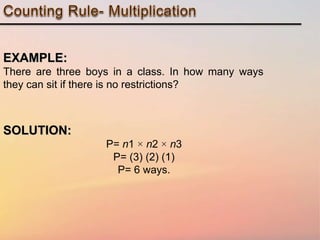
EXAMPLE:
There are three boys in a class. In how many ways
they can sit if there is no restrictions?
SOLUTION:
P= n1 × n2 × n3
P= (3) (2) (1)
P= 6 ways.
A permutation is any arrangement of r objects selected from
n possible objects. The order of arrangement is important in
permutations.
The formula for calculating permutation is:
EXAMPLE:
2 markers are drawn from 3 markers. Find the number of
permutations that can be possible?
SOLUTION:
n=3
r= 2
The total number of sample points is
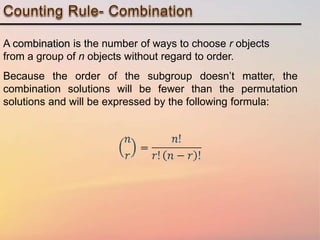
A combination is the number of ways to choose r objects
from a group of n objects without regard to order.
Because the order of the subgroup doesn’t matter, the
combination solutions will be fewer than the permutation
solutions and will be expressed by the following formula:
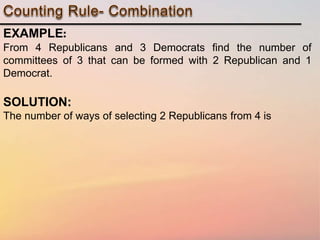
EXAMPLE:
From 4 Republicans and 3 Democrats find the number of
committees of 3 that can be formed with 2 Republican and 1
Democrat.
SOLUTION:
The number of ways of selecting 2 Republicans from 4 is
Probability

Probability

  • 1.
    DEFINITION: A probability isa measure of the likelihood that an event in the future will happen. It can only assume a value between 0 and 1. It can be calculate by using the following formula:
  • 2.
    If the probabilityof an event occurring is 0, then it is an impossible event means it will never happen. If the probability of an event occurring is 1, then it is a certain event, means it will definitely happen.
  • 3.
    EXAMPLE: six faced cubicaldice is thrown once, what is the probability of getting an even number? SOLUTION: Number of possible outcomes= 6 {1, 2, 3, 4, 5, 6} Number of targeted outcomes (even numbers)= 3 {2, 4, 6}
  • 5.
    If an operationcan be performed in n1 ways, if for each of these a second operation can be performed in n2 ways, third operation can be performed in n3 ways and so on, then the sequence of k operations can be performed in n1.n2. n3…..nk ways. P = n1 × n2 × n3…. nk Note: Every event should be different or independent with each other.
  • 6.
    EXAMPLE: There are threeboys in a class. In how many ways they can sit if there is no restrictions? SOLUTION: P= n1 × n2 × n3 P= (3) (2) (1) P= 6 ways.
  • 8.
    A permutation isany arrangement of r objects selected from n possible objects. The order of arrangement is important in permutations. The formula for calculating permutation is:
  • 9.
    EXAMPLE: 2 markers aredrawn from 3 markers. Find the number of permutations that can be possible? SOLUTION: n=3 r= 2 The total number of sample points is
  • 11.
    A combination isthe number of ways to choose r objects from a group of n objects without regard to order. Because the order of the subgroup doesn’t matter, the combination solutions will be fewer than the permutation solutions and will be expressed by the following formula:
  • 12.
    EXAMPLE: From 4 Republicansand 3 Democrats find the number of committees of 3 that can be formed with 2 Republican and 1 Democrat. SOLUTION: The number of ways of selecting 2 Republicans from 4 is