Downloaded 271 times



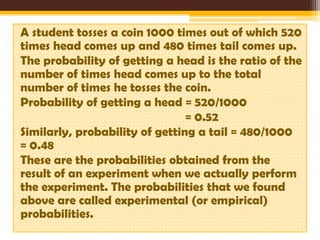
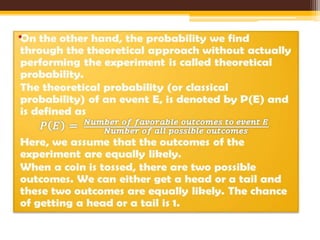


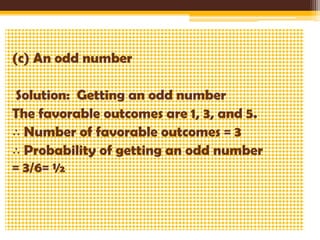
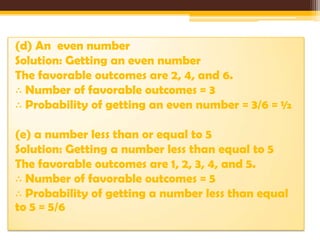


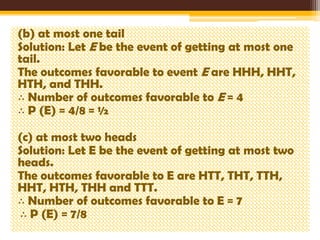


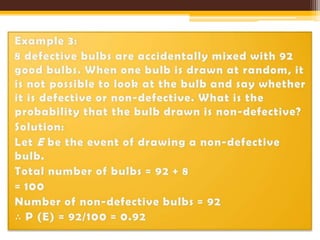
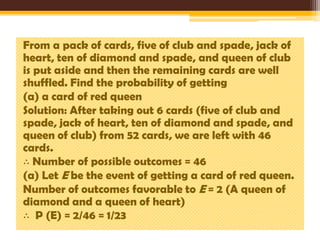
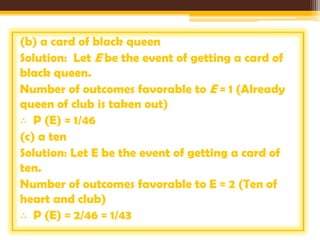
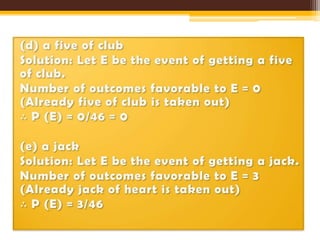



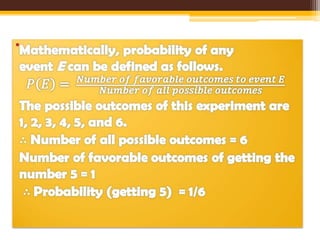
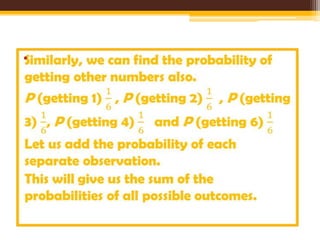
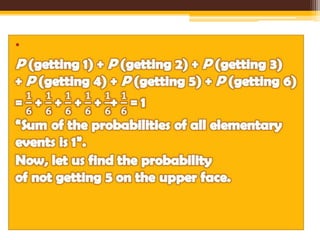


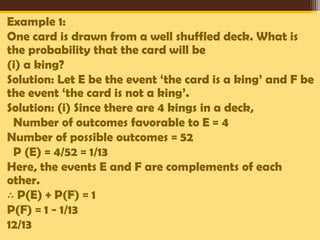
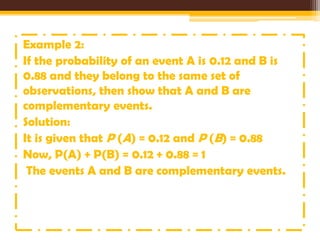

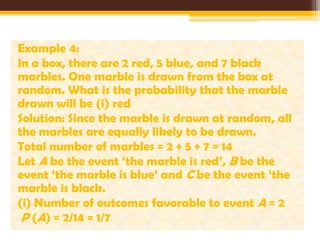



This document discusses theoretical and experimental probability. It provides examples of calculating probabilities from experiments and outcomes. Some key points: - An experiment of tossing a coin 1000 times resulted in 520 heads and 480 tails, giving experimental probabilities of 0.52 for heads and 0.48 for tails. - Theoretical probabilities can be calculated by considering all possible outcomes and the number of favorable outcomes. For example, the probability of getting at least one head when tossing two coins is 3/4. - Complementary events have probabilities that sum to 1, so the probability of an event can be found by subtracting its complement's probability from 1. - Examples demonstrate calculating probabilities from the number of favorable outcomes for different


