

Proactive Feedback Strategies
!
`
Combining Objective and Subjective Criteria
to Provide Constructive Student Criticism
!
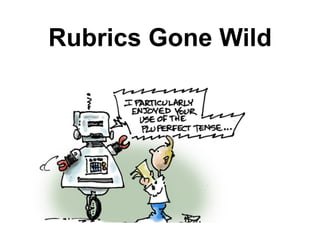
Rubrics Gone Wild
Robo-Grading
Good work on this assignment, but several issues below resulted
in significant point deductions.
!
• Publication Quality: Fair 15/25
The work exhibits fair publication quality, insufficient research,
few credible sources and fair writing.
• Production Mechanics: Good 20/25
The work exhibits good scripting/text, audio, photography,
infographics, videography, and editing as appropriate.
• Advocacy: Good 17/20
The work exhibits good use of persuasive and/or promotional
tactics with a clear, prominent, but fails to provide a specific
hyperlinked call to action.
• APA Style & Grammar: Good 12/15
The work was contained only a few grammar or AP Style errors.
• Attribution: Good 12/15
Purp
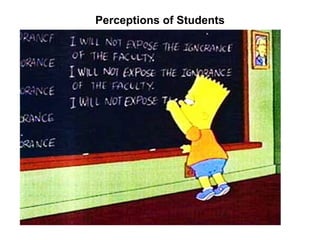
Perceptions of Students
Analyzing Feedback
Begs Questions
1. Types of Students: Consumers vs. Participants
2.Types of Assignments: Discussions, Projects, Test
& Quizzes
3. Types of Feedback
4. Best Practices and Examples
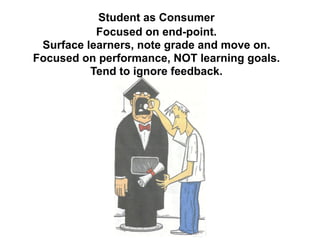
Focused on end-point.
Surface learners, note grade and move on.
Focused on performance, NOT learning goals.
Tend to ignore feedback.
Student as Consumer
Dr#Malcolm#Murray#
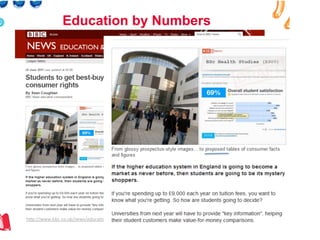
Education by Numbers
h-p://www.bbc.co.uk/news/educa9on:13874483##
Dr#Malcolm#Murray#
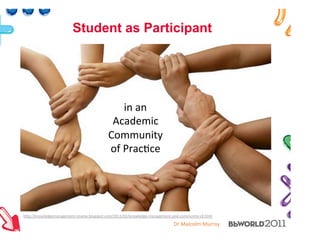
Student as Participant
in#an#
Academic#
Community#
of#Prac5ce#
h7p://knowledgemanagement>review.blogspot.com/2011/02/knowledge>management>and>community>of.html##
Dr#Malcolm#Murray#
Implications
Consumers
•  Focus on the end result
•  Never look back
Participants
•  Learning the rules
•  Want to gain acceptance
Types of Assignments
• Discussions
• Formal Assignments/Projects
• Tests/Quizzes
Class Discussion
Recommendations from Students
1.Required/graded participation — and when instructors used “cold-calling.”
2.Incorporating ideas and experience into discussion — instructor’s elaborate
on their ideas, apply them to course content, include real-life examples and
experience.
3.Active facilitation — Challenging students to answer in depth, not letting people
dominate the discussion, and stopping participation for the sake of participating.
4.Asking effective questions —“When a facilitator is looking for specific answers
and does not consider alternative concepts.”
5.Supportive classroom environment— Teachers should “Encourage” and “Be
Patient” with students, give them time to find their way to a correct or better
answer.
6.Affirm contributions and provide constructive feedback— Explain benefits
from wrong answers and acknowledge accurate and complete answers.
!
• Threaded discussions are one of the most commonly used
tools in online teaching.
• Discussion forums provide the ability for asynchronous
discussion to occur over a period of time.
• The ability to learn asynchronously is one of the primary
benefits of online learning.
• Students are able to reflect upon their ideas before sharing
them with the class, leading to more reflective responses and
in-depth learning. Source: Edutopia
Discussion Purposes
1.Demonstration of Knowledge of Key Concepts -
Using the discussion board to discuss key concepts allows
students to learn from one another and share ideas.
2.Community Building - Build a community of learners.
Students become part of a vibrant learning community,
rather than an just an independent learner completing and
submitting assignments with no real peer interaction.
3.Reflection - Reflective activities require students to share
a synthesis of the learning experience, or to describe how
a situation or experience has personal value to them.
Discussion Purposes!
!
!
!
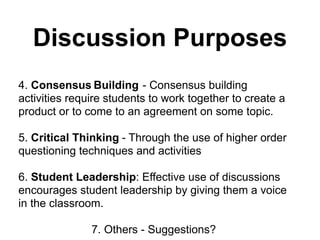
4. Consensus Building - Consensus building
activities require students to work together to create a
product or to come to an agreement on some topic.
!
5. Critical Thinking - Through the use of higher order
questioning techniques and activities
!
6. Student Leadership: Effective use of discussions
encourages student leadership by giving them a voice
in the classroom.
!
7. Others - Suggestions?
Planning Discussions
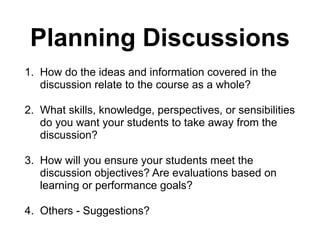
1. How do the ideas and information covered in the
discussion relate to the course as a whole?
2. What skills, knowledge, perspectives, or sensibilities
do you want your students to take away from the
discussion?
3. How will you ensure your students meet the
discussion objectives? Are evaluations based on
learning or performance goals?
4. Others - Suggestions?
Week 1 Discussion
Event Marketing and Production Best Practices
Discussion Overview
!
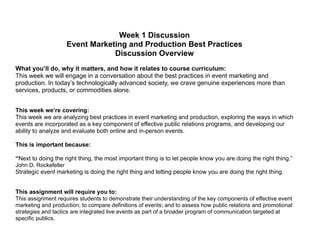
What you’ll do, why it matters, and how it relates to course curriculum:
This week we will engage in a conversation about the best practices in event marketing and
production. In today’s technologically advanced society, we crave genuine experiences more than
services, products, or commodities alone.
!
This week we’re covering:
This week we are analyzing best practices in event marketing and production, exploring the ways in which
events are incorporated as a key component of effective public relations programs, and developing our
ability to analyze and evaluate both online and in-person events.
!
This is important because:
!
“Next to doing the right thing, the most important thing is to let people know you are doing the right thing.”
John D. Rockefeller
Strategic event marketing is doing the right thing and letting people know you are doing the right thing.
!
This assignment will require you to:
This assignment requires students to demonstrate their understanding of the key components of effective event
marketing and production; to compare definitions of events; and to assess how public relations and promotional
strategies and tactics are integrated live events as part of a broader program of communication targeted at
specific publics.
Event Marketing and Production Week 1 – Best Practices
!
Name:
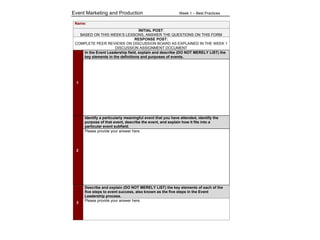
INITIAL POST:
BASED ON THIS WEEK’S LESSONS, ANSWER THE QUESTIONS ON THIS FORM
RESPONSE POST:
COMPLETE PEER REVIEWS ON DISCUSSION BOARD AS EXPLAINED IN THE WEEK 1
DISCUSSION ASSIGNMENT DOCUMENT
1
In the Event Leadership field, explain and describe (DO NOT MERELY LIST) the
key elements in the definitions and purposes of events.
2
Identify a particularly meaningful event that you have attended, identify the
purpose of that event, describe the event, and explain how it fits into a
particular event subfield.
Please provide your answer here.
3
Describe and explain (DO NOT MERELY LIST) the key elements of each of the
five steps to event success, also known as the five steps in the Event
Leadership process.
Please provide your answer here.
For Your Response Post
Critique any two classmates’ answers on their submission forms. Be sure to answer each of
the questions below in regard to each classmate’s answers on his or her Submission Form.
You must post your responses in reply to any two classmates’ submission forms on the
Discussion Board.
1. How did each classmate define “events” and explain their purposes? Was any aspect of
the definition or purposes overlooked or need more explanation?
2. What event did each classmate identify as meaningful? What subfield did each event fit
into?
3. How did each classmate describe the key elements of the five steps to event success?
Where any aspects of these key elements overlooked or need more explanation?
4. How well did each classmate describe the Five Event Ws? What are your suggestions for
them to consider?
5. Did any of the Six Ps of Event Marketing need more explanation or elaboration?
6. What suggestions and/or feedback can you provide your classmates in their explanations
of the five ways to engage potential event attendees?
7. What suggestions and/or feedback do you have for your classmates three
potential topics for the webinar presentation due in week 3?
8. Provide information, insight, and logical analysis about each of the topics and/or
questions of the assignment.
9. Follow the assignment instructions, including presenting your ideas in the format
requested.
10. Do not limit your discussion to “I agree,” “That’s great,” and so forth. Substantiate
your position by using meaningful observations for corroboration, such as:
professional experiences, relationships, and citing scholarly or reputable sources
when appropriate. As a guide for high quality response posts, use the RISE model, which
encourages the steps of Reflect, Inquire, Suggest, and Elevate as outlined in the rubric.
Assignments:
Learning Goals
• What are the goals for the assignment?
• Why are you assigning this project, and what do you hope
your students will gain from completing it?
• What knowledge, skills, and abilities do you aim to measure
with this assignment?
• Ultimately, the connection between the assignment and its
purpose should be clear to both you and your students to
ensure that it is fulfilling the desired goals and doesn’t seem
like “busy work.”
• Do these goals align with the course learning outcomes?
Assignments:
Learning Goals
• What are the levels of the students?
• What do they already know?
• Do they have the requisite skills to complete the assignment?
1. Have they experienced “socialization” in the culture of your discipline?
Are they familiar with any conventions you might want them to know?
2. Do they know how to conduct research? Do they know the proper style
format, documentation style, acceptable resources, including how to use
the library or evaluate resources?
3. What kinds of writing or work have they previously completed? Have
they ever engaged in analysis, reflection, or argumentation? Do they
know how to write a literature review or scientific report?
Assignments:
Six Considerations
1. What are the main units/modules in the course?
2. What are the learning objectives for each module and for the
course?
3. What thinking skills are targeted for development in each
module and throughout the course?
4. What are the most difficult aspects of the course?
5. What study/learning habits does this course shape?
6. What differences should this course make in students’ lives?
1 of 4 New Media Journalism MA: Multimedia Reporting
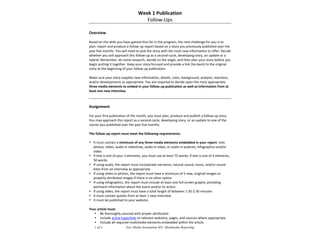
Week$1$Publication$
Follow%Ups)
$
Overview$
)
Based)on)the)skills)you)have)gained)thus)far)in)the)program,)the)next)challenge)for)you)is)to)
plan,)report)and)produce)a)follow%up)report)based)on)a)story)you)previously)published)over)the)
past)five)months.)You)will)need)to)pick)the)story)with)the)most)new)information)to)offer.)Decide)
whether)you)will)approach)this)follow%up)as)a)second%cycle,)developing)story,)an)update)or)a)
hybrid.)Remember,)do)some)research,)decide)on)the)angle,)and)then)plan)your)story)before)you)
begin)putting)it)together.)Keep)your)story)focused)and)provide)a)link)(tie%back))to)the)original)
story)at)the)beginning)of)your)follow%up)publication.))
)
Make)sure)your)story)supplies)new)information,)details,)color,)background,)analysis,)reactions,)
and/or)developments)as)appropriate.)You)are)required)to)decide)upon)the)most)appropriate)
three$media$elements$to$embed$in$your$follow:up$publication$as$well$as$information$from$at$
least$one$new$interview.$$
$
$
Assignment$
)
For)your)first)publication)of)the)month,)you)must)plan,)produce)and)publish)a)follow%up)story.)
You)may)approach)this)report)as)a)second%cycle,)developing)story,)or)an)update)to)one)of)the)
stories)you)published)over)the)past)five)months.)
)
The$follow:up$report$must$meet$the$following$requirements:$
$
• It)must)contain)a)minimum$of$any$three$media$elements$embedded$in$your$report:)text,)
photos,)slides,)audio)in)slideshow,)audio)in)video,)or)audio)in)podcast,)infographics)and/or)
video)
• If)text)is)one)of)your)3)elements,)you)must)use)at)least)75)words;)if)text)is)one)of)4)elements,)
50)words.)
• If)using)audio,)the)report)must)incorporate)narration,)natural)sound,)music,)and/or)sound)
bites)from)an)interview)as)appropriate)
• If)using)slides)or)photos,)the)report)must)have)a)minimum)of)5)new,)original)images)or)
properly)attributed)images)if)there)is)no)other)option)
• If)using)infographics,)the)report)must)include)at)least)one)full%screen)graphic)providing)
pertinent)information)about)the)event)and/or)its)actors)
• If)using)video,)the)report)must)have)a)total)length)of)between)1:30%2:30)minutes)
• It)must)contain)quotes)from)at)least)1)new)interview)
• It)must)be)published)to)your)website.$
$
Your$article$must:$
• Be)thoroughly)sourced)with)proper)attribution)
• Include)active)hyperlinks)to)relevant)websites,)pages,)and)sources)where)appropriate)
• Include)all)required)multimedia)elements)embedded)within)the)article)
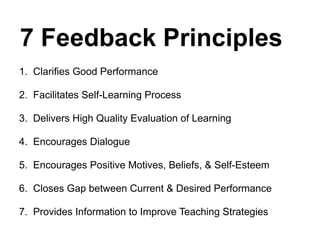
7 Feedback Principles
1. Clarifies Good Performance
2. Facilitates Self-Learning Process
3. Delivers High Quality Evaluation of Learning
4. Encourages Dialogue
5. Encourages Positive Motives, Beliefs, & Self-Esteem
6. Closes Gap between Current & Desired Performance
7. Provides Information to Improve Teaching Strategies
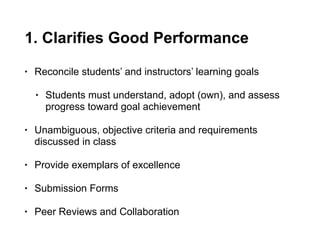
1. Clarifies Good Performance
• Reconcile students’ and instructors’ learning goals
• Students must understand, adopt (own), and assess
progress toward goal achievement
• Unambiguous, objective criteria and requirements
discussed in class
• Provide exemplars of excellence
• Submission Forms
• Peer Reviews and Collaboration
2. Facilitates Development of
Self-Assessment
• Self-Assessment and Reflection
• After Receiving Peer and Instructor Feedback
• Peer reviews develop ability to make judgments
using objective criteria
• Peer processes develop skills needed when
students become professionals regulating their work
3. Delivers High Quality
Evaluation of Learning
1. Based on Pre-Defined Criteria
2. Timely
3. Corrective Examples
4. Does Not Overwhelm
5. Prioritizes Areas for Improvement
6. Accessible
4. Encourages Dialogue About
Learning
• Teachers should stimulate a continuing dialog about
assignment topics, content, requirements,
performance, and feedback
• Discussions help students develop understanding of
expectations and standards, to correct
misunderstandings, and get immediate response to
difficulties
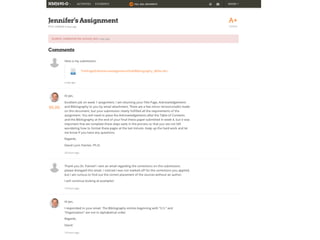
• Innumerable Feedback Channels
• FSO 3 Facilitates Feedback
5. Encourages Positive Motives,
Beliefs, & Self-Esteem
• Instructor’s perceived motives color interpretation of
feedback
• Focus on feedback (learning goal), not numerical grade
(performance goal)
• Praising effort and strategic behaviors, and focusing
students through feedback on learning goals, leads to
higher achievement than praising ability or intelligence
• Instructor, Peer, and Internal (Self) Feedback is an
evaluation, not of the person but of the performance in
context.
6. Closes Gap between Current &
Desired Performance
• The only way to tell if learning results from feedback
is for students to make some kind of response to
complete the feedback loop (Sadler, 1989).
• Unless students are able to use the feedback to
produce improved work, neither they nor those
giving the feedback will know that it has been
effective (Boud, 2000, p158).
6. Closes Gap Between Current &
Desired Performance
1. Closing the gap requires supporting students while
engaged in the act of production of a piece of
work.
2. Requires providing opportunities to repeat the
same ‘task performance-external feedback cycle’
in subsequent assignments.
6. Closing Gap Between Current &
Desired Performance
1. Provide feedback on work in progress and
increase opportunities for resubmission
2. Two-stage assignments where feedback on stage
one helps improve stage two t
3. Model the strategies to close a performance gap
in class (exemplars and templates)
4. Provide specific ‘action points’
5. Involve students in groups in identifying their own
action points in class after they have read the
feedback on their assignments.
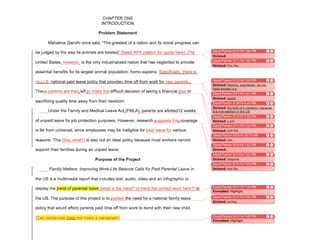
Spelling & Grammar
Settings inWord
Customizing Microsoft Word Settings for Formal Writing
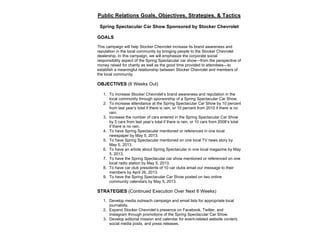
Public Relations Goals, Objectives, Strategies, & Tactics
Spring Spectacular Car Show Sponsored by Stocker Chevrolet
GOALS
This campaign will help Stocker Chevrolet increase its brand awareness and
reputation in the local community by bringing people to the Stocker Chevrolet
dealership. In this campaign, we will emphasize the corporate social
responsibility aspect of the Spring Spectacular car show—from the perspective of
money raised for charity as well as the good time provided to attendees—to
establish a meaningful relationship between Stocker Chevrolet and members of
the local community.
OBJECTIVES (6 Weeks Out)
1. To increase Stocker Chevrolet’s brand awareness and reputation in the
local community through sponsorship of a Spring Spectacular Car Show.
2. To increase attendance at the Spring Spectacular Car Show by 10 percent
from last year’s total if there is rain, or 10 percent from 2010 if there is no
rain.
3. Increase the number of cars entered in the Spring Spectacular Car Show
by 5 cars from last year’s total if there is rain, or 10 cars from 2008’s total
if there is no rain.
4. To have Spring Spectacular mentioned or referenced in one local
newspaper by May 5, 2013.
5. To have Spring Spectacular mentioned on one local TV news story by
May 5, 2013.
6. To have an article about Spring Spectacular in one local magazine by May
5, 2013.
7. To have the Spring Spectacular car show mentioned or referenced on one
local radio station by May 5, 2013.
8. To have car club presidents of 10 car clubs email our message to their
members by April 26, 2013.
9. To have the Spring Spectacular Car Show posted on two online
community calendars by May 5, 2013.
STRATEGIES (Continued Execution Over Next 6 Weeks)
1. Develop media outreach campaign and email lists for appropriate local
journalists.
2. Expand Stocker Chevrolet’s presence on Facebook, Twitter, and
Instagram through promotions of the Spring Spectacular Car Show.
3. Develop editorial mission and calendar for event-related website content,
social media posts, and press releases.
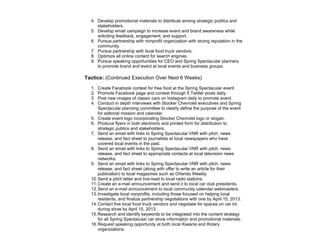
4. Develop promotional materials to distribute among strategic publics and
stakeholders.
5. Develop email campaign to increase event and brand awareness while
soliciting feedback, engagement, and support.
6. Pursue partnership with nonprofit organization with strong reputation in the
community.
7. Pursue partnership with local food truck vendors.
8. Optimize all online content for search engines.
9. Pursue speaking opportunities for CEO and Spring Spectacular planners
to promote brand and event at local events and business groups.
Tactics: (Continued Execution Over Next 6 Weeks)
1. Create Facebook contest for free food at the Spring Spectacular event.
2. Promote Facebook page and contest through 5 Twitter posts daily.
3. Post new images of classic cars on Instagram daily to promote event.
4. Conduct in depth interviews with Stocker Chevrolet executives and Spring
Spectacular planning committee to clearly define the purpose of the event
for editorial mission and calendar.
5. Create event logo incorporating Stocker Chevrolet logo or slogan.
6. Produce flyers in both electronic and printed form for distribution to
strategic publics and stakeholders.
7. Send an email with links to Spring Spectacular VNR with pitch, news
release, and fact sheet to journalists at local newspapers who have
covered local events in the past.
8. Send an email with links to Spring Spectacular VNR with pitch, news
release, and fact sheet to appropriate contacts at local television news
networks.
9. Send an email with links to Spring Spectacular VNR with pitch, news
release, and fact sheet (along with offer to write an article for their
publication) to local magazines such as Orlando Weekly
10.Send a pitch letter and live-read to local radio stations.
11.Create an e-mail announcement and send it to local car club presidents.
12.Send an e-mail announcement to local community calendar webmasters.
13.Investigate local nonprofits, including those focused on helping local
residents, and finalize partnership negotiations with one by April 15, 2013.
14.Contact five local food truck vendors and negotiate for spaces on car lot
during show by April 15, 2013.
15.Research and identify keywords to be integrated into the content strategy
for all Spring Spectacular car show information and promotional materials.
16.Request speaking opportunity at both local Kiwanis and Rotary
organizations.
7. Provides Information to Improve
Teaching Strategies
• The act of assessing has an effect on the assessor
as well as the student. Assessors learn about the
extent to which they [students] have developed
expertise and can tailor their teaching accordingly
(York, 2003, p482).
Proactive Feedback Strategies in Online (and Offline) Teaching

Proactive Feedback Strategies in Online (and Offline) Teaching

  • 2.
    Proactive Feedback Strategies ! ` CombiningObjective and Subjective Criteria to Provide Constructive Student Criticism !
  • 3.
  • 4.
    Robo-Grading Good work onthis assignment, but several issues below resulted in significant point deductions. ! • Publication Quality: Fair 15/25 The work exhibits fair publication quality, insufficient research, few credible sources and fair writing. • Production Mechanics: Good 20/25 The work exhibits good scripting/text, audio, photography, infographics, videography, and editing as appropriate. • Advocacy: Good 17/20 The work exhibits good use of persuasive and/or promotional tactics with a clear, prominent, but fails to provide a specific hyperlinked call to action. • APA Style & Grammar: Good 12/15 The work was contained only a few grammar or AP Style errors. • Attribution: Good 12/15
  • 5.
  • 6.
    Analyzing Feedback Begs Questions 1.Types of Students: Consumers vs. Participants 2.Types of Assignments: Discussions, Projects, Test & Quizzes 3. Types of Feedback 4. Best Practices and Examples
  • 7.
    Focused on end-point. Surfacelearners, note grade and move on. Focused on performance, NOT learning goals. Tend to ignore feedback. Student as Consumer
  • 8.
  • 9.
  • 10.
    Dr#Malcolm#Murray# Implications Consumers •  Focus onthe end result •  Never look back Participants •  Learning the rules •  Want to gain acceptance
  • 11.
    Types of Assignments •Discussions • Formal Assignments/Projects • Tests/Quizzes
  • 12.
    Class Discussion Recommendations fromStudents 1.Required/graded participation — and when instructors used “cold-calling.” 2.Incorporating ideas and experience into discussion — instructor’s elaborate on their ideas, apply them to course content, include real-life examples and experience. 3.Active facilitation — Challenging students to answer in depth, not letting people dominate the discussion, and stopping participation for the sake of participating. 4.Asking effective questions —“When a facilitator is looking for specific answers and does not consider alternative concepts.” 5.Supportive classroom environment— Teachers should “Encourage” and “Be Patient” with students, give them time to find their way to a correct or better answer. 6.Affirm contributions and provide constructive feedback— Explain benefits from wrong answers and acknowledge accurate and complete answers.
  • 13.
    ! • Threaded discussionsare one of the most commonly used tools in online teaching. • Discussion forums provide the ability for asynchronous discussion to occur over a period of time. • The ability to learn asynchronously is one of the primary benefits of online learning. • Students are able to reflect upon their ideas before sharing them with the class, leading to more reflective responses and in-depth learning. Source: Edutopia
  • 14.
    Discussion Purposes 1.Demonstration ofKnowledge of Key Concepts - Using the discussion board to discuss key concepts allows students to learn from one another and share ideas. 2.Community Building - Build a community of learners. Students become part of a vibrant learning community, rather than an just an independent learner completing and submitting assignments with no real peer interaction. 3.Reflection - Reflective activities require students to share a synthesis of the learning experience, or to describe how a situation or experience has personal value to them.
  • 15.
    Discussion Purposes! ! ! ! 4. ConsensusBuilding - Consensus building activities require students to work together to create a product or to come to an agreement on some topic. ! 5. Critical Thinking - Through the use of higher order questioning techniques and activities ! 6. Student Leadership: Effective use of discussions encourages student leadership by giving them a voice in the classroom. ! 7. Others - Suggestions?
  • 16.
    Planning Discussions 1. Howdo the ideas and information covered in the discussion relate to the course as a whole? 2. What skills, knowledge, perspectives, or sensibilities do you want your students to take away from the discussion? 3. How will you ensure your students meet the discussion objectives? Are evaluations based on learning or performance goals? 4. Others - Suggestions?
  • 17.
    Week 1 Discussion EventMarketing and Production Best Practices Discussion Overview ! What you’ll do, why it matters, and how it relates to course curriculum: This week we will engage in a conversation about the best practices in event marketing and production. In today’s technologically advanced society, we crave genuine experiences more than services, products, or commodities alone. ! This week we’re covering: This week we are analyzing best practices in event marketing and production, exploring the ways in which events are incorporated as a key component of effective public relations programs, and developing our ability to analyze and evaluate both online and in-person events. ! This is important because: ! “Next to doing the right thing, the most important thing is to let people know you are doing the right thing.” John D. Rockefeller Strategic event marketing is doing the right thing and letting people know you are doing the right thing. ! This assignment will require you to: This assignment requires students to demonstrate their understanding of the key components of effective event marketing and production; to compare definitions of events; and to assess how public relations and promotional strategies and tactics are integrated live events as part of a broader program of communication targeted at specific publics.
  • 18.
    Event Marketing andProduction Week 1 – Best Practices ! Name: INITIAL POST: BASED ON THIS WEEK’S LESSONS, ANSWER THE QUESTIONS ON THIS FORM RESPONSE POST: COMPLETE PEER REVIEWS ON DISCUSSION BOARD AS EXPLAINED IN THE WEEK 1 DISCUSSION ASSIGNMENT DOCUMENT 1 In the Event Leadership field, explain and describe (DO NOT MERELY LIST) the key elements in the definitions and purposes of events. 2 Identify a particularly meaningful event that you have attended, identify the purpose of that event, describe the event, and explain how it fits into a particular event subfield. Please provide your answer here. 3 Describe and explain (DO NOT MERELY LIST) the key elements of each of the five steps to event success, also known as the five steps in the Event Leadership process. Please provide your answer here.
  • 19.
    For Your ResponsePost Critique any two classmates’ answers on their submission forms. Be sure to answer each of the questions below in regard to each classmate’s answers on his or her Submission Form. You must post your responses in reply to any two classmates’ submission forms on the Discussion Board. 1. How did each classmate define “events” and explain their purposes? Was any aspect of the definition or purposes overlooked or need more explanation? 2. What event did each classmate identify as meaningful? What subfield did each event fit into? 3. How did each classmate describe the key elements of the five steps to event success? Where any aspects of these key elements overlooked or need more explanation? 4. How well did each classmate describe the Five Event Ws? What are your suggestions for them to consider? 5. Did any of the Six Ps of Event Marketing need more explanation or elaboration? 6. What suggestions and/or feedback can you provide your classmates in their explanations of the five ways to engage potential event attendees? 7. What suggestions and/or feedback do you have for your classmates three potential topics for the webinar presentation due in week 3? 8. Provide information, insight, and logical analysis about each of the topics and/or questions of the assignment. 9. Follow the assignment instructions, including presenting your ideas in the format requested. 10. Do not limit your discussion to “I agree,” “That’s great,” and so forth. Substantiate your position by using meaningful observations for corroboration, such as: professional experiences, relationships, and citing scholarly or reputable sources when appropriate. As a guide for high quality response posts, use the RISE model, which encourages the steps of Reflect, Inquire, Suggest, and Elevate as outlined in the rubric.
  • 20.
    Assignments: Learning Goals • Whatare the goals for the assignment? • Why are you assigning this project, and what do you hope your students will gain from completing it? • What knowledge, skills, and abilities do you aim to measure with this assignment? • Ultimately, the connection between the assignment and its purpose should be clear to both you and your students to ensure that it is fulfilling the desired goals and doesn’t seem like “busy work.” • Do these goals align with the course learning outcomes?
  • 21.
    Assignments: Learning Goals • Whatare the levels of the students? • What do they already know? • Do they have the requisite skills to complete the assignment? 1. Have they experienced “socialization” in the culture of your discipline? Are they familiar with any conventions you might want them to know? 2. Do they know how to conduct research? Do they know the proper style format, documentation style, acceptable resources, including how to use the library or evaluate resources? 3. What kinds of writing or work have they previously completed? Have they ever engaged in analysis, reflection, or argumentation? Do they know how to write a literature review or scientific report?
  • 22.
    Assignments: Six Considerations 1. Whatare the main units/modules in the course? 2. What are the learning objectives for each module and for the course? 3. What thinking skills are targeted for development in each module and throughout the course? 4. What are the most difficult aspects of the course? 5. What study/learning habits does this course shape? 6. What differences should this course make in students’ lives?
  • 23.
    1 of 4New Media Journalism MA: Multimedia Reporting Week$1$Publication$ Follow%Ups) $ Overview$ ) Based)on)the)skills)you)have)gained)thus)far)in)the)program,)the)next)challenge)for)you)is)to) plan,)report)and)produce)a)follow%up)report)based)on)a)story)you)previously)published)over)the) past)five)months.)You)will)need)to)pick)the)story)with)the)most)new)information)to)offer.)Decide) whether)you)will)approach)this)follow%up)as)a)second%cycle,)developing)story,)an)update)or)a) hybrid.)Remember,)do)some)research,)decide)on)the)angle,)and)then)plan)your)story)before)you) begin)putting)it)together.)Keep)your)story)focused)and)provide)a)link)(tie%back))to)the)original) story)at)the)beginning)of)your)follow%up)publication.)) ) Make)sure)your)story)supplies)new)information,)details,)color,)background,)analysis,)reactions,) and/or)developments)as)appropriate.)You)are)required)to)decide)upon)the)most)appropriate) three$media$elements$to$embed$in$your$follow:up$publication$as$well$as$information$from$at$ least$one$new$interview.$$ $ $ Assignment$ ) For)your)first)publication)of)the)month,)you)must)plan,)produce)and)publish)a)follow%up)story.) You)may)approach)this)report)as)a)second%cycle,)developing)story,)or)an)update)to)one)of)the) stories)you)published)over)the)past)five)months.) ) The$follow:up$report$must$meet$the$following$requirements:$ $ • It)must)contain)a)minimum$of$any$three$media$elements$embedded$in$your$report:)text,) photos,)slides,)audio)in)slideshow,)audio)in)video,)or)audio)in)podcast,)infographics)and/or) video) • If)text)is)one)of)your)3)elements,)you)must)use)at)least)75)words;)if)text)is)one)of)4)elements,) 50)words.) • If)using)audio,)the)report)must)incorporate)narration,)natural)sound,)music,)and/or)sound) bites)from)an)interview)as)appropriate) • If)using)slides)or)photos,)the)report)must)have)a)minimum)of)5)new,)original)images)or) properly)attributed)images)if)there)is)no)other)option) • If)using)infographics,)the)report)must)include)at)least)one)full%screen)graphic)providing) pertinent)information)about)the)event)and/or)its)actors) • If)using)video,)the)report)must)have)a)total)length)of)between)1:30%2:30)minutes) • It)must)contain)quotes)from)at)least)1)new)interview) • It)must)be)published)to)your)website.$ $ Your$article$must:$ • Be)thoroughly)sourced)with)proper)attribution) • Include)active)hyperlinks)to)relevant)websites,)pages,)and)sources)where)appropriate) • Include)all)required)multimedia)elements)embedded)within)the)article)
  • 24.
    7 Feedback Principles 1.Clarifies Good Performance 2. Facilitates Self-Learning Process 3. Delivers High Quality Evaluation of Learning 4. Encourages Dialogue 5. Encourages Positive Motives, Beliefs, & Self-Esteem 6. Closes Gap between Current & Desired Performance 7. Provides Information to Improve Teaching Strategies
  • 25.
    1. Clarifies GoodPerformance • Reconcile students’ and instructors’ learning goals • Students must understand, adopt (own), and assess progress toward goal achievement • Unambiguous, objective criteria and requirements discussed in class • Provide exemplars of excellence • Submission Forms • Peer Reviews and Collaboration
  • 27.
    2. Facilitates Developmentof Self-Assessment • Self-Assessment and Reflection • After Receiving Peer and Instructor Feedback • Peer reviews develop ability to make judgments using objective criteria • Peer processes develop skills needed when students become professionals regulating their work
  • 29.
    3. Delivers HighQuality Evaluation of Learning 1. Based on Pre-Defined Criteria 2. Timely 3. Corrective Examples 4. Does Not Overwhelm 5. Prioritizes Areas for Improvement 6. Accessible
  • 31.
    4. Encourages DialogueAbout Learning • Teachers should stimulate a continuing dialog about assignment topics, content, requirements, performance, and feedback • Discussions help students develop understanding of expectations and standards, to correct misunderstandings, and get immediate response to difficulties • Innumerable Feedback Channels • FSO 3 Facilitates Feedback
  • 35.
    5. Encourages PositiveMotives, Beliefs, & Self-Esteem • Instructor’s perceived motives color interpretation of feedback • Focus on feedback (learning goal), not numerical grade (performance goal) • Praising effort and strategic behaviors, and focusing students through feedback on learning goals, leads to higher achievement than praising ability or intelligence • Instructor, Peer, and Internal (Self) Feedback is an evaluation, not of the person but of the performance in context.
  • 36.
    6. Closes Gapbetween Current & Desired Performance • The only way to tell if learning results from feedback is for students to make some kind of response to complete the feedback loop (Sadler, 1989). • Unless students are able to use the feedback to produce improved work, neither they nor those giving the feedback will know that it has been effective (Boud, 2000, p158).
  • 37.
    6. Closes GapBetween Current & Desired Performance 1. Closing the gap requires supporting students while engaged in the act of production of a piece of work. 2. Requires providing opportunities to repeat the same ‘task performance-external feedback cycle’ in subsequent assignments.
  • 38.
    6. Closing GapBetween Current & Desired Performance 1. Provide feedback on work in progress and increase opportunities for resubmission 2. Two-stage assignments where feedback on stage one helps improve stage two t 3. Model the strategies to close a performance gap in class (exemplars and templates) 4. Provide specific ‘action points’ 5. Involve students in groups in identifying their own action points in class after they have read the feedback on their assignments.
  • 39.
    Spelling & Grammar SettingsinWord Customizing Microsoft Word Settings for Formal Writing
  • 41.
    Public Relations Goals,Objectives, Strategies, & Tactics Spring Spectacular Car Show Sponsored by Stocker Chevrolet GOALS This campaign will help Stocker Chevrolet increase its brand awareness and reputation in the local community by bringing people to the Stocker Chevrolet dealership. In this campaign, we will emphasize the corporate social responsibility aspect of the Spring Spectacular car show—from the perspective of money raised for charity as well as the good time provided to attendees—to establish a meaningful relationship between Stocker Chevrolet and members of the local community. OBJECTIVES (6 Weeks Out) 1. To increase Stocker Chevrolet’s brand awareness and reputation in the local community through sponsorship of a Spring Spectacular Car Show. 2. To increase attendance at the Spring Spectacular Car Show by 10 percent from last year’s total if there is rain, or 10 percent from 2010 if there is no rain. 3. Increase the number of cars entered in the Spring Spectacular Car Show by 5 cars from last year’s total if there is rain, or 10 cars from 2008’s total if there is no rain. 4. To have Spring Spectacular mentioned or referenced in one local newspaper by May 5, 2013. 5. To have Spring Spectacular mentioned on one local TV news story by May 5, 2013. 6. To have an article about Spring Spectacular in one local magazine by May 5, 2013. 7. To have the Spring Spectacular car show mentioned or referenced on one local radio station by May 5, 2013. 8. To have car club presidents of 10 car clubs email our message to their members by April 26, 2013. 9. To have the Spring Spectacular Car Show posted on two online community calendars by May 5, 2013. STRATEGIES (Continued Execution Over Next 6 Weeks) 1. Develop media outreach campaign and email lists for appropriate local journalists. 2. Expand Stocker Chevrolet’s presence on Facebook, Twitter, and Instagram through promotions of the Spring Spectacular Car Show. 3. Develop editorial mission and calendar for event-related website content, social media posts, and press releases.
  • 42.
    4. Develop promotionalmaterials to distribute among strategic publics and stakeholders. 5. Develop email campaign to increase event and brand awareness while soliciting feedback, engagement, and support. 6. Pursue partnership with nonprofit organization with strong reputation in the community. 7. Pursue partnership with local food truck vendors. 8. Optimize all online content for search engines. 9. Pursue speaking opportunities for CEO and Spring Spectacular planners to promote brand and event at local events and business groups. Tactics: (Continued Execution Over Next 6 Weeks) 1. Create Facebook contest for free food at the Spring Spectacular event. 2. Promote Facebook page and contest through 5 Twitter posts daily. 3. Post new images of classic cars on Instagram daily to promote event. 4. Conduct in depth interviews with Stocker Chevrolet executives and Spring Spectacular planning committee to clearly define the purpose of the event for editorial mission and calendar. 5. Create event logo incorporating Stocker Chevrolet logo or slogan. 6. Produce flyers in both electronic and printed form for distribution to strategic publics and stakeholders. 7. Send an email with links to Spring Spectacular VNR with pitch, news release, and fact sheet to journalists at local newspapers who have covered local events in the past. 8. Send an email with links to Spring Spectacular VNR with pitch, news release, and fact sheet to appropriate contacts at local television news networks. 9. Send an email with links to Spring Spectacular VNR with pitch, news release, and fact sheet (along with offer to write an article for their publication) to local magazines such as Orlando Weekly 10.Send a pitch letter and live-read to local radio stations. 11.Create an e-mail announcement and send it to local car club presidents. 12.Send an e-mail announcement to local community calendar webmasters. 13.Investigate local nonprofits, including those focused on helping local residents, and finalize partnership negotiations with one by April 15, 2013. 14.Contact five local food truck vendors and negotiate for spaces on car lot during show by April 15, 2013. 15.Research and identify keywords to be integrated into the content strategy for all Spring Spectacular car show information and promotional materials. 16.Request speaking opportunity at both local Kiwanis and Rotary organizations.
  • 43.
    7. Provides Informationto Improve Teaching Strategies • The act of assessing has an effect on the assessor as well as the student. Assessors learn about the extent to which they [students] have developed expertise and can tailor their teaching accordingly (York, 2003, p482).