In relation to Brain Compatibility ResearchIREX ProgramClassroom Assessment Strategies
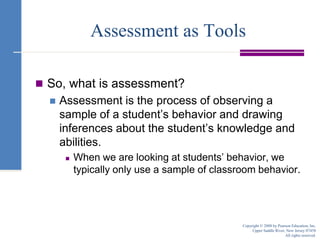
Assessment as ToolsSo, what is assessment? Assessment is the process of observing a sample of a student’s behavior and drawing inferences about the student’s knowledge and abilities.When we are looking at students’ behavior, we typically only use a sample of classroom behavior.Copyright © 2008 by Pearson Education, Inc.Upper Saddle River, New Jersey 07458All rights reserved.
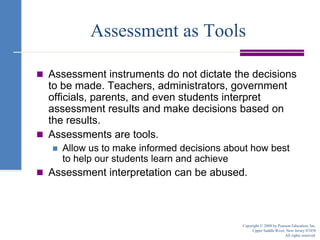
Assessment as ToolsAssessment instruments do not dictate the decisions to be made. Teachers, administrators, government officials, parents, and even students interpret assessment results and make decisions based on the results.Assessments are tools.Allow us to make informed decisions about how best to help our students learn and achieveAssessment interpretation can be abused.Copyright © 2008 by Pearson Education, Inc.Upper Saddle River, New Jersey 07458All rights reserved.
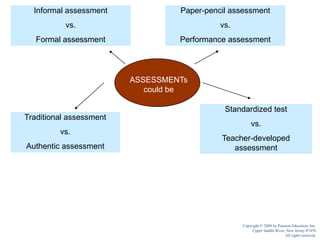
Informal assessment vs.Formal assessmentPaper-pencil assessmentvs.Performance assessmentTraditional assessment vs.Authentic assessmentStandardized test vs.Teacher-developed assessmentASSESSMENTs could beCopyright © 2008 by Pearson Education, Inc.Upper Saddle River, New Jersey 07458All rights reserved.
Using Assessment for Different PurposesWhy do teachers assess students?Two basic types of assessment (what are they?)Some assessments are formative and assess students’ knowledge before or during instruction.Homework assignments, in-class assignments, quizzesSome assessments are summative and assess students’ achievement after instruction.ExamsCopyright © 2008 by Pearson Education, Inc.Upper Saddle River, New Jersey 07458All rights reserved.
Important Qualities of Good AssessmentRemember RSVP:ReliabilityStandardizationValidityPracticalityCopyright © 2008 by Pearson Education, Inc.Upper Saddle River, New Jersey 07458All rights reserved.
ReliabilityThere may be slight variation from time to time. eliability may fall onto teachers or students.Students change from day to day.The physical environment may change.Sometimes teachers are more clear in their instructions than others.There is always subjectivity in scoring.More likely when responses are scored on the basis of vague, imprecise criteriaCopyright © 2008 by Pearson Education, Inc.Upper Saddle River, New Jersey 07458All rights reserved.
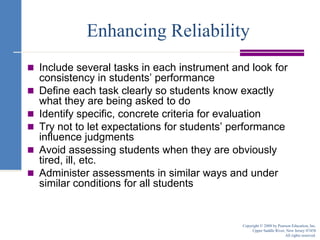
Enhancing ReliabilityInclude several tasks in each instrument and look for consistency in students’ performanceDefine each task clearly so students know exactly what they are being asked to doIdentify specific, concrete criteria for evaluationTry not to let expectations for students’ performance influence judgmentsAvoid assessing students when they are obviously tired, ill, etc. Administer assessments in similar ways and under similar conditions for all studentsCopyright © 2008 by Pearson Education, Inc.Upper Saddle River, New Jersey 07458All rights reserved.
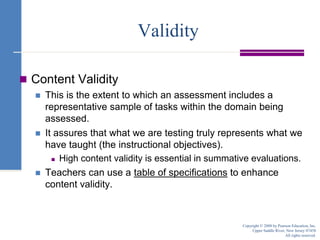
ValidityContent ValidityThis is the extent to which an assessment includes a representative sample of tasks within the domain being assessed.It assures that what we are testing truly represents what we have taught (the instructional objectives).High content validity is essential in summative evaluations.Teachers can use a table of specifications to enhance content validity.Copyright © 2008 by Pearson Education, Inc.Upper Saddle River, New Jersey 07458All rights reserved.
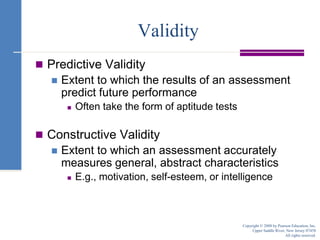
ValidityPredictive ValidityExtent to which the results of an assessment predict future performanceOften take the form of aptitude testsConstructive ValidityExtent to which an assessment accurately measures general, abstract characteristicsE.g., motivation, self-esteem, or intelligenceCopyright © 2008 by Pearson Education, Inc.Upper Saddle River, New Jersey 07458All rights reserved.
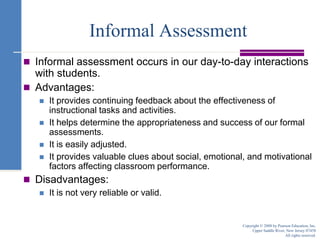
Informal AssessmentInformal assessment occurs in our day-to-day interactions with students.Advantages:It provides continuing feedback about the effectiveness of instructional tasks and activities.It helps determine the appropriateness and success of our formal assessments.It is easily adjusted.It provides valuable clues about social, emotional, and motivational factors affecting classroom performance.Disadvantages:It is not very reliable or valid.Copyright © 2008 by Pearson Education, Inc.Upper Saddle River, New Jersey 07458All rights reserved.
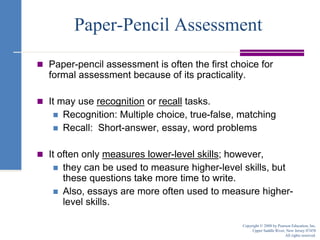
Paper-Pencil AssessmentPaper-pencil assessment is often the first choice for formal assessment because of its practicality.It may use recognition or recall tasks.Recognition: Multiple choice, true-false, matchingRecall:  Short-answer, essay, word problemsIt often only measures lower-level skills; however,they can be used to measure higher-level skills, but these questions take more time to write.Also, essays are more often used to measure higher-level skills.Copyright © 2008 by Pearson Education, Inc.Upper Saddle River, New Jersey 07458All rights reserved.
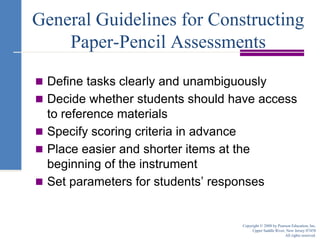
General Guidelines for Constructing Paper-Pencil AssessmentsDefine tasks clearly and unambiguouslyDecide whether students should have access to reference materialsSpecify scoring criteria in advancePlace easier and shorter items at the beginning of the instrumentSet parameters for students’ responsesCopyright © 2008 by Pearson Education, Inc.Upper Saddle River, New Jersey 07458All rights reserved.
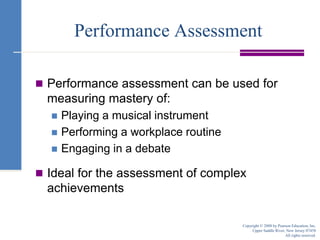
Performance AssessmentPerformance assessment can be used for measuring mastery of:Playing a musical instrumentPerforming a workplace routineEngaging in a debateIdeal for the assessment of complex achievementsCopyright © 2008 by Pearson Education, Inc.Upper Saddle River, New Jersey 07458All rights reserved.
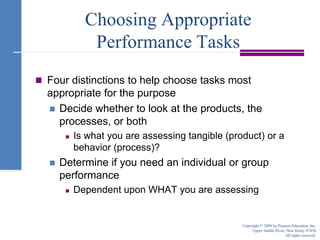
Choosing Appropriate Performance TasksFour distinctions to help choose tasks most appropriate for the purposeDecide whether to look at the products, the processes, or bothIs what you are assessing tangible (product) or a behavior (process)?Determine if you need an individual or group performanceDependent upon WHAT you are assessingCopyright © 2008 by Pearson Education, Inc.Upper Saddle River, New Jersey 07458All rights reserved.
Choosing Appropriate Performance TasksRestricted vs. extended performanceE.g., is  the student playing a few notes or an entire piano piece?Should you use static or dynamic assessment?Dynamic assessment applies the Vygotskian concept of the zone of proximal development.Copyright © 2008 by Pearson Education, Inc.Upper Saddle River, New Jersey 07458All rights reserved.
Consider incorporating the assessment into normal instructional activitiesProvide an appropriate amount of structurePlan classroom management strategies for the assessment activityBe continually aware of what the students are doing and make sure all students are busy and engagedPlanning and Administering Performance AssessmentsCopyright © 2008 by Pearson Education, Inc.Upper Saddle River, New Jersey 07458All rights reserved.
Strategies for Scoring Student PerformanceConsider using checklists, rating scales, or both in your rubricDecide whether analytic or holistic scoring better serves your purpose(s)Analytic: Scoring a student’s performance by evaluating various aspects of it separatelyHolistic: Summarizing a student’s performance with a single scoreLimit the criteria to the most important aspects of the desired responseDescribe the criteria as explicitly and concretely as possibleMake note of other significant aspects of a student’s performance that the rubric doesn’t addressCopyright © 2008 by Pearson Education, Inc.Upper Saddle River, New Jersey 07458All rights reserved.
Including Students in the Assessment ProcessIncluding students in the process encourages them to self-assess.Teachers should:Provide examples of “good” and “poor” productsMake evaluation criteria explicitAllow students to compare self-ratings with teacher-ratingsEncourage self-reflection via the use of daily journal entriesStudents may co-design scoring rubrics with the teacher.Copyright © 2008 by Pearson Education, Inc.Upper Saddle River, New Jersey 07458All rights reserved.
20Assessment tools vs Assessment Measurement InstrumentAs a teacher planning for assessment, you need to think of these questions:What do I need to measure?What are the appropriate tools?Are there any measurement instruments that match with these specific tools?23
Taking Students’ Diversity into AccountSome things to keep in mind:Students often suffer from test anxiety.Gender and ethnic differences may impact assessment performance independently of their actual learning and achievement.Students intelligences are different and since we should differentiate in instruction, we should differntiate in assessments as well.Assessment instruments must comply with the federal mandates regarding students with special needs.Copyright © 2008 by Pearson Education, Inc.Upper Saddle River, New Jersey 07458All rights reserved.
The “Big Picture” of AssessmentOur assessments will indirectly affect students’ learning and achievement.Our instruments and practices should match our instructional goals and objectives.Remember RSVP.Our scoring criteria should be as explicit as possible.Students’ errors provide valuable information about where their difficulties lie.We should continually evaluate our instruments.Copyright © 2008 by Pearson Education, Inc.Upper Saddle River, New Jersey 07458All rights reserved.

Assessment Pp[1]

  • 1.
    In relation toBrain Compatibility ResearchIREX ProgramClassroom Assessment Strategies
  • 2.
    Assessment as ToolsSo,what is assessment? Assessment is the process of observing a sample of a student’s behavior and drawing inferences about the student’s knowledge and abilities.When we are looking at students’ behavior, we typically only use a sample of classroom behavior.Copyright © 2008 by Pearson Education, Inc.Upper Saddle River, New Jersey 07458All rights reserved.
  • 3.
    Assessment as ToolsAssessmentinstruments do not dictate the decisions to be made. Teachers, administrators, government officials, parents, and even students interpret assessment results and make decisions based on the results.Assessments are tools.Allow us to make informed decisions about how best to help our students learn and achieveAssessment interpretation can be abused.Copyright © 2008 by Pearson Education, Inc.Upper Saddle River, New Jersey 07458All rights reserved.
  • 4.
    Informal assessment vs.FormalassessmentPaper-pencil assessmentvs.Performance assessmentTraditional assessment vs.Authentic assessmentStandardized test vs.Teacher-developed assessmentASSESSMENTs could beCopyright © 2008 by Pearson Education, Inc.Upper Saddle River, New Jersey 07458All rights reserved.
  • 5.
    Using Assessment forDifferent PurposesWhy do teachers assess students?Two basic types of assessment (what are they?)Some assessments are formative and assess students’ knowledge before or during instruction.Homework assignments, in-class assignments, quizzesSome assessments are summative and assess students’ achievement after instruction.ExamsCopyright © 2008 by Pearson Education, Inc.Upper Saddle River, New Jersey 07458All rights reserved.
  • 6.
    Important Qualities ofGood AssessmentRemember RSVP:ReliabilityStandardizationValidityPracticalityCopyright © 2008 by Pearson Education, Inc.Upper Saddle River, New Jersey 07458All rights reserved.
  • 7.
    ReliabilityThere may beslight variation from time to time. eliability may fall onto teachers or students.Students change from day to day.The physical environment may change.Sometimes teachers are more clear in their instructions than others.There is always subjectivity in scoring.More likely when responses are scored on the basis of vague, imprecise criteriaCopyright © 2008 by Pearson Education, Inc.Upper Saddle River, New Jersey 07458All rights reserved.
  • 8.
    Enhancing ReliabilityInclude severaltasks in each instrument and look for consistency in students’ performanceDefine each task clearly so students know exactly what they are being asked to doIdentify specific, concrete criteria for evaluationTry not to let expectations for students’ performance influence judgmentsAvoid assessing students when they are obviously tired, ill, etc. Administer assessments in similar ways and under similar conditions for all studentsCopyright © 2008 by Pearson Education, Inc.Upper Saddle River, New Jersey 07458All rights reserved.
  • 9.
    ValidityContent ValidityThis isthe extent to which an assessment includes a representative sample of tasks within the domain being assessed.It assures that what we are testing truly represents what we have taught (the instructional objectives).High content validity is essential in summative evaluations.Teachers can use a table of specifications to enhance content validity.Copyright © 2008 by Pearson Education, Inc.Upper Saddle River, New Jersey 07458All rights reserved.
  • 10.
    ValidityPredictive ValidityExtent towhich the results of an assessment predict future performanceOften take the form of aptitude testsConstructive ValidityExtent to which an assessment accurately measures general, abstract characteristicsE.g., motivation, self-esteem, or intelligenceCopyright © 2008 by Pearson Education, Inc.Upper Saddle River, New Jersey 07458All rights reserved.
  • 11.
    Informal AssessmentInformal assessmentoccurs in our day-to-day interactions with students.Advantages:It provides continuing feedback about the effectiveness of instructional tasks and activities.It helps determine the appropriateness and success of our formal assessments.It is easily adjusted.It provides valuable clues about social, emotional, and motivational factors affecting classroom performance.Disadvantages:It is not very reliable or valid.Copyright © 2008 by Pearson Education, Inc.Upper Saddle River, New Jersey 07458All rights reserved.
  • 12.
    Paper-Pencil AssessmentPaper-pencil assessmentis often the first choice for formal assessment because of its practicality.It may use recognition or recall tasks.Recognition: Multiple choice, true-false, matchingRecall: Short-answer, essay, word problemsIt often only measures lower-level skills; however,they can be used to measure higher-level skills, but these questions take more time to write.Also, essays are more often used to measure higher-level skills.Copyright © 2008 by Pearson Education, Inc.Upper Saddle River, New Jersey 07458All rights reserved.
  • 13.
    General Guidelines forConstructing Paper-Pencil AssessmentsDefine tasks clearly and unambiguouslyDecide whether students should have access to reference materialsSpecify scoring criteria in advancePlace easier and shorter items at the beginning of the instrumentSet parameters for students’ responsesCopyright © 2008 by Pearson Education, Inc.Upper Saddle River, New Jersey 07458All rights reserved.
  • 14.
    Performance AssessmentPerformance assessmentcan be used for measuring mastery of:Playing a musical instrumentPerforming a workplace routineEngaging in a debateIdeal for the assessment of complex achievementsCopyright © 2008 by Pearson Education, Inc.Upper Saddle River, New Jersey 07458All rights reserved.
  • 15.
    Choosing Appropriate PerformanceTasksFour distinctions to help choose tasks most appropriate for the purposeDecide whether to look at the products, the processes, or bothIs what you are assessing tangible (product) or a behavior (process)?Determine if you need an individual or group performanceDependent upon WHAT you are assessingCopyright © 2008 by Pearson Education, Inc.Upper Saddle River, New Jersey 07458All rights reserved.
  • 16.
    Choosing Appropriate PerformanceTasksRestricted vs. extended performanceE.g., is the student playing a few notes or an entire piano piece?Should you use static or dynamic assessment?Dynamic assessment applies the Vygotskian concept of the zone of proximal development.Copyright © 2008 by Pearson Education, Inc.Upper Saddle River, New Jersey 07458All rights reserved.
  • 17.
    Consider incorporating theassessment into normal instructional activitiesProvide an appropriate amount of structurePlan classroom management strategies for the assessment activityBe continually aware of what the students are doing and make sure all students are busy and engagedPlanning and Administering Performance AssessmentsCopyright © 2008 by Pearson Education, Inc.Upper Saddle River, New Jersey 07458All rights reserved.
  • 18.
    Strategies for ScoringStudent PerformanceConsider using checklists, rating scales, or both in your rubricDecide whether analytic or holistic scoring better serves your purpose(s)Analytic: Scoring a student’s performance by evaluating various aspects of it separatelyHolistic: Summarizing a student’s performance with a single scoreLimit the criteria to the most important aspects of the desired responseDescribe the criteria as explicitly and concretely as possibleMake note of other significant aspects of a student’s performance that the rubric doesn’t addressCopyright © 2008 by Pearson Education, Inc.Upper Saddle River, New Jersey 07458All rights reserved.
  • 19.
    Including Students inthe Assessment ProcessIncluding students in the process encourages them to self-assess.Teachers should:Provide examples of “good” and “poor” productsMake evaluation criteria explicitAllow students to compare self-ratings with teacher-ratingsEncourage self-reflection via the use of daily journal entriesStudents may co-design scoring rubrics with the teacher.Copyright © 2008 by Pearson Education, Inc.Upper Saddle River, New Jersey 07458All rights reserved.
  • 20.
    20Assessment tools vsAssessment Measurement InstrumentAs a teacher planning for assessment, you need to think of these questions:What do I need to measure?What are the appropriate tools?Are there any measurement instruments that match with these specific tools?23
  • 21.
    Taking Students’ Diversityinto AccountSome things to keep in mind:Students often suffer from test anxiety.Gender and ethnic differences may impact assessment performance independently of their actual learning and achievement.Students intelligences are different and since we should differentiate in instruction, we should differntiate in assessments as well.Assessment instruments must comply with the federal mandates regarding students with special needs.Copyright © 2008 by Pearson Education, Inc.Upper Saddle River, New Jersey 07458All rights reserved.
  • 22.
    The “Big Picture”of AssessmentOur assessments will indirectly affect students’ learning and achievement.Our instruments and practices should match our instructional goals and objectives.Remember RSVP.Our scoring criteria should be as explicit as possible.Students’ errors provide valuable information about where their difficulties lie.We should continually evaluate our instruments.Copyright © 2008 by Pearson Education, Inc.Upper Saddle River, New Jersey 07458All rights reserved.