Overview
 Portrayals on television construct reality
 Television often presents stereotypical images.
 Stereotype is a generalization about a person or
group of people.
 In the absence of real experience, television's
stereotypical representations may be all we
know about some people or groups of people.
Common Stereotypes on
Television
 Sex (women and men, boys and girls)
 Age (old people, young people, teenagers)
 Jobs (teacher, model, truck driver, doctor, lawyer)
 Culture (Arab, French, Irish, Italian)
 Race (black, white, Asian, Hispanic)
 Looks (beautiful, ugly, 'nerdy')
 Position in a family (mother, father, sister, brother,
grandmother, grandfather)
Presentations of Women
 (A) Frequency of appearance on TV
 1. There are twice as many men as women in
television prime time dramas.
 2. There are 3-4 times as many men as women in
children's TV programs and cartoons.
 3. Music videos on TV show twice as many men
as women.
Presentations of Women
(cont.)
 4. A substantial minority of TV news anchors and
weathercasters are now women, although very few
sportcasters are.
 5. Only 10% of those interviewed on news shows are
women.
 6. Only in soap operas are women well represented
in numbers and in professional career roles.
Presentation of Women
(cont.)
 (B) Presentations of Women's Roles on TV
 1. Physical Appearance:
 women on TV are usually young and beautiful (usually under 30) and must
fight aging.
Dove video 1 Dove video 2
 The ideal portrayal of feminine beauty, especially in advertising is very
unusual body type, namely very tall, very thin, and small-hipped – the
model body-type
 2. Women are usually portrayed in nonprofessional roles.
Presentation of Women
(cont.)
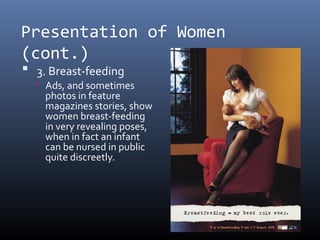
 3. Breast-feeding
 Ads, and sometimes
photos in feature
magazines stories, show
women breast-feeding
in very revealing poses,
when in fact an infant
can be nursed in public
quite discreetly.
Presentation of Women
(cont.)
 4. Women are also usually seen as:
 a. dependent on men, needing protection
 b. often using their sex to manipulate men and get what
they want
 c. often the victims of violence--or the subtle message is
sent that women are really "asking for it" as in Luke and
Laura/General Hospital
 d. not seen making important decisions
 e. current trends to undo the old stereotypes emphasize
the new "superwoman" who can handle a career, be a
sexy wife, and a do-it-all mom.
Portayals of Men on TV
 1. More often employed in high-status jobs and
careers.
 2. More dominant, violent, powerful than women.
They are professionally competent but bunglers when
it comes to household and parenting skills.
 3. Men drive, drink and smoke more, engage more in
athletic activities.
 4. Men are emotionless.
Portayals of Men on TV
(cont.)
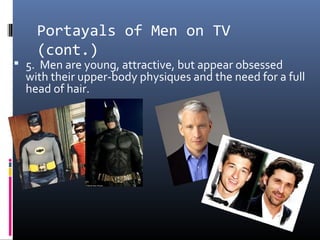
 5. Men are young, attractive, but appear obsessed
with their upper-body physiques and the need for a full
head of hair.
Portrayals of Minority Groups
 4 stages:
 1. Nonrecognition
 2. Ridicule
 3. Regulation (protectors, police, firemen)
 4. Respect (full range of roles as majority)
Older Americans/Senior
Citizens
 1. Very few of central characters on TV are over 65.
 2. 62-70% of older Americans in TV are men (but
only 40% of population over 65 = men).
 3. Characters often treated with disrespect.
 4. Physically and mentally weak, feeble, in poor
health.
Older Americans/Senior
Citizens (cont.)
 5. Either sexless or dirty old men
 6. Doing trivial things--bingo, sitting in rockers
 7. Physically unattractive, wearing dowdy
clothing
 6. Complaining and ill-humored
African Americans
 12% of US population in the last Census (2000)
 Early days of TV, African Americans were largely
unseen. Movie roles often ridiculed them or showed
them as comedic characters.
 With the civil rights movement of the 1960s,
television began to provide more even-handed
presentations of African Americans, and they
appeared in many starring roles in prime time
sitcoms, although they were still often shown as
buffoons. The Cosby Show was a big break-through
for acceptance of African American programming
success.
African Americans (cont.)
 Now African Americans actually make up a
larger percentage of prime time roles (17%)
than they do the population (12.3%).
 News coverage on local stations still retains
some stereotypical images and often shows
African Americans as perpetrators of violence
and criminal acts at a disproportionate rate to
reality.
Latino Presentations on TV
 Make up 12.5% of population (in 2000 Census) but only
2 to 4% of prime time roles.
 Despite great diversity of Hispanic traditions and
heritages, Latino characters are often
stereotyped as:
a. greasy dirty Mexican bandits (in Westerns)
b. Latino women have been stereotyped as harlots,
sex-obsessed
c. buffoons (Ricky Ricardo from I Love Lucy)
 On TV, most Latin characters are male, criminals or law
enforcement officers.
Native Americans
Presentations
 1% of US population
 Common stereotypes:
 Bloodthirsty, savages of the American Western
 Wise men
 Now virtually invisible
Video
Native Americans
Presentations
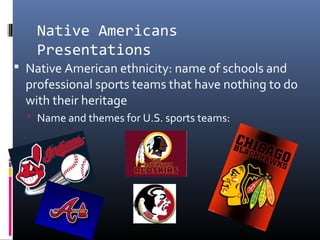
 Native American ethnicity: name of schools and
professional sports teams that have nothing to do
with their heritage
 Name and themes for U.S. sports teams:
Asian American
Presentations
 Very few roles on TV
 Stereotyped in movies as sinister villains,
often running Chinese laundries or
restaurants
 Now more positively portrayed than most
other minorities in U.S. TV
Arab and Arab Americans
 Often stereotyped as terrorists, oil sheiks,
sexual perverts involved in slavery.
 Identification with Islamic religion which is
portrayed as cruel and vicious.
 No balanced portrayals of good things about
Islamic culture and history.
Other groups often
stereotyped:
 1. Those with physical disabilities.
 2. Those with psychological disorders.
 3. Gay and Lesbian individuals
Video
 4. Occupations:
 farmers and rural life
 lawyers
 police officers
 doctors, particularly psychiatrists and psychologists
 college students (drinking beer and partying, spring break at
the beach)

Television Stereotypes

  • 2.
    Overview  Portrayals ontelevision construct reality  Television often presents stereotypical images.  Stereotype is a generalization about a person or group of people.  In the absence of real experience, television's stereotypical representations may be all we know about some people or groups of people.
  • 3.
    Common Stereotypes on Television Sex (women and men, boys and girls)  Age (old people, young people, teenagers)  Jobs (teacher, model, truck driver, doctor, lawyer)  Culture (Arab, French, Irish, Italian)  Race (black, white, Asian, Hispanic)  Looks (beautiful, ugly, 'nerdy')  Position in a family (mother, father, sister, brother, grandmother, grandfather)
  • 4.
    Presentations of Women (A) Frequency of appearance on TV  1. There are twice as many men as women in television prime time dramas.  2. There are 3-4 times as many men as women in children's TV programs and cartoons.  3. Music videos on TV show twice as many men as women.
  • 5.
    Presentations of Women (cont.) 4. A substantial minority of TV news anchors and weathercasters are now women, although very few sportcasters are.  5. Only 10% of those interviewed on news shows are women.  6. Only in soap operas are women well represented in numbers and in professional career roles.
  • 6.
    Presentation of Women (cont.) (B) Presentations of Women's Roles on TV  1. Physical Appearance:  women on TV are usually young and beautiful (usually under 30) and must fight aging. Dove video 1 Dove video 2  The ideal portrayal of feminine beauty, especially in advertising is very unusual body type, namely very tall, very thin, and small-hipped – the model body-type  2. Women are usually portrayed in nonprofessional roles.
  • 7.
    Presentation of Women (cont.) 3. Breast-feeding  Ads, and sometimes photos in feature magazines stories, show women breast-feeding in very revealing poses, when in fact an infant can be nursed in public quite discreetly.
  • 8.
    Presentation of Women (cont.) 4. Women are also usually seen as:  a. dependent on men, needing protection  b. often using their sex to manipulate men and get what they want  c. often the victims of violence--or the subtle message is sent that women are really "asking for it" as in Luke and Laura/General Hospital  d. not seen making important decisions  e. current trends to undo the old stereotypes emphasize the new "superwoman" who can handle a career, be a sexy wife, and a do-it-all mom.
  • 9.
    Portayals of Menon TV  1. More often employed in high-status jobs and careers.  2. More dominant, violent, powerful than women. They are professionally competent but bunglers when it comes to household and parenting skills.  3. Men drive, drink and smoke more, engage more in athletic activities.  4. Men are emotionless.
  • 10.
    Portayals of Menon TV (cont.)  5. Men are young, attractive, but appear obsessed with their upper-body physiques and the need for a full head of hair.
  • 11.
    Portrayals of MinorityGroups  4 stages:  1. Nonrecognition  2. Ridicule  3. Regulation (protectors, police, firemen)  4. Respect (full range of roles as majority)
  • 12.
    Older Americans/Senior Citizens  1.Very few of central characters on TV are over 65.  2. 62-70% of older Americans in TV are men (but only 40% of population over 65 = men).  3. Characters often treated with disrespect.  4. Physically and mentally weak, feeble, in poor health.
  • 13.
    Older Americans/Senior Citizens (cont.) 5. Either sexless or dirty old men  6. Doing trivial things--bingo, sitting in rockers  7. Physically unattractive, wearing dowdy clothing  6. Complaining and ill-humored
  • 14.
    African Americans  12%of US population in the last Census (2000)  Early days of TV, African Americans were largely unseen. Movie roles often ridiculed them or showed them as comedic characters.  With the civil rights movement of the 1960s, television began to provide more even-handed presentations of African Americans, and they appeared in many starring roles in prime time sitcoms, although they were still often shown as buffoons. The Cosby Show was a big break-through for acceptance of African American programming success.
  • 15.
    African Americans (cont.) Now African Americans actually make up a larger percentage of prime time roles (17%) than they do the population (12.3%).  News coverage on local stations still retains some stereotypical images and often shows African Americans as perpetrators of violence and criminal acts at a disproportionate rate to reality.
  • 16.
    Latino Presentations onTV  Make up 12.5% of population (in 2000 Census) but only 2 to 4% of prime time roles.  Despite great diversity of Hispanic traditions and heritages, Latino characters are often stereotyped as: a. greasy dirty Mexican bandits (in Westerns) b. Latino women have been stereotyped as harlots, sex-obsessed c. buffoons (Ricky Ricardo from I Love Lucy)  On TV, most Latin characters are male, criminals or law enforcement officers.
  • 17.
    Native Americans Presentations  1%of US population  Common stereotypes:  Bloodthirsty, savages of the American Western  Wise men  Now virtually invisible Video
  • 18.
    Native Americans Presentations  NativeAmerican ethnicity: name of schools and professional sports teams that have nothing to do with their heritage  Name and themes for U.S. sports teams:
  • 19.
    Asian American Presentations  Veryfew roles on TV  Stereotyped in movies as sinister villains, often running Chinese laundries or restaurants  Now more positively portrayed than most other minorities in U.S. TV
  • 20.
    Arab and ArabAmericans  Often stereotyped as terrorists, oil sheiks, sexual perverts involved in slavery.  Identification with Islamic religion which is portrayed as cruel and vicious.  No balanced portrayals of good things about Islamic culture and history.
  • 21.
    Other groups often stereotyped: 1. Those with physical disabilities.  2. Those with psychological disorders.  3. Gay and Lesbian individuals Video  4. Occupations:  farmers and rural life  lawyers  police officers  doctors, particularly psychiatrists and psychologists  college students (drinking beer and partying, spring break at the beach)