Running head: PROBLEM STATEMENT
1
PROBLEM STATEMENT
3
Problem statement
Name:
Institution:
Date:
There is a critical need for a good instructional design
because it is a multipurpose learning tools that not only serves
instructional designers but also learners of all ages. According
to Clark (2016), e-learning courses need to be integrated with
instructional methods which align with high-quality research.”
The implication is that the process of designing instructional
designs should involve careful planning, preparing and
researching in order to achieve high quality learning outcomes.
In this regard, those responsible for designing must identify
their strategic purpose as it predetermines the goals, objectives,
expected outcomes, and resource allocation of the entire
instruction model.
The main approach involves studying the critical
elements in the design phases of an instructional model which
enhances the learning experience of learners based on evidence-
based literature. This is because humans apply appropriate
cognitive processes to learn and thus instruction must adopt
similar cognitive processing (Clark, 2016).The main purpose is
therefore to emphasize the importance of good instructional
design in enhancing the quality of education among instructors
and learners. The objective involves highlighting the goals of
an instructional program, the instructional objectives, relevant
instructional materials and design assessment which rationalize
the need for a good instructional design with the goal of
engaging both learners and instructors. After all, learning is a
process that requires the active participation of the learners
(Reigeluth, 1987). This research study seeks to identify answers
to two questions: a) What are the critical elements that build up
a strong foundation for a good instructional design and b) what
value do these elements offer to the learners and instructor who
are the main consumers of learning instructional designs.
References
Clark, R.C. (2016). E-learning and the science of instruction:
proven guideline for consumers and designers of multimedia.
Walden University Library.
Regeiluth, C.M. (1987). Instructional Theories in Action:
Lessons Illustrating Selected Theories and Models. Walden
University Library.
Running head: PROBLEM STATEMENT
1
PROBLEM STATEMENT
6
Need working title
Problem statement
Tangela Jones
Walden University
11/10/18
Need section heading
There is a critical need for a good instructional design
because it is a multipurpose learning tools that not only serves
instructional designers but also learners of all ages. According
to Clark (2016), e-learning courses need to be integrated with
instructional methods which align with high-quality research.”
(direct quotes need page numbers) The implication is that the
process of designing instructional designs should involve
careful planning, preparing and researching in order to achieve
high quality learning outcomes. In this regard, those responsible
for designing must identify their strategic purpose as it
predetermines the goals, objectives, expected outcomes, and
resource allocation of the entire instruction model.
The main approach involves studying the critical
elements in the design phases of an instructional model which
enhances the learning experience of learners based on evidence-
based literature. This is because humans apply appropriate
cognitive processes to learn and thus instruction must adopt
similar cognitive processing (Clark, 2016). Avoid using same
reference back to back. The main purpose is therefore to
emphasize the importance of good instructional design in
enhancing the quality of education among instructors and
learners. The objective involves highlighting the goals of an
instructional program, the instructional objectives, relevant
instructional materials and design assessment which rationalize
the need for a good instructional design with the goal of
engaging both learners and instructors. After all, learning is a
process that requires the active participation of the learners
(Reigeluth, 1987). This research study seeks to identify answers
to two questions: a) What are the critical elements that build up
a strong foundation for a good instructional design and b) what
value do these elements offer to the learners and instructor who
are the main consumers of learning instructional designs.
References
Clark, R.C. (2016). E-learning and the science of instruction:
proven guideline for consumers and designers of multimedia.
Walden University Library.
Regeiluth, C.M. (1987). Instructional Theories in Action:
Lessons Illustrating Selected Theories and Models. Walden
University Library.
Good start but more references would have been helpful. Try to
use Section headingsWalden University M.S. in Instructional
Design and Technology
Formative Evaluative Criteria for Application and Reflection
Assignments
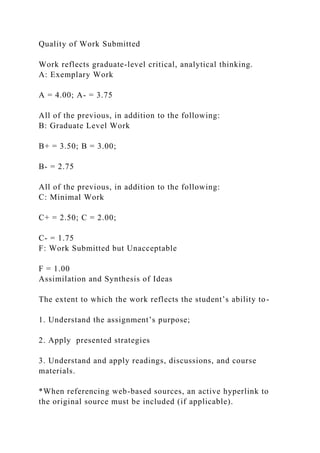
Quality of Work Submitted
Work reflects graduate-level critical, analytical thinking.
A: Exemplary Work
A = 4.00; A- = 3.75
All of the previous, in addition to the following:
B: Graduate Level Work
B+ = 3.50; B = 3.00;
B- = 2.75
All of the previous, in addition to the following:
C: Minimal Work
C+ = 2.50; C = 2.00;
C- = 1.75
F: Work Submitted but Unacceptable
F = 1.00
Assimilation and Synthesis of Ideas
The extent to which the work reflects the student’s ability to-
1. Understand the assignment’s purpose;
2. Apply presented strategies
3. Understand and apply readings, discussions, and course
materials.
*When referencing web-based sources, an active hyperlink to
the original source must be included (if applicable).
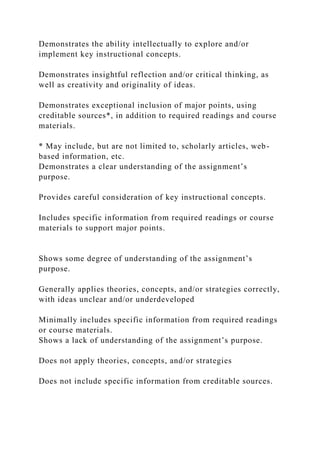
Demonstrates the ability intellectually to explore and/or
implement key instructional concepts.
Demonstrates insightful reflection and/or critical thinking, as
well as creativity and originality of ideas.
Demonstrates exceptional inclusion of major points, using
creditable sources*, in addition to required readings and course
materials.
* May include, but are not limited to, scholarly articles, web-
based information, etc.
Demonstrates a clear understanding of the assignment’s
purpose.
Provides careful consideration of key instructional concepts.
Includes specific information from required readings or course
materials to support major points.
Shows some degree of understanding of the assignment’s
purpose.
Generally applies theories, concepts, and/or strategies correctly,
with ideas unclear and/or underdeveloped
Minimally includes specific information from required readings
or course materials.
Shows a lack of understanding of the assignment’s purpose.
Does not apply theories, concepts, and/or strategies
Does not include specific information from creditable sources.
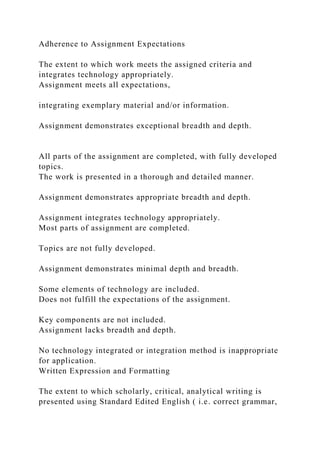
Adherence to Assignment Expectations
The extent to which work meets the assigned criteria and
integrates technology appropriately.
Assignment meets all expectations,
integrating exemplary material and/or information.
Assignment demonstrates exceptional breadth and depth.
All parts of the assignment are completed, with fully developed
topics.
The work is presented in a thorough and detailed manner.
Assignment demonstrates appropriate breadth and depth.
Assignment integrates technology appropriately.
Most parts of assignment are completed.
Topics are not fully developed.
Assignment demonstrates minimal depth and breadth.
Some elements of technology are included.
Does not fulfill the expectations of the assignment.
Key components are not included.
Assignment lacks breadth and depth.
No technology integrated or integration method is inappropriate
for application.
Written Expression and Formatting
The extent to which scholarly, critical, analytical writing is
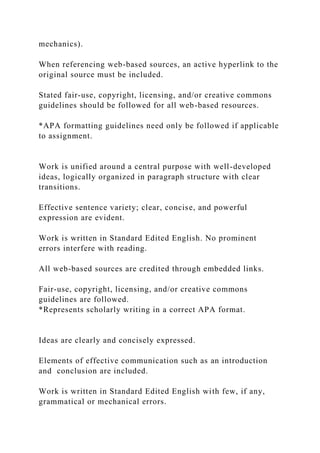
presented using Standard Edited English ( i.e. correct grammar,
mechanics).
When referencing web-based sources, an active hyperlink to the
original source must be included.
Stated fair-use, copyright, licensing, and/or creative commons
guidelines should be followed for all web-based resources.
*APA formatting guidelines need only be followed if applicable
to assignment.
Work is unified around a central purpose with well-developed
ideas, logically organized in paragraph structure with clear
transitions.
Effective sentence variety; clear, concise, and powerful
expression are evident.
Work is written in Standard Edited English. No prominent
errors interfere with reading.
All web-based sources are credited through embedded links.
Fair-use, copyright, licensing, and/or creative commons
guidelines are followed.
*Represents scholarly writing in a correct APA format.
Ideas are clearly and concisely expressed.
Elements of effective communication such as an introduction
and conclusion are included.
Work is written in Standard Edited English with few, if any,
grammatical or mechanical errors.
Few, if any, errors in crediting web-based sources.
Few, if any, errors following fair-use, copyright, licensing,
and/or creative commons guidelines.
*Work is well organized with correct APA formatting
throughout.
Ideas are not clearly and concisely expressed.
Elements of effective communication such as an introduction
and conclusion are not included.
Work contains more than a few grammatical, or mechanical
errors.
Some web-based sources are not credited.
Some errors in following fair-use, copyright, licensing, and/or
creative commons guidelines.
*Somewhat represents mature, scholarly, graduate-level writing,
with APA generally followed.
Major points do not reflect appropriate elements of
communication.
No effort to express ideas clearly and concisely.
Work is not written in Standard Edited English. Contains many
grammatical or mechanical errors
Web-based sources are not credited..
Fair-use, copyright, licensing, and/or creative commons
guidelines are not followed.
* The quality of writing and/or APA formatting are not
acceptable for graduate level work.
Final Assignment Grade
A: Exemplary Work
A = 4.00; A- = 3.75
B: Graduate Level Work
B+ = 3.50; B = 3.00;
B- = 2.75
C: Minimal Work
C+ = 2.50; C = 2.00;
C- = 1.75
F: Work Submitted but Unacceptable
F = 1.00
It is expected that all applications and reflective essays will be
submitted according to the assignment due dates indicated.
Exceptions may be made at the discretion of the faculty member
if contacted by the student prior to the due date describing
extenuating circumstances. Last Updated: 7.14.09

Running head PROBLEM STATEMENT .docx

  • 1.
    Running head: PROBLEMSTATEMENT 1 PROBLEM STATEMENT 3 Problem statement Name: Institution: Date: There is a critical need for a good instructional design because it is a multipurpose learning tools that not only serves instructional designers but also learners of all ages. According to Clark (2016), e-learning courses need to be integrated with instructional methods which align with high-quality research.” The implication is that the process of designing instructional designs should involve careful planning, preparing and researching in order to achieve high quality learning outcomes. In this regard, those responsible for designing must identify their strategic purpose as it predetermines the goals, objectives, expected outcomes, and resource allocation of the entire instruction model. The main approach involves studying the critical elements in the design phases of an instructional model which enhances the learning experience of learners based on evidence- based literature. This is because humans apply appropriate cognitive processes to learn and thus instruction must adopt similar cognitive processing (Clark, 2016).The main purpose is therefore to emphasize the importance of good instructional design in enhancing the quality of education among instructors and learners. The objective involves highlighting the goals of an instructional program, the instructional objectives, relevant instructional materials and design assessment which rationalize the need for a good instructional design with the goal of engaging both learners and instructors. After all, learning is a
  • 2.
    process that requiresthe active participation of the learners (Reigeluth, 1987). This research study seeks to identify answers to two questions: a) What are the critical elements that build up a strong foundation for a good instructional design and b) what value do these elements offer to the learners and instructor who are the main consumers of learning instructional designs. References Clark, R.C. (2016). E-learning and the science of instruction: proven guideline for consumers and designers of multimedia. Walden University Library. Regeiluth, C.M. (1987). Instructional Theories in Action: Lessons Illustrating Selected Theories and Models. Walden University Library. Running head: PROBLEM STATEMENT 1 PROBLEM STATEMENT 6 Need working title Problem statement Tangela Jones Walden University 11/10/18 Need section heading There is a critical need for a good instructional design because it is a multipurpose learning tools that not only serves instructional designers but also learners of all ages. According to Clark (2016), e-learning courses need to be integrated with instructional methods which align with high-quality research.” (direct quotes need page numbers) The implication is that the process of designing instructional designs should involve careful planning, preparing and researching in order to achieve high quality learning outcomes. In this regard, those responsible
  • 3.
    for designing mustidentify their strategic purpose as it predetermines the goals, objectives, expected outcomes, and resource allocation of the entire instruction model. The main approach involves studying the critical elements in the design phases of an instructional model which enhances the learning experience of learners based on evidence- based literature. This is because humans apply appropriate cognitive processes to learn and thus instruction must adopt similar cognitive processing (Clark, 2016). Avoid using same reference back to back. The main purpose is therefore to emphasize the importance of good instructional design in enhancing the quality of education among instructors and learners. The objective involves highlighting the goals of an instructional program, the instructional objectives, relevant instructional materials and design assessment which rationalize the need for a good instructional design with the goal of engaging both learners and instructors. After all, learning is a process that requires the active participation of the learners (Reigeluth, 1987). This research study seeks to identify answers to two questions: a) What are the critical elements that build up a strong foundation for a good instructional design and b) what value do these elements offer to the learners and instructor who are the main consumers of learning instructional designs. References Clark, R.C. (2016). E-learning and the science of instruction: proven guideline for consumers and designers of multimedia. Walden University Library. Regeiluth, C.M. (1987). Instructional Theories in Action: Lessons Illustrating Selected Theories and Models. Walden University Library. Good start but more references would have been helpful. Try to use Section headingsWalden University M.S. in Instructional Design and Technology Formative Evaluative Criteria for Application and Reflection Assignments
  • 4.
    Quality of WorkSubmitted Work reflects graduate-level critical, analytical thinking. A: Exemplary Work A = 4.00; A- = 3.75 All of the previous, in addition to the following: B: Graduate Level Work B+ = 3.50; B = 3.00; B- = 2.75 All of the previous, in addition to the following: C: Minimal Work C+ = 2.50; C = 2.00; C- = 1.75 F: Work Submitted but Unacceptable F = 1.00 Assimilation and Synthesis of Ideas The extent to which the work reflects the student’s ability to- 1. Understand the assignment’s purpose; 2. Apply presented strategies 3. Understand and apply readings, discussions, and course materials. *When referencing web-based sources, an active hyperlink to the original source must be included (if applicable).
  • 5.
    Demonstrates the abilityintellectually to explore and/or implement key instructional concepts. Demonstrates insightful reflection and/or critical thinking, as well as creativity and originality of ideas. Demonstrates exceptional inclusion of major points, using creditable sources*, in addition to required readings and course materials. * May include, but are not limited to, scholarly articles, web- based information, etc. Demonstrates a clear understanding of the assignment’s purpose. Provides careful consideration of key instructional concepts. Includes specific information from required readings or course materials to support major points. Shows some degree of understanding of the assignment’s purpose. Generally applies theories, concepts, and/or strategies correctly, with ideas unclear and/or underdeveloped Minimally includes specific information from required readings or course materials. Shows a lack of understanding of the assignment’s purpose. Does not apply theories, concepts, and/or strategies Does not include specific information from creditable sources.
  • 6.
    Adherence to AssignmentExpectations The extent to which work meets the assigned criteria and integrates technology appropriately. Assignment meets all expectations, integrating exemplary material and/or information. Assignment demonstrates exceptional breadth and depth. All parts of the assignment are completed, with fully developed topics. The work is presented in a thorough and detailed manner. Assignment demonstrates appropriate breadth and depth. Assignment integrates technology appropriately. Most parts of assignment are completed. Topics are not fully developed. Assignment demonstrates minimal depth and breadth. Some elements of technology are included. Does not fulfill the expectations of the assignment. Key components are not included. Assignment lacks breadth and depth. No technology integrated or integration method is inappropriate for application. Written Expression and Formatting The extent to which scholarly, critical, analytical writing is presented using Standard Edited English ( i.e. correct grammar,
  • 7.
    mechanics). When referencing web-basedsources, an active hyperlink to the original source must be included. Stated fair-use, copyright, licensing, and/or creative commons guidelines should be followed for all web-based resources. *APA formatting guidelines need only be followed if applicable to assignment. Work is unified around a central purpose with well-developed ideas, logically organized in paragraph structure with clear transitions. Effective sentence variety; clear, concise, and powerful expression are evident. Work is written in Standard Edited English. No prominent errors interfere with reading. All web-based sources are credited through embedded links. Fair-use, copyright, licensing, and/or creative commons guidelines are followed. *Represents scholarly writing in a correct APA format. Ideas are clearly and concisely expressed. Elements of effective communication such as an introduction and conclusion are included. Work is written in Standard Edited English with few, if any, grammatical or mechanical errors.
  • 8.
    Few, if any,errors in crediting web-based sources. Few, if any, errors following fair-use, copyright, licensing, and/or creative commons guidelines. *Work is well organized with correct APA formatting throughout. Ideas are not clearly and concisely expressed. Elements of effective communication such as an introduction and conclusion are not included. Work contains more than a few grammatical, or mechanical errors. Some web-based sources are not credited. Some errors in following fair-use, copyright, licensing, and/or creative commons guidelines. *Somewhat represents mature, scholarly, graduate-level writing, with APA generally followed. Major points do not reflect appropriate elements of communication. No effort to express ideas clearly and concisely. Work is not written in Standard Edited English. Contains many grammatical or mechanical errors Web-based sources are not credited.. Fair-use, copyright, licensing, and/or creative commons guidelines are not followed. * The quality of writing and/or APA formatting are not
  • 9.
    acceptable for graduatelevel work. Final Assignment Grade A: Exemplary Work A = 4.00; A- = 3.75 B: Graduate Level Work B+ = 3.50; B = 3.00; B- = 2.75 C: Minimal Work C+ = 2.50; C = 2.00; C- = 1.75 F: Work Submitted but Unacceptable F = 1.00 It is expected that all applications and reflective essays will be submitted according to the assignment due dates indicated. Exceptions may be made at the discretion of the faculty member if contacted by the student prior to the due date describing extenuating circumstances. Last Updated: 7.14.09