Dynamite Tips:
Changing your DFWs
into Successful Learners
Raymond Rose Alese Smith
Rose & Smith Associates University of North Texas
Tell us who you are.
•K-12
•Community College
•4-yr College/University
•Course Designer/Instructor
•Instructor/Facilitator
•Program Manager
1
Tell us about your program or
course.
•Is your course/program fully or
partly online?
•How old is your course/program?
•Do you know your course/program’s
DFW rate?
•Has the DFW rate changed over time?
2
Tell us why you’re here.
3
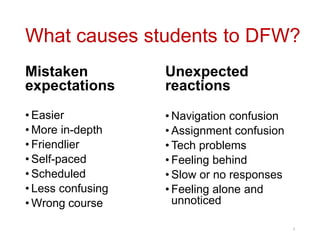
What causes students to DFW?
Mistaken
expectations
• Easier
• More in-depth
• Friendlier
• Self-paced
• Scheduled
• Less confusing
• Wrong course
Unexpected
reactions
• Navigation confusion
• Assignment confusion
• Tech problems
• Feeling behind
• Slow or no responses
• Feeling alone and
unnoticed
4
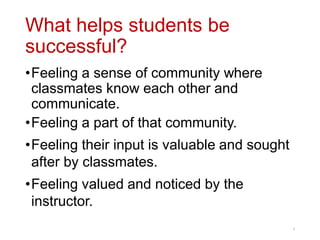
What helps students be
successful?
5
•Feeling a sense of community where
classmates know each other and
communicate.
•Feeling a part of that community.
•Feeling their input is valuable and sought
after by classmates.
•Feeling valued and noticed by the
instructor.
What are the ways to change
DFWs into successful
learners?
6
As you design the course...
Start students with a Start Here
section, and detail, detail, detail.
AKA: a simple syllabus isn’t enough.
7
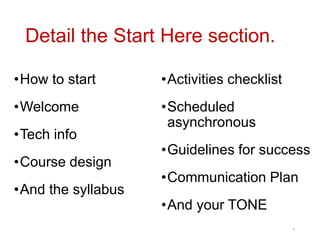
Detail the Start Here section.
•How to start
•Welcome
•Tech info
•Course design
•And the syllabus
•Activities checklist
•Scheduled
asynchronous
•Guidelines for success
•Communication Plan
•And your TONE
8
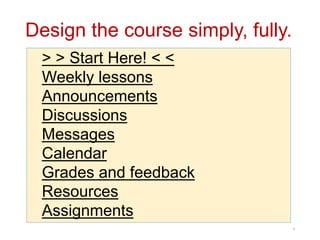
Design the course simply, fully.
9
> > Start Here! < <
Weekly lessons
Announcements
Discussions
Messages
Calendar
Grades and feedback
Resources
Assignments
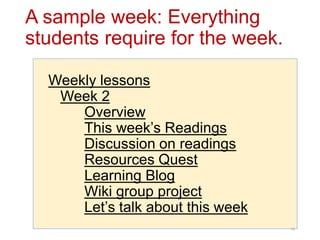
A sample week: Everything
students require for the week.
Weekly lessons
Week 2
Overview
This week’s Readings
Discussion on readings
Resources Quest
Learning Blog
Wiki group project
Let’s talk about this week
10
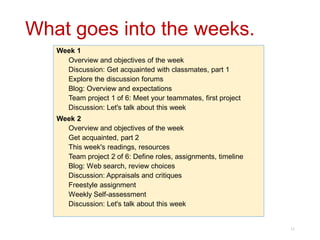
What goes into the weeks.
Week 1
Overview and objectives of the week
Discussion: Get acquainted with classmates, part 1
Explore the discussion forums
Blog: Overview and expectations
Team project 1 of 6: Meet your teammates, first project
Discussion: Let's talk about this week
Week 2
Overview and objectives of the week
Get acquainted, part 2
This week's readings, resources
Team project 2 of 6: Define roles, assignments, timeline
Blog: Web search, review choices
Discussion: Appraisals and critiques
Freestyle assignment
Weekly Self-assessment
Discussion: Let's talk about this week
11
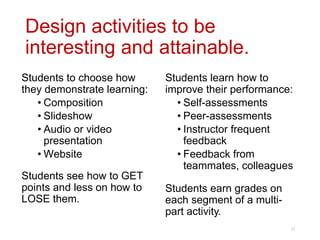
Design activities to be
interesting and attainable.
Students learn how to
improve their performance:
• Self-assessments
• Peer-assessments
• Instructor frequent
feedback
• Feedback from
teammates, colleagues
Students earn grades on
each segment of a multi-
part activity.
Students to choose how
they demonstrate learning:
• Composition
• Slideshow
• Audio or video
presentation
• Website
Students see how to GET
points and less on how to
LOSE them.
12
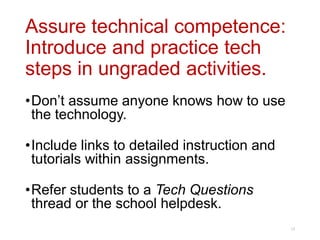
Assure technical competence:
Introduce and practice tech
steps in ungraded activities.
•Don’t assume anyone knows how to use
the technology.
•Include links to detailed instruction and
tutorials within assignments.
•Refer students to a Tech Questions
thread or the school helpdesk.
13
The course is final and ready.
Have the course formally reviewed
against your institution’s quality
standards.
At a minimum, have a colleague
review it for reactions.
14
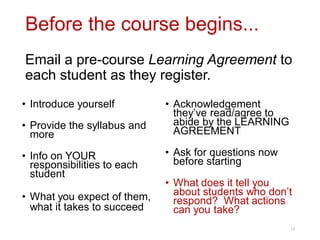
Before the course begins...
Email a pre-course Learning Agreement to
each student as they register.
• Introduce yourself
• Provide the syllabus and
more
• Info on YOUR
responsibilities to each
student
• What you expect of them,
what it takes to succeed
• Acknowledgement
they’ve read/agree to
abide by the LEARNING
AGREEMENT
• Ask for questions now
before starting
• What does it tell you
about students who don’t
respond? What actions
can you take?
15
Before the course begins...
Send students to the course to test their
login and test access to the course.
•Display the syllabus
and Start Here before
the course starts.
•If not, email it to them
in the Learning
Agreement.
•Use it to:
• Test technical abilities
• Give a head-start on
course layout
• Give students practice
going to the course
site
16
As the course begins...
After students read the Start Here
section and syllabus, consider
quizzing on it.
Why not identify those who might have skipped
it, especially those who registered late?
17
Make the community building a first
priority.
• Make the very first
assignment an ice-
breaker discussion.
• Host it in a Student
Lounge and assign
continued conversations.
• Ice breakers don’t have to
have anything to do with
the subject matter.
• Make it fun!
• Considering posting your
ice-breaker introduction to
model.
• Community-building is a
process, not an event.
18
Once the course is underway...
Provide multiple communication
channels.
•Use Announcements for breaking news and
reminders.
•Keep all communications within the course
and out of email.
•Consider hosting live video events.
•Exploit the discussion forums.
19
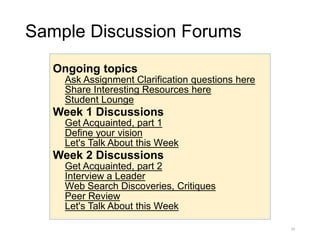
Sample Discussion Forums
Ongoing topics
Ask Assignment Clarification questions here
Share Interesting Resources here
Student Lounge
Week 1 Discussions
Get Acquainted, part 1
Define your vision
Let's Talk About this Week
Week 2 Discussions
Get Acquainted, part 2
Interview a Leader
Web Search Discoveries, Critiques
Peer Review
Let's Talk About this Week
20
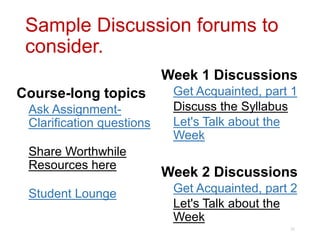
Sample Discussion forums to
consider.
Course-long topics
Ask Assignment-
Clarification questions
Share Worthwhile
Resources here
Student Lounge
Week 1 Discussions
Get Acquainted, part 1
Discuss the Syllabus
Let's Talk about the
Week
Week 2 Discussions
Get Acquainted, part 2
Let's Talk about the
Week
21
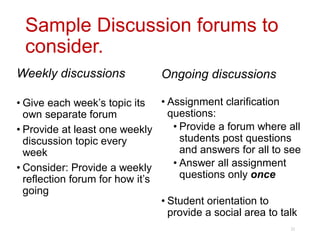
Sample Discussion forums to
consider.
Weekly discussions
• Give each week’s topic its
own separate forum
• Provide at least one weekly
discussion topic every
week
• Consider: Provide a weekly
reflection forum for how it’s
going
Ongoing discussions
• Assignment clarification
questions:
• Provide a forum where all
students post questions
and answers for all to see
• Answer all assignment
questions only once
• Student orientation to
provide a social area to talk
22
Provide frequent feedback on
students’ performance,
especially in the early weeks.
Feedback can communicate to a
student what they’re doing well,
and provide a map to doing better.
23
Consider audio feedback.
Comparing WRITTEN feedback to AUDIO
feedback: Research found overwhelming
preference by both students and instructors.
Students: Understood more, incorporated it into
next work, felt more involved and motivated.
Instructors: Quicker, increased amount of
feedback, easier to express, less need to be
perfect.
24
Focus on late arrivals to help
them catch up with their
classmates.
25
•Starting late can be
extremely difficult to
overcome.
•Show them special
attention and interest.
•Help them prioritize
essential activities.
•Do a live video chat.
•Several? Introduce in
an announcement and
asking others to meet.
•Assign a mentor
Successful learners need to...
Be comfortable with the course’s physical layout
and how to use its areas.
Be aware of what’s expected of them.
Feel they’re valued contributors to the community.
Feel a connection with the instructor.
Be aware of how well they’re performing.
26
Let’s talk about your questions,
observations, experiences,
successes.
27
Alese Smith
alese.smith@unt.edu
Rose and Smith Associates
Raymond Rose
ray@rose-smith.com
http://rmrose.blogspot.com
28

Dynamite Tips to Change DFWs into Successful Learners (TxDLA 2014)

  • 1.
    Dynamite Tips: Changing yourDFWs into Successful Learners Raymond Rose Alese Smith Rose & Smith Associates University of North Texas
  • 2.
    Tell us whoyou are. •K-12 •Community College •4-yr College/University •Course Designer/Instructor •Instructor/Facilitator •Program Manager 1
  • 3.
    Tell us aboutyour program or course. •Is your course/program fully or partly online? •How old is your course/program? •Do you know your course/program’s DFW rate? •Has the DFW rate changed over time? 2
  • 4.
    Tell us whyyou’re here. 3
  • 5.
    What causes studentsto DFW? Mistaken expectations • Easier • More in-depth • Friendlier • Self-paced • Scheduled • Less confusing • Wrong course Unexpected reactions • Navigation confusion • Assignment confusion • Tech problems • Feeling behind • Slow or no responses • Feeling alone and unnoticed 4
  • 6.
    What helps studentsbe successful? 5 •Feeling a sense of community where classmates know each other and communicate. •Feeling a part of that community. •Feeling their input is valuable and sought after by classmates. •Feeling valued and noticed by the instructor.
  • 7.
    What are theways to change DFWs into successful learners? 6
  • 8.
    As you designthe course... Start students with a Start Here section, and detail, detail, detail. AKA: a simple syllabus isn’t enough. 7
  • 9.
    Detail the StartHere section. •How to start •Welcome •Tech info •Course design •And the syllabus •Activities checklist •Scheduled asynchronous •Guidelines for success •Communication Plan •And your TONE 8
  • 10.
    Design the coursesimply, fully. 9 > > Start Here! < < Weekly lessons Announcements Discussions Messages Calendar Grades and feedback Resources Assignments
  • 11.
    A sample week:Everything students require for the week. Weekly lessons Week 2 Overview This week’s Readings Discussion on readings Resources Quest Learning Blog Wiki group project Let’s talk about this week 10
  • 12.
    What goes intothe weeks. Week 1 Overview and objectives of the week Discussion: Get acquainted with classmates, part 1 Explore the discussion forums Blog: Overview and expectations Team project 1 of 6: Meet your teammates, first project Discussion: Let's talk about this week Week 2 Overview and objectives of the week Get acquainted, part 2 This week's readings, resources Team project 2 of 6: Define roles, assignments, timeline Blog: Web search, review choices Discussion: Appraisals and critiques Freestyle assignment Weekly Self-assessment Discussion: Let's talk about this week 11
  • 13.
    Design activities tobe interesting and attainable. Students learn how to improve their performance: • Self-assessments • Peer-assessments • Instructor frequent feedback • Feedback from teammates, colleagues Students earn grades on each segment of a multi- part activity. Students to choose how they demonstrate learning: • Composition • Slideshow • Audio or video presentation • Website Students see how to GET points and less on how to LOSE them. 12
  • 14.
    Assure technical competence: Introduceand practice tech steps in ungraded activities. •Don’t assume anyone knows how to use the technology. •Include links to detailed instruction and tutorials within assignments. •Refer students to a Tech Questions thread or the school helpdesk. 13
  • 15.
    The course isfinal and ready. Have the course formally reviewed against your institution’s quality standards. At a minimum, have a colleague review it for reactions. 14
  • 16.
    Before the coursebegins... Email a pre-course Learning Agreement to each student as they register. • Introduce yourself • Provide the syllabus and more • Info on YOUR responsibilities to each student • What you expect of them, what it takes to succeed • Acknowledgement they’ve read/agree to abide by the LEARNING AGREEMENT • Ask for questions now before starting • What does it tell you about students who don’t respond? What actions can you take? 15
  • 17.
    Before the coursebegins... Send students to the course to test their login and test access to the course. •Display the syllabus and Start Here before the course starts. •If not, email it to them in the Learning Agreement. •Use it to: • Test technical abilities • Give a head-start on course layout • Give students practice going to the course site 16
  • 18.
    As the coursebegins... After students read the Start Here section and syllabus, consider quizzing on it. Why not identify those who might have skipped it, especially those who registered late? 17
  • 19.
    Make the communitybuilding a first priority. • Make the very first assignment an ice- breaker discussion. • Host it in a Student Lounge and assign continued conversations. • Ice breakers don’t have to have anything to do with the subject matter. • Make it fun! • Considering posting your ice-breaker introduction to model. • Community-building is a process, not an event. 18 Once the course is underway...
  • 20.
    Provide multiple communication channels. •UseAnnouncements for breaking news and reminders. •Keep all communications within the course and out of email. •Consider hosting live video events. •Exploit the discussion forums. 19
  • 21.
    Sample Discussion Forums Ongoingtopics Ask Assignment Clarification questions here Share Interesting Resources here Student Lounge Week 1 Discussions Get Acquainted, part 1 Define your vision Let's Talk About this Week Week 2 Discussions Get Acquainted, part 2 Interview a Leader Web Search Discoveries, Critiques Peer Review Let's Talk About this Week 20
  • 22.
    Sample Discussion forumsto consider. Course-long topics Ask Assignment- Clarification questions Share Worthwhile Resources here Student Lounge Week 1 Discussions Get Acquainted, part 1 Discuss the Syllabus Let's Talk about the Week Week 2 Discussions Get Acquainted, part 2 Let's Talk about the Week 21
  • 23.
    Sample Discussion forumsto consider. Weekly discussions • Give each week’s topic its own separate forum • Provide at least one weekly discussion topic every week • Consider: Provide a weekly reflection forum for how it’s going Ongoing discussions • Assignment clarification questions: • Provide a forum where all students post questions and answers for all to see • Answer all assignment questions only once • Student orientation to provide a social area to talk 22
  • 24.
    Provide frequent feedbackon students’ performance, especially in the early weeks. Feedback can communicate to a student what they’re doing well, and provide a map to doing better. 23
  • 25.
    Consider audio feedback. ComparingWRITTEN feedback to AUDIO feedback: Research found overwhelming preference by both students and instructors. Students: Understood more, incorporated it into next work, felt more involved and motivated. Instructors: Quicker, increased amount of feedback, easier to express, less need to be perfect. 24
  • 26.
    Focus on latearrivals to help them catch up with their classmates. 25 •Starting late can be extremely difficult to overcome. •Show them special attention and interest. •Help them prioritize essential activities. •Do a live video chat. •Several? Introduce in an announcement and asking others to meet. •Assign a mentor
  • 27.
    Successful learners needto... Be comfortable with the course’s physical layout and how to use its areas. Be aware of what’s expected of them. Feel they’re valued contributors to the community. Feel a connection with the instructor. Be aware of how well they’re performing. 26
  • 28.
    Let’s talk aboutyour questions, observations, experiences, successes. 27
  • 29.
    Alese Smith alese.smith@unt.edu Rose andSmith Associates Raymond Rose ray@rose-smith.com http://rmrose.blogspot.com 28