Stroke Rehabilitation
        Dr Deshan Kumar
            Registrar
    TTSH Rehabilitation Centre
Definition
• From Latin “ habilitas “ – to make able

• Literal translation – “ to be able again “

• The process of helping a person achieve the
  highest level of function, independence and
  quality of life
Why impt

• 4th leading cause of death

• Prevalence of 3.65 % in adults > 50 years old

• Leading cause of long term disability

• 63% of stroke survivors in Singapore are
  moderately to severely disabled 3 months after
  stroke
Types of Stroke

                         Intracerebral
   Ischemic (~74%)       hemorrhage(~24%)


30 day survival 73-81%     30 day survival 36%
Recovery
• Neurological recovery
  • from early spontaneous recovery
  • usually within the initial few weeks when penumbral area
    recovers their function

• Functional recovery
  • recovery in everyday function with adaptation and training in
     presence/ absence of natural neurologic recovery
  • lags neurological recovery by 2 weeks
  • the part most helped by rehabilitation
Neurological Recovery
• Early recovery ( Local processes )

      2.   Resolution of post stroke edema
      3.   Reperfusion of ischemic penumbra
      4.   Resorption of local toxins
      5.   Recovery of partially damaged ischemic neurons

• Later recovery ( Neuroplasticity )
   • Ability of nervous system to modify structural and functional
     organisation
      1.   Collateral sprouting of new synaptic connections
      2.   Unmasking of previously latent functional pathways
      3.   Reversibility from diaschisis
      4.   Denervation supersensitivity
Neurological Recovery
• Majority of neurological recovery in first 3
  months
• 5% of patients continuing to show recovery for
  up to 1 year
• Return of motor power not synonymous with
  recovery of function
Functional Recovery
• Improvement in independence in areas of self
  care and mobility
• Dependent on quality and intensity of therapy

• Dependent on patient’s motivation

• Modifiable by interventions
Copenhagen Stroke Study
Stroke Rehabilitation
• ~ 10% of patients have complete spontaneous
  recovery
• ~10% do not benefit from rehab due to severity
  of lesion
• remaining ~80% will benefit from rehabilitation
Stroke Rehab Principles
• Identify impairments

• Careful attention to comorbidities and complications

• Early goal directed treatment

• Systematic assessment of progress

• Experienced interdisciplinary team

• Education

• Comprehensive discharge planning
Early Mobilisation
• If condition stable – To start active
  mobilisation within 24-48 hours
• Early mobilisation reduces complications

• Strong positive psychological benefit

• Tolerance for therapy affected by stroke
  severity, medical stability, mental status, level
  of function
Early Mobilisation
• Physiologically sound changes in bed position

• Range of motion exercises

• Specific tasks ( sitting up, turning from side to
  side )

• Self care activities ( feeding, grooming,
  dressing )
Secondary Complications
• Recurrent Stroke

• DVT

• Pressure sores

• Bowel /bladder dysfunction

• Dysphagia
Pressure Sores
• Pressure ulcer risk assessment tools eg.
  Braden scale
• High risk patients ( dependent in mobility, DM, peripheral
  vascular disease, urine incontinence, low BMI)

• Thorough assessment of skin integrity

• Proper positioning, turning, transferring

• Avoid skin injury from friction/ excessive
  pressure
Bladder/Bowel
• Urine incontinence

• Constipation

• To remove indwelling catheters ASAP

• Establish proper bladder and bowel regime
Dysphagia
• Leads to aspiration pneumonia and
  malnutrition
• Swallowing screen to be done for all patients

• If abnormal, speech therapist to perform
  complete bedside examination

• Videofluoroscopy Swallowing Study

• Functional Endoscopic Examination of
  Swallowing
Criteria for Admission to Rehab
                          Programme
• Stable neurological status

• Significant persisting neurologic deficit

• Identified disability affecting at least 2 of the following:
   •   Mobility
   •   Self- care
   •   Communication
   •   Bowel/bladder control
   •   Swallowing

• Sufficient cognition to learn

• Sufficient communicative ability to engage with therapists

• Physical ability to tolerate the active program

• Achievable therapeutic goals
International Classification of
             Functioning
• Impairment

• Activity limitation

• Participation barrier
Stroke Impairments
• Cognitive

• Communication

• Motor

• Sensory

• Visual
Outcome Measures
• Stroke Severity – NIHSS

• Upper and lower extremity function – Fugyl
  Meyer
• Visual perception – Line bisection

• Balance – Berg Balance

• Cognition – MMSE

• ADLs and ambulation – FIM score, Barthel
  index
FIM Score
• Functional Independence Measure
• 18 items
 1.   Selfcare (dress, eat, groom, toilet, bathe)
 2.   Sphincter control (bowel and bladder)
 3.   Transfers (bed, toilet, tub)
 4.   Locomotion (walking or wheelchair)
 5.   Communication (comprehension and expression)
 6.   Social/ cognition (Problem solving and memory)

• Scored into one of seven levels of function
  ranging from complete dependence (level 1) to
  complete independence (level 7).
Rehabilitation Goals
• Specific
• Measurable
• Acheivable
• Realistic
• Timely
Interdisciplinary Team
• Rehabilitation physician

• Nurse

• Physiotherapist

• Occupational therapist

• Speech therapist

• Psychologist

• Social Worker

• Prosthetist and Orthotist

• Dietician
Stroke rehab: Where?


•   Inpatient

•   Community Hospital

•   Nursing Home

•   Day Rehabilitation Centres

•   Home based therapy (eg.
    Community rehab
    programme)
Stroke- Awareness of Self
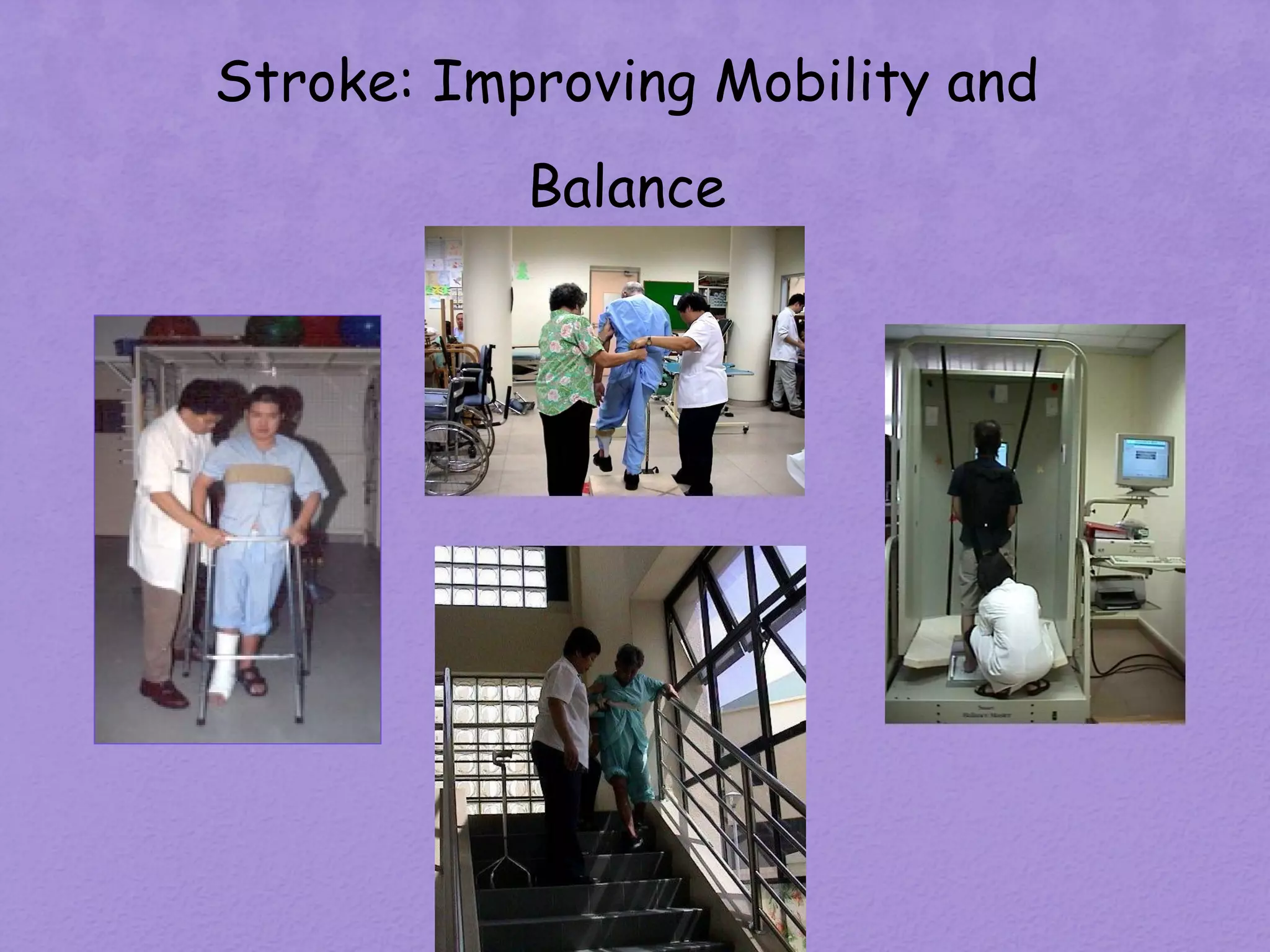
Stroke: Improving Mobility and
           Balance
Stroke: Improving Upper Limb Function

  Functional electrical stimulation
  (FES)
Stroke- Upper Limb Function
Stroke- Improving self care
Stroke- Higher ADLS
Stroke- Dysphagia Therapy
Stroke- Improving Communication
Late Rehabilitation
           Issues
               • Spasticity
• Psychological
  maladjustment     • Hemiplegic shoulder
• Depression          pain
                      • Rotator cuff injury
• Sexuality           • Spasticity
                      • Subluxation
• Vocational
                      • Complex regional pain
                        syndrome
• Driving
                      • Contactures
• Equipment needs
                    • Central post stroke
                      pain
Spasticity
• Proper positioning of limb

• Passive ranging and stretching

• Functional electrical stimulation

• Pharmacological ( baclofen, clonazepam, dantrolene)

• Alcohol/phenol neurolysis

• IM botox

• Surgical options eg. Intrathecal baclofen pumps,
  tendon release
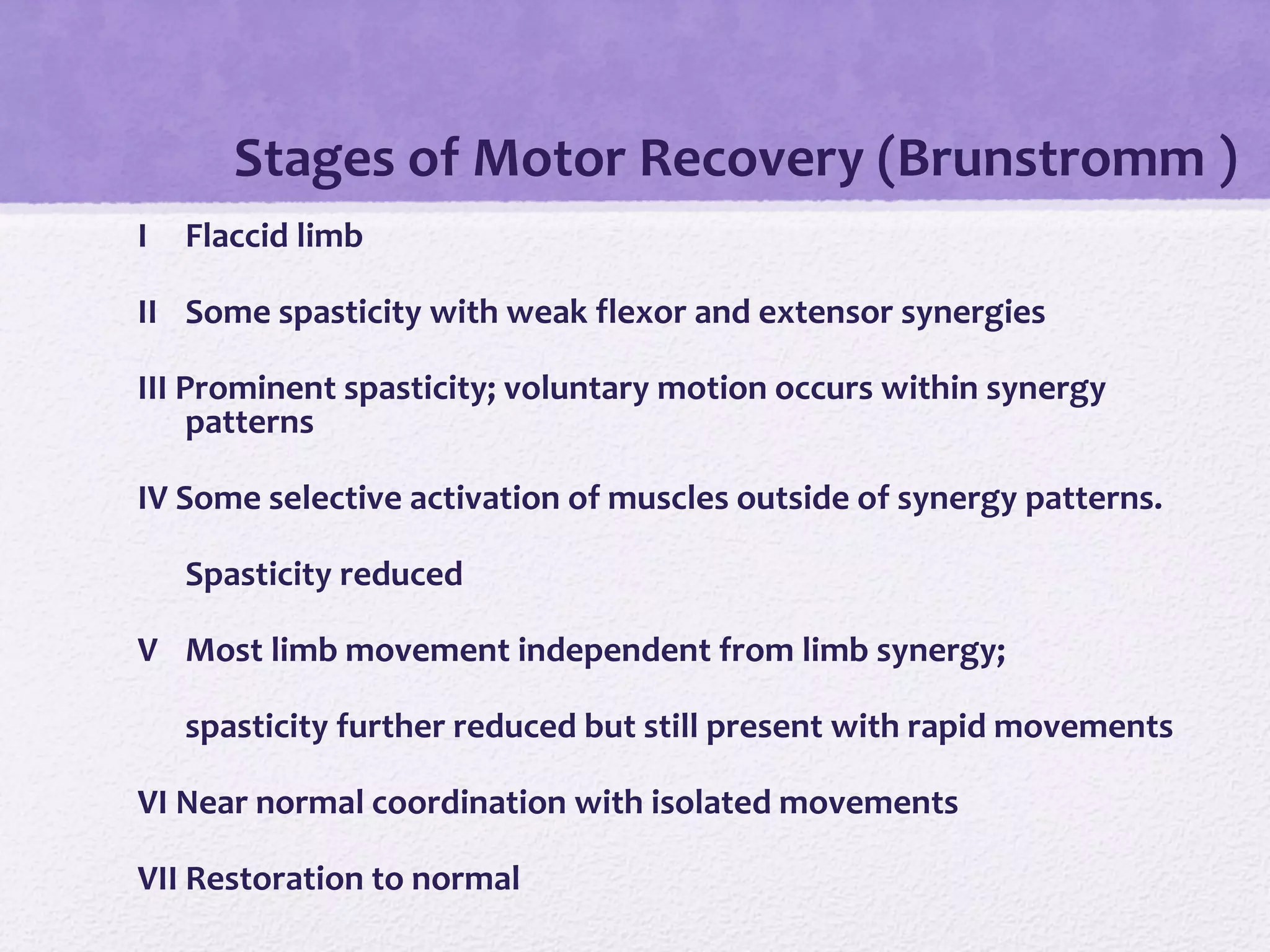
Stages of Motor Recovery (Brunstromm )
I   Flaccid limb

II Some spasticity with weak flexor and extensor synergies

III Prominent spasticity; voluntary motion occurs within synergy
     patterns

IV Some selective activation of muscles outside of synergy patterns.

    Spasticity reduced

V Most limb movement independent from limb synergy;

    spasticity further reduced but still present with rapid movements

VI Near normal coordination with isolated movements

VII Restoration to normal
Shoulder Pain - Spasticity
Shoulder pain- Spasticity


                 Neurolysis


Serial casting
Shoulder pain- Subluxation


SUBLUXATION
lSlings, straps,               Proper positioning
supports                       Arm trough/lapboard


                   - Reduction of subluxation in sitting and standing
                   - Dynamic joint compression of shoulder, elbow
                     and wrist during standing
                   - Avoiding pulling on affected arm during transfers
Functional
       Electrical
      Stimulation
•   Target strengthening muscles
    around shoulder
•   Can stimulate supraspinatus
    and posterior deltoid
Shoulder pain- Subacromial
      Impingement
Post-stroke Depression
           May present early or late

           Negative impact on function

           Difficult diagnosis:
             Æ Aphasia/Dysarthria
             Æ Cognitive impairment
             Æ Neglect

           Treatment:

           Restoration of function

           Drugs : SSRI, TCA

           Psychosocial support

           Cognitive behavioural therapy
Driving
•   Promotes independence and help
    avoid sense of isolation

•   Neuropsychological testing for
    persons with cognitive or behavioural
    disorders
    •   impulsivity
    •   poor attention span
    •   slowed decision making

•   Simulated driving test

•   Adaptive driving instruction program

•   Driving Assessment and
    rehabilitation program (DARP)
Return to work
• Important
  determinant of the
  quality of life
• “Work hardening”
  therapy
• Greatest
  opportunities to
  support vocational
  reintegration are in
  the areas of education
  and advocacy
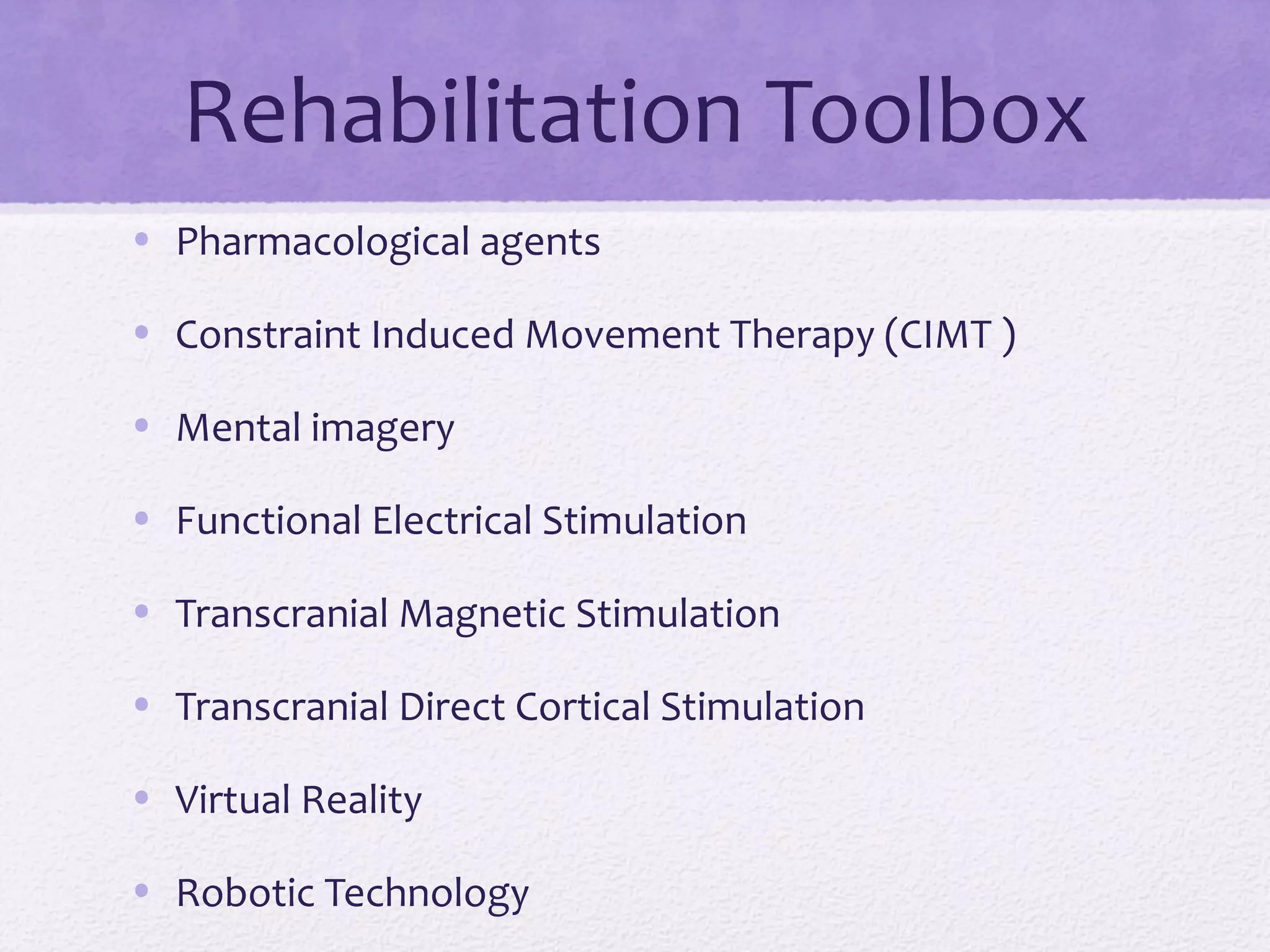
Rehabilitation Toolbox
• Pharmacological agents

• Constraint Induced Movement Therapy (CIMT )

• Mental imagery

• Functional Electrical Stimulation

• Transcranial Magnetic Stimulation

• Transcranial Direct Cortical Stimulation

• Virtual Reality

• Robotic Technology
Pharmacology
• SSRI eg. Fluoxetine

• Dopaminergic agents eg. Levodopa,
  memantine
• Acetylcholinesterase inhibitors eg. donepezil

• Piracetam
CIMT
• Evidence for arm
  improvement ( EXCITE
  trial )
• Good upper limb is
  constrained ( 90% of
  patient’s waking time )
• Affected upper limb
  trained in functional tasks
• Must have some wrist
  and finger function
  before starting
Mental Imagery
• Mirror box therapy

• Small trials

• Better evidence for use
  to improve upper limb
  function

• Must be used in
  combination with
  therapy
Functional Electrical
          Stimulation
• Bioness Arm Unit

• Used as a
  neuroprosthesis

• Functional aid to
  performing ADL

• Can aid motor recovery
Functional Electrical
          Stimulation
• Lower extremity FES
  unit

• Facilitate more fluid
  gait

• Has a gait sensor,
  miniature control unit
  and is wireless

• Increased walking
  speed
Transcranial Magnetic
     Stimulation
Transcranial Direct
Cortical Stimulation
Virtual Rehab
• Shown to have
  improvement in
  balance and gait

• Immersive vs. non
  immersive

• Wii games
Robotic Technology
• New class of clinical
  tools

• Highly reproducible
  motor learning
  experience

• Relieves strenous
  repetitive effort of
  therapists
Robotic Technology
Functional outcome following stroke
• ~1 in 10 functionally independent at time of
  stroke and nearly one-half are independent at 6
  months
• Most improvements in ADLs occurs during the
  1st 6 months- up to 5% of pts may show
  continued measurable improvement at 12
  months post- stroke
Predictors of Functional
        Outcome
• Severity of stroke

• Age

• Sitting balance

• Admission FIM score
Typical disabilities
• Typical disabilities in some specific activities at
  6 months post- stroke
  •   Unable to walk (15%)
  •   Needs assist transfer (20%)
  •   Needs assist to bathe (50%)
  •   Needs assist to dress (30%)
Poor Prognostic Indicators for Upper
                 Limb Recovery
• Severe proximal spasticity

• Prolonged flaccid period

• Absence of voluntary hand movement at 4-6
  weeks

• Onset of movement at >2-4 weeks

• Full recovery is usually complete within 3
  months of onset
Prognosis
• Best neurological recovery is seen by 11 wks for
  95% of patients
• Prognosis in patients with mild or moderate
  stroke is usually excellent
• Most ADL recovery (Barthel Index) is by 12.5
  weeks with daily PT/OT

• But recovery could take 2 years or more

• Periodic rehabilitation interventions may be
  necessary to maintain function
THE END……


   THANK YOU

Principles of stroke rehab

  • 1.
    Stroke Rehabilitation Dr Deshan Kumar Registrar TTSH Rehabilitation Centre
  • 2.
    Definition • From Latin“ habilitas “ – to make able • Literal translation – “ to be able again “ • The process of helping a person achieve the highest level of function, independence and quality of life
  • 3.
    Why impt • 4thleading cause of death • Prevalence of 3.65 % in adults > 50 years old • Leading cause of long term disability • 63% of stroke survivors in Singapore are moderately to severely disabled 3 months after stroke
  • 4.
    Types of Stroke Intracerebral Ischemic (~74%) hemorrhage(~24%) 30 day survival 73-81% 30 day survival 36%
  • 5.
    Recovery • Neurological recovery • from early spontaneous recovery • usually within the initial few weeks when penumbral area recovers their function • Functional recovery • recovery in everyday function with adaptation and training in presence/ absence of natural neurologic recovery • lags neurological recovery by 2 weeks • the part most helped by rehabilitation
  • 6.
    Neurological Recovery • Earlyrecovery ( Local processes ) 2. Resolution of post stroke edema 3. Reperfusion of ischemic penumbra 4. Resorption of local toxins 5. Recovery of partially damaged ischemic neurons • Later recovery ( Neuroplasticity ) • Ability of nervous system to modify structural and functional organisation 1. Collateral sprouting of new synaptic connections 2. Unmasking of previously latent functional pathways 3. Reversibility from diaschisis 4. Denervation supersensitivity
  • 7.
    Neurological Recovery • Majorityof neurological recovery in first 3 months • 5% of patients continuing to show recovery for up to 1 year • Return of motor power not synonymous with recovery of function
  • 8.
    Functional Recovery • Improvementin independence in areas of self care and mobility • Dependent on quality and intensity of therapy • Dependent on patient’s motivation • Modifiable by interventions
  • 9.
  • 10.
    Stroke Rehabilitation • ~10% of patients have complete spontaneous recovery • ~10% do not benefit from rehab due to severity of lesion • remaining ~80% will benefit from rehabilitation
  • 11.
    Stroke Rehab Principles •Identify impairments • Careful attention to comorbidities and complications • Early goal directed treatment • Systematic assessment of progress • Experienced interdisciplinary team • Education • Comprehensive discharge planning
  • 12.
    Early Mobilisation • Ifcondition stable – To start active mobilisation within 24-48 hours • Early mobilisation reduces complications • Strong positive psychological benefit • Tolerance for therapy affected by stroke severity, medical stability, mental status, level of function
  • 13.
    Early Mobilisation • Physiologicallysound changes in bed position • Range of motion exercises • Specific tasks ( sitting up, turning from side to side ) • Self care activities ( feeding, grooming, dressing )
  • 14.
    Secondary Complications • RecurrentStroke • DVT • Pressure sores • Bowel /bladder dysfunction • Dysphagia
  • 15.
    Pressure Sores • Pressureulcer risk assessment tools eg. Braden scale • High risk patients ( dependent in mobility, DM, peripheral vascular disease, urine incontinence, low BMI) • Thorough assessment of skin integrity • Proper positioning, turning, transferring • Avoid skin injury from friction/ excessive pressure
  • 16.
    Bladder/Bowel • Urine incontinence •Constipation • To remove indwelling catheters ASAP • Establish proper bladder and bowel regime
  • 17.
    Dysphagia • Leads toaspiration pneumonia and malnutrition • Swallowing screen to be done for all patients • If abnormal, speech therapist to perform complete bedside examination • Videofluoroscopy Swallowing Study • Functional Endoscopic Examination of Swallowing
  • 18.
    Criteria for Admissionto Rehab Programme • Stable neurological status • Significant persisting neurologic deficit • Identified disability affecting at least 2 of the following: • Mobility • Self- care • Communication • Bowel/bladder control • Swallowing • Sufficient cognition to learn • Sufficient communicative ability to engage with therapists • Physical ability to tolerate the active program • Achievable therapeutic goals
  • 19.
    International Classification of Functioning • Impairment • Activity limitation • Participation barrier
  • 20.
    Stroke Impairments • Cognitive •Communication • Motor • Sensory • Visual
  • 21.
    Outcome Measures • StrokeSeverity – NIHSS • Upper and lower extremity function – Fugyl Meyer • Visual perception – Line bisection • Balance – Berg Balance • Cognition – MMSE • ADLs and ambulation – FIM score, Barthel index
  • 22.
    FIM Score • FunctionalIndependence Measure • 18 items  1. Selfcare (dress, eat, groom, toilet, bathe)  2. Sphincter control (bowel and bladder)  3. Transfers (bed, toilet, tub)  4. Locomotion (walking or wheelchair)  5. Communication (comprehension and expression)  6. Social/ cognition (Problem solving and memory) • Scored into one of seven levels of function ranging from complete dependence (level 1) to complete independence (level 7).
  • 23.
    Rehabilitation Goals • Specific •Measurable • Acheivable • Realistic • Timely
  • 24.
    Interdisciplinary Team • Rehabilitationphysician • Nurse • Physiotherapist • Occupational therapist • Speech therapist • Psychologist • Social Worker • Prosthetist and Orthotist • Dietician
  • 25.
    Stroke rehab: Where? • Inpatient • Community Hospital • Nursing Home • Day Rehabilitation Centres • Home based therapy (eg. Community rehab programme)
  • 26.
  • 27.
  • 28.
    Stroke: Improving UpperLimb Function Functional electrical stimulation (FES)
  • 29.
  • 30.
  • 31.
  • 32.
  • 33.
  • 34.
    Late Rehabilitation Issues • Spasticity • Psychological maladjustment • Hemiplegic shoulder • Depression pain • Rotator cuff injury • Sexuality • Spasticity • Subluxation • Vocational • Complex regional pain syndrome • Driving • Contactures • Equipment needs • Central post stroke pain
  • 35.
    Spasticity • Proper positioningof limb • Passive ranging and stretching • Functional electrical stimulation • Pharmacological ( baclofen, clonazepam, dantrolene) • Alcohol/phenol neurolysis • IM botox • Surgical options eg. Intrathecal baclofen pumps, tendon release
  • 36.
    Stages of MotorRecovery (Brunstromm ) I Flaccid limb II Some spasticity with weak flexor and extensor synergies III Prominent spasticity; voluntary motion occurs within synergy patterns IV Some selective activation of muscles outside of synergy patterns. Spasticity reduced V Most limb movement independent from limb synergy; spasticity further reduced but still present with rapid movements VI Near normal coordination with isolated movements VII Restoration to normal
  • 37.
    Shoulder Pain -Spasticity
  • 38.
    Shoulder pain- Spasticity Neurolysis Serial casting
  • 39.
  • 40.
    lSlings, straps, Proper positioning supports Arm trough/lapboard - Reduction of subluxation in sitting and standing - Dynamic joint compression of shoulder, elbow and wrist during standing - Avoiding pulling on affected arm during transfers
  • 41.
    Functional Electrical Stimulation • Target strengthening muscles around shoulder • Can stimulate supraspinatus and posterior deltoid
  • 42.
  • 43.
    Post-stroke Depression May present early or late Negative impact on function Difficult diagnosis: Æ Aphasia/Dysarthria Æ Cognitive impairment Æ Neglect Treatment: Restoration of function Drugs : SSRI, TCA Psychosocial support Cognitive behavioural therapy
  • 44.
    Driving • Promotes independence and help avoid sense of isolation • Neuropsychological testing for persons with cognitive or behavioural disorders • impulsivity • poor attention span • slowed decision making • Simulated driving test • Adaptive driving instruction program • Driving Assessment and rehabilitation program (DARP)
  • 45.
    Return to work •Important determinant of the quality of life • “Work hardening” therapy • Greatest opportunities to support vocational reintegration are in the areas of education and advocacy
  • 46.
    Rehabilitation Toolbox • Pharmacologicalagents • Constraint Induced Movement Therapy (CIMT ) • Mental imagery • Functional Electrical Stimulation • Transcranial Magnetic Stimulation • Transcranial Direct Cortical Stimulation • Virtual Reality • Robotic Technology
  • 47.
    Pharmacology • SSRI eg.Fluoxetine • Dopaminergic agents eg. Levodopa, memantine • Acetylcholinesterase inhibitors eg. donepezil • Piracetam
  • 48.
    CIMT • Evidence forarm improvement ( EXCITE trial ) • Good upper limb is constrained ( 90% of patient’s waking time ) • Affected upper limb trained in functional tasks • Must have some wrist and finger function before starting
  • 49.
    Mental Imagery • Mirrorbox therapy • Small trials • Better evidence for use to improve upper limb function • Must be used in combination with therapy
  • 50.
    Functional Electrical Stimulation • Bioness Arm Unit • Used as a neuroprosthesis • Functional aid to performing ADL • Can aid motor recovery
  • 51.
    Functional Electrical Stimulation • Lower extremity FES unit • Facilitate more fluid gait • Has a gait sensor, miniature control unit and is wireless • Increased walking speed
  • 52.
  • 53.
  • 54.
    Virtual Rehab • Shownto have improvement in balance and gait • Immersive vs. non immersive • Wii games
  • 55.
    Robotic Technology • Newclass of clinical tools • Highly reproducible motor learning experience • Relieves strenous repetitive effort of therapists
  • 56.
  • 57.
    Functional outcome followingstroke • ~1 in 10 functionally independent at time of stroke and nearly one-half are independent at 6 months • Most improvements in ADLs occurs during the 1st 6 months- up to 5% of pts may show continued measurable improvement at 12 months post- stroke
  • 58.
    Predictors of Functional Outcome • Severity of stroke • Age • Sitting balance • Admission FIM score
  • 59.
    Typical disabilities • Typicaldisabilities in some specific activities at 6 months post- stroke • Unable to walk (15%) • Needs assist transfer (20%) • Needs assist to bathe (50%) • Needs assist to dress (30%)
  • 60.
    Poor Prognostic Indicatorsfor Upper Limb Recovery • Severe proximal spasticity • Prolonged flaccid period • Absence of voluntary hand movement at 4-6 weeks • Onset of movement at >2-4 weeks • Full recovery is usually complete within 3 months of onset
  • 61.
    Prognosis • Best neurologicalrecovery is seen by 11 wks for 95% of patients • Prognosis in patients with mild or moderate stroke is usually excellent • Most ADL recovery (Barthel Index) is by 12.5 weeks with daily PT/OT • But recovery could take 2 years or more • Periodic rehabilitation interventions may be necessary to maintain function
  • 62.
    THE END…… THANK YOU

Editor's Notes

  • #13 Early mobilisation reduces DVT, deconditioning, GERD, aspiration pneumonia, contractures, skin breakdown, constipation,orthostatic intolerance
  • #17 Urine incontinence is 50% in acute admission and 20% at 6 months
  • #22 Should be reliable , valid and sensitive
  • #25 Improves short term survival, functional ability and most independent discharge location
  • #59 Patients <55 yrs had a 67% max possible improvement cf 50% for those aged >55 years Younger patients also had faster functional recovery