Physiotherapy and
Robotic Devices
What is
Physiotherapy?
Physiotherapy as described by World
Physiotherapy is a healthcare profession
concerned with human function and
movement and maximizing physical potential.
It is concerned with identifying and
maximizing quality of life and movement
potential within the spheres of promotion,
prevention, treatment/intervention,
habilitation, and rehabilitation.
What Is Robotic
Therapy?
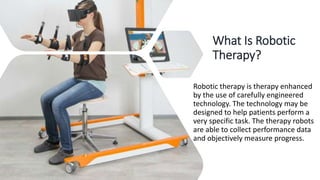
Robotic therapy is therapy enhanced
by the use of carefully engineered
technology. The technology may be
designed to help patients perform a
very specific task. The therapy robots
are able to collect performance data
and objectively measure progress.
Robotic Technology in Rehabilitation
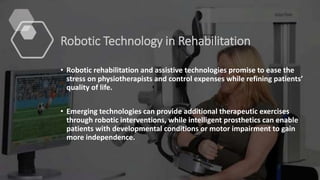
• Robotic rehabilitation and assistive technologies promise to ease the
stress on physiotherapists and control expenses while refining patients’
quality of life.
• Emerging technologies can provide additional therapeutic exercises
through robotic interventions, while intelligent prosthetics can enable
patients with developmental conditions or motor impairment to gain
more independence.
Robotic Technology in Rehabilitation (Cont.)
Robotic technology designed to assist rehabilitation can potentially
increase the efficiency of and accessibility to therapy by assisting
therapists to provide consistent training for extended periods of time
and collecting data to assess progress. The data collected can be used to
objectively assess performance and document compliance as well as
progress. All of these characteristics can make therapists more efficient
in treating larger numbers of patients. Most importantly for the patient,
it can increase access to therapy which is often in high demand and
rationed severely in today’s fiscal climate.
Robotic Technology
in Rehabilitation
(Cont.)
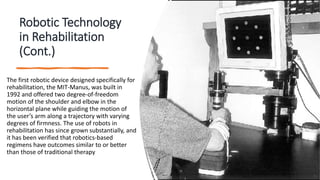
The first robotic device designed specifically for
rehabilitation, the MIT-Manus, was built in
1992 and offered two degree-of-freedom
motion of the shoulder and elbow in the
horizontal plane while guiding the motion of
the user’s arm along a trajectory with varying
degrees of firmness. The use of robots in
rehabilitation has since grown substantially, and
it has been verified that robotics-based
regimens have outcomes similar to or better
than those of traditional therapy
Advantages and Disadvantages of Robotic
Rehabilitation
Advantages
Lower and upper extremity
rehabilitation can require significant
time and physical effort on the part
of physiotherapists. The use of
robotic devices is a highly motivating
method, as it allows for repetitive,
intensive, and task-specific training,
whilst potentially offloading
therapists’ burdens.
Disadvantages
Often robots are very costly – in terms of the
initial cost, maintenance, the need for extra
components and the need to be programmed
to do the task.
One disadvantage may be that the therapists
should be trained and skilled in using the
devices appropriately. Motivating patients as
well as therapist to use devices in gait therapy
might be a challenge.
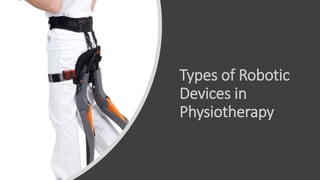
Types of Robotic
Devices in
Physiotherapy
Rehabilitation
Robots and
Their
Classifications
According to Robot Treatment Approaches:
• Rehabilitation robots can be classified into two types,
according to their treatment approaches.
• The first approach is continuous passive movement
(CPM). CPM requires no volunteer effort performed
by the patient where the limb is controlled and
moved by the robot. CPM treatment reduces muscle
tone, which eventually improves the mobility of
muscles, joints, and tendons.
• The second approach is active-assisted movement,
where the robot requires a signal from the patient to
perform the movement. This signal could be an
electromyogram (EMG) and follows the patient’s
intention to move the limb.
Rehabilitation
Robots and
Their
Classifications
According to the Robot Structures:
• Rehabilitation robots are also classified as end-
effectors and exoskeleton robots.
• End-effectors are simple robots that have a distal
movable handle, and the patient attaches his/her
hand to this handle and follows a specific
trajectory. This kind of robot is characterized by
its ability to adapt to different sizes and shapes
of movements, as the rehabilitation process
requires. End-effectors have been developed
recently to provide bilateral rehabilitation
training, where the impaired limb copies the
movement of the unimpaired limb in a
synchronized behavior.
Rehabilitation
Robots and
Their
Classifications
• Exoskeleton robots are characterized by
encapsulating the limb with a splint or bionic
structure. Exoskeleton robots calculate the
required torque for each joint and control the
limb movements. In comparison with end-
effector robots, exoskeletons require a smaller
working environment. Exoskeleton robots,
however, comprise the limb joint axes as they
provide a very specific movement.
Examples of Rehabilitation
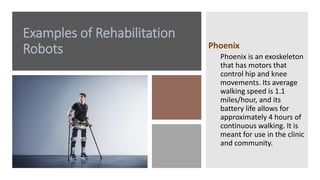
Robots Phoenix
Phoenix is an exoskeleton
that has motors that
control hip and knee
movements. Its average
walking speed is 1.1
miles/hour, and its
battery life allows for
approximately 4 hours of
continuous walking. It is
meant for use in the clinic
and community.
Examples of Rehabilitation
Robots
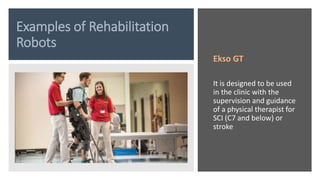
Ekso GT
It is designed to be used
in the clinic with the
supervision and guidance
of a physical therapist for
SCI (C7 and below) or
stroke
Examples of Rehabilitation
Robots
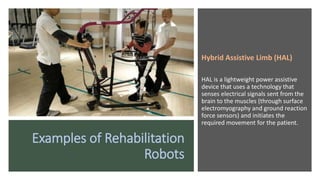
Hybrid Assistive Limb (HAL)
HAL is a lightweight power assistive
device that uses a technology that
senses electrical signals sent from the
brain to the muscles (through surface
electromyography and ground reaction
force sensors) and initiates the
required movement for the patient.
Examples of Rehabilitation
Robots
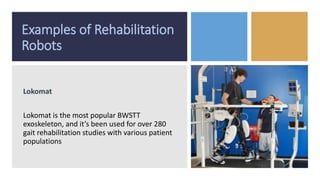
Lokomat
Lokomat is the most popular BWSTT
exoskeleton, and it’s been used for over 280
gait rehabilitation studies with various patient
populations
Examples of Rehabilitation
Robots
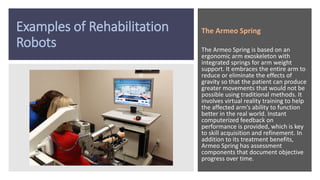
The Armeo Spring
The Armeo Spring is based on an
ergonomic arm exoskeleton with
integrated springs for arm weight
support. It embraces the entire arm to
reduce or eliminate the effects of
gravity so that the patient can produce
greater movements that would not be
possible using traditional methods. It
involves virtual reality training to help
the affected arm’s ability to function
better in the real world. Instant
computerized feedback on
performance is provided, which is key
to skill acquisition and refinement. In
addition to its treatment benefits,
Armeo Spring has assessment
components that document objective
progress over time.
Examples of Rehabilitation
Robots
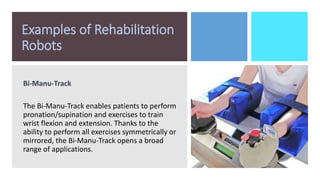
Bi-Manu-Track
The Bi-Manu-Track enables patients to perform
pronation/supination and exercises to train
wrist flexion and extension. Thanks to the
ability to perform all exercises symmetrically or
mirrored, the Bi-Manu-Track opens a broad
range of applications.
Examples of Rehabilitation
Robots
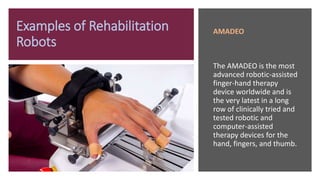
AMADEO
The AMADEO is the most
advanced robotic-assisted
finger-hand therapy
device worldwide and is
the very latest in a long
row of clinically tried and
tested robotic and
computer-assisted
therapy devices for the
hand, fingers, and thumb.
Examples of Rehabilitation
Robots
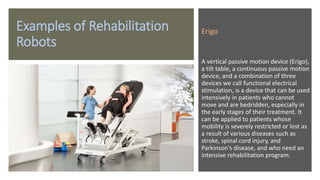
Erigo
A vertical passive motion device (Erigo),
a tilt table, a continuous passive motion
device, and a combination of three
devices we call functional electrical
stimulation, is a device that can be used
intensively in patients who cannot
move and are bedridden, especially in
the early stages of their treatment. It
can be applied to patients whose
mobility is severely restricted or lost as
a result of various diseases such as
stroke, spinal cord injury, and
Parkinson's disease, and who need an
intensive rehabilitation program.
Future of Robotics
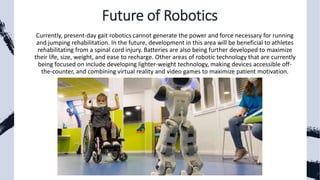
Currently, present-day gait robotics cannot generate the power and force necessary for running
and jumping rehabilitation. In the future, development in this area will be beneficial to athletes
rehabilitating from a spinal cord injury. Batteries are also being further developed to maximize
their life, size, weight, and ease to recharge. Other areas of robotic technology that are currently
being focused on include developing lighter-weight technology, making devices accessible off-
the-counter, and combining virtual reality and video games to maximize patient motivation.
References
• Steven Hua, Brandon Graham, Sebastian Wozniak, Eric Beech/Robotic Rehabilitation for the Lower
Extremity/Physiopedia.
• Bentzen Takyi, Michael Richards, and Richard Iheadindu as part of the Queen's University Neuromotor
Function Project/Upper Extremity Rehabilitation using Robotics/Physiopedia.
• Robotic Technology & Advanced Physical Therapy Tools/Bacharach
• Jeffrey Laut, Maurizio Porfiri, and Preeti Raghavan/ The Present and Future of Robotic Technology in
Rehabilitation/ Curr Phys Med Rehabil Rep. 2016 Dec; 4(4): 312–319.
• By Smita Deshmukh, Transparency Market Research/October 21, 2019/ Robotic rehabilitation and
assistive technologies to revolutionize physiotherapy.
• 11/19/19, 07:50 AM /Mobile Robots/Len Calderone - Contributing Author/Medical and Service
• Hassan Qassim/03 Nov 2020/Computer Science, Artificial Intelligence/Rehabilitation Robots
• Pate Rehabilitation Corporate Offices/Armeo Spring Movement Therapy
• https://www.neurorehabdirectory.com/rehab-products/bi-manu-
track/#:~:text=The%20Bi%2DManu%2DTrack%20enables,a%20broad%20range%20of%20applications.
• https://www.ectron.co.uk/amadeo-robotic-hand-
therapy1#:~:text=The%20AMADEO%20is%20the%20most,the%20hand%2C%20fingers%20and%20thu
mb.
• https://summitmedsci.co.uk/products/hocoma-
erigo/#:~:text=The%20Erigo%20combines%20gradual%20verticalisation,of%20the%20central%20nervo
us%20system.
• https://www.madeformovement.com/robotic-rehabilitation-therapy
• Professor Richard Mitchell/Advantages and disadvantages of robots/© University of Reading
• Jan Mehrholz and Marcus Pohl/ 05 June 2014/ Cambridge University/Rehabilitation robotics, orthotics,
and prosthetics: lower limb
Thank you
Prepared by;
Selina Deniz Bakıcı

Pyhsiotherapy and Robotic Devices.pptx

  • 1.
  • 2.
    What is Physiotherapy? Physiotherapy asdescribed by World Physiotherapy is a healthcare profession concerned with human function and movement and maximizing physical potential. It is concerned with identifying and maximizing quality of life and movement potential within the spheres of promotion, prevention, treatment/intervention, habilitation, and rehabilitation.
  • 3.
    What Is Robotic Therapy? Robotictherapy is therapy enhanced by the use of carefully engineered technology. The technology may be designed to help patients perform a very specific task. The therapy robots are able to collect performance data and objectively measure progress.
  • 4.
    Robotic Technology inRehabilitation • Robotic rehabilitation and assistive technologies promise to ease the stress on physiotherapists and control expenses while refining patients’ quality of life. • Emerging technologies can provide additional therapeutic exercises through robotic interventions, while intelligent prosthetics can enable patients with developmental conditions or motor impairment to gain more independence.
  • 5.
    Robotic Technology inRehabilitation (Cont.) Robotic technology designed to assist rehabilitation can potentially increase the efficiency of and accessibility to therapy by assisting therapists to provide consistent training for extended periods of time and collecting data to assess progress. The data collected can be used to objectively assess performance and document compliance as well as progress. All of these characteristics can make therapists more efficient in treating larger numbers of patients. Most importantly for the patient, it can increase access to therapy which is often in high demand and rationed severely in today’s fiscal climate.
  • 6.
    Robotic Technology in Rehabilitation (Cont.) Thefirst robotic device designed specifically for rehabilitation, the MIT-Manus, was built in 1992 and offered two degree-of-freedom motion of the shoulder and elbow in the horizontal plane while guiding the motion of the user’s arm along a trajectory with varying degrees of firmness. The use of robots in rehabilitation has since grown substantially, and it has been verified that robotics-based regimens have outcomes similar to or better than those of traditional therapy
  • 7.
    Advantages and Disadvantagesof Robotic Rehabilitation Advantages Lower and upper extremity rehabilitation can require significant time and physical effort on the part of physiotherapists. The use of robotic devices is a highly motivating method, as it allows for repetitive, intensive, and task-specific training, whilst potentially offloading therapists’ burdens. Disadvantages Often robots are very costly – in terms of the initial cost, maintenance, the need for extra components and the need to be programmed to do the task. One disadvantage may be that the therapists should be trained and skilled in using the devices appropriately. Motivating patients as well as therapist to use devices in gait therapy might be a challenge.
  • 8.
    Types of Robotic Devicesin Physiotherapy
  • 9.
    Rehabilitation Robots and Their Classifications According toRobot Treatment Approaches: • Rehabilitation robots can be classified into two types, according to their treatment approaches. • The first approach is continuous passive movement (CPM). CPM requires no volunteer effort performed by the patient where the limb is controlled and moved by the robot. CPM treatment reduces muscle tone, which eventually improves the mobility of muscles, joints, and tendons. • The second approach is active-assisted movement, where the robot requires a signal from the patient to perform the movement. This signal could be an electromyogram (EMG) and follows the patient’s intention to move the limb.
  • 10.
    Rehabilitation Robots and Their Classifications According tothe Robot Structures: • Rehabilitation robots are also classified as end- effectors and exoskeleton robots. • End-effectors are simple robots that have a distal movable handle, and the patient attaches his/her hand to this handle and follows a specific trajectory. This kind of robot is characterized by its ability to adapt to different sizes and shapes of movements, as the rehabilitation process requires. End-effectors have been developed recently to provide bilateral rehabilitation training, where the impaired limb copies the movement of the unimpaired limb in a synchronized behavior.
  • 11.
    Rehabilitation Robots and Their Classifications • Exoskeletonrobots are characterized by encapsulating the limb with a splint or bionic structure. Exoskeleton robots calculate the required torque for each joint and control the limb movements. In comparison with end- effector robots, exoskeletons require a smaller working environment. Exoskeleton robots, however, comprise the limb joint axes as they provide a very specific movement.
  • 12.
    Examples of Rehabilitation RobotsPhoenix Phoenix is an exoskeleton that has motors that control hip and knee movements. Its average walking speed is 1.1 miles/hour, and its battery life allows for approximately 4 hours of continuous walking. It is meant for use in the clinic and community.
  • 13.
    Examples of Rehabilitation Robots EksoGT It is designed to be used in the clinic with the supervision and guidance of a physical therapist for SCI (C7 and below) or stroke
  • 14.
    Examples of Rehabilitation Robots HybridAssistive Limb (HAL) HAL is a lightweight power assistive device that uses a technology that senses electrical signals sent from the brain to the muscles (through surface electromyography and ground reaction force sensors) and initiates the required movement for the patient.
  • 15.
    Examples of Rehabilitation Robots Lokomat Lokomatis the most popular BWSTT exoskeleton, and it’s been used for over 280 gait rehabilitation studies with various patient populations
  • 16.
    Examples of Rehabilitation Robots TheArmeo Spring The Armeo Spring is based on an ergonomic arm exoskeleton with integrated springs for arm weight support. It embraces the entire arm to reduce or eliminate the effects of gravity so that the patient can produce greater movements that would not be possible using traditional methods. It involves virtual reality training to help the affected arm’s ability to function better in the real world. Instant computerized feedback on performance is provided, which is key to skill acquisition and refinement. In addition to its treatment benefits, Armeo Spring has assessment components that document objective progress over time.
  • 17.
    Examples of Rehabilitation Robots Bi-Manu-Track TheBi-Manu-Track enables patients to perform pronation/supination and exercises to train wrist flexion and extension. Thanks to the ability to perform all exercises symmetrically or mirrored, the Bi-Manu-Track opens a broad range of applications.
  • 18.
    Examples of Rehabilitation Robots AMADEO TheAMADEO is the most advanced robotic-assisted finger-hand therapy device worldwide and is the very latest in a long row of clinically tried and tested robotic and computer-assisted therapy devices for the hand, fingers, and thumb.
  • 19.
    Examples of Rehabilitation Robots Erigo Avertical passive motion device (Erigo), a tilt table, a continuous passive motion device, and a combination of three devices we call functional electrical stimulation, is a device that can be used intensively in patients who cannot move and are bedridden, especially in the early stages of their treatment. It can be applied to patients whose mobility is severely restricted or lost as a result of various diseases such as stroke, spinal cord injury, and Parkinson's disease, and who need an intensive rehabilitation program.
  • 20.
    Future of Robotics Currently,present-day gait robotics cannot generate the power and force necessary for running and jumping rehabilitation. In the future, development in this area will be beneficial to athletes rehabilitating from a spinal cord injury. Batteries are also being further developed to maximize their life, size, weight, and ease to recharge. Other areas of robotic technology that are currently being focused on include developing lighter-weight technology, making devices accessible off- the-counter, and combining virtual reality and video games to maximize patient motivation.
  • 21.
    References • Steven Hua,Brandon Graham, Sebastian Wozniak, Eric Beech/Robotic Rehabilitation for the Lower Extremity/Physiopedia. • Bentzen Takyi, Michael Richards, and Richard Iheadindu as part of the Queen's University Neuromotor Function Project/Upper Extremity Rehabilitation using Robotics/Physiopedia. • Robotic Technology & Advanced Physical Therapy Tools/Bacharach • Jeffrey Laut, Maurizio Porfiri, and Preeti Raghavan/ The Present and Future of Robotic Technology in Rehabilitation/ Curr Phys Med Rehabil Rep. 2016 Dec; 4(4): 312–319. • By Smita Deshmukh, Transparency Market Research/October 21, 2019/ Robotic rehabilitation and assistive technologies to revolutionize physiotherapy. • 11/19/19, 07:50 AM /Mobile Robots/Len Calderone - Contributing Author/Medical and Service • Hassan Qassim/03 Nov 2020/Computer Science, Artificial Intelligence/Rehabilitation Robots • Pate Rehabilitation Corporate Offices/Armeo Spring Movement Therapy • https://www.neurorehabdirectory.com/rehab-products/bi-manu- track/#:~:text=The%20Bi%2DManu%2DTrack%20enables,a%20broad%20range%20of%20applications. • https://www.ectron.co.uk/amadeo-robotic-hand- therapy1#:~:text=The%20AMADEO%20is%20the%20most,the%20hand%2C%20fingers%20and%20thu mb. • https://summitmedsci.co.uk/products/hocoma- erigo/#:~:text=The%20Erigo%20combines%20gradual%20verticalisation,of%20the%20central%20nervo us%20system. • https://www.madeformovement.com/robotic-rehabilitation-therapy • Professor Richard Mitchell/Advantages and disadvantages of robots/© University of Reading • Jan Mehrholz and Marcus Pohl/ 05 June 2014/ Cambridge University/Rehabilitation robotics, orthotics, and prosthetics: lower limb
  • 22.