Dr. Maheshwari Harishchandre
Assistant Professor
M.P.Th (Neurosciences)
DVVPF College of Physiotherapy,
Ahmednagar
 Introduction
 Principles
 Rules of sensory input
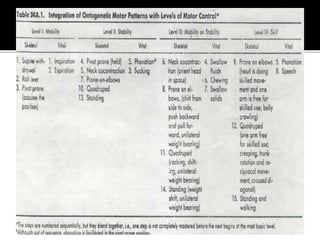
 Sequence of Motor Development
 Ontogenic Motor Pattern
 Facilitation Technique
 Inhibition Technique
 Margared Rood (1976)
 PT & OT
 CP & patients with motor control
problems.
1. Controlled use of sensory stimulus.
a. Specific Motor response
b. Normalization of muscle tone
2. Use of Developmental sequences.
a. Sensorimotor development = from lower to higher
level.
3. Use of activity to demand a purposeful response.
4. Practice of sensory motor response is necessary
for motor learning.
1. A fast brief stimulus produces a large synchronous motor
output.
Use : stimulus confirms the reflex are functioning.
2. A fast repetitive sensory input produces a mantained response.
3. A mantained sensory input produces a mantained response.
e.g. Gravity, positions
4. Slow, rhythmical, repetitive sensory input deactivates body &
mind.
e.g. Slow rocking or soft music.
1. Reciprocal Inhibition/Innervation :
 Early mobility pattern protective in nature.
 Phasic & reciprocal type of movement.
 Contraction of agonist & relaxation of
antagonist.
2. Co- contraction :
 Tonic (static ) pattern
 Simultaneous agonist & antagonist contraction.
3. Heavy Work :
 Controlled mobility pattern
 Stock meyer “mobility superimposed on stability”
 Proximal ms. contract & move & the distal segment is fixed.
 E.g. Creeping
4. Skill :
 Highest level of motor control
 Combined Pattern
 Proximal segments are stabilized , distal segments moves
freely. E.g. Typing.
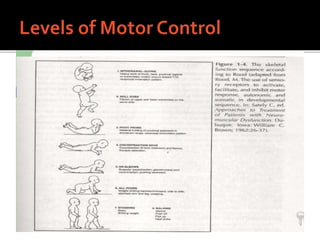
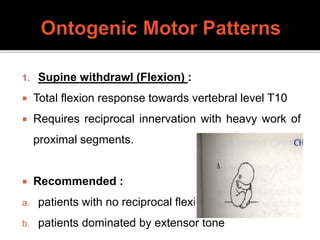
1. Supine withdrawl (Flexion) :
 Total flexion response towards vertebral level T10
 Requires reciprocal innervation with heavy work of
proximal segments.
 Recommended :
a. patients with no reciprocal flexion
b. patients dominated by extensor tone
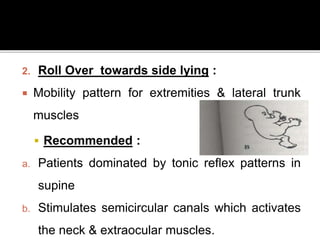
2. Roll Over towards side lying :
 Mobility pattern for extremities & lateral trunk
muscles
 Recommended :
a. Patients dominated by tonic reflex patterns in
supine
b. Stimulates semicircular canals which activates
the neck & extraocular muscles.
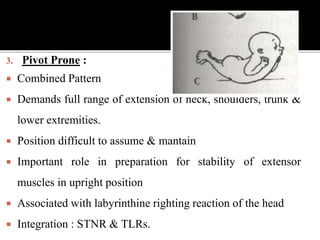
3. Pivot Prone :
 Combined Pattern
 Demands full range of extension of neck, shoulders, trunk &
lower extremities.
 Position difficult to assume & mantain
 Important role in preparation for stability of extensor
muscles in upright position
 Associated with labyrinthine righting reaction of the head
 Integration : STNR & TLRs.
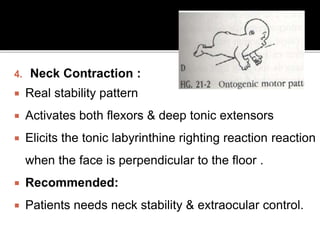
4. Neck Contraction :
 Real stability pattern
 Activates both flexors & deep tonic extensors
 Elicits the tonic labyrinthine righting reaction reaction
when the face is perpendicular to the floor .
 Recommended:
 Patients needs neck stability & extraocular control.
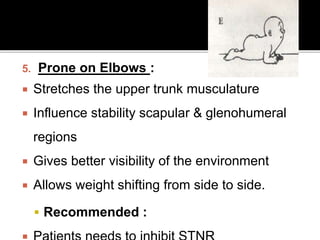
5. Prone on Elbows :
 Stretches the upper trunk musculature
 Influence stability scapular & glenohumeral
regions
 Gives better visibility of the environment
 Allows weight shifting from side to side.
 Recommended :
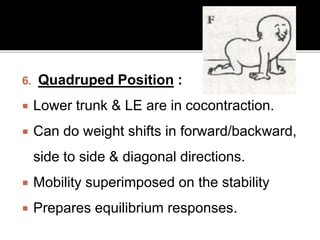
6. Quadruped Position :
 Lower trunk & LE are in cocontraction.
 Can do weight shifts in forward/backward,
side to side & diagonal directions.
 Mobility superimposed on the stability
 Prepares equilibrium responses.
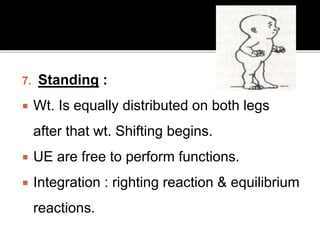
7. Standing :
 Wt. Is equally distributed on both legs
after that wt. Shifting begins.
 UE are free to perform functions.
 Integration : righting reaction & equilibrium
reactions.
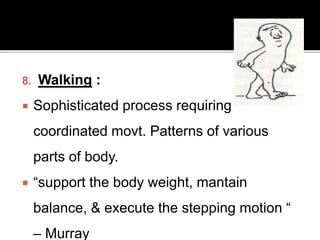
8. Walking :
 Sophisticated process requiring
coordinated movt. Patterns of various
parts of body.
 “support the body weight, mantain
balance, & execute the stepping motion “
– Murray
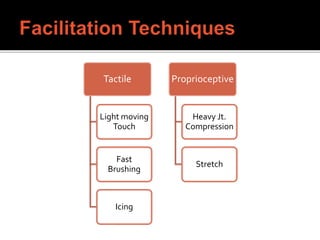
Tactile
Light moving
Touch
Fast
Brushing
Icing
Proprioceptive
Heavy Jt.
Compression
Stretch
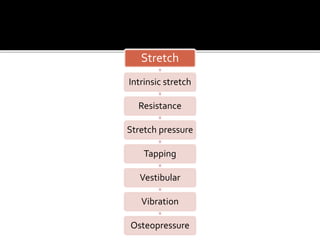
Stretch
Intrinsic stretch
Resistance
Stretch pressure
Tapping
Vestibular
Vibration
Osteopressure
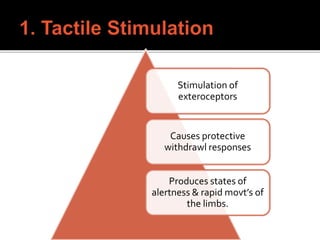
Stimulation of
exteroceptors
Causes protective
withdrawl responses
Produces states of
alertness & rapid movt’s of
the limbs.
 Touch is imp. for normal growth &
development ( Montague A, 1978)
 Mechanism
1. Mediated by A delta sensory fibers
2. Stimulates A delta sensory fibers
synapses with fusimotor system reciprocal
innervation ( phasic withdrawl response)
 Effects :
1. Activates low threshold hair end organ & free
nerve endings.
2. Activates sup. mobilizing muscles,
3. Increases corticosteroid levels in the blood
stream.
4. Increases resistance against disease.
5. Improves fluid & electrolyte balance.
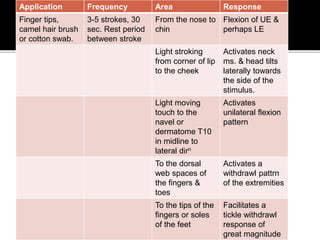
Application Frequency Area Response
Finger tips,
camel hair brush
or cotton swab.
3-5 strokes, 30
sec. Rest period
between stroke
From the nose to
chin
Flexion of UE &
perhaps LE
Light stroking
from corner of lip
to the cheek
Activates neck
ms. & head tilts
laterally towards
the side of the
stimulus.
Light moving
touch to the
navel or
dermatome T10
in midline to
lateral dirn
Activates
unilateral flexion
pattern
To the dorsal
web spaces of
the fingers &
toes
Activates a
withdrawl pattrn
of the extremities
To the tips of the
fingers or soles
of the feet
Facilitates a
tickle withdrawl
response of
great magnitude
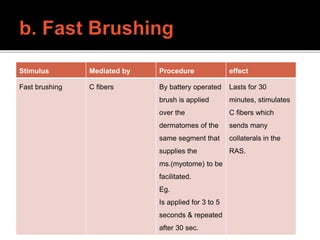
Stimulus Mediated by Procedure effect
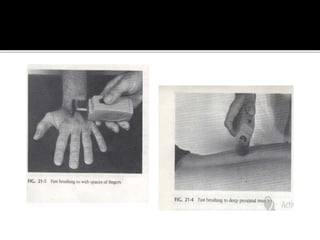
Fast brushing C fibers By battery operated
brush is applied
over the
dermatomes of the
same segment that
supplies the
ms.(myotome) to be
facilitated.
Eg.
Is applied for 3 to 5
seconds & repeated
after 30 sec.
Lasts for 30
minutes, stimulates
C fibers which
sends many
collaterals in the
RAS.
 Extreme thermal facilitation
 Facilitation of ms activity & ANS responses.
 Uses :
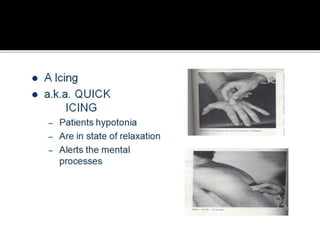
1. Quick icing – hypotonia (3 swipes, blott water after each
swipe)
2. Pressing ice cubes to the skin of dermatome corresponding
to myotome to be stimulated.
3. Ice to stimulate SNS & glandular output of thyroid & adrenal
glands.
Note : cardiac problems.
 Jt. gives control over the motor response.
 Proprioceptors adapt more slowly than
exteroceptors & can produce sustained
postural patterns.
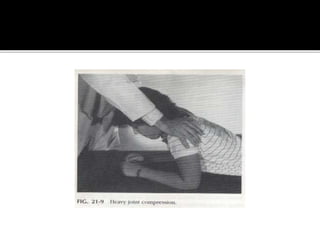
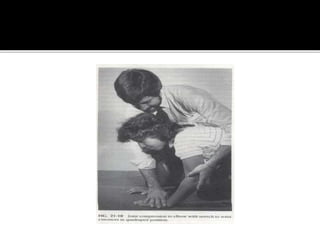
 Defn : Jt. Compression > body wt. applied through the
longitudinal axis of the bone.(Ager J, 1974)
 Causes :
1. cocontraction around jt under compression
2. Combined with ontogenetic patterns s/a prone on
elbows, quadruped, sitting & standing position.
 Can be applied manually or by weighted cuffs or sand
bags.
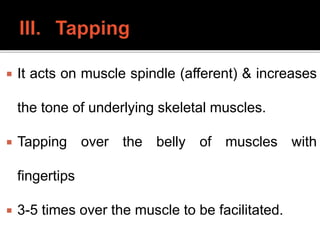
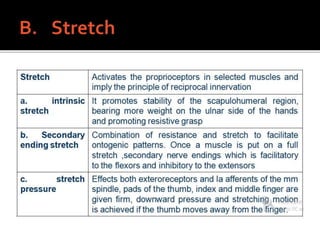
 It acts on muscle spindle (afferent) & increases
the tone of underlying skeletal muscles.
 Tapping over the belly of muscles with
fingertips
 3-5 times over the muscle to be facilitated.
 Powerful propriocetive input (De Quiros JB)
 Therapeutic Uses :
1. To promote extensor patterns of the neck,
trunk & extremities (Static labyrinthine
system)
2. To elicit subcortical responses, s/a
protective extension
3.To activate antigravity muscles & their
antagonist
4.Fast stimulation s/a rocking stimulates while
rhythmic slow rocking causes relaxation
5.Vestibular stimulation affects tone, balance,
protective responses, bilateral integration &
auditory language development.
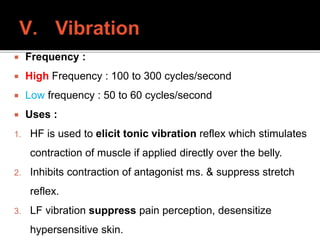
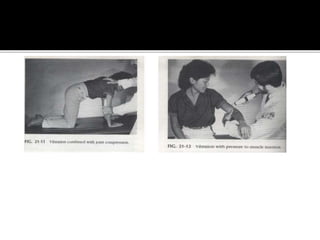
 Frequency :
 High Frequency : 100 to 300 cycles/second
 Low frequency : 50 to 60 cycles/second
 Uses :
1. HF is used to elicit tonic vibration reflex which stimulates
contraction of muscle if applied directly over the belly.
2. Inhibits contraction of antagonist ms. & suppress stretch
reflex.
3. LF vibration suppress pain perception, desensitize
hypersensitive skin.
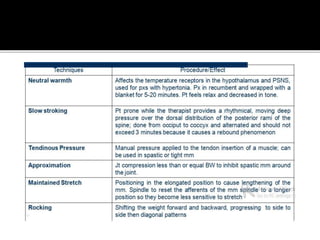
 Defn : presure on bony prominence to
facilitate or inhibit voluntary muscles.
E.g.
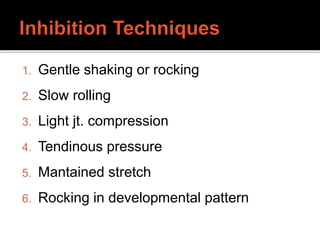
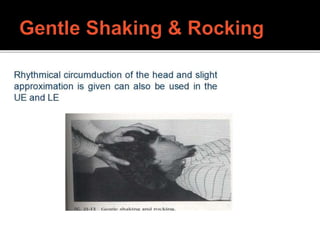
1. Gentle shaking or rocking
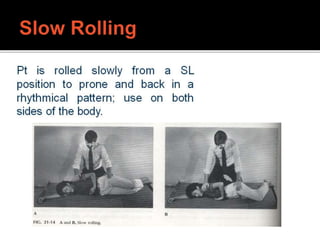
2. Slow rolling
3. Light jt. compression
4. Tendinous pressure
5. Mantained stretch
6. Rocking in developmental pattern
1. Concise Exercise Therapy : A comprehensive TB for
physical & occupational thearapist by Roshan Mecna
2. Therapeutic Approaches in Neurorehabilitation by
Gajanan Bhalerao
3. Manual Therapy Approaches in neurophysiotherapy
by S. S. Ganvir
4. International Occupational therapy (Sixth edition)m by
Pedretti S.

Roods approach

  • 1.
    Dr. Maheshwari Harishchandre AssistantProfessor M.P.Th (Neurosciences) DVVPF College of Physiotherapy, Ahmednagar
  • 2.
     Introduction  Principles Rules of sensory input  Sequence of Motor Development  Ontogenic Motor Pattern  Facilitation Technique  Inhibition Technique
  • 3.
     Margared Rood(1976)  PT & OT  CP & patients with motor control problems.
  • 4.
    1. Controlled useof sensory stimulus. a. Specific Motor response b. Normalization of muscle tone 2. Use of Developmental sequences. a. Sensorimotor development = from lower to higher level. 3. Use of activity to demand a purposeful response. 4. Practice of sensory motor response is necessary for motor learning.
  • 5.
    1. A fastbrief stimulus produces a large synchronous motor output. Use : stimulus confirms the reflex are functioning. 2. A fast repetitive sensory input produces a mantained response. 3. A mantained sensory input produces a mantained response. e.g. Gravity, positions 4. Slow, rhythmical, repetitive sensory input deactivates body & mind. e.g. Slow rocking or soft music.
  • 6.
    1. Reciprocal Inhibition/Innervation:  Early mobility pattern protective in nature.  Phasic & reciprocal type of movement.  Contraction of agonist & relaxation of antagonist. 2. Co- contraction :  Tonic (static ) pattern  Simultaneous agonist & antagonist contraction.
  • 7.
    3. Heavy Work:  Controlled mobility pattern  Stock meyer “mobility superimposed on stability”  Proximal ms. contract & move & the distal segment is fixed.  E.g. Creeping 4. Skill :  Highest level of motor control  Combined Pattern  Proximal segments are stabilized , distal segments moves freely. E.g. Typing.
  • 9.
    1. Supine withdrawl(Flexion) :  Total flexion response towards vertebral level T10  Requires reciprocal innervation with heavy work of proximal segments.  Recommended : a. patients with no reciprocal flexion b. patients dominated by extensor tone
  • 10.
    2. Roll Overtowards side lying :  Mobility pattern for extremities & lateral trunk muscles  Recommended : a. Patients dominated by tonic reflex patterns in supine b. Stimulates semicircular canals which activates the neck & extraocular muscles.
  • 11.
    3. Pivot Prone:  Combined Pattern  Demands full range of extension of neck, shoulders, trunk & lower extremities.  Position difficult to assume & mantain  Important role in preparation for stability of extensor muscles in upright position  Associated with labyrinthine righting reaction of the head  Integration : STNR & TLRs.
  • 12.
    4. Neck Contraction:  Real stability pattern  Activates both flexors & deep tonic extensors  Elicits the tonic labyrinthine righting reaction reaction when the face is perpendicular to the floor .  Recommended:  Patients needs neck stability & extraocular control.
  • 13.
    5. Prone onElbows :  Stretches the upper trunk musculature  Influence stability scapular & glenohumeral regions  Gives better visibility of the environment  Allows weight shifting from side to side.  Recommended :
  • 14.
    6. Quadruped Position:  Lower trunk & LE are in cocontraction.  Can do weight shifts in forward/backward, side to side & diagonal directions.  Mobility superimposed on the stability  Prepares equilibrium responses.
  • 15.
    7. Standing : Wt. Is equally distributed on both legs after that wt. Shifting begins.  UE are free to perform functions.  Integration : righting reaction & equilibrium reactions.
  • 16.
    8. Walking : Sophisticated process requiring coordinated movt. Patterns of various parts of body.  “support the body weight, mantain balance, & execute the stepping motion “ – Murray
  • 18.
  • 19.
  • 20.
    Stimulation of exteroceptors Causes protective withdrawlresponses Produces states of alertness & rapid movt’s of the limbs.
  • 21.
     Touch isimp. for normal growth & development ( Montague A, 1978)  Mechanism 1. Mediated by A delta sensory fibers 2. Stimulates A delta sensory fibers synapses with fusimotor system reciprocal innervation ( phasic withdrawl response)
  • 22.
     Effects : 1.Activates low threshold hair end organ & free nerve endings. 2. Activates sup. mobilizing muscles, 3. Increases corticosteroid levels in the blood stream. 4. Increases resistance against disease. 5. Improves fluid & electrolyte balance.
  • 23.
    Application Frequency AreaResponse Finger tips, camel hair brush or cotton swab. 3-5 strokes, 30 sec. Rest period between stroke From the nose to chin Flexion of UE & perhaps LE Light stroking from corner of lip to the cheek Activates neck ms. & head tilts laterally towards the side of the stimulus. Light moving touch to the navel or dermatome T10 in midline to lateral dirn Activates unilateral flexion pattern To the dorsal web spaces of the fingers & toes Activates a withdrawl pattrn of the extremities To the tips of the fingers or soles of the feet Facilitates a tickle withdrawl response of great magnitude
  • 24.
    Stimulus Mediated byProcedure effect Fast brushing C fibers By battery operated brush is applied over the dermatomes of the same segment that supplies the ms.(myotome) to be facilitated. Eg. Is applied for 3 to 5 seconds & repeated after 30 sec. Lasts for 30 minutes, stimulates C fibers which sends many collaterals in the RAS.
  • 26.
     Extreme thermalfacilitation  Facilitation of ms activity & ANS responses.  Uses : 1. Quick icing – hypotonia (3 swipes, blott water after each swipe) 2. Pressing ice cubes to the skin of dermatome corresponding to myotome to be stimulated. 3. Ice to stimulate SNS & glandular output of thyroid & adrenal glands. Note : cardiac problems.
  • 30.
     Jt. givescontrol over the motor response.  Proprioceptors adapt more slowly than exteroceptors & can produce sustained postural patterns.
  • 31.
     Defn :Jt. Compression > body wt. applied through the longitudinal axis of the bone.(Ager J, 1974)  Causes : 1. cocontraction around jt under compression 2. Combined with ontogenetic patterns s/a prone on elbows, quadruped, sitting & standing position.  Can be applied manually or by weighted cuffs or sand bags.
  • 36.
     It actson muscle spindle (afferent) & increases the tone of underlying skeletal muscles.  Tapping over the belly of muscles with fingertips  3-5 times over the muscle to be facilitated.
  • 37.
     Powerful propriocetiveinput (De Quiros JB)  Therapeutic Uses : 1. To promote extensor patterns of the neck, trunk & extremities (Static labyrinthine system) 2. To elicit subcortical responses, s/a protective extension
  • 38.
    3.To activate antigravitymuscles & their antagonist 4.Fast stimulation s/a rocking stimulates while rhythmic slow rocking causes relaxation 5.Vestibular stimulation affects tone, balance, protective responses, bilateral integration & auditory language development.
  • 39.
     Frequency : High Frequency : 100 to 300 cycles/second  Low frequency : 50 to 60 cycles/second  Uses : 1. HF is used to elicit tonic vibration reflex which stimulates contraction of muscle if applied directly over the belly. 2. Inhibits contraction of antagonist ms. & suppress stretch reflex. 3. LF vibration suppress pain perception, desensitize hypersensitive skin.
  • 41.
     Defn :presure on bony prominence to facilitate or inhibit voluntary muscles. E.g.
  • 42.
    1. Gentle shakingor rocking 2. Slow rolling 3. Light jt. compression 4. Tendinous pressure 5. Mantained stretch 6. Rocking in developmental pattern
  • 46.
    1. Concise ExerciseTherapy : A comprehensive TB for physical & occupational thearapist by Roshan Mecna 2. Therapeutic Approaches in Neurorehabilitation by Gajanan Bhalerao 3. Manual Therapy Approaches in neurophysiotherapy by S. S. Ganvir 4. International Occupational therapy (Sixth edition)m by Pedretti S.