Practical
Guidelines in
Stroke Rehab
Dr. Varsha Soni(PT)
Neurorehab Incharge
Pacific Centre of
Neurosciences
Key Points
• NeuroRehab Team
• Role of Rehab
• Recovery
• Acute / ICU Management
• Subacute /Ward Management
• Chronic /OPD Management
• Support Group
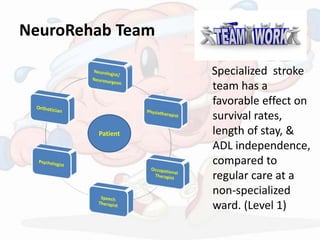
NeuroRehab Team
Specialized stroke
team has a
favorable effect on
survival rates,
length of stay, &
ADL independence,
compared to
regular care at a
non-specialized
ward. (Level 1)
Patient
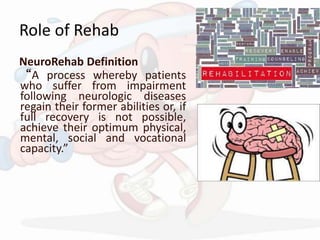
Role of Rehab
NeuroRehab Definition
“A process whereby patients
who suffer from impairment
following neurologic diseases
regain their former abilities or, if
full recovery is not possible,
achieve their optimum physical,
mental, social and vocational
capacity.”
Recovery
• Neurological recovery
– Early recovery (Local Processes)
– Late recovery (Neuroplasticity)
modification in structural and functional
organization
• Functional recovery
– Recovery in everyday function with adaptation
and training in presence/ absence of natural
neurologic recovery
– Dependent on quality ,intensity of therapy &
patient’s motivation
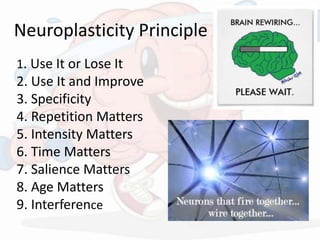
Neuroplasticity Principle
1. Use It or Lose It
2. Use It and Improve
3. Specificity
4. Repetition Matters
5. Intensity Matters
6. Time Matters
7. Salience Matters
8. Age Matters
9. Interference
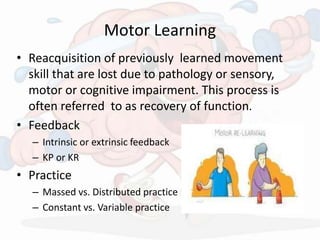
Motor Learning
• Reacquisition of previously learned movement
skill that are lost due to pathology or sensory,
motor or cognitive impairment. This process is
often referred to as recovery of function.
• Feedback
– Intrinsic or extrinsic feedback
– KP or KR
• Practice
– Massed vs. Distributed practice
– Constant vs. Variable practice
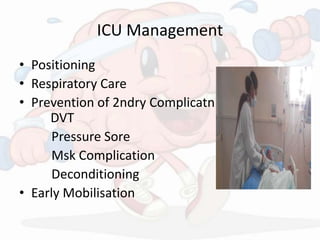
ICU Management
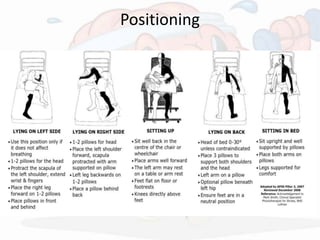
• Positioning
• Respiratory Care
• Prevention of 2ndry Complicatn
DVT
Pressure Sore
Msk Complication
Deconditioning
• Early Mobilisation
Positioning
Early Mobilisation
• If condition stable – To start active mobilisation
within 24-48 hours
• Physiologically sound changes in bed position & ROM
exercise.
• Specific tasks ( sitting up, turning from side to side )
& Self care activities ( feeding, grooming, dressing )
• Tolerance for therapy affected by stroke severity,
medical stability, mental status, cardiac instability &
level of Consciousness.
Conti..
• Early mobilisation reduces complications and
enhances functional recovery (Level 1)
• Strong positive psychological benefit
• It remains unclear whether early mobilization
from the bed, i.e. within 24 hours after the
stroke, is more effective than later mobilization as
regards complications, neurological deterioration,
fatigue, basic ADL activities and discharge home.
(Level 1)
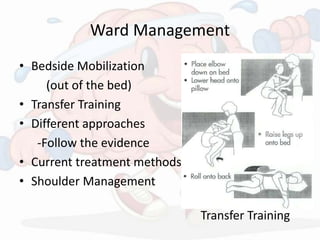
Ward Management
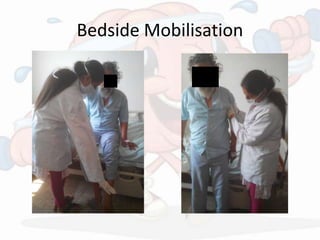
• Bedside Mobilization
(out of the bed)
• Transfer Training
• Different approaches
-Follow the evidence
• Current treatment methods
• Shoulder Management
Transfer Training
Bedside Mobilisation
Different Approaches
• Neurodevelopment Approach/ Bobath Therapy
• Rood’s Approach
• Brunnstorm Approach
• Proprioceptive Neuromuscular Facilitation
• Motor Relearning Program
• No single therapy was superior than other. Mixed
therapy was better than no treatment or
placebo for improving physical function.
(Cochrane Review, Pollock et al).
Current Treatment Methods
• CIMT [Level 1]
• Bimanual Training[ Level 2]
• Mirror Therapy [LEVEL 2]
• Mental Imagery [Level 3]
• NMES/ FES [Level 2]
• EMG- Biofeedback [Level 3]
• Virtual Reality [Level 2]
• BWSTT [Level 2]
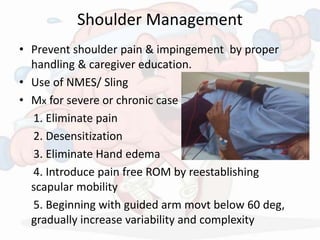
Shoulder Management
• Prevent shoulder pain & impingement by proper
handling & caregiver education.
• Use of NMES/ Sling
• Mx for severe or chronic case
1. Eliminate pain
2. Desensitization
3. Eliminate Hand edema
4. Introduce pain free ROM by reestablishing
scapular mobility
5. Beginning with guided arm movt below 60 deg,
gradually increase variability and complexity
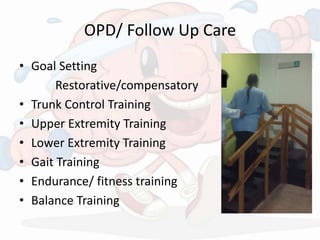
OPD/ Follow Up Care
• Goal Setting
Restorative/compensatory
• Trunk Control Training
• Upper Extremity Training
• Lower Extremity Training
• Gait Training
• Endurance/ fitness training
• Balance Training
Predictive Prognosis
• Most improvements in ADLs occurs during the 1st
6 months- up to 5% of pts may show
improvement even at 12 months post- stroke
• But recovery could take 2 years or more
• Prognosis in patients with mild or moderate
stroke is usually excellent
Improving Trunk Control
• Trunk forms a foundation for any posture &
movement.
• Post hemi - loss of selective muscle activity in
trunk & tone - Compensatory movement is seen
• Rx focus on
-Trunk rotation, side flexion [all cardinal plane]
-Combination of movement
-Balance reaction[Anticipatory & Reactive]
-Functional Activity
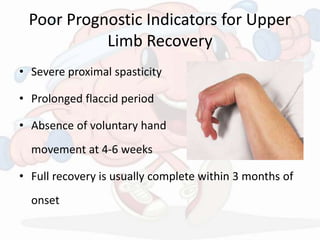
Poor Prognostic Indicators for Upper
Limb Recovery
• Severe proximal spasticity
• Prolonged flaccid period
• Absence of voluntary hand
movement at 4-6 weeks
• Full recovery is usually complete within 3 months of
onset
Improve UE Function
• Relearning of movt pattern & retraining of missing
component
• Upper body initiated wt shift pattern[reaching &
picking object]
• UL weight bearing & Dynamic stabilization exercise
• Functional movement & Combination movt
• Power production - Throwing
• Fine motor function- Object Manipulation
• Spastic Hand Rehab- Botox
• Adjuncts – Orthoses, CIMT, BF, NMES, VR, Robotics
Improve LE function
• Strengthening muscles in appropriate pattern
& Functional pattern.
• Training for posterior weight shift, Anterior
weight shift & Lateral weight shift (sitting).
• Co-ordinated combination movement
• Power production [Kicking]
• Cycling & treadmill training
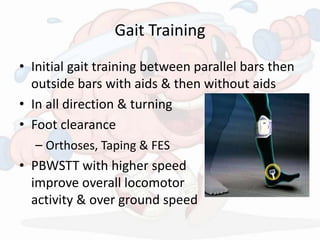
Gait Training
• Initial gait training between parallel bars then
outside bars with aids & then without aids
• In all direction & turning
• Foot clearance
– Orthoses, Taping & FES
• PBWSTT with higher speed
improve overall locomotor
activity & over ground speed
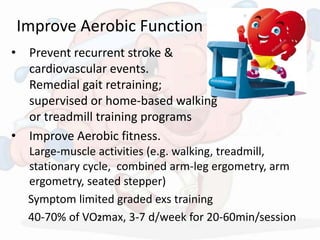
Improve Aerobic Function
• Prevent recurrent stroke &
cardiovascular events.
Remedial gait retraining;
supervised or home-based walking
or treadmill training programs
• Improve Aerobic fitness.
Large-muscle activities (e.g. walking, treadmill,
stationary cycle, combined arm-leg ergometry, arm
ergometry, seated stepper)
Symptom limited graded exs training
40-70% of VO2max, 3-7 d/week for 20-60min/session
Balance Training
• Facilitate symmetrical wt bearing on both side
• Anticipatory and Reactive postural strategy
training in different plane
• Dual task training s/a kicking ball in standing,
throwing activities, carrying an object while
walking, cognitive task
• Single limb stance and walking on unstable
surface
• Ball Exercise
Support Group
• www.ssgu.org
• www.strokeindia.org
• www.strokeassociation.org
• www.stroke.org
References
• KNGF Guidelines for Stroke 2014.
• Physical Activity and Exercise Recommendations for
Stroke Survivors. American Heart
Association/American Stroke Association, 2014.
• Cochrane Database
• O’ Sullivan SB, Schmitz TJ. Stroke. Physical
rehabilitation. 5th ed., 2007.
• Darcy A. Umphred. Neurological Rehabilitation, 6th
ed., 2012.
• Right in the Middle: Patricia Davis
Take home message
• Team Approach
• Evidence Based Practice
• Early Mobilisation
• SMART Goal
• Different approach’s & Treatment adjuncts
• Aerobic Training
• Neuroplasticity & Motor learning principle
Practical Guidelines in Stroke Rehabilitation

Practical Guidelines in Stroke Rehabilitation

  • 1.
    Practical Guidelines in Stroke Rehab Dr.Varsha Soni(PT) Neurorehab Incharge Pacific Centre of Neurosciences
  • 2.
    Key Points • NeuroRehabTeam • Role of Rehab • Recovery • Acute / ICU Management • Subacute /Ward Management • Chronic /OPD Management • Support Group
  • 3.
    NeuroRehab Team Specialized stroke teamhas a favorable effect on survival rates, length of stay, & ADL independence, compared to regular care at a non-specialized ward. (Level 1) Patient
  • 4.
    Role of Rehab NeuroRehabDefinition “A process whereby patients who suffer from impairment following neurologic diseases regain their former abilities or, if full recovery is not possible, achieve their optimum physical, mental, social and vocational capacity.”
  • 5.
    Recovery • Neurological recovery –Early recovery (Local Processes) – Late recovery (Neuroplasticity) modification in structural and functional organization • Functional recovery – Recovery in everyday function with adaptation and training in presence/ absence of natural neurologic recovery – Dependent on quality ,intensity of therapy & patient’s motivation
  • 6.
    Neuroplasticity Principle 1. UseIt or Lose It 2. Use It and Improve 3. Specificity 4. Repetition Matters 5. Intensity Matters 6. Time Matters 7. Salience Matters 8. Age Matters 9. Interference
  • 7.
    Motor Learning • Reacquisitionof previously learned movement skill that are lost due to pathology or sensory, motor or cognitive impairment. This process is often referred to as recovery of function. • Feedback – Intrinsic or extrinsic feedback – KP or KR • Practice – Massed vs. Distributed practice – Constant vs. Variable practice
  • 8.
    ICU Management • Positioning •Respiratory Care • Prevention of 2ndry Complicatn DVT Pressure Sore Msk Complication Deconditioning • Early Mobilisation
  • 9.
  • 10.
    Early Mobilisation • Ifcondition stable – To start active mobilisation within 24-48 hours • Physiologically sound changes in bed position & ROM exercise. • Specific tasks ( sitting up, turning from side to side ) & Self care activities ( feeding, grooming, dressing ) • Tolerance for therapy affected by stroke severity, medical stability, mental status, cardiac instability & level of Consciousness.
  • 11.
    Conti.. • Early mobilisationreduces complications and enhances functional recovery (Level 1) • Strong positive psychological benefit • It remains unclear whether early mobilization from the bed, i.e. within 24 hours after the stroke, is more effective than later mobilization as regards complications, neurological deterioration, fatigue, basic ADL activities and discharge home. (Level 1)
  • 12.
    Ward Management • BedsideMobilization (out of the bed) • Transfer Training • Different approaches -Follow the evidence • Current treatment methods • Shoulder Management Transfer Training
  • 13.
  • 14.
    Different Approaches • NeurodevelopmentApproach/ Bobath Therapy • Rood’s Approach • Brunnstorm Approach • Proprioceptive Neuromuscular Facilitation • Motor Relearning Program • No single therapy was superior than other. Mixed therapy was better than no treatment or placebo for improving physical function. (Cochrane Review, Pollock et al).
  • 15.
    Current Treatment Methods •CIMT [Level 1] • Bimanual Training[ Level 2] • Mirror Therapy [LEVEL 2] • Mental Imagery [Level 3] • NMES/ FES [Level 2] • EMG- Biofeedback [Level 3] • Virtual Reality [Level 2] • BWSTT [Level 2]
  • 16.
    Shoulder Management • Preventshoulder pain & impingement by proper handling & caregiver education. • Use of NMES/ Sling • Mx for severe or chronic case 1. Eliminate pain 2. Desensitization 3. Eliminate Hand edema 4. Introduce pain free ROM by reestablishing scapular mobility 5. Beginning with guided arm movt below 60 deg, gradually increase variability and complexity
  • 17.
    OPD/ Follow UpCare • Goal Setting Restorative/compensatory • Trunk Control Training • Upper Extremity Training • Lower Extremity Training • Gait Training • Endurance/ fitness training • Balance Training
  • 18.
    Predictive Prognosis • Mostimprovements in ADLs occurs during the 1st 6 months- up to 5% of pts may show improvement even at 12 months post- stroke • But recovery could take 2 years or more • Prognosis in patients with mild or moderate stroke is usually excellent
  • 19.
    Improving Trunk Control •Trunk forms a foundation for any posture & movement. • Post hemi - loss of selective muscle activity in trunk & tone - Compensatory movement is seen • Rx focus on -Trunk rotation, side flexion [all cardinal plane] -Combination of movement -Balance reaction[Anticipatory & Reactive] -Functional Activity
  • 20.
    Poor Prognostic Indicatorsfor Upper Limb Recovery • Severe proximal spasticity • Prolonged flaccid period • Absence of voluntary hand movement at 4-6 weeks • Full recovery is usually complete within 3 months of onset
  • 21.
    Improve UE Function •Relearning of movt pattern & retraining of missing component • Upper body initiated wt shift pattern[reaching & picking object] • UL weight bearing & Dynamic stabilization exercise • Functional movement & Combination movt • Power production - Throwing • Fine motor function- Object Manipulation • Spastic Hand Rehab- Botox • Adjuncts – Orthoses, CIMT, BF, NMES, VR, Robotics
  • 22.
    Improve LE function •Strengthening muscles in appropriate pattern & Functional pattern. • Training for posterior weight shift, Anterior weight shift & Lateral weight shift (sitting). • Co-ordinated combination movement • Power production [Kicking] • Cycling & treadmill training
  • 23.
    Gait Training • Initialgait training between parallel bars then outside bars with aids & then without aids • In all direction & turning • Foot clearance – Orthoses, Taping & FES • PBWSTT with higher speed improve overall locomotor activity & over ground speed
  • 24.
    Improve Aerobic Function •Prevent recurrent stroke & cardiovascular events. Remedial gait retraining; supervised or home-based walking or treadmill training programs • Improve Aerobic fitness. Large-muscle activities (e.g. walking, treadmill, stationary cycle, combined arm-leg ergometry, arm ergometry, seated stepper) Symptom limited graded exs training 40-70% of VO2max, 3-7 d/week for 20-60min/session
  • 25.
    Balance Training • Facilitatesymmetrical wt bearing on both side • Anticipatory and Reactive postural strategy training in different plane • Dual task training s/a kicking ball in standing, throwing activities, carrying an object while walking, cognitive task • Single limb stance and walking on unstable surface • Ball Exercise
  • 26.
    Support Group • www.ssgu.org •www.strokeindia.org • www.strokeassociation.org • www.stroke.org
  • 27.
    References • KNGF Guidelinesfor Stroke 2014. • Physical Activity and Exercise Recommendations for Stroke Survivors. American Heart Association/American Stroke Association, 2014. • Cochrane Database • O’ Sullivan SB, Schmitz TJ. Stroke. Physical rehabilitation. 5th ed., 2007. • Darcy A. Umphred. Neurological Rehabilitation, 6th ed., 2012. • Right in the Middle: Patricia Davis
  • 28.
    Take home message •Team Approach • Evidence Based Practice • Early Mobilisation • SMART Goal • Different approach’s & Treatment adjuncts • Aerobic Training • Neuroplasticity & Motor learning principle