+`
POST CVA REHABILITATION
Presented By Supervisor
Maj Syeda Nafeesa Mumtaz Maj Muhammad Ikram
RN,RM,Rehab Nurse Rehab Medical Specialist
OJT in occupational therapy(uk) HoD Rehab Deptt CMH Nowshera
CONTENTS
 Aim
 Case Presentation
 Case Discussion
 Definition
 Epidemiology
 Types of stroke
 Risk factors
 Signs and symptoms
 Blood supply
 Rehabilitation
 Nursing management
 Conclusion
AIM
To emphasize on early Rehabilitation
not only to save life BUT
To improve both quantity and quality of
life of patient.
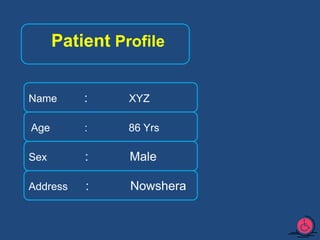
Patient Profile
Name : XYZ
Age : 86 Yrs
Sex : Male
Address : Nowshera
Presenting Complaints
*pictures are displayed with patient's permission*
Difficulty in walk
Weakness Rt half of
body
Slurring Of speech
History of present illness
History
8
Dependence
ADLS
Bladder/Bowel
care
Transfers
Mobility
Ambulation
Functional History
PAST HISTORY
DM IHD
HTN CVA
Family History
Vocational History
Retired Audit Officer In karachi
No history of
Diabetes
Hypertension
Stroke
Personal History
Married
Has three children
Non smoker non addict
Graduate
Socioeconomic History
Belongs to a well established family
Resident of Karachi
Easy road access
Nearby hospital facilities
Examination
14
 Vitals
 Pulse : 78/min Regular
 B.P : 168/85mmHg
 R.R : 16/min
 Temp : 98.4
o
F
 Jaundice
 Pallor
 Cyanosis
 Clubbing
 lymphadenopathy
Not present
General Physical Examination
EXAMINATION (cont…)
Chest
CVS
Abdomen
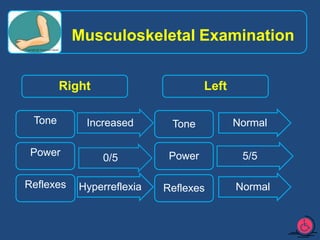
NormalTone
0/5
Normal
Increased Tone
5/5Power
Hyperreflexia Reflexes
Right Left
Reflexes
Power
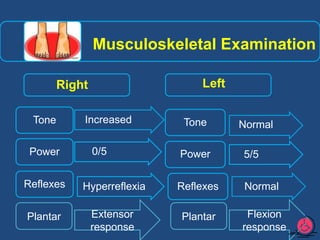
Musculoskeletal Examination
NormalTone
5/5Power
NormalReflexes
Increased Tone
0/5 Power
Hyperreflexia Reflexes
Right Left
Plantar Flexion
response
PlantarExtensor
response
Investigations
 CP/ESR
 RFT,s
 LFT,s
 PT PTTK
 Xray chest
 CT scan Brain
CTCT Scan
Medical Diagnosis
Ischemic stroke Lt ,
hemiplegia Rt
Rt Hemiparesis
Potential for
Thromboembolism
Medical
Problems
Self care dependent
Ambulation dependent
Transfer skill dependent
Physical
Problems
Health Issues
Psychological
Problems
Anxiety
 Patient and family education.
 Prevention of secondary medical complications.
 Independence in ADLs ,mobility and ambulation.
 Bladder management
 Psychotherapy
 Physiotherapy
 Occupational therapy
Goals
Management Plan
Positioning
Physical
therapy
Gait training
Occupational
Therapy
Speech
Therapy
Psycho
therapy
ADL’s
Training
Posture And Positioning
Physical Therapy
Physiological
standing
Electrical muscle
stimulation @100
contractions x BD
*
Therapeutic Exercises
Therapeutic Exercises (cntd………..)
Occupational Therapy
Parallel bar training
Ankle foot orthosis
Knee immobilizer
Co ordination exercises
Standing balance
Gait Training
Pharmacotherapy
Tab Lipiget 1xHS
Tab Eziday 50mg 1/ 2xOD
Tab Qalsan D 1xOD
Tab Ibert folic 1x OD
Orthotic Devices
Ankle Foot Orthosis (AFO)
Knee Immobilizer
Wrist Hand Orthosis
(WHO)
Outcome After
Rehabilitation
Independent
sitting
balance and
walk with
support
achieved on
34 th day
Case Discussion
REHABILITATION
Derived from the Latin word
‘Habilitas’ which means ‘to make
able’
The first department of physical
medicine established at Mayo
clinic in 1936
STROKE
A stroke is caused by the interruption of the
blood supply to the brain, usually because
of
a. Rupture of blood vessel
b. Blockage by blood clot
Types Of Stroke
 Ischemic stroke  Hemorrhagic stroke
 Ischemic
Hemorrhagic
TYPES OF STROKE
Epidemiology
Third leading
cause of death
in U.S.
Leading cause
of severe
disability in
U.S.
One-third to
one-half have
disability
Most common
reason for
rehabilitation
Signs And Symptoms
The five warning signs of stroke are ;
1. Sudden weakness on one side of the body
involving the face , arm or leg.
2. Dizziness , loss of balance or coordination.
3. Sudden severe unexplained headache.
4. Sudden confusion and difficulty in
understanding or speaking.
5. Visual impairment of one or both eyes.
Risk Factors
Modifiable
 Hypertension
 Diabetes
 Smoking
 Hyperlipidemia
 Other cardiac disease
 Obesity
 Life style
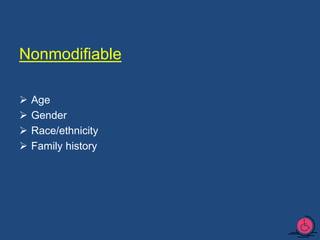
Nonmodifiable
 Age
 Gender
 Race/ethnicity
 Family history
Effect of a Stroke
 Weakness on the side of the body opposite the site of
the brain affected by the stroke
 Spasticity
 Balance and/or coordination
Aphasia Or dysarthria
 bodily neglect or inattention
 Pain, numbness or odd sensations
(Contd……)
 Problems with memory, thinking, attention or learning
 Being unaware of the effects of a stroke
 Trouble swallowing (dysphagia)
 Problems with bowel or bladder control
 Difficulty controlling emotions (emotional lability)
 Depression
 Difficulties with daily activities
Stable neurological status
Significant persisting neurological deficit
Sufficient cognitive function to learn
Sufficient communicative ability to interact
with the therapist
Admission Criteria For Rehabilitation
Rehabilitation Goal
To restore lost abilities as much as possible.
To prevent stroke-related complications.
To improve the patient's quality of life.
Promote re-integration into family, home,
work, leisure and community activities.
Successful Rehabilitation
Depends on
 how early rehabilitation begins
 the extent of the brain injury
 the survivor’s attitude
 the rehabilitation team’s skill
 the cooperation of family and caregiver
LEVEL OF STROKE REHABILITATION
Day rehabilitation
Outpatient therapy
Home therapy
Intpatient rehabilitation
Multidisciplinary Team
PATIENT
PSYCHOLOGIST
PHYSIATRIST
OCCUPATIONAL
THERAPIST
NURSE
DIETICIAN
SOCIAL
WORKER
PHYSICAL
THERPIST
General Nursing Care of Stroke
 Nutrition
 Dysphagia Screening
to prevent risk of aspiration pneumonia
and determine feeding mobility
 Early mobility
to prevent DVT, pulmonary emboli
 Bowel and bladder care –
best to avoid urinary catheter insertion
but if necessary remove as soon as possible
 Falls prevention
 Skin care
 Positioning
 Body alignment
General Nursing Care of Stroke
(Contd…..)
Occurs when body alignment is not maintained
or when the patient’s position is not changed
often enough
 Pressure ulcer (bedsores) result when unrelieved
pressure on a bony prominence interferes with
blood flow to the area
 Contractures occurs when a joint is allowed to
remain in the same position for too long
Complications
Emergency Nursing Interventions In The
Hyperacute Phase Of Stroke:
The First 24 Hours
 Stroke symptoms can evolve over minutes
to hours.
 Nurses should be aware of unusual stroke
presentations.
 Assessments include:
Neurological assessment, vital signs ,
temperature, and should be done not less
than every 30 minutes.
Stroke Prevention
 Stop smoking
 Exercise regularly
 Improve eating habits
 Take medication as
prescribed
 Reduce stress level
 Maintain a healthy
weight
 Get regular medical
check-ups
Goal of Rehabilitation Nursing
“Goal of rehabilitation nursing is to assist the
patient to attain and to maintain optimum
health as it is defined by the patient.”
(Hoeman, 2002)
 Promote maximum functional ability
 Optimal health
 Adaptation to an altered lifestyle
Areas Of Concern
 ACTIVITY OF DAILY LIVINGS (ADL,S)
 MOBILITY
 COMMUNICATION
Activity of daily living
SELF CARE
1.Feeding
2.Grooming
3.Toilet use
4.Bathing
5.Dressing
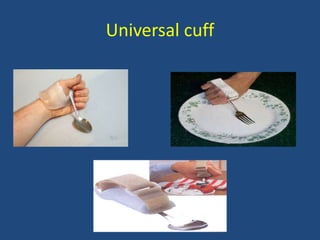
Adapt or specially design device
Universal cuff
Adapted Feeding Spoons
Modified utensils
Modified Grooming Aids
(Contd……. )
( Contd…… )
Modified Plug
Modified key holder
BATH AND TOILET MODIFICATION
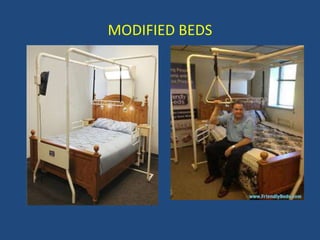
Transfer Aids And Techniques
MODIFIED BEDS
MOBILITY AIDS
SHOULDER SUPPORTS
ASSISTIVE DEVICES
(WHO)
Poor Prognostic Factors
Advanced age
Recurrent stroke
Medical or surgical instability
Severe memory problems
Impaired cognition
Prognosis
 The prognosis of a stroke patient depends on the
severity of brain tissue damage.
 Recovery from stroke is generally fastest in the first
weeks after onset, with measureable neurological and
functional recovery occurring in the first month after
stroke.
Conclusion
 Early referral to rehabilitation unit
benefits the patient to improve his/her
ADLs and motor function.
 Complete recovery is not always
possible, however, living an enjoyable life
is still within reach.
Stroke  ppt by syeda  nafeesa mumtaz

Stroke ppt by syeda nafeesa mumtaz