Introduction
about
International Classification of
Functioning, Disability and
Health
Suvarna Ganvir
Professor
DVVPF’s College of Physiotherapy,
Ahmednagar
Contents
• Why ICF
• Application of ICF
• Definition of terms used in ICF along with
examples
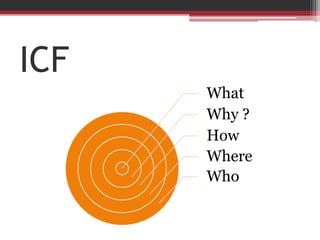
ICF
What
Why ?
How
Where
Who
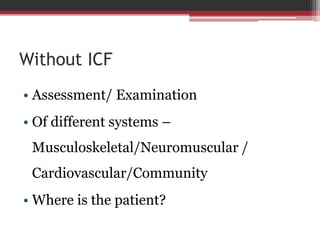
Without ICF
• Assessment/ Examination
• Of different systems –
Musculoskeletal/Neuromuscular /
Cardiovascular/Community
• Where is the patient?
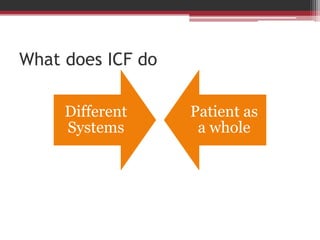
What does ICF do
Different
Systems
Patient as
a whole
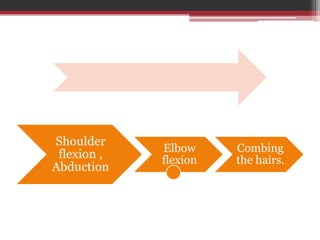
Shoulder
flexion ,
Abduction
Elbow
flexion
Combing
the hairs.
What is ICF?
• WHO framework for measuring health and
disability at both individual and population
levels.
• Provides a standard language and framework for
the description of health and health-related
states.
• Disability is a complex phenomena that is both a
problem at the level of a person's body, and a
complex and primarily social phenomena.
• Shift in the focus from hospital-based acute care
to community-based long-term services for
chronic conditions.
• Diagnosis alone does not predict service needs,
length of hospitalization, level of care or
functional outcomes.
• Hence other aspects needs to be considered.
• The units of ICF classification are categories
within health and health-related domains.
• The ICF classifies physiological (including
psychological) functions, anatomical structures,
actions, tasks, areas of life, and external
influences.
• ICF provides a framework for the description of
human functioning and disability and for the
documentation, organisation and analysis of this
information.
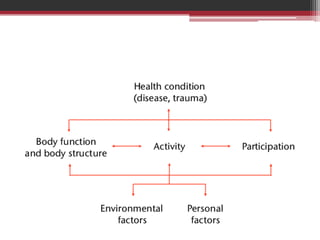
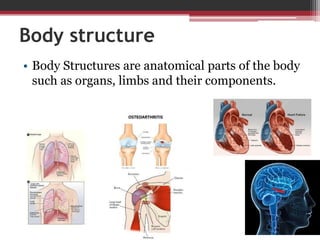
Body structure
• Body Structures are anatomical parts of the body
such as organs, limbs and their components.
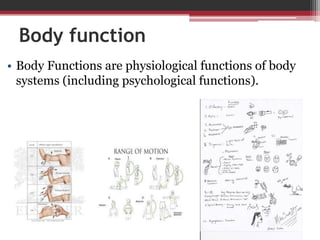
Body function
• Body Functions are physiological functions of body
systems (including psychological functions).
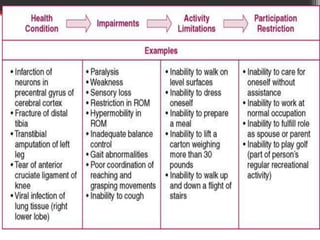
• Impairments are problems in body function or
structure such as a significant deviation or loss.
• Impairments of structure – anomaly, defect, loss
or significant deviation
• Impairments of function – deviation form
physiological function of the body.
• Impairments –
• Temporary or permanent, progressive,
regressive or static, intermittent or continuous.
• Cause of impairment itsself may not explain the
extent of impairment in certain situations.
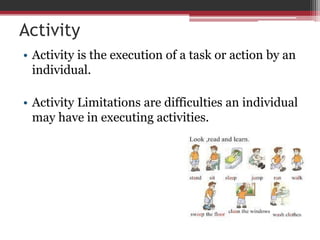
Activity
• Activity is the execution of a task or action by an
individual.
• Activity Limitations are difficulties an individual
may have in executing activities.
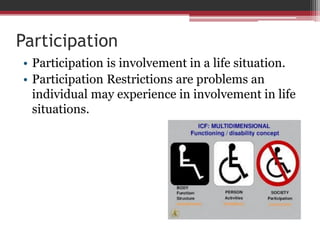
Participation
• Participation is involvement in a life situation.
• Participation Restrictions are problems an
individual may experience in involvement in life
situations.
Contextual factors
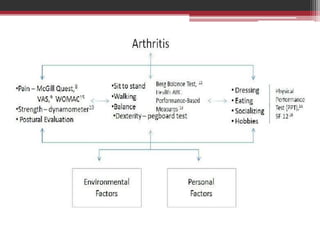
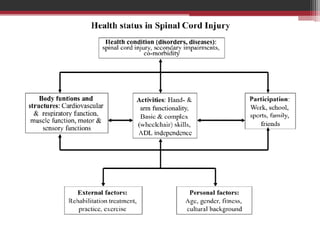
• Environmental Factors make up the physical,
social and attitudinal environment in which people
live and conduct their lives.
• Personal factors – individual characteristics that
may not be a direct part of the disease process.
• Environmental factors
• Individual – immediate environment : home ,
workplace and school.
• Societal – formal and informal societal
structures, health system approaches, health
systems in the community.
•Thank you!!
•suvarna.ganvir@gmail.com

Introduction about ICF

  • 1.
    Introduction about International Classification of Functioning,Disability and Health Suvarna Ganvir Professor DVVPF’s College of Physiotherapy, Ahmednagar
  • 2.
    Contents • Why ICF •Application of ICF • Definition of terms used in ICF along with examples
  • 3.
  • 4.
    Without ICF • Assessment/Examination • Of different systems – Musculoskeletal/Neuromuscular / Cardiovascular/Community • Where is the patient?
  • 5.
    What does ICFdo Different Systems Patient as a whole
  • 6.
  • 7.
    What is ICF? •WHO framework for measuring health and disability at both individual and population levels. • Provides a standard language and framework for the description of health and health-related states.
  • 8.
    • Disability isa complex phenomena that is both a problem at the level of a person's body, and a complex and primarily social phenomena. • Shift in the focus from hospital-based acute care to community-based long-term services for chronic conditions.
  • 9.
    • Diagnosis alonedoes not predict service needs, length of hospitalization, level of care or functional outcomes. • Hence other aspects needs to be considered.
  • 10.
    • The unitsof ICF classification are categories within health and health-related domains. • The ICF classifies physiological (including psychological) functions, anatomical structures, actions, tasks, areas of life, and external influences.
  • 11.
    • ICF providesa framework for the description of human functioning and disability and for the documentation, organisation and analysis of this information.
  • 13.
    Body structure • BodyStructures are anatomical parts of the body such as organs, limbs and their components.
  • 14.
    Body function • BodyFunctions are physiological functions of body systems (including psychological functions).
  • 15.
    • Impairments areproblems in body function or structure such as a significant deviation or loss. • Impairments of structure – anomaly, defect, loss or significant deviation • Impairments of function – deviation form physiological function of the body.
  • 16.
    • Impairments – •Temporary or permanent, progressive, regressive or static, intermittent or continuous. • Cause of impairment itsself may not explain the extent of impairment in certain situations.
  • 17.
    Activity • Activity isthe execution of a task or action by an individual. • Activity Limitations are difficulties an individual may have in executing activities.
  • 18.
    Participation • Participation isinvolvement in a life situation. • Participation Restrictions are problems an individual may experience in involvement in life situations.
  • 19.
    Contextual factors • EnvironmentalFactors make up the physical, social and attitudinal environment in which people live and conduct their lives. • Personal factors – individual characteristics that may not be a direct part of the disease process.
  • 20.
    • Environmental factors •Individual – immediate environment : home , workplace and school. • Societal – formal and informal societal structures, health system approaches, health systems in the community.
  • 25.