External FixationExternal Fixation
IndicationsIndications
and Techniquesand Techniques
ObjectivesObjectives
Identify the following as they pertain to
external fixation:
– Advantages & disadvantages
– Indications
– Types of frames
– Biomechanics stability
– Pre-operative planning
– Common complications
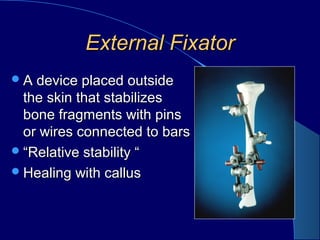
External FixatorExternal Fixator
A device placed outsideA device placed outside
the skin that stabilizesthe skin that stabilizes
bone fragments with pinsbone fragments with pins
or wires connected to barsor wires connected to bars
““Relative stability “Relative stability “
Healing with callusHealing with callus
External FixationExternal Fixation
AdvantagesAdvantages
Minimal damage to blood supplyMinimal damage to blood supply
Minimal damage to soft tissuesMinimal damage to soft tissues
Fixation is away from site of injuryFixation is away from site of injury
Good option when significant infection riskGood option when significant infection risk
External FixationExternal Fixation
DisadvantagesDisadvantages
Restricted joint motionRestricted joint motion
Pin tract infectionPin tract infection
CumbersomeCumbersome
Inadequate stability for certain fracturesInadequate stability for certain fractures
IndicationsIndications
Most commonly used:Most commonly used:
– TibiaTibia
– Distal radiusDistal radius
Less commonly used:Less commonly used:
– FemurFemur
– HumerusHumerus
– ForearmForearm
IndicationsIndications
Open fracturesOpen fractures
Closed fractures with soft tissueClosed fractures with soft tissue
compromisecompromise
Periarticular fracturesPeriarticular fractures
Polytrauma/Damage controlPolytrauma/Damage control
Pelvic fracturesPelvic fractures
Children’s fracturesChildren’s fractures
Open FracturesOpen Fractures
Avoids injury siteAvoids injury site
Avoids additional injuryAvoids additional injury
to soft tissues andto soft tissues and
vascularityvascularity
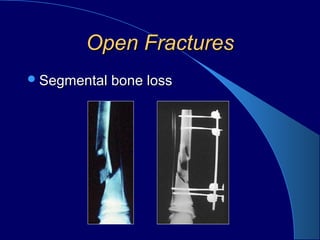
Open FracturesOpen Fractures
Segmental bone lossSegmental bone loss
Open FracturesOpen Fractures
Fractures needing nerve orFractures needing nerve or
vessel repairvessel repair
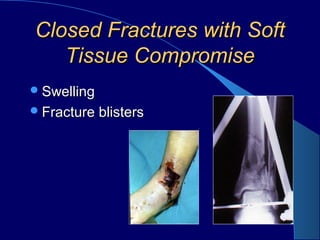
Closed Fractures with SoftClosed Fractures with Soft
Tissue CompromiseTissue Compromise
SwellingSwelling
Fracture blistersFracture blisters
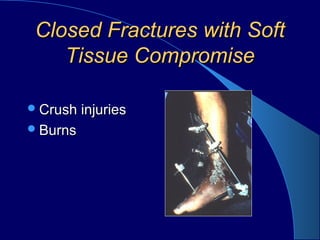
Closed Fractures with SoftClosed Fractures with Soft
Tissue CompromiseTissue Compromise
Crush injuriesCrush injuries
BurnsBurns
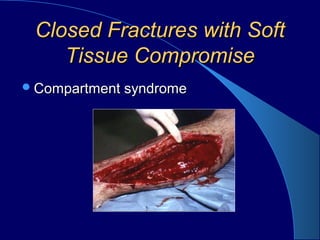
Closed Fractures with SoftClosed Fractures with Soft
Tissue CompromiseTissue Compromise
Compartment syndromeCompartment syndrome
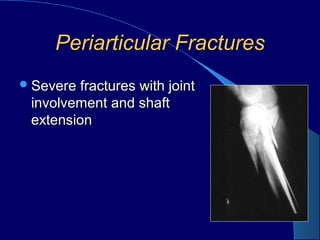
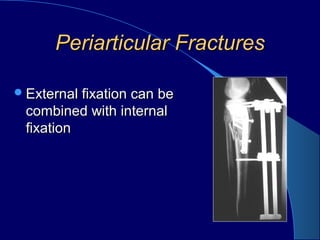
Periarticular FracturesPeriarticular Fractures
Severe fractures with jointSevere fractures with joint
involvement and shaftinvolvement and shaft
extensionextension
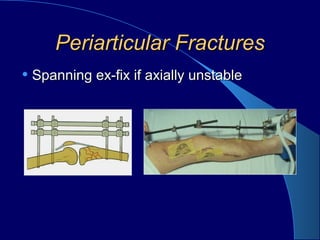
Periarticular FracturesPeriarticular Fractures
• Spanning ex-fix if axially unstableSpanning ex-fix if axially unstable
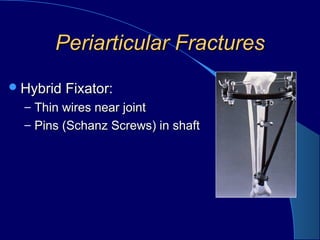
Periarticular FracturesPeriarticular Fractures
Hybrid Fixator:Hybrid Fixator:
– Thin wires near jointThin wires near joint
– Pins (Schanz Screws) in shaftPins (Schanz Screws) in shaft
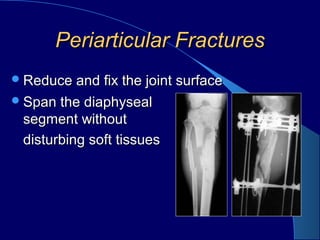
Periarticular FracturesPeriarticular Fractures
Reduce and fix the joint surfaceReduce and fix the joint surface
Span the diaphysealSpan the diaphyseal
segment withoutsegment without
disturbing soft tissuesdisturbing soft tissues
Periarticular FracturesPeriarticular Fractures
External fixation can beExternal fixation can be
combined with internalcombined with internal
fixationfixation
PolytraumaPolytrauma
Temporary stabilization of long boneTemporary stabilization of long bone
injuries in unstable patientinjuries in unstable patient
– Minimally invasiveMinimally invasive
– Decreases bleedingDecreases bleeding
– Pain controlPain control
– Nursing careNursing care
– ““Damage control”Damage control”
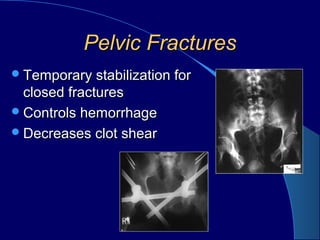
Pelvic FracturesPelvic Fractures
Temporary stabilization forTemporary stabilization for
closed fracturesclosed fractures
Controls hemorrhageControls hemorrhage
Decreases clot shearDecreases clot shear
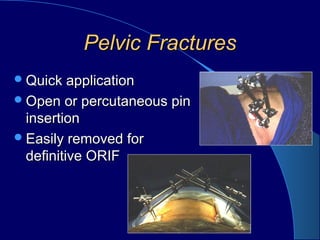
Pelvic FracturesPelvic Fractures
Open pelvic fractures = “The lethal injury”Open pelvic fractures = “The lethal injury”
Pelvic FracturesPelvic Fractures
Quick applicationQuick application
Open or percutaneous pinOpen or percutaneous pin
insertioninsertion
Easily removed forEasily removed for
definitive ORIFdefinitive ORIF
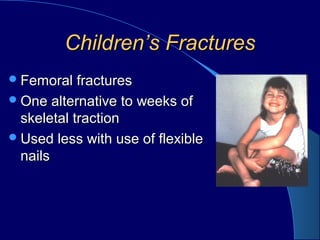
Children’s FracturesChildren’s Fractures
Femoral fracturesFemoral fractures
One alternative to weeks ofOne alternative to weeks of
skeletal tractionskeletal traction
Used less with use of flexibleUsed less with use of flexible
nailsnails
Children’s FracturesChildren’s Fractures
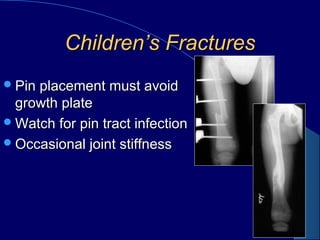
Pin placement must avoidPin placement must avoid
growth plategrowth plate
Watch for pin tract infectionWatch for pin tract infection
Occasional joint stiffnessOccasional joint stiffness
External FixationExternal Fixation
Fixator construct will depend on treatmentFixator construct will depend on treatment
strategy:strategy:
– Emergency careEmergency care
– Provisional careProvisional care
– Definitive careDefinitive care
External Fixator ConstructsExternal Fixator Constructs
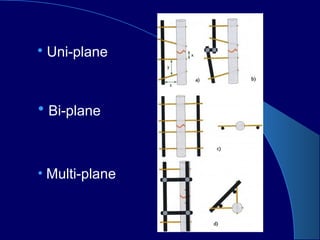
Uni-planeUni-plane
Bi-planeBi-plane
Multi-planeMulti-plane
RingRing
• Uni-plane
• Bi-plane
• Multi-plane
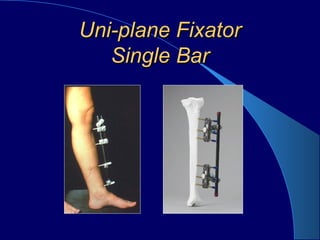
Uni-plane FixatorUni-plane Fixator
Single BarSingle Bar
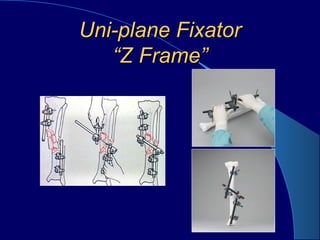
Uni-plane FixatorUni-plane Fixator
“Z Frame”“Z Frame”
Uni-plane FixatorUni-plane Fixator
Double StackedDouble Stacked
Bi-plane FixatorBi-plane Fixator
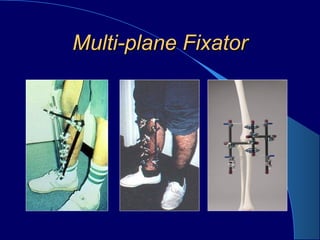
Multi-plane FixatorMulti-plane Fixator
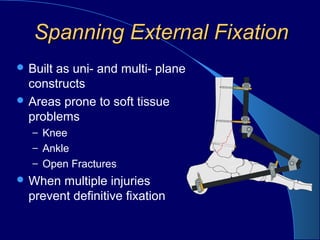
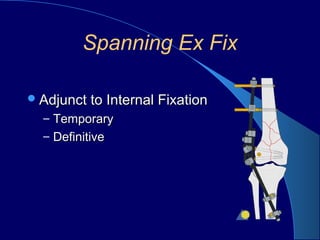
Spanning External FixationSpanning External Fixation
 Built as uni- and multi- plane
constructs
 Areas prone to soft tissue
problems
– Knee
– Ankle
– Open Fractures
 When multiple injuries
prevent definitive fixation
Spanning Ex Fix
Adjunct to Internal FixationAdjunct to Internal Fixation
– TemporaryTemporary
– DefinitiveDefinitive
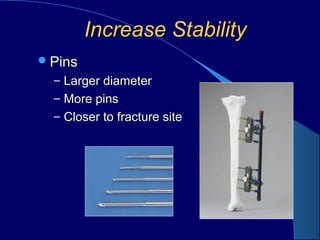
Increase StabilityIncrease Stability
PinsPins
– Larger diameterLarger diameter
– More pinsMore pins
– Closer to fracture siteCloser to fracture site
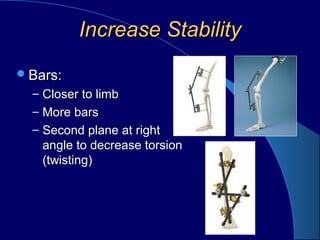
Increase StabilityIncrease Stability
Bars:Bars:
– Closer to limbCloser to limb
– More barsMore bars
– Second plane at rightSecond plane at right
angle to decrease torsionangle to decrease torsion
(twisting)(twisting)
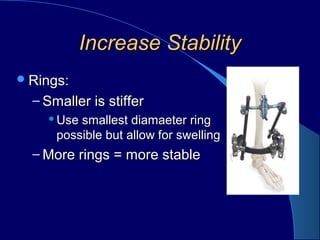
Increase StabilityIncrease Stability
Rings:Rings:
– Smaller is stifferSmaller is stiffer
Use smallest diamaeter ringUse smallest diamaeter ring
possible but allow for swellingpossible but allow for swelling
– More rings = more stableMore rings = more stable
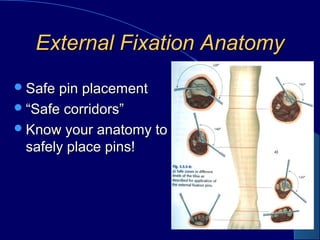
External Fixation AnatomyExternal Fixation Anatomy
Safe pin placementSafe pin placement
““Safe corridors”Safe corridors”
Know your anatomy toKnow your anatomy to
safely place pins!safely place pins!
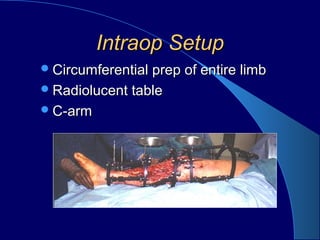
Intraop SetupIntraop Setup
Circumferential prep of entire limbCircumferential prep of entire limb
Radiolucent tableRadiolucent table
C-armC-arm
Intraop SetupIntraop Setup
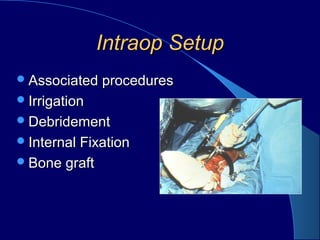
Associated proceduresAssociated procedures
IrrigationIrrigation
DebridementDebridement
Internal FixationInternal Fixation
Bone graftBone graft
Intraop SetupIntraop Setup
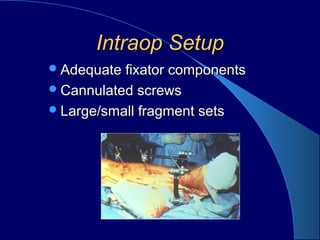
Adequate fixator componentsAdequate fixator components
Cannulated screwsCannulated screws
Large/small fragment setsLarge/small fragment sets
Intraop Technique
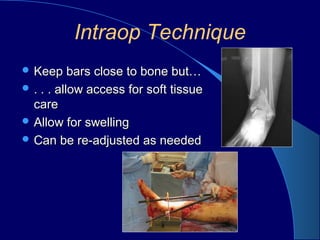
 Keep bars close to bone but…Keep bars close to bone but…
 . . . allow access for soft tissue. . . allow access for soft tissue
carecare
 Allow for swellingAllow for swelling
 Can be re-adjusted as neededCan be re-adjusted as needed
ComplicationsComplications
 Neurovascular injuryNeurovascular injury
 Pin looseningPin loosening
 Pin tract infectionPin tract infection
 Joint stiffnessJoint stiffness
 MalalignmentMalalignment
 MalunionMalunion
 NonunionNonunion
ComplicationsComplications
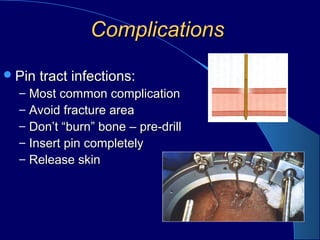
Pin tract infections:Pin tract infections:
– Most common complicationMost common complication
– Avoid fracture areaAvoid fracture area
– Don’t “burn” bone – pre-drillDon’t “burn” bone – pre-drill
– Insert pin completelyInsert pin completely
– Release skinRelease skin
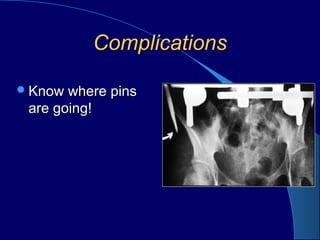
ComplicationsComplications
Know where pinsKnow where pins
are going!are going!
THANK YOU!THANK YOU!

(9)external fixation indications and techniques(bonatus)

Editor's Notes

  • #35 Animation. 1st click. Title and graphic Bullets come in separately.
  • #36 Animation. 1st click. Title and graphic Bullets come in separately.