Maxillo-Mandibular Relation (MMR)
in complete dentures
Dr Mandakini Mohan
International Medical University (IMU)
Learning objectives:
 to understand what is the component parts of the maxillo-mandibular
relation and it is role in the success of the complete denture treatment.
 to understand the clinical steps of maxillo-mandibular relation in complete
denture treatment.
 to uderstand the theory of the face-bow transfer , it’s indication & clinical
application procedure.
Maxillo-Mandibular Relation (MMR) in
complete dentures
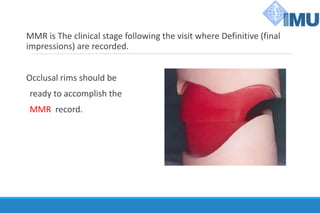
MMR is The clinical stage following the visit where Definitive (final
impressions) are recorded.
Occlusal rims should be
ready to accomplish the
MMR record.
MMR stage is composed of three component
parts:
1. Creating and outlining the form of the dentures
2. Recording of intermaxillary relations
3. Selection of teeth.
1. Creating and outlining the form of
the dentures
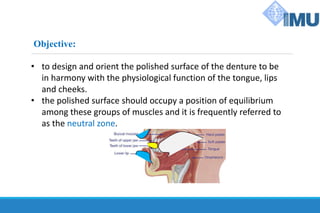
Objective:
• to design and orient the polished surface of the denture to be
in harmony with the physiological function of the tongue, lips
and cheeks.
• the polished surface should occupy a position of equilibrium
among these groups of muscles and it is frequently referred to
as the neutral zone.
Clinical steps in Creating and outlining the form of the
maxillary denture:
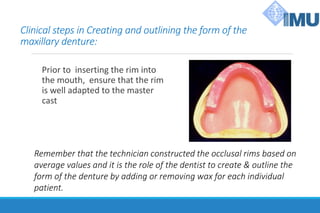
Prior to inserting the rim into
the mouth, ensure that the rim
is well adapted to the master
cast
Remember that the technician constructed the occlusal rims based on
average values and it is the role of the dentist to create & outline the
form of the denture by adding or removing wax for each individual
patient.
Clinical steps in Creating and outlining the form of
the maxillary denture:
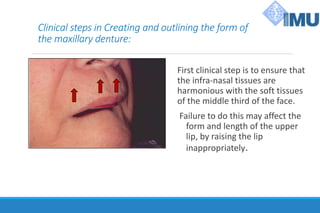
First clinical step is to ensure that
the infra-nasal tissues are
harmonious with the soft tissues
of the middle third of the face.
Failure to do this may affect the
form and length of the upper
lip, by raising the lip
inappropriately.
Clinical steps in Creating and outlining the form of the
maxillary denture:
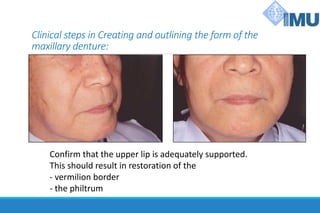
Confirm that the upper lip is adequately supported.
This should result in restoration of the
- vermilion border
- the philtrum
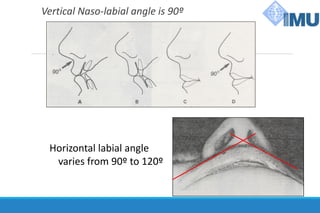
Vertical Naso-labial angle is 90º
Horizontal labial angle
varies from 90º to 120º
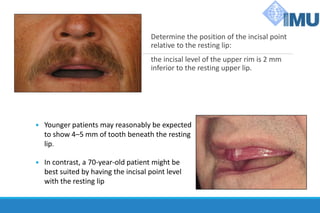
Determine the position of the incisal point
relative to the resting lip:
the incisal level of the upper rim is 2 mm
inferior to the resting upper lip.
 In contrast, a 70-year-old patient might be
best suited by having the incisal point level
with the resting lip
 Younger patients may reasonably be expected
to show 4–5 mm of tooth beneath the resting
lip.
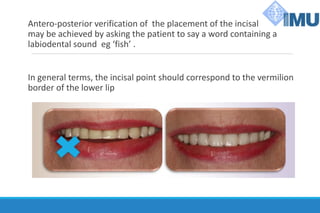
Antero-posterior verification of the placement of the incisal point
may be achieved by asking the patient to say a word containing a
labiodental sound eg ‘fish’ .
In general terms, the incisal point should correspond to the vermilion
border of the lower lip
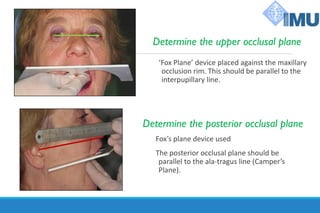
‘Fox Plane’ device placed against the maxillary
occlusion rim. This should be parallel to the
interpupillary line.
Determine the upper occlusal plane
Fox’s plane device used
The posterior occlusal plane should be
parallel to the ala-tragus line (Camper’s
Plane).
Determine the posterior occlusal plane
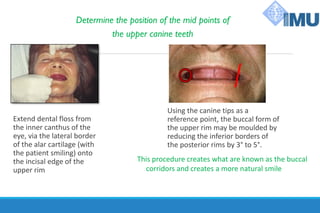
Extend dental floss from
the inner canthus of the
eye, via the lateral border
of the alar cartilage (with
the patient smiling) onto
the incisal edge of the
upper rim
Determine the position of the mid points of
the upper canine teeth
Using the canine tips as a
reference point, the buccal form of
the upper rim may be moulded by
reducing the inferior borders of
the posterior rims by 3° to 5°.
This procedure creates what are known as the buccal
corridors and creates a more natural smile
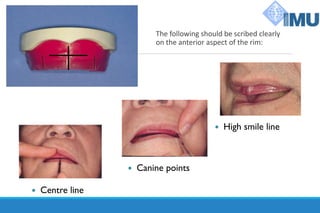
The following should be scribed clearly
on the anterior aspect of the rim:
 Centre line
 High smile line
 Canine points
2. Recording of intermaxillary relations
JAW RELATIONSHIPS:
Vertical Relationships
Horizontal Relationships
Orientation of the occlusal plane in relation to the condyler axis.
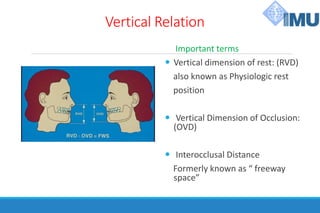
Vertical Relation
Important terms
 Vertical dimension of rest: (RVD)
also known as Physiologic rest
position
 Vertical Dimension of Occlusion:
(OVD)
 Interocclusal Distance
Formerly known as “ freeway
space”
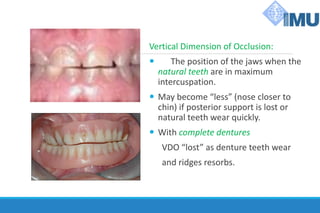
Vertical Dimension of Occlusion:
 The position of the jaws when the
natural teeth are in maximum
intercuspation.
 May become “less” (nose closer to
chin) if posterior support is lost or
natural teeth wear quickly.
 With complete dentures
VDO “lost” as denture teeth wear
and ridges resorbs.
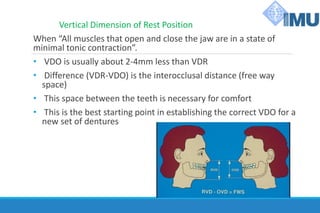
Vertical Dimension of Rest Position
When “All muscles that open and close the jaw are in a state of
minimal tonic contraction”.
• VDO is usually about 2-4mm less than VDR
• Difference (VDR-VDO) is the interocclusal distance (free way
space)
• This space between the teeth is necessary for comfort
• This is the best starting point in establishing the correct VDO for a
new set of dentures
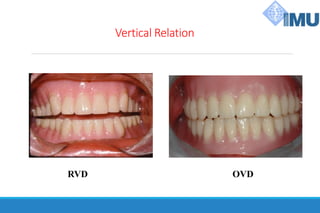
Vertical Relation
RVD OVD
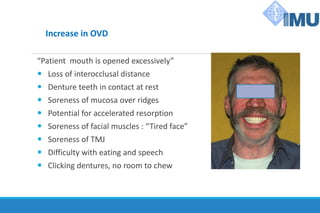
Increase in OVD
“Patient mouth is opened excessively”
 Loss of interocclusal distance
 Denture teeth in contact at rest
 Soreness of mucosa over ridges
 Potential for accelerated resorption
 Soreness of facial muscles : “Tired face”
 Soreness of TMJ
 Difficulty with eating and speech
 Clicking dentures, no room to chew
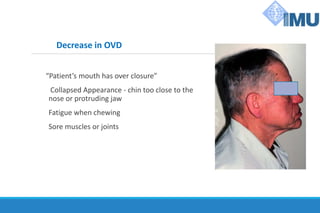
Decrease in OVD
“Patient’s mouth has over closure”
Collapsed Appearance - chin too close to the
nose or protruding jaw
Fatigue when chewing
Sore muscles or joints
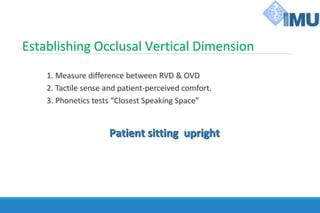
Establishing Occlusal Vertical Dimension
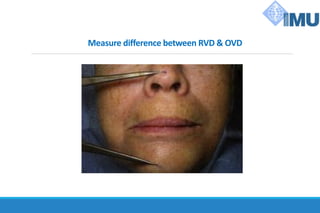
1. Measure difference between RVD & OVD
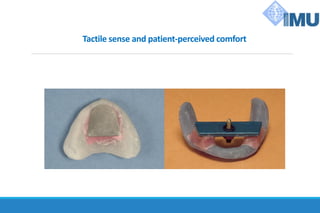
2. Tactile sense and patient-perceived comfort.
3. Phonetics tests “Closest Speaking Space”
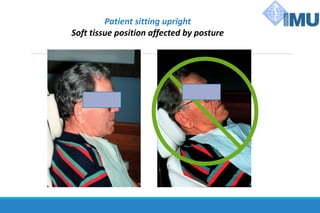
Patient sitting upright
Soft tissue position affected by posture
Measure difference between RVD & OVD
Tactile sense and patient-perceived comfort
Phonetics tests “Closest Speaking Space”
Closest Speaking Space confirms OVD
Sibilant sounds ("s", "z", sh", ch")
Rims should be at least 1 mm apart.
Don’t worry about sounds quality yet.
Horizontal Relationships
The generally agreed position for recording the antero-
posterior position of the mandible relative to the maxilla is that
of the retruded contact position (RCP).
RCP=CR (centric relation)
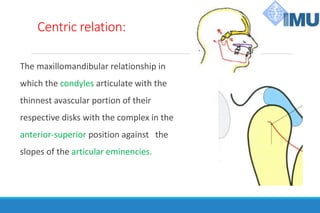
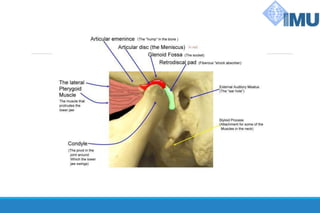
Centric relation:
The maxillomandibular relationship in
which the condyles articulate with the
thinnest avascular portion of their
respective disks with the complex in the
anterior-superior position against the
slopes of the articular eminencies.
Why centric relation ...?
 it is the only repeatable , recordable & reproducible position in
the edentulous patient.
 abnormal contact between opposing dentures when set up in
other than the retruded relationship results in denture
instability.
 the apparatus used for reproducing relevant jaw movements
(the articulator) operates from the retruded position.
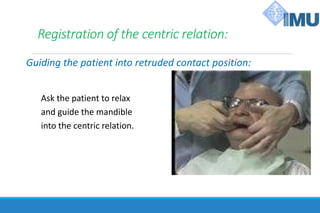
Registration of the centric relation:
Guiding the patient into retruded contact position:
Ask the patient to relax
and guide the mandible
into the centric relation.
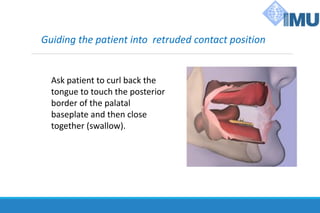
Guiding the patient into retruded contact position
Ask patient to curl back the
tongue to touch the posterior
border of the palatal
baseplate and then close
together (swallow).
Guiding the patient into retruded contact position
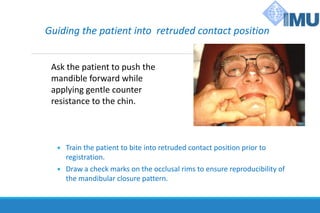
Ask the patient to push the
mandible forward while
applying gentle counter
resistance to the chin.
 Train the patient to bite into retruded contact position prior to
registration.
 Draw a check marks on the occlusal rims to ensure reproducibility of
the mandibular closure pattern.
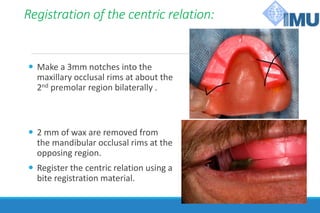
Registration of the centric relation:
 Make a 3mm notches into the
maxillary occlusal rims at about the
2nd premolar region bilaterally .
 2 mm of wax are removed from
the mandibular occlusal rims at the
opposing region.
 Register the centric relation using a
bite registration material.
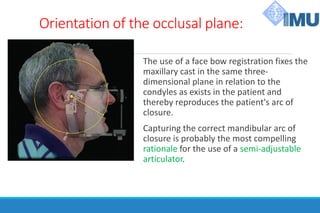
Orientation of the occlusal plane:
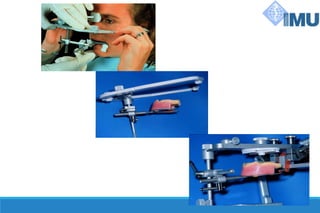
The use of a face bow registration fixes the
maxillary cast in the same three-
dimensional plane in relation to the
condyles as exists in the patient and
thereby reproduces the patient's arc of
closure.
Capturing the correct mandibular arc of
closure is probably the most compelling
rationale for the use of a semi-adjustable
articulator.
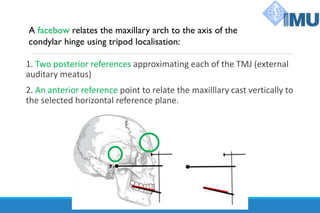
1. Two posterior references approximating each of the TMJ (external
auditary meatus)
2. An anterior reference point to relate the maxilllary cast vertically to
the selected horizontal reference plane.
A facebow relates the maxillary arch to the axis of the
condylar hinge using tripod localisation:
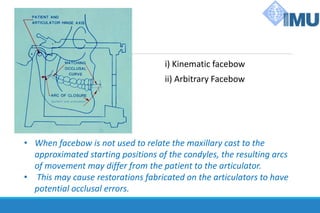
i) Kinematic facebow
ii) Arbitrary Facebow
• When facebow is not used to relate the maxillary cast to the
approximated starting positions of the condyles, the resulting arcs
of movement may differ from the patient to the articulator.
• This may cause restorations fabricated on the articulators to have
potential occlusal errors.
3. Teeth selection
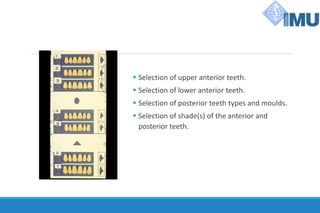
▪ Selection of upper anterior teeth.
▪ Selection of lower anterior teeth.
▪ Selection of posterior teeth types and moulds.
▪ Selection of shade(s) of the anterior and
posterior teeth.
Selection of upper anterior teeth
Pre-extraction record:
 Photograph
 Relate canine points to pupils.
 Relate canine points to inter-alar width.
 Relate six anterior teeth to smile line.
 Radiograph
 Cast of arch
 Relative of similar facial appearance.
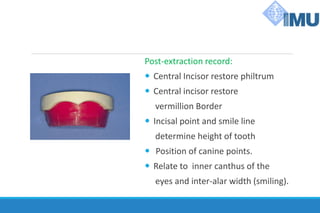
Post-extraction record:
 Central Incisor restore philtrum
 Central incisor restore
vermillion Border
 Incisal point and smile line
determine height of tooth
 Position of canine points.
 Relate to inner canthus of the
eyes and inter-alar width (smiling).
Selection of lower anterior teeth
Lower anterior teeth selected to be harmonious with upper teeth.
Selection of posterior teeth types and
moulds
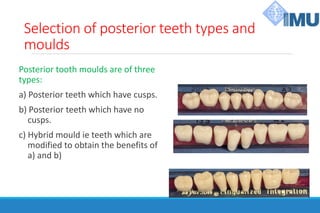
Posterior tooth moulds are of three
types:
a) Posterior teeth which have cusps.
b) Posterior teeth which have no
cusps.
c) Hybrid mould ie teeth which are
modified to obtain the benefits of
a) and b)
Selection of teeth shade(s)
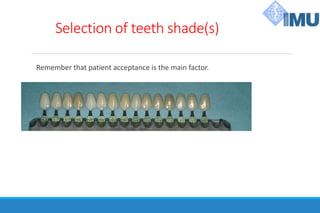
Remember that patient acceptance is the main factor.
Factors affecting
•Face form and shape
•Gender
•Personality
•Age
References:
Davies SJ, Gray RM, McCord JF. Good occlusal practice in
removable prosthodontics (2001).Br Dent J.10;191(9):491-4, 497-502.
Grant A. A., Heath J. R. & McCord J. F. (1994). Complete prosthodontics problems
diagnosis and management. Mosby.
Mc Cord J F, Grant AA(2000).Registration: stage I--creating and outlining the form of
the upper denture. Br Dent J. 27;188(10):529-36.
Mc Cord J F, Grant AA(2000). Registration: stage II--intermaxillary relations.
Mc Cord J F, Grant AA(2000). Registration: stage III—selection of teeth.
The glossary of prosthodontic terms (2005) J Prosthet Dent ;94(1):10-92.
 Zarb Bolender (2004) Prosthodontic treatment for edentulous patients. Complete
dentures and implant-supported prostheses. Mosby. Twelfth Edition.
Br Dent J. 24;188(12):660-6.
MMR 2022.pdf

MMR 2022.pdf

  • 1.
    Maxillo-Mandibular Relation (MMR) incomplete dentures Dr Mandakini Mohan International Medical University (IMU)
  • 2.
    Learning objectives:  tounderstand what is the component parts of the maxillo-mandibular relation and it is role in the success of the complete denture treatment.  to understand the clinical steps of maxillo-mandibular relation in complete denture treatment.  to uderstand the theory of the face-bow transfer , it’s indication & clinical application procedure.
  • 3.
  • 4.
    MMR is Theclinical stage following the visit where Definitive (final impressions) are recorded. Occlusal rims should be ready to accomplish the MMR record.
  • 5.
    MMR stage iscomposed of three component parts: 1. Creating and outlining the form of the dentures 2. Recording of intermaxillary relations 3. Selection of teeth.
  • 6.
    1. Creating andoutlining the form of the dentures
  • 7.
    Objective: • to designand orient the polished surface of the denture to be in harmony with the physiological function of the tongue, lips and cheeks. • the polished surface should occupy a position of equilibrium among these groups of muscles and it is frequently referred to as the neutral zone.
  • 8.
    Clinical steps inCreating and outlining the form of the maxillary denture: Prior to inserting the rim into the mouth, ensure that the rim is well adapted to the master cast Remember that the technician constructed the occlusal rims based on average values and it is the role of the dentist to create & outline the form of the denture by adding or removing wax for each individual patient.
  • 9.
    Clinical steps inCreating and outlining the form of the maxillary denture: First clinical step is to ensure that the infra-nasal tissues are harmonious with the soft tissues of the middle third of the face. Failure to do this may affect the form and length of the upper lip, by raising the lip inappropriately.
  • 10.
    Clinical steps inCreating and outlining the form of the maxillary denture: Confirm that the upper lip is adequately supported. This should result in restoration of the - vermilion border - the philtrum
  • 11.
    Vertical Naso-labial angleis 90º Horizontal labial angle varies from 90º to 120º
  • 12.
    Determine the positionof the incisal point relative to the resting lip: the incisal level of the upper rim is 2 mm inferior to the resting upper lip.  In contrast, a 70-year-old patient might be best suited by having the incisal point level with the resting lip  Younger patients may reasonably be expected to show 4–5 mm of tooth beneath the resting lip.
  • 13.
    Antero-posterior verification ofthe placement of the incisal point may be achieved by asking the patient to say a word containing a labiodental sound eg ‘fish’ . In general terms, the incisal point should correspond to the vermilion border of the lower lip
  • 14.
    ‘Fox Plane’ deviceplaced against the maxillary occlusion rim. This should be parallel to the interpupillary line. Determine the upper occlusal plane Fox’s plane device used The posterior occlusal plane should be parallel to the ala-tragus line (Camper’s Plane). Determine the posterior occlusal plane
  • 15.
    Extend dental flossfrom the inner canthus of the eye, via the lateral border of the alar cartilage (with the patient smiling) onto the incisal edge of the upper rim Determine the position of the mid points of the upper canine teeth Using the canine tips as a reference point, the buccal form of the upper rim may be moulded by reducing the inferior borders of the posterior rims by 3° to 5°. This procedure creates what are known as the buccal corridors and creates a more natural smile
  • 16.
    The following shouldbe scribed clearly on the anterior aspect of the rim:  Centre line  High smile line  Canine points
  • 17.
    2. Recording ofintermaxillary relations
  • 18.
    JAW RELATIONSHIPS: Vertical Relationships HorizontalRelationships Orientation of the occlusal plane in relation to the condyler axis.
  • 19.
    Vertical Relation Important terms Vertical dimension of rest: (RVD) also known as Physiologic rest position  Vertical Dimension of Occlusion: (OVD)  Interocclusal Distance Formerly known as “ freeway space”
  • 20.
    Vertical Dimension ofOcclusion:  The position of the jaws when the natural teeth are in maximum intercuspation.  May become “less” (nose closer to chin) if posterior support is lost or natural teeth wear quickly.  With complete dentures VDO “lost” as denture teeth wear and ridges resorbs.
  • 21.
    Vertical Dimension ofRest Position When “All muscles that open and close the jaw are in a state of minimal tonic contraction”. • VDO is usually about 2-4mm less than VDR • Difference (VDR-VDO) is the interocclusal distance (free way space) • This space between the teeth is necessary for comfort • This is the best starting point in establishing the correct VDO for a new set of dentures
  • 22.
  • 23.
    Increase in OVD “Patientmouth is opened excessively”  Loss of interocclusal distance  Denture teeth in contact at rest  Soreness of mucosa over ridges  Potential for accelerated resorption  Soreness of facial muscles : “Tired face”  Soreness of TMJ  Difficulty with eating and speech  Clicking dentures, no room to chew
  • 24.
    Decrease in OVD “Patient’smouth has over closure” Collapsed Appearance - chin too close to the nose or protruding jaw Fatigue when chewing Sore muscles or joints
  • 25.
    Establishing Occlusal VerticalDimension 1. Measure difference between RVD & OVD 2. Tactile sense and patient-perceived comfort. 3. Phonetics tests “Closest Speaking Space” Patient sitting upright
  • 26.
    Patient sitting upright Softtissue position affected by posture
  • 27.
  • 28.
    Tactile sense andpatient-perceived comfort
  • 29.
    Phonetics tests “ClosestSpeaking Space” Closest Speaking Space confirms OVD Sibilant sounds ("s", "z", sh", ch") Rims should be at least 1 mm apart. Don’t worry about sounds quality yet.
  • 30.
    Horizontal Relationships The generallyagreed position for recording the antero- posterior position of the mandible relative to the maxilla is that of the retruded contact position (RCP). RCP=CR (centric relation)
  • 31.
    Centric relation: The maxillomandibularrelationship in which the condyles articulate with the thinnest avascular portion of their respective disks with the complex in the anterior-superior position against the slopes of the articular eminencies.
  • 33.
    Why centric relation...?  it is the only repeatable , recordable & reproducible position in the edentulous patient.  abnormal contact between opposing dentures when set up in other than the retruded relationship results in denture instability.  the apparatus used for reproducing relevant jaw movements (the articulator) operates from the retruded position.
  • 34.
    Registration of thecentric relation: Guiding the patient into retruded contact position: Ask the patient to relax and guide the mandible into the centric relation.
  • 35.
    Guiding the patientinto retruded contact position Ask patient to curl back the tongue to touch the posterior border of the palatal baseplate and then close together (swallow).
  • 36.
    Guiding the patientinto retruded contact position Ask the patient to push the mandible forward while applying gentle counter resistance to the chin.  Train the patient to bite into retruded contact position prior to registration.  Draw a check marks on the occlusal rims to ensure reproducibility of the mandibular closure pattern.
  • 37.
    Registration of thecentric relation:  Make a 3mm notches into the maxillary occlusal rims at about the 2nd premolar region bilaterally .  2 mm of wax are removed from the mandibular occlusal rims at the opposing region.  Register the centric relation using a bite registration material.
  • 38.
    Orientation of theocclusal plane: The use of a face bow registration fixes the maxillary cast in the same three- dimensional plane in relation to the condyles as exists in the patient and thereby reproduces the patient's arc of closure. Capturing the correct mandibular arc of closure is probably the most compelling rationale for the use of a semi-adjustable articulator.
  • 39.
    1. Two posteriorreferences approximating each of the TMJ (external auditary meatus) 2. An anterior reference point to relate the maxilllary cast vertically to the selected horizontal reference plane. A facebow relates the maxillary arch to the axis of the condylar hinge using tripod localisation:
  • 40.
    i) Kinematic facebow ii)Arbitrary Facebow • When facebow is not used to relate the maxillary cast to the approximated starting positions of the condyles, the resulting arcs of movement may differ from the patient to the articulator. • This may cause restorations fabricated on the articulators to have potential occlusal errors.
  • 42.
  • 43.
    ▪ Selection ofupper anterior teeth. ▪ Selection of lower anterior teeth. ▪ Selection of posterior teeth types and moulds. ▪ Selection of shade(s) of the anterior and posterior teeth.
  • 44.
    Selection of upperanterior teeth Pre-extraction record:  Photograph  Relate canine points to pupils.  Relate canine points to inter-alar width.  Relate six anterior teeth to smile line.  Radiograph  Cast of arch  Relative of similar facial appearance.
  • 45.
    Post-extraction record:  CentralIncisor restore philtrum  Central incisor restore vermillion Border  Incisal point and smile line determine height of tooth  Position of canine points.  Relate to inner canthus of the eyes and inter-alar width (smiling).
  • 46.
    Selection of loweranterior teeth Lower anterior teeth selected to be harmonious with upper teeth.
  • 47.
    Selection of posteriorteeth types and moulds Posterior tooth moulds are of three types: a) Posterior teeth which have cusps. b) Posterior teeth which have no cusps. c) Hybrid mould ie teeth which are modified to obtain the benefits of a) and b)
  • 48.
    Selection of teethshade(s) Remember that patient acceptance is the main factor.
  • 49.
    Factors affecting •Face formand shape •Gender •Personality •Age
  • 50.
    References: Davies SJ, GrayRM, McCord JF. Good occlusal practice in removable prosthodontics (2001).Br Dent J.10;191(9):491-4, 497-502. Grant A. A., Heath J. R. & McCord J. F. (1994). Complete prosthodontics problems diagnosis and management. Mosby. Mc Cord J F, Grant AA(2000).Registration: stage I--creating and outlining the form of the upper denture. Br Dent J. 27;188(10):529-36. Mc Cord J F, Grant AA(2000). Registration: stage II--intermaxillary relations. Mc Cord J F, Grant AA(2000). Registration: stage III—selection of teeth. The glossary of prosthodontic terms (2005) J Prosthet Dent ;94(1):10-92.  Zarb Bolender (2004) Prosthodontic treatment for edentulous patients. Complete dentures and implant-supported prostheses. Mosby. Twelfth Edition. Br Dent J. 24;188(12):660-6.