SURGERY OR
ORTHODONTICS?
Class II division 2 malocclusion
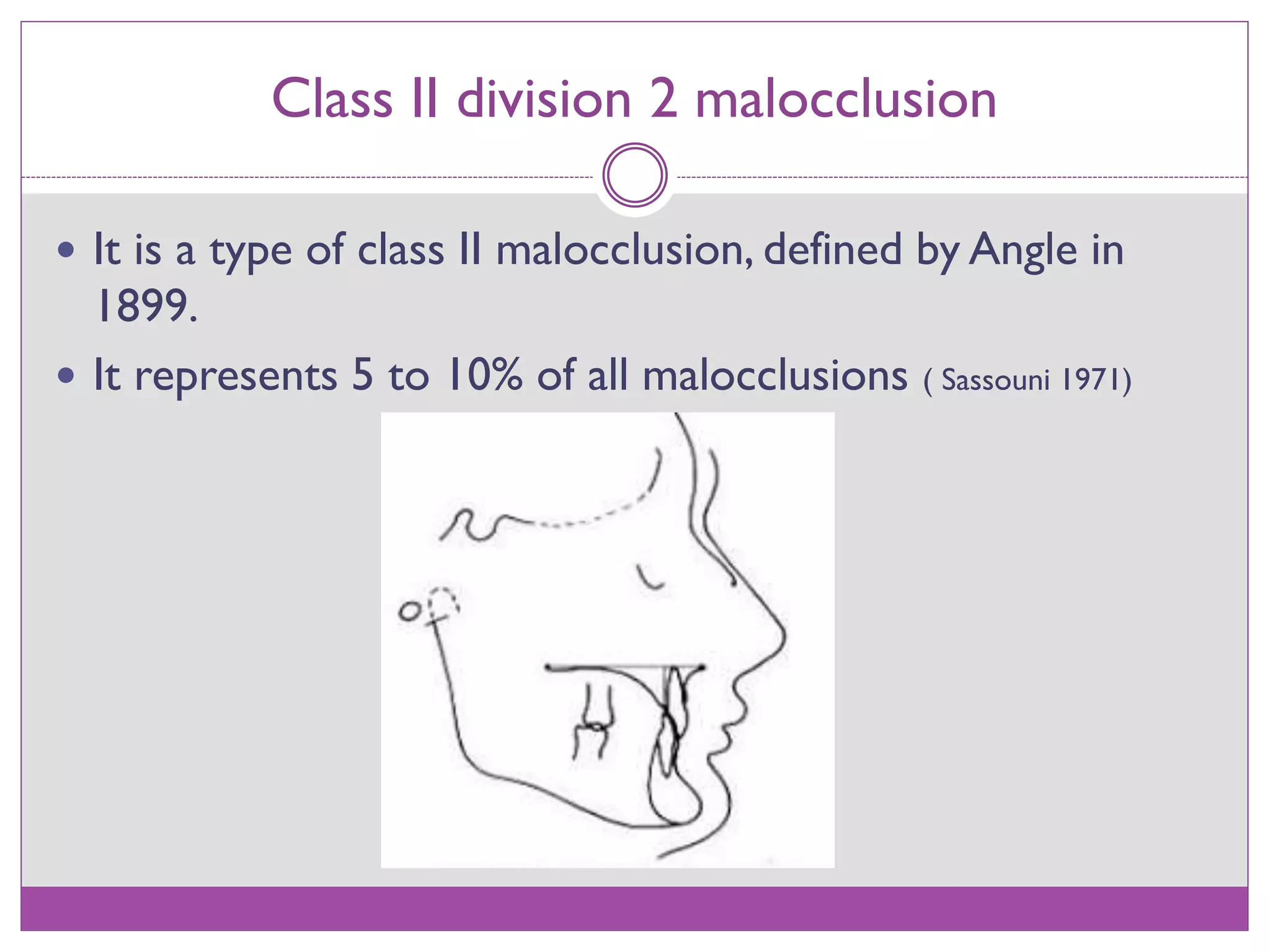
 It is a type of class II malocclusion, defined by Angle in
1899.
 It represents 5 to 10% of all malocclusions ( Sassouni 1971)
Class II division 2
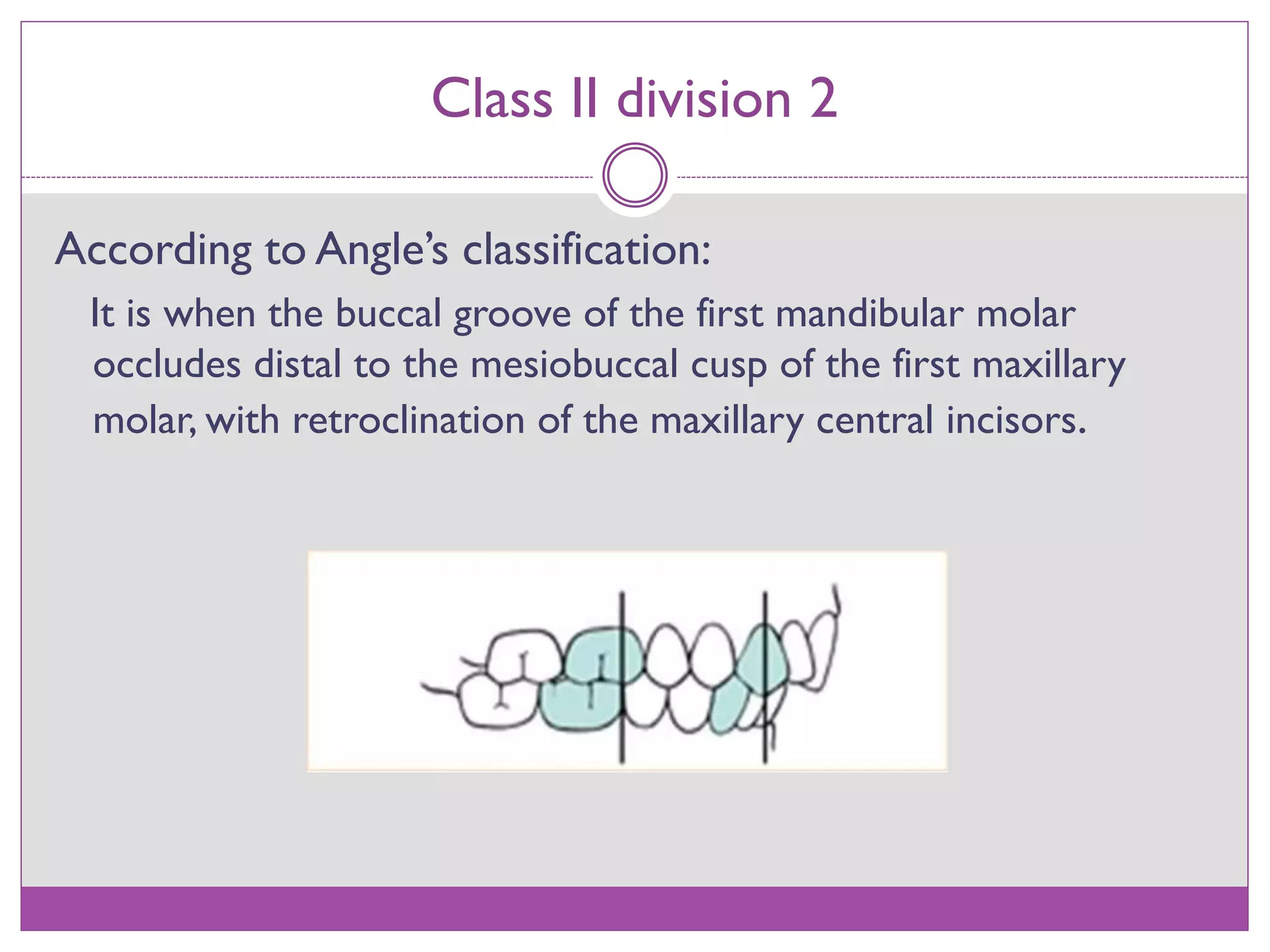
According to Angle’s classification:
It is when the buccal groove of the first mandibular molar
occludes distal to the mesiobuccal cusp of the first maxillary
molar, with retroclination of the maxillary central incisors.
Class II division 2
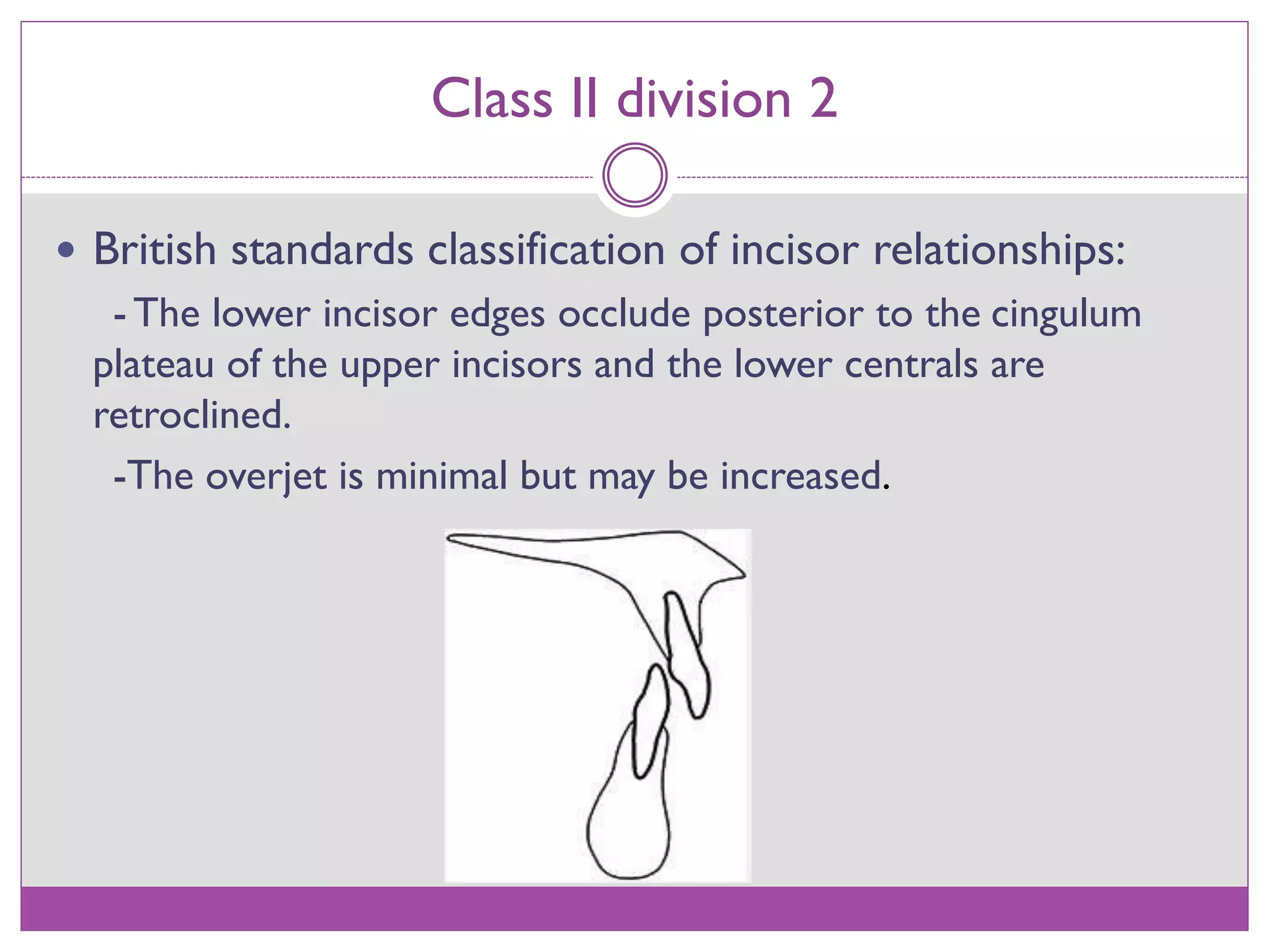
 British standards classification of incisor relationships:
- The lower incisor edges occlude posterior to the cingulum
plateau of the upper incisors and the lower centrals are
retroclined.
-The overjet is minimal but may be increased.
Class II division 2
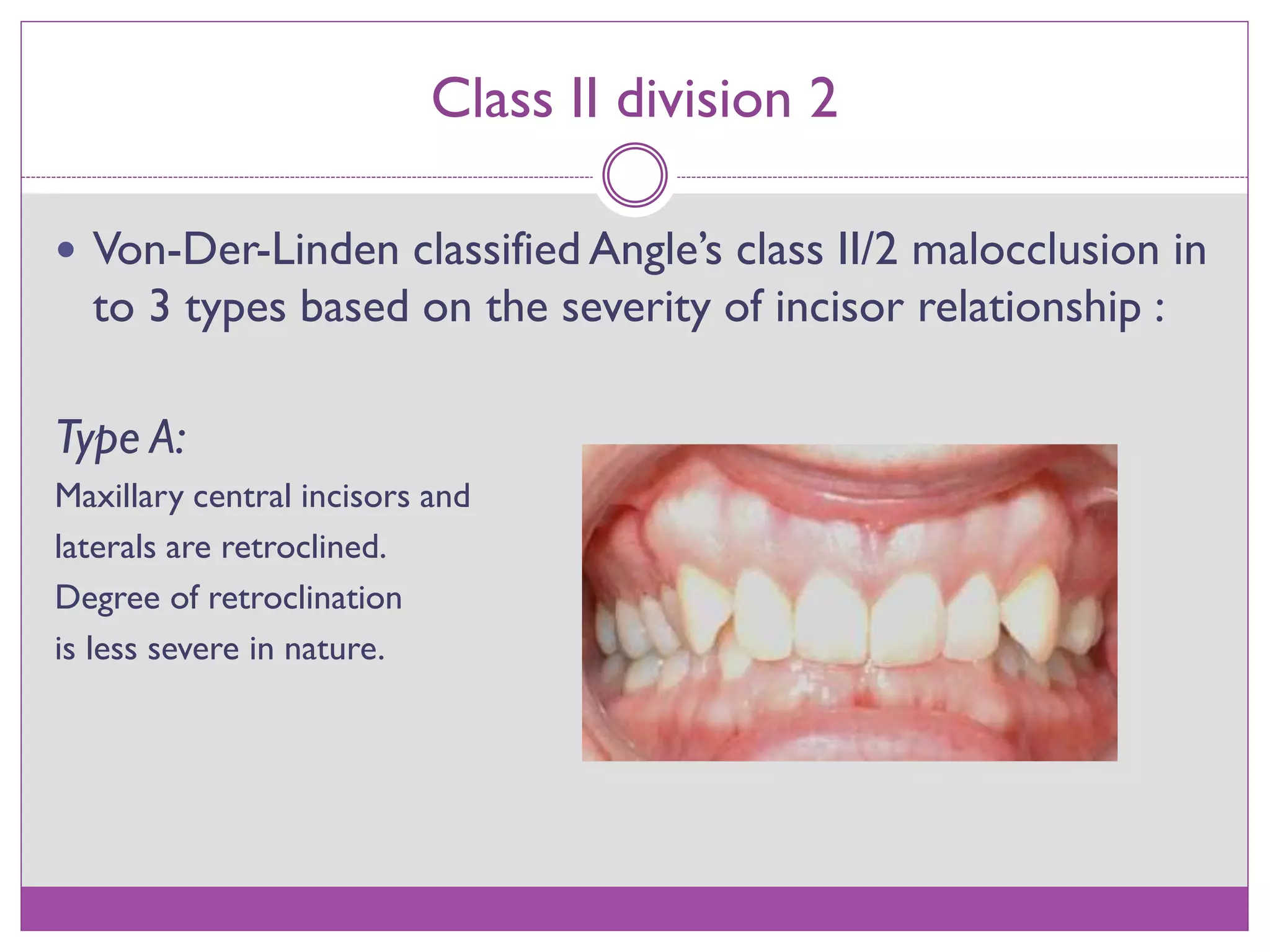
 Von-Der-Linden classified Angle’s class II/2 malocclusion in
to 3 types based on the severity of incisor relationship :
Type A:
Maxillary central incisors and
laterals are retroclined.
Degree of retroclination
is less severe in nature.
Von-Der-Linden Classification of class II/2
Type B:
Maxillary lateral incisors are
overlapping the retroclined
maxillary central incisors.
Type C :
Maxillary central and lateral incisors
Are retroclined and are overlapped
By the maxillary canines.
General clinical features of Class II division 2
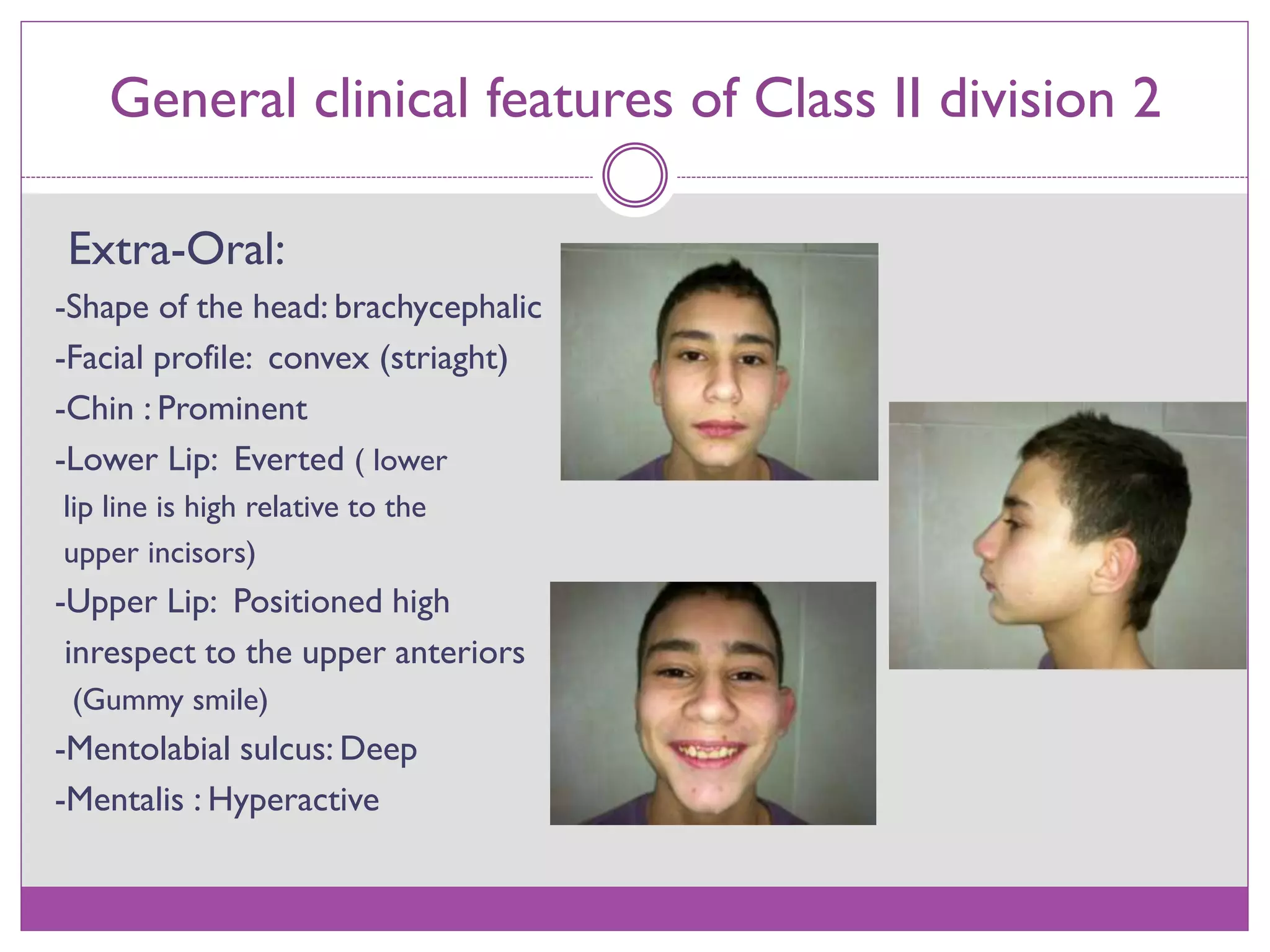
Extra-Oral:
-Shape of the head: brachycephalic
-Facial profile: convex (striaght)
-Chin : Prominent
-Lower Lip: Everted ( lower
lip line is high relative to the
upper incisors)
-Upper Lip: Positioned high
inrespect to the upper anteriors
(Gummy smile)
-Mentolabial sulcus: Deep
-Mentalis : Hyperactive
General clinical features of Class II division 2
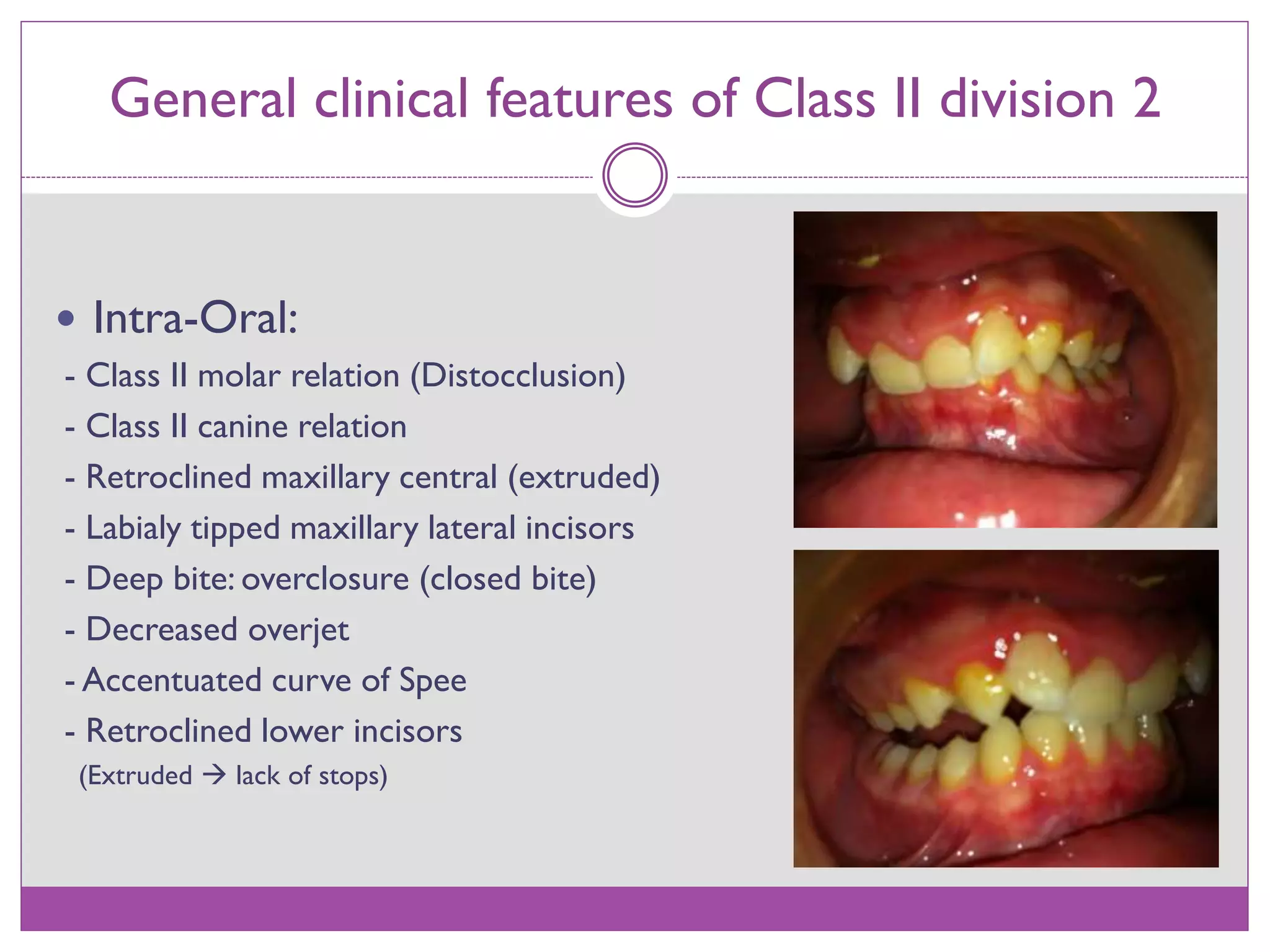
 Intra-Oral:
- Class II molar relation (Distocclusion)
- Class II canine relation
- Retroclined maxillary central (extruded)
- Labialy tipped maxillary lateral incisors
- Deep bite: overclosure (closed bite)
- Decreased overjet
- Accentuated curve of Spee
- Retroclined lower incisors
(Extruded  lack of stops)
Etiology of Class II division 2
 Class II division 2 malocclusions arise from a number of
interrelated dental, skeletal, soft tissue and genetic factors.
 Most of class II/2 malocclusions are caused by an underlying
skeletal discrepancy, and few have a normal skeletal jaw
relationship.
Class II div 2
Dental or Skeletal
( combination of both)
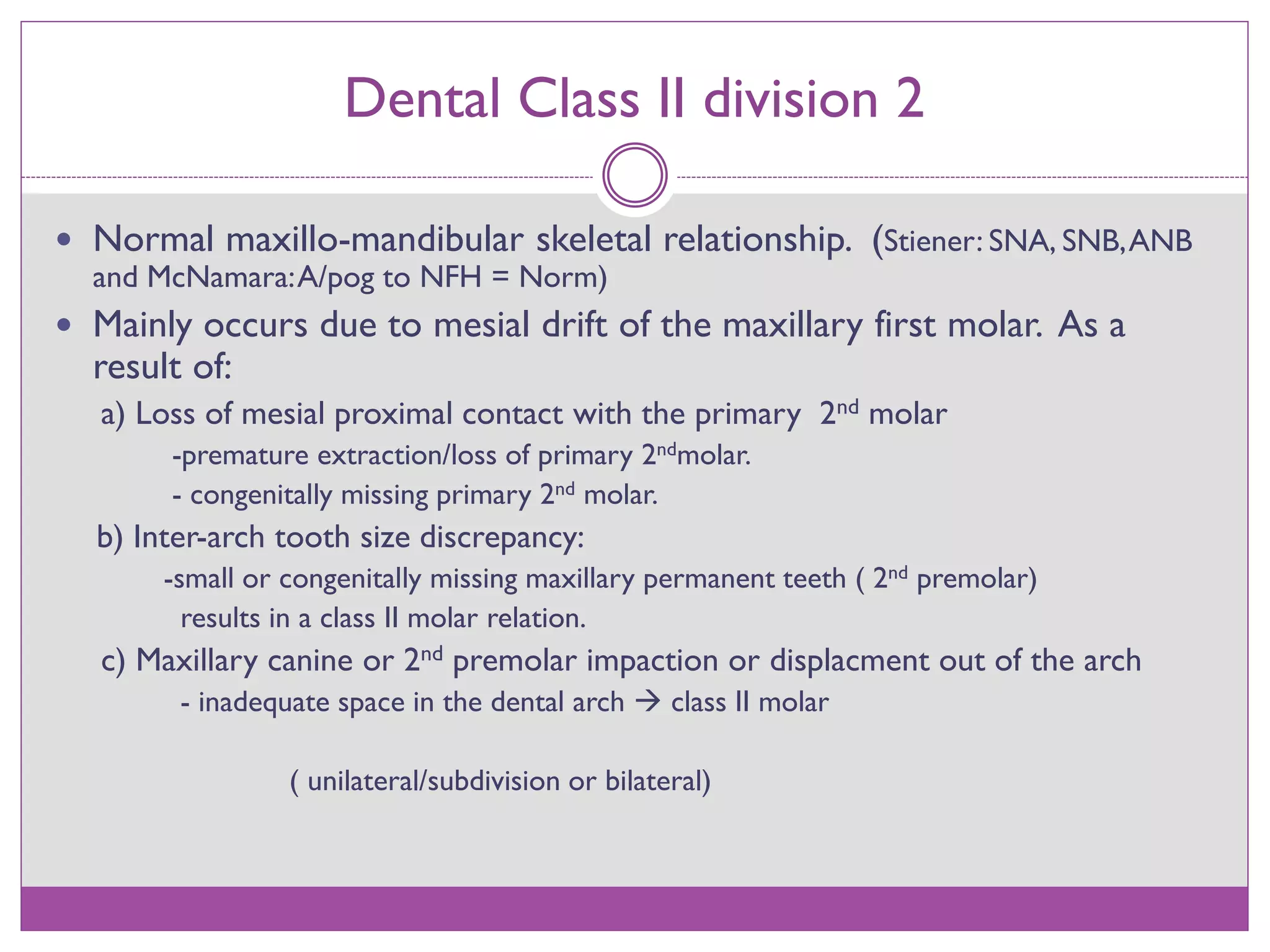
Dental Class II division 2
 Normal maxillo-mandibular skeletal relationship. (Stiener: SNA, SNB,ANB
and McNamara:A/pog to NFH = Norm)
 Mainly occurs due to mesial drift of the maxillary first molar. As a
result of:
a) Loss of mesial proximal contact with the primary 2nd molar
-premature extraction/loss of primary 2ndmolar.
- congenitally missing primary 2nd molar.
b) Inter-arch tooth size discrepancy:
-small or congenitally missing maxillary permanent teeth ( 2nd premolar)
results in a class II molar relation.
c) Maxillary canine or 2nd premolar impaction or displacment out of the arch
- inadequate space in the dental arch  class II molar
( unilateral/subdivision or bilateral)
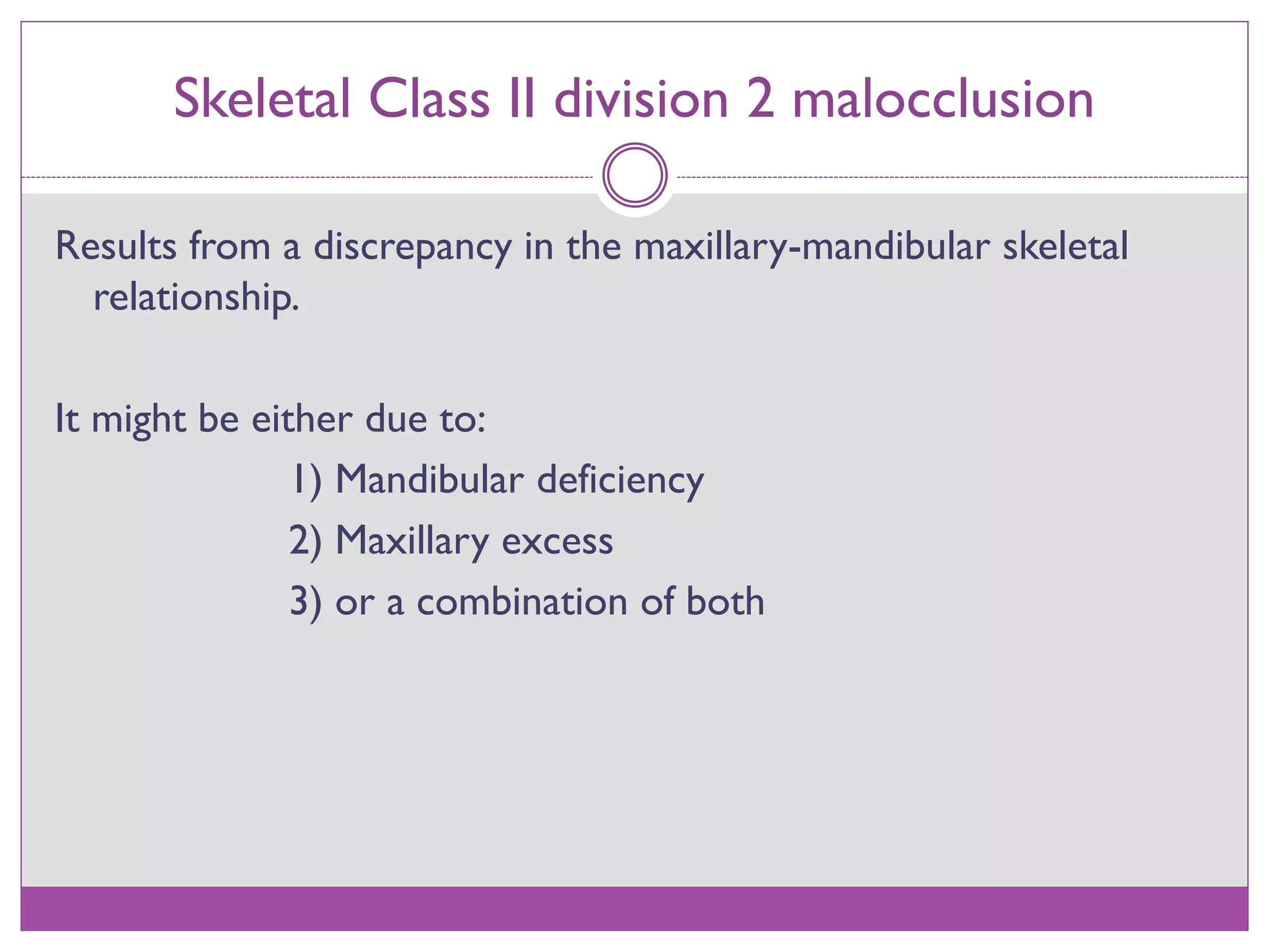
Skeletal Class II division 2 malocclusion
Results from a discrepancy in the maxillary-mandibular skeletal
relationship.
It might be either due to:
1) Mandibular deficiency
2) Maxillary excess
3) or a combination of both
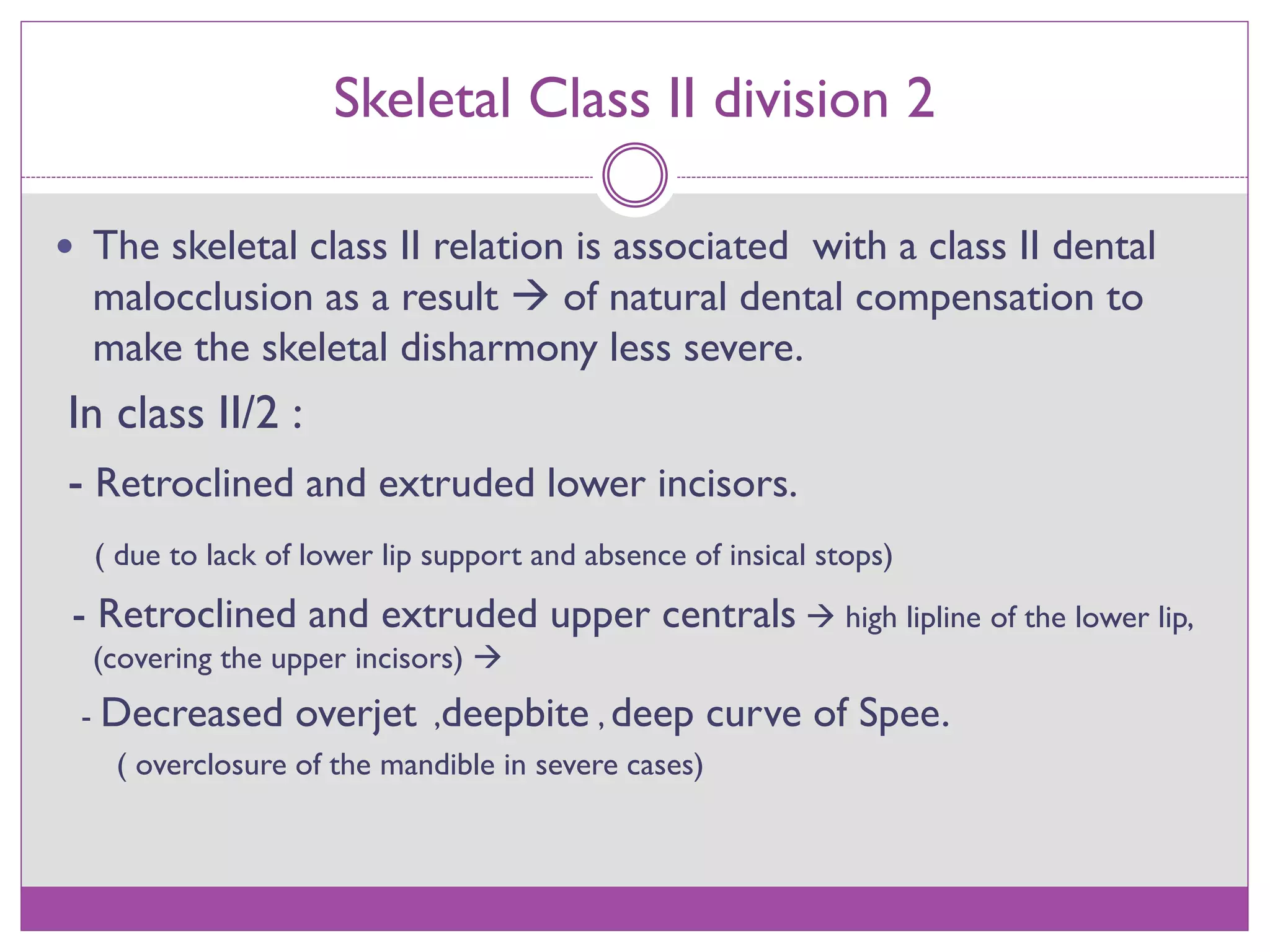
Skeletal Class II division 2
 The skeletal class II relation is associated with a class II dental
malocclusion as a result  of natural dental compensation to
make the skeletal disharmony less severe.
In class II/2 :
- Retroclined and extruded lower incisors.
( due to lack of lower lip support and absence of insical stops)
- Retroclined and extruded upper centrals  high lipline of the lower lip,
(covering the upper incisors) 
- Decreased overjet ,deepbite , deep curve of Spee.
( overclosure of the mandible in severe cases)
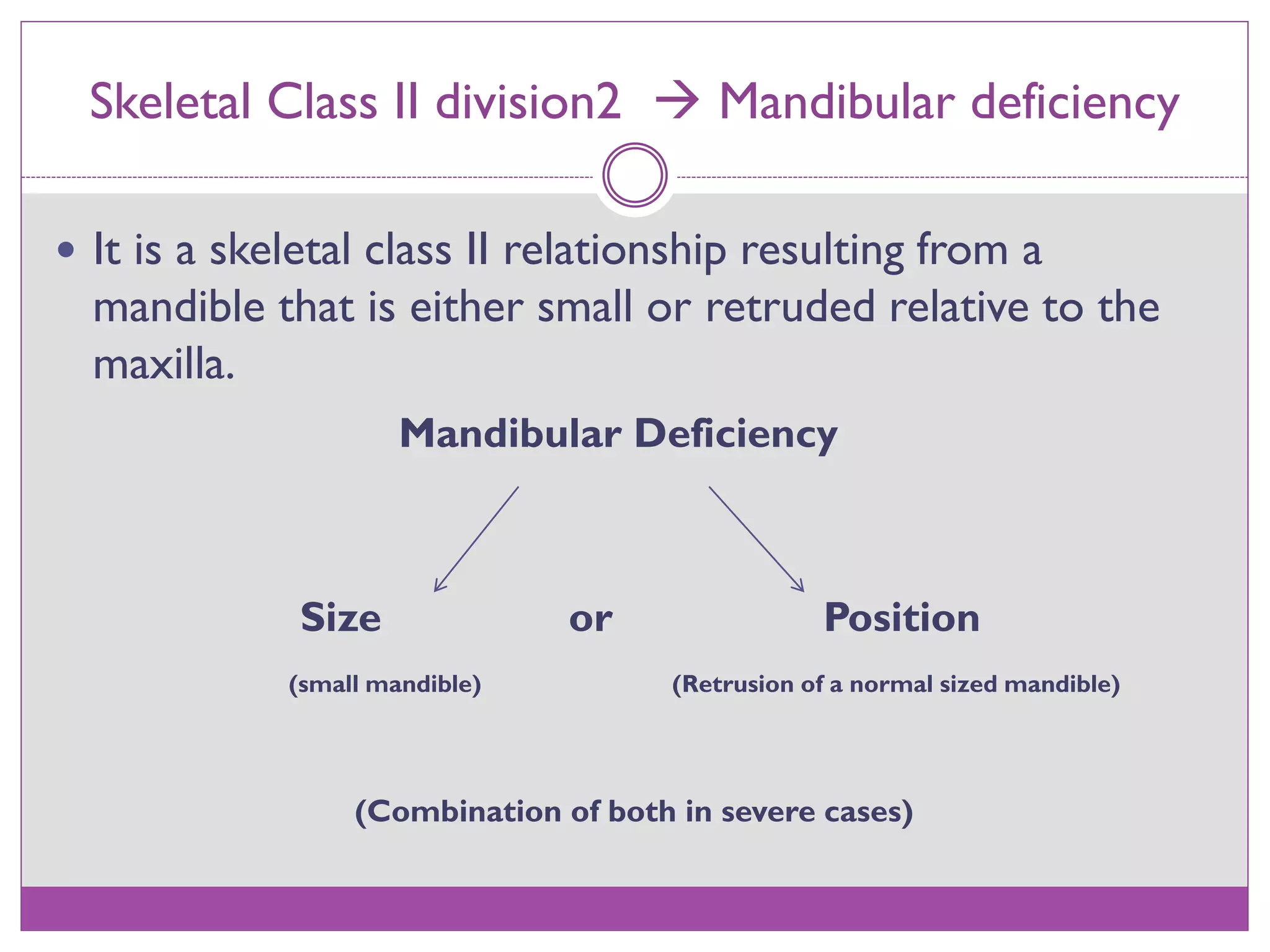
Skeletal Class II division2  Mandibular deficiency
 It is a skeletal class II relationship resulting from a
mandible that is either small or retruded relative to the
maxilla.
Mandibular Deficiency
Size or Position
(small mandible) (Retrusion of a normal sized mandible)
(Combination of both in severe cases)
Skeletal Class II division 2  Mandibular deficiency
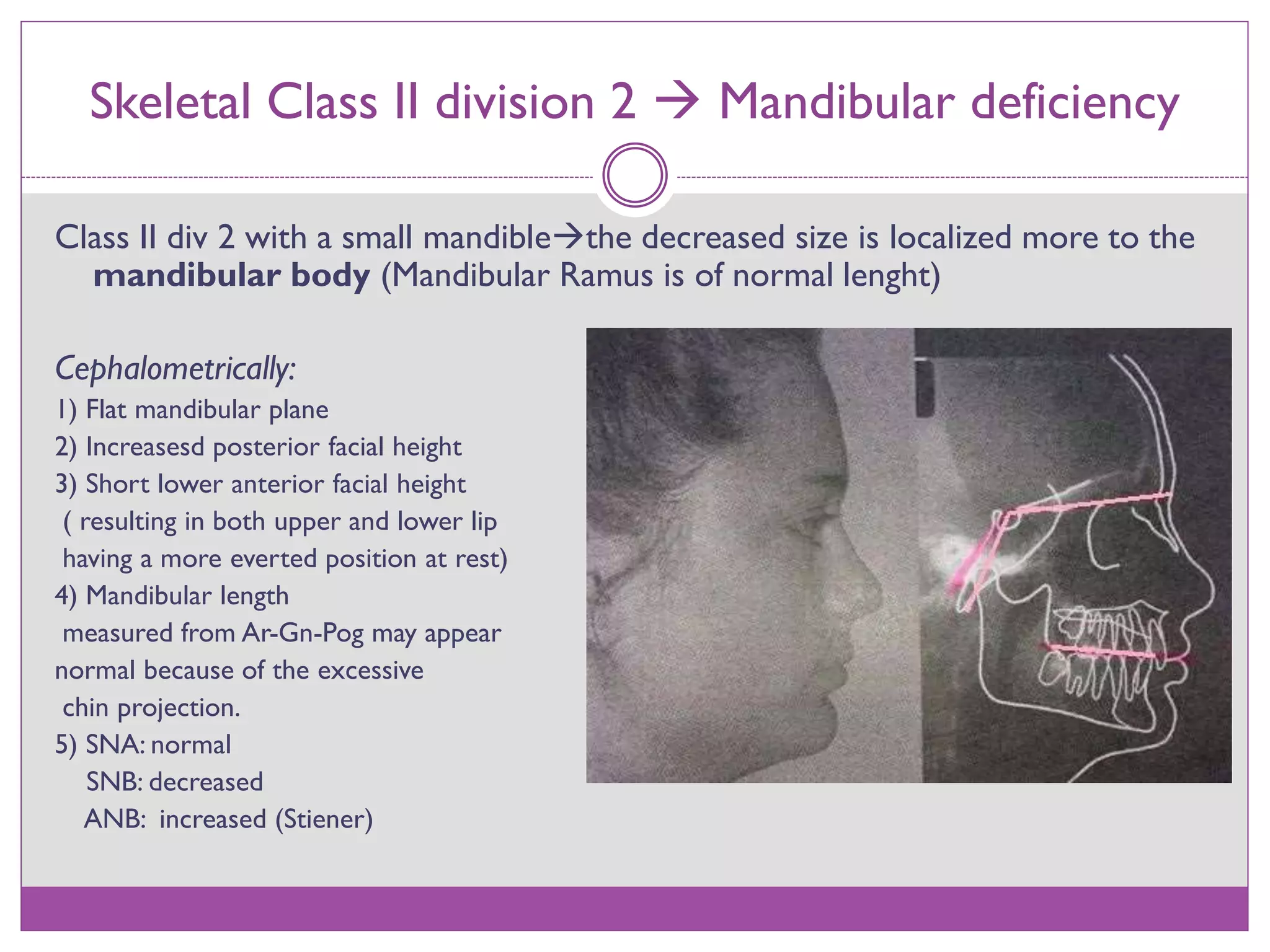
Class II div 2 with a small mandiblethe decreased size is localized more to the
mandibular body (Mandibular Ramus is of normal lenght)
Cephalometrically:
1) Flat mandibular plane
2) Increasesd posterior facial height
3) Short lower anterior facial height
( resulting in both upper and lower lip
having a more everted position at rest)
4) Mandibular length
measured from Ar-Gn-Pog may appear
normal because of the excessive
chin projection.
5) SNA: normal
SNB: decreased
ANB: increased (Stiener)
Skeletal Class II division 2  Mandibular deficiency
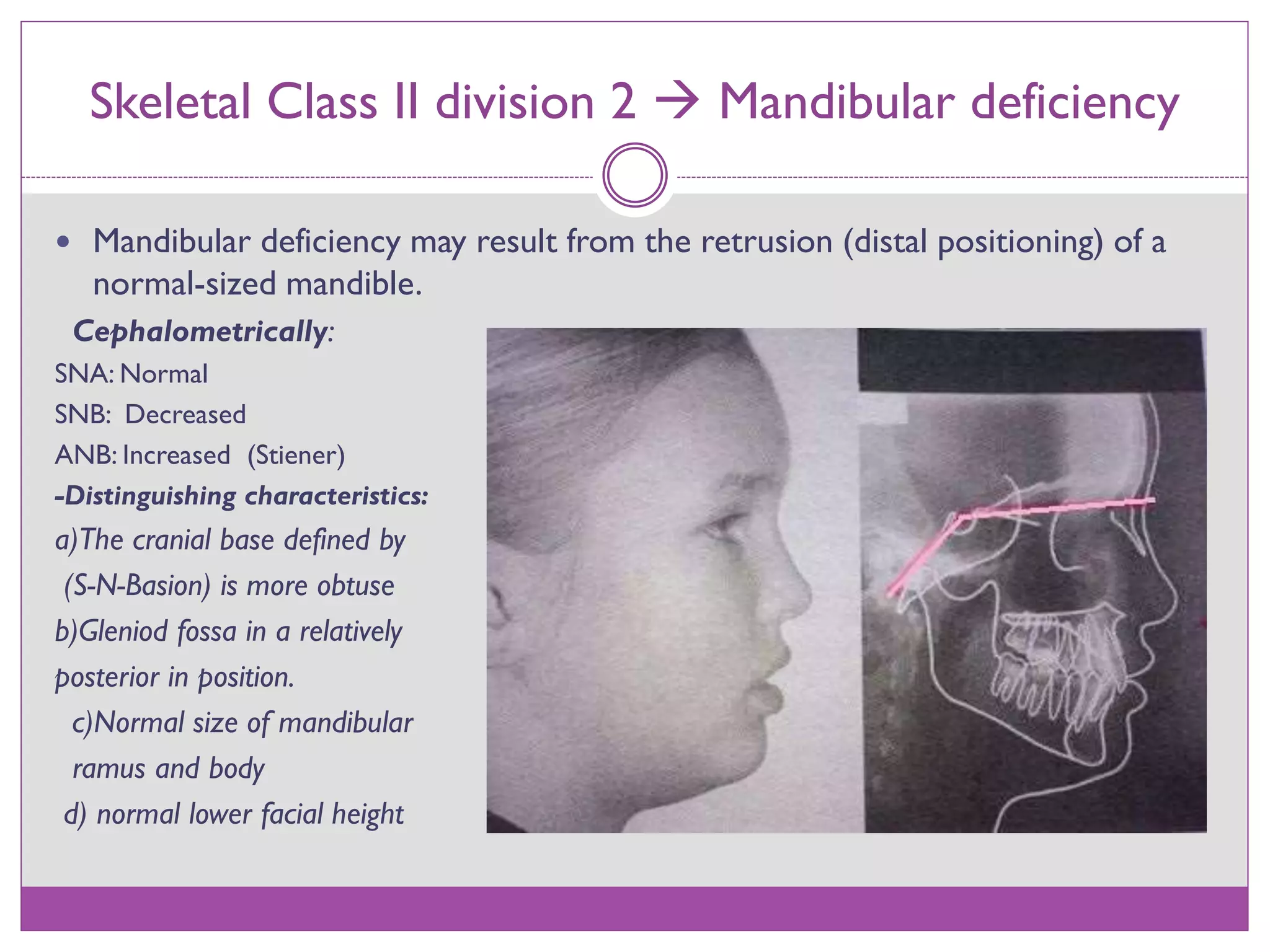
 Mandibular deficiency may result from the retrusion (distal positioning) of a
normal-sized mandible.
Cephalometrically:
SNA: Normal
SNB: Decreased
ANB: Increased (Stiener)
-Distinguishing characteristics:
a)The cranial base defined by
(S-N-Basion) is more obtuse
b)Gleniod fossa in a relatively
posterior in position.
c)Normal size of mandibular
ramus and body
d) normal lower facial height
Skeletal Class II division 2  Maxillary excess
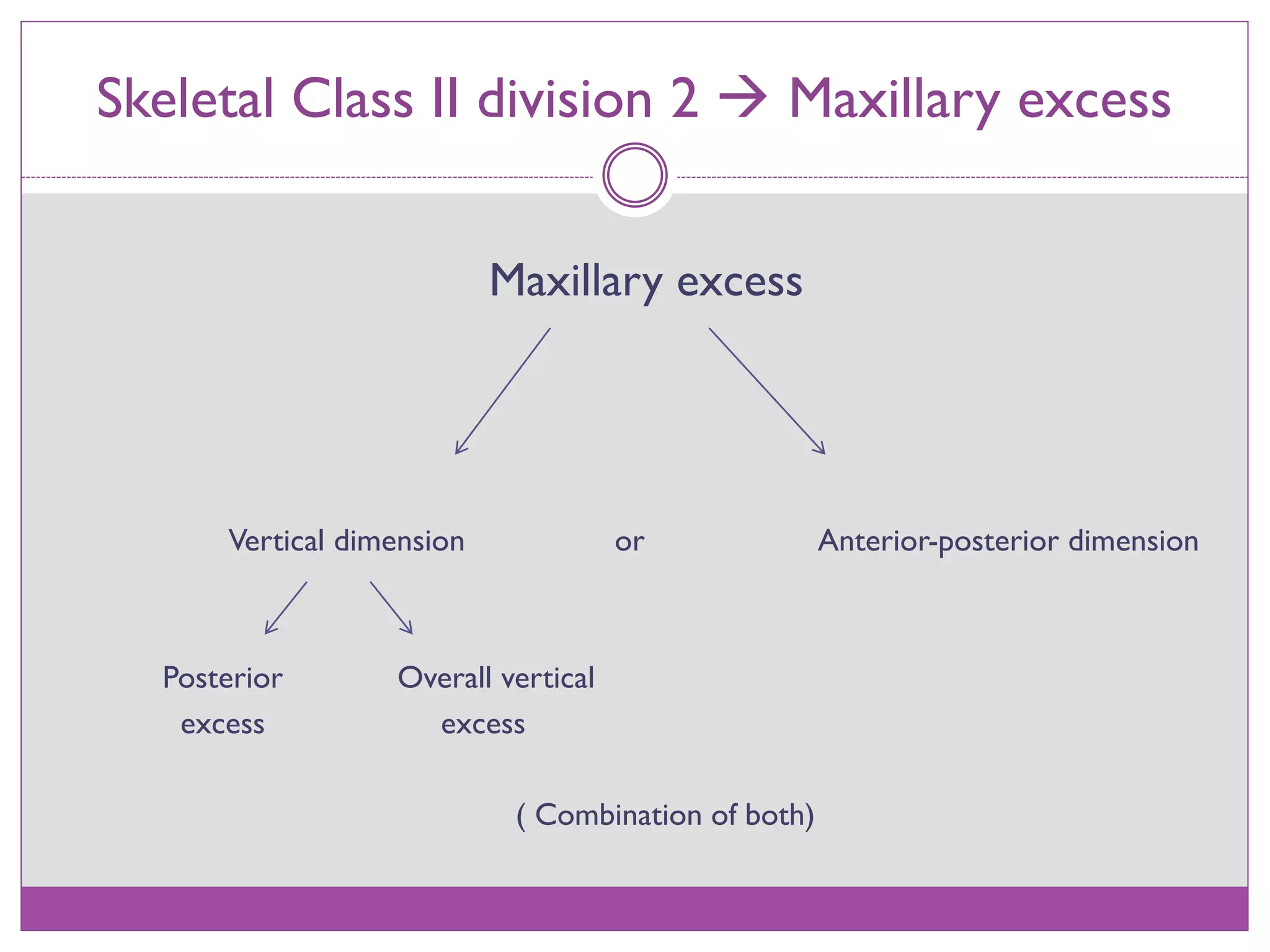
Maxillary excess
Vertical dimension or Anterior-posterior dimension
Posterior Overall vertical
excess excess
( Combination of both)
Skeletal Class II division 2  Maxillary excess
 Vertical Maxillary excess may be localized only to the posterior area  Open
bite and incompetent lips ( normal vertical display of maxillary incisors in
repose and during smiling.)
 Overall maxillary excess includes both the anterior and the posterior area 
resulting in an excessive vertical display of the maxillary incisors in repose and
during smiling (high smile line) Gummy smile. (classII/2) and incompetent
lips.
 In these 2 conditions of maxillary excess Mandible is rotated downward
and posteriorly (clockwise) resulting in a class II skeletal relationship.
Skeletal Class II division 2  Maxillary excess
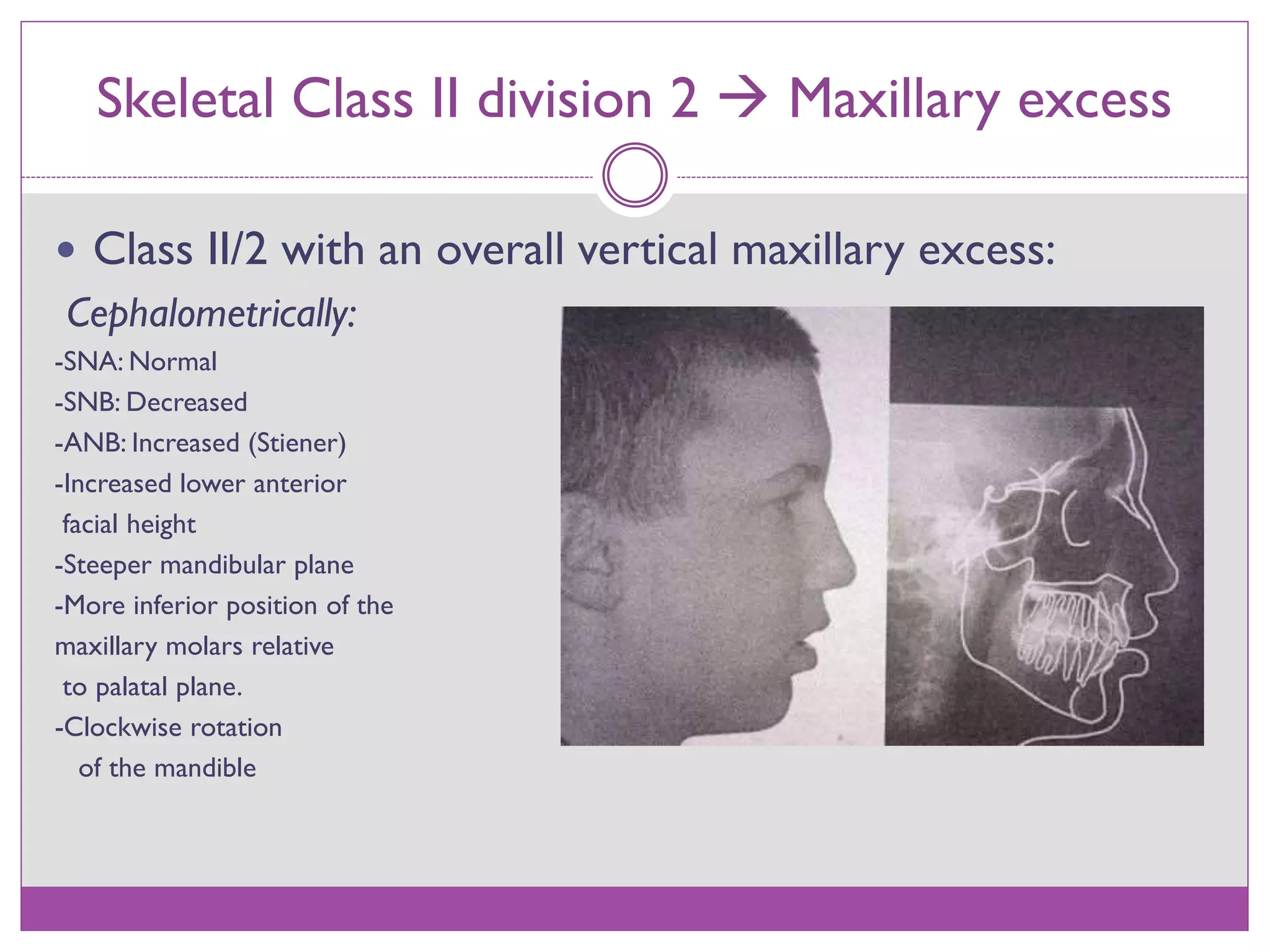
 Class II/2 with an overall vertical maxillary excess:
Cephalometrically:
-SNA: Normal
-SNB: Decreased
-ANB: Increased (Stiener)
-Increased lower anterior
facial height
-Steeper mandibular plane
-More inferior position of the
maxillary molars relative
to palatal plane.
-Clockwise rotation
of the mandible
Skeletal Class II div 2  Maxillary excess
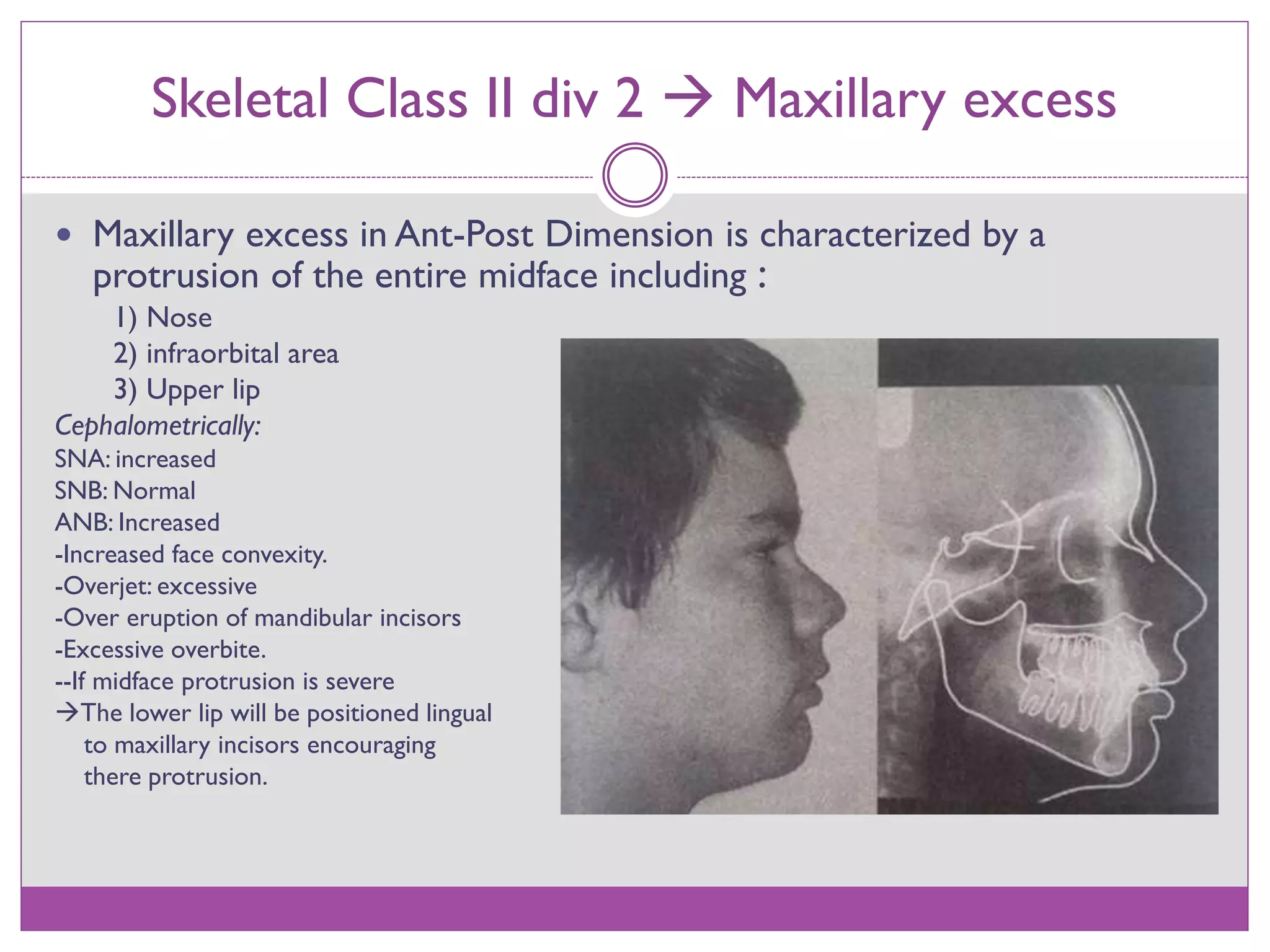
 Maxillary excess in Ant-Post Dimension is characterized by a
protrusion of the entire midface including :
1) Nose
2) infraorbital area
3) Upper lip
Cephalometrically:
SNA: increased
SNB: Normal
ANB: Increased
-Increased face convexity.
-Overjet: excessive
-Over eruption of mandibular incisors
-Excessive overbite.
--If midface protrusion is severe
The lower lip will be positioned lingual
to maxillary incisors encouraging
there protrusion.
Skeletal Class II division 2
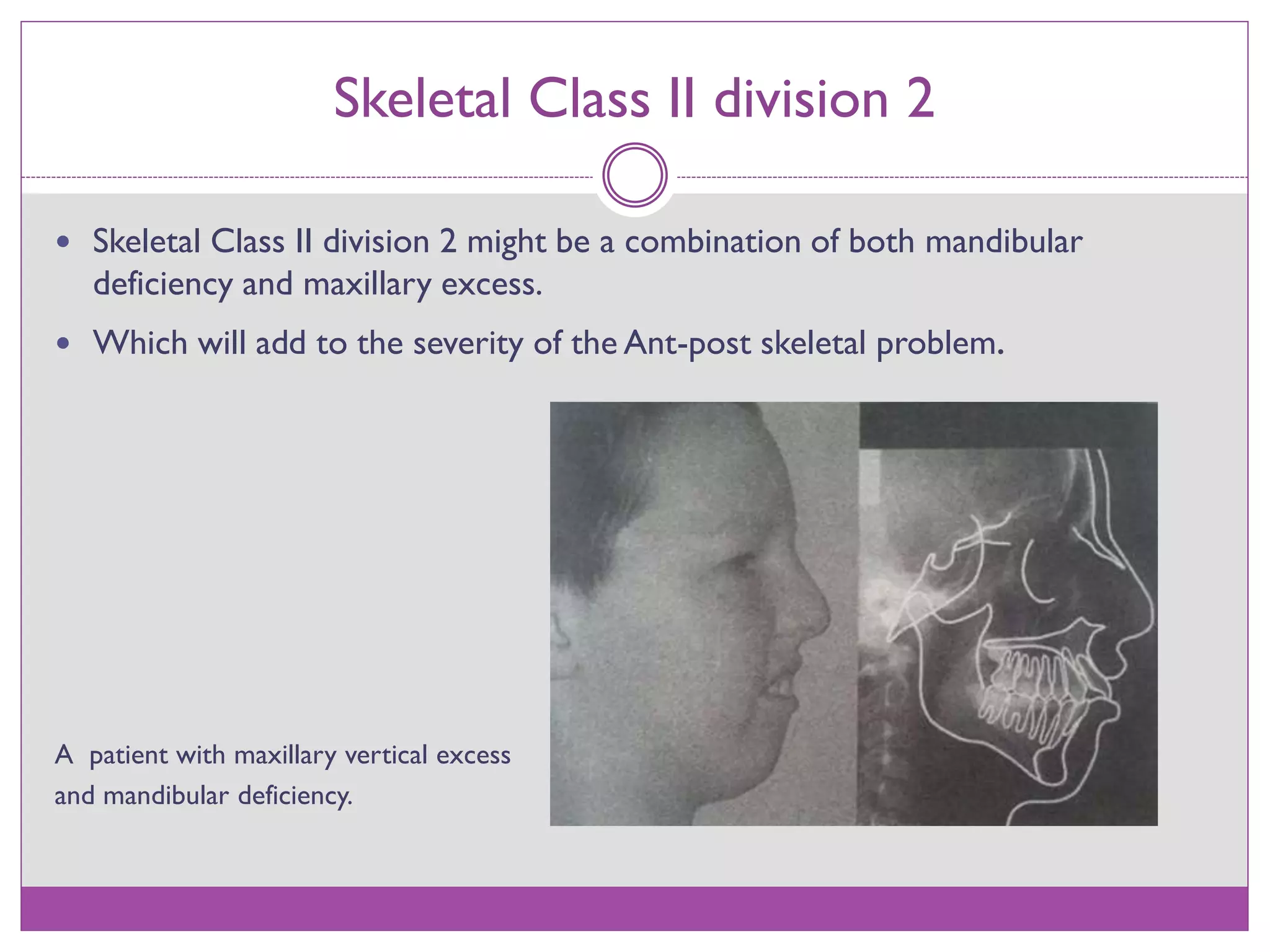
 Skeletal Class II division 2 might be a combination of both mandibular
deficiency and maxillary excess.
 Which will add to the severity of the Ant-post skeletal problem.
A patient with maxillary vertical excess
and mandibular deficiency.
Diagnosis : Problem-Oriented approach
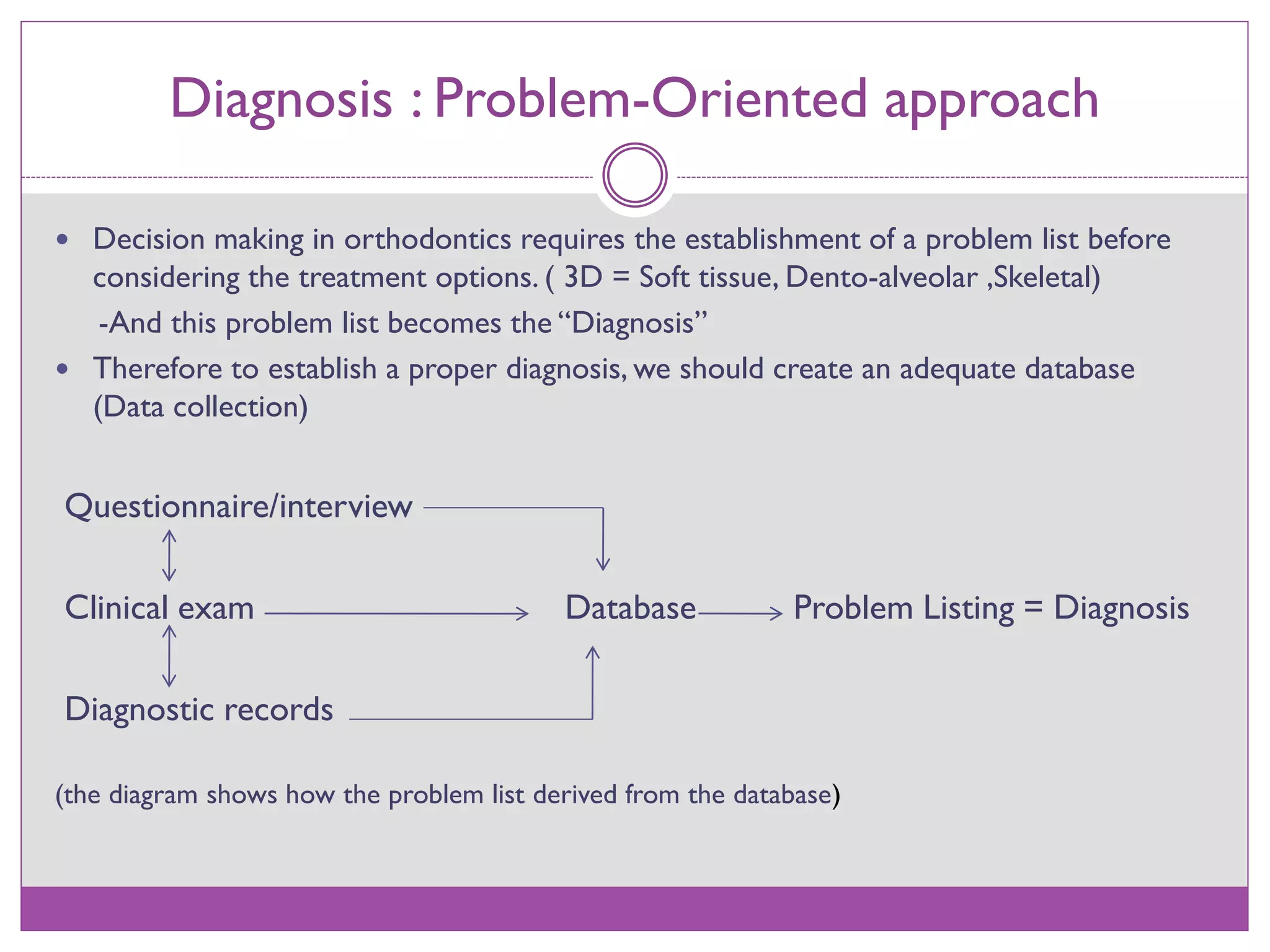
 Decision making in orthodontics requires the establishment of a problem list before
considering the treatment options. ( 3D = Soft tissue, Dento-alveolar ,Skeletal)
-And this problem list becomes the “Diagnosis”
 Therefore to establish a proper diagnosis, we should create an adequate database
(Data collection)
Questionnaire/interview
Clinical exam Database Problem Listing = Diagnosis
Diagnostic records
(the diagram shows how the problem list derived from the database)
Diagnosis: Problem-Oriented approach
 Database is derived from 3 major sources:
1) Patient questioning (interview)
-chief compliant: to fined what is important to the patient.
- Medical and dental history
-Physical growth status (Age & Sex) = Growing or non-growing
-Motivation and expectation
2) Clinical examination : to evaluate facial, occlusal , and functional characteristics
(Extra-oral and intra-oral)
Proper evaluation of the face , smile , and profile  to define the esthetic problem list
3) Evaluation of diagnostic records:
a) Diagnostic casts
b) Radiographic records: Lateral ceph. /panoramic
c) Photographs : frontal/ frontal dynamic : posed smile,
-close-up image of posed smile/ ¾ view / profile etc..
Treatment planning : Problem-Oriented approach
After evaluation of the collected database and
establishment of a prioritized problem list  we should
start thinking about the potential solutions of these
problems (Treatment Planning)
The treatment plan describes the procedures meant to
correct each problem on the list.
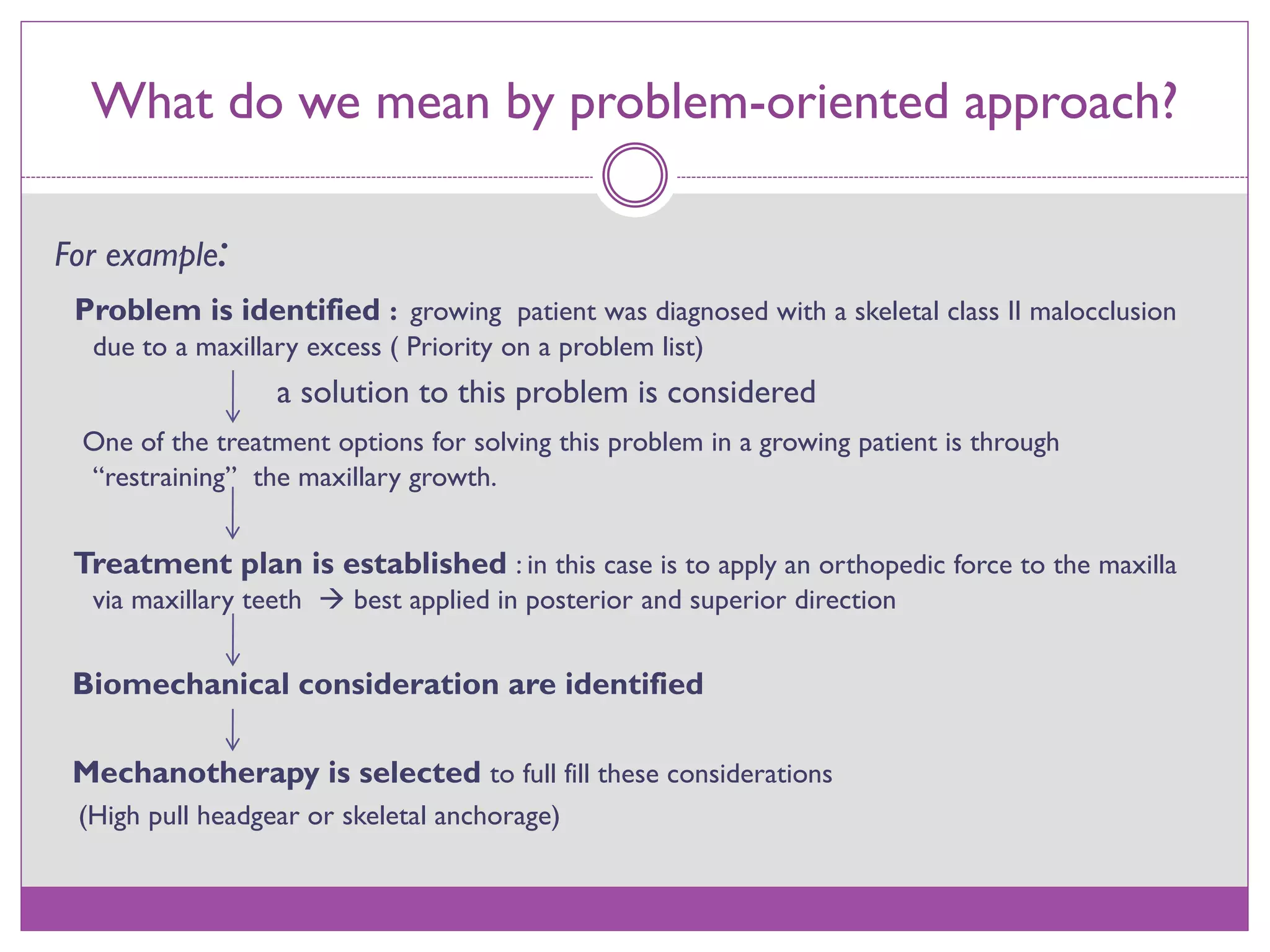
What do we mean by problem-oriented approach?
For example:
Problem is identified : growing patient was diagnosed with a skeletal class II malocclusion
due to a maxillary excess ( Priority on a problem list)
a solution to this problem is considered
One of the treatment options for solving this problem in a growing patient is through
“restraining” the maxillary growth.
Treatment plan is established : in this case is to apply an orthopedic force to the maxilla
via maxillary teeth  best applied in posterior and superior direction
Biomechanical consideration are identified
Mechanotherapy is selected to full fill these considerations
(High pull headgear or skeletal anchorage)
Treatment options for Class II division 2
For any characteristics of malocclusion 3 ranges of correction exists:
1) A range of correction that can be accomplished by orthodontic tooth
movement alone.
2) A larger amount that can be accomplished by orthodontics tooth movement
aided by absolute anchorage
3) Additional amount that can be achieved by functional and orthopedic
treatment. (growth modification)
4) A larger range of correction that requires surgery as a part of treatment plan.
The range of tooth movement for a patient is determined by the
1) Severity of malocclusion
2) Age of the patient ( growing or non-growing)
3) Facial esthetics
These 3 main features will determine the treatment option that is
suitable for the patient.
Limitations of orthodontic treatment
 Epker Envelope of discrepancy:
Represents the maximum amount of tooth movement possible by 3 different
means of treatment: (Orthodontic / Orthopedic / Orthognathic)
It has 3 envelopes the perimeter of each envelope gives the maximum range of
movements possible by different methods of treatment .
Limitations of orthodontic treatment
 Inner envelope : Orthodontic treatment
 Middle envelope: Orthodontic and growth modification
 Outer-most envelope : Orthognathic surgey
Treatment of class II division 2 malocclusion
7mm maxillary incisors retraction (within the range of ortho tooth movment)
12 mm maxillary incisor retraction : ( orthopedic and orthodontic tooth movment)
15 mm maxillary incisor retraction : Requires orthognathic surgey
 The orthodontic treatment with or without orthopedic treatment can create
a larger A-P correction then in Transverse and Vertical dimension.
 Greater amount of maxillary retraction then mandibular can be established
(due to anatomic and physiologic limits)
 Soft tissue limitations:
The soft tissues will largely determine the limitation of orthodontic treatment
from the perspective of:
1) Functional stability.
2) Facial esthetics.
 Limitations in orthodontic treatment related to the soft
tissue:
 1) Pressure exerted on teeth from lips, cheeks, and tongue
 2) Peridontal attachment
 3) Neuro-muscular influence on mandibular position
 4) Contours of the soft tissue facial mask
 5) Lip-Tooth relationship ( Anterior tooth display during facial animation)
Timing of the treatment: is an important factor in the
amount of change that can be produced
Optimum time for growth modification Pre-pubertal
growth spurt
therefore proper diagnosis of the patient at early age
and the use of correct functional appliances will cause
the patient to  aviod surgery
Treatment of Class II Division 2
 Class II Div 2 malocclusion  Dental or Skeletal
Dental Class II div 2  Orthodontic treatment ( extraction or non extraction)
Skeletal Class II div 2 
1) Growth modification (Growing patient)
2) Dental camouflage ( extraction vs non extraction)
(mild to moderate skeletal class II)
3) Orthognathic surgey + with orthodontic treatment
(moderate to severe Class II)
Treatment options for dental Class II dvision 2
For a dental Class II/2 malocclusion:
Extraction or non-extraction treatment. depending on the severity of
mesial drift of the maxillary 1st molar.
-slight mesial drift ( mesial crown tipping) + minimal crowding 
Nonextraction + distalization of maxillary 1st molar
- severe mesial drift (roots and crown are mesially positioned)  extraction
is indicated to obtain space.
Treatment options for skeletal Class II division 2
 Three treatment approaches are available :
1) Growth modification
2) Dental camouflage
3) Orthognathic surgery (with orthodontic treatment)
Treatment of skeletal Class II division 2 malocclusion
 Growth modification for class II skeletal problem: (Orthopedic treatment)
- the goal of growth modification is to enhance the unacceptable skeletal relationship
by modifying remaining facial growth pattern of the jaws.
- Optimum timing : Pre-pubertal growth spurt (active growth period)
Two types of orthopedic appliances used in skeletal class II div 2:
I) Headgear ( extra-oral force)
2) Functional appliances ( Removable and fixed )
Treatment of skeletal class II division 2 malocclusion
 Headgear:
it delivers an extra-oral orthopedic force to compress the maxillary sutures
and modify the pattern of bone apposition at these sites.
2 TYPES
Facebow J-Hooks
(maxillary excess ) ( Maxillary anterior retraction)
and intrusion
Treatment of skeletal class II division 2 malocclusion
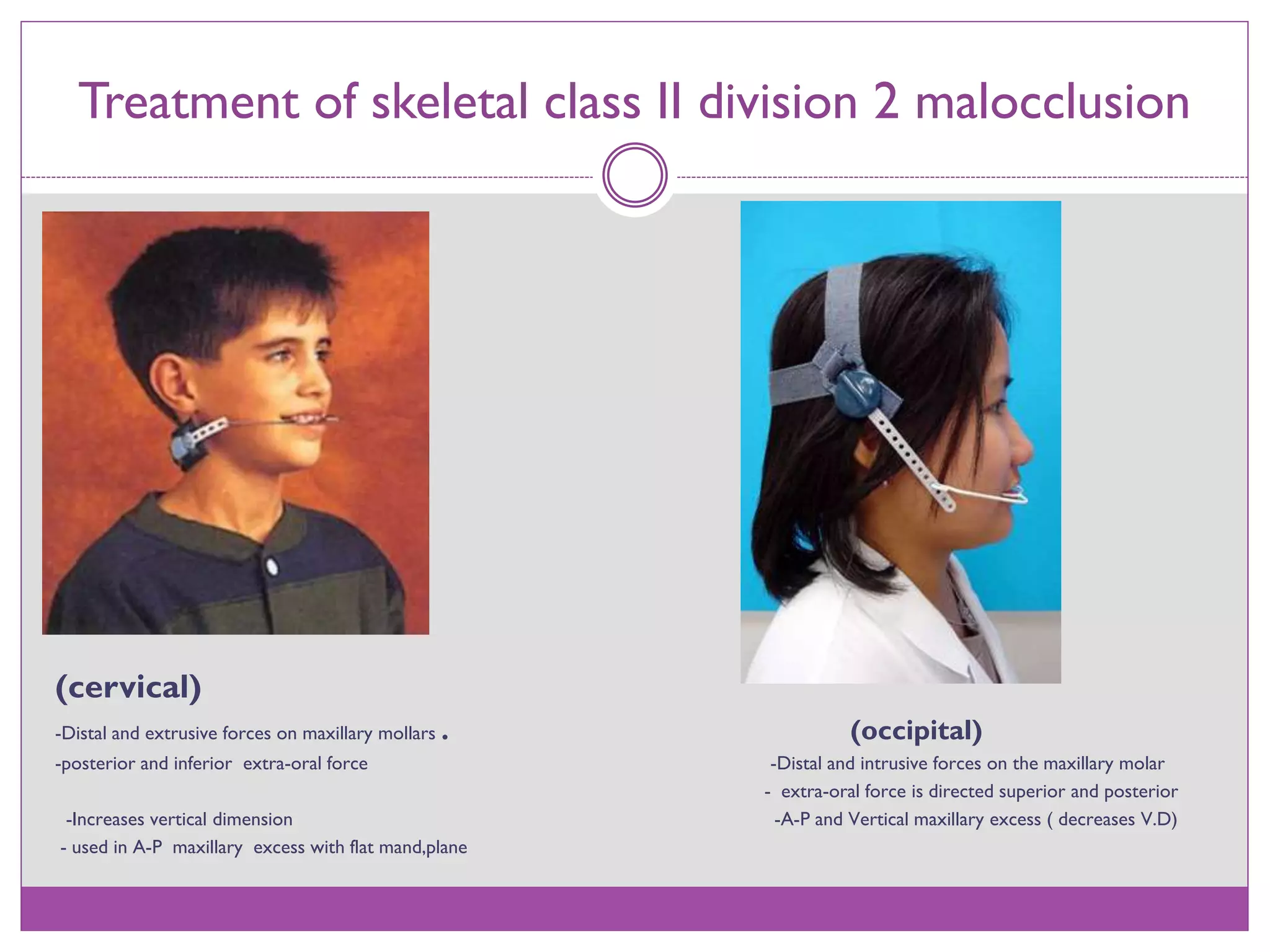
(cervical)
-Distal and extrusive forces on maxillary mollars . (occipital)
-posterior and inferior extra-oral force -Distal and intrusive forces on the maxillary molar
- extra-oral force is directed superior and posterior
-Increases vertical dimension -A-P and Vertical maxillary excess ( decreases V.D)
- used in A-P maxillary excess with flat mand,plane
Treatment of skeletal Class II division 2 malocclusion
 Functional appliances: Class II functional appliances are designed to
position the mandible in a downward and forward to enhance its mandibular
growth pattern.
 Indication: Mandibular deficiency
Removable Functional: Fixed Functional:
-Activator -Herbst
- Bionator -Jasper jumper
-Twin bloc
- Frankyl II
Treatment of a skeletal class II division 2 malocclusion
Treatment of skeletal class II division 2 malocclusion
Dental Camouflage:
It is a treatment that seeks to create a dental compensation to hide the skeletal discrepancy
 Maxillary Retroclination and Mandibular Protraction.
Indicated:
1) Adults
2) Mild to Moderate skeletal Class II cases
3) Minimal dental crowding .
4) Acceptable facial esthetics
5) Usually requires extraction
Dental camouflage without extraction is rare in case of skeletal class II
-Mild skeletal class II cases
- Mild excessive overjet
- Adequate space available
- Max Molar distalization
Treatment of Skeletal Class II division 2 malocclusion
Orthognathic surgery:
A combination of orthodontic therapy and Orthognathic surgery for the
correction of moderate to severe skeletal class II malocclusion
(Adults, no growth potential)
Indicated:
1) Moderate to Severe skeletal discrepancy
2) Facial imbalances or asymmetries: long lower face , Gummy smile
3) Limitations of tooth movement : Upright on basal bone
4) Relapse potential of orthodontic treatment.
5) Severe crowding and protrusion in the dental arches with skeletal
class II malocclusion (extraction space is not sufficient to correct buccal occlusion)
Treatment of skeletal class II division 2 malocclusion
 Surgical correction includes:
1) Mandibular Advancment:
Indicated: skeletal class II cases with mandibular deficiency
The intraoral sagittal split ramus osteotomy is the most popular technique for
surgical mandibular advancment.
Treatment of skeletal class II division 2 malocclusion
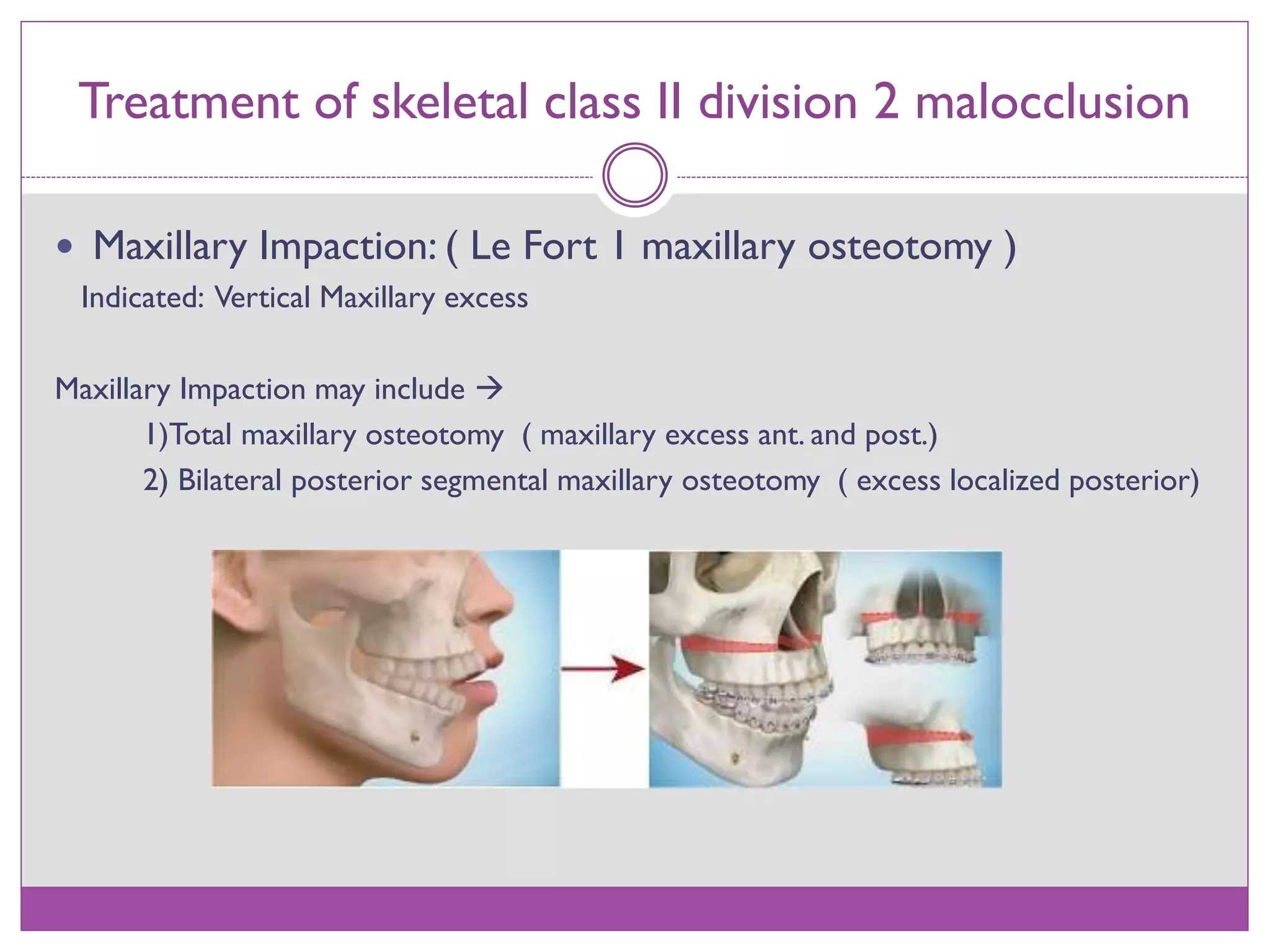
 Maxillary Impaction: ( Le Fort 1 maxillary osteotomy )
Indicated: Vertical Maxillary excess
Maxillary Impaction may include 
1)Total maxillary osteotomy ( maxillary excess ant. and post.)
2) Bilateral posterior segmental maxillary osteotomy ( excess localized posterior)
Treatment of skeletal class II division 2 malocclusion
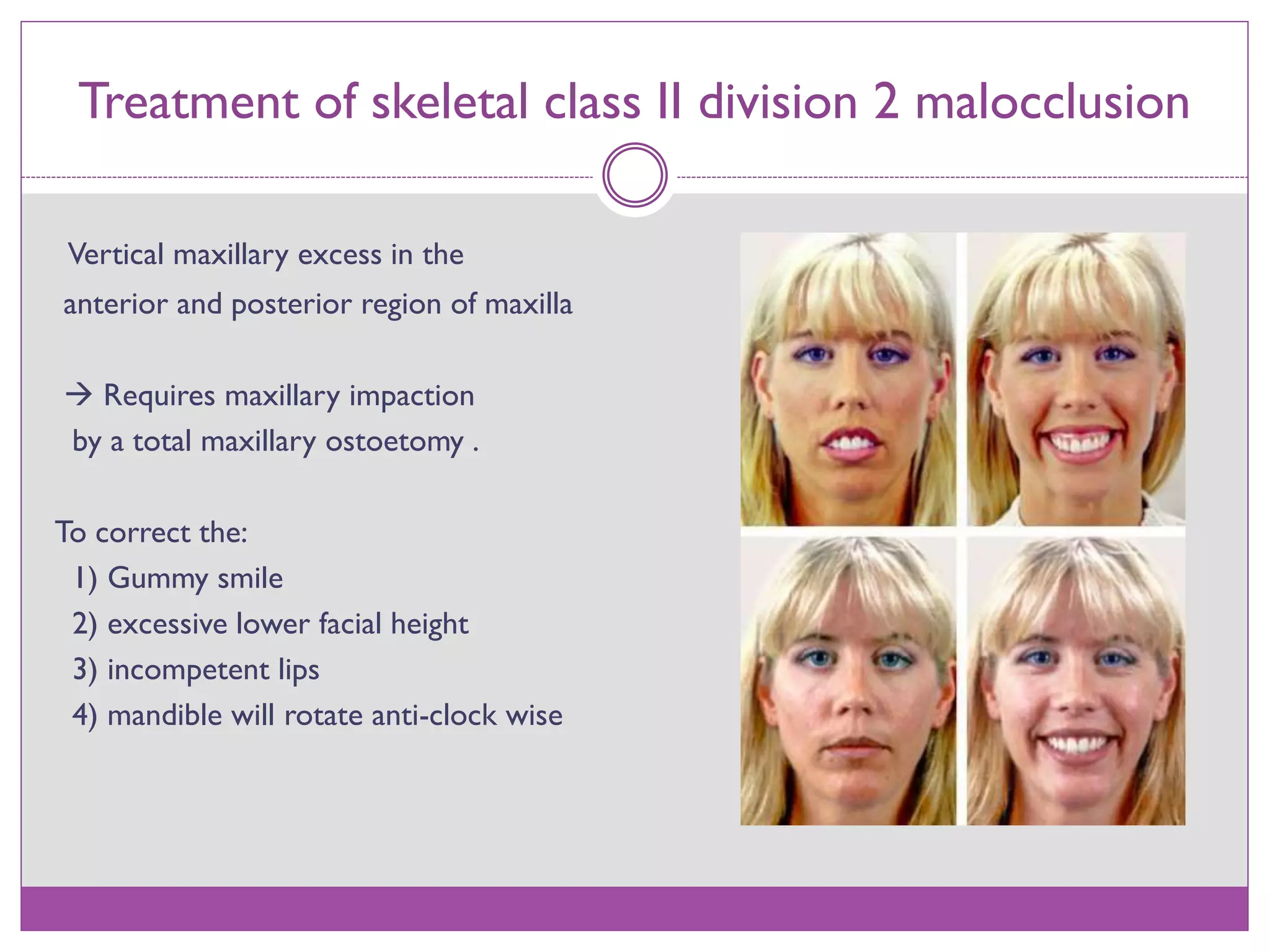
Vertical maxillary excess in the
anterior and posterior region of maxilla
 Requires maxillary impaction
by a total maxillary ostoetomy .
To correct the:
1) Gummy smile
2) excessive lower facial height
3) incompetent lips
4) mandible will rotate anti-clock wise
Treatment of skeletal class II division 2 malocclusion
- Anterior Maxillary sub-apical setback
Indicated: Maxillary excess is in A-P dimension/ Mid-face protrusion (
No vertical excess)
- Combined Surgical approaches :
Indicated: Maxillary excess (vertical or A-P) combined with
mandibular deficiency.
Treatment of skeletal class II division 2 malocclusion
Moderate class II division 2 malooclusion are usually
associated with mandibular deficiency or maxillary excess.
 Resulting in a compromised facial esthetics.
The choice between orthognathic surgery or orthodontics
as a treatment option might be confusing to the
orthodontist in borderline cases.
 Strong consideration of surgical correction of a class II div 2 with skeletal
discrepancy should be based on the following questions:
1) Do the patient's goals for treatment place a high priority on improvement in
facial esthetics?
2) Are the orthodontic movements required in excess of the envelope of
discrepancy so that adequate orthodontic correction may not be achieved?
3) Are the risks of surgery within acceptable levels?
4) Are the benefits of surgical treatment, as previously described, obvious?
References
 Text Book of Orthodontics ( Samir E. Bishara)
 Orthodontics contemporary ( William R. Proffit)
 Orthodontics current principles and techniques 5th edition (Graber)
 Hand book of Orthodontics (Robert Moyers)
 Pubmed
1995 May Orthognathic surgery versus orthodontic camouflage in the treatment of
mandibular deficiency

Class II division 2 malocclusion

  • 1.
    SURGERY OR ORTHODONTICS? Class IIdivision 2 malocclusion
  • 2.
    Class II division2 malocclusion  It is a type of class II malocclusion, defined by Angle in 1899.  It represents 5 to 10% of all malocclusions ( Sassouni 1971)
  • 3.
    Class II division2 According to Angle’s classification: It is when the buccal groove of the first mandibular molar occludes distal to the mesiobuccal cusp of the first maxillary molar, with retroclination of the maxillary central incisors.
  • 4.
    Class II division2  British standards classification of incisor relationships: - The lower incisor edges occlude posterior to the cingulum plateau of the upper incisors and the lower centrals are retroclined. -The overjet is minimal but may be increased.
  • 5.
    Class II division2  Von-Der-Linden classified Angle’s class II/2 malocclusion in to 3 types based on the severity of incisor relationship : Type A: Maxillary central incisors and laterals are retroclined. Degree of retroclination is less severe in nature.
  • 6.
    Von-Der-Linden Classification ofclass II/2 Type B: Maxillary lateral incisors are overlapping the retroclined maxillary central incisors. Type C : Maxillary central and lateral incisors Are retroclined and are overlapped By the maxillary canines.
  • 7.
    General clinical featuresof Class II division 2 Extra-Oral: -Shape of the head: brachycephalic -Facial profile: convex (striaght) -Chin : Prominent -Lower Lip: Everted ( lower lip line is high relative to the upper incisors) -Upper Lip: Positioned high inrespect to the upper anteriors (Gummy smile) -Mentolabial sulcus: Deep -Mentalis : Hyperactive
  • 8.
    General clinical featuresof Class II division 2  Intra-Oral: - Class II molar relation (Distocclusion) - Class II canine relation - Retroclined maxillary central (extruded) - Labialy tipped maxillary lateral incisors - Deep bite: overclosure (closed bite) - Decreased overjet - Accentuated curve of Spee - Retroclined lower incisors (Extruded  lack of stops)
  • 9.
    Etiology of ClassII division 2  Class II division 2 malocclusions arise from a number of interrelated dental, skeletal, soft tissue and genetic factors.  Most of class II/2 malocclusions are caused by an underlying skeletal discrepancy, and few have a normal skeletal jaw relationship. Class II div 2 Dental or Skeletal ( combination of both)
  • 10.
    Dental Class IIdivision 2  Normal maxillo-mandibular skeletal relationship. (Stiener: SNA, SNB,ANB and McNamara:A/pog to NFH = Norm)  Mainly occurs due to mesial drift of the maxillary first molar. As a result of: a) Loss of mesial proximal contact with the primary 2nd molar -premature extraction/loss of primary 2ndmolar. - congenitally missing primary 2nd molar. b) Inter-arch tooth size discrepancy: -small or congenitally missing maxillary permanent teeth ( 2nd premolar) results in a class II molar relation. c) Maxillary canine or 2nd premolar impaction or displacment out of the arch - inadequate space in the dental arch  class II molar ( unilateral/subdivision or bilateral)
  • 11.
    Skeletal Class IIdivision 2 malocclusion Results from a discrepancy in the maxillary-mandibular skeletal relationship. It might be either due to: 1) Mandibular deficiency 2) Maxillary excess 3) or a combination of both
  • 12.
    Skeletal Class IIdivision 2  The skeletal class II relation is associated with a class II dental malocclusion as a result  of natural dental compensation to make the skeletal disharmony less severe. In class II/2 : - Retroclined and extruded lower incisors. ( due to lack of lower lip support and absence of insical stops) - Retroclined and extruded upper centrals  high lipline of the lower lip, (covering the upper incisors)  - Decreased overjet ,deepbite , deep curve of Spee. ( overclosure of the mandible in severe cases)
  • 13.
    Skeletal Class IIdivision2  Mandibular deficiency  It is a skeletal class II relationship resulting from a mandible that is either small or retruded relative to the maxilla. Mandibular Deficiency Size or Position (small mandible) (Retrusion of a normal sized mandible) (Combination of both in severe cases)
  • 14.
    Skeletal Class IIdivision 2  Mandibular deficiency Class II div 2 with a small mandiblethe decreased size is localized more to the mandibular body (Mandibular Ramus is of normal lenght) Cephalometrically: 1) Flat mandibular plane 2) Increasesd posterior facial height 3) Short lower anterior facial height ( resulting in both upper and lower lip having a more everted position at rest) 4) Mandibular length measured from Ar-Gn-Pog may appear normal because of the excessive chin projection. 5) SNA: normal SNB: decreased ANB: increased (Stiener)
  • 15.
    Skeletal Class IIdivision 2  Mandibular deficiency  Mandibular deficiency may result from the retrusion (distal positioning) of a normal-sized mandible. Cephalometrically: SNA: Normal SNB: Decreased ANB: Increased (Stiener) -Distinguishing characteristics: a)The cranial base defined by (S-N-Basion) is more obtuse b)Gleniod fossa in a relatively posterior in position. c)Normal size of mandibular ramus and body d) normal lower facial height
  • 16.
    Skeletal Class IIdivision 2  Maxillary excess Maxillary excess Vertical dimension or Anterior-posterior dimension Posterior Overall vertical excess excess ( Combination of both)
  • 17.
    Skeletal Class IIdivision 2  Maxillary excess  Vertical Maxillary excess may be localized only to the posterior area  Open bite and incompetent lips ( normal vertical display of maxillary incisors in repose and during smiling.)  Overall maxillary excess includes both the anterior and the posterior area  resulting in an excessive vertical display of the maxillary incisors in repose and during smiling (high smile line) Gummy smile. (classII/2) and incompetent lips.  In these 2 conditions of maxillary excess Mandible is rotated downward and posteriorly (clockwise) resulting in a class II skeletal relationship.
  • 18.
    Skeletal Class IIdivision 2  Maxillary excess  Class II/2 with an overall vertical maxillary excess: Cephalometrically: -SNA: Normal -SNB: Decreased -ANB: Increased (Stiener) -Increased lower anterior facial height -Steeper mandibular plane -More inferior position of the maxillary molars relative to palatal plane. -Clockwise rotation of the mandible
  • 19.
    Skeletal Class IIdiv 2  Maxillary excess  Maxillary excess in Ant-Post Dimension is characterized by a protrusion of the entire midface including : 1) Nose 2) infraorbital area 3) Upper lip Cephalometrically: SNA: increased SNB: Normal ANB: Increased -Increased face convexity. -Overjet: excessive -Over eruption of mandibular incisors -Excessive overbite. --If midface protrusion is severe The lower lip will be positioned lingual to maxillary incisors encouraging there protrusion.
  • 20.
    Skeletal Class IIdivision 2  Skeletal Class II division 2 might be a combination of both mandibular deficiency and maxillary excess.  Which will add to the severity of the Ant-post skeletal problem. A patient with maxillary vertical excess and mandibular deficiency.
  • 21.
    Diagnosis : Problem-Orientedapproach  Decision making in orthodontics requires the establishment of a problem list before considering the treatment options. ( 3D = Soft tissue, Dento-alveolar ,Skeletal) -And this problem list becomes the “Diagnosis”  Therefore to establish a proper diagnosis, we should create an adequate database (Data collection) Questionnaire/interview Clinical exam Database Problem Listing = Diagnosis Diagnostic records (the diagram shows how the problem list derived from the database)
  • 22.
    Diagnosis: Problem-Oriented approach Database is derived from 3 major sources: 1) Patient questioning (interview) -chief compliant: to fined what is important to the patient. - Medical and dental history -Physical growth status (Age & Sex) = Growing or non-growing -Motivation and expectation 2) Clinical examination : to evaluate facial, occlusal , and functional characteristics (Extra-oral and intra-oral) Proper evaluation of the face , smile , and profile  to define the esthetic problem list 3) Evaluation of diagnostic records: a) Diagnostic casts b) Radiographic records: Lateral ceph. /panoramic c) Photographs : frontal/ frontal dynamic : posed smile, -close-up image of posed smile/ ¾ view / profile etc..
  • 23.
    Treatment planning :Problem-Oriented approach After evaluation of the collected database and establishment of a prioritized problem list  we should start thinking about the potential solutions of these problems (Treatment Planning) The treatment plan describes the procedures meant to correct each problem on the list.
  • 24.
    What do wemean by problem-oriented approach? For example: Problem is identified : growing patient was diagnosed with a skeletal class II malocclusion due to a maxillary excess ( Priority on a problem list) a solution to this problem is considered One of the treatment options for solving this problem in a growing patient is through “restraining” the maxillary growth. Treatment plan is established : in this case is to apply an orthopedic force to the maxilla via maxillary teeth  best applied in posterior and superior direction Biomechanical consideration are identified Mechanotherapy is selected to full fill these considerations (High pull headgear or skeletal anchorage)
  • 25.
    Treatment options forClass II division 2 For any characteristics of malocclusion 3 ranges of correction exists: 1) A range of correction that can be accomplished by orthodontic tooth movement alone. 2) A larger amount that can be accomplished by orthodontics tooth movement aided by absolute anchorage 3) Additional amount that can be achieved by functional and orthopedic treatment. (growth modification) 4) A larger range of correction that requires surgery as a part of treatment plan.
  • 26.
    The range oftooth movement for a patient is determined by the 1) Severity of malocclusion 2) Age of the patient ( growing or non-growing) 3) Facial esthetics These 3 main features will determine the treatment option that is suitable for the patient.
  • 27.
    Limitations of orthodontictreatment  Epker Envelope of discrepancy: Represents the maximum amount of tooth movement possible by 3 different means of treatment: (Orthodontic / Orthopedic / Orthognathic) It has 3 envelopes the perimeter of each envelope gives the maximum range of movements possible by different methods of treatment .
  • 28.
    Limitations of orthodontictreatment  Inner envelope : Orthodontic treatment  Middle envelope: Orthodontic and growth modification  Outer-most envelope : Orthognathic surgey
  • 29.
    Treatment of classII division 2 malocclusion 7mm maxillary incisors retraction (within the range of ortho tooth movment) 12 mm maxillary incisor retraction : ( orthopedic and orthodontic tooth movment) 15 mm maxillary incisor retraction : Requires orthognathic surgey
  • 30.
     The orthodontictreatment with or without orthopedic treatment can create a larger A-P correction then in Transverse and Vertical dimension.  Greater amount of maxillary retraction then mandibular can be established (due to anatomic and physiologic limits)
  • 31.
     Soft tissuelimitations: The soft tissues will largely determine the limitation of orthodontic treatment from the perspective of: 1) Functional stability. 2) Facial esthetics.
  • 32.
     Limitations inorthodontic treatment related to the soft tissue:  1) Pressure exerted on teeth from lips, cheeks, and tongue  2) Peridontal attachment  3) Neuro-muscular influence on mandibular position  4) Contours of the soft tissue facial mask  5) Lip-Tooth relationship ( Anterior tooth display during facial animation)
  • 33.
    Timing of thetreatment: is an important factor in the amount of change that can be produced Optimum time for growth modification Pre-pubertal growth spurt therefore proper diagnosis of the patient at early age and the use of correct functional appliances will cause the patient to  aviod surgery
  • 34.
    Treatment of ClassII Division 2  Class II Div 2 malocclusion  Dental or Skeletal Dental Class II div 2  Orthodontic treatment ( extraction or non extraction) Skeletal Class II div 2  1) Growth modification (Growing patient) 2) Dental camouflage ( extraction vs non extraction) (mild to moderate skeletal class II) 3) Orthognathic surgey + with orthodontic treatment (moderate to severe Class II)
  • 35.
    Treatment options fordental Class II dvision 2 For a dental Class II/2 malocclusion: Extraction or non-extraction treatment. depending on the severity of mesial drift of the maxillary 1st molar. -slight mesial drift ( mesial crown tipping) + minimal crowding  Nonextraction + distalization of maxillary 1st molar - severe mesial drift (roots and crown are mesially positioned)  extraction is indicated to obtain space.
  • 36.
    Treatment options forskeletal Class II division 2  Three treatment approaches are available : 1) Growth modification 2) Dental camouflage 3) Orthognathic surgery (with orthodontic treatment)
  • 37.
    Treatment of skeletalClass II division 2 malocclusion  Growth modification for class II skeletal problem: (Orthopedic treatment) - the goal of growth modification is to enhance the unacceptable skeletal relationship by modifying remaining facial growth pattern of the jaws. - Optimum timing : Pre-pubertal growth spurt (active growth period) Two types of orthopedic appliances used in skeletal class II div 2: I) Headgear ( extra-oral force) 2) Functional appliances ( Removable and fixed )
  • 38.
    Treatment of skeletalclass II division 2 malocclusion  Headgear: it delivers an extra-oral orthopedic force to compress the maxillary sutures and modify the pattern of bone apposition at these sites. 2 TYPES Facebow J-Hooks (maxillary excess ) ( Maxillary anterior retraction) and intrusion
  • 39.
    Treatment of skeletalclass II division 2 malocclusion (cervical) -Distal and extrusive forces on maxillary mollars . (occipital) -posterior and inferior extra-oral force -Distal and intrusive forces on the maxillary molar - extra-oral force is directed superior and posterior -Increases vertical dimension -A-P and Vertical maxillary excess ( decreases V.D) - used in A-P maxillary excess with flat mand,plane
  • 40.
    Treatment of skeletalClass II division 2 malocclusion  Functional appliances: Class II functional appliances are designed to position the mandible in a downward and forward to enhance its mandibular growth pattern.  Indication: Mandibular deficiency Removable Functional: Fixed Functional: -Activator -Herbst - Bionator -Jasper jumper -Twin bloc - Frankyl II
  • 41.
    Treatment of askeletal class II division 2 malocclusion
  • 42.
    Treatment of skeletalclass II division 2 malocclusion Dental Camouflage: It is a treatment that seeks to create a dental compensation to hide the skeletal discrepancy  Maxillary Retroclination and Mandibular Protraction. Indicated: 1) Adults 2) Mild to Moderate skeletal Class II cases 3) Minimal dental crowding . 4) Acceptable facial esthetics 5) Usually requires extraction Dental camouflage without extraction is rare in case of skeletal class II -Mild skeletal class II cases - Mild excessive overjet - Adequate space available - Max Molar distalization
  • 43.
    Treatment of SkeletalClass II division 2 malocclusion Orthognathic surgery: A combination of orthodontic therapy and Orthognathic surgery for the correction of moderate to severe skeletal class II malocclusion (Adults, no growth potential) Indicated: 1) Moderate to Severe skeletal discrepancy 2) Facial imbalances or asymmetries: long lower face , Gummy smile 3) Limitations of tooth movement : Upright on basal bone 4) Relapse potential of orthodontic treatment. 5) Severe crowding and protrusion in the dental arches with skeletal class II malocclusion (extraction space is not sufficient to correct buccal occlusion)
  • 44.
    Treatment of skeletalclass II division 2 malocclusion  Surgical correction includes: 1) Mandibular Advancment: Indicated: skeletal class II cases with mandibular deficiency The intraoral sagittal split ramus osteotomy is the most popular technique for surgical mandibular advancment.
  • 45.
    Treatment of skeletalclass II division 2 malocclusion  Maxillary Impaction: ( Le Fort 1 maxillary osteotomy ) Indicated: Vertical Maxillary excess Maxillary Impaction may include  1)Total maxillary osteotomy ( maxillary excess ant. and post.) 2) Bilateral posterior segmental maxillary osteotomy ( excess localized posterior)
  • 46.
    Treatment of skeletalclass II division 2 malocclusion Vertical maxillary excess in the anterior and posterior region of maxilla  Requires maxillary impaction by a total maxillary ostoetomy . To correct the: 1) Gummy smile 2) excessive lower facial height 3) incompetent lips 4) mandible will rotate anti-clock wise
  • 47.
    Treatment of skeletalclass II division 2 malocclusion - Anterior Maxillary sub-apical setback Indicated: Maxillary excess is in A-P dimension/ Mid-face protrusion ( No vertical excess) - Combined Surgical approaches : Indicated: Maxillary excess (vertical or A-P) combined with mandibular deficiency.
  • 48.
    Treatment of skeletalclass II division 2 malocclusion Moderate class II division 2 malooclusion are usually associated with mandibular deficiency or maxillary excess.  Resulting in a compromised facial esthetics. The choice between orthognathic surgery or orthodontics as a treatment option might be confusing to the orthodontist in borderline cases.
  • 49.
     Strong considerationof surgical correction of a class II div 2 with skeletal discrepancy should be based on the following questions: 1) Do the patient's goals for treatment place a high priority on improvement in facial esthetics? 2) Are the orthodontic movements required in excess of the envelope of discrepancy so that adequate orthodontic correction may not be achieved? 3) Are the risks of surgery within acceptable levels? 4) Are the benefits of surgical treatment, as previously described, obvious?
  • 50.
    References  Text Bookof Orthodontics ( Samir E. Bishara)  Orthodontics contemporary ( William R. Proffit)  Orthodontics current principles and techniques 5th edition (Graber)  Hand book of Orthodontics (Robert Moyers)  Pubmed 1995 May Orthognathic surgery versus orthodontic camouflage in the treatment of mandibular deficiency