Download as PDF, PPTX

![REFERENCES
• DIOGUARDI M, DI GIOIA G, ILLUZZI G, LANEVE E, COCCO A, TROIANO G.
ENDODONTIC IRRIGANTS: DIFFERENT METHODS TO IMPROVE EFFICACY AND
RELATED PROBLEMS. EUR J DENT [SERIAL ONLINE] 2018 [CITED 2018 DEC
13];12:459-66.
• WWW.EURJDENT.COM/TEXT.ASP?2018/12/3/459/237873
• TOPBAS C, ADIGUZEL O. ENDODONTIC IRRIGATION SOLUTIONS: A REVIEW. INT
DENT RES 2017;7:54-61.
• PATHWAY OF THE PULP “ COHENS” 11TH EDITION CH6
• TEXTBOOK OF ENDODONTICS NISHA GARG 2ND ED CH17
• SIQUEIRA JR JF, MACHADO AG, SILVEIRA RM, LOPES HP, DE UZEDA M. EVALUATION
OF THE EFFECTIVENESS OF SODIUM HYPOCHLORITE USED WITH THREE IRRIGATION
METHODS IN THE ELIMINATION OF
• ENTEROCOCCUS FAECALIS FROM THE ROOT CANAL, IN VITRO. INT ENDOD J
1997;30:279-82.
REVIEW ARTICLE
Year : 2018 | Volume :
12 | Issue : 3 | Page : 459-466](https://image.slidesharecdn.com/irrigationbyce-201119070853/85/Irrigation-in-endodontics-41-320.jpg)


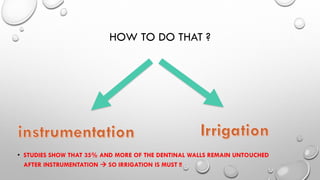
This document provides an outline and overview of various irrigants used in endodontics (root canal treatment). It discusses the components of the dental pulp that need to be removed during root canal treatment and the ideal characteristics of an irrigant. Several commonly used irrigants are described in detail, including sodium hypochlorite, chlorine dioxide, EDTA, citric acid, and chlorhexidine. The document outlines the advantages and disadvantages of each irrigant and notes important interactions between irrigants. The goal of irrigation is to fully cleanse the root canal of both organic and inorganic tissues and microbes.


