How to Design PrimersFor PCR using Primer3 websiteYousef Alhashem2011
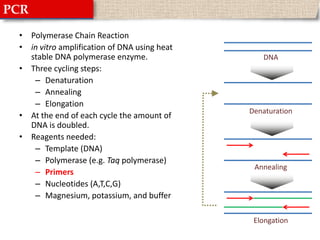
PCRPolymerase Chain Reactionin vitro amplification of DNA using heat stable DNA polymerase enzyme.Three cycling steps:DenaturationAnnealingElongationAt the end of each cycle the amount of DNA is doubled.Reagents needed:Template (DNA)Polymerase (e.g. Taq polymerase)PrimersNucleotides (A,T,C,G)Magnesium, potassium, and bufferDNADenaturationAnnealingElongation
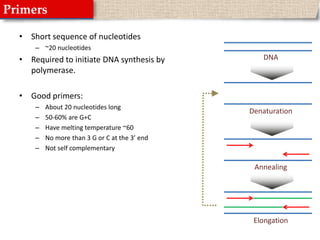
PrimersShort sequence of nucleotides ~20 nucleotidesRequired to initiate DNA synthesis by polymerase.Good primers:About 20 nucleotides long50-60% are G+CHave melting temperature ~60No more than 3 G or C at the 3’ endNot self complementaryDNADenaturationAnnealingElongation
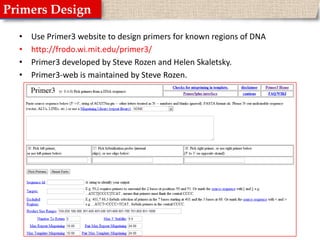
Primers DesignUse Primer3 website to design primers for known regions of DNAhttp://frodo.wi.mit.edu/primer3/Primer3 developed by Steve Rozen and Helen Skaletsky. Primer3-web is maintained by Steve Rozen.
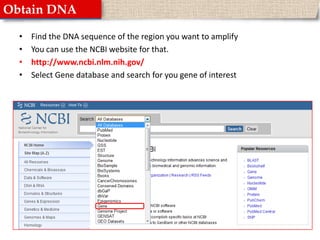
Obtain DNAFind the DNA sequence of the region you want to amplifyYou can use the NCBI website for that.http://www.ncbi.nlm.nih.gov/Select Gene database and search for you gene of interest
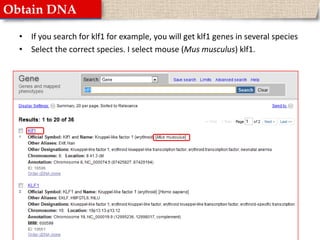
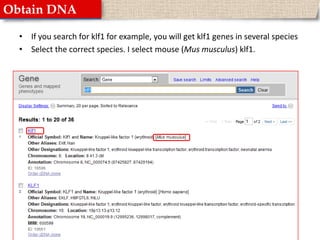
Obtain DNAIf you search for klf1 for example, you will get klf1 genes in several speciesSelect the correct species. I select mouse (Musmusculus) klf1.
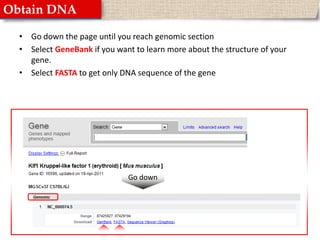
Obtain DNAGo down the page until you reach genomic sectionSelect GeneBank if you want to learn more about the structure of your gene.Select FASTA to get only DNA sequence of the geneGo down
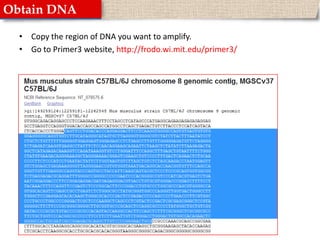
Obtain DNACopy the region of DNA you want to amplify.Go to Primer3 website, http://frodo.wi.mit.edu/primer3/
Primer3Paste the DNA sequence into the provided spaceTell the website where do you want you primers to be by adding “[“ and “]” around the sequence of interst.Tell the website what is the size of amplicon you would like to see.Hit “Pick Primers”
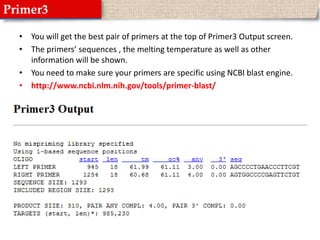
Primer3You will get the best pair of primers at the top of Primer3 Output screen.The primers’ sequences , the melting temperature as well as other information will be shown.You need to make sure your primers are specific using NCBI blast engine.http://www.ncbi.nlm.nih.gov/tools/primer-blast/
T.h.a.n.kY.o.u

Primer design

  • 1.
    How to DesignPrimersFor PCR using Primer3 websiteYousef Alhashem2011
  • 2.
    PCRPolymerase Chain Reactioninvitro amplification of DNA using heat stable DNA polymerase enzyme.Three cycling steps:DenaturationAnnealingElongationAt the end of each cycle the amount of DNA is doubled.Reagents needed:Template (DNA)Polymerase (e.g. Taq polymerase)PrimersNucleotides (A,T,C,G)Magnesium, potassium, and bufferDNADenaturationAnnealingElongation
  • 3.
    PrimersShort sequence ofnucleotides ~20 nucleotidesRequired to initiate DNA synthesis by polymerase.Good primers:About 20 nucleotides long50-60% are G+CHave melting temperature ~60No more than 3 G or C at the 3’ endNot self complementaryDNADenaturationAnnealingElongation
  • 4.
    Primers DesignUse Primer3website to design primers for known regions of DNAhttp://frodo.wi.mit.edu/primer3/Primer3 developed by Steve Rozen and Helen Skaletsky. Primer3-web is maintained by Steve Rozen.
  • 5.
    Obtain DNAFind theDNA sequence of the region you want to amplifyYou can use the NCBI website for that.http://www.ncbi.nlm.nih.gov/Select Gene database and search for you gene of interest
  • 6.
    Obtain DNAIf yousearch for klf1 for example, you will get klf1 genes in several speciesSelect the correct species. I select mouse (Musmusculus) klf1.
  • 7.
    Obtain DNAIf yousearch for klf1 for example, you will get klf1 genes in several speciesSelect the correct species. I select mouse (Musmusculus) klf1.
  • 8.
    Obtain DNAGo downthe page until you reach genomic sectionSelect GeneBank if you want to learn more about the structure of your gene.Select FASTA to get only DNA sequence of the geneGo down
  • 9.
    Obtain DNACopy theregion of DNA you want to amplify.Go to Primer3 website, http://frodo.wi.mit.edu/primer3/
  • 10.
    Primer3Paste the DNAsequence into the provided spaceTell the website where do you want you primers to be by adding “[“ and “]” around the sequence of interst.Tell the website what is the size of amplicon you would like to see.Hit “Pick Primers”
  • 11.
    Primer3You will getthe best pair of primers at the top of Primer3 Output screen.The primers’ sequences , the melting temperature as well as other information will be shown.You need to make sure your primers are specific using NCBI blast engine.http://www.ncbi.nlm.nih.gov/tools/primer-blast/
  • 12.